
Ocean’s Thirteen

•June 16, 2007 • Leave a Comment

starring George Clooney, Brad Pitt, Matt Damon and Al Pacino
written by Brian Koppelman and David Levien and directed by Steven Soderbergh
rated PG-13 for brief sensuality.
87%

A week later, as opportunity and finances permitted, I headed over to catch Ocean’s Thirteen. I really enjoy a good caper movie. The Sting is one of my favorite movies ever, and of course Ocean’s Eleven is excellent. Both of these are, I would say, great caper movies. Ocean’s Thirteen is merely good (better, however, than Ocean’s Twelve, which failed entirely to leave an impression).

Reuben (Elliott Gould) is getting old and, tired of pulling endless jobs, enters a partnership with Willy Banks (franchise newcomer Al Pacino) against the advice of his friend Danny Ocean (George Clooney). When Banks muscles him out of their casino deal, the shock and stress set off a nearly-fatal heart attack. As he recovers, Ocean summons the usual suspects to Las Vegas to ruin Banks’ grand opening.

The group has an awful lot of irons in the fire this time around, some more fantastical than others. They plan to fix every game in the house (blackjack, slots, craps, roulette . . . the works) so that Banks’ patrons walk out with an obscene amount of cash. They will ruin the stay of the prestigious hotel inspector, earning Banks a terrible review. They will cause an earthquake on opening night with a plan involving both drills used to dig the tunnel under the English Channel.

And, of course, each of these schemes involves untold substeps and complications. For instance, a sudden lack of funds prompts them to seek additional help from their old archnemesis (Andy Garcia). I don’t bother to look up his character’s name, although I don’t remember it, because it isn’t important. Really, none of the character names are important, only the actors that are playing them as ultra-cool versions of themselves.

This would quickly become tiresome if employed too often, I suppose, but there is something charmingly throwback about it all the same. After all, who can watch a classic film starring Gene Kelly, Cary Grant, Humphrey Bogart, or (for that matter) Dean Martin, Frank Sinatra and any other member of the original Rat Pack without being conscious of their larger-than-life personas?

As for the plot and the way in which it unfolds, yes, it is quite ridiculous and stretches the bounds of credulity. It almost has to in order to show us something we haven’t seen before, but in any case one will either succeed in suspending one’s disbelief or one will not. I had very little trouble doing so because I was so involved with trying to keep track of what was going on. This is a fun, mostly-smart thrill ride that works and entertains on its own terms.

Even those who enjoy Ocean’s Thirteen may not share this sentiment, but as I chuckled at the final scene I found myself openly hoping for yet another sequel. Not because the material itself is so deserving, but because the Ocean gang has taken on a life of its own and I would love to see them return to action again (and maybe even again and again, should they retain their especial quality).
It Is To Laugh

•June 15, 2007 • Leave a Comment

After all the heavy stuff last weekend, I was ready for some rather lighter fare. Namely, classic screwball comedies from the ’30s and ’40s starring Cary Grant. Sometimes it’s hard to imagine that a suave and sophisticated leading man like Grant, one of the greatest legends of the Golden Age of Hollywood, had the most success with comedic roles. Grant never won an acting Oscar, and his two nominations were for serious roles in movies few people have seen. Well, over the course of the week, I re-acquainted myself with four of his best and funniest from the first decade of his three+ decade career.

The Awful Truth (1937)

Leo McCarey, who had worked with W.C. Fields and the Marx Brothers and was responsible for the pairing of Laurel and Hardy, directs Cary Grant and Irene Dunne in this zany story of fractured love. Lucy and Jerry Warriner allow suspicion of infidelity to creep into the midst of their marital bliss, and before you know it they’re sitting in divorce court arguing over who will get custody of their dog, Mr. Smith (played by Asta of the Thin Man movies). As they wait for the details to be finalized, they both find new significant others to make each other jealous, then attempt mutual sabotage.

Favorite funny moment: Jerry, having foolishly told his new fiance that the phone in his room was answered by his nonexistent sister rather than his soon-to-be-ex-wife is mortified when Lucy shows up at the small gathering of in-laws pretending to be his sister (who has obviously already had a few too many drinks).

Bringing Up Baby (1938)

For many people this is the definitivescrewball comedy (despite bombing in its initial release). Howard Hawks, who dabbled with great success in several genres (comedy, war drama, musical, noir, western, etc.), directs Cary Grant and Katherine Hepburn in barely-controlled chaos. Dr. David Huxley is a scientist who studies dinosaur bones and is looking to score a huge grant for his museum from wealthy Elizabeth Random. Elizabeth’s niece Susan Vance is a scatterbrained free spirit with a talent for getting herself and anyone near her into the most awkward situations imaginable.

After five minutes with her, David soon finds himself wandering around her aunt’s house in a woman’s bathrobe and pretending his name is Bone, all while he follows the dog George (also Asta, see above) around in hopes of finding the extremely valuable dinosaur fossil he has buried and helps Susan keep Baby, a domesticated leopard, under wraps. Hilarity and bizarre circumstances ensue.

Favorite funny moment: Oh, there are probably too many moments to pick just one. Grant’s comic timing is flawless as always and Hepburn’s airhead act is roll-on-the-floor-laughing funny. Still, to avoid copping out, let’s go with Susan pretending to be a notorious gangster in order to escape from the bumbling constable (watch for the fun reference to The Awful Truth!).

His Girl Friday (1940)

Howard Hawks directs again, but this time it’s Cary Grant and Rosalind Russell in a fast-talking look at the newspaper business. Grant plays Walter Burns, an editor who will stop at nothing to get the scoop, even if it means marrying his star reporter Hildy Johnson. But now Hildy has divorced him and is leaving the newspaper business to settle down quietly with the oafish Bruce Baldwin . . . unless, that is, Walter can con her back into the newsroom with the lure of writing one last explosive expose on the impending execution of a hapless factory worker by the corrupt city officials. Grant is in top form here as he and his co-stars fire out snappy dialogue over, around, and above each other. The wit is as hilarious as it is sharp.

Favorite funny moment: Walter plots feverishly to smuggle a roll-top desk concealing a fugitive out of an upper-story room as every character in the movie inadvertently gets in his way. This is probably my favorite movie of the four.

Arsenic and Old Lace (1944)

This movie, based on a Julius Epstein screenplay, was directed by Frank Capra, the man behind such beloved classics as It Happened One Night, Mr. Deeds Goes to Town, Mr. Smith Goes to Washington and It’s a Wonderful Life. Cary Grant stars alongside a bizarre battery of eccentric characters played by the likes of Peter Lorre and Josephine Hull. The comedy is dark, but not as dark as you might think. Mostly it’s just extremely funny.

On the eve of his marriage to the minister’s daughter from next-door, Mortimer Brewster discovers that his beloved maiden aunts have been poisoning elderly gentlemen and having his crazy uncle (who believes he is Teddy Roosevelt) bury them in the cellar. His efforts to cover up their misdeeds and keep them out of an asylum are complicated by the arrival of his sadistic, serial-killer brother Jonathan and the sniveling quack Dr. Einstein.

Favorite funny moment: Dr. Einstein makes an interesting discovery when he accompanies Uncle Teddy down into the cellar to survey “the Panama Canal” . . . also Uncle Teddy’s frequent re-enactments of the charge up San Juan Hill.

These four classic films really have very little in common outside of sharing a leading man and containing plots and situations that are fantastically unbelievable. Well, that and the promise of great entertainment. Check them out sometime if you want (or need) a laugh.

Forrest Gump: Best Picture, 1994

•June 14, 2007 • Leave a Comment

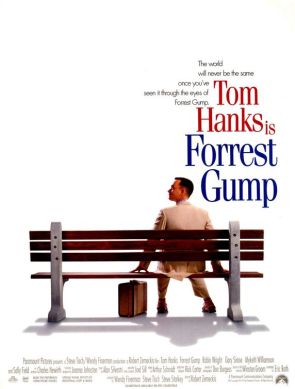
forrestgumpposter.jpgThe 67th Annual Academy Awards were hosted by David Letterman. Forrest Gump, definitely the star of the evening, received an incredible 13 nominations: Best Picture, Best Director, Best Film Editing, Best Adapted Screenplay, Best Actor (Tom Hanks), Best Supporting Actor (Gary Sinise), Best Cinematography, Best Original Score, Best Sound, Best Sound Effects, Best Visual Effects, Best Art Direction, and Best Makeup (I suppose it would have been easier to list the awards it wasn’t up for). Despite some minor overlap from great movies like Ed Wood and The Madness of King George, the other serious contenders were The Shawshank Redemption and Pulp Fiction, which covered 9 of the same nominations between them, including Best Picture.

Gump lost Best Supporting Actor to Martin Landau’s brilliant portrayal of Bela Lugosi in Ed Wood, which also won Best Makeup, Best Cinematography went to Legends of the Fall, Best Art Direction to The Madness of King George, Best Sound and Sound Effects to Speed, and The Lion King took Best Original Score. Forrest Gump was left with the remaining 6, while Pulp Fiction won only Best Original Screenplay and The Shawshank Redemption won nothing (more on that later).

Forrest Gump is the story of the life of its title character (played by Tom Hanks), a mentally-handicapped man who coasts through life on his mother’s (Sally Fields) homespun philosophy (“Life is like a box of chocolates,” “Stupid is as stupid does,” etc.). Along the way he manages to blunder his way into or through nearly every major event in American history and popular culture, from forced integration to Vietnam to Watergate, meeting with presidents and hobnobbing with Elvis and Lennon. The gag, of course, is that he never realizes the significance of his interactions. He only cares about a few meaningful people: his mother, his childhood sweetheart Jenny (Robin Wright Penn), and Lieutenant Dan Taylor (Gary Sinise).

Tom Hanks is amazing. Tom Hanks is always amazing. He has deserved an acting nomination almost every year for at least the past 15, and he certainly deserved his win for Gump. Sinise, as the nomination indicates is excellent as well. I would also have nominated Robin Wright for her performance as Jenny, which is a complex and difficult role handled with sympathy and dignity. Forrest Gump has no shortage of quality acting.

And then there is the novelty of new technology which allowed the filmmakers to insert their character into scenes with dead presidents and other such archived footage. A cute trick, to be sure, and used to reasonably good effect. And yet, I was surprised, while watching, at how poorly dubbed the insertions are. The visual matching is all but flawless, and Hanks certainly appears to be in the scene, but when the others talk the movements of their lips bear no resemblance to the sounds coming out. Surely, in a movie which was nominated for Best Sound, this is unforgivable.

It also accentuates all the more that what we are seeing is really just a shallow illusion. Forrest Gump is an easy film to appreciate on several levels and from almost any angle, but this is only so because it has nothing of real substance to say. Viewers can see anything they want to see, and will get out exactly what they put in. I believe that the ultimate success of the movie lies in its pedestrian nature. This movie is shamelessly safe. It’s fun, but it’s fluff.

Continue reading ‘Forrest Gump: Best Picture, 1994′

It Is To Weep

•June 11, 2007 • Leave a Comment

I finally saw Bridge to Terabithiathis weekend (at my wife’s continued insistence that I take her), and I was mostly impressed, although I’m still not sure exactly how much I enjoyed myself. Peter Chattaway covered in detail the shamelessly inaccurate and exploitative marketing campaign around the release, but assured his readers that the actual movie was not, in fact, a Narnia knock-off.

I think I read Bridge to Terabithia when I was in 8th grade, probably all in one sitting. It was a good book, but failed to make a huge impression on me. I couldn’t really relate, although I did feel a bit of its impact . . . But mostly I think I was just expecting something very different. I had heard that the book was frequently challenged, and even banned, and I kept waiting for something shocking that never came. I couldn’t figure out what people were objecting to.

From what I remember, this is a largely faithful adaptation, both in style and in substance. As a movie, I felt a bit like I was watching a shaky tight-rope walker. Too far to one side and the whole thing would be childishly saccharine, in keeping with the bulk of its genre’s family-friendly fare. Too far to the other and it ran the risk of needless self-indulgence in digital effects.

There were several moments when I felt the whole thing teetering a bit to one side or the other. The movie was at its weakest when it is waxing fantastical. Somehow it seems less magical the more it shovels on the pixie dust. but the overall effect was mature and meaningful. This is a well-executed movie with a few forgivable flaws. I’d probably watch it again.

Then, yesterday afternoon, I finally got around to watching In the Bedroom, which I’ve been meaning to catch since I was enthralled by last year’s Little Children. As it happens, In the Bedroom is also a movie about loss and grieving, but at the opposite end of the age spectrum from Bridge to Terabithia. This is a quiet, thoughtful movie with a double handful of very fine performances.

I must note, however, that while I can appreciate very much a movie that takes its time, the pacing here is positively glacial. I was shocked when I checked the time halfway through and discovered that there was still an hour and change to go. I wasn’t bored per se, but I’d have difficulty sitting through it a second time.

Additionally, I felt the film took a strange turn towards the end which didn’t really seem to follow (although I was delighted that something was going on). It was very similar to an incomprehensible action taken by a character at the end of Little Children, but on a larger and more sustained scale. Until that point, In the Bedroom had me thinking of Ordinary People (which I think is the better film, in the end). After that I’m not sure what I had in mind, but it was a different sort of movie entirely.

I was reminded that Soul Food Movies compiled a list of “Movies About Grief” a few weeks ago. In the Bedroom and Ordinary People are both on there, but Bridge to Terabithia somehow slipped through the cracks. Actually, I’m sure quite a few are missing, but they covered everything else I could think of.

The Further Adventures of Link Roundup

•June 9, 2007 • Leave a Comment

There are a few new additions to my ever-growing collection of movie links over on the right side. Check them out, if you have a chance.

First, a long overdue link to the Apple Quicktime Movie Trailers site, your one-stop shop for previews of new releases (barring the occasional exclusive elsewhere). I’ve visited it frequently for some years now, and I’m rather surprised at myself for forgetting to add it in the first place.

Second, I’ve added a section for non-FFCC movie blogs that interest me. Most of these are on trial as I read them over the next few weeks and decide whether I’ll keep coming back long-term:

Church of the Masses – the blog of a scriptwriter/script consultant who occasionally reviews, but more often discusses the movies and entertainment on more general terms.

Just An Amateur – there’s some great stuff here: reviews of recent releases as well as lots and lots of discussion of old stuff (like, silent-era old). I approve.

Not Coming to a Theater Near You – a very steady stream of reviews and whatnot appear here, with a special focus on limited-release stuff that you won’t find in the local multiplex.

Rightwing film geek – I may not endorse his politics, but his taste in movies is beyond question. I relish the thoughtful ruminations I’ve seen here thus far.

In the Heat of the Night: Best Picture, 1967

•June 4, 2007 • Leave a Comment

intheheatofthenightposter.jpgThe 40th Annual Academy Awards were hosted by Bob Hope, and what an amazing year for movies 1967 was. 1966 and ’67 saw the final collapse of the Production Code, but the new MPAA ratings system would not be in place until November of 1968. With a freedom they hadn’t experienced in over three decades, filmmakers produced some of the greatest American films ever. Nominees for Best Picture were: Bonnie and Clyde, Guess Who’s Coming to Dinner, The Graduate, In the Heat of the Night and . . . Dr. Dolittle. Okay, so we can’t all be brilliant and edgy.
In the Heat of the Night was nominated for 7 Oscars: Best Picture, Best Director, Best Editing, Best Adapted Screenplay, Best Actor (Rod Steiger), Best Sound and Best Sound Effects. It was Norman Jewison’s second directing nomination of five (the next would be for Fiddler on the Roof a few years later), but he never won the award. Best Director went to Mike Nichols for The Graduate. Interestingly, this was Nichols’ second of five directing nominations, and the only one he won. Meanwhile, Best Sound Effects went to The Dirty Dozen. In the Heat of the Night won all five of the remaining awards.

The movie takes place in tiny Sparta, a fictional Mississippi town on the Arkansas border. A wealthy investor has just turned up murdered in a downtown street, and the pressure is on Bill Gillespie (Rod Steiger), the local police chief, to nose up a conviction. As luck would have it, Philadelphia cop Virgil Tibbs (Sidney Poitier) finds himself in the wrong place at the wrong time, traveling back home by train after visiting his mother. The local Barney Fife, officer Sam Wood (Warren Oates), picks the black man up as an automatic suspect. Amidst resolving the mix-up, Gillespie discovers that Tibbs is a homicide detective, and reluctantly asks him to take a look at the body.

The plot become complex very rapidly at this point, as personal and local politics mix and new characters float in and out of the story. Gillespie struggles between his knee-jerk prejudice and his genuine need for help. Tibbs must choose between his disgust for these people and his desire to see justice done. And meanwhile, a lynch mob is slowly building force . . . if Tibbs can’t solve the murder soon, he won’t live to return to Philadelphia.

Poitier is cool, no matter the role. This is undoubtedly one of his coolest and most memorable performances. The moment when he finally loses his temper and grinds out an enraged “They call me ‘Mr. Tibbs.’” is unforgettable. It gave me chills. He has gravitas and an incredible screen presence. 1967 was a big year for him: In the Heat of the Night, Guess Who’s Coming to Dinner, and To Sir, With Love, three of his best-known movies, were all released. Two of them were nominated for Best Picture (cf. Yul Brynner in 1956).

Poitier himself, however, was completely ignored by the acting nominations (which he certainly deserved), both of which went to old white men (Rod Steiger and Spencer Tracy, who was nominated posthumously). This is especially ironic considering that both of those movies broke new ground in examining racial prejudice (Guess Who’s Coming to Dinner featured the first on-screen interracial kiss, I’m told). It should be noted, however, that Poitier had already won an Oscar three years before for Lilies of the Field.

In any case, In the Heat of the Night is top-notch; suspenseful, smart, and very stylish. The plot is intricate, but easy to follow, and makes masterful use of red herrings and McGuffins. I say “McGuffins” because the investigation doubles back on itself several times, and the obvious solutions to the mystery are followed through and abandoned simply as a means of keeping Tibbs in town (although I enjoyed the twists and turns in their own right). But Steiger and Poitier glare and spar and (of course) slowly develop a grudging mutual respect and it’s all very entertaining to watch.

I should also mention the music, at least briefly. I think it is largely very good: hip period stuff that does a lot to enhance the atmosphere. But I’m not too sure about the title song that pops up at the beginning and end of the film. I like the song, but it is intrusive and distracting, particularly at the end. I don’t approve of having the title belted out so insistently . . . I know what I’m watching.

I have yet to see Bonnie and Clyde, but I’ve seen the other four Best Picture nominees. I wouldn’t have given the award to Dr. Dolittle, but beyond that I’m not certain. In the Heat of the Night is an excellent, fun movie, but I’d say it has the least staying power of the remaining three choices. I think, in the end, I’d have chosen The Graduate, which remains one of my favorite films.

An AFI Draft

•June 1, 2007 • 3 Comments

I’ve still got that upcoming (June 20th) AFI “New Top 100” unveiling on my mind. I like the idea more than I did when I first heard it. They plan on doing this once every ten years throughout this century, not only to give the latest films a chance to be counted among the greatest ever, but measure changing cultural standards of movie quality. That’s pretty cool.

So, in honor of the effort and because I’m such a big fan of lists, I downloaded their selection of 400 nominees to see if I could come up with my own top 100 choices. Well . . . 100 movies isn’t enough, and everybody who loves the movies knows that. How can you measure which 100 American movies are the greatest? You can’t. But it’s fun to try, and that’s really all I’ve done. This is a draft, more than anything else. That’s part of what I like about this “once every 10 years” business . . . it acknowledges that there is not, nor can there be, a definitive list.

Just so you have something to keep in mind, here are the criteria for a top 100 movie. It must be a “FEATURE-LENGTH, AMERICAN FICTION FILM” that has achieved “CRITICAL RECOGNITION,” won “MAJOR AWARDS,” and demonstrates “POPULARITY OVER TIME,” “HISTORICAL SIGNIFICANCE” and
“CULTURAL IMPACT.”

The official ballot requests that you select up to 100 movies from its list of nominees, but allows for up to five write-in votes for anything they may not have included. It also asks that you rank your top 5 movie picks “for tie-breaking purposes only.” So, below, I have my top 5 followed by my write-in votes and then my remaining selections. Keep in mind that everything below the write-in section is taken from the nominee list provided by the AFI.

One further note: I have six write-ins. I just couldn’t whittle it down below that. I consider it justified because the new nominee list includes selections like Austin Powers, Shrek and Harry Potter 3 in lieu of worthier choices. Furthermore, the three starred write-ins appeared on the 1997 nominee list but were bumped from the new one.

As always, comments and suggestions are welcome, even solicited. What shouldn’t be her? What ought to replace it? Why? What does your top five look like, and what else ought to be written-in?

Top 5

1. The Godfather
2. Citizen Kane
3. Casablanca
4. Schindler’s List
5. To Kill a Mockingbird

Write-ins

Anatomy of a Murder*
Fiddler on the Roof*
Judgment at Nuremberg*
Oh Brother, Where Art Thou?
The Princess Bride
Road to Perdition

Remaining List (alphabetical order)
Continue reading ‘An AFI Draft’

The Deer Hunter: Best Picture, 1978

•May 28, 2007 • Leave a Comment

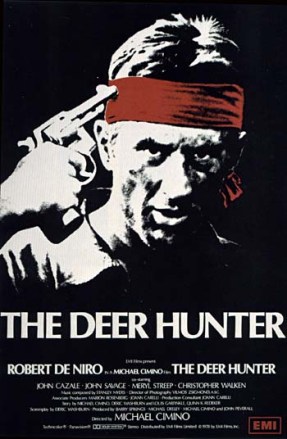
thedeerhunterposter.jpgThe 51st Annual Academy Awards were hosted by Johnny Carson. The Deer Hunterwas nominated for 9 Oscars: Best Picture, Best Director, Best Actor (Robert De Niro), Best Actress (Meryl Streep), Best Supporting Actor (Christopher Walken), Best Editing, Best Original Screenplay, Best Cinematography, and Best Sound. It shared 6 nominations with Coming Home, another Vietnam War movie, which took Best Original Screenplay and Best Actor (for Jon Voight). Maggie Smith walked off with Best Actress for her performance in California Suite, a screwball comedy with an illustrious ensemble cast. Best Cinematography went to Days of Heaven, a gripping human drama starring Richard Gere. The Deer Hunter scooped up the remaining five, including (of course), Best Picture.
For the record, I’ve never heard of any of the other movies, and I’m willing to bet you haven’t either. 1978 was not an illustrious year for film. Of all the other movies that received nominations that year, I have seen three: Death on the Nile, Superman and Grease.

Christopher Walken’s award for the role of Nick remains his only Oscar win to date. John Cazale appears in this, his final film, as Stan. You may know Cazale as Fredo from the Godfather movies. He was dying of cancer during the filming of The Deer Hunter, and all of his scenes were shot first. Cazale appeared in five films before his untimely death. All were nominated for Best Picture. Three won.

Michael Cimino, the director, got bucketloads of acclaim from all sides for The Deer Hunter, but chances are you haven’t heard of him, either. Two years later, he released a nearly 4-hour epic calledHeaven’s Gate. Cimino had complete control, production ran way over schedule, and the budget skyrocketed to an outrageous (at the time) $40 million. The original cut of the movie was some five-and-a-half hours long. When it was released, it bombed spectacularly, earning back around 10% of its budget. Critics hated it. Audiences hated it. The studio, United Artists, already on the brink, folded and was bought out by MGM. And that’s why Michael Cimino doesn’t get to make many movies anymore.

The Deer Hunteris a delibaretly-paced story of three buddies from a small Pennsylvania town and how Vietnam changes their lives. Michael (De Niro), Nick (Christopher Walken) and Steven (John Savage) all work together in a steel mill, and the movie spends its first hour on our their last few days at home. They finish their shift, spend the day drinking and shooting pool, and then they go to Steven’s wedding that evening. After partying hard most of the night, they go deer hunting the next morning.

Throughout all of this, we slowly develop a picture of who these men are. Michael is wild, tough and masculine. His religion is hunting deer, and killing his prey with a single shot is his creed. He can’t wait to get to Vietnam and wade into the thick of things. Nick still has reservations about going, but he’s coasting on Michael’s confidence. He is addicted to gambling, and in the midst of the activity swirling around them he has asked their friend Linda (Meryl Streep) to await his return. She has agreed.

Steven gets somewhat less attention than the other two. He is marrying Angela (Rutanya Alda), but we know very little more about him. He seems passive, as though things happen to him, carrying him along through life, and he allows them to take him wherever they will. There are others who will not be going to war: Axel (Chuck Aspegren), a rather brutish but personable fellow, Stan (John Cazale), a weasely, combative little guy, and John, a bartender with a rich sense of humor.

The deer hunt segues straight into a scene of violence and confusion in Vietnam, where the three friends are captured and forced to play a game of Russian roulette against each other. It is a long and chilling sequence, followed by a tense escape (orchestrated by Michael) back to friendly territory (with a severely wounded Steven in tow). Back in Saigon, Michael and Nick both end up watching a game of Russian roulette in a smoky back alley, but they do not leave together. The final hour of the film is concerned with Michael and Steven and their struggle to fit back in at home, and then with Michael’s return to Saigon to rescue Nick from a nightmarish hell of high-stakes Russian roulette.

The Deer Hunter is not particularly easy or fun to watch (nor was it meant to be). It is extremely long and very draggy in places. Whether it could have been trimmed down further without sacrificing its effect I am not sure. Certainly we understand these characters very well before they ever leave for war, but at the same time I do not necessarily follow their choices; particularly Nick and his decision to remain in Saigon. Perhaps if there had been a tighter focus on Michael’s development as the deer hunter of the title, which is certainly the most interesting and redemptive storyline.

In any case, this is either a masterpiece or a very hollow facsimile of one. There are some very well-developed themes and motifs to be traced from beginning to end. The story follows a very simple and logical three act structure, ending where it began so that we can contrast the two and see what difference the middle portion has made. The Russian roulette game (highly controversial because no such events were ever actually documented during the Vietnam War) struck me as a fantastic symbol of the random and pointless violence of war, and nothing more. The movie ends with the least sentimental display of emotional patriotism I think I have ever seen.

As I mentioned above, 1978 was not an auspicious year, and my (admittedly very limited) experience of what it had to offer indicate that The Deer Hunter deserved its win as much as any. It just left me feeling more than a little drained and cold.

Star Wars turns 30

•May 25, 2007 • Leave a Comment

starwars.jpg

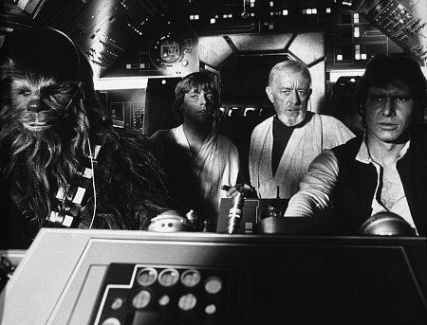
A long time ago (30 years to the day, to be exact), George Lucas unleashed the full force of the summer blockbuster on the world and changed the landscape of American moviemaking. Today, the conclusion to the Pirates of the Caribbean trilogy is strolling into theaters with an ostentatious swashing of buckles, just one of a dozen other mega-moneymakers which will bless (and curse) us during the summer months. Sometimes it’s hard to know whether to thank Lucas and Spielberg, or round up a gang of people to go throw eggs at their houses.

No, that’s a lie. I’ve gotten far more joy than grief from the films of Spielberg and Lucas. And speaking of Spielberg, although today is the 30th birthday of Star Wars, it does not actually mark the birth of the summer blockbuster. That won’t be for another month. It is generally agreed that Jaws (1975) introduced big summer hits to America’s movie studios.

However, I think it would be difficult to argue, in that respect at least, that Jaws was anything more than a herald announcing the imminent arrival of royalty. After all, Jaws may be the 35th-highest grossing movie ever (in America), but Star Wars is the biggest summer movie in history, and the five other movies in its franchise are in the top 25. None of the three Jaws sequels even rates (and really, did you even know there were three?).

30 years. Wow. I went through a rather long Star Wars phase (not so very long ago), and I still love the movies. I used to set up a TV, or even a video projector, in a quiet, out-of-the-way room and have an all-day marathon. Of course, this was when there weren’t quite so many movies, but I remember planning to have a 6-movie marathon sometime in the far-off year of 2006 when the final installment was released on VHS (yes, VHS . . . DVD had not yet reached me). And so, when I read about something like this, I am almost tempted to follow suit (almost).

Still, perhaps I’ll pop in Star Wars tonight and let it run in the background, for old times’ sake.

Pirates of the Caribbean: At World’s End

•May 24, 2007 • Leave a Comment

starring Johnny Depp, Keira Knightley, Orlando Bloom and Geoffrey Rush
written by Ted Elliott and Terry Rossio and directed by Gore Verbinski
rated PG-13 for intense sequences of action/adventure violence and some frightening images.
90%

It’s been a wild ride (no pun intended), but Jack Sparrow and his crew of miscreants have finally brought a whole trilogy into port with Pirates of the Caribbean: At World’s End. How to even begin a description of the 168-minute finale? Well, let’s assume you’ve seen the first two.

Hitting the high points: Jack Sparrow (Johnny Depp) is trapped in Davy Jones’ locker with his ship, the Black Pearl, fighting to keep his sanity (and losing). Will Turner (Orlando Bloom) plots to free his father, Bootstrap Bill (Stellan Skarsgård), from the clutches of Davy Jones (Bill Nighy) who is himself in the clutches of Lord Cutler Beckett (Tom Hollander). Lord Beckett, with the willing help of Admiral Norrington (Jack Davenport) and the unwilling help of Governor Swann (Jonathan Pryce) has the Flying Dutchman hunting down pirates across the seven seas in his quest for corporate domination (“It’s just good business”). Meanwhile, Elizabeth Swann (Keira Knightley) and the resurrected Captain Barbossa (Geoffrey Rush), with the help of Tia Dalma (Naomie Harris), have traveled to Singapore to talk Captain Sao Feng (Chow Yun-Fat) out of a ship and crew so they can go rescue Jack. Barbossa needs Jack (who, it turns out, is one of the 9 Pirate Lords) so that he can call a pirate assembly and unleash the wrath of the sea goddess, Calypso, on the East India Company. Any of these characters will readily sell out any other in order to achieve their goals should a conflict of interest arise. And those are just new story arcs belonging to major characters as of the beginning of the movie.

For all intents and purposes, this is the second half of a very long movie that began with Dead Man’s Chest last year. As the conclusion to a trilogy, it does a great job “tying it all together” (much to the detriment, sadly, of standing on its own as a good movie). There is also the device (also mastefully employed by J.K. Rowling in the Harry Potter books) of having a recurring element in the series which seemed frivolous revealed to be significant to the larger story. There are some clever little plot twists that add entertainment along the way.

As always, Pirates greatest success is in its characterization. Jack Sparrow is more hilarious than ever (“She is a woman scorned, fury like which hell hath no.”), but be prepared for a long introduction before he makes his first appearance. Watch for an awesome cameo by Keith Richards as Jack’s father (Depp has cited Richards as his inspiration for the character). Elizabeth Swannhasn’t been a conventional damsel in distress at any point in the series, but often her role is to watch the bulk of the action from the sidelines in frustrated annoyance. This time she drops into a very surprising position courtesy of Jack and Sao Feng, which leads to (among other things) one of the greatest stand-off scenes and one of the worst climactic speeches ever.

Oh, and let’s not forget Davy Jones. It would be no exaggeration to say that Jones is the greatest movie villain of the past decade, the Darth Vader of this generation. He is just such a fantastic character, with a great look and feel and presence, and At World’s End adds further layers of intrigue to his already complex background. By far the smartest move, however, was bringing back Geoffrey Rush to play Barbossa for the final chapter. Barbossa is the only character with enough personality and attitude to carry the scenes that lack Jack Sparrow. He is the anti-Jack, and they make great foils for each other once Jack rejoins the heroes.

What At World’s End does not do well is maintain that rare and tenuous balance between great storytelling and tongue-in-cheek hilarity that its predecessors did so well. There are laughs galore in the movie, but they are spread too thin: a one-liner here, aninopportune pratfall there, with several minutes of portentuous dialogue and meaningful glances in-between.

As a serious epic thriller it works reasonably well, but it’s not what we want and it’s not what we came to see. What we end up with is just over two hours of largely unbroken drama. This is all very absorbing, but the flashes of wit and fun break through just often enough to make us wish that this was a very different sort of movie.

Then, during the final half-hour, this movie suddenly remembers what it is, and it proceeds to cut loose with fervor and glee. Too little, too late? Not really. The climax is fun and exciting and nothing went the way I expected it to. The ending managed the difficult trick of catching me completely off-guard while making it impossible to imagine things going any other way. Ignore the nay-sayers, Pirates 3 is a good night at the movies and I plan to own the trilogy on DVD once it’s all out together. That’s more than I can say for Shrek or Spider-man.