
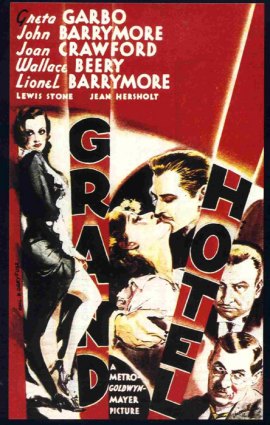
Grand Hotel: Best Picture, 1932

•November 14, 2007 • 1 Comment

grandhotelposter.jpgThe 5th Annual Academy Award ceremony has very little to offer the modern viewer in the way of classic American cinema. You probably haven’t heard of most (perhaps all) of the nominees. Grand Hotel received a single nomination, for Best Picture, which it won, making it the only winning film in academy history to receive no other nominations. However, one of its stars (Wallace Beery) won Best Actor (tied with Fredric March for Dr. Jekyll and Mr. Hyde) for his role in The Champ. The Champ (a boxing movie) was nominated for 4 awards, including Best Picture, and won 2.

Grand Hotel is as impressive an undertaking as its name implies. The project was orchestrated by the legendary Irving G. Thalberg (of the special Irving G. Thalberg academy award). Thalberg lit upon the bright (and, at the time, novel) idea of casting a film with not just one or two big name stars, but half a dozen. Grand Hotel is the original ensemble film. Thalberg bent over backwards to convince Greta Garbo, John and Lionel Barrymore, Joan Crawford, Wallace Beery, and others to join the production. Most of them refused their offered roles at least once.

The story of Grand Hotel is based on the play Menschen im Hotel by Vicki Baum, which was in turn based on her experiences working as a chambermaid in two Berlin hotels during the roaring ’20s. In it, the lives of several people flow in and out of each other over the course of a few days in a luxurious hotel. A bankrupt-but-charming baron-turned-cat burglar (John Barrymore) stalks the pearls of a fading prima ballerina from Russia (Garbo), but accidentally falls in love with her instead.

A lowly bookkeeper (Lionel Barrymore) who has just discovered that he is dying decides to blow all of his savings on a last fling of luxury after a life of slaving for a blustering, sleazy industrial magnate (Beery). The magnate is sweating over a merger that could make or break his company, and over his charming stenographer (Crawford). Meanwhile, the hotel porter (Jean Hersholt) has a wife that is in labor and a jaded doctor (Lewis Stone) watches events unfold, wryly noting, “Grand Hotel . . . always the same. People come, people go. Nothing ever happens.”

What we have here is a big-budget, Depression-era melodrama that has not aged well. Overacting abounds, and while the mini-plots are occasionally amusing or even moving, none of it manages to gel into anything like a compelling story. The movie is all over the place, emotionally, and takes two rather ridiculous turns in the third act that completely threw me. The first unexpectedly darkens the tone of the whole story, which is all well and good, except that the second attempts to drag things back up for a happy ending. None of it can really be said to work.

As for the actors, well . . . John Barrymore struggles to sell us on a character whose actions make no sense. Lionel Barrymore (in a role originally slated for Buster Keaton) tries very hard but is completely hopeless. His character ought to evoke pathos, but is far too annoying. Wallace Beery plays the guy you love to hate, but he is jarringly out of place. Beery only agreed to take the role when he was told he would be the only actor allowed to use a German accent . . . considering all of the German names (Baron von Geigern, Flaemmchen, Kringelein, Dr. Otternschlag) and the fact that this is set in Berlin, his character only draws sharper attention to the fact that we are watching an elaborate fantasy.

Joan Crawford, as the only character that isn’t a done-to-death cliche, turns in probably the best performance in the whole film and very nearly steals the show from top-billed Greta Garbo. But never underestimate the star power at play here. Garbo emotes mercilessly, and almost never convincingly, but her screen presence and magnetism are virtually unmatched in Hollywood history. She seems to exist in her own little movie in the corner, segregated from the other plots and characters.

In actuality, Crawford and Garbo never shared a scene because it was feared that one might upstage the other, and additional Garbo scenes were filmed after Crawford received the lion’s share of the buzz at a preview screening. That pretty much says it all. Grand Hotel represents the worst that the studio system of the Golden Age had to contribute to the development of film, and its only remaining value is as a cultural dinosaur. It has its admirable aspects, but there is no mystery surrounding its demise.

Freebie

•November 10, 2007 • Leave a Comment

If you are dating or engaged or married, or just need to find something to take a girl to, get yourselves over to Dan in Real Life. This is pure date movie gold. Steve Carell plays a widower with 3 daughters and a successful advice column. During the annual gathering of his large family at their home in Rhode Island, he runs into the perfect woman (Juliette Binoche, of course) at a bookstore and instantly connects. But before he can even figure out when he should call the number she gave him, she is introduced to him as his younger brother Mitch’s (Dane Cook) new girlfriend. Painfully-awkward hilarity and heart-warming hijinks ensue ad nauseum, but it all manages to be sweet, charming, and disarmingly funny rather than the less savory alternatives. Part of the appeal is in the movie’s treatment of family. It is incredibly rare to see a big-screen clan that is both functional and believable, and it turns out to be rather refreshing. The rest is in the great writing, endearing performances and obvious passion that went into the making of it. Seriously, get out there and see it.

Alternately, if that doesn’t sound at all like your girl’s cup of tea, give 30 Days of Night a shot. If warm romantic comedy doesn’t do the trick, surely you can’t go far wrong with a slightly above-average survival horror starring really cool vampires, right?

The Darjeeling Limited

•November 9, 2007 • Leave a Comment

starring Owen Wilson, Adrien Brody and Jason Schwartzman
Written by Wes Anderson, Roman Coppola and Jason Schwartzman and directed by Wes Anderson
Rated R for language
87%

Francis (Wilson), Peter (Brody) and Jack (Schwartzman) are three brothers who haven’t spoken to each other since their father’s funeral a year ago, but Francis, the oldest, was recently in a near-fatal car wreck and he wants to reconnect. He lures his younger brothers to India under the pretext of embarking on a “spiritual odyssey” across the country by train. He also has an ulterior motive: to visit their mother (Anjelica Huston), who skipped the funeral and is now a Catholic nun in the Himalayas. The trip hits a bit of a snag when the siblings get thrown off the train halfway and must navigate the rest of the way by less conventional means, but of course, only then can their personal journey truly begin.

Wilson, Brody and Schwartzan have great chemistry together and it’s easy to buy them as siblings. Each one has his own peculiar quirks. Francis, whose head remains swathed in bandages throughout the film, is more than a little controlling. He begins most of his sentences with “Let’s make an agreement . . .” and ends them with advice which he considers beneficial and which he expects to be followed. He orders for his brothers when they are in the dining car and assigns them their beds in the cabin. He expects to run the whole journey by way of strict adherence to the detailed daily itinerary, which, no doubt, already has major epiphanies scheduled regularly along the way.

Peter seems to have been the most affected by his father’s passing. He is along on the trip even though his wife is almost 8 months pregnant. His brothers are disturbed to note that he has taken possession of a number of his father’s old things, including a pair of prescription sunglasses which he refuses to stop wearing even though they give him splitting headaches. Jack is fresh out of a destructive relationship that just won’t go away. He frequently sneaks off to check his ex’s answering machine messages and plans to sneak out of the trip early to meet up with her in Italy.

This is, as noted above, a Wes Anderson movie. If you’ve seen a Wes Anderson movie (Rushmore, The Royal Tenenbaums or The Life Aquatic with Steve Zissou, for example), then you would have no trouble recognizing his distinct style here. His films have a great deal in common with each other, and The Darjeeling Limited is no exception. Stylistically we have Anderson’s carefully-constructed scene composition, his odd characters, his unique choice of soundtrack and even his unique yellow titles. Anderson has more or less settled on a particular set of actors, as well: Schwartzman, Wilson and Huston are all regulars, as are Bill Murray (who has a very brief cameo appearance) and several other familiar faces whose names I don’t even know. It’s a little like watching a Christopher Guest mockumentary, waiting to see what roles the regulars will crop up in. Adrien Brody, in this case, is a newcomer to the Anderson scene, but he is excellent as always.

Most importantly, though, are the recurring themes that Anderson addresses in his stories. His movies tend to be about gifted but emotionally-distant people whose families have weighed them down with a great deal of baggage, handicapping their ability to maintain healthy relationships. Over the course of a series of bizarre and often hilarious events, these characters experience something life-changing and begin to heal rifts between themselves and their families and friends. The key difference in The Darjeeling Limited is in its setting. Whereas Max Fischer had his beloved Rushmore prep school, the Tenenbaums gathered in their odd little townhouse, and Steve Zissou sailed the seven seas in his expeditionary yacht, the Whitman brothers find themselves completely outside their normal environment.

India, the country, the people, the culture (music, religion, food), is woven deep in the very fabric of this film. The bulk of Anderson’s other films often transpire within a carefully constructed and almost gleefully artificial set. While this remains true to a certain extent of the train, a large portion of the movie is spent off the tracks, among the people of India, in their towns and villages and beautiful countryside. Perhaps Anderson is maturing as a filmmaker or perhaps he simply couldn’t tame India the way he has other locales, but the country is almost another character, and the film is much richer because of it. In A Passage to India, the characters seek in vain to experience “the real India,” in The Darjeeling Limited, the characters succeed. This is not just India by way of Wes Anderson, it is Anderson by way of India.

Note: The recent, wider release of The Darjeeling Limited includes Anderson’s short film Hotel Chevalier tacked on in the front of it. The short stars Jason Schwartzman and Natalie Portman in an interlude in a hotel in Paris that serves as a sort of introduction to Jack’s character. The bit was previously available to be viewed online, and audiences were encouraged to see it before seeing the longer film. It is a decidedly unconventional thing to do, and I don’t know what the reasons behind it were (perhaps an altercation with the studio due to the nudity in the short film). In any case, Hotel Chevalier certainly enriches our understanding of events in The Darjeeling Limited and I was pleased to be able to see them both together in the theater (where they probably should have been in the first place).

Those Crazy Writers

•November 7, 2007 • Leave a Comment

So, the writers strike . . . seems to have left a lot of people with too much spare time on their hands, as a cursory YouTube search will reveal. Check these out if you want to know what it’s all about:

Well, the creativity that Greg Daniels noted doesn’t stop there. Now the studios have noted that, not only are the free shows available on the internet “just promos,” but actually even they aren’t making any money out of making them available. At least, that’s what Disney’s Michael Eisner claims. He acknowledges that there will one day be money coming in from the interwebs, but that writers are stupid for jumping the gun. Riiiight.

I just watched an episode of NBC’s “Heroes” online yesterday and was forced to endure something like seven previews for the upcoming CG version of Beowulf. I suppose they just slipped those ads in there for free, and don’t really expect them to get anyone into a theater seat anyway. I have to say, it’s really nice of these large corporations (and totally characteristic of their general charitableness) to give stuff away like that without expecting anything in return. Seriously, Eisner, don’t be a jackass. You aren’t fooling anyone.

Oh, and speaking of NBC and “The Office,” you may have noticed in the second video the mention that “Office” star (and WGA member) Steve Carell won’t cross the picket line. Well, other sources state that he has informed the studio that he is unable to report to work because he is suffering from “enlarged balls.” That is truly awesome, even if it’s not true (survey is out).

I should note that I recently started watching “The Office” (after a friend introduced me to it several weeks ago), and I am indeed watching it on the internet. It is a fantastic show, and I’m most of the way through Season 2. Thus far I’ve seen it all through Netflix. Netflix has all 3 seasons available online (no ads, though), and my subscription allows me to watch up to 15 hours per month of whatever movies and TV shows they have available for streaming. They have a pretty good selection of web content, though of course it’s nothing compared to their total DVD selection.

Anyway, slight topic change there . . . head over to here for some great further reading on the strike.

Film Roundup II

•November 5, 2007 • Leave a Comment

House, M.D. – 87%

I don’t do TV very much, but occasionally someone brings a show to my attention. Generally a dramatic show’s pilot episode will function more or less as a complete story, and of course it has a listing at IMDb, so I add it to the list . . . particularly if I go on to watch the entire first season of the show in question. House is now in its 4th season, and only time will tell how much longer viewers will keep coming back for Hugh Laurie’s magnificent curmudgeon shtick, but this is just about the opening episode. Laurie plays Dr. Gregory House, a character who is reverse-engineered from Doyle’s Sherlock Holmes (the inspiration for the character was a doctor Doyle knew) with a hefty dose of snide, bitter cynicism. House is a brilliant diagnostic specialist at a hospital in New Jersey with a team of 3 fresh-faced, not-quite-as-brilliant interns at his beck and call, and their only job is to diagnose and treat the medical cases that no one else can figure out. In this episode, a kindergarten teacher suddenly begins spouting gobblety-gook before collapsing in her classroom, and House is on the case.

The show gets pretty formulaic during its first season, but its not a bad formula. There’s drama, suspense, emotion, and most importantly, comedy. The verbal wit regularly on display is second to none, and watching Laurie employ it is what keeps me coming back. It will ultimately come down, really, to whether viewers find themselves put off by his demeanor. I, for one, love it, just as I love Dr. Cox (John McGinley) from T.V.’s Scrubs.

The Truth About Cats and Dogs – 56%

This is a very forgettable romantic comedy that functions as a sort of reverse (and reverse-gender) Cyrano de Bergerac. Abby (Janeane Garofalo) is a successful veterinarian with her own radio talk show in which she counsels pet owners who call in for advice. Brian is a new dog owner who tunes in to the show and soon falls in love with Abby’s voice. When he arrives at the studio he runs into Abby’s friend Noelle (Uma Thurman) and mistakes her for Abby. Abby is rather self-conscious about her appearance (she needn’t be) and so convinces Noelle to stand in for her in person while she handles the relationship over the phone.

Hilarity is supposed to ensue, followed by the obvious ending. Aside from being an elongated sitcom episode, and generally becoming very tiresome very quickly when no one behaves in a way that makes sense, I suppose it has its charms. Garofalo is a fun performer, and she brightens up the screen, but overall there is little to be said about the movie. Everyone already knows whether or not they like this sort of thing before it begins, and I hardly need to say that I didn’t choose to watch it or watch it alone, or that my companion was thoroughly charmed.

Tristram Shandy: A Cock and Bull Story – 94%

Tristram Shandy is such a hard movie to pin down. As I’ve mentioned before, it’s a movie that is about making a movie about a novel that is about writing a novel. As a result, not much happens, but lots seems to happen. Steve Coogan plays the title character, as well as the title character’s father, as well as himself, and there are smaller roles filled by Gillian Anderson and Stephen Fry and Jeremy Northam and various other people. The cast moves from scene to scene, totally out of order, of course, of the bizarre story of the life of an 18th century Englishman which in actuality never quite manages to get past the day of his birth.

Meanwhile, the main actors argue about who should have top billing, give on-set interviews, and endure last-minute script re-writes. Coogan juggles a visiting girlfriend who has their newborn son in tow and his personal assistant, who he feels just a little attracted to, and all around them is the delightful chaos and quirkiness of a group of people trying to make a successful and coherent film out of an obscure and incoherent book that none of them has read. It’s the sort of spectacle that suffers a bit on repeated viewings, when the sheer originality has worn off a bit, but mostly it’s colorful fun with an off-beat brilliance that I find it difficult not to appreciate.

The Pacifier – 34%

When you come right down to it, I don’t really know which I hate more: movies starring Vin Diesel or low-grade family movies that children enjoy and the adults that brought them suffer through. The Pacifier manages to combine them both into a single stink-tastic package of bad . . . and it’s not even a movie that hasn’t already been made a few dozen times. Diesel plays Shane Wolfe, a consummate Navy SEAL whose mission to protect a government scientist ended in failure and disgrace. Now, while the scientist’s wife is flown to a Swiss bank to help retrieve a secret formula, Wolfe will attempt to redeem himself by protecting the scientist’s five children from foreign operatives. Start plugging in the cliches and go.

Wolfe is a hardened special-ops type who approaches this mission as he would any other, in a completely businesslike fashion. Of course at first he finds things getting a bit out of control (queue slapstick, out-of-your-element fun), and his relationship with the children is non-existent. Slowly, the kids and the soldier start to thaw, he gets the hang of suburban life and starts a little romance with the kids’ principal (Lauren Graham). Ultimately, he not only masters the nanny job and solves the kids’ various major problems, but also discovers that the secret formula has been hidden in the house all along, allowing for a little more genuine action at the climax before the heartwarming conclusion rolls in. Vin Diesel doesn’t take himself very seriously in this film, which is all to the good (because, seriously . . .) and allows for a few moments of solid movie. Other than that and a few mediocre plot twists to keep things interesting, The Pacifier is pure boilerplate.

Big – 78%

I remember first enjoying Big as a kid . . . and I was definitely in the target audience. This was Tom Hanks’ first major success and it’s been mostly uphill from here. Josh, a 12-year-old boy, ages 18 years over night when he makes a wish to be bigger at a mysterious fortune-telling machine in a traveling carnival. Kicked out of the house by his own mother (who doesn’t recognize him) he heads for the big city. Uncertain how to act like an adult, he naturally gets a job at a toy company and manages to impress the CEO with his childlike spirit and his ability to both pick and design successful toys. Meanwhile, a co-worker (Elizabeth Perkins) is falling in love with him. But how long will he have to keep pretending to be grown-up when inside he still feels like a kid?

Clocking in at over 2 hours, it is definitely too long, and more than a little depressing from time to time (again, partially thanks to the length). But Hanks completely sells the idea that he is 12 even though he looks 30. Never for a moment do you doubt that this is just a really adult kid, or remember that you’re only watching a movie and this is really a grown-up pretending to be young. It’s a great feat and a great gag that keeps things going even when you know it’s time for it all to be over.

From Here to Eternity: Best Picture, 1953

•November 3, 2007 • Leave a Comment

fromheretoeternityposter.jpgThe 26th Annual Academy Award ceremony was dominated by From Here to Eternity, one of the most financially-successful and critically-acclaimed films of its decade. It received 13 nominations, the most of any film since 1939’s benchmark Gone With the Wind. They were: Best Picture, Best Director, Best Screenplay, Best Editing, Best Actor (Montgomery Clift), Best Actor (Burt Lancaster), Best Actress (Deborah Kerr), Best Supporting Actor (Frank Sinatra), Best Supporting Actress (Donna Reed), Best Cinematography, Best Music, Best Sound, and Best Costumes.
Best Picture competition included the light romantic comedy Roman Holiday, Cinemascope biblical epic The Robe, and iconic western Shane. The Best Actor Oscar went to William Holden for Stalag 17 (who reportedly felt that the award should have gone to Lancaster, I think Clift’s performance is equally deserving) and the Best Actress Award was given to Audrey Hepburn for Roman Holiday. Roman Holiday also took Best Costumes, while Best Music went to Lili leaving From Here to Eternity with the remaining 8 (also the most Oscars won since Gone With the Wind).

The film is based on a book of the same name by James Jones. The story was considered by many to be completely unfilmable because of its criticism of the military, which would need to support any serious production with hardware and so forth. As a result, the content of the novel was toned down (as much to pass the rigors of the Production Code as to appease the army), and the fates of some major characters reworked. The result, happily, doesn’t feel watered-down to anyone who hasn’t read the source material. Quite the contrary, even over 50 years later it still feels edgy and powerful.

The story follows a number of characters stationed at an army base in Hawaii in the weeks leading up to the surprise attack on Pearl Harbor. There’s Sergeant Warden (Lancaster), the ultra-efficient right-hand man to Captain Holmes who finds himself carrying on a torrid affair with Holmes’ neglected wife Karen (Deborah Kerr). Then there’s Private Robert E. Lee Prewitt (Montgomery Clift), a proud, stubborn bugler who transfers in from another base after his old commander gives an inferior bugler pride of place in the corps.

Prewitt, a former boxing champion who accidentally blinded a man in a fight, immediately faces pressure from Captain Holmes to join the base’s top-notch boxing team. If he cooperates, he stands to gain preferential treatment and rapid promotion, but his staunch refusal to fight gets him nothing but trouble and constant persecution from the other boxers (all of whom are non-commissioned officers). Finally there’s Frank Sinatra, in the role that single-handedly breathed life back into his dying career, as Private Maggio, whose hot temper and high spirits threaten to cost him everything unless he can keep them in check, especially when he begins a feud with Sergeant Judson (Ernest Borgnine), the sadistic warden of the stockade.

The Japanese attack on Pearl Harbor is perhaps one of the most frequently and poorly exploited American historical events in fiction, but From Here to Eternity handles it skillfully by not drawing undue attention to foreshadowing or becoming distracted by the excitement of larger forces coming into play. As evidenced by its five acting nominations, top-notch performances by a magnificent cast are this film’s strongest assets. The story has several subplots, but they interact with and flow into each other in a way that feels natural rather than compartmentalized. In fact, we become so drawn into the private struggles and triumphs of our heroes that we are almost as ignorant of the imminent disruption as they are when it arrives. They have no reason to think of it, so neither do we. What an ambitious undertaking, to attempt to recreate some the surprise and shock of the attack for an audience that is already extremely familiar with how events unfold (this film being released a mere 12 years later).

From Here to Eternity is full of great moments, and it delicately manages to avoid being either anti-military or jingoistic. It is a great story of human courage, passion, evil and folly set on the eve of an even greater tale of the same, and I grow more impressed with it during each subsequent viewing. This is landmark cinema, much-loved on its release, but with a somewhat lower profile today than similar successes such as Gone With the Wind. That’s a shame. It deserves recognition.

Continue reading ‘From Here to Eternity: Best Picture, 1953′

Happy Halloween

•October 31, 2007 • Leave a Comment

I dunno what you did yesterday, but I watched a few movies that seemed fitting considering the holiday. It was my first time to see these, too. I had actually planned to finish off the evening with Evil Dead II, but I just didn’t get to it. Pity. Anyway, here they are, and here’s what I thought.

halloween

It didn’t inspire the genre. That was Psycho (1960). And it wasn’t the first true slasher movie. That was Black Christmas (1974). But when John Carpenter’s Halloween burst onto the scene in 1978, it pretty much ignited the craze that would last for over a decade while establishing the hallmarks of its legions of imitators. Even the critics liked it . . . this was, of course, long before they’d been made to sit through more of what Ebert would come to call “dead teenager movies” than they could ever have conceived of or imagined.

In Halloween, little Michael Myers stabs his sister on Halloween night in 1963 and is carted off to a mental institution. 15 years later, he breaks free and returns to his hometown to go on a killing spree, recreating and expanding on his previous crime. Jamie Lee Curtis plays Laurie Strode, the “Final Girl,” in her breakout role. Donald Pleasence provides the star power, such as it is, playing Dr. Loomis, Myers’ psychologist and arch-nemesis. He went on to reprise the role in 4 out of 5 sequels. As movies go, Halloween isn’t too bad. It’s reasonably well made, considering the shoe-string budget, and employs some very sophisticated techniques. As scary movies go, my thoroughly desensitized viewing pegged it as only slightly scarier than Psycho.

I love Psycho, I don’t love Halloween. Both have their campy elements, and both have endured for quite some time with a very devoted fan base. To my mind, I’d say the key difference is perhaps target audience. Psycho is perhaps a more serious and innovative psychological thriller, while Halloween is basically a filmed version of the sorts of stories teens tell each other at slumber parties and around campfires. Not bad, but I’m not by any means a fan.


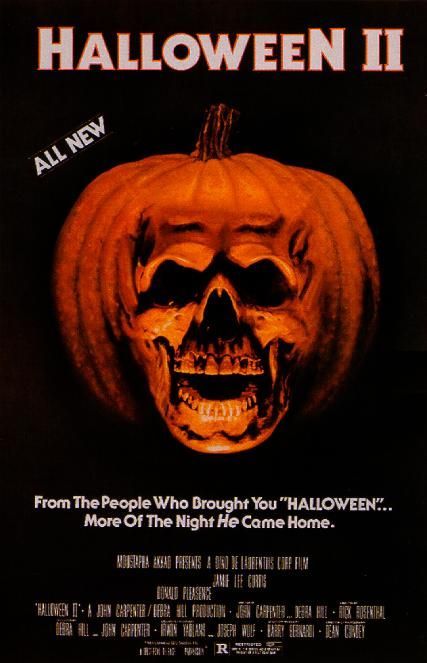
halloween ii

Carpenter wrote the script for Halloween II, which came out 3 years after the runaway success of its predecessor, but declined to direct. It begins seconds after Halloween ended . . . actually it re-runs the final scene to jog your memory . . . and the major players return to reprise their roles. Dr. Loomis runs around all over town, hunting for Myers, while Myers picks off the staff of the hospital that Laurie has been taken to one by one. Needless to say, this sequel was not nearly as well received as the original, and for good reason. It relies heavily on what Ebert calls “an Idiot Plot,” i.e. a plot that requires its characters to act like idiots to keep it moving forward. I wasn’t scared, I was mind-numbingly bored. Not even the adrenaline-packed final 15 minutes could prevent me from wishing the movie was over. Too little, too late, and the less said about it, the better.

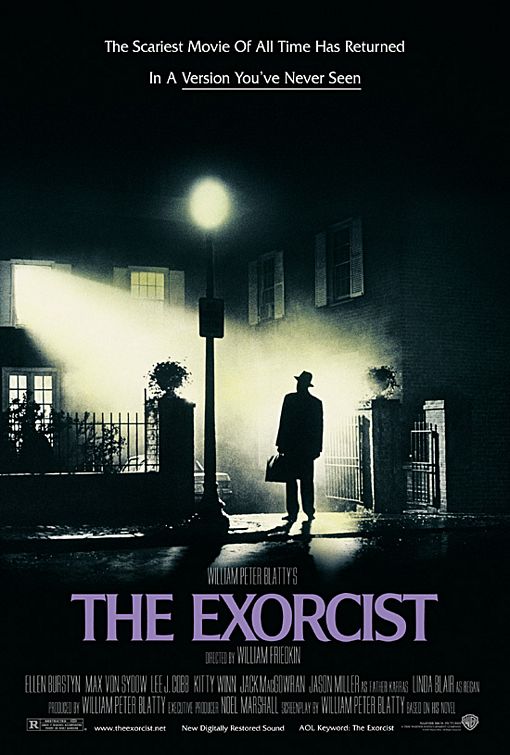
the exorcist

Can their be any doubt that The Exorcist is the definitive scary movie? Has any story more deeply terrifying ever been committed to film? I don’t know . . . but I hope not. I’m probably a bit biased, of course. I’ve been terrified of demonic activity since a traumatizing chapel experience when I was in the 3rd grade. But not only is The Exorcist a very scary movie (perhaps because it takes its subject so very seriously . . . whether you believe in demons or not, The Exorcist makes you feel that its creators certainly do), it is also an extremely good movie. It was actually nominated for Best Picture of 1973, although it lost to The Sting.

Two subplots run parallel to each other for much of the movie before joining up near the end: Regan (Linda Blair), the possessed girl, and her mother (Ellen Burstyn) see every scientific and medical specialist anyone can think of, and while all of them are quick to suggest an explanation for what clearly seem to be supernatural symptoms, none of them can adequately explain what is going on. Meanwhile, Father Damien Karras (Jason Miller), a Catholic priest who also happens to be an expert psychologist, feels that his faith is slipping away. He reluctantly agrees to investigate Regan’s case to determine whether an exorcism is called for, but the possibility that she might actually be demon-possessed is completely implausible to him. Watching him gradually realize that this is really happening is riveting viewing. And, if all that weren’t enough, Max von Sydow shows up as the title character for a climactic spiritual showdown that is second to none (and, like the rest of this movie, certainly not for the weak of stomach).

Welcome to Film Roundup

•October 30, 2007 • Leave a Comment

Welcome to Film Roundup (inspired here), wherein I realize that I’ve watched a lot of movies over the years that I never discussed on the blog (like, several hundred) and double back to pick them up, a handful or so at a time. Herein you will find a somewhat random assortment, drawn as they fall from the past 3 and a half years (and counting), and probably only reviewed very briefly before we move on. If a feature is something extra-special that I haven’t discussed yet but have definite plans to cover at greater length later (like one of the Oscar winners, say), I’ll probably leave it alone for now; plenty of material without fishing for that stuff. And so, without further ado . . .

The Taming of the Shrew – 61%

Famous screen couple Richard Burton and Elizabeth Taylor shoot sparks out of their eyeballs as famous Shakespeare couple Petruchio and Katharina in this Franco Zeffirelli production. I saw this just after completing a course on Shakespeare and while taking a course on film, so perhaps I was in hyper-critical mode, or maybe I just don’t buy into everything this play does to its characters. Either way, while I did enjoy it, the casting felt gimmicky and the entire movie seemed to think it could run off of the gimmick alone. Not that it wasn’t fun to watch Burton and Taylor beat the snot out of each other, but the antics felt somehow lifeless. Michael York is also well cast, but languishes in a subplot. Just like the Zeffirelli’s Romeo and Juliet, which I had seen in class, the art direction and staging seemed to lack any sort of flair, and the acting was generally too muted to make up the difference. Shakespeare’s comedies were written to be hammed up to the max! I know it can be done better!

Calendar Girls – 81%

A group of middle-aged British women decide to pose nude for a calendar to raise money for cancer research. Hoping to sell a few hundred copies in their area, they are all taken by surprise when the story catches fire worldwide and their calendar raises hundreds of thousands of dollars. Based on a true story. This is risqué comedy fit for polite society. It’s cute and occasionally guffaw-worthy. Helen Mirren and Julie Walters are, of course, fantastic. Overall the movie will probably leave you quite satisfied, but it’s not going to blow you out of the water. Has it’s moments, but they are largely forgettable. Great film to scandalize older relations without getting into too much trouble.

The Life Aquatic with Steve Zissou – 85%

I love Wes Anderson. His style is immediately identifiable, and his movies are quirky and off-beat. He brings immense talent together and puts it to work in the service of his vision, and the results are always good and often great. This film follows Steve Zissou (Bill Murray), a Jacques Cousteau-like documentary filmmaker who travels the world’s oceans with a team of eccentric misfits (Anjelica Huston, Willem Defoe, et al) which serves as both his family and his crew. As the movie begins, his best friend has just been eaten by the elusive jaguar shark, and he has vowed not to rest until the shark is dead. The hunt, of course, will all be captured on film. Joining him for the voyage are an inquisitive and very pregnant journalist (Cate Blanchett) and a young airline pilot who believes he is Zissou’s illegitimate son (Owen Wilson). Zissou and his crew face piracy, mutiny, and a host of other adventures as their voyage leads each of them towards personal epiphanies that will change their lives.

Don’t mistake the above description as a sign that Life Aquatic says anything terribly deep. Most of the time it’s just crazy fun. This isn’t my favorite Anderson movie, but it entertains me. If you like different, this is for you.

Meet the Parents – 76%

A lot of people hate Ben Stiller, but he keeps showing up in movies, so someone, somewhere must love him. I fall into the camp that is often highly amused by Stiller’s antics, and Meet the Parents came out before he’d worn out the “Oh look, I’ve accidentally landed in another painfully embarrassing situation again” shtick. Robert De Niro, as the prospective father-in-law to Stiller’s very unsuitable suitor, is the perfect foil. He’s terrifying even before you learn that he used to work for the CIA. This isn’t high art by any stretch, but there are a number of masterful scenes that build awkwardness like Hitchcock used to build suspense, until you’re almost ready to explode. They’re all outrageously implausible, yet they somehow feel like they could actually happen.

My favorite is probably the dinner table sequence, which involves a mangled prayer, bad poetry, cat milking, a poorly-aimed champagne cork, and an urn containing the ashes of a beloved relative. If you’ve never had the experience of meeting a significant other’s family for the first time, you may not want to after this movie. At least, that was how I felt. Just take comfort (or caution) in the fact that, unlike this film’s protagonist, you probably aren’t a moron.

Sky High – 82%

Sky High is Harry Potter meets The Incredibles. There’s just no other way to describe it. Will Stronghold, the son of two famous superheroes, enrolls in a special high school for superheroes with equal parts excitement and trepidation. Of course, superhero high school turns out to be a lot like normal high school, and Will finds himself facing a lot of the same problems his more average peers are facing, though somewhat amplified by all of the superpowers. But before the end of the year, he’ll face challenges only a true superhero can overcome.

At first glance, it appears to be just the sort of thing you’d expect to find aired during the day on the Disney Channel. At times, the special effects are just a notch above made-for-TV, but somehow, cheesy works for this movie, and works well. The plot is surprisingly intricate, the characters are well-developed, and the script is full of affectionate, self-aware prods at the superhero genre, much like Galaxy Quest did to Star Trek. There are quite a few fun performances by the adult cast as well, including Kurt Russell as Will’s father (geez, he’s been appearing in Disney movies for nearly 40 years now), Bruce Campbell as the loud-mouth gym teacher, Cloris Leachman as the school nurse, and Lynda Carter (yes, Wonder Woman) as the school principal. Sky High represents just about the most fun you can have with pure fluff.

Link Roundup for President

•October 29, 2007 • Leave a Comment

Yes, even at this rate my sidebar blogroll will eventually stretch to completely unmanageable proportions. But I’m sure there will be a few links to trim by then, and after all, most of the sites (like this one) don’t warrant daily visits. Anyway, here are the new additions:

Pick-Up Flix

The Oscar® Igloo

Film Buff On Line

That last provided me with some fun and fascinating reading today in the form of two of my favorite subjects: scoops of information about movies that do not currently exist and stories about how movies that do exist made it to the screen against all odds. The subject is Who Framed Roger Rabbit. No surprise that film had trouble getting made, but I’m definitely glad it did. I can only hope that The Hobbit doesn’t suffer the same fate as Roger Rabbit II. Be sure to glance over some of the other great stuff on all 3 sites (particularly the articles in “Film Buff”).

Who Delayed Roger Rabbit?: Why there has been no sequel to one of the most popular films of the 1980s.

Script review of dead-in-the-water Roger Rabbit II: The Toon Platoon

Gone Baby Gone

•October 25, 2007 • Leave a Comment

starring Casey Affleck, Michelle Monaghan, Morgan Freeman and Ed Harris
written by Ben Affleck and Aaron Stockard and directed by Ben Affleck
rated R for violence, drug content and pervasive language.
97%

Gone Baby Gone, Ben Affleck’s directorial debut and his first screenwriting credit since Good Will Hunting, is something special. I guess some people just belong behind the camera rather than in front of it (just look at Mel Brooks). I expect and hope for Oscar nominations. It is definitely reminiscent of Mystic River and The Departed, both of which are also set in Boston and deal with crime in a very R-rated manner, but this is the better film. Both of the other films feel like talented people trying to make a Great Movie (note the self-conscious style of the The Departed and the carefully cast relationships of Mystic River). Gone Baby Gone frequently makes you forget that you’re even watching a movie. There are obviously genuine Bostonians mixed in as extras, but the riveting performances are so skillful it’s very difficult to tell where the extras end and the actors begin.

On the surface this is a story about a 4-year-old girl who disappears without a trace, her screwed-up family, the officers who try to find her (Morgan Freeman, Ed Harris) and Patrick (Casey Affleck) and Angie (Michelle Monaghan), 2 private investigators hired by the girl’s aunt to help. That story keeps you glued to your seat, but the deeper questions are what will really stick with you later. Gone Baby Gone was not afraid to train an uncomfortably close lens on everything I’ve ever believed about morality, and I say that as someone who has, by turns, seen value in both situational ethics and a commitment to moral absolutes. The movie presents us with seemingly impossible ethical choices, where either decision could turn out to be mostly right or tragically wrong, and it never gives us an easy solution. Many of those questions will probably haunt me for some time to come. It is the sort of movie that should be seen with good friends and discussed seriously and at great length afterwards.

In the end, Patrick does what he believes to be the right thing, even though he may be the only one (among the characters on screen and the audience members in the theater) who thinks so. I couldn’t confidently say whether he made the right decision, but I was personally convicted by the strength of his moral courage. I can’t remember the last movie I saw which displayed so unflinchingly that doing what you think is right is necessarily easy to do or easy to live with afterwards. Affleck (as quoted in the Christianity Today review) declared, “I wanted a character who makes a choice that will change the course of his life, and I didn’t want to tip the scales with what I would have done or what I think of his choice. I wanted the audiences to ask themselves the big questions.” I heartily applaud his vision and its successful realization.

But speaking of Christian reviews of the film, I have to note an instance of very poor judgment on the part of Focus on the Family’s “Plugged In.” As I noted above, Gone Baby Gone is rated R for a reason. Aside from a great deal of language and some violence, it deals rather frankly with sex crimes and is at times difficult to watch as a result. Tallying these sorts of things is the reason “Plugged In” exists, and although I think it is a terrible approach, I have often found it useful to know more about what I’m going to see (particularly when bringing others along with me). However, their ultimate assessment of a film is what I tend to find objectionable. In this case, the conclusion to their review confidently asserts that “Gone Baby Gone wants us to hate [Patrick’s] decision,” and goes on to conclude very quickly and easily that he obviously made the right decision and that the movie promotes vigilantism and anarchy and all sorts of other icky things.

I don’t really know whether they expect to be taken seriously as reviewers, but lacking a modicum of personal insight you’d think they could at least do a minimal amount of research (like, say, Christianity Today did). To take such a powerful and admirable example of doing the right thing even when you have every reason not to and flip it around to use as yet another example of amoral Hollywood values (they lump it in with recent shallow vigilante fantasies Death Sentence, The Brave One, and We Own the Night) is pretty shoddy. In fact, nothing could stand in starker contrast to the long tradition of facile trigger-pulling exemplified by the above titles than Gone Baby Gone, and I encourage you to see it if you can handle the raw content.

As for “Plugged In,” I briefly considered removing them from my sidebar because I really don’t want to direct people to their site as though I thought they had anything of value to contribute to the dialogue between faith and film. But for the time being I will continue visiting the site and reading what they have to say, even though I may (and usually do) disagree. Unlike “Plugged In” I find a great deal of value in listening carefully and respectfully to people I disagree with, and I have faith in the personal discernment of my audience. If they say something outrageous, you’ll catch it too. The link stays . . . for now.