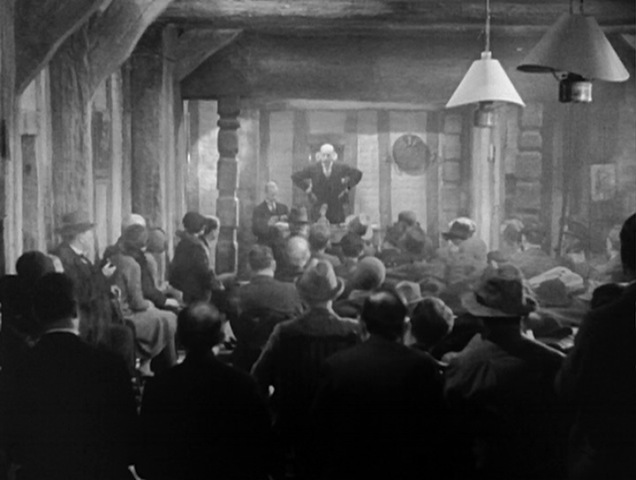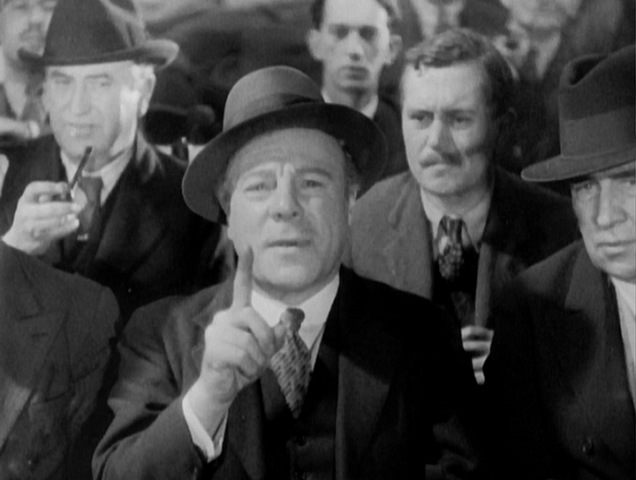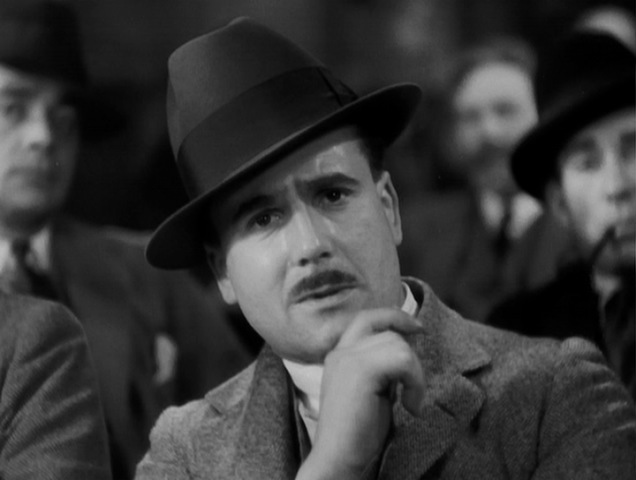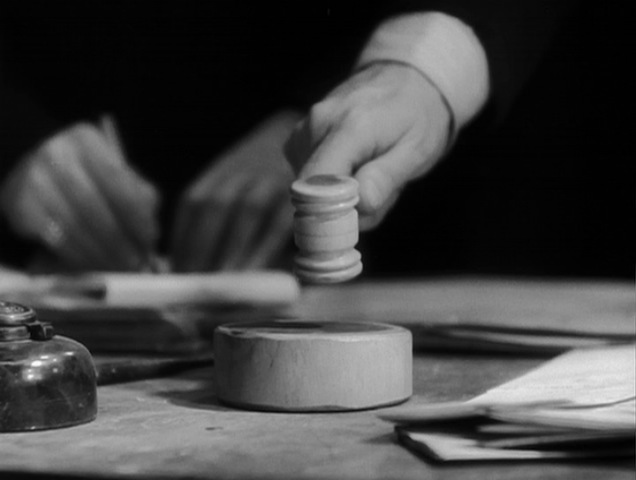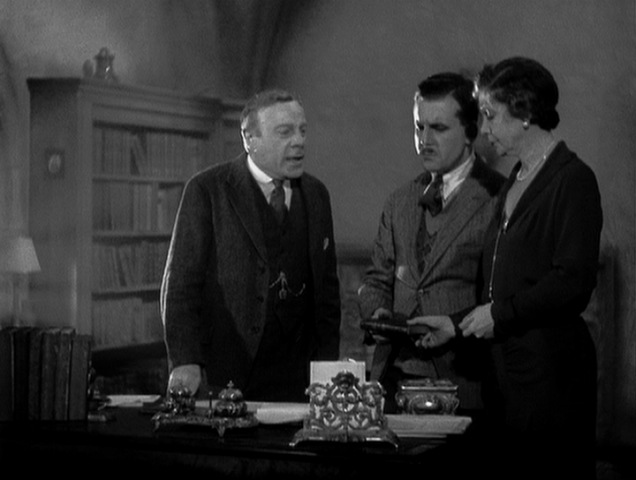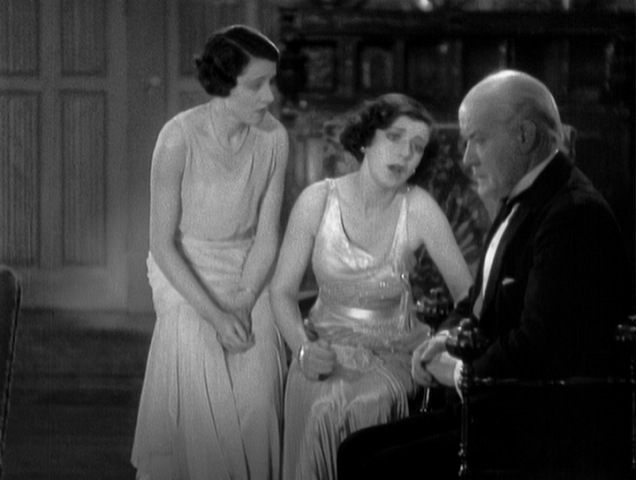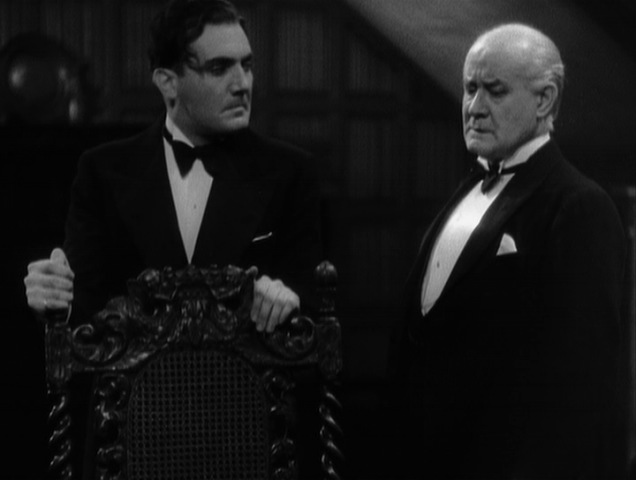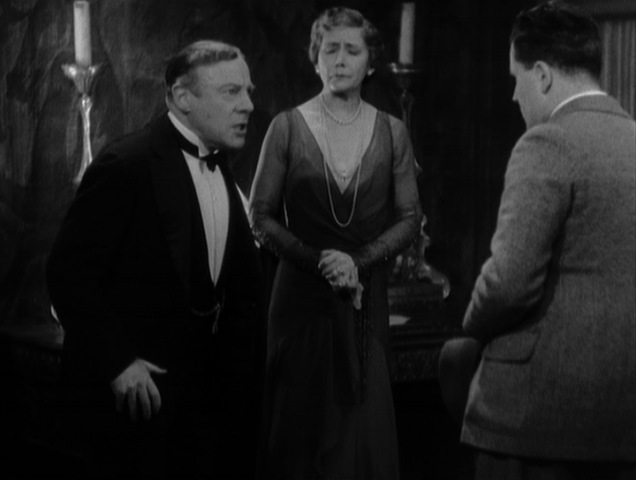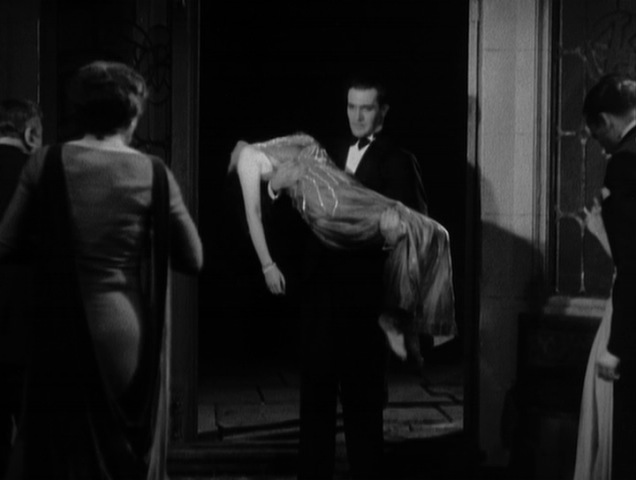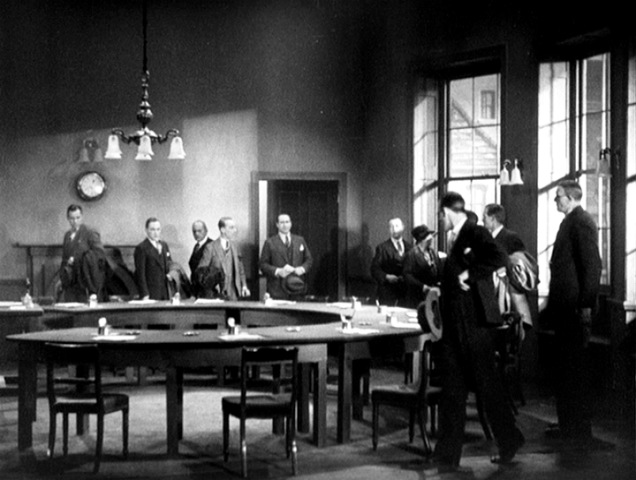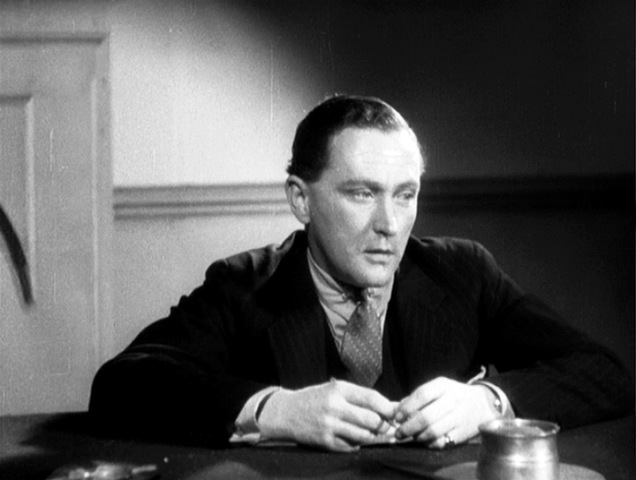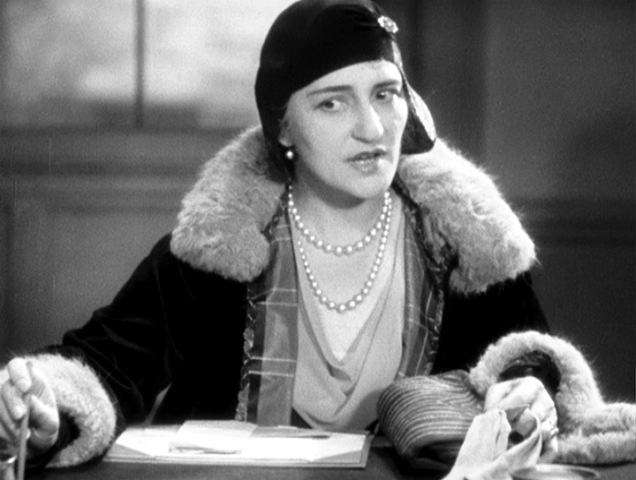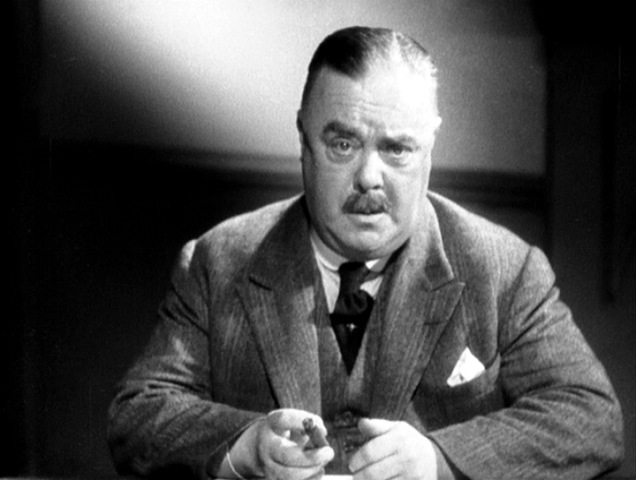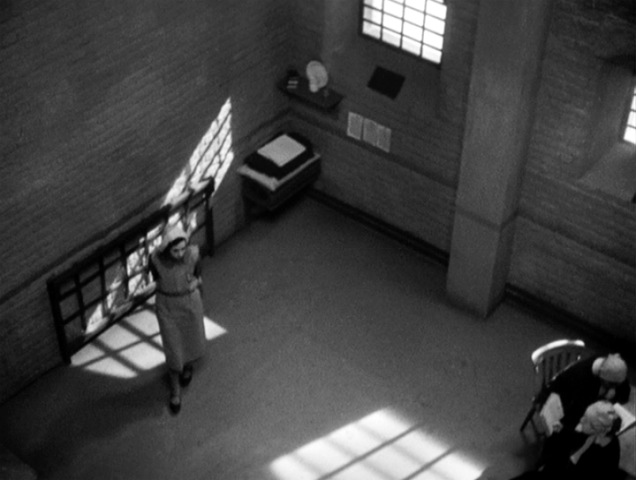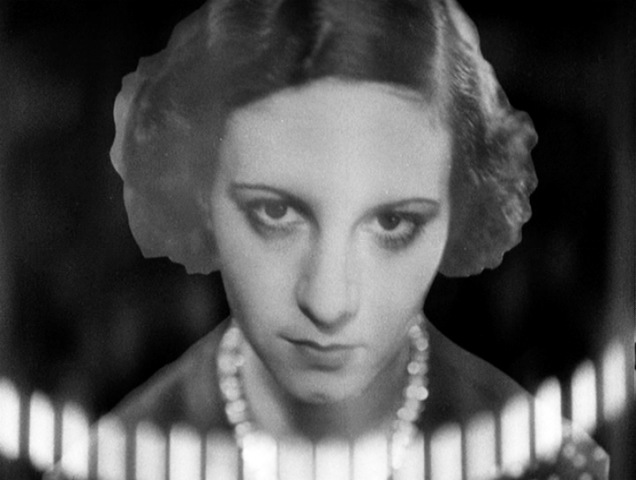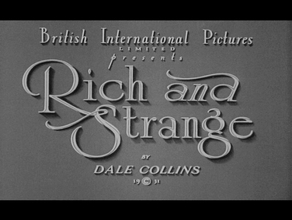
Week 13: Rich and Strange (1931)

•March 26, 2008 • Leave a Comment

richandstrangetitle“Mr. Baker will give his twelfth talk on accountancy in three minutes.”
“The curtain’s gone up too soon! They’re not dressed!”
“I couldn’t wear this! People will think we’re not married.”
“Don’t you forget you’re coming with me to buy my carpet, too!”
“Go have your dance with the gossip woman. Then she will not look for you.”
“If a woman can’t hold her man, there’s no reason why he should take the blame.”
“I like being shipwrecked! It’s not half as bad as people make out!”

Rich and Strange

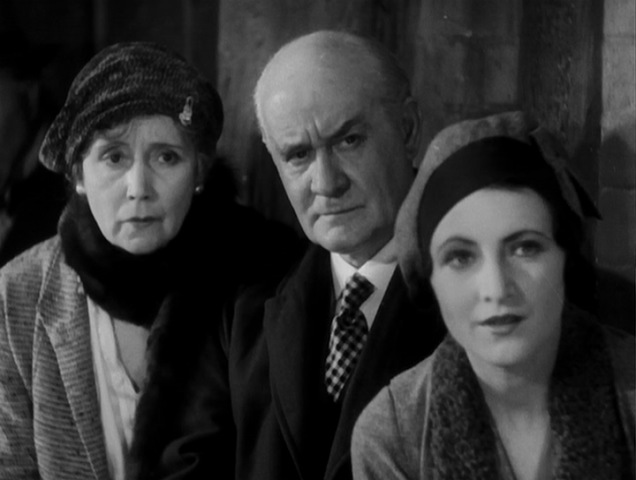
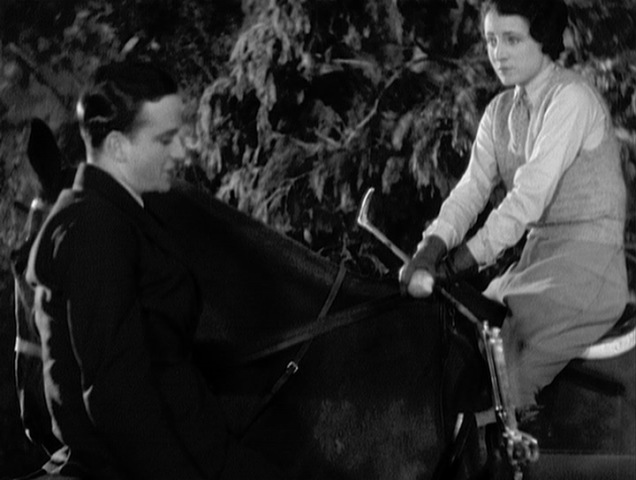
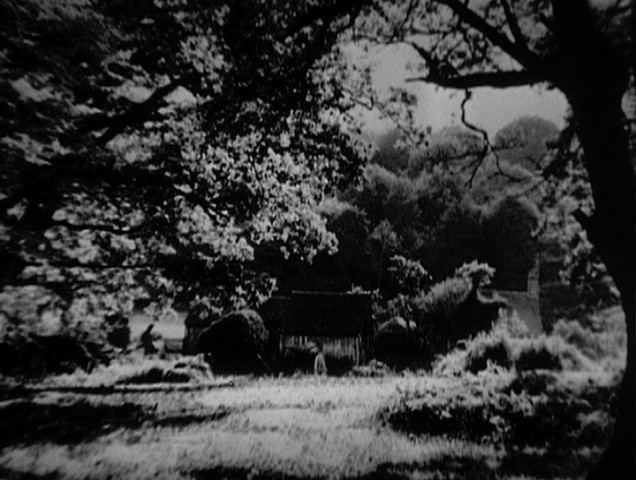
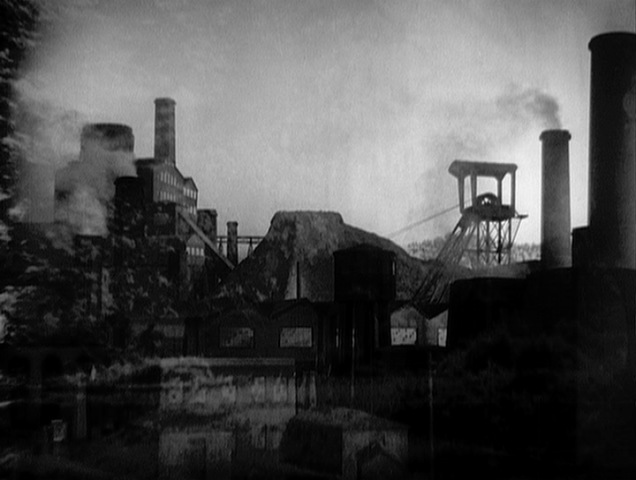
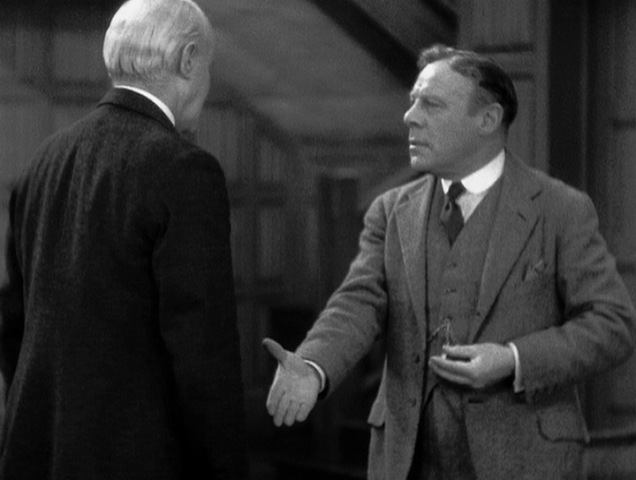
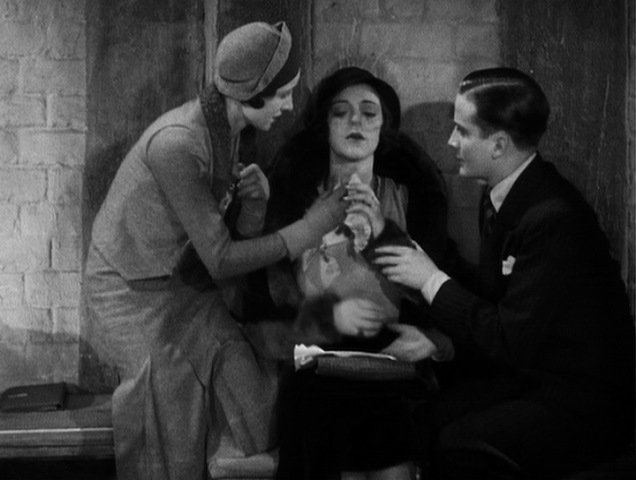
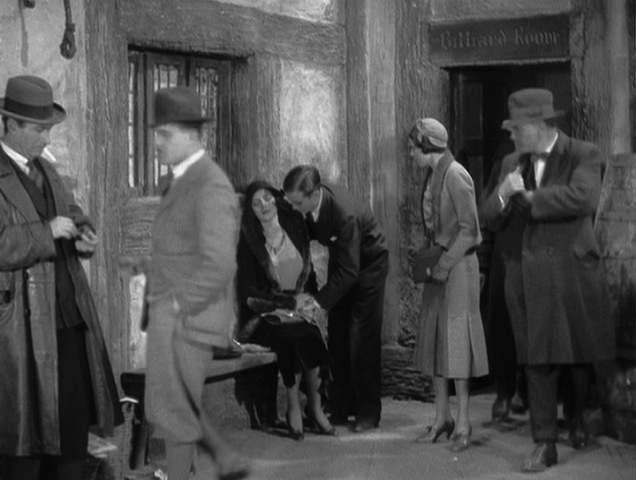
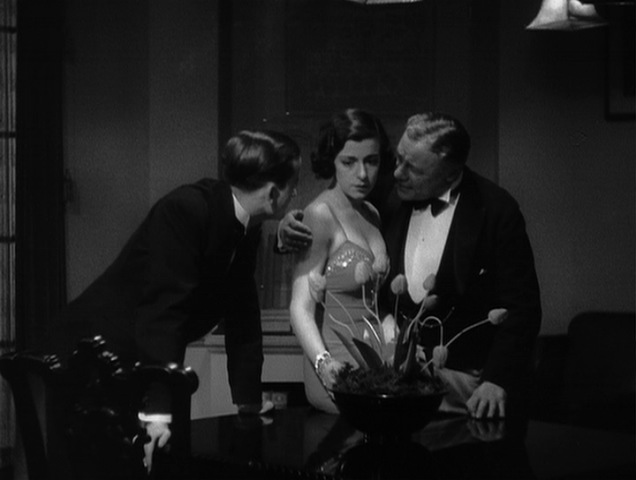
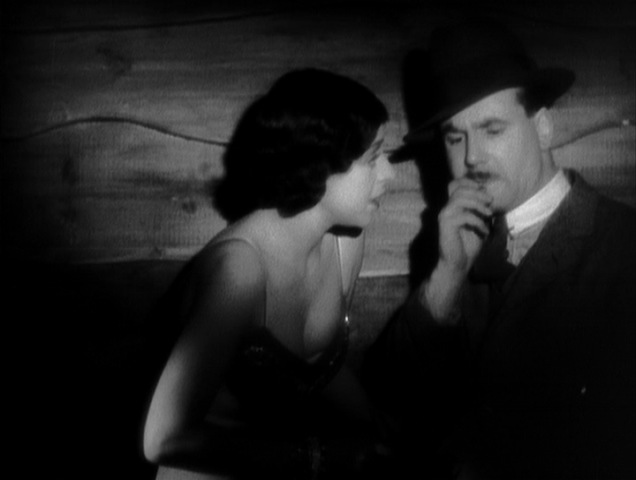
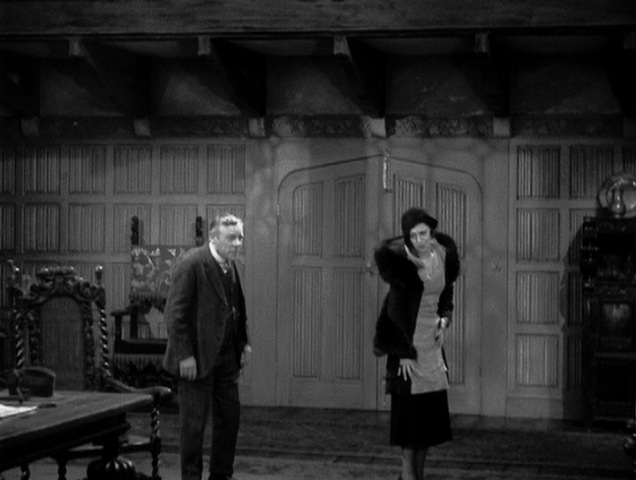
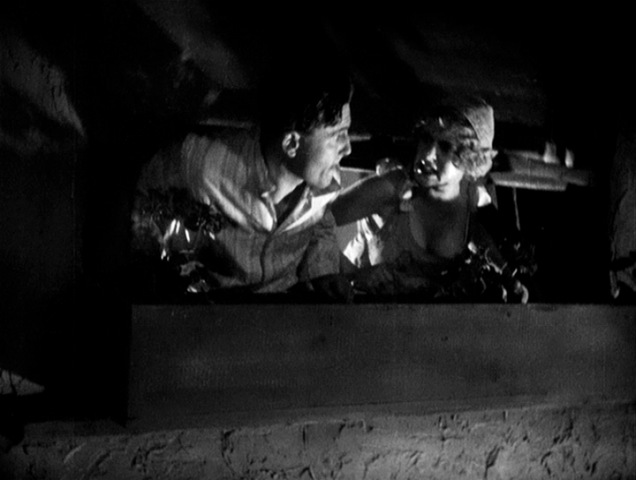
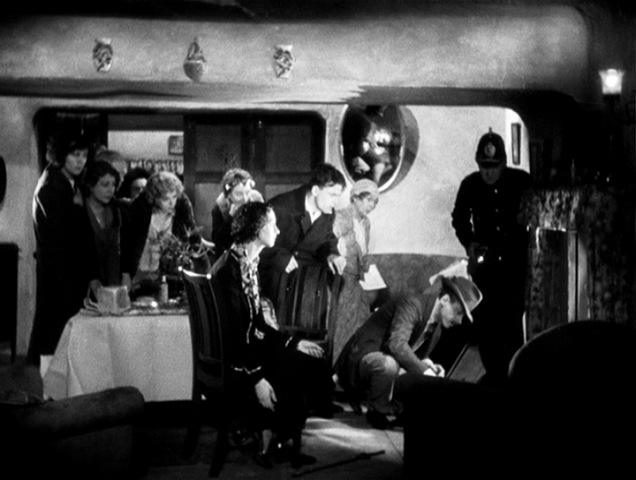
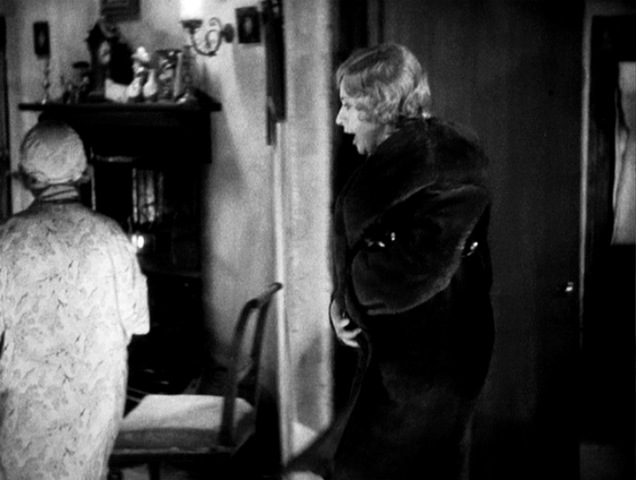
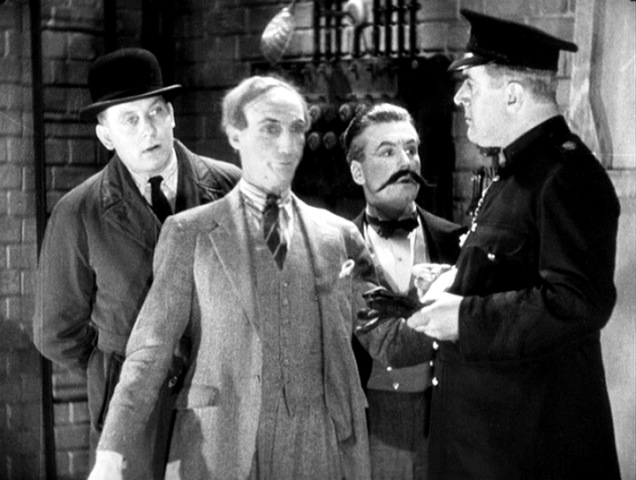
fredHitchcock’s Rich and Strange, adapted from a contemporary novel by Dale Collins by Hitchcock, Alma and Val Valentine, is a romantic melodrama that begins as a screwball comedy, continues as a travelogue, segues unpleasantly into a morality play, then throws in a shipwreck before hopping a Chinese junk right back to where it began. Hitchcock later called it “just an adventure story,” though that description hardly does justice to this largely shallow hash of elements.
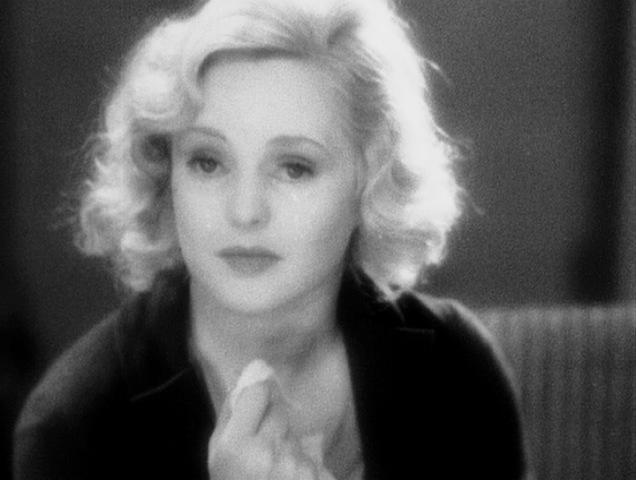
emilyA young couple, Fred (Henry Kendall) and Emily (Joan Barry, who had previously provided the voice for Anny Ondra’s character in Blackmail), jump at the chance, offered by a rich uncle, to escape the dull routine of their conventional British lives and see the world. On the voyage they fumble through a series of silly misadventures, most of which result from falling foolishly in love with other people. After losing most of their money and nearly losing their lives, they finally return home once more, relieved but not much wiser.

More than anything, Rich and Strange, the director’s 6th talkie, plays very much as a throwback to the director’s silent days. This is true both of small stylistic touches that crop up repeatedly throughout the movie, and of the story it is telling. Hitchcock falls back once more on the “unfaithful lover/awkward triangle” theme that had been a staple of his early films. In tone, this effort is probably closest to 1928’s Champagne, with its frivolous depictions of wealthy revelry and slightly-jarring moralizing.

It is almost as though Hitchcock, after four rather thin and talky stage adaptations in a row, finally saw some material that was a bit more malleable to the cinematic form, and took advantage of it. This is not to say that the movie ultimately succeeds on most levels, merely that there is a noticeable departure from some of the problems of the other early talkies.
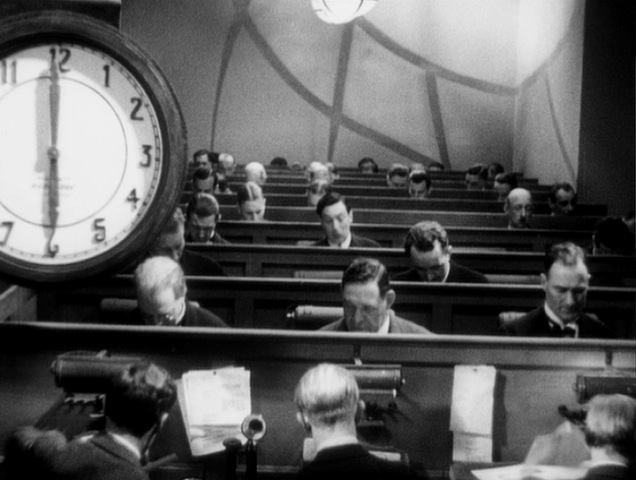
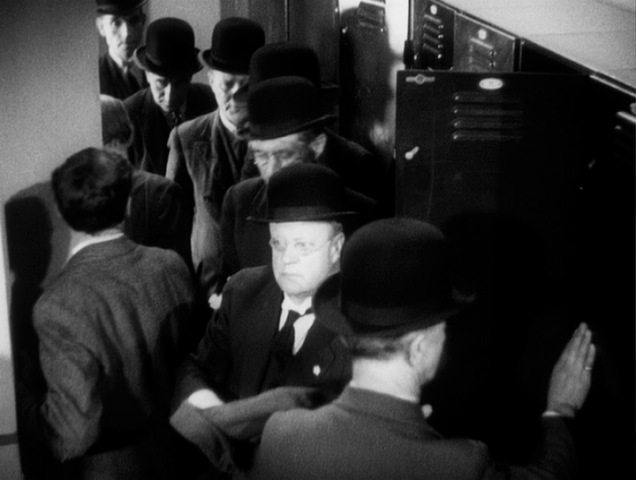
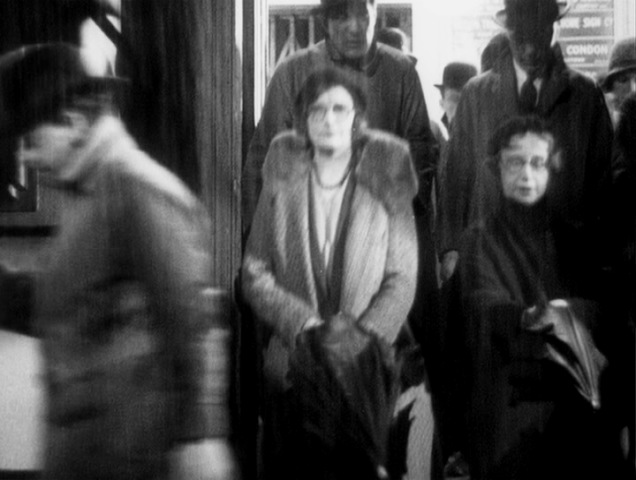
quittingtime1The first four minutes of the film have no dialogue at all, and one might almost think that the film is silent at first. In a crowded room full of cubicles, ledgers are closing and people are getting up. It is the end of the day. Throngs of employees fill the halls of the office building, each man wearing an identical black bowler hat, the women also wearing similar attire. It is raining outside, and the employees step out the door, two-by-two in rhythmic unison, opening their umbrellas in a single smooth motion and heading home; all but one, that is. Our hero, Fred Hill, out of step with his fellow office drones, wrestles haplessly with his umbrella for several seconds, but it refuses to open. Grimacing, he braves the rain unprotected.
quittingtime2quittingtime3quittingtime4

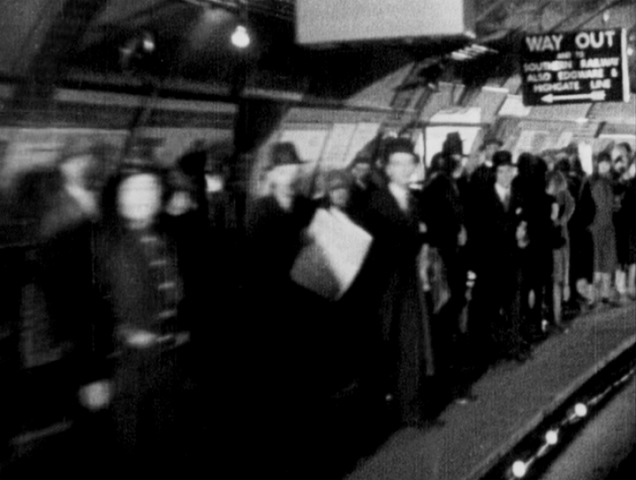
undergroundA camera mounted on the rails pans rapidly past the tightly-packed crowd waiting to board the tube. As it comes to rest they shove their way aboard, and Fred finds himselffeather standing next to an older woman with a garish feather in her hat. He accidentally snatches it out as the train gets underway, but she doesn’t notice until he tries to give it back. Annoyed, he glances at the advertisements that line the walls above the train windows, describing experiences he won’t be having tonight: theater revues and fine dining.
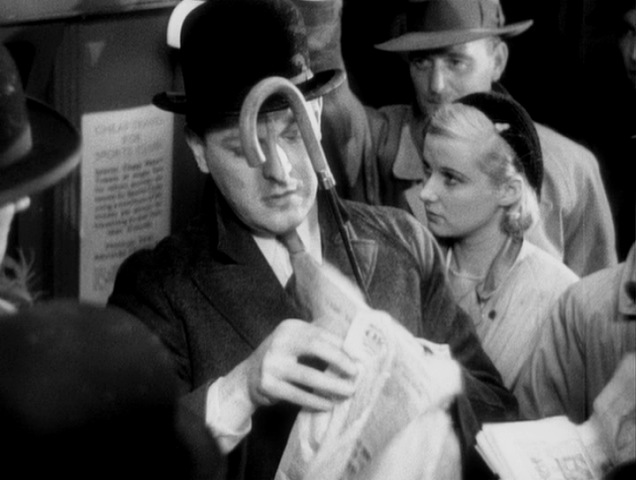
newspaperfumbleBalancing himself carefully, he lets go of the strap overhead and attempts to open his newspaper, which promptly falls apart as he tries to open it. After wrestling with it for a moment, the first item his eyes fall on bears the headline, “Are you satisfied with your present Circumstances?” As his eyes shift left and right, the answer to the question seems obvious.
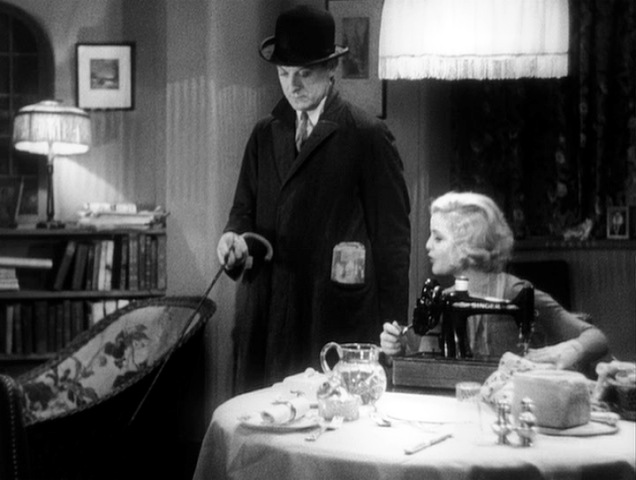
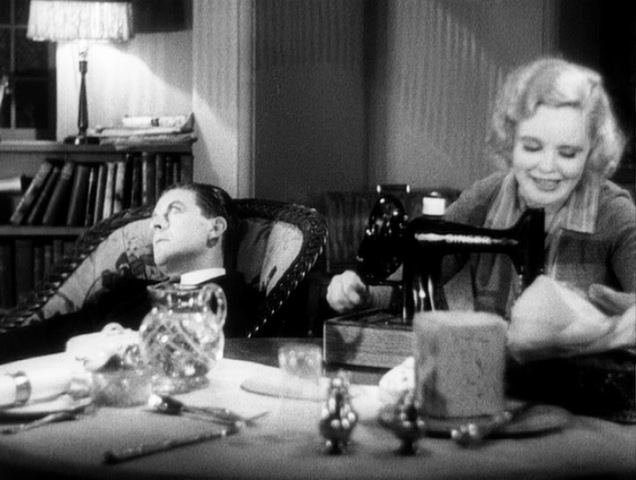
brokenumbrellaTo this point, the movie has played as standard silent slapstick, but now Fred arrives home and dialogue enters the picture. Emily is waiting cheerfully with a steak and kidney pudding for dinner, and she irritates him immediately when she asks brightly, happycouple “Have you broken your umbrella?” She is busily at work on making herself a new dress on the sewing machine, and she asks Fred whether he’d rather stay at home and listen to the wireless or go out to the pictures. Fred has no interest in either option, and he finally explodes with the frustration of his ordinary life.
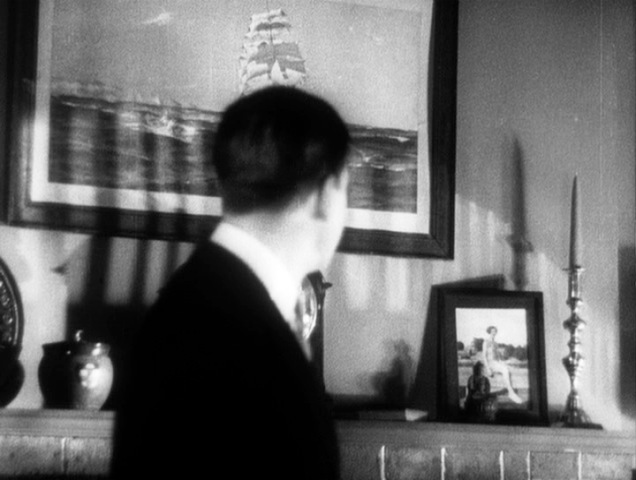
seachangeEmily is not impressed by his outburst, but just then the mail arrives. Expecting nothing but bills, Fred sorts listlessly through it until he comes upon an unexpected item: a letter from his magic plot device . . . err, that is, rich uncle. The uncle is aware of his nephew’s restlessness, and sees no reason why he should have to wait for the death of a relative to experience life. He can have his inheritance early, and travel the world on it. Fred and Emily are both thrilled by this turn of events, and as the scene fades out, Fred stares rapturously up at the large painting of a ship hanging over the mantle.

intertitle1At this point Rich and Strange puts another trick from the silents back into circulation: the intertitle. They appear at several points throughout the rest of the story, telling us where we are, when we are, who we’re looking at, what is about to happen and, in at least one case, what has just happened. Perhaps it was meant to evoke some feelings of nostalgia and appreciation for the old days (not so far gone at this point). Perhaps Hitchcock, who, after all, got his start in the business designing intertitles, simply missed them.

Whatever the logic behind their inclusion, the overall effect feels lazy, superfluous and more than a little clumsy. There should be a better way for the audience to tell the difference between Marseilles and the Suez Canal. And, flashing “Fred had met a princess!” on the screen immediately after Fred is introduced to, yes, a princess, is unintentionally hilarious at best.

seasickcameraAs the couple crosses the English Channel, Fred has his first bout with seasickness. He feels a bit woozy while trying unsuccessfully to target Emily with the camera lens up on deck and goes below. Hitchcock employs his favorite POV tricks to indicate seasickness here, as in Champagne, by blurring and wobbling the shot as Fred peers through the lens.
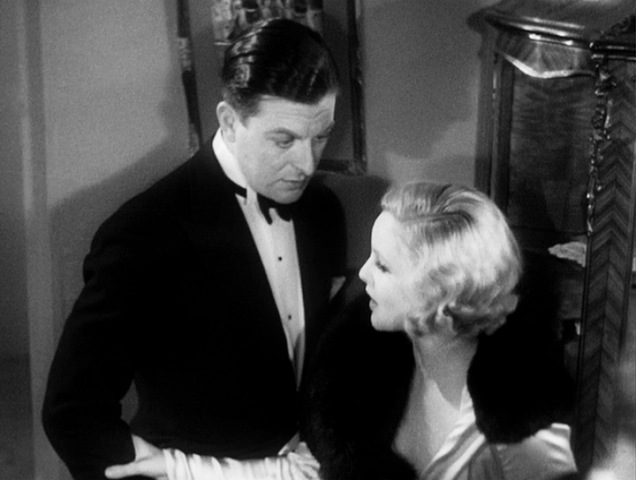
parisThe Hills fly through France largely by way of a whirlwind montage, which adds little of substance to the proceedings. Their heads swivel back and forth in close-up shots, interspersed with location footage of the famous landmarks of Paris (all of the location shooting is edited in around the main action taking place on small, mostly interior sets). They attend an extravagant stage revue and Emily is mildly scandalized by the showgirls’ costumes. On the way out she gets felt up in the lobby and seems generally uncomfortable.

confusionShe and Fred stay out late drinking, and stagger back to their hotel room with some difficulty. There is some mild amusement here: Fred confusedly believes the elevator dial is a clock and resets his watch, only to have the time change when the elevatorprayer moves. As the two climb into their separate Ricky-and-Lucy-style beds. Fred slips and lands on his knees, where he remains for a few moments while he collects himself. Emily, glancing over her shoulder, is convicted by his piety and gets on her knees as well to say her prayers. Fred, rising to his feet once more, spots Emily praying and joins her.

gordonThe next day, they board “the big ship bound for the Far East” and meet some of their fellow passengers. Fred soon feels queasy and disappears below-deck, leaving Emily to converse with Commander Gordon (Percy Marmont) and a nameless character referredoldmaid to as “the old maid” (Elsie Randolph). Randolph’s character, as her title indicates, is a broad stereotype; a parasitic and profoundly irritating gossip who is comical only because she on the screen rather than in the room. Gordon is a genial bachelor on his way back to his post in Asia. With her husband confined to quarters, Emily and he become fast friends.

friendsThey sit and talk on deck together for hours, day and night, as the ship makes it way across the Mediterranean. The friendship remains purely platonic, at least on the surface, until one fateful night when they take a walk in a remote corner of the upper deck in an effort to escape from the old maid (who, of course, wants to play a card game). The beauty and solitude of the scene, and the ambiance of the music floating up from below, lead to a passionate embrace, after which they return quickly and quietly to a more populated area of the boat.
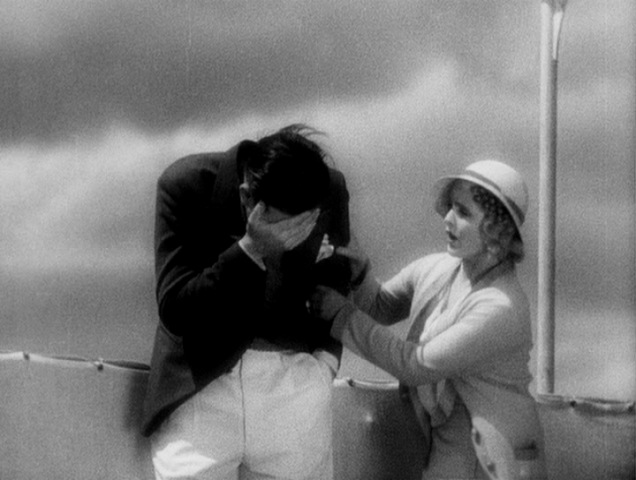
eyeshotThe old maid, suspecting nothing, comes upon them again and provides Emily with something she believes will have Fred back on his feet. Sure enough, the next morningprincess he feels well enough to escort his wife up on deck. As they stroll, someone playing a nearby game throws something that hits Fred in the eye. Upset at first, he becomes much less cross when he catches sight of the woman who threw it . . . particularly when he learns that she is a princess (played by Betty Amann).

homewreckerNow there is no chance of Fred noticing how friendly his wife has become with Commander Gordon, and he doesn’t seem to care whether she notices his feelings towards the Princess or not. It is worth pointing out the fundamental difference in the way each spouse cultivates a relationship on the side. Emily and Gordon both seem a bit ashamed of the attraction they feel for each other, and neither of them has any serious intention of acting on it, or of ending Emily’s marriage. Fred and the Princess are just the opposite. She is brazenly seductive. He is slavishly devoted, and generally behaves like a cad.

rug1As the ship drops anchor at an Egyptian harbor, husband and wife go ashore separately, and the old maid casts about for a victim to come help her bargain for a rug. A bit of visual comedy surrounding this purchase takes uprug2 most of this interlude. Gordon and another British officer (referred to only as “the Colonel”) accompany the old maid, who makes a great show of picking out just the right rug. As she pays the vendor, Gordon notices Emily wandering alone through the crowd and goes to join her. The Colonel, too, makes use of the opportunity to escape, leaving the old maid alone and a bit confused.

costumes1Somewhere beyond the Suez Canal, a costume ball takes place aboard the ship. Emily goes as a milkmaid and Gordon seems dressed in some sort of 18th-century-stylecostumes2 riding cloak. Fred and the Princess both wear Arabic garb. As the old maid, in a shepherdess outfit, extracts a dance from every man in sight, both couples wander away from the crowd. Emily returns to the party after a few minutes, in case Fred is looking for her. However, he is busy getting himself invited back to the Princess’s cabin for an illicit rendezvous.

oldmaiddanceThe Princess slips off to cabin 19, and Fred returns impatiently to dance with the old maid so she won’t wonder where he is later. It is clear, however, that his mind is elsewhere. When she coyly asks him how old her costume makes her look, he absently replies, “Nineteen.” Finally, unable to take anymore, he signals to the band to cut the song short, settles the old maid in a chair, and disappears to “fetch her a drink.” Busily making sure no one is following or watching him, he walks into the wrong cabin at first, then finds the right place and disappears inside.

drinksSometime later, the four meet up in the dining room and Fred and Emily end up sitting next to each other across from the Princess. She notes innocently that it is “a perfect night for lovers,” prompting husband and wife to steal sidelong glances at one another while they quickly take a drink.
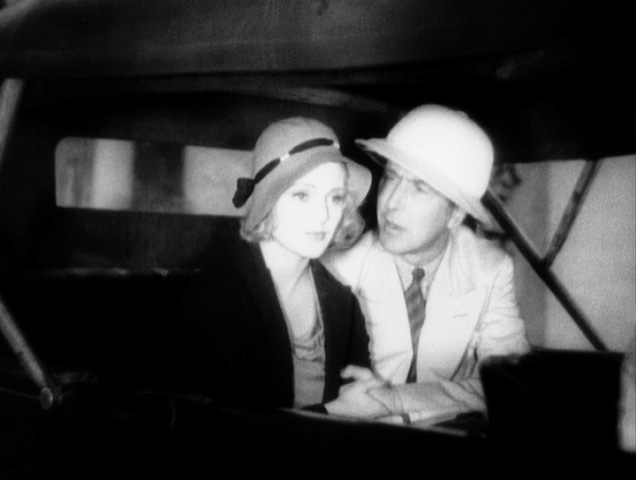
leaving1From here, events move on apace. Fred and the Princess plan to run away together. Emily, knowing what’s coming, accepts Gordon’s proposal of marriage on the last night of the voyage. She will return home with him and try to forget how badly leaving2Fred has treated her. The ship arrives at its final destination, and Emily hops into a carriage with Gordon. Fred has already set up shop at a hotel with the Princess, and it appears that the two will simply go their separate ways without ever talking about it.

Despite Fred’s behavior, Emily still harbors feelings of guilt about walking out on her marriage. Then, Gordon informs her that the Princess is actually a fraud, a con artist who intends to take all of Fred’s money and leave him in the lurch. Somehow, we have already sensed instinctively that this is the case. A beautiful princess would never attach herself to a towering lackwit like Fred. Emily is torn, but finally decides to leave Gordon and return to warn Fred, even though he doesn’t deserve it.

She arrives at the hotel room, and the Princess leaves them alone. An argument ensues, as Emily attempts to convince her husband of the Princess’s duplicity. He arrogantly refuses to believe her, and finally storms out. While he is gone, a letter arrives from Gordon, declaring his love for Emily but accepting her choice to remain with Fred. Just as she finishes, Fred slowly comes back in with the news that the Princess has absconded with all of their money.

foolishboorEmily is very supportive, expressing disgust at the other woman’s actions, but Fred, who ought to fool like the greatest fool in the world, continues to behave proudly and express annoyance at his wife. He really is a prize bounder, and his attitude is so off-putting by this point that there is no way he will win back the sympathies of the audience, protagonist or not. As a contemporary review put it, “The hero is unsympathetic, a foolish boor, and the film neither excuses nor explains him.”

In any case, the couple uses the minute amount of cash that remains to them to purchase a spot in the bowels of a steamer headed back to England. They share a small cabin, and are barely on speaking terms until the ship runs into some sort of giant plot device, ripping open the side and allowing water to gush in.

sinkingIt is late at night, and Fred and Emily are both in bed. The collision knocks something off of a shelf and lands on Fred’s head. Emily rushes to his side to clean the cut, then they both try to get out. Some sort of pipe has fallen in front of the door, trapping them inside and their porthole is already submerged. As water begins to seep into the room under the door, they huddle together on the bed. Sure they are about to die, all the misdeeds of the trip are forgiven and forgotten. Eventually, they fall asleep.
seepageThe sequence would be capable of generating more genuine suspense were we not so thoroughly fed up with the main characters by this point in the story. Still, the thought of being trapped on ship that is sinking to the bottom of the ocean is a powerful and affecting one. The situation makes itself felt, even if the characters trapped in the midst of it don’t.
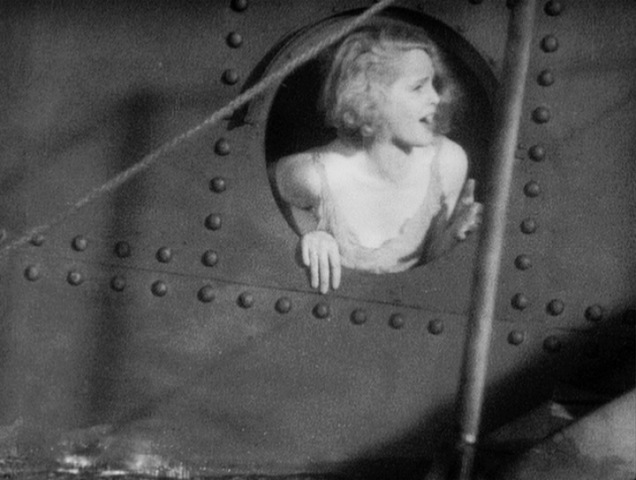
porthole1They wake up to find that the ship is still afloat, and they manage to climb out of the porthole and up on deck. Their boat is drifting and deserted of every living thing save a black cat. Still in their pajamas, they find large sailor coats to put on, and a very baggy pair of pants for Emily (another comical dressing scene!).

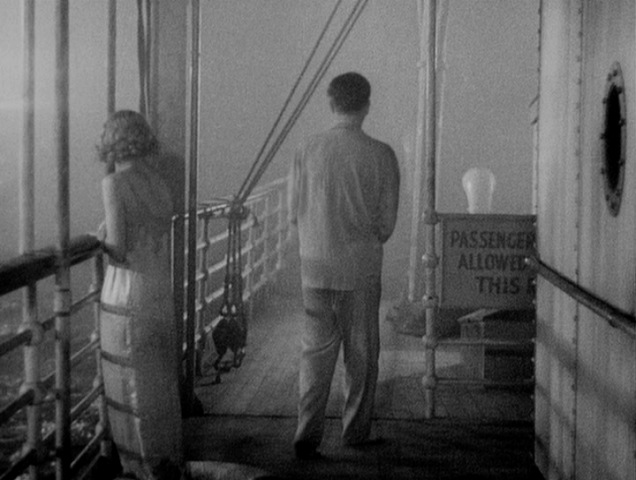
porthole2drifting1drifting2

junk1They wander around a bit and help themselves to some liquor from the bar, but before they can seriously start to wonder what they ought to do a Chinese junk appears alongside. The occupants of the ship don’t appear to be particularly interested in either Fred or Emily, and while they busily loot the derelict the couple invite themselves aboard the neighboring ship and get comfortable.

junk2junk3junk4

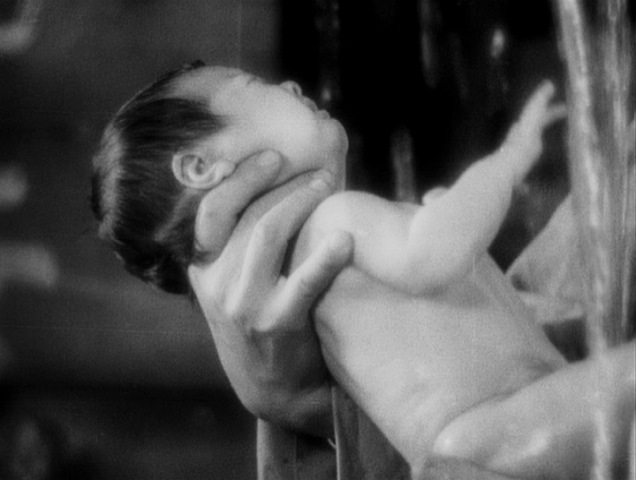
These particular Chinese sailors are a silent, scary bunch, and Fred and Emily are largely ignored as the ship sails away. There is a pregnant woman on board, and she brings them a meal at one point. Husband and wife tuck heartily into what seems to be a sort of meat stew, enjoying it very much until one of the sailors comes up on deck and tacks the pelt of the black cat to the wall. Later on, the baby is born and Emily is horrified when the father pours cold seawater over his newborn infant. The couple is drawn closer together, not only as a result of their troubles, but because the others on the boat are so totally alien to them.

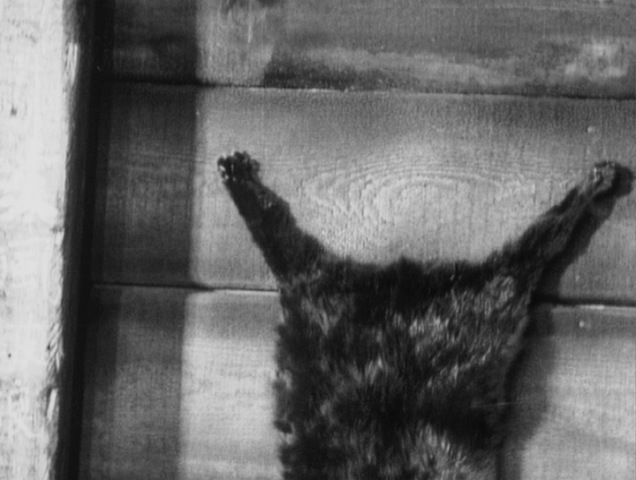
stew1stew2stew3baby1baby2baby3

Their adventures come to an end at last back in their small, ordinary flat in England. The landlady welcomes them joyously home with a warm fire and dinner on the table. Fred glances up distastefully now at the painting of the ship hanging up over the mantle, and it seems unlikely he will ever set foot on another boat again if he can help it. After the landlady leaves, the couple share a private kiss, fully reconciled at last, but a few seconds later they have started another trivial argument about the future as the final fade-out creeps in.

In an interview decades later, Hitchcock recalled that, “There was an amusing sequence at the end […] after it’s all over, they meet me in the lounge. This is my most devastating appearance in a picture. They tell me their story, and I say, ‘No, I don’t think it’ll make a movie.’ And it didn’t.” The scene he described is not known to exist in any version of Rich and Strange, but it is a very telling image of how the director felt about this stage in his career in general (as well as this film in particular).

The movie did not do well, either critically or financially. A contemporary reviewer noted, “Admirers of Mr. Hitchcock’s work will be dissatisfied […] Mr. Hitchcock is clearly out of form.” Hitch’s time at British International Pictures, which seemed so promising during his silent period there, was finally drawing to a rather pedestrian close with an unfortunate run of forgettable adaptations during the early years of sound pictures.

Next Week: Hitchcock directs a train wreck

The Sting: Best Picture, 1973

•March 25, 2008 • Leave a Comment

The 46th Annual Academy Awards are perhaps best-remembered for a totally unplanned event: the notorious incident of a streaker running across the stage behind David Niven just as he was about to announce the Best Picture award, and Niven’s subsequent snide remark about the man “showing his shortcomings.” The Sting, meanwhile, was nominated for 10 awards: Best Picture, Best Director, Best Original Screenplay, Best Editing, Best Cinematography, Best Actor (Robert Redford), Best Art Direction, Best Costume Design, Best Music and Best Sound. Other serious contenders included William Friedkin’s The Exorcist (10 nominations, 2 wins), Ingmar Bergman’s Cries and Whispers and George Lucas’s American Graffiti (5 nominations each with 1 and 0 wins, respectively) as well as Paper Moon and Jesus Christ Superstar.
Unnominated that year were Terrence Malick’s Badlands and Martin Scorsese’s Mean Streets. Best Actor went to Jack Lemmon (his 2nd and final win out of 8 nominations) for Save the Tiger. Cries and Whispers won Best Cinematography and The Exorcist took Best Sound, leaving The Sting with the remaining seven awards.

The Sting is a largely happy-go-lucky tale of two men who organize a large-scale con in 1930s Chicago. The film reunited the successful acting team of Robert Redford, as devil-may-care small-time grifter Johnny Hooker, and Paul Newman, as cool big-time operator Henry Gondorff. The two had previously had a very successful collaboration as the title characters in Butch Cassidy and the Sundance Kid, also directed by George Roy Hill.

Hooker, after a nasty character named Doyle Lonnegan offs his old partner Luther, joins forces with Gondorff to run an old school scam known as “The Wire.” The con (and I paraphrase for simplicity) involves hooking the mark into believing he has a sure bet and placing a crippling amount of money on it, only to have the bottom drop out, allowing the con men to walk away with a large payday. Further complications require Hooker and Gondorff to make sure Lonnegan never suspects that anything unusual went down . . . and the film makes a fair lunge at turning the tables on the audience more than once.

One of the most enjoyable aspects of the movie is the “period” soundtrack, featuring the music of Scott Joplin (including many variations on “The Entertainer”). Joplin’s ragtime masterpieces, which had been composed two or three decades before, were actually waning in popularity at the time when the film is set, but they still provide the perfect atmosphere. The music worked so well, in fact, that it prompted a revival of interest in Joplin’s music, and the film’s soundtrack became a hit record. Hill further evokes an early-cinema feel by announcing each new act with colorfully-illustrated intertitles with chapter headings like “The Set-Up,” to say nothing of the excellent period costumes and the gritty backlot backdrop where most of the action takes place.

Redford and Newman undoubtedly form one of the most inspired movie pairings of all time, with a strong supporting cast of a few dozen fellow con men that help lay the trap and run things from behind the scenes. The plot is smart, sophisticated and suspenseful, and not afraid to run the emotional gamut from humor to pathos. Contemporary “caper” films are generally more about being slick than being sentimental (i.e. the Ocean trilogy), but The Sting makes its characters more real because they are more vulnerable. Hooker in particular gets put through the ringer over the course of the film.

While The Sting is probably not the most artistically significant film of the year, it is difficult to understate its charming popular appeal. It’s an extremely watchable experience, entertaining to sit back in front of just about anytime.

Continue reading ‘The Sting: Best Picture, 1973′

Bingeing

•March 24, 2008 • Leave a Comment

So, I’ve had my younger brother visiting from college since Friday before last (yay Spring Break!), and I’ve just returned from dropping him off at the airport. Hence, I’ve been watching movies in lieu of blogging about them. We watched a ton of movies, let me tell you. It would take me a long time to come up with a full list, but we probably averaged at least 3 a day the whole time he was here.

Mostly we watched favorites of mine that I own and that he hadn’t seen. Some I have seen many, many times (like The Three Burials of Melquiades Estrada and The Graduate), some I had only seen once before this week (like Gone Baby Gone, which I got from Netflix). Some movies we watched just for fun, like Little Miss Sunshine, The History Boys and Shaun of the Dead. Others we watched because they are so worth seeing, like No Country for Old Men, Apocalypse Now and Little Children. Most, at least in my opinion, fell into both categories, like Magnolia, Pulp Fiction and Run Lola Run. We also watched Gattaca, Junebug, The Red Violin and . . . lots of other stuff.

I guess for me, this was kind of an ultra-condensed version of many of my most fondly-remembered movie-watching experiences of the past 3 or 4 years, and something I have sorely missed since I graduated from college myself. All that to say, you should now be returned (more or less) to your regularly-scheduled blogging.

Film Roundup IX

•March 21, 2008 • Leave a Comment

Still sick. Still have visitors. Still broke. I really want to see Horton Hears a Who and Run, Fat Boy, Run, and I’m vaguely interested in 21. We’ll see which, if any, I make it out to see in the days and weeks ahead. I may not get to a theater until Leatherheads comes out in April. We’ll just have to wait and see.

Patriot Games – 84%

CIA analyst Jack Ryan finds himself in the right place at the right time while vacationing in England, and thwarts an attempted assassination of a British royal by the IRA. Unfortunately, his actions make him and his family the group’s next target. This, in my opinion, is the lesser of the two Harrison-Ford-as-Jack-Ryan Clancy adaptations. Then again, they’re both a cut above the others. This is a smart, solid early-90s American action movie, and may well be some of the best the genre had to offer before Matt Damon’s Jason Bourne burst onto movie screens a decade later.

Faust – 98%

Brilliant, amazing work of German silent cinema by master filmmaker F.W. Murnau. This adaptation of the German literary masterpiece was his last German film before he moved to Hollywood. His very next project was Sunrise, which would win one of the first two Academy Awards for Best Picture. With guys like Murnau around, it’s surprising the film world felt that it needed sound at all. Not to be missed.

Strictly Ballroom – 34%

An odd couple fights to win an ultra-competitive Australian dancing championship. I am willing to concede the very real possibility that I just didn’t get this Aussie flick by director Baz Luhrmann, who would eventually go on to make Moulin Rouge! (a favorite of mine). I thought it was unnecessarily broad in a grotesque, silly and totally off-putting way. The characters were freaks, and the plot was far too thin to justify even its hour-and-a-half runtime.

Much Ado About Nothing – 92%

Kenneth Branagh directs and stars in an adaptation of one of Shakespeare’s sharpest verbal comedies, squaring off against Emma Thompson in the female lead. This is probably the best bit of Branagh Shakespeare that I have seen to date, with a rich supporting cast that includes Denzel Washington, Brian Blessed and Michael Keaton. Even Keanu Reeves, bizarrely cast as the surly villain, can’t spoil the fun. The opening battle of insults between Beatrice and Benedick and Benedick’s pivotal “The world must be peopled!” monologue alone are worth your trouble.

Uptown Girls – 80%

Brittany Murphy is the childish daughter of a rock star who has fallen on hard times and finds herself forced to get a job, in this case as nanny to Dakota Fanning as an ultra-precocious 8-year old. They teach each other many important lessons in very touching ways, and it all turns out quite happily in the end. Don’t watch this one alone, find a female to watch it with (regardless of your gender). Keep a box of Kleenex handy for her.

Week 12: The Skin Game (1931)

•March 19, 2008 • Leave a Comment

skingametitle.jpg“He wants it for spite. We want it for sentiment.”
“Lies between the Duke’s and Squire Hillcrest’s. An emerald isle. No allusion to Ireland, gentlemen! Perfect peace in the century!”
“Dodo, may I spit in his eye or something?”
“Well, what’s the meaning of it, eh? Is it sheer impudence or lunacy or what?”
“His car. It always seems to make more noise than any other.”
“And me six thousand out of pocket? No. No, I’ll keep it, and hold it over you!”
“What’s gentility worth, if it can’t stand fire?”

The Skin Game

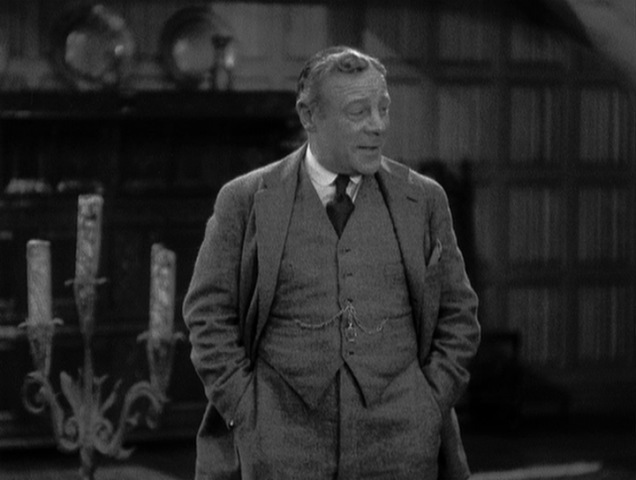
gwenn.jpgAfter Murder! Hitchcock took on John Galsworthy’s popular stage play The Skin Game. His 3rd stage adaptation in a row, The Skin Game is a story of old money and new money coming into conflict in rural England. Hitchcock and Alma took on the adaptation again, and brought on several of the players from the previous films, including Phyllis Konstam, John Longden and Edward Chapman. The movie features Edmund Gwenn, a major star already who would go on to win an Oscar in the late ’40s for his performance as Kris Kringle in Miracle on 34th Street.

chloe.jpgThe story of The Skin Game did not lend itself easily to Hitchcock’s specialty, but he at least seemed more determined to avoid the complete absence of cinematic life from Juno and the Paycock. It helps that most of the performers are top-notch, particularly Gwenn as Mr. Hornblower and Phyllis Konstam as the hapless Chloe, and that the story makes for reasonably-compelling social drama.

hillcrests1.jpgThe Skin Game concerns two families: the Hillcrests and the Hornblowers. The Hillcrests are minor nobility who have occupied their beautiful corner of the English countryside for centuries. The Hornblowers have recently made a fortune in industry and are setting up shop on Hillcrest turf, spoiling the scenery with factories and turning old tenants out of their cottages to make room for young workers. Determined to put a stop to Hornblower’s schemes for the neighborhood, Mrs. Hillcrest enlists the help of an unsavory underling named Dawker and they dig up some damning dirt from the past. The ensuing blackmail defeats the Hornblowers entirely, but at what cost to the Hillcrests?

jillrolf.jpgThe film begins, as most of Hitchcock’s previous films with rural settings do, by establishing the scene with various shots of the countryside. Jill Hillcrest, atop the traditional vehicle of the idle rich (a horse), meets Rolf Hornblower, driving a shiny new automobile, in a country lane and they discuss the tension between their respective families. Moving on, the elder Mr. Hornblower arrives at the Jackman cottage to inform them that they’ll have to move out immediately, despite having promised Squire Hillcrest when he initially bought the land that he’d leave all of the original tenants in peace.

centry1.jpgThe two rush immediately over to the Hillcrest home to complain to the squire, and inform him of Hornblower’s more sinister plan: to buy “the Centry,” a gorgeous tract of land bordering the Hillcrest property, and tear it up with industrial development. As the Jackmans continue talking, Hillcrest wanders to his window, tuning them out as he imagines his lush backyard view transformed into acentry2.jpg skyline of ugly chimneys belching foul-smelling smoke. Although his primary concern is for the tenants, his wife and his agent, Dawker, are far more pragmatic and selfish. As soon as she gets the news, Mrs. Hillcrest dispatches Dawker to convince the owner of the Centry not to sell to Hornblower, who happens to arrive in person just as Dawker leaves the house.

row.jpgHornblower and the older Hillcrests manage to annoy each other thoroughly in the ensuing conversation. The Hillcrests are disdainful and condescending, and Hornblower expresses his impatience with their stodginess and his anger at the repeated snubbing of his daughter-in-law, Chloe, by Mrs. Hillcrest. Jill comes home in the midst of this and is generally frustrated with the squabbling elders.

As Hornblower leaves, Dawker meets him returning the other way and goes on to report to the Hillcrests that he has persuaded the owner to put the land up for auction rather than sell it to Hornblower outright. Dawker and Mrs. Hillcrest retire to scheme in private, leaving Jill to further expound on her dislike of “rows” once she is alone with her father.

salts.jpgThe scene jumps to the day of the auction (with a seamless cut from father and daughter looking out over the Centry to a picture of it in extreme close-up on an auction poster). Everyone is arriving at once, and Chloe Hornblower pauses to greet the Hillcrests as they pass by. Mrs. Hillcrest, however, turns up her nose and pushes quickly past as though the other woman weren’t there, outraging Chloe’s husband and father-in-law.

The younger woman follows Mrs. Hillcrest inside and tries to engage her in conversation. Mrs. Hillcrest is civil, but makes it plain that she doesn’t want to talk. As the auction prepares to get underway, Chloe spots a man standing with Dawker on the other side of the room and goes noticeably pale. Jill rushes to her side with some smelling salts, and she seems to recover, at least somewhat.

auctionroom.jpgMeanwhile, Dawker has joined Hornblower in the front row of the room, while the Hillcrests sit together on the sidelines to watch. Dawker will bid against Hillcrest up to 6,000 pounds. If Hillcrest wishes him to exceed that sum, he is to blow his nose loudly. When he is ready for Dawker to stop, he will blow his nose again. The auctioneer spends a few minutes talking up the property, and has his assistant read the legal fine print out loud.

As the assistant reads, the microphone seems to have been deliberately placed too far away for us to hear what he is saying, and all we hear is muttering. Someone in the audience yells for him to speak up, but he finishes up without having spoken a single audible word. It comes off as a mildly amusing way to handle a boring patch of dialogue, but the way it is carried off smacks tangibly of a blooper rather than an intentional gag. The result is confusing and off-putting as much as it is funny.

In any case, the auction sequence is by far the most exciting, lively scene in the film; genuinely suspenseful with a few surprising twists. Hitchcock keeps the camera in constant motion, mostly panning rapidly between the competing bids of Dawker and Hornblower, with occasional cuts to Hillcrests or the auctioneer. The price of the property creeps inevitably above 6,000 pounds, and Hillcrest (after a slight hesitation) blows his nose, muttering to his family that if the bid should pass 7,000 he’s not sure they can stand it. Finally, he is forced to blow his nose again and Dawker stops bidding. However, just as the auctioneer is about to declare the property sold, Hillcrest jumps in and begins to bid for himself.

auction1.jpgauction2.jpgauction3.jpg

chloedistressed.jpgThe price continues to climb on into the 9,000 range, but Hornblower seems determined. It seems he will be victorious until the mysterious man in the back of the room puts in one final bid and snatches the property from under Hornblower’s nose. The Hillcrests are thrilled, certain that an agent of the neighboring Duke has stepped in with the winning bid. It seems that they have been victorious, but just as they prepare to drive away in triumph, Hornblower pokes his head into their car and reveals that the winning bid was placed by his agent, not the Duke’s. Meanwhile, Chloe is still looking very unwell, and it seems that Dawker has unearthed something about her that she would very much have rather kept buried.

chloeinterrogated.jpgMrs. Hillcrest decide more drastic measures are required to preserve the sanctity of the countryside, and writes to Hornblower requesting a meeting where she will reveal “something of the utmost importance” regarding his daughter-in-law. Hornblower takes the message straight to Chloe, who claims to have no idea what Mrs. Hillcrest might mean, unless she intends to tell Hornblower that Chloe’s father once declared bankruptcy. Hornblower laughs this off and leaves Chloe alone with her brother-in-law. Throughout this scene and the surrounding sequences, Hitchcock uses a combination of close-ups on Chloe’s stricken features and wider shots that make her appear both trapped and isolated within the frame, emphasizing the desperation and pathos of her situation.

chloebegs.jpgClaiming a fierce headache, Chloe goes into the garden to get some air and, by prior arrangement, meets Dawker in the shadows. She tries everything she can think of (begging, bargaining, threatening) to persuade him to leave her out of the family feud, to no effect. He claims he has no choice and the matter is out of his hands, although he expresses a cavalier sort of sympathy that her happiness should be a collateral victim of the altercation. Retiring to her room with her husband, Chloe desperately but subtly attempts to ensure his love for her, going so far as to tell him that she is carrying his child (a claim that is not definitively confirmed or refuted).

chloediscovered.jpgHornblower arrives at the Hillcrest home with Chloe in tow, demanding to know the meaning of the letters Mrs. Hillcrest has been sending him. She and Dawker have sequestered their star witnesses in a nearby room in preparation for the meeting. They tell Hornblower that his daughter-in-law was once a prostitute, or as they put it, accompanied men to hotels in order to help them get a divorce. Hornblower is outraged by the accusation and calls Chloe in with the intention of hearing her deny the charge and forcing Dawker and Mrs. Hillcrest to apologize. She does deny it, but then Dawker produces two of the men that she once worked for, and her jig is up.

swear.jpgDefeated and deflated, Hornblower sends Chloe out and waits to hear what arrangement Mrs. Hillcrest wishes to propose. He still has a bit of fight left, and they eventually agree that he will keep the Centry undeveloped, as stipulated by his signature on a legal document produced by Dawker. Meanwhile, Dawker and Mrs. Hillcrest both swear on a Bible that they will not reveal what they know about Chloe to anyone.

chloeappeal.jpgThat night, Jill and Hillcrest sit quietly, speculating about what might have transpired earlier and agreeing that it couldn’t have been anything good. Chloe sneaks in through the open door to the garden and hides behind the curtain, listening. Jill discovers her there a few moments later and they invite her in to sit down. She is very distressed and tells them that her husband is quite agitated and is coming to demand an explanation. She begs them to make up a convincing lie that will allay his darker fears. Hillcrest doesn’t like the idea of lying, but he and Jill soon agree that they will say Chloe left a previous employer under a cloud of suspicion regarding a problem with the books.

angryhusband.jpgCharles Hornblower arrives right on schedule, and Chloe dives back behind the curtain as he enters the room. He wants to know where his wife is, and declares Hillcrest’s explanation an outright lie, claiming he’s just had the full story from Dawker. Jill and Hillcrest attempt to calm him, but he is too upset and wants nothing more to do with Chloe.

brokenpromises.jpgJill goes to the curtain and finds that Chloe has disappeared outside. Charles rushes out after her, and Jill and Hillcrest, fearing the worst, follow. Soon, they find that Chloe has attempted to drown herself in the pond, and may have succeeded. Not to break the mood, but the story goes that Hitchcock originally filmed a scene of Chloe throwing herself into the pond, and demanded that Phyllis Konstam dunk herself several times while the camera rolled. All of these takes eventually ended up on the cutting room floor, and it is possible that Hitch never intended to use the scene in the first place.

drowned.jpgAs the anxious searchers pull Chloe out of the water and seek medical attention, Hornblower arrives and declares that he is ruined in the area, as word of the scandal has somehow gotten out. He declares a scathing hatred for every Hillcrest in earshot and promises to do them any ill turn he can think of in the future as he leaves with a possibly-dead Chloe (and perhaps his unborn grandchild as well).

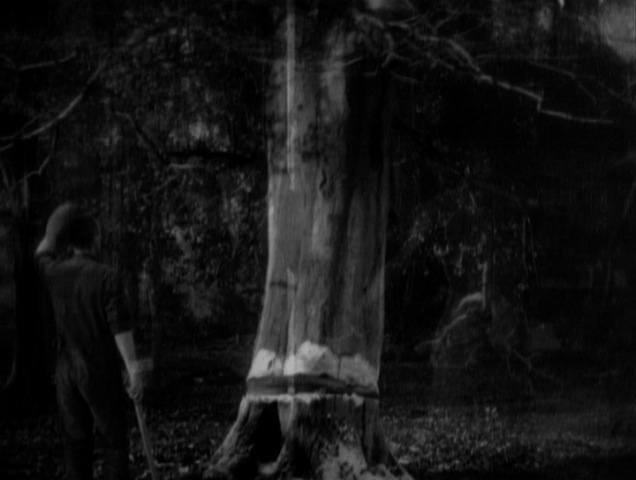
timber.jpgAfter everyone has left, the Jackmans arrive to thank Squire Hillcrest for intervening on their behalf, as they will now be permitted to return to their cottage. He is too disheartened to feign courtesy, and after they leave he expresses feeling ashamed of the entire affair to his wife. Meanwhile, Rolf Hornblower and Jill meet one final time out in the garden. They have nothing to say to each other, and simply clasp hands before parting again, probably forever. The scene cuts to a final shot of a large, old tree (possibly located on the Centry, possibly wholly symbolic) being noisily felled by a group of workmen.

The Skin Game was probably a rather engaging theatrical experience, particularly at the time, dealing with the human element of some of the social and cultural turmoil that England was experiencing in the years after World War I. Hitchcock successfully translates this element onto the screen. However, beyond its appeal as a historical and literary curiosity, very little distinguishes the film as the work of the famous director and even less sets it apart from other examples of early sound cinema in Britain.

1929’s Blackmail should have represented a major breakthrough for Hitchcock’s career, but throughout the early 1930s his cinematic work would continue to languish in a grim purgatory of often-dull, second-rate adaptations and fantastically unsuitable projects. After an initially-exciting rush freedom and creative control four years before, Hitchcock’s treatment by British International Pictures was by now looking depressingly similar to the situation which had first prompted him to abandon Gainsborough.

Next Week: Hitchcock goes globetrotting

Film Roundup VIII

•March 14, 2008 • 1 Comment

I have guests this week, and I’m pretty sick, so I’m not going to the movies. I don’t like it when people with loud, hacking coughs join me in the theater, so I certainly have no intention of subjecting fellow moviegoers to the same. You know what that means:

The Producers – 93%

Producer Max Bialystock (Nathan Lane), once the toast of Broadway, is now the king of expensive flops. Until, that is, timid accountant Leo Bloom (Matthew Broderick) clues him in to a scheme that’ll make him some real cash: raise a ton of money for a guaranteed flop and no one will notice that you cooked the books. The two settle on “Springtime for Hitler,” an idea sure to have the whole audience storming out in a huff by the end of the opening number. But, the best laid plans . . . well, you know the rest.

I have a little rule. Mel Brooks movies are brilliantly hilarious, as long as he stays out of them. In this case (a movie based on a stage muscial based on a movie based on a stage musical) the rule definitely holds. The movie is a hilarious send-up of the genre, and a great, catchy musical in its own right.

Robots – 49%

In a world populated by robots, an idealistic young inventor-bot travels to the big city to follow his dreams. Instead, he finds himself battling evil corporate fat-cats with a rag-tag band of new friends. This is yet another lousy product of the recent mania for CG-cartoons starring a slate of big-name actors as long as your arm (including, in this case, Halle Berry, Jim Broadbent, Mel Brooks, Amanda Bynes, Drew Carey, Paul Giamatti, James Earl Jones, Greg Kinnear, Jay Leno, Ewan McGregor, Stanley Tucci and Robin Williams). Can you say overkill? It’s flashy and fast-talking, but very shallow stuff.

Gattaca – 98%

In the world of the future, every child is engineered to be excellent. Unfortunately, Vincent Freeman (Ethan Hawke) missed the boat, thanks to his parents, who declined any genetic modification when he was born at the cusp of the new technology. His younger brother, who was engineered, is stronger, faster, taller, and (his parents think) better than he is. And so is everyone else of his generation. But Vincent has a dream: to become an astronaut. To realize that dream, he’ll have to assume the identity of Jerome Morrow (Jude Law), a golden-boy track runner whose career ended abruptly when he stepped in front of a car, borrowing his blood, urine, hair and saliva to defeat a barrage of tests and checkpoints. Everything is proceeding smoothly until, just before Vincent’s first outer space mission, his supervisor is murdered. The ensuing investigation threatens everything he has worked so hard to achieve.

This is possibly the best science fiction movie of the decade, and certainly one of the best of all time. It’s sort of a combination of Aldous Huxley’s Brave New World and Isaac Asimov’s The Caves of Steel, with an incredible visual style all its own. The story is brilliant, intricate, suspenseful and deeply satisfying. A real masterpiece.

The Devil Wears Prada – 77%

Inexperienced Andy Sachs (Anne Hathaway) comes to New York City with journalistic aspirations and lands a job as assistant to Miranda Priestly (Meryl Streep), the terrifying queen bee of the fashion world, in charge of “Runway” magazine. The movie, adapted from a hit novel, is alright, if you like that sort of thing. It largely amounts to empty entertainment, but it is funny and reasonably engaging. This is basically a painless experience with which to kill an evening.

Fast Food Nation – 60%

The marketing director for a major fast-food chain (Greg Kinnear) discovers that there are traces of fecal matter in their best-selling burger, and heads down to the supplier to investigate. What he discovers is a system of corruption and exploitation that includes everyone from local restaurant workers to slaughterhouse employees. The movie puts its ensemble cast (which includes Ethan Hawke, Catalina Sandino Moreno, Bruce Willis, Paul Dano and Avril Lavigne) to work illustrating the evils of capitalism and burger production, but mostly they just sermonize. There are loads of self-righteous speeches, which bog the movie down severely. Its heart may be in the right place, but the result is too preachy to be effective. Note to filmmakers: If you can’t get your point across naturally through the course of the story, a script rewrite may be in order.

Mosaic Madness

•March 13, 2008 • Leave a Comment

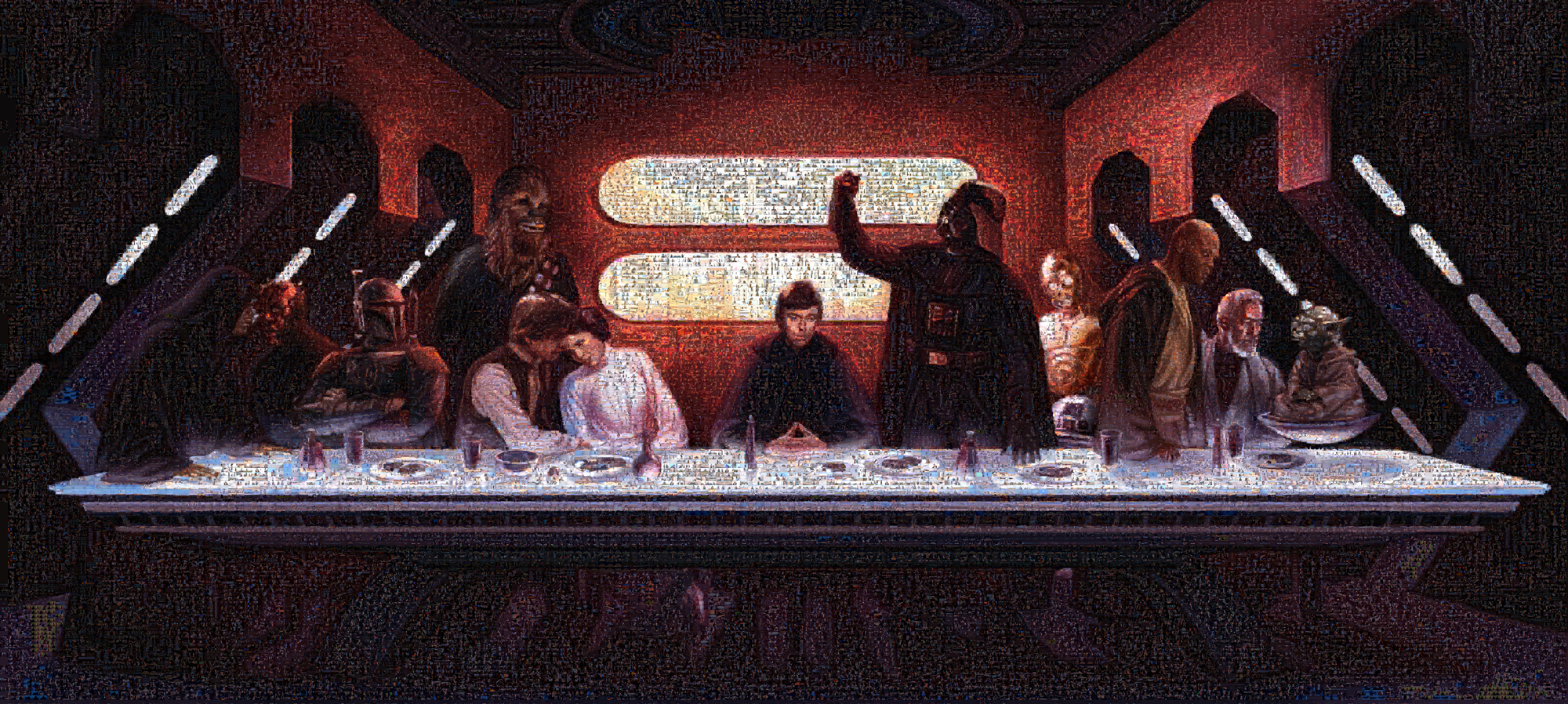
So, some guy made this crazy “Last Supper” style mosaic with all your favorite Star Wars characters cobbled together out of 69,000 images from all six movies. Wow. See below.

starwarsmosaic.jpg

More information (and more detailed pictures) here.

Beyond the Ordinar-e

•March 12, 2008 • Leave a Comment

Exciting stuff, and definitely near the top of my “summer movies to look forward to” list. Thanks to Looking Closer for the heads up.

Week 11: Murder! (1930)

•March 12, 2008 • 2 Comments

murdertitle.jpg“People ought to be ashamed of themselves, kicking up all that racket at this time of night!”
“I assure you, Inspector, I’m not the other woman in this case.”
“I presume, sir, that an ugly woman would have very little chance at your hands.”
“She had a quick changeover from a barmaid to a Salvation Army lass, and it told on her. There’s no doubt it told on her.”
“That was me. Or was it I? Do you know, Markham? I never know.”
“Yes, that’s him alright. Dressed up as a woman, eh? Always was very good at that.”
“Now, my dear, you must save those tears. They’ll be very, very useful . . . in my new play.”

Murder!

Following his “photograph of a stage play,” Hitchcock’s next project seemed like a recipe for more of the same: another stage-to-screen adaptation. This one, however, was a murder mystery, originally adapted for the stage by Clemence Dane and Helen Simpson from their own novel of the same title: Enter Sir John. Hitchcock wrote the screenplay with Walter Mycroft (the brains behind Champagne), with Alma once again receiving credit for the scenario. The production was filmed simultaneously in German and English, with different casts performing on the same sets and Hitchcock directing both versions. Whether inspired by the film’s genre or simply determined to exercise some more obvious creative control, Hitch managed to enliven Murder! with stylistic touches to a far greater degree than his previous effort.

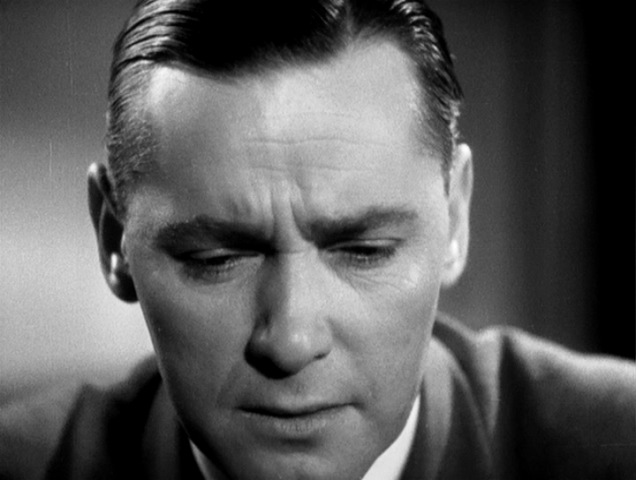
herbertmarshall.jpgDespite the title, the murder takes place off-screen just before the movie begins. Actress Edna Druce is found dead in a room with fellow performer Diana Baring (Norah Baring), who is sitting in a dazed state with a bloody poker on the floor next to her. Diana claims to have no memory of what transpired between her and Edna, and so she is quickly convicted of the murder and sentenced to death. However, one of the jurors, Sir John Menier (Herbert Marshall), finds that he is not at all convinced of her guilt. An actor himself, he sets out to apply the principles of his art to the investigation of this real-life mystery so that he may clear the lovely young woman’s name.

village.jpgThe film opens on a shot of a deserted village street in the dead of night, the peace of the scene already shattered by a loud scream and a persistent banging noise. A few birds fly out from under the eaves of one house, and a cat streaks away up the street as various windows begin to open and heads emerge. Two of the heads belong to Ted and Doucie Markham (played by Edward Chapman, from Juno and the Paycock, and Phyllis Konstam, respectively). Ted is the stage manager of the acting troupe and Doucie is one of the performers.

markhams.jpgAs the two wonder what is going on, Doucie spots a policeman, but when she points him out to Ted, he has disappeared. Soon, a different policeman appears, and a small crowd begins to gather around him in front of the house that produced the disturbance. Ted and Doucie struggle into their clothes as we hear snatches of conversation down below. That is, I say we see the couple getting dressed. In reality, we seedressing.jpg Ted’s shadow on the wall as he puts his clothes on, but the camera is focused entirely on Doucie (at the least the fourth time that Hitchcock had filmed a woman dressing or undressing before the camera). As with the dressing scene in The Pleasure Garden, Doucie’s frantic hopping and wriggling into her clothing seems largely intended for comic effect.

murder.jpgThe most immediately obvious way in which Hitchcock enlivens the long stretches of dialogue this time is by keeping the camera almost constantly in motion. The best examples of this are the three main stretches of expository set-up during the first third of the film. First, after the crowd of locals (led by the policeman) stumbles onto the scene of the murder, Diana’s landlady goes to make her some tea, accompanied by Doucie. The two discuss what they have just seen, establishing which characters are members of the acting troupe and noting that Diana is generally rather well-liked,follow.jpg but was known to be carrying on a long and bitter feud with the murdered woman. While they talk, the landlady walks back and forth between the kitchen and the breakfast room. There is a chair on the right side of each room, and Doucie follows behind, chattering constantly and settling into the chair for a few seconds each time before being forced to get up and move to the other room.

farce.jpgSecond, in the rather clever police inquiry scene, two detectives show up backstage during a performance. As they ask various actors questions, they are constantly interrupted by “Oh, there’s my cue,” as their subject drops into character and steps on-stage. In addition to the two Markhams, the officers talk with a man named Handel Fane (Esme Percy), whose specialty is acting indrag.jpg drag, and Ion Stewart (Donald Calthrop, the villain from Blackmail) who has the part of a policeman in the play. While the scene is quite humorous, it proves to be fairly linear in building an even stronger case against Diana. Little do the police (or the audience) realize, but a vital clue is played out before our very eyes in this scene (more on that later).

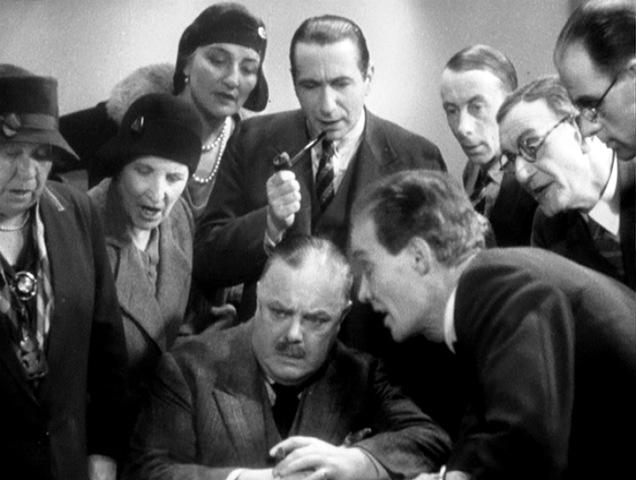
jury.jpgThird, there is Diana’s trial. We enter the scene just as the closing arguments are winding down, and the jury is sent off to begin their deliberations. Most of these jurors are very eccentric-looking characters, and the camera moves almost constantly between them. Although we are told very little about them, they represent easily-recognizable “types” thanks to elements such as dress, choice of smoking paraphernalia, build, facial expression, etc. The scene is intentionally quite humorous in places, before it gets down to the serious business of the final conviction.

barbarous.jpgThe deliberations are quite long (a full 15 minutes), and rather reminiscent of a reverse-version of 12 Angry Men. The foreman outlines the facts of the case and a vote is called for. Seven of the jurors vote guilty. Two abstain, one on the grounds that the whole idea of punishment (capital or otherwise) isthick.jpg “barbarous,” though he soon sullenly signs off on the guilty verdict. The other seems to be a bit “slow,” and was confused by the defense’s statement that the accused was “in a fit of daytime sleepwalking” when in fact the murder was committed at night. He, too, votes guilty.

psych.jpgThen there are the three “not guilty” votes. The first, a woman (Violet Farebrother, the horrid mother from Easy Virtue), is quite taken by the psychological angle of the defense. She seems to think it is quite clear that Diana should be found innocent by reason of temporary insanity ordashitall1.jpg “disassociation.” One of the other female jurors points out that, even if that were true, one would never know when Diana might kill again, which convinces the first woman to change her vote. The second not guilty vote comes from a rotund, cigar-smoking, walrus-moustached man who essentially thinks that Diana looks far too nice to have murdered anyone. He is easily convinced to change his vote, leaving one dissenter.

That dissenting voter (whom we now see for the first time) proves to be Sir John. He doesn’t believe that Diana has behaved in a way that a guilty woman would, and thinks the prosecution has failed to address the possibility that another person might have been able to commit the crime. Of course, this is merely instinctual on his part, and the other members of the jury gather tightly around him, slowly wearing him down. His protests become increasingly feeble until, finally, he agrees to the guilty verdict. Hitchcock employs a unique (and ultimately rather poor) sound technique here, as the other jurors build up a rhythmic battery of objections, finally chanting repeatedly in unison, “Any answer to that, Sir John?” The attempt is to expressionistically show how Sir John succumbs to the peer pressure of the group, but the chant is too jarringly unnatural to succeed.

sirjohn1.jpgsirjohn2.jpgsirjohn3.jpg

verdict.jpgThe jury moves back out into the courtroom to present the verdict, but the camera remains in the same room. Rather than show us the reaction of the court (and particularly of the accused), we watch as a janitor tidies up while we listen to the foreman and the judge talk in the next room. This visual disconnect from the proceedings emphasizes the emotional detachment of the majority of the jury, and of the entire process. Speaking of emotional distance, it is worth noting here that it will later be revealed that Sir John had some prior association with Diana Baring. I can’t say for certain, but it seems unlikely that British jury policy of the 1930s can be so far different from our own that this association would not have invalidated his sitting on the jury in the first place. Then again, he could easily have lied about it if asked, or simply not realized who she was until later. Chalk it up as a minor plot oddity.

diana.jpgHitchcock does one other interesting thing with the sound in Murder!, employed in both the next scene and a previous one. He employs the first known instance in film of a character’s internal monologue inserted as voice-over. First, after Diana is hauled away to prison, the scene cuts to people buying their tickets for the next day’s show, then to the curtain. As it rises, the scene transitions again and we find that the curtain has risen on Diana’s cell, where she sits calmly with a quiet smile on her face. As she stares off into space, we hear her imagining the performance going on at the theater.

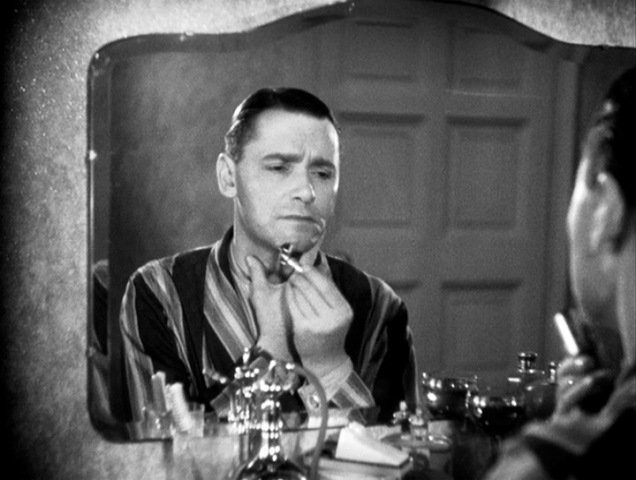
shaving.jpgLater, in a more frequently-cited scene, Sir John is standing in his bathroom shaving and listening to music on the radio. As the notes wash over him, he remembers something that he hadn’t thought to bring up during the deliberations: Diana seemed quite sure that neither she nor Edna had touched a drop of the brandy that was on the table in the room. And yet, the container was empty. Who drank that brandy? We hear his voice as he considers all of this and what it means, and determines to get to the bottom of things himself. The piece coming over the radio is a well-known bit from Wagner’s Tristan und Isolde, and the monologue seems to have been written so that the more dramatic statements coincide with the dramatic swells of the music.

In setting up this sequence, Hitchcock opens with a shot of the building which Sir John lives in, then moves inside to the elevator, up to his outer door, into his lavish sitting room, and finally into the bathroom itself. In addition to establishing Sir John as a wealthy and influential character, the scene seems to be drawing us further and further into his private sanctum as a build-up to our entry all the way into his unspoken thoughts. The effect of the voice-over, in those days before post-production sound editing, was achieved by having a full orchestra playing the music that was supposed to be coming from the radio, while simultaneously playing a recording made by the actor as he modified his expression for the camera to coincide with what he is supposed to be “thinking.” The effect ends up coming off rather well.

washbasin.jpgTo aid in his investigation, he enlists two of the people who were closest to the events of the case: Ted and Doucie Markham. Together, the three knock about the scene of the crime and Sir John entertains further doubts: he learns of the mysterious disappearing policeman that Doucie saw and discovers that the landlady could have mistaken a man’s voice speaking in a falsetto for a woman’s voice (she claims she heard Edna and Diana quarreling). Most important of all, he finds a cigarette lighter that one of the actors has left behind in a dressing room with a broken wash basin. The basin is located just below the room’s lone window, and would make an ideal step up or down.

hitchcameo.jpgIt is around this point that Hitchcock makes his cameo appearance. As Sir John and the Markhams leave Diana’s landlady and go out into the street, he strolls by from left to right with a woman on his arm. One wonders whether this could have been Alma, however she is completely obscured by Hitchcock’s prodigious profile, and there is no record of her having appeared in front of the camera in any of his films.

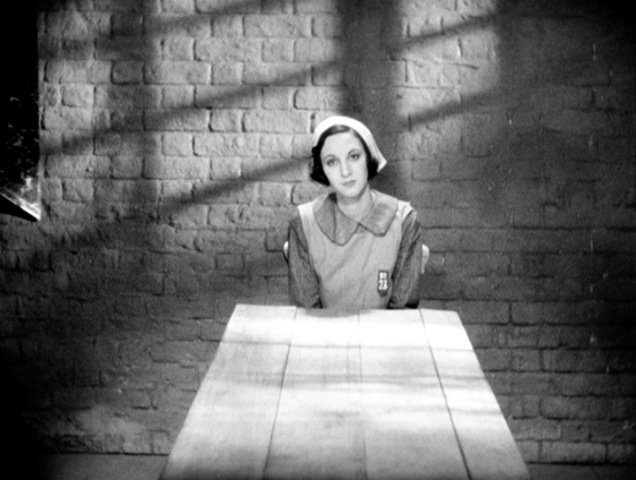
prison1.jpgNext he goes to visit Diana in prison (in a visitiation cell which is deliciously stark) and attempts to question her further. She is very reluctant to discuss the case, and there is obviously some chemistry between them. It is also obvious that there is something she hasn’t told anyone. Her story ofprison2.jpg remembering nothing seems to be not quite true, and it seems that the murdered woman was trying to tell her something terrible about a fellow actor which she didn’t want to hear. Sir John can get no more out of her at this point, but he doesn’t need to. He feels sure that he needs to find the cross-dressing actor, Fane, who seems to have dropped out of sight since the trial.

What follows is a rather brilliant little montage showing the search for Fane. Showing is actually inaccurate, as the audience only hears Sir John and Markham discussing the ongoing search. What we see are a series of images which heighten the tension and raise the stakes at this late point in the film. First, a recurring shot of a shifting weather vane, representing the hunt in all directions. Second, an image of Diana pacing circles around her tiny cell, shot from the upper corner of the room. Finally, the shadow of a gallows cast on a brick wall which slowly grows upwards as the camera zooms very slowly in on the noose, showing how time is running out for Diana. The montage ends with a satisfied voice-over declaring, “Got him at last!” just as the camera reaches the noose.

gallows1.jpggallows2.jpggallows3.jpg

playacting.jpgIt turns out that Fane is working as a female trapeze artist in a traveling circus. Sir John has hatched an idea which he hopes will be able to entrap the murderer. Or, more accurately, he has stolen an ideaplayacting2.jpg from Hamlet. He will write out his idea of how the murder transpired in play form, then have Fane read the part of the murderer and watch how he reacts. The plan goes off without a hitch, and the results are most satisfactory. By the end of the reading, they know Fane is the murderer, and he knows they know. Nevertheless, he ducks out of Sir John’s office before they confront him. (After all, they really have no evidence at this point.)

fane.jpgMore importantly, allowing Fane to leave the office makes a much more dramatic Hitchcockian climax possible. Sir John and Markham show up in Fane’s dressing room before his performance that night and find him sealing an envelope and applying the finishing touches to his make-up. Any discussion will have to wait until after the act, though. As the other two watch from the wings, Fane enters the tent and climbs the ladder to begin his performance on the trapeze. As he goes into his high-altitude act he is obviously shaken.

guilt1.jpgSwinging back and forth on the trapeze, Diana’s face appears before him (much to his consternation). He is so off his game, in fact, that it seems he might be about to fall to his death. He makes it off the trapeze and stands looking out from the top of the ladder. Then he proceeds to pull a nearby rope over, knot the end into a noose, slip it over his neck and leap. The whole tent erupts in chaos, and Fane’s fellow performers take his body down and carry it back to his dressing room. There it is discovered that the envelope we saw him seal earlier is addressed to Sir John, and contains what amounts to a full confession.


guilt2.jpg guilt3.jpgguilt4.jpg

It seems that Diana was protecting him because they were in love, and his dirty secret was that he was a “half-caste” (a person of mixed race). On the whole, this seems a bit disingenuous considering the character’s propensity for posing as a woman. It comes as no surprise to learn that in the original novel, Fane’s secret was that he was homosexual. Up to now, Hitchcock had only toyed in the vaguest sense with any portrayals of transvestism or homosexuality, however these themes would show up much more prominently in some of his later films (though often kept in the closet, as it is here).

curtain.jpgAnother recurring Hitchcockian element, of course, is the wrongfully accused victim of justice run amok. In this case, the victim is a very passive female character who is forced to rely on a male proxy to do the investigative legwork (much like the Daisy and Alice characters in The Lodger and Blackmail). In any case, Diana is soon freed from prison into the waiting arms of Sir John, who promptly casts her as the female lead opposite himself in a new play. The final scene shows what is presumably the final scene of that play, as their characters embrace on the stage and the curtain comes down to applause from the audience before the final fade-out.

Murder! is not entirely successful in leaving the trappings of its origins on the stage behind. Quite the contrary, it cleverly brings certain theatrical elements into play to its advantage (toying with rising and falling curtains and so forth). This is, after all, a story that is closely concerned with not only the stage, but various elements of acting and theatricality in general. There is a well-developed thematic examination of life imitating art and, more importantly, vice-versa running just beneath the surface throughout the film.

Sir John methods as a detective are ostensibly informed by his experience as an actor on the stage, a fact which he references more than once. Nearly every character is “performing” in some sense. Sir John ensnares the real killer through the conventions of the stage performance. Earlier, Fane does a quick change out of a dress and into a policeman’s uniform before the clueless eyes of the police, mirroring the way he had imitated a woman’s voice to fool Diana’s landlady then slipped away in the confusion disguised as a policeman. Then, of course, there is the fact that the movie ends with the hero and heroine sharing the traditional passionate embrace, except that they are also acting for the audience in front of the stage, who are in turn only pretending to be an audience for our benefit. Hitchcock would go on to revisit some of these themes two decades later in Stage Fright.

In the meantime, Murder! manages to be a reasonably entertaining and engaging bit of Hitchcockian fluff. Ultimately, there is a great deal that is not adequately explained, and much of what is supposed to have transpired seems suspect if exposed to intense scrutiny. However, many methods and techniques the director would employ to much greater effect later on are clearly recognizable here. This would mark yet one more highly successful foray by Hitchcock into the territory of crime and suspense. One critic remarked, “[Alfred Hitchcock] has produced a picture of which any country might be proud, and has shown that when so minded we can make films superior in intelligence and style to any submitted to us by America or Germany.” One can only wonder how it had already taken so long for the studio powers to recognize that, in this genre, the still-young director’s true talent could be expected to deliver on a consistent basis.

Next Week: Hitchcock photographs more theater

I Am Legend Redux

•March 8, 2008 • Leave a Comment

I saw and reviewed I Am Legend about three months ago, and at the time I thought it started off quite strong, but disapproved of the ending on a number of levels. Then, last night I stumbled on this, the film’s original ending, which completely alters the final seven minutes. It is set to be included on the DVD release. Check it out.

Many of my problems with I Am Legend remain. I felt the CGI was over-used and sub-par, and disliked the deus-ex-machina introduction of other human characters into the story. However, this ending is a major improvement in several ways, including addressing a certain plot-hole, redirecting the story in the direction of its source material and adding some much-needed surprise, peace and ambiguity to the final moments. My original rating was 72%. I’d say the original ending would have been worth at least an extra 15%. Someone made a very bad call.