
WALL•E

•June 27, 2008 • Leave a Comment

starring Ben Burtt, Elissa Knight and Jeff Garlin
written & directed by Andrew Stanton
Rated G.
100%

700 years in the future, a very special WALL•E (Waste Allocation Load Lifter – Earth-Class) unit is the only robot still operational as part of an attempt to clean-up a planet so contaminated humanity abandoned it long ago for the comforts of a luxury star cruiser. WALL•E has been cleaning for a very long time, without really knowing why, and along the way he has picked up a number of unique personality quirks. His solitary life is totally disrupted one day when a sleek, high-tech ‘bot named EVE lands on Earth as part of a top-secret automated mission that the fat, lazy humans back on the ship have forgotten all about. When the time comes for EVE to return, WALL•E (who has fallen in love) stows away, and their arrival back on the cruiser shakes things up in ways no one could have imagined.

It almost seems unnecessary to confirm that Pixar has gone and knocked another one right out of the park, but they have. With WALL•E, however, they have not only brought to the screen the visual flair and riveting storytelling to which we have grown accustomed, they have all but reinvented the wheel with respect to what we expect when we go to see an animated film, a cartoon. This movie probably has the best shot of any animated film ever at winning the Oscar for Best Picture, (to say nothing of the awards it is all but guaranteed to win). WALL•E is pure movie magic from beginning to end, an experience more than anything else. It is entertaining, enthralling and, yes, even enriching in its beauty and its simplicity.

The most amazing thing about WALL•E is that it barely relies at all on spoken dialogue. I predict that this film will be huge overseas. The language it speaks is universal. Because so little of the movie contains any actual dialogue, there is nothing to impair our enjoyment of the visual feast of ideas that is on display throughout. The first third of the film, which revolves almost entirely around WALL•E and his activities on earth, is among the greatest sequences I have ever seen. I felt that I could watch an entire movie built solely around that, and not get bored or restless.

Ben Burtt, the legendary sound designer behind the Star Wars and Indiana Jones movies, supplies the non-verbal robots with their voices, a whole synthetic vocabulary the likes of which haven’t been heard since R2-D2 first charmed audiences in 1977. Burtt outdoes himself here, several-fold. The endearing language of the title character together with his amazingly-expressive body language are certain to captivate. If WALL•E and his robot friends don’t win you over, you have a heart of stone.

Another key supporting player in this nearly-wordless masterpiece is yet another fantastic score by Thomas Newman (who previously worked with Pixar on the excellent Finding Nemo). His beautiful, haunting music (which I have enjoyed so much in films like Road to Perdition, American Beauty and Little Children) is a perfect fit for this project, and thanks to the relative silence the audience has no trouble enjoying it.

WALL•E invokes a variety of science fiction themes and conventions along the way, and isn’t above some truly hilarious nods to classics like 2001: A Space Odyssey, but there is no denying the creative originality at work here, either. Certainly the last thing one would expect from a cartoon about robots would be one of the most touching love stories of recent years. It pushes all of the right buttons without even seeming to try.

Superlatives fail me, and I am loathe to discuss WALL•E overmuch lest I spoil a single moment. We will all, no doubt, be hearing a lot about this movie in days to come. You should see it. It’s as simple as that. I must spare a moment further, though, to mention the very beginning and the very end. The short with which Pixar opens the film is “Presto,” a raucously funny slapstick bit concerning an on-stage altercation between a talented magician and his uncooperative rabbit, is an instant classic among Pixar shorts. As for the end, just in case you are not regularly in the habit of doing so, stay for the credits. Yes, in WALL•E, even the end credits are among the best I’ve ever seen. I can’t wait to go again tomorrow.

All the kids are singing it.

•June 24, 2008 • Leave a Comment

This clip is part of a song from the upcoming Hamlet 2 (which stars Steve Coogan and looks, to me anyway, rather hilarious). To those who are easily offended by pseudo-sacrilege, you have been warned. I, for one, am struck (much to my amusement) by how much this sounds like something you might hear at a particularly hip and progressive Christian youth group. Anyone agree?

(Thanks to FilmChat for the heads up.)

Get Smart

•June 21, 2008 • 1 Comment

starring Steve Carell, Anne Hathaway and Alan Arkin
written by Tom J. Astle and Matt Ember & directed by Peter Segal
Rated PG-13 for some rude humor, action violence and language.
54%

When a massive security leak compromises the identity of almost every agent in US super-spy organization CONTROL, the Chief (Arkin) is forced to promote his top analyst, Maxwell Smart (Carell). Smart, together with Agent 99 (Hathaway), encounters a series of zany misadventures as he criss-crosses the globe to stop a nuclear plot perpetrated by CONTROL’s evil rival, KAOS.

I’ve been a fan of Get Smart reruns for many years, so you might say I was among those who approached this modern-day reimagining with trepidation, and with certain expectations. The casting of Steve Carell in the title role (not to mention Alan Arkin) seemed inspired, to say the least. Still, how well would the filmmakers be able to translate the Cold War-era espionage humor into a more modern climate.

The answer, unfortunately, is not well. Not well at all. This script is a complete disaster which doesn’t function on any level. Foreshadowing, plot development and expository dialogue are the clumsiest I’ve seen in some time. Borrowing the germ of its story and most of its best ideas from much funnier spy spoofs like Johnny English was not the route to take. And, yes, a movie starring Mr. Bean had more laughs than this. Unsurprisingly, Get Smart is at its best when it returns to its roots, with the cone of silence, the shoe phone, Max’s ubiquitous catchphrases, etc. Homage, however, is kept to a minimum. The humor is forced, unoriginal and disconnected from the action, the dialogue is frequently painful and there are more than a handful of already-dated political cheap-shots. Above all, the material is devoid of subtlety, which, I guess, is probably the greatest crime a satirical comedy can commit.

Frankly, I was appalled to find myself embarassed for the plight of the fine actors on the screen. Carell and Arkin do great work, and Hathaway (though not quite Barbara Feldon) was very good as 99. Dwayne “The Rock” Johnson is as hilarious as always when lampooning his own persona, and it was nice to see small roles filled by the likes of Masi Oka (Hiro Nakamura from TV’s “Heroes”). Cameo appearances by Bill Murray and Patrick Warburton (who doesn’t often show up in live-action fare) were also welcome. That this movie is even tolerable is almost entirely thanks to the inherent humor of performers like Arkin and Carell.

Sadly, the material couldn’t even begin to live up to the talent enlisted in support of it. Little wonder when one notices that the director’s last decade has been spent on Adam Sandler movies and The Nutty Professor II. It’s not like I never laughed, but I cringed three times for every chuckle. At first it seemed like they might just be trying too hard, but eventually it became apparent that the writers just weren’t trying at all. Anyone could have written this script, and it feels like a slapdash rough draft meant to give shape to further doctoring efforts.

It looks like the first season of the original television show is finally getting a DVD release soon (perhaps the only positive benefit of the big-screen treatment). I plan on picking up a copy, and I recommend that you save any money you might otherwise have spent going to the theater this week and put it towards that. The DVDs are due out in early August, and I plan to spend all of the time from now until then putting
this adaptation well out of my mind.

A Note from AMPAS

•June 20, 2008 • Leave a Comment

The Academy has just made a change to the rules governing the Best Original Song Oscar for next year: No film may have more than two nominated songs. A quick glance back through the Academy annals reveals that the rule change would only have been relevant four times in Academy’s history. In 1991, Beauty and the Beast became the first film to score three song nominations, winning one. Three years later, Disney did it again with The Lion King, which also won.

Then, of course, for the past two years running, with 2006’s Dreamgirls and 2007’s Enchanted (another Disney release), films have racked up triple song nominations, and lost both times. I wonder if, had either film won, the Academy would feel it necessary to implement a rule change. In any case, just because I like lists, here’s a quick history of double song nominee films (those marked with an asterisk had a winning song):

1980 — Fame*
1983 — Flashdance*, Yentl
1984 — Footloose
1985 — White Nights*
1989 — The Little Mermaid*
1992 — The Bodyguard, Aladdin*
1993 — Philadelphia*
2003 — Cold Mountain

The AFI Genre Report

•June 19, 2008 • Leave a Comment

One of my favorite television events of the summer is the AFI television special . . . and I straight-up missed it this time around. This year’s list was the “10 Top 10,” a list of the best examples of various film genres. The full report, straight from the horse’s mouth, can be found here (or here, for the slightly more accessible Wikipedia article). It’s not a terrible idea, but I think it may be indicative of a rather foolish desperation on their part. It seems from this latest list that they are becoming hard-pressed to come up with new ideas, and yet they’ve gone and blown a decade’s worth on a single special. Why not spend the whole special on a single genre? Perhaps with a top-25 list instead? Meanwhile, the genres which were ignored include Horror, Comedy, Action/Adventure, War and Musical. Strange omissions considering some of the genres that were deemed worthy of our attention. Let’s tackle those one by one:

Animation is a fun one to consider, though perhaps a bit pointless when 90% of the list is (albeit rightly) either Disney or Pixar. I don’t have any real complaints about Snow White and the Seven Dwarfs claiming the top spot (it is both great and significant), except that it implies that no one has improved on the genre since its inception. In fact, nearly half of the list is comprised of the first few animated features ever made, and then it essentially jumps to the 1990s. I would have bumped Beauty and the Beast and Finding Nemo up several spots and replaced Shrek with something else.

Romantic Comedies, on the other hand, is a poor choice, no doubt made to pull in a more widely-varied audience. “Comedies” would have been a much better pick. I’m not really qualified to comment, though. It’s obviously not my preferred genre.

Western is, of course, a quintessential American film genre, and this is a pretty good list for the most part. Not much room for revisionist westerns, of course, but overall not bad. The Searchers is a great pick for the top spot. Cat Ballou, on the other hand, is a bizarre choice, even for #10 . . . especially when The Magnificent Seven didn’t make the cut (despite, I hear, having its theme music used to represent the genre).

Sports is undoubtedly the worst genre choice on the list. Almost anything would have been a better substitute. And, of course, the two top spots go to *shudder* boxing movies. Yuck. And Caddyshack? What is that about? Most egregious of all, however, is the exclusion of Chariots of Fire (and, yes, they did use that famous theme, as well). Bad call. Monumentally bad call.

Mystery is probably the best list of the bunch. Five Hitchcocks and some really great film noir. No significant problems here (though I’m sure there are some great films missing from the list that could replace some of the weaker entries). Vertigo is the right choice for the top spot.

Fantasy is by far the weakest entry here, thanks in great part to a ridiculous inclusivism. It also includes the most ridiculous oversight: No Princess Bride. What is that about? That and, not one, but two Christmas movies, Big (?!), and a refugee from the Sports list. I guess they simply couldn’t think of anything to fill things out.

Science Fiction probably should have been combined with Fantasy (that would have eliminated the problematic categorization of Star Wars, for instance). A Clockwork Orange doesn’t really belong here, either. Small hope for a more obscure entry like Gattaca to take its place, though. I would have replaced one of the campy entries with Planet of the Apes, for sure. I see AFI is still laying claim to 2001 as an American film, as well. Nice. Well, it’s not the only British film on the list.

Gangster is another important American film genre, I suppose. And their are some great films on the list. Just like animation, however, it’s a bit predictable. There are no real surprises here. I suppose that’s true of westerns, as well, but not quite as much.

Courtroom Drama is an awesome grouping of movies, but I’m not convinced that it legitimately belongs here. Surely this, even more than any of the other selections, is a sub-genre of mystery, crime, thriller . . . something like that. It definitely swiped a few entries that could just have easily made the mystery list.

Epic is just a crazy mess of a genre pick. It sort of seems to mean “movies that are really long and don’t fit anywhere else.” That’s why we can have Titanic, The Ten Commandments and Lawrence of Arabia (another British flick!) in the same group. Well, I guess they’re all vaguely historical, but the title of the genre seems to imply a certain scale. One could almost call this genre “Oscar” . . . over half of it is made up of Best Picture winners.

All right, AFI . . . Do better next year. Not that I’ll stop paying attention either way.

How Cool

•June 16, 2008 • 1 Comment

Check out this awesome collection of the Top 10 Rube Goldberg Machines from movies. I can’t find any of them on YouTube, so you’ll just have to go watch them all there. I assure you, however, that it is well worth the trip via hyperlink.

American Movie: Intolerance (1916)

•June 12, 2008 • Leave a Comment

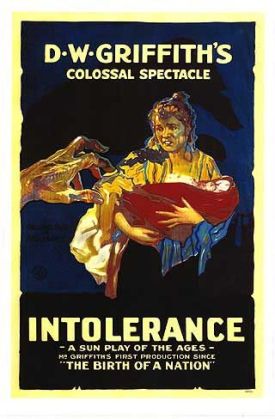
After the success of The Birth of a Nation in 1915, D.W. Griffith could make any movie he wanted. After the wide-spread criticism of that film (and its director), the only movie he wanted to make was Intolerance. The film, which grew exponentially in scope during production, was nothing if not ambitious. In budget, in scale and in length, Intolerance dwarfed Griffith’s first feature-length film, just as The Birth of a Nation had, in its turn, dwarfed everything that came before it. The film cost in the neighborhood of $2 million (some twenty times the cost of its predecessor, and largely funded with the profits from the same) and the initial cut ran at about eight hours (although most widely-available versions of the film today come in at about a third of that length).
Griffith had initially conceived, and begun work on, a much smaller film entitled The Woman and the Law, but as the work progressed he identified in it certain broad, universal themes which he felt merited a more holistic treatment. He added three more stories to the mix, set throughout the whole breadth of recorded human history and united by the common denominator from which the film draws its title. One story is set in ancient Babylon, another in Judea at the time of Christ, and a third in 16th-century France. All three are based (at least loosely) on historical accounts, while the fourth segment, set in modern times (that is, before 1916), is fictional; a contemporary fable of sorts.

The stories, which are woven carefully together by some very imaginative editing, are linked by a recurring visual motif: an archetypal vision of a woman (played by Lillian Gish) rocking the cradle of humanity with an intertitle from Whitman’s “Out of the Cradle Endlessly Rocking.” The editing of this massive feature is indeed very impressive. Almost non-existent at first, allowing long segments of each story to develop and establish characters before transitioning, the cuts between stories become more rapid and abrupt as the film picks up speed during the climax. This serves to build suspense with even greater intensity than the action-packed scenes of Griffith’s previous opus, and the situations seem almost to blend together into one great, overarching story that transcends human history (which is precisely the director’s intention).

The biblical portion is the least-developed (and shortest) of the segments. The story of Christ’s final days is lifted in its entirety from the four gospels and dropped into the movie, dressed up in conventional period garb amid some fairly unimaginative sets. The French interludes are hardly more interesting, and the story they tell is somewhat clumsily assembled. It depicts the infamous St. Bartholomew’s Day Massacre of Protestant Huguenots by Roman Catholics in 1572. Catherine de Medici incites her son Charles IX to instigate the atrocity, which spoils (to say the least) the wedding day of Brown Eyes and Prosper Latour, a Huguenot couple. In this segment, even more than the others, the scenes involving the heroes and the villains are almost totally disconnected from each other until the tragic final moments, which slows the pace considerably.

The Babylonian section, which concerns the heroic Mountain Girl’s doomed efforts to warn Belshazzar of the impending betrayal by the priesthood to Cyrus of Persia, is most notable for its impressive sets. Nothing like it had ever been seen before then, nor would be for many years after. Griffith constructed a massive outdoor replica of ancient Babylon and populated it with over 16,000 extras. The set, with its gargantuan elephant statues and walls on which a full-sized chariot could be driven, towered 100 feet into the air and could be seen at an immense distance. The raucous, orgiastic banquet scene remains, nearly a century later, one of the most impressive spectacles Hollywood has ever produced. After filming wrapped, Griffith found he didn’t have enough money to dismantle the set, and it remained for several years as a notable landmark until it had deteriorated to the point of being declared a hazard by the LA Fire Department. By then, it was dilapidated enough to be demolished at a reasonable cost.

The modern story, out of which the rest of the film eventually grew, remains the most absorbing and well-developed of the four. On a narrative level, the characters capture our sympathies and the story generates a great deal of dramatic tension. As a tale of social injustice, the story also has a great deal to tell about the time in which it was made. In this segment, a sanctimonious women’s reform movement wreaks havoc on the lives of the working classes in the name of cleaning up the streets. As a result of their efforts, a large number of factory workers and their families are fired and are forced to move to the inner-city where they take up all manner of vices to combat poverty, including prostitution and organized crime.

Mae Marsh (of Birth of a Nation) plays the naive, innocent Dear One, a girl orphaned after her father loses his job at the factory. Barely scraping out a living in the city, she falls in love with the Boy, a petty criminal (orphaned in a strike on the factory) who cleans up his act after meeting her. However, the Boy is framed for the murder of his former boss, the Musketeer of the Slums. Meanwhile, the meddlesome women reformers swoop in to take away the Dear One’s baby, claiming she is an unfit mother. As the day of the Boy’s execution draws nearer, things look bleak indeed, coinciding with the increasing unrest among the Babylonian priesthood and the approach of Passover in Judea and St. Bartholomew’s Day in France.

As all four stories near their climax, the real killer in the modern story (the dead man’s mistress, who had tragically turned to prostitution after the lay-offs at the factory) confesses to the crime. In a thrilling sequence, the Dear One races by automobile to catch the governor’s train so that he can sign a last-minute pardon in time to save her husband from the gallows. By the time the modern story is nearing resolution, the historical segments have ended badly with the deaths of the heroes, and it seems that this will be the case once again. Just when it appears that the Dear One will arrive moments too late to prevent the hanging, the movie’s lone happy ending rides in to save the day.

I say “lone” loosely, as the overall film ends happily, as well, in a very similar fashion to Birth of a Nation. Everything dissolves into an idealized vision of a future world without sickness, war, poverty or trouble of any kind as Griffith’s earnest intertitles sermonize rhapsodically about the beauty of a world without intolerance. The final shot is of the rocking cradle, which now feels like a symbol of hope for the future of civilization as much as anything.

Intolerance is aptly described as “Griffith’s colossal spectacle.” So much so, in fact, that it rarely transcends the level of a brilliantly-conceived visual stunt to connect with the audience on a more human level. Length is definitely a problem, as it is almost inevitable that the film should drag in places (and the version I saw was far from the longest known cut). It is not unjust to say that, from time to time, continuing to watch is something of a chore, but it would be unjust to pretend that this is the case throughout. There is a great deal to marvel at here, even for a jaded viewer of the present.

The chief problem, as one might expect despite the attempt at thematic unity between the stories, is a lack of focus. Our attention is simply pulled in too many directions. Despite the grandeur, in particular, of the Babylonian portions of the film, it is difficult to believe that Griffith would not have done far better had he simply retained the germ of his original idea: The Woman and the Law. American audiences at the time seemed to agree, and Intolerance failed completely to recuperate even a reasonable fraction of its costs. Overseas, however, particularly among up-and-coming filmmakers in countries like Russia and Germany, Intolerance was quite well-received, and would ultimately prove to be enormously influential over the development of world cinema. Meanwhile, although he continued to make films in America throughout the silent era, he never again achieved success on a scale that could compare with The Birth of a Nation, or attempted a project as grandiose as Intolerance. These two films remain, for better or for worse, his most lasting legacy.

Film Roundup XI

•June 6, 2008 • 1 Comment

The Seventh Seal – 100%

A knight returns to Sweden from the Crusades after many years and finds Death waiting for him on the beach. A tortured agnostic, the knight buys himself some time to continue his search for evidence of God by challenging Death to a game of chess. They play sporadically as the knight makes his way home, debating existential issues with his squire and picking up a variety of odd traveling companions.

The Seventh Seal was the first Ingmar Bergman film I ever saw, as well as the first legitimate foreign-language film. I was totally floored by it and watched it 3 or 4 times within a few days. I have seen it several times since, and it never fails to leave me deep in thought. Some might find it a bit too transparently allegorical, but it is by turns moving and terrifying, and the layers of meaning run very, very deep. I suppose it’s odd that, after all this time, I still have only seen 3 of Bergman’s films, but there it is. I’m working on it.

Good Bye Lenin! – 89%

An East German woman’s weak heart puts her in a coma at the sight of her son Alexander’s arrest at a protest rally. Several months later, the wall comes down in Berlin and life changes drastically. When the woman wakes up from her coma, her doctor warns Alex that her heart will not be able to stand the shock of the news. He is forced to desperately attempt a re-creation in miniature of a way of life that has rapidly become a thing of the past. The movie has been criticized for romanticizing the socialist regime, but that really misses the point. Good Bye Lenin! may be a bit glib in its treatment of the issues it addresses, but it is, after all, a comedy. There is a message, but ultimately it just has fun with its great concept.

Thoroughly Modern Millie – 79%

This cheeky musical from the tail-end of the golden age of the genre stars Julie Andrews (Millie) and Mary Tyler Moore (Dorothy) as two single women in the big city in 1922. Millie is a strong-willed, independent flapper with ambitions of marrying her boss. Dorothy is a naive ingénue who is befriended by Millie before getting herself kidnapped by the Oriental slavers who run the girls’ hotel. It is extremely shallow, but still rather amusing. The songs are peppy but forgettable, though any viewer familiar with 1920s culture will find many sly winks and nudges tossed their way before the movie dissolves into its slapstick-heavy climax.

White Oleander – 97%

When Ingrid (Michelle Pfeiffer), murders her boyfriend, she is sent away to prison and her daughter, Astrid (Alison Lohman), is shuffled off to spend her childhood in the California foster-care system. Moving from the home trailer-trash fundamentalist Starr (Robin Wright Penn) to lonely, depressive actress Claire (Renee Zellweger) and beyond, Astrid struggles to emerge from under the long shadow her mother casts over her life, even from behind bars. This is a powerful film based (rather faithfully) on an equally-powerful novel, and featuring a strong line-up of fantastic performances. It tells a compelling story that also puts a memorable human face on a larger social issue. Lesser filmmakers could easily have reduced the material to a Lifetime movie-of-the-week trope, but the result is far superior in this instance. This is definitely worth seeing.

Hitch – 57%

Perhaps this trite blip of a cliche-ridden rom-com, about a man (played by Will Smith) who acts as a “date doctor” for his clueless fellows until he encounters relationship difficulties of his own, deserves a bit less disdain than I am generally inclined to aim in its direction. I think I might be a little bitter at now having to differentiate between the nickname of one of the greatest directors of all time (whom I refer to regularly) and the title of an insignificant, sub-par retread of banalities about romantic relationships (which I try to avoid discussing whenever possible). In any case, while you may not be as annoyed by a sit-through of this movie as I was, it certainly isn’t worth two hours of your time.

For My Consideration

•June 3, 2008 • 2 Comments

This past month has been a bit hectic for me, as evidenced by the state of the Hitchcock project, which continues to drop further and further behind. I’ve started a new job, traveled a bit, and helped my wife bring her first year of teaching to a successful conclusion.

As of now, I have an almost completely written entry on Sabotage, which puts me 6 weeks behind and counting. I’m still watching the films on schedule, I’m just not able to keep up with the writing. By the end of this month I will have reached (in my viewing schedule) the halfway mark, which will signal a major difference in the films I will be viewing. Namely, that before this project began I had seen about 15% of the films from the first half of Hitch’s career, while I’ve seen something like 70% from the second half.

I find that each film requires 2, sometimes 3 viewings, plus careful attention to a few specific scenes as I go, but they are much easier to write about if I have seen them before. Length on the last few (having at last entered one of Hitchcock’s better periods) got a bit out of control, and I’m working on finding better ways to discuss the movies with a reasonable word count. Also, naturally, selecting and arranging the screencaps takes time, as well. I have no doubt that, should I finish (rather, when I finish), I will return to each post for revision.

Of course, once I begin grad school in the fall, I can hardly hope to continue the project at even a steady pace (if at all), so I had hoped to get far enough ahead to be able to complete the writing by year’s end. My current inability to even catch up makes that prospect seem bleak indeed. Naturally, I have thought long and hard about how best to proceed under the circumstances, but I am determined, in the meantime, to forge ahead as best I can. I intend to continue backposting my entries according to original schedule for now. I may catch up yet. However, I think I will start each entry as the most recent post for the first few days after publication before bumping it back.

That, however, is not what I really was going to post about . . . the state of the Hitchcock Project is just a side-topic. Roughly four years and one month ago, I began to keep a record of the films that I was watching (a list that is reproduced in the regularly-updated Movielogue on this site). Each time I reached a landmark on the list (generally at 100, 200, 300, etc.) I tried to be aware and select a film that was at least somewhat significant or acclaimed to take the slot. Sometimes I was prepared in advance. Other times I only realized where I was at the last second, and had to go with whatever was immediately available. Twice in particular I blew it entirely. See if you can pick those out of the list below:

100. To Kill a Mockingbird
200. Guess Who’s Coming to Dinner
300. A Beautiful Mind
400. Madagascar
500. Reservoir Dogs
600. All Quiet on the Western Front
700. Finding Nemo
800. Miracle on 34th Street (the remake)
900. Treasure of the Sierra Madre

Now, I am approaching the thousandth entry on the list, and I’m on the hunt for the perfect film to fill it. I spent awhile this afternoon poking about here and there and came up with a tentative list of nearly 40 films that I haven’t seen which might potentially work. Looking at all of the possibilities, I was reluctant to pick just one, so I narrowed it to a list of 10 which I’m pretty happy with. I’m not quite sure how to go about it yet (watch as movies 991-1000? 1000-1009? 996-1005?), but these are all movies that I definitely want to see.

I’d certainly appreciate some input from anyone who . . . feels qualified to give me some. I have my original list divided into three chunks, so if you have any comments on any of them, or on any that I might want to consider, feel free to make a note. (If you need to know whether I’ve already seen it, all you have to do is search for it on the blog. If a Movielogue entry turns up in the results, then I’ve got it covered.)

The 10

Battleship Potemkin (Russia, 1925)
Metropolis
(Germany, 1927)
City Lights
(USA, 1931)
The 400 Blows
(France, 1959)
Lawrence of Arabia
(UK, 1962)
Winter Light
(Sweden, 1962)
8 1/2
(Italy, 1963)
Andrei Rublev
(Russia, 1966)
Wings of Desire
(Germany, 1987)
Three Colors: Blue
(France, 1993)

Viable Possibilities

The Bad and the Beautiful (USA, 1952)
Ordet (Denmark, 1955)
Mother India (India, 1957)
Yojimbo (Japan, 1961)
Through a Glass Darkly (Sweden, 1961)
La Dolce Vita (Italy, 1964)
The Gospel According to St. Matthew (Italy, 1964)
The Good, the Bad and the Ugly (Italy, 1966)
Persona (Sweden, 1966)
Aguirre: The Wrath of God (Germany, 1972)
One Flew Over the Cuckoo’s Nest (USA, 1975)
Brazil (UK, 1985)
Jesus of Montreal (Canada, 1989)
Spirited Away (Japan, 2001)

Less-Viable Possibilities

The Rules of the Game (France, 1939)
The Magnificent Ambersons (USA, 1942)
Brief Encounter (UK, 1946)
Shane (USA, 1953)
Throne of Blood (Japan, 1957)
The Defiant Ones (USA, 1958)
The Silence (Sweden, 1963)
Deliverance (USA, 1972)
Ran (Japan, 1985)
Three Colors: White (France, 1994)
Three Colors: Red (France, 1994)
Trainspotting (UK, 1996)
Amores Perros (Mexico, 2000)
Y Tu Mama Tambien (Mexico, 2001)
Million Dollar Baby (USA, 2004)

Son of Rambow/The Fall

•May 31, 2008 • Leave a Comment

starring Bill Milner and Will Poulter
written and directed by Garth Jennings
Rated PG-13 for some violence and reckless behavior.
96%

Will Proudfoot (Milner) is a sheltered young member of the Plymouth Brethren with a wild imagination. Lee Carter (Poulter) is the school troublemaker. A fateful meeting in the hall (where Lee has been exiled from his class and Will is waiting out the watching of a documentary which he is not allowed to see) leads the two to form a tenuous friendship. Before long, Lee has enlisted Will to help make a short film for a BBC contest, and Will, inspired by his clandestine screening of a bootleg copy of just-released Rambo: First Blood, already has a story in mind.

*
starring Catinca Untaru & Lee Pace
written by Dan Gilroy, Nico Soultanakis & Tarsem Singh and directed by Tarsem Singh
Rated R for some violent images.
94%

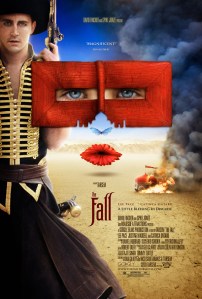
In the early days of moving pictures, Alexandria (Untaru), a young immigrant girl who has broken her arm while picking oranges with her family, and Roy (Pace), a stuntman with a broken back and a broken heart, befriend each other in the hospital. Roy, sensing an opportunity, beguiles Alexandria with an epic story of romance and revenge starring an eclectic mix of characters and events drawn loosely from their surroundings. In return, he hopes to convince her to steal him enough morphine to end his misery permanently, but things don’t go exactly as he expects.

Son of Rambow is a hilarious coming-of-age comedy and The Fallis surreal, visually-rich drama, but they are not as different as they might seem. Superficially, both involve unconventional friendships between characters who fill voids in each others’ lives, moviemaking and crazy stunts that lead to hospital visits. On a deeper level, both are about the power that crafting and telling stories can have over our lives.

The Fall, more than anything, is a bravura technical display of pure moviemaking skill. It begins with a silent, black-and-white segment of something which we will not understand until later on, but which is so beautifully-shot that it doesn’t matter. In fact, the film would be worth seeing (with or without sound) even if its only positive attribute was the stunning visuals. To be honest, both of the stories it tells are a little bit lacking (though enjoyable), and the climax is extremely overwrought. But what the filmmakers have accomplished and how they accomplished it, eschewing computer-generated effects in favor of more conventional tricks of photography and design. The film ends with a lovely montage of some of the greatest stunts from old silent films; a tribute to the days when filmmakers were limited by courage and ingenuity as well as imagination (not entirely different from the situation of the boy filmmakers in Son of Rambow, in fact).

Everything about the production is gorgeous and captivating, even when the story itself is not quite up to the daunting task of being worthy of its surroundings (it almost seems unfair to demand that it should be).  One scene transitions from a close-up of a beautiful blue butterfly tacked to a deep-blue background with a white pin to a small island of white sand surrounded by butterfly-shaped area of light blue shallows set amidst the deeper blue of the surrounding ocean. The transition is accomplished with such seamless subtlety that it takes the viewer a few seconds to realize that the butterfly is no longer on the screen. The result is breath-taking (an apt term for how I felt about most of the film, in fact).

The filmmakers scoured the entire planet for striking locations to use. The Fall was shot in nearly 20 countries and 6 continents around the globe. The natural and man-made beauty paraded across the screen in virtually every scene made me wish for a guidebook. I don’t know where most of these places are, but I am grateful to the movie for transporting me to them so memorably.

Son of Rambow is less about a display of skill (though it is excellent, particularly the music) and more about depicting passion for making movies; of believing in a story so completely that one is compelled to put it into action and preserve the result for posterity. It is a passion that I have known (with strikingly similar results), and its portrayal here is as touching and heart-felt as it is funny.

There is some prodigious talent from the young actors on display in these movies. The two main characters in Son of Rambow are convincing and incredibly funny, particularly Milner’s Will Proudfoot. Will is a sweet kid, and obviously talented and creative, but also very impressionable. Watching Rambo at work in possibly the first movie he has ever seen wakes something up inside of him, and he’ll never be the same again (an experience most longtime movie fans will probably have shared at some point in their childhood). He rushes out once the movie is over (leaving Lee completely baffled) and runs screaming through open country, throwing punches at the air and imitating the noise of machine guns firing. His active imagination has clearly been kicked into overdrive.

Will and Lee are both outcasts in their own way. No one likes Lee because he is, frankly, obnoxious, but Will is too selfless to notice or care. Will is simply too strange to have any friends, but Lee is disarmed by his innocence and his giving nature. This may be a comparison that is better left unmade, but Son of Rambow is in some ways the film that Napoleon Dynamite ought to have been. Both are funny, quirky stories about  eccentric outcasts, but Son of Rambow features actual character growth (and depth) and a certain irresistible charm that the other lacks. In the end, of course, their struggle to bring to life on film the story they have dreamed together enriches both of their lives immeasurably. And if the resulting ending is a bit too pat and “feel-good,” that is what we want it to be.

Alexandria is also a character with a rich imagination, though we are probably not meant to believe that it is quite as rich as the visuals The Falltreats us to. Untaru’s performance as Alexandria (her first appearance in a movie) may well be one of the most realistic portrayals of childhood I have ever seen in a movie. Her conversations with Roy are often rambling, random and confusing to both of them. She lacks the unnatural (and often off-putting) precociousness displayed by many child actors when their characters are meant to be cute and endearing.

Part of what makes her relationship with Roy so interesting is that she is not trying to lead him out of his depression. She doesn’t even know that he is depressed; she is merely a little girl who wants someone to pay attention to her and tell her a story. There is a great scene where Alexandria steals a handful of communion wafers from the hospital chapel before heading to Roy’s room for the next segment of the ongoing adventure. She offers one to Roy, who eats it solemnly and then asks her, “Are you trying to save my soul?” A typically confusing conversation ensues, and it becomes clear that Alexandria is not even familiar with the words “soul” or “Eucharist.” She was just sharing a snack with a friend, but that does not keep her from being an unwitting agent of grace in Roy’s life, nonetheless. Moments like this manage to raise the film (at least occasionally) above the level of pure spectacle.