
 Yes? Well, just click here. It’s the Portable Film Festival, an effort built around the presentation of quality short films from all over the world to interested viewers, wherever they may be. There is also an annual competition. I’ve checked out several of the available films, and they range from the quite good to the not-so-great (just like the real thing!). Right now, the featured film is Pismo (The Letter), and it is definitely worth a look. Also be sure and glance through the animation section, which ranges from sophisticated computer-generated work (like the rather amusing Big Buck Bunny) to more stylized fare.
Wanna go to a film festival?
•November 24, 2008 • 1 CommentBolt
•November 21, 2008 • Leave a Comment starring John Travolta and Miley Cyrus
written by Dan Fogelman and Chris Williams & directed by Chris Williams and Byron Howard
Rated PG for some mild action and peril.
79%
Bolt (Travolta) is the canine star of a hit action show, wherein he plays the scientifically-enhanced bodyguard of Penny (Cyrus), the daughter of a genius scientist who holds the key to world domination sought by the evil, cat-loving Dr. Calico (Malcolm McDowell). The glue that seemingly holds the show together is Bolt’s earnest belief that he truly is a super-dog, living the reality of the show (and the cast and crew go to extreme lengths to keep him deluded). Unfortunately, Bolt escapes from the set one day and is mistakenly shipped across the country to New York City, still under the misapprehension that Penny is in mortal danger. Dragging a world-weary cat named Mittens (Susie Essman) and joined by a maniacally-enthusiastic hamster named Rhino (Mark Walton), Bolt sets out on the epic journey back to Hollywood.
Bolt has a lot of baggage to overcome. Namely, the fact that it has cribbed two of its major character arcs off of the Toy Story movies, and features a cast of computer-animated talking animals voiced by celebrities. In originality of conception, this movie short-changes the audience rather drastically. However, much to my surprise, I didn’t notice or care nearly as much as I thought I would. Bolt may be a cinematic retread, but it never feels lazy and only rarely seems uninspired.
We begin inside the world of Bolt’s television show, with an (extremely) extended sequence of action-driven mayhem. In a movie that is not afraid to strain credibility, perhaps the biggest stretch for the audience will be believing this cornball display is a popular prime-time drama rather than an Inspector Gadget-like Saturday morning cartoon. The animators missed a number of opportunities here to really send-up some genre conventions (though they do get a few licks in), and it seems certain that Bolt will fall into the trap of taking itself too seriously.
In making its premise seem workable, Bolt is either trying too hard or not hard enough. Sure, we might wonder why Bolt would actually think he is a super dog when he isn’t, but we’d probably have forgotten the trouble once the story moved on. Instead, they dreamed up that cockamamie business about making the dog a better actor, a fantastical ruse that requires every stunt and special effect to be carefully engineered beforehand and which allows no retakes. It is an explanation that raises more questions than it answers, opening up a yawning hole in the plot that threatened to swallow my suspension of disbelief.
The feeling happily dissipates as soon as Bolt sets paw in the Big Apple and meets the more colorful supporting cast, beginning with a trio of eccentric pigeons. Between them and the hilarious antics of Rhino, Bolt is sporting a strong comedic backbone, but it is Mittens that really steals the show in every possible way. Essman’s performance brings us one of the strongest animated sidekicks in recent memory, a firmly-grounded, three-dimensional anchor for our sympathies who invokes laughter and tears in equal measure. Perhaps this is simply the cat person in me talking, but Mittens brings the sort of heart and balance that Dory supplies in Pixar’s Finding Nemo (to cite the example that comes most readily to mind).
By the time Bolt has shed his delusions and hit the road with Mittens and Rhino, the movie really hits its stride, coasting the story comfortably (if predictably) in for a warm, cozy landing. Bolt won’t surprise, but it will most likely entertain, particularly if you are gifted with the ability of not over-thinking. There are plenty of laughs, and it equals or betters Disney’s uneven output of the last decade or so: a vast improvement over abysmal fare like Home on the Range and Chicken Little, and on-par with last year’s frivolous Meet the Robinsons (though, disappointingly, lacking the latter’s pre-feature short cartoon, which I continue to hope will become a tradition again). Here’s hoping the upward trend continues.
Intermission: Johnny Depp’s Mad Hatter, Watchmen, Star Trek, Harry Potter
•November 17, 2008 • 1 CommentThere are some exciting trailers popping up all over just now, it seems. Props to Peter Chattaway for rounding them up. First, though, here’s a cool image from Tim Burton’s upcoming Alice in Wonderland. The cast list already had my eyes popping (Depp as Mad Hatter, of course, then Helena Bonham Carter as the Red Queen, Alan Rickman as the Caterpillar, Michael Sheen as the Cheshire Cat, and Christopher Lee in an as-yet unspecified role). So now we have a glimpse of what it all may look like:

Now, the trailers: We’ve seen some footage from all three of these before, of course, but the following previews for Watchmen, Star Trek, and Harry Potter and the Half-Blood Prince really kick it up a notch. I’m feeling the hype. A new trailer for Harry Potter is a bit ludicrous, since the film is complete and has merely been held back for marketing reasons, but I’ll take what I can get. Really, though, they shouldn’t have reminded me that I was supposed to be seeing the whole movie this month, instead of getting a lousy couple minutes of spliced action. In any case, enjoy:
Film Roundup XVII
•November 14, 2008 • Leave a CommentShrek 2 – 74%
When last we left him, Shrek the Ogre (Mike Myers) had rescued Princess Fiona (Cameron Diaz) from a dragon and the two had gotten married (with Fiona discovering her own inner ogre). But before they can live happily ever after, Shrek has to meet the parents, who happen to be the rulers of Far Far Away. And, as if in-law troubles weren’t enough, the stunningly good-looking Prince Charming and his mother are not happy that Fiona has broken off the arranged marriage to Charming. They’ll do anything to throw a kink in the works. All of the surviving characters from the first Shrek return, most notably Donkey (Eddie Murphy), for this latest adventure.
Shrek 2 scored big with audiences, becoming the highest-grossing animated movie of all time. Its immense popularity however, is no indication of quality. Lacking the fresh originality of its predecessor, Shrek 2 opted for a bedazzling display of crowd-pleasing maneuvers: more celebrity voices (including John Cleese, Julie Andrews, and Rupert Everett), more overtly adult humor, and a non-stop barrage of pop culture references. The result is an unmistakably entertaining but undeniably soulless display of marketing elan. Enjoyable but forgettable, in another decade or two no one will understand the jokes anymore and Shrek 2 will fade quietly into the vast dark of cultural irrelevance.
Mystery Science Theater 3000: The Movie – 91%
Perhaps the greatest TV show concept in history journeyed to the big screen for a single outing after eight years on the air (it would continue for another three). A hapless average guy (Mike Nelson) is trapped aboard an orbiting satellite by an evil scientist, who monitors his brainwaves while forcing him to watch the most awful movies ever filmed. In an effort to retain his sanity, Mike hauls his robot buddies, Crow and Tom Servo, into the theater with him each week and the three mock these stinkers mercilessly for our amusement. “The Movie” is merely an episode of the television show produced with a much higher budget. The film under consideration is 1955 sci-fi cheese-fest This Island Earth, and the boys are in rare form, offering a consistently hilarious commentary track with breaks for the occasional wacky skit. Fans of the show won’t want to miss this, and non-fans will experience an excellent introduction to the series here, so that they may join the rest of us as soon as possible.
Gunga Din – 80%
Loosely based on the poem by Rudyard Kipling, Gunga Din stars Cary Grant, Victor McLaglen, and Douglas Fairbanks Jr. as three mischievous British sergeants stationed in India. The three are alerted to an uprising of the dangerous Thuggee cult by the loyal Indian Gunga Din, and must stop it single-handedly in their last great adventure together before one of them goes off to get married. If they play their cards right, they might just get rich off the deal, as well. This is a classic, much-beloved swashbuckling adventure flick from the late-1930s, but I feel that it has at least somewhat outlived its appeal. The film is frequently rather dull, and Grant’s Cockney (despite his being a native Brit) is jarringly painful to listen to. Nevertheless, it certainly has its moments of both high adventure and chuckle-worthy humor, and its status isn’t accidental.
The Muppets Take Manhattan – 86%
Jim Henson’s beloved Muppets crash Broadway in their third screen outing, but can’t find anyone who will agree to put on their show. Forced to separate and find real jobs, trouble arises when Kermit is hit by a car and develops amnesia, but you can be sure that everything will work out in the end. There’s no reason to skip this movie if you appreciate the Muppet oeuvre, all the more so as it was the final Muppet outing before the death of their creator, and the difference is pretty clear. The Muppets are frequently bizarre and occasionally cheesy, but always enjoyable.
Primer – 78%
A couple of whip-smart engineers accidentally design a time machine while experimenting with superconductors. The catch: You can only travel backwards, and only to the point where you first turned the machine on. The two initially exploit their new technology to play the stock market, but soon become inextricably enmeshed in a trackless labyrinth of paranoia and obsession thanks to their lack of scruples. Primer is an interesting study; a low-budget, small-scale independent production which certainly breaks the mold of traditional storytelling. Its downfall is in its inaccessibility: good luck figuring any of it out after just one viewing. There is certainly something to be said for refusing to concede to the audience, but any movie that requires an enormous multi-layered diagram to understand should really consider simplifying.
Madagascar: Escape 2 Africa
•November 7, 2008 • Leave a Comment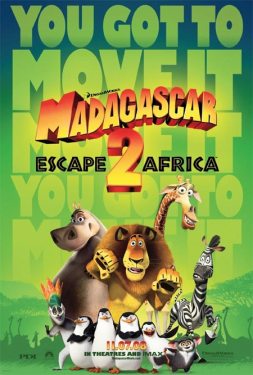 starring Ben Stiller and Chris Rock
written by Etan Cohen & directed by Eric Darnell and Tom McGrath
Rated PG for some mild crude humor.
74%
Alex the Lion (Stiller), Marty the Zebra (Rock), Gloria the Hippo (Jada Pinkett Smith) and Melman the Giraffe (David Schwimmer) return in an unlooked-for sequel to 2005’s Madagascar. This time, the four friends from the New York zoo plot their return home via a cobbled-together airplane wreck flown by the militaristic penguins. Unfortunately, their craft only takes them as far as a reservation in the neighboring African continent, where they meet all sorts of new friends. The gang also runs into Alex’s long-lost father, Zuba (Bernie Mac). Zuba is thrilled that his son has returned to take his rightful place as alpha lion in charge of the community, but the evil Makunga (Alec Baldwin) has other plans.
For those of us who just can’t get enough computer-animated features starring wise-cracking animals who sound suspiciously like big-name celebrities, DreamWorks has come through once again. The studio has, during the past four years, brought us Shark Tale, Over the Hedge, Flushed Away, Bee Movie, Kung Fu Panda, and, of course, the original Madagascar. They have certainly shown that they can fill theater seats with this talking-animal shtick, but can they do anything else? However, perhaps such accusations are uncalled for. Most of the above were clever and reasonably enjoyable, and Kung Fu Panda could even be called excellent. Moreover, I have failed to mention the elephant in the room: DreamWorks’ Shrek franchise (though it, too, features a prominent talking animal). These are tangential considerations, and the Madagascar sequel deserves to be judged on its own merits within the narrower limits of the franchise.
The guiding theory behind the production of Escape 2 Africa seems to have been to bring back every element of the original (whether it makes any sense or not) and multiply it tenfold (in some cases, literally). Pretty much all of the characters have returned, including the penguins, the monkeys, and the lemurs. Even the old lady who beats up lions is back, and (in a fantastically ill-conceived move) wielding a much-expanded role as a crucial piece of the plot. In fact, everyone has their own compartmentalized subplot, only some of which work their way into the grand finale. The result is an extremely busy movie that sometimes works and sometimes doesn’t, but probably ensures the viewer at least a few segments that they can enjoy along the way.
In terms of the overarching story, if Madagascar was primarily Marty’s movie, the sequel is all about Alex, filling in some of his backstory and granting him center-stage over the other animals. Despite obvious (and, honestly, superficial) similarities to The Lion King, this works fairly well. In any case, the supporting cast walks away with the show. Alec Baldwin voices a charismatic villain, Sacha Baron Cohen’s King Julien is actually more funny than grating, and the real stars are still the penguins, whose ingenuity and focus continue to provide the lion’s share of laughs.
Madagascar: Escape 2 Africa is reminiscent of Shrek 2 in that both attempt to improve on the simplicity of the original by adding more noise, more pop culture references, more of everything. The result will probably play better with contemporary audiences, but at the cost of providing a much emptier spectacle. Then again, perhaps the movie doesn’t aspire to any higher purpose than empty, transient fun, in which case it succeeds tolerably well. But, for the record, I still don’t understand the “Move It, Move It” thing.
New Trailer for Pixar’s Up
•November 7, 2008 • Leave a CommentA new and much more detailed trailer for the new Pixar movie has just emerged! Watch it forthwith!
I was spectacularly amused, but then, Carl Fredricksen reminds me of someone I know. Nevertheless, it looks promising. And a brief reminder of all the Pixar movies we’ve enjoyed over the years is always welcome, especially when I’m probably going to be dragged to see Madagascar 2.
Intermission: Slumdog Millionaire, The Reader, Fanboys
•November 6, 2008 • Leave a CommentTrailer break! First, a movie that I await with great anticipation (and not just because I loved 28 Days Later and Sunshine):
Next, a movie about Nazis . . . Is it just me, or are there an unusual number of Nazi-themed movies scheduled for imminent release? Valkyrie, Defiance, The Boy in the Striped Pajamas, Good, and now The Reader (and probably a few that I’ve missed). I’m aware that it’s a popular subject, this just seems like a lot.
Finally, two trailers for a comedy that the Star Wars fan in me is sure will be hilarious (despite some odd-looking and seemingly-irrelevant elements):
American Movie: The Cheat (1915)
•November 4, 2008 • Leave a Comment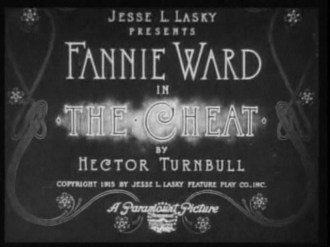 While D.W. Griffith was busily introducing the nation to mega-hit, multi-hour historical epics, most feature films of the period continued to clock in at somewhere around an hour in length. Griffith may be the name among early silent filmmakers, but he was not the only director making a name for himself and enlisting A-list acting talent. Cecil B. DeMille, who would eventually be perceived as the consummate Hollywood showman, began his filmmaking career in 1914 by directing The Squaw Man, the first feature-length film to be made in Hollywood. By the time he made The Cheat about a year later, he had added nearly two dozen pictures to his filmography, mostly Westerns.
The Cheat is about a foolish society woman, Edith Hardy (Fannie Ward), who falls under the charming spell of a sinister Japanese ivory merchant, Hishuru Tori (Sessue Hayakawa). While her husband Richard (Jack Dean) tirelessly plays the stock market, Edith fritters away his money as quickly as it comes in, despite his attempts to curtail her spending while he waits for investments to pay off. Meanwhile, Edith is convinced by a friend of Richard’s to invest the $10,000 entrusted to her keeping (as treasurer of her charity), but the investment is a bad one and the money is lost. Knowing that her husband hasn’t a dollar to spare due to his own investments, she allows Tori to loan her the sum in order to avoid certain disgrace.
The following day, her husband’s investments pay off and he writes her a check for $10,000, no questions asked, but Tori is not interested in the money. He refuses to accept the check, instead locking Edith inside his house and attempting to rape her. When she resists, he brands her with his mark. She finds a gun and shoots him in the shoulder before fleeing. Richard, who has suspiciously followed her to Tori’s house, bursts in to find the wounded man and then claims to have fired the gun himself when the police arrive. He is placed on trial and found guilty, but Edith (who has remained inexplicably silent) can finally contain herself no longer. She reveals everything to the shocked courtroom, and she and her husband go free while the judge only just prevents the crowd from lynching the plaintiff.
Fannie Ward is the top-billed star and title character of The Cheat. She is the heroine and the damsel-in-distress. However, this film belongs to Sessue Hayakawa, who delivers his role with a skill and subtlety that belies the film’s racist undertones. Hayakawa is best known today for his role as Colonel Saito in 1957’s The Bridge on the River Kwai, but he got his start in the industry as something of a heartthrob. One of the first Asians to make a name in Hollywood, Hayakawa amassed a personal fortune and was a well-known member of the movie star social scene throughout the late teens. During the ’20s he performed throughout America, Europe, and Asia. With the arrival of sound, however, roles began to dry up, and when the Production Code banned miscegenation in movies, Hayakawa left acting behind until the post-World War II demand for Japanese actors returned him to the screen.
Incidentally, despite Hayakawa’s willingness to play a role that demonizes Asians, Japanese Americans in California objected very strongly to the film’s portrayal and the Japanese Embassy even lodged a complaint. As a result, the character’s name was changed to Haka Arakau and his country of origin changed to Burma for the 1918 re-release. The change seems to rather miss the point, but it satisfied the Japanese.
The Cheat ventures ever so slightly into territory that would define DeMille’s films for much of his career: the lascivious morality play. The stories they tell, while ultimately affirming traditional values, wallow shamelessly in the vices of their characters until the final comeuppance arrives. Thus, thrill-seeking audiences are allowed to have their cake and eat it, too, reveling in vice without having to feel guilty about it. Even after he moved on to making biblical epics, he rarely failed to titillate audiences. DeMille’s lowbrow, commercial approach to filmmaking filled theater seats, but did little to endear him to critics. However, in The Cheat he was still experimenting with more artistic approaches to the form, and the result was much-admired, particularly in Europe, and holds up well even now.
The film tells its story with an admirable clarity and visual flair that are surprising to find in such an early work. The dialogue between characters is extremely easy to make out, even without intertitles, and the characterizations are sketched rapidly and economically. The introduction to the Tori character, which the film opens with, is particularly striking. He sits alone in a dark room, lit only by the glowing embers he is using to heat a small iron, which he then draws out to brand a small ivory statue. The scene sets the mood, establishes the character, and foreshadows a pivotal scene.
After his foreboding entrance, however, Tori appears fairly innocuous and likable during the first half of the film. He is suave, handsome, and well-mannered, and it seems at first that the villain will be Richard, whose suspicions of the Asian man come across as ill-founded jealousy. Hayakawa masterfully shifts the tone of his character while he is giving Edith a tour of his house during a party. Taking her into a back room he shows her the branding iron. She asks what it is for and he presents one of the statuettes with the logo on the bottom. When she wonders what it means, he answers that it means the object is his property. His presence has very suddenly moved from friendly to menacing.
The Cheat is full of expert touches. For instance, when Edith discovers that her investment has tanked, her imagination runs wild. A newspaper appears in a corner of the screen with a headline that reads, “Society Wife Steals Charity Money.” By far the best scene, however, is the climax of the film, where Edith finds herself assaulted by Tori. The moment when he subdues her and brands her shoulder is shocking, if not unexpected. Bad things are not supposed to happen to the heroine, and the act is jarringly brutal. Richard arrives just in time to see the wounded Tori, silhouetted against the paper screen, slumping back and sliding to the floor. A ghastly blood stain (a masterful image, and an unusual sight in early American cinema) streaks the paper in his wake and Richard smashes his way through to the other side. The courtroom scene showcases DeMille’s skill at wrangling crowds, and the surge of the enormous crowd towards Tori, who cowers behind the judge, is a powerful moment.
At its core, The Cheat is boilerplate melodrama, packed with overwrought cliches and lazy stereotypes. Despite this, however, something about the treatment of the material elevates it beyond its merits. The great performance by Sessue Hayakawa and experimentation by DeMille make it not only watchable, but enjoyable; a genuine classic of the silent era.
Changeling
•October 31, 2008 • Leave a Comment starring Angelina Jolie and John Malkovich
written by J. Michael Straczynski & directed by Clint Eastwood
Rated R for some violent and disturbing content, and language.
94%
Christine Collins (Jolie) is a single mother working as a telephone operator in Los Angeles in 1928. Her life revolves around her young son Walter, and when he disappears from their home one quiet Saturday while she is covering someone else’s shift, she is devastated. Matters go from bad to worse when the police claim to have found her son in Illinois and bring her another boy claiming to be Walter. Christine is immediately certain that the boy does not belong to her, but the police are insistent. Soon it becomes apparent that Christine’s hope of finding the real Walter depends on her resolve to first convince a conspiracy of corrupt city officials that the case is not closed.
Changeling is a horror movie, an appalling, often-terrifying reenactment of an instance of institutional abuse that would strain audience credulity beyond the breaking point were it not based on true events. Truth truly is stranger than fiction, if only because it can afford to be. The film is difficult to watch, but impossible to look away from; an intense and immersive human drama told with skill and sympathy. Fans of Clint Eastwood’s other films will recognize and appreciate his familiar style immediately. The first thing the viewer notices about Changeling is its top-shelf production values. The film immediately evokes its setting with a stunning attention to detail that goes a long way towards establishing the plausibility of the account. It feels like we are in 1928 from the very beginning, and the film never really loses its sense of time and place.
The supporting cast is very strong. Don’t get me wrong, Angelina Jolie is great in the lead, reminding us why she won an Oscar eight years ago, but this is truly a group effort. Jeffrey Donovan, as Captain J.J. Jones, is creepily, callously, complacently evil in a way that I loved to hate. He walks a line so fine that it is never really clear whether he was deliberately deceptive or dismissively arrogant in his dealings with Christine. In contrast there is Michael Kelly’s heroic detective character, who uncovers a shocking truth and cannot bring himself to stay silent about it despite the insistence of his superior. And then there is the seemingly ubiquitous Amy Ryan, who just wrapped up her guest stint on “The Office” and who pops up here as a hooker that Christine meets in the psych ward. And the list goes on.
There is a particularly magnificent scene after Christine has been thrown unceremoniously into an asylum after she continues to publicly insist that the police have made a mistake. Having been warned that, regardless of how sane she tries to act, the doctor in charge will interpret her emotions as some sort of disorder, she sits nervously across the desk from him for an interview. He asks her questions, barely looking at her, and she attempts to answer them as normally as she can. He grunts and scribbles on his pad, then asks another question. Another answer, another grunt, more scribbling. The tension is fantastic, and when he goes on the attack, the point is well-made: almost anyone admitted to an asylum can be made to appear as though they belong there.
Eastwood winds up our emotions, particularly rage and frustration, beyond the breaking point until we are desperate for some sort of catharsis. This does finally arrive, but only partially. Justice may be done, but there can be no true comfort for the agony of this separation. Many of the loose ends are tied up as the movie slides past the two-hour mark, but the knots are loose and a little unsatisfying. Disorganized rather than neat, just like real life (which this is, of course, closely based on). This lack of “closure” (for lack of a better word) is a necessary weakness, but Changeling occasionally feels scattered in other respects as well, as though there were too much going on in the margins. Or perhaps as though the events taking place in the margins ought to be more central. The screenplay in general is excellent, despite the occasional misstep (for instance, the film’s final line is such a hopelessly-overused cliche that the spell was nearly broken).
There is also a completely mystifying scene near the end where Christine enters an Oscar pool at work, placing her bet on dark horse It Happened One Night to win Best Picture. She turns the radio up as the announcement is made, and squeals with glee to herself when her favorite takes the award. A few moments later, the phone rings and the film moves on, leaving us to wonder why the Oscars had a cameo. I will not assume that Eastwood or Jolie are dropping broad hints for the consideration of AMPAS. Perhaps this is merely an affectionate bit of nostalgia from a filmmaker who has made his own mark on Oscar history. Nevertheless, it is odd.
Changeling is riveting as a portrait of a time when sexism was ingrained in every facet of society, and it plays with that idea without making an easy, 20/20 hindsight condemnation. This is simply the way things were, way back when, and this is the sort of thing that happened as a result. I enjoy and appreciate the way Eastwood has of drawing these stories out and treating them with sensitivity, but also without pulling any of his punches. Changeling may not be the finest example of a Clint Eastwood film (it feels entirely too movie-like, which is partially a casting issue), but it is still a quality film and well-worth seeing.
Film Roundup XVI
•October 24, 2008 • Leave a CommentSigns – 94%
Graham (Mel Gibson) is a former pastor struggling to raise his two kids with the help of his brother Merrill (Joaquin Phoenix). Graham has lost his faith in the wake of his wife’s death in a freak accident, an occurrence which has left him somewhat withdrawn. All of that seems moot, though, when signs begin to point to an imminent alien invasion of the planet. Whether the alien threat is genuine or not, if Graham and his family are to have a chance to reach the other side of the coming insanity, he will have to re-evaluate his past and reconsider his future.
Some people identify Signs as a marked downturn for writer/director M. Night Shyamalan after the runaway success of The Sixth Sense and the more thoughtful, but still well-received, Unbreakable. For me, though, Shyamalan didn’t jump the shark until The Village, and this remains (to date) his last good film. It is a tight and entertaining psychological thriller, replete with interesting, likeable characters. The story unwinds with complete control, revealing itself slowly and carefully, when the time is right. Best of all, it flips the old sci-fi trope of a global alien invasion on its head, focusing claustrophobically in on a single family in a single location and using the situation to examine thought-provoking questions of faith and skepticism.
Yours, Mine and Ours – 15%
Two single parents responsible for a total of eighteen children meet and fall in love, deciding to get married and combine their clans into one giant house of fun. There’s just one problem: He is a Coast Guard Admiral and a rigid disciplinarian, while she is a laid-back artist who doesn’t believe in restricting her children’s development. Sparks will fly in all directions and shenanigans will be gotten up to in a familial collision that is sure to include more pratfalls, pranks, and peculiar pet encounters than you can shake a stick at. The rather charming 1968 original starring Henry Fonda and Lucille Ball gets rudely updated into the 21st-Century in this unfunny travesty of a family film. Dennis Quaid and Rene Russo ought to know better, but it is no surprise to find director Raja Gosnell’s filmography gorged with the likes of Home Alone 3, Big Momma’s House, and Beverly Hills Chihuahua. But seriously, do check out the original.
Corpse Bride – 85%
Nerve-wracked Victor Van Dort (Johnny Depp) is on his way to meet his fiancee for the first time when he pauses to practice his wedding vows in what he thinks is an isolated spot. Unfortunately, the outcropping on which he deposits the ring happens to be the skeletal finger of a dead woman (Helena Bonham Carter), who rises on the spot and claims that the two are now bound by holy matrimony. It is an awkward situation, to say the least, and only a journey to the land of the dead can yield Victor a way out of his predicament. With Depp and Bonham Carter in the leads, it is no surprise to find Tim Burton manning the helm of this stop-motion romp which owes more than a bit of its style and atmosphere to his earlier Nightmare Before Christmas. Unfortunately, there is a certain something (whimsy, perhaps?) which is missing from this effort. It is amusing and visually-pleasing, but ultimately kind of forgettable.
Scent of a Woman – 97%
Charlie Simms (Chris O’Donnell) has a major problem. A student at a high-class prep school, he witnessed the set-up of a prank that has the headmaster looking for blood. Now, he has been given an ultimatum: Reveal what he knows or face an expulsion that he can ill-afford. He has the Thanksgiving holiday to think it over, but little does he know that he will be spending the holiday touring New York City with Col. Frank Slade (Al Pacino). Slade is blind and surly, and Charlie takes a job “babysitting” him while the relatives he lives with visit other family. Slade whisks Charlie away on a last hurrah that will change both of their lives. This is a fantastic movie, full of life and humor, and winner of a much-deserved acting Oscar that went to Pacino. It is the sort of film that one could sit through, rewind, and begin again immediately. Highly recommended.
Dreamgirls – 86%
The Broadway musical comes to the big screen, telling the story of the tempestuous career of a fictional R&B trio called The Dreamettes during the 1960s and ’70s. Featuring a killer cast (with some killer voices) and an established stage success, Dreamgirls has a lot going for it. Unlike most musicals I’ve seen in recent years, however, I never really connected to the story, the characters, or even the music. In fact, more than once I was a little bored during the more than 2-hour runtime. The production values are high, and I can think of no complaints that I might fairly make about the movie, it just didn’t take me anywhere.


 Moviegoings