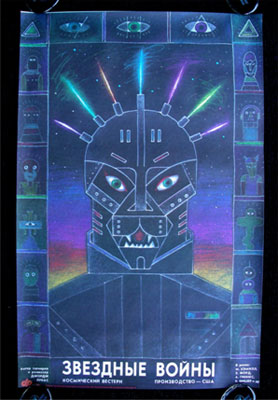
Some Kind of Robotic Disco Puma

•February 4, 2009 • Leave a Comment

russianstarwarsThe image on the right is apparently a Russian poster for the first Star Wars movie, and the title of this post comes from the hysterical commentary here. Check it out for a weird and disturbing journey through 19 more “Baffling Foreign Movie Posters.” It’s pretty funny stuff, and for some reason it makes me want to watch an episode of Mystery Science Theater 3000.
And, for a little more movie poster-related humor, check out this post from Holy Taco, entitled “If Movie Posters Were Honest.” The humor is not quite as inspired, which presumably has to do with the fact that the posters are not real. Still, there is a bit of the “funny ‘cuz it’s true” factor giving these fakes a boost.

Enjoy.

DVD Alphabet Meme

•February 2, 2009 • 1 Comment

From Blog Cabins via Cinexcellence.

The Rules

1. Pick one film to represent each letter of the alphabet.

2. The letter “A” and the word “The” do not count as the beginning of a film’s title, unless the film is simply titled A or The, and I don’t know of any films with those titles.

3. Return of the Jedi belongs under “R,” not “S” as in Star Wars Episode VI: Return of the Jedi. This rule applies to all films in the original Star Wars trilogy; all that followed start with “S.” Similarly, Raiders of the Lost Ark belongs under “R,” not “I” as in Indiana Jones and the Raiders of the Lost Ark. Conversely, all films in the LOTR series belong under “L” and all films in the Chronicles of Narnia series belong under “C,” as that’s what those filmmakers called their films from the start. In other words, movies are stuck with the titles their owners gave them at the time of their theatrical release. Use your better judgement to apply the above rule to any series/films not mentioned.

4. Films that start with a number are filed under the first letter of their number’s word. 12 Monkeys would be filed under “T.”

You’ll notice there isn’t a rule designating how to select the movies for your list. You could just list the first movie that pops into your head. You could try to find an old favorite for each letter. You could look for movies that you’ve never seen before. Or, if your DVD collection happens to be large enough or eclectic enough, you could take a stab at what I did. I own every movie on this list, although I had to reach into the VHS section for one or two titles. If you borrow movies regularly or have a Netflix subscription, you could also expand the limit to films that are currently in your house (I thought I would have to, but then I didn’t). Anyway:

Anatomy of a Murder

Back to the Future

Conquest of the Planet of the Apes

Double Indemnity

Empire Strikes Back, The

Fiddler on the Roof

Gattaca

His Girl Friday

Indiana Jones and the Last Crusade

Junebug

Killing, The

Little Children

Monty Python and the Holy Grail

North by Northwest

Office Space

Princess Bride, The

Quiet Man, The

Run Lola Run

Shaun of the Dead

To Kill a Mockingbird

Uptown Girls

Vertigo

WALL-E

X2

Young and Innocent

Zodiac

Milk

•January 31, 2009 • Leave a Comment

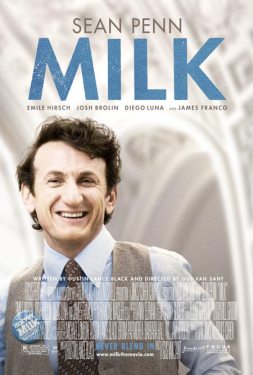
milkposterstarring Sean Penn, Josh Brolin, and Emile Hirsch
written by Dustin Lance Black & directed by Gus Van Sant
Rated R for language, some sexual content and brief violence.
79%

In the 1970s, Harvey Milk (Penn), is inspired to move to San Francisco with his new boyfriend and eventually to campaign for political office in an attempt to combat the anti-gay bigotry he sees all around him. Eventually, after a series of hard-fought elections, he becomes the first openly-gay man elected to major political office (city supervisor) in the United States. Overnight, Milk becomes an inspirational figure to a community of individuals that have felt threatened and marginalized throughout their entire lives, but the real battles have just begun. However, Milk’s crusade is cut tragically short when, for reasons that remain cloudy, he, along with San Francisco mayor George Moscone, is assassinated by fellow supervisor Dan White (Brolin), a conservative Catholic, in 1978.

I know that this is an Important Movie that communicates Important Ideas, because it told me so (several times, in fact). To paraphrase Harvey Milk’s catchphrase: This film’s name is Milk, and it is here to recruit you. Perhaps its cause is a just one, but when the message cannot be communicated without waving it in the audience’s face like a banner, and draining heroes and villains alike of moral complexity, then the storyteller has utterly failed. And Milk‘s screenwriter, Dustin Lance Black, has utterly failed.

I really have no other significant complaints about the film. Penn has a very magnetic screen presence, well-suited to the portrayal of a man whose charisma must have been formidable. His co-stars also do notable work. Brolin’s Dan White is, unfortunately, inscrutable, but this is doubtless a failure of the writing, or (thinking more charitably) simply because no one really knows what drove to White to act as he did. Van Sant is a good director, and Milk is solidly-constructed (if largely conventional). None of this matters, however; the transparency and lack of depth in this screenplay are an insurmountable problem.

White alone, in fact, develops a certain complexity, but ultimately he is an enigma. One might even be tempted to say (unfairly, no doubt) that he is not explained because he could not be easily reduced to the film’s simplistic conceptions of “good” and “evil” like every other character. Harvey, on the other hand, is a saint. This not only makes him rather uninteresting, but is doubtless a disservice to the reality of the living, breathing, imperfect man Milk actually was. He encounters hardship in the film, certainly, but somehow they hardly register. He seems so extraordinary that his accomplishments aren’t terribly surprising.

The tale’s framing device is a particularly poor one. Harvey tells his own story, via tape recorder. This allows for voice-overs to explain what is going on and create bridges between scenes when a lot of time has passed. What I never quite understood was why Harvey was sitting alone in his kitchen, shortly before his death, dictating his life story into a microphone. It’s almost as though he expects to be killed (which doesn’t make any sense). Because this is a biopic, are we expected to believe that he actually did this? Surely not. The device is lazy and confusing. I say that Harvey tells his life story, but this isn’t entirely true. One might expect to hear more about where he came from and what made him the man he became. His life seems to begin on his 40th birthday, and he emerges out of nowhere to become the political savior of San Francisco’s gay community. This only adds to the dull hagiographic feel of the movie.

Milk draws a very hard, extreme line down one side of a volatile and complex issue, and then demands that its characters and its audience choose a side. If they, and we, choose the right side, we become brave and heroic individuals, standing on principle for what is right. If we choose incorrectly, we are everything that is bad and wrong in America today. Whether or not I agree with the ideology in play here (and I am far from unsympathetic to it), this sort of high-handed invective is a major turn-off, and certainly no way to win hearts and minds. No amount of high-brow production standards or armload of Oscar nominations is going to change that.

Intermission: At the Movies in 2008

•January 29, 2009 • Leave a Comment

I had intended to post two videos here, starting with the one below followed by the fantastic end credits music video from Slumdog Millionaire. However, predictably, the latter seems to have been eradicated from YouTube for the time being. The following is montage tribute to the films of 2008 (the good, the bad, and the ugly). If you went to the movies at all last year, you probably saw at least one of the films in this video. I particularly like the priorities of this little piece because it special attention to the best picture of the year (whatever Oscar might say). Check it out:

Revolutionary Road

•January 23, 2009 • Leave a Comment

revolutionaryroadposterstarring Leonardo DiCaprio, Kate Winslet, and Michael Shannon
written by Richard Yates and Justin Haythe & directed by Sam Mendes
Rated R for language and some sexual content/nudity.
79%

Once upon a time, Frank (DiCaprio) and April (Winslet) met at a party, fell in love, and got married. Now, seven years and two kids later, the Wheelers are living in a suburb in 1950s America, and (as everyone knows) that means they are leading lives of quiet desperation. However, April has an escape plan. The couple has some money set aside, and it seems that the French government pays its secretaries excellent salaries. In order to escape the banality of their present existence, Frank will quit the job that he hates and the family will move to Paris, where April will work to support them and Frank will finally have a chance to discover what he truly wants to do with his life. No sooner has the plan been set into motion, however, than unexpected problems begin to rise and block their way.

In 1999, Sam Mendes directed American Beauty, a story of a joyless drone living in suburbia who wakes up one day and starts to live for himself, at his family’s expense, only to discover (almost too late) that the secret to genuine joie de vivre has a lot more to do with loving others than loving yourself. Then, in 2006, Kate Winslet starred in Little Children, a story of a young mother and a young father, also leading unhappy lives in suburbia, who meet while pushing their children on the swings at the playground. They, too, eventually begin to live for themselves, to the detriment of their families, before being unexpectedly jolted back into fulfilling their marital and parental responsibilities as adults. I love both movies (though I have oversimplified them a bit here) for their great artistic beauty, powerful storytelling, and redemptive themes. Now, Mendes directs Winslet (the two are married) in a story about marital infidelity, living for self, and suburban malaise. Strangely enough, the result left me completely cold.

There is no technical reason why this should be so. Winslet is one of my favorite actresses (although here she seems to have trouble humanizing a somewhat inaccessible character), and DiCaprio is very good when, as here, he has been cast appropriately. Roger Deakins’ cinematography is as haunting and beautiful as always, and the film is underlined with a lovely score by Thomas Newman (my favorite composer of the moment), who also scored American Beauty and Little Children. I have no specific criticisms to offer, beyond a vague sense of discomfort and unease that lasted from the moment the film began until after the credits had ended. What is Revolutionary Road trying to say, and why?

I would like to draw attention to two performances that may be able to help me express my problem. First, of course, there is Michael Shannon, whose brief but attention-grabbing part as John Givings has earned him an Oscar nomination. Shannon is good, and I don’t want to run down his performance in any way, but the part is a showy one which doesn’t require a great deal of subtlety. Givings is a mathematician who has suffered some sort of mental collapse and has been institutionalized. We are not told precisely what his trouble is, but it is hinted that there may be nothing the matter with him; that the problem may belong to everyone around him.

Givings is the only character who is free to speak the truth and shatter the layers of self-deception, thick and thin, which coat the perceptions of the other characters. In fact, he is not so much a character as a plot device; a loud and bitter force of nature who verbalizes what everyone else is afraid to say, or even think. He is helpful (to the audience), and his violent outbursts are satisfying amidst the sterile civility around him, but he is not terribly interesting.

David Harbour’s portrayal of Shep Campbell stands as a stark contrast to Givings. Campbell is the Wheeler’s next-door neighbor, and their are deep, deep layers to him that we never catch more than a glimpse of on his face. I felt that he was the most real, and most interesting, character in the film. If we could have spent more time with him, he might have had the most to say. But he is a footnote in the Wheeler’s story; a story which, unfortunately, is not all that compelling.

The Wheelers seemingly exist to illustrate the consequences of settling for bland mediocrity instead of pursuing one’s dreams, but neither of them seems to have any real dreams of their own beyond the vague ambition to move to Paris, as though that alone will bring their lives meaning. Frank has not given up on what he wanted to do with his life, because he never knew what that was. April, who has never even been to Paris, seems to have given up the desire to act, not because circumstances have prevented her, but because she just isn’t very good.

Most of the movie is like watching a car wreck in slow motion. One braces for the impact long before the vehicles collide, and then cringes at the screeching of metal, breaking of glass, and shattering of emotional bone. The exercise feels all the more empty in light of all of the opportunities to avoid disaster that the characters are afforded. Instead, they steer steadily and deliberately and almost knowingly towards disaster, as though they wanted to end badly in order to prove some still-obscure point. Or maybe the point isn’t obscure at all. Maybe it is so crushingly obvious that I am ignoring it in the vain hope that Revolutionary Road has something meaningful and profound to say.

2009: An Oscar Primer

•January 22, 2009 • Leave a Comment

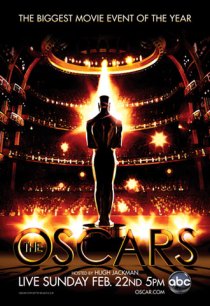
oscarposter2009I’ve been more than a little out of it lately, but I was still up this morning in time to get a a first look at the nominees for this year’s Oscar ceremony. By this weekend, I’ll have seen at least 18 of the 26 nominees (not counting documentaries and foreign films), but so far I have only seen one of the nominees for Best Picture. This is, in my opinion, somewhat pathetic. I find it utterly absurd that, as someone who lives in a mid-sized city and tries to keep up on the films that are getting positive critical buzz at any given moment, I have not had an opportunity to see more than one nominee for Best Picture of 2008 by the time the nominations are announced in 2009. The onus does not fall on the Academy, certainly, for selecting films that have not appeared in wide release, but rather on the film distributors who continue to crowd the multiplexes with asinine slop all the year round while withholding general public access to any (or at least most) films that might actually be worth going to see for as long as possible . . . but I’ll climb off that soapbox now. The pool of nominees (which you can find here) is much smaller than last year, when it was spread over about 35 movies.

There were definitely a few surprises, at least for me, during the announcement. The biggest shock would have to be the exclusion of The Dark Knight from both Best Picture and Best Original Screenplay despite an astonishing 8 nominations to its credit (Heath Ledger for Best Supporting Actor, plus nominations for Best Cinematography, Best Editing, Best Art Direction, Best Makeup, Best Sound, Best Sound Editing, and Best Visual Effects). I, for one, wouldn’t call The Dark Knight the best film of the year, but it is certainly among the best in addition to being something of a cultural and financial phenomenon. It’s exclusion from the major categories may well turn out to be one of the Academy’s most unpopular moves of the past several years.

My own personal favorite, WALL-E, was confined to the “Best Animated” ghetto as expected, with an additional 5 nominations (Best Original Screenplay, Best Original Score, Best Original Song, Best Sound, and Best Sound Editing). In any case, let’s take a look at the five major players (although it feels a bit odd to say that this year, when we have two films not nominated for Best Picture holding 6 and 8 nominations). Be that as it may, the nominees for Best Picture are:

The Curious Case of Benjamin Button – Not a huge surprise here, what with its sweeping historical and geographical scope and epic (even moving) love story. I could very definitely see Benjamin Button walking away with the award, but so far this is the one nominee that I have had an opportunity to see. The film has 13 total nominations: Best Actor (Brad Pitt), Best Supporting Actress (Taraji P. Henson), Best Director, Best Adapted Screenplay, Best Cinematography, Best Editing, Best Art Direction, Best Costumes, Best Makeup, Best Original Score, Best Sound and Best Visual Effects. That’s just about as many nominations as you can get (the record is 14), and we haven’t seen a film collect that many since Chicago in 2002. I am a little surprised not to see Cate Blanchett nominated for Best Actress, because her performance particularly struck me when I saw the film (even more so than Brad Pitt’s, surprise surprise). However, all of the nominations in that category seem very strong.

Frost/Nixon – I’ll finally be seeing this over the weekend, and I very much look forward to it. However, while I expect to enjoy it very much (and may change my mind), this definitely feels like a dark horse to win big, and I was mildly surprised to see it included. It has only 5 nominations in all: Best Actor (Frank Langella), Best Director, Best Adapated Screenplay, and Best Editing. Those are all strong nominations to be sure, but then again, they are only in major categories.

Milk – Definitely an expected pick, and one which I am not sure when (or if) I will be able to see. I wonder if Milk‘s nomination will produce the same sort of controversy we saw a few years ago with Brokeback Mountain, particularly considering that (from what I’ve heard) it paints a much more positive picture of homosexuality than the earlier film. On the other hand, Milk is a biopic based on a true story, while Brokeback Mountain was seen by its detractors as something of an assault on the cherished masculinity of the Western genre. Milk matches The Dark Knight with 8 nominations: Best Actor (Sean Penn), Best Supporting Actor (Josh Brolin), Best Director, Best Original Screenplay, Best Editing, Best Costumes, and Best Original Score. Off-hand I think Milk might only pick up one or two awards and then fade to the background.

The Reader – This was the biggest surprise in the category for me, as I hadn’t heard any real nomination buzz around it for Best Picture. Again, I’m not really sure when I’ll be able to catch this one, but I’m definitely on the lookout for it. Like Frost/Nixon, only 5 nominations here: Best Actress (Kate Winslet), Best Director, Best Adapted Screenplay, and Best Cinematography. This is the only Best Picture nominee without a Best Editing spot (which went to The Dark Knight). As I said, I was surprised to see it nominated for the big award, and I would be even more surprised to see it win.

Slumdog Millionaire – I’ll also be catching this one over the weekend, and I’ve looked forward to it a great deal as well. From everything I hear, this is a real crowd-pleaser and Benjamin Button‘s strongest competitor for Best Picture. It has 10 nominations: Best Director, Best Adapted Screenplay, Best Cinematography, Best Editing, Best Original Score, Best Original Song (two nominations), and Best Sound. It is interesting (but not shocking) to see this film shut out of the acting nominations. I’m sure I’ll have more to say about it after I’ve seen it.

Now let’s take a brief look at the other nominees, starting with those that I’ve actually seen:

Continue reading ‘2009: An Oscar Primer’

Defiance

•January 19, 2009 • Leave a Comment

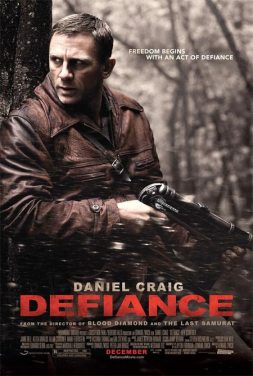
defianceposterstarring Daniel Craig, Liev Schreiber, and Jamie Bell
written by Clayton Frohman and Edward Zwick & directed by Edward Zwick
Rated R for violence and language.
92%

When the Nazis invade their neck of the Belorussian woods, the three Jewish Bielski brothers, Tuvia (Craig), Zus (Schreiber), and Asael (Bell), retreat deep into the forest, set up camp, and prepare for long-term survival. Before long, however, the camp is overflowing with refugees, ranging from the young, strong, and skilled to the old, weak, and sick. Tuvia and Zus, as the natural leaders of this place of refuge, are soon engaged in an ethical and philosophical clash over the best course of action. Tuvia thinks that they must hold on to their humanity at all costs and do their best to take responsibility for the weak, even if it endangers everyone’s chances of survival, while Zus believes they should assure the survival of the strong and join the local partisan forces in waging war on the Nazis.

I wouldn’t say that American movie audiences have not become desensitized to the Holocaust, but a certain jadedness does exist towards films about the Holocaust. Defiance suffers from its relation to a genre that can feel exploited (and exploitative) at times. Consider, for instance, the very fact that one can categorize “movies about the Holocaust” as a genre. This year alone has produced several such films, and the subject feels a bit belabored. However, as long as there are more stories to be told about that ultimately indescribable event (and there always will be), movies will continue to tell them. Defiance, at least, brings to life a genuinely incredible story that deserves to be told, and does it well.

Perceptive viewers will immediately notice that Defiance has an obvious historiographical axe to grind. Zwick obviously believes that the film’s first duty is to tell the story he wants to tell, and its second (when it can be made to coincide with the first) is to remain true to history. However, as long as we are aware of the film’s creative license, this is a strength rather than a weakness. Zwick uses the idea of a group of Jewish partisans facing eradication in 1940s Eastern Europe to explore what are really universal human questions.

In setting up a moral conflict between Zus and Tuvia, the film forces us to confront our own assumptions about how to prioritize our own self-preservation when it might threaten the sanctity of other innocent human lives. The film also refuses to allow its characters to exist in a simplistic world of obvious choices between right and wrong, nor do the “heroes” always act “heroically.” The power of these moments exists in the uncomfortable disconnect between the exhilaration we can’t help but feel and the queasy knowledge that it wasn’t right.

These were the elements that lent depth to my viewing of Defiance and prompted me to sit up and take notice. I should say, though, that first and foremost I definitely connected to this film on a visceral level. It is thrilling in an armrest-gripping way that is very easy to get caught up in. I presume it could be argued that there is a great deal of calculated effort to play on audience emotions, but if that is so it is not done with the sort of ham-fisted blundering that drags the viewer out of the movie. By the end I was just sort of in awe at the thought that even a fraction of this story might actually be true. In the face of an account that compelling, it seems almost superfluous to compliment the production on its various components: performances, cinematography, score, and so forth. All are good enough, but the important thing is the way they come together to bring the incredible world of the Bielski otriad to life.

Film Roundup XIX

•January 15, 2009 • Leave a Comment

Clear and Present Danger – 87%

Harrison Ford reprises the role of CIA analyst Jack Ryan that he took over from Alec Baldwin in Patriot Games. In this adaptation of a Tom Clancy novel, Jack finds himself drawn into the web of intrigue surrounding an illegally-waged war between US special forces and a Colombian drug cartel. Any attempt to further summarize this tightly-plotted thrill ride would be counter-productive.

This is both the absolute best of the Jack Ryan movies to-date, and one of the last really good movies Harrison Ford appeared in before dropping into second-rate alley in the late ’90s. Clear and Present Danger is an intense blend of action and intrigue that keeps me on the edge of my seat in ways that few movies do anymore. It’s the sort of film that really makes me struggle to remember the last really good action movie I saw. Action is not really my top genre, but if more of them were like this, it might be. And let’s not forget the strong supporting cast, including Willem Dafoe, James Earl Jones, and a very young Thora Birch (who, as it happens, is actually older than I am).

Blade Runner – 95%

In the future (2019), humanity has created hyper-advanced androids, known as replicants, to work in off-world colonies. The replicants, which are nearly indistinguishable from humans, have been declared illegal on planet Earth, where they are hunted and terminated by “blade runners.” One such blade runner, Rick Deckard (Harrison Ford), faces the biggest challenge of his career when he is assigned to track down four rogue replicants who have hijacked a ship back to Earth and disappeared into the hive of humanity that Los Angeles has become.

Oh, look, I’m talking about Harrison Ford again; this time at a point in his career when he ruled the world, fresh from helping create pop culture icons in Han Solo and Indiana Jones. Blade Runner is an intense movie as well, but also a more cerebral one; a sometimes-troubling investigation into the question of what it truly means to be human. It’s strange to think that this film (which was released some 27 years ago now), portrays a “distant” that is only a decade away, but its shortcomings as prophecy have no effect on its philosophical impact. For any fans of sci-fi and cinema, Blade Runner is undoubtedly required viewing.

The Martian Chronicles – 28%

Ray Bradbury’s classic collection of short stories chronicling humanity’s colonization of Mars got the 6-hour miniseries treatment in 1980. Notable faces include Rock Hudson and Roddy McDowall, as the episodes follow the first abortive missions to the planet and the surge of colonization which follows across a period of several years. The original stories are riveting, and their episodic nature ought to translate well to television, but this adaptation falls far short of its potential. It never succeeds in convincing us to believe we are seeing Mars, which is partially a failure of special effects and partly a failure of creative design. Even these sorts of lapses could be overlooked, however, if it weren’t for the fact that the show is such an unbearable snoozefest. The greatest failure is not the show’s apparent lack of budget, but its lack of anything interesting to keep us awake.

A Time to Kill – 84%

This adaptation of John Grisham’s first novel (although it was the fourth to be made into a motion picture), is a story about an explosive trial that rocks a sleepy Southern town (as you might expect). After Carl Lee Hailey’s (Samuel L. Jackson) ten-year old daughter is raped by a couple of drunk rednecks, he ambushes them in the courthouse and kills them both. Now he is standing trial for murder, and it is up to local lawyer Jake Tyler Brigance (Matthew McConaughey) to get him off. Meanwhile, the controversy stirred up by the trial brings the KKK and NAACP to town, and it seems almost certain that serious violence will erupt between them.

I’m a big fan of Grisham’s pot-boilers, and the film versions of them never fail to translate the novels on which they are based faithfully and compellingly to the screen. This is no exception, despite the somewhat manipulative nature of the set-up. The cast is killer, as well, another standard of Grisham movies: Sandra Bullock, Kevin Spacey, Oliver Platt, Ashley Judd, Donald and Kiefer Sutherland. It’s not great art, but I like it.

The Russians Are Coming, The Russians Are Coming – 75%

Carl Reiner and Alan Arkin face off in this outrageous Cold War farce about a Soviet submarine that accidentally runs aground near a small New England village. All the Russians want is to get out unnoticed, but their inability to blend in as Americans convinces the locals that an invasion is imminent, prompting panic to set in. Reiner plays the mostly level-headed Walt Whittaker, who is determined to avert full-scale chaos, while Arkin is the Soviet officer assigned to clandestinely acquire a boat large enough to pull the sub back out to sea.

The film is cute, and funny enough in its way, but doesn’t even begin to approach the dark brilliance of Stanley Kubrick’s Dr. Strangelove. Oddly enough, The Russians Are Coming, The Russians Are Coming was nominated for four Oscars, including Best Picture, Best Actor (Arkin) and Best Adapted Screenplay, just like Strangelove. Russians (deservedly) lost to A Man for All Seasons, while Strangelove fell before the popularity of My Fair Lady. I guess the Academy just never found the threat of nuclear war to be all that humorous.

Curtain Call

•January 10, 2009 • Leave a Comment

Well, my first semester as a graduate student is over, and my second is about to begin. I saw plenty of very good movies last fall, but not as many “great” ones as I generally like to find. I blame the studios for their outrageous refusal to release the most critically-acclaimed films of 2008 in 2008 (at least not in a venue where they can be accessed by the general public). I hope this doesn’t become a habit, but with any luck the extra boost of Oscar nominations should bring some decent fare to town. In the meantime, I’ll content myself with the great movies I did manage to stumble over in the dark as I continue to feel my way through the vast territories of “cinema.” But enough metaphorical ramblings, here are my top picks of the fall (in no particular order, as per usual):

Syndromes and a Century

Scotland, PA

Recount

Ghost World

The Sensation of Sight

Aliens

I Confess

Doubt

Changeling

Shakespeare in Love

I’ve already reviewed The Sensation of Sight (great film! grab a DVD copy!), Changeling (a harrowing but worthwhile experience), and Shakespeare in Love (part-silly, part-profound, all good fun). Syndromes and a Century which comes to us from Thailand, is a very difficult film to describe. I think that it is unlike any other cinematic experience I have ever had. Actually, “experience” is just the word to use here, for that is what this is. It would take at least two viewings to really begin to unpack what is going on in a meaningful way, but that first viewing was, for me, a sublime experience of what I would call “pure cinema” (a term I never use because it sounds a bit snotty, but in this case it genuinely applies).

Scotland, PA is a different sort of thing entirely. It takes the characters and the story of Shakespeare’s tragic Macbeth and turns it into a Coen-esque dark comedy about a white trash couple who plot to take over the burger joint where they both work. It is brilliant in its sheer audacity and hilarious in its execution (and having Christopher Walken as your straight man never hurts). Ghost World also combines tragedy with quirky comedy, though in a very different way. It follows two cruelly-cynical best friends as they grow apart over the course of the summer after they graduate from high school.

Recount, which is a made-for-TV movie that sports an enviable cast, recounts (harhar) the whole epic, outrageous saga surrounding the 2000 presidential election in Florida. The story is told in a fascinating, compelling, and surprisingly (or is it?) balanced way. Doubt also pits two volatile forces against each other, in this case a Catholic priest and a militaristic nun who believes him to be guilty of an impropriety with an altar boy. Based on a stage play, the performances in the film sizzle and pop deliciously, and we are left to draw our own conclusions about what really happened as best we can and in the face of an almost overwhelming ambiguity.

In the arena of newly-discovered classics, my favorite Hitchcock discovery of last year’s project to watch his entire canon was undoubtedly I Confess. This is Hitchcock at his most symbolic, and the film is full of significant religious imagery. Montgomery Clift, in his one Hitchcockian role, is fantastic as well. I also watched Aliens for the first time, and found in it a rip-roaring sci-fi action flick that offered wall-to-wall entertainment throughout. Why hadn’t I seen this sooner? Who knows.

Honorable Mentions

Nashville

Robert Altman delivers a towering epic of American politics and country-western music. This movie is a long and wild ride through a few days in the lives of some very strange (but very American) characters as they struggle to steal the limelight. It is an ambitious project, brought off in spades, and I knew immediately when it was over that I would need to see it again. The last scene is killer.

The Curious Case of Benjamin Button

This story of a man who experiences the 20th century while moving backwards from extreme old age to youth is certainly not without its flaws. It is often sentimental and occasionally trite, but it can also veer into profundity and is even genuinely moving once or twice. Cate Blanchett turns in a great performance, and visually the movie is just a pleasure to look at.

The Train

As the Allies approach Paris to liberate it from Nazis, an art-loving Nazi officer engages in a high-stakes battle of wits with members of the French Resistance. He has loaded a train car with great works of art to be shipped back to Berlin, and his opponents will have to expend every trick in their repertoire to keep the train from leaving with its priceless cargo. I’d never heard of this movie at all until a few months ago. The concept intrigued me so much that I watched it immediately, and was not disappointed.

Trainspotting

Danny Boyle’s breakthrough film is just the sort of kinetic, full-sprint production you might expect from, say, 28 Days Later or Slumdog Millionaire. It is a harrowing drug odyssey that doesn’t quite rival Requiem for a Dream for sheer disturbing impact (though it has its moments), but does succeed in getting the same point across. Definitely a must-see for any later fans of Boyle’s work who (like me) picked up his career within the past four or five years.

The Hudsucker Proxy

Although it is undoubtedly considered “lesser” Coen brothers fare by those who only seem to like their serious films, The Hudsucker Proxy is a light and lovely throwback to fast-talking comedies from the ’30s and ’40s. Jennifer Jason Leigh’s performance is clearly meant to channel Rosalind Russel’s character from His Girl Friday, and she pulls it off rather well. Paul Newman pulls a toweringly funny turn as an evil corporate executive, and Tim Robbins is the fresh-faced rube who comes up with a million-dollar idea and struggles to hold on to his identity as he rides the corporate elevator “all the way to the top” (literally). But this is more than just great nostalgic comedy. The Coens have created a whole world inside the soulless skyscraper of Hudsucker Industries, and it is a genuine pleasure to visit.

Alien

Without Alien there could never have been an Aliens, though that is by no means the only compliment I can extend in its favor. Alien, made seven years before Aliens, is a very different, more cerebral sort of sci-fi which at times has more in common with 2001: A Space Odyssey than with its space-marine-shoot-em-up sequel. Ultimately my preference for the more visceral pleasures of Aliens is purely arbitrary, as both were great in their own way and well-worth seeing.

Marnie

Burn After Reading

City of Ember

The French Connection

Spring Movielogue, 2009

•January 10, 2009 • Leave a Comment

January 10 – May 7

# Title (Production Year) Rating% Date Watched — Review links, if any (*Title* denotes top ten movie of period)

1115 Capturing the Friedmans (2003) 93% 1/12/2009
1116 After Innocence (2005) 78% 1/12/2009
1117 Brother Born Again (2001) 89% 1/12/2009
1118 The Bad and the Beautiful (1952) 94% 1/13/2009
1119 Crumb (1994) 90% 1/14/2009
1120 Sleuth (2007) 33% 1/15/2009
1121 The Poseidon Adventure (1972) 89% 1/15/2009
1122 Who the #$&% is Jackson Pollock? (2006) 82% 1/16/2009
1123 Mars Attacks! (1996) 74% 1/16/2009
1124 Superbad (2007) 85% 1/16/2009
1125 Pure Luck (1991) 51% 1/18/2009
1126 Defiance (2008) 92% 1/19/2009 — Post
1127 Revolutionary Road (2008) 79% 1/23/2009 — Post
1128 Rachel Getting Married (2008) 90% 1/24/2009
1129 Mighty Aphrodite (1995) 93% 1/25/2009
1130 Gone in 60 Seconds (2000) 81% 1/26/2009
1131 The Bachelor and the Bobby-Soxer (1947) 75% 1/26/2009
1132 House of Wax (1953) 41% 1/27/2009
1133 Sling Blade (1996) 78% 1/27/2009
1134 Pee-wee’s Big Adventure (1985) 89% 1/28/2009
1135 *Frost/Nixon* (2008) 98% 1/28/2009
1136 *Slumdog Millionaire* (2008) 96% 1/29/2009
1137 *Crimes and Misdemeanors* (1989) 99% 1/30/2009
1138 Milk (2008) 79% 1/31/2009 — Post
1139 My Neighbor Totoro (1988) 94% 2/2/2009
1140 A League of Their Own (1992) 76% 2/3/2009
1141 Starting Out in the Evening (2007) 80% 2/3/2009
1142 The Enigma of Kaspar Hauser (1974) 84% 2/5/2009
1143 The Reader (2008) 90% 2/5/2009
1144 *Shotgun Stories* (2007) 96% 2/5/2009
1145 *Coraline* (2009) 96% 2/6/2009 — Post
1146 The Omega Man (1971) 31% 2/7/2009
1147 The Man from Earth (2007) 83% 2/8/2009
1148 THX 1138 (1971) 90% 2/9/2009
1149 Derrida (2002) 42% 2/10/2009
1150 20,000 Leagues Under the Sea (1916) 89% 2/10/2009 — Post
1151 Paranoid Park (2007) 88% 2/11/2009
1152 Henry Poole Is Here (2008) 72% 2/11/2009
1153 The Wrestler (2008) 93% 2/13/2009 — Post
1154 The Egg and I (1947) 84% 2/15/2009
1155 *Frozen River* (2008) 97% 2/15/2009
1156 Ma and Pa Kettle Go to Town (1950) 54% 2/16/2009
1157 The Duchess (2008) 91% 2/17/2009
1158 One Flew Over the Cuckoo’s Nest (1975) 94% 2/18/2009 — Post
1159 Wanted (2008) 70% 2/19/2009
1160 Vicky Cristina Barcelona (2008) 94% 2/20/2009
1161 Crawford (2008) 78% 2/21/2009
1162 Dog Day Afternoon (1975) 83% 2/21/2009
1163 Encounters at the End of the World (2007) 88% 2/22/2009
1164 Man on Wire (2008) 92% 2/22/2009
1165 Young@Heart (2007) 94% 2/25/2009
1166 American Teen (2008) 71% 2/27/2009
1167 Appaloosa (2008) 80% 2/28/2009
1168 D.O.A. (1950) 70% 2/28/2009
1169 *Smile* (1975) 96% 3/1/2009
1170 *Radio Days* (1987) 96% 3/2/2009
1171 The Unforeseen (2007) 80% 3/2/2009
1172 Mississippi Burning (1988) 82% 3/2/2009 — Post
1173 The Palm Beach Story (1942) 94% 3/3/2009
1174 Rebirth of a Nation (2007) 84% 3/3/2009
1175 Storytelling (2001) 90% 3/3/2009
1176 Wild and Woolly (1917) 85% 3/4/2009 — Post
1177 Watchmen (2009) 94% 3/6/2009 — Post
1178 The Seven Year Itch (1955) 73% 3/7/2009
1179 Confessions of a Shopaholic (2009) 69% 3/7/2009
1180 He’s Just Not That Into You (2009) 61% 3/7/2009
1181 Welcome to the Dollhouse (1995) 89% 3/8/2009
1182 The Class (2008) 90% 3/10/2009
1183 Fallen Angel (1945) 79% 3/10/2009
1184 12 Monkeys (1995) 92% 3/10/2009
1185 Ghosts of Mississippi (1996) 87% 3/11/2009 — Post
1186 Happy-Go-Lucky (2008) 84% 3/11/2009
1187 The Postman Always Rings Twice (1946) 95% 3/11/2009
1188 Race to Witch Mountain (2009) 64% 3/13/2009 — Post
1189 Without a Clue (1988) 84% 3/14/2009
1190 Synecdoche, New York (2008) 97% 3/15/2009
1191 At the Death House Door (2008) 68% 3/16/2009
1192 Nausicaa of the Valley of the Wind (1984) 92% 3/16/2009
1193 The American Future: A History (2008) 85% 3/21/2009
1194 Jezebel (1938) 92% 3/21/2009
1195 Going My Way (1944) 92% 3/23/2009 — Post
1196 Monsters vs. Aliens (2009) 83% 3/27/2009 — Post
1197 The Cat’s Meow (2001) 88% 4/2/2009
1198 *This Is Spinal Tap* (1984) 95% 4/3/2009
1199 Bubble Boy (2001) 12% 4/4/2009
1200 Love and Death (1975) 88% 4/5/2009
1201 South Park: Bigger, Longer & Uncut (1999) 80% 4/7/2009
1202 Event Horizon (1997) 70% 4/8/2009
1203 The Blue Bird (1918) 38% 4/13/2009
1204 The Linguists (2008) 90% 4/17/2009
1205 The Sign of the Cross (1932) 58% 4/18/2009
1206 A Gathering of Old Men (1987) 39% 4/21/2009
1207 earth (2007) 94% 4/22/2009 — Post
1208 Laura (2001) 93% 4/23/2009 — Post
1209 Crimes of the Heart (1986) 68% 4/24/2009
1210 Sunshine Cleaning (2008) 92% 4/24/2009
1211 The Big Sleep (1946) 94% 4/28/2009 — Post
1212 *The Third Man* (1949) 99% 4/28/2009 — Post
1213 Touch of Evil (1958) 85% 4/29/2009 — Post
1214 Beverly Hills Chihuahua (2008) 8% 5/2/2009