Alice in Wonderland

•March 5, 2010 • 3 Comments

starring Mia Wasikowska, Johnny Depp, and Helena Bonham Carter
written by Linda Woolverton & directed by Tim Burton
Rated PG for fantasy action/violence involving scary images and situations, and for a smoking caterpillar.
52%

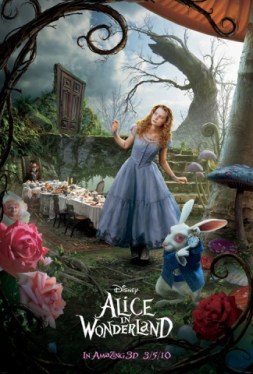
For thirteen years, 19-year old Alice Kingsleigh (Wasikowska) has been haunted by a nightmare about a strange world full of weird creatures. But Alice is about to learn that this other place is more than just a dream; she actually visited Underland as a little girl. Now, her old friends need her to return to fulfill a prophecy that shows her defeating the Jabberwocky and saving Underland from the tyranny of the evil Red Queen (Bonham Carter).

Tim Burton needs to have his creative license revoked until such time as he can demonstrate that he is able to use it responsibly. There is so much that is wrong with Burton’s Alice in Wonderland (a grossly-misleading misnomer, as the entire film takes place in “Underland” and a single throwaway line of dialogue near the end explains the discrepancy) that it is difficult to notice the brief flashes of things that are right. Most of these come courtesy of the cast, which is surely one of the most notable assemblies since, well, the last Harry Potter movie.

I am not primarily referring to the heavily-marketed and wildly-uneven Depp, here doing his best Carrot Top impression as the Mad Hatter. Wasikowska, still a relative unknown if not a newcomer, does a good job with a flatly-written character whose development never makes any sense, and Bonham Carter and Hathaway are delightfully broad in their depictions of royal sisters, the Red Queen and the White Queen. Best of all, though, are the actors whose faces we never see, like Alan Rickman’s all-too-brief scenes as the Caterpillar and Stephen Fry as the Cheshire Cat.

There ought to be something positive to say about the film’s visuals, as Burton is perhaps best known for his unique aesthetic. There are certainly some striking concepts in play at various points, but Alice in Wonderland is perhaps the most distractingly rendered movie I have ever seen. Virtually every frame seizes you by the lapels and screams, “I am a computer-generated image!” in your face.

With films like District 9 and Avatar bringing us real and CG images which convincingly inhabit the same space, the garish artificiality of Alice, in which none of the actors in any given scene appear to be performing in front of the same camera, looks primitive and lazy. The creature design runs the gamut from nearly realistic to totally cartoonish, while the human and human-like characters in the movie wander aimlessly through the uncanny valley. Their appearances are marked by an off-putting grotesqueness and their movements impaired by an odd, stop-motion jerkiness. Nothing ever looks quite right, and your eyes know it, even if your mind can’t quite process what the problem is.

None of this would matter a great deal if the film’s story weren’t the worst sort of disaster imaginable. Aside from the occasional laugh, screenwriter Woolverton has failed in nearly every way that it is possible to fail. The attempts to reference the original source are perfunctory and haphazard, but its very essence is sacrificed for a flavor-of-the-month, cookie-cutter fantasy quest involving the recovery of a special sword, the slaying of a terrible monster, the fulfilling of an ancient prophecy, and the salvation of an imaginary kingdom. The whole business is obviously meant to be some sort of sequel, as it repeatedly refers to Alice’s first visit, but it seems to be cherry-picking elements from Carroll’s Alice in Wonderland, Through the Looking Glass, and Disney’s 1951 animated classic completely at random. In short, it is a follow-up to a story that does not exist.

Finally, after a titanic but pointless battle between the Red Queen’s cards and the White Queen’s chessmen, the movie stops pretending and just jumps the shark. The Mad Hatter does an appallingly stupid victory dance to some upbeat pseudo-pop dreck, then Alice heads back to rejoin the framing story so she can apply the lessons of Underland to her own life. What that amounts to, in this case, is showing her new “empowered Victorian woman” chops by turning down the stuffy British lord she is supposed to marry. She then wows her father’s old business partner with a radical new idea: Why not be the first English company to open up trade with China? It’s so crazy that it just might work!

The absurdity of this proposition beggars the imagination. Leaving aside, if one even can, the fact that, by the time Carroll’s Alice in Wonderland was published in 1865, England had been trading with China for centuries, the implications of this development are almost too embarrassing to point out. After her transformation from eccentric, weak-willed girl to proto-feminist warrior woman, Alice’s first move is to open new frontiers in colonial imperialism. This exemplifies perfectly the inept, clueless inanity that seems to have informed nearly every filmmaking decision behind Burton’s Alice in Wonderland.
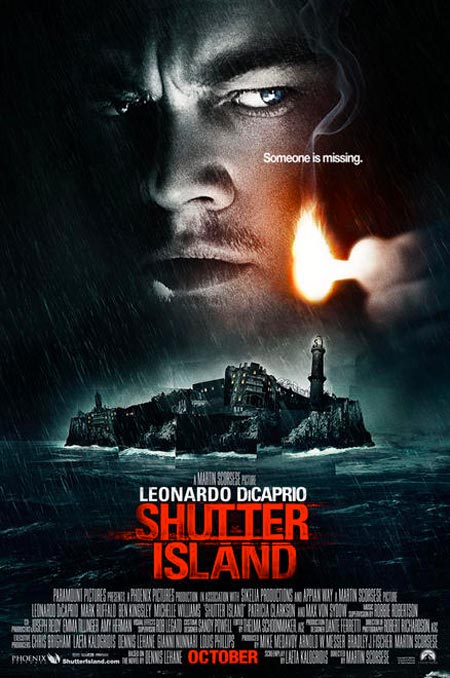
Shutter Island

•February 19, 2010 • Leave a Comment

starring Leonardo DiCaprio, Mark Ruffalo, and Ben Kingsley
written by Laeta Kalogridis & directed by Martin Scorsese
Rated R for disturbing violent content, language and some nudity.
97%

It is 1954, and U.S. Marshal Teddy Daniels (DiCaprio), along with his new partner Chuck (Ruffalo), has been summoned to an asylum for the criminally insane located on a remote island to look into the mysterious disappearance of one of the patients. Soon after their arrival, a violent storm cuts them off from civilization, and as the investigation continues it becomes increasingly obvious that nothing on Shutter Island is as it seems.

From the very first shot, Shutter Island sucks you completely into its world and never lets go. The cinematography, the setting, the costumes, the dialog; everything about this film is flawlessly crafted to create a perfect mood and then to sustain it. Meanwhile, the audience struggles in vain to piece together a carefully-rationed series of clues and avoid entrapment in the weird web that seems to have ensnared the characters. I cannot remember the last time I had a chance to see a suspense-thriller of this caliber.

As with all great examples of the genre, watching this film is not a passive experience. The movie demands that the audience grapple with its mysteries. Of course, being a genre piece, Scorsese is dealing with certain expectations and tropes. The dark, Gothic mood of the film which appealed to me may strike some viewers as totally overblown. Scorsese is hitting a lot of broad, familiar notes, certainly, but in a way that feels natural and justified (I’ll say no more lest I spoil the ending). Besides, anyone anyone who complains about the lengths this film goes to for the sake of atmosphere has forgotten what makes a thriller tick, or never knew in the first place.

Best of all, though, it never feels as though the movie is “cheating” or withholding vital information. Certainly a great deal of faith is required from the audience that all of the disparate elements floating around will eventually come together in a way that makes sense. However, all of the necessary clues are presented (in fact, virtually everything is a clue of some kind); the challenge is to piece them together for yourself before everything is revealed. This is not a film which requires a second viewing in order to make sense (although it would certainly be rewarding), but it does demand full attention the first time through. Hours later, small pieces are still be clicking into place in my mind as I continue to realize just how perfectly constructed the whole thing is.

Although Shutter Island is obviously being billed as yet another Scorsese/DiCaprio vehicle, it has an amazing ensemble cast. Basically every significant speaking role (however small) is filled by a performer that I am delighted to see. I should particularly note how nice it is to see Sir Ben Kingsley, the four-time Oscar nominee and Shakespearean thespian extraordinaire, for once taking on a project that is worthy of his immense talent (having appeared most recently as Guru Tugginmypudha in Mike Myers’ abominable The Love Guru).

In addition to Kingsley (and, of course, Ruffalo), there are also welcome appearances by Max von Sydow, Emily Mortimer, Patricia Clarkson, Ted Levine, and Jackie Earle Haley. I don’t want to downplay DiCaprio’s performance, however. Actually, that is hardly possible, as the nature of the narrative demands that he appear in every single scene. This places enormous weight on his performance, and it is only after the story has fully played out that it becomes clear what a subtle, delicate balancing act he has managed to carry off.

When I was a teenager, my favorite movie experiences took place in front of a tense thriller, watched late at night with my brother or a friend. I actively craved, and constantly sought, films that would keep both my mind and my heart racing frantically. These could be difficult to come by with any regularity (particularly in a foreign country), and that often meant relying on Alfred Hitchcock for my fix. I can think of no higher compliment to pay Scorsese’s latest film than to say that it carried me back to that earlier time, and conjured up all of the reasons why I loved the genre so much in the first place.

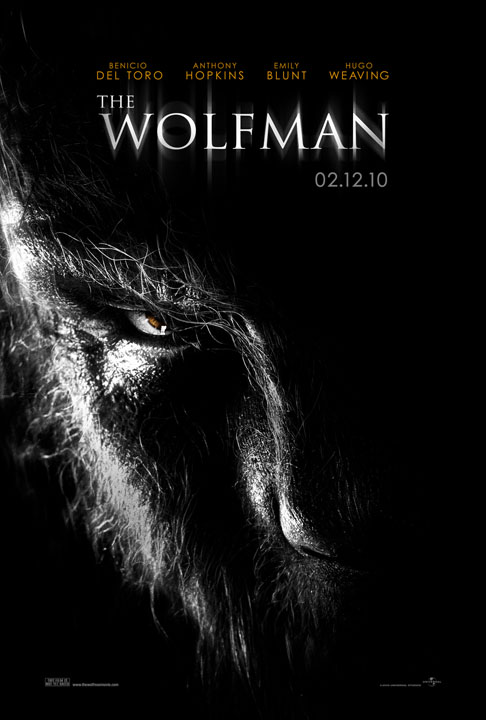
The Wolfman

•February 12, 2010 • Leave a Comment

starring Benicio Del Toro, Emily Blunt, and Anthony Hopkins
written by Andrew Kevin Walker and David Self & directed by Joe Johnston
Rated R for bloody horror violence and gore.
67%

After many years in America, Lawrence Talbot (Del Toro) returns to the family estate in rural England in response to a frantic letter about his brother’s mysterious disappearance from Gwen Conliffe (Blunt), his brother’s fiancee. Shortly after his arrival, his brother’s mutilated body is discovered, and panic sweeps through the small village as rumors circulate of a man who turns into a ravenous beast whenever the moon is full.

Top marks to the various ways in which The Wolfman pays homage to the classic 1941 The Wolf Man while trying to take the material in a new direction. For anyone who has seen the original (as I have just recently), it is fascinating to see how it has been reworked in surprising and (sometimes) clever ways. The first obvious change is the period setting; while the 1941 film was decidedly contemporary, the remake turns the clock back an additional half-century to cash in on our associations with a creepy, Victorian ambiance.

In some ways, this seems like the only smart move to make. Updating the story to the 21st-century would have been nearly impossible, and leaving it in the 1940s would appear almost as baffling. In any case, the filmmakers skillfully milk their chosen era for whatever they can; everything from making Talbot’s father, Sir John (Hopkins), an exotic big-game hunter with a mysterious Indian servant, to a brief but bizarre sequence in a 19th-century insane asylum. All of this, though almost totally reliant on cliches, works really well in building a mood around a solid aesthetic.

The Wolfman also throws in an A-list cast, which certainly isn’t common for a horror movie with somewhat disreputable (read: non-literary) origins. Del Toro is an excellent choice as the title character (which, I suppose, technically constitutes a spoiler), even though I was never remotely convinced that he was Hopkins’ son. Hopkins, of course, does very well in a role that ranges from subtle touches to over-the-top excess. Hugo Weaving (whom I can’t recall having seen in anything for some years) plays such a sympathetic antagonist that he threatens to shift audience loyalties. Meanwhile, Emily Blunt, enormously talented as she is, feels utterly wasted in her role. She is given virtually nothing to do, and (in the spirit of the period) even less to say.

Actually, the cast is so good that one almost doesn’t notice the movie wandering leisurely off the rails partway through (during the aforementioned asylum sequence), despite a sudden (though hardly unforeseen) twist in the plot. At this point, the remainder of the story unfolds with complete clarity before the viewer, and it simply becomes a question of how long it will take to play out. The answer, unfortunately, is “far too long.” I am not so easily bored that I felt that the movie had outstayed its welcome, but once the events that must transpire in the climax become obvious, it is generally time for the story to carry us there as swiftly as possible. As much as horror audiences appreciate thrilling action scenes involving buckets of stomach-churning gore, a few less guts and a few more cuts might have been in order here.

Then again, perhaps I wouldn’t have minded the longer journey as much if the ending hadn’t been so jaw-droppingly stupid, for reasons which were completely unnecessary. The writers managed to betray what had seemed like a very carefully-laid foundation of foreshadowing in a way that almost seemed as though they had forgotten about it entirely. In its place was the obligatory open-ended conclusion, brought about by the most implausible sequence of events imaginable. Actually, the most frustrating thing about the movie’s final moments is that they hit what would have been the perfect note, if only everything leading up to them hadn’t been so needlessly counter-intuitive.

The Wolfman is at its most entertaining when it is riffing on elements from the 1941 film, a pleasure that will be entirely lost on audiences that haven’t seen the original. Independent from that source, it offers very little to justify its existence. It is by no means a painful viewing experience; the worst that can be said about it is that it is quite forgettable. What it has to offer is some lightweight fun to carry audiences through the studio dumping ground of January and February, but (unsurprisingly) I do not think it will still be inspiring filmmakers and horror fans alike some 70 years after its release.

2010: An Oscar Primer

•February 2, 2010 • 4 Comments

So, the big day is finally here. Well, the big day that begins the lead-up to the big day. Because, love it or hate it, Oscar still rules the highbrow portion of the American move industry in a lot of ways. Today’s Oscar nomination announcements were of particular interest because this marks the first time in decades that the Academy (in what is basically a desperate grab for failing television ratings) has doubled the Best Picture field from 5 to 10.

I am basically of two minds about this decision. On the one hand, it was obvious that it would lead to nominations that should not even remotely be considered serious contenders for the top industry film award. On the other hand, I can’t deny that it makes things interesting. There may not be 10 worthy nominees for Best Picture, but there are definitely more than 5. (Actually, I should qualify that a bit. Of course there are 10 worthy nominees for Best Picture of 2009. However, many of them are nowhere near the Academy’s radar.) In any case, for me, nearly all of this morning’s surprises came from the Best Picture category, so I’ll move straight on to that.

Avatar – This is no great surprise, particularly after Avatar‘s big night at the Golden Globes. I’m sure fans of The Dark Knight are feeling a twinge of bitterness this morning, and I wonder just how much the backlash for the Academy’s failure to nominate that film last year had to do with what is obviously a populist choice this year. Then again, aside from the fact that this film is still raining giant buckets of money over a month after its release, Avatar does satisfy many of the tropes that Oscar loves in its films. The film has “only” 9 nominations: Best Director, Best Cinematography, Best Editing, Best Art Direction, Best Original Score, Best Sound, Best Sound Editing, and Best Visual Effects. Virtually all of those are technical awards, which is to be expected, and which (I hope) does not speak highly of its chances for the Big Award.

The Blind Side – I wish I could say I was more surprised by this choice, but I can say that I am far from pleased. I will confess right now that this is one of two Best Picture nominees that I have not yet seen, but this is definitely a pick that rings totally false in this category. Sports movies as a genre are as tired and formulaic as romantic comedies, and sports films dealing with racial issues have been absolutely done to death. I am not pleased at feeling obligated to see The Blind Side, with its mere 2 nominations. The other is, of course, for Sandra Bullock as Best Actress. Is it safe to say that the bigger nomination is the sole result of that performance? I don’t know, but I am sure there were other films more deserving of this spot. Where are the foreign films?

District 9 – This prompted my first real gasp of surprise. I enjoyed District 9 immensely. In fact, it was the only summer action-blockbuster that I did enjoy last year. But Best Picture? Really? On a practical level, Avatar has made far more money and its technical achievements have received far more attention, virtually guaranteeing this film also-ran status. However, it felt so fresh and original, that I can’t say I’m not happy to see it here. What a year for science fiction fans! District 9 has 4 nominations: Best Adapted Screenplay, Best Editing, and Best Visual Effects. I am pretty confident it will strike out in every category, but it should be proud to have made the list.

An Education – This film, which I managed to catch in November, was pretty much a lock. I expect it to be huge at the BAFTAs (or “British Oscars”). It’s a quiet, beautiful little film with a stand-out performance by Carey Mulligan, but (unlike The Blind Side) that isn’t the only thing going for it. There are 3 nominations for this film, with recognition for Mulligan’s performance (Best Actress) and a nod for Best Adapted Screenplay.

The Hurt Locker – This was my first pick for best film of the year when I saw it back in July. I immediately knew that it was one of the top films that I would see all year, and I have watched with pleasure as recognition and acclaim have continued to build. This is genuinely a fantastic movie, and I would be very happy to see it win. Matching Avatar, it has 9 nominations: Best Actor (Jeremy Renner), Best Director, Best Original Screenplay, Best Cinematography, Best Editing, Best Original Score, Best Sound, and Best Sound Editing.

Inglourious Basterds – I have to say that I am also pleased to see this film nominated. Never count Quentin Tarantino out. I didn’t go to see this movie when it first ran in theaters, but on the strength of the response it got, I went once it made it to the dollar theater. And then I promptly saw it a second time. There are some really interesting things going on beneath the surface of this movie, and of course it carries the inimitable flair of Tarantino’s style. I don’t believe that this film will win the big award, but I wouldn’t be upset if it did. Inglourious Basterds is nominated for 8 awards: Best Director, Best Supporting Actor (Christoph Waltz), Best Original Screenplay, Best Cinematography, Best Editing, Best Sound, and Best Sound Editing.

Precious: Based on the Novel Push by Sapphire – This is the other major nominee that I have not yet seen. Now, of course, I wish that I had. I missed a few opportunities to do so because I was never sure I was really in the mood for it, and now I have very little to say about it, except that it has a very respectable 6 nominations: Best Director, Best Actress (Gabourey Sidibe), Best Supporting Actress (Mo’Nique), Best Adapted Screenplay, and Best Editing.

A Serious Man – I am beyond thrilled to see this movie nominated. Its nomination is the best argument I can think of for having 10 nominees. It was the best film I saw this year, and perhaps even in the last few years. I cannot imagine that it will win, but I love that it is getting this kind of recognition and exposure. Of all the nominees this year, this is the one that I will be watching again and again and again. It only has 2 nominations, with one for Best Original Screenplay.

Up – 10 nominees or not, you could have knocked me over with a feather when this title appeared on the list. After the Academy’s unforgivable treatment of WALL-E last year, it seemed that the animation ghetto truly was impermeable. Up joins Beauty and the Beast as the only two animated films ever nominated for Best Picture (unless you count Avatar, of course), and it is the first animated film to be so recognized since the creation of a special animation category. I couldn’t be happier about that. Up received a total of 5 nominations: Best Original Screenplay, Best Original Score, Best Sound Editing, and Best Animated Film.

Up in the Air – This may end up being the most polarizing choice among the nominees. Its spot on the list has been a virtual lock for months, and (were it not for The Hurt Locker) I would say its chances for victory are excellent. Its fans are outspoken in their praise, but its detractors are equally vehement. I saw the film twice, and enjoyed it very much both times. I feel that it does deserve to be on the list, and I would not be appalled if it won, but there are no less than 4 superior films among the other nominees. Up in the Air has a healthy 6 nominations (although 2 are overlapping): Best Director, Best Actor (George Clooney), Best Supporting Actress (Vera Farmiga), Best Supporting Actress (Anna Kendrick), and Best Adapted Screenplay.

And now for a brief look at the other nominees, beginning with those which I have already seen:

Continue reading ‘2010: An Oscar Primer’

Mixing It Up

•January 12, 2010 • Leave a Comment

There wasn’t a lot of activity on Moviegoings last semester, but as I started to look over the list of films I’d seen, I realized that there was still a lot going on. A few years ago, I thought that before long it would start to become difficult to select 30 movies a year worthy of special attention (let alone 60, now that I’ve instituted my system of Honorable Mentions). It has become obvious to me that this is not the case. If anything, this was one of the most difficult selections I’ve made. I’ve been aware for some time that it isn’t possible to keep up with all of the movies released in the world, let alone make any real headway in catching up with the nearly century-long backlog that I’m working against. However, I’m beginning to realize that it may not be possible even to see everything that “the Critical Consensus” advises. In other words, I’m not going to suddenly run out of good movies to watch. Which is a pretty cool realization, actually. In any case, here are the best films I saw during the final months of 2009:

Inglorious Basterds

Fantastic Mr. Fox

The Fog of War

The Last Temptation of Christ

Toy Story 2

Kill Bill: Vol. 2

Almost Famous

Spirited Away

The Browning Version

A Serious Man

Roald Dahl was one of my favorite authors growing up (and still is), and I was super-excited when I learned that none other than Wes Anderson would be turning Dahl’s Fantastic Mr. Fox into a film. The final result did not disappoint. It is a model of how to get adaptation right, nailing the spirit and feel of the original while still making it your own and using it as a jumping-off point for exploring new themes and ideas. On top of which, it’s just a whole lot of fun.

Also on the animated front, I finally watched Hayao Miyazaki’s Spirited Away, and it is a masterpiece; probably one of the top 5 animated films ever made. And, finally, after enjoying the re-release of Pixar’s Toy Story movies as a 3D double feature, I realized that it had been a very long time since I had seen them at all. Including Toy Story 2 (one of the tiny handful of sequels that manages to top the original) is my way of honoring both of them.

Speaking of sequels, I also finally watched Quentin Tarantino’s epic Kill Bill movies. It’s kind of absurd to consider them separately, so again, the inclusion of the second volume (which I did enjoy more) is also a tip of the hat to the first. And then of course I have Tarantino’s latest, Inglorious Basterds, on here as well. I resisted seeing it for a time because I disliked the way that it was being marketed, but ultimately I gave in and was promptly blown away. I’m still not sure about the claim that I “haven’t seen war” until I’ve seen it “through the eyes of Quentin Tarantino,” but that’s not really the point.

On a related note, however, you really haven’t seen war until you’ve seen it through the eyes of Robert S. McNamara. But you won’t know that until you see The Fog of War, an amazing feature-length interview (well, it’s a documentary about his life and experiences, narrated by him) that I watched four times over Christmas break. I watched it because I’m trying to catch up with some of the most-acclaimed films of the past decade as I slowly craft a “Best of the Decade” list of my own (coming soon!). This also led me to see Almost Famous (which I had only managed to catch bits of before). On top of being incredibly entertaining, it had some really fascinating insights on American culture (specifically, musical culture).

On a totally unrelated note, my absolute favorite films of the past few months were the two at the bottom, both about academics (shock). I actually (coincidentally) watched them on consecutive days. The first is an older British film starring Michael Redgrave as a failed teacher of Greek, now rapidly approaching retirement and hoping pathetically for a sign that he has not completely wasted his career. The second is the latest film from the inimitable Coen Brothers; a hilarious, no-holds-barred spin on the book of Job, with a midwestern college physics professor in the 1960s standing in for the Old Testament patriarch. If you only see one movie this year  . . . etc.

Honorable Mentions:

The Earrings of Madame de…

A flawless exercise in cinematic form which tells a brilliantly executed story reminiscent of Gustave Flaubert’s celebrated Madame Bovary.

Eve’s Bayou

I had never even heard of this film before we watched it in the Contemporary Film Theory course I took last semester. It is a fantastic coming-of-age tale dripping with Gothic, Southern flavor.

Spartacus

I always forget how fantastic this movie is; truly one of the greatest cinema epics in film history. The big battle scene, accomplished without the aid of computerized special effects, is still a mind-boggling spectacle. It remains a fascinating story about a single man told on a scale that threatens to dwarf the imagination. Still hard to believe that this film was denied a Best Picture nomination in favor of John Wayne’s lifeless, overlong The Alamo.

The Firemen’s Ball

This quaint, hilarious comedy about the revels and travails experienced by the fire department of a small Czech village when they try to throw a party for a revered colleague was the last film made by Milos Forman (One Flew Over the Cuckoo’s Nest, Amadeus) under watchful communist eyes before he emigrated to the United States. Despite the best efforts of censors and bureaucrats, the film still manages to be delightfully subversive and rollicking good fun.

Avatar

Only time will tell how well James Cameron’s towering sci-fi epic holds up with future audiences, but there is little point in denying its current merits as an experience of pure spectacle. By sheer force of will, Cameron seems to have accomplished what most sci-fi filmmakers can only dream of: The thoroughly convincing creation of an alien world which audiences are invited to visit, if only for a few hours.

A Man for All Seasons

Even though it never quite manages to escape the confines of its stage-bound origins, this story of the martyrdom of Saint Thomas More at least has a magnificent screenplay to work from, and talented actors to deliver it. With dialog like it has, one can almost forget that it looks like a particularly stodgy and outdated period piece.

The Great Buck Howard

This is a weird little film that made very little noise when it was made just a few years ago. Featuring a flamboyant John Malkovich in the title role, and Colin Hanks (son of Tom) as the protagonist, The Great Buck Howard offers both a great character study, and an amusing, absorbing inside look at the lost art of the mentalist.

Zombieland

There were undoubtedly better movies released last year, but surely none of them was as much fun to watch as Zombieland. Good zombie films are so rare, that I can almost count them all on the fingers of one hand, and most of those are comedies. This is one of the best of both; a sort of American spin on Shaun of the Dead, substituting more gratuitous blood and gore, spectacular set pieces, and sight gags for the Brits’ witty satire.

Jesus of Montreal

I saw two very different Jesus films for the first time last semester as part of my independent study in film and theology. One is up there in my top ten (The Last Temptation of Christ, of course), and the other is here. Neither is particularly conventional in its approach, but this is perhaps the more traditional of the two. A talented actor, given a free hand to stage the local Catholic church’s annual passion play, steps into the part of a lifetime and finds that his own life will never be the same now that he has taken on the role of Jesus Christ.

Up in the Air

Perhaps it is all a bit slick and a bit pat, but this mainstream film that feels like an indie still has a lot of heart and feels extraordinarily timely. It slides comfortably back and forth between humor and pathos, and (while hitting a lot of the expected notes) manages to keep a few unconventional surprises up its sleeve.

Spring Movielogue, 2010

•January 11, 2010 • Leave a Comment

January 11 – May 12

# Title (Production Year) Rating% Date Watched — Review links, if any (*Title* denotes top ten movie of period)

1387 Creepshow (1982) 72% 1/11/2010
1388 Monster (2003) 79% 1/14/2010
1389 The Cutting Edge: The Magic of Movie Editing (2004) 84% 1/15/2010
1390 Grey Gardens (1975) 88% 1/15/2010
1391 America the Beautiful (2007) 85% 1/17/2010
1392 The Hours (2002) 79% 1/20/2010
1393 Erin Brockovich (2000) 87% 1/20/2010
1394 Second Skin (2008) 92% 1/22/2010
1395 Kiki’s Delivery Service (1989) 87% 1/24/2010
1396 Dracula (1931) 63% 1/25/2010
1397 Frankenstein (1931) 82% 1/25/2010
1398 The Constant Gardener (2005) 84% 1/25/2010
1399 In America (2002) 85% 1/26/2010
1400 Yi Yi (2000) 98% 1/27/2010
1401 Lost in Translation (2003) 99% 1/28/2010
1402 Friday Night Lights (2004) 92% 1/29/2010
1403 *Monster Camp* (2007) 94% 1/29/2010
1404 Hancock (2008) 45% 1/31/2010
1405 The Wolf Man (1941) 84% 2/1/2010
1406 Cat People (1942) 93% 2/1/2010
1407 The Seventh Victim (1943) 64% 2/1/2010
1408 *I’m Not There* (2007) 96% 2/3/2010
1409 Monsters, Inc. (2001) 95% 2/5/2010
1410 Ballast (2008) 64% 2/7/2010
1411 Phoebe in Wonderland (2008) 77% 2/7/2010
1412 Them! (1954) 84% 2/8/2010
1413 Invasion of the Body Snatchers (1956) 88% 2/8/2010
1414 Easy Virtue (2008) 66% 2/9/2010
1415 Precious: Based on the Novel Push by Sapphire (2009) 75% 2/11/2010
1416 The Wolfman (2010) 67% 2/12/2010 — Post
1417 Percy Jackson & the Olympians: The Lightning Thief (2010) 73% 2/12/2010
1418 Forgiving Dr. Mengele (2006) 79% 2/13/2010
1419 The Blind Side (2009) 61% 2/14/2010
1420 Match Point (2005) 92% 2/15/2010
1421 The Curse of Frankenstein (1957) 53% 2/15/2010
1422 Fiend Without a Face (1958) 74% 2/15/2010
1423 United 93 (2006) 95% 2/16/2010
1424 Crazy Heart (2009) 78% 2/18/2010
1425 A Single Man (2009) 74% 2/18/2010
1426 In the Loop (2009) 95% 2/18/2010
1427 *Shutter Island* (2010) 97% 2/19/2010 — Post
1428 The Cove (2009) 93% 2/19/2010
1429 The Pervert’s Guide to Cinema (2006) 76% 2/20/2010
1430 Trumbo (2007) 81% 2/20/2010
1431 Bright Star (2009) 84% 2/21/2010
1432 Eyes Without a Face (1960) 88% 2/22/2010
1433 *Suspiria* (1977) 94% 2/22/2010
1434 The Hangover (2009) 76% 2/23/2010
1435 Wallace and Gromit: A Matter of Loaf and Death (2008) 79% 2/25/2010
1436 *State of Play* (2009) 92% 2/25/2010
1437 All the Real Girls (2003) 57% 2/26/2010
1438 4 Months, 3 Weeks and 2 Days (2007) 95% 2/26/2010
1439 Run Fatboy Run (2007) 91% 2/26/2010
1440 Munyurangabo (2007) 72% 2/28/2010
1441 Invictus (2009) 95% 2/28/2010
1442 Let the Right One In (2008) 96% 2/28/2010
1443 Lust, Caution (2007) 97% 3/1/2010
1444 Repulsion (1965) 74% 3/1/2010
1445 Flags of Our Fathers (2006) 93% 3/3/2010
1446 25th Hour (2002) 58% 3/4/2010
1447 Alice in Wonderland (2010) 52% 3/5/2010 — Post
1448 Oldboy (2003) 76% 3/5/2010
1449 G.I. Joe: The Rise of Cobra (2009) 54% 3/6/2010
1450 Anchorman: The Legend of Ron Burgundy (2004) 77% 3/6/2010
1451 The Beach (2000) 83% 3/8/2010
1452 *Raising Arizona* (1987) 96% 3/13/2010
1453 Tormented (1960) 0% 3/13/2010
1454 Hulk (2003) 84% 3/14/2010
1455 Walk the Line (2005) 92% 3/15/2010
1456 The Texas Chain Saw Massacre (1974) 67% 3/15/2010
1457 Sideways (2004) 86% 3/15/2010
1458 The Last Word (2008) 53% 3/16/2010
1459 Broadcast News (1987) 83% 3/17/2010
1460 Saving Private Ryan (1998) 90% 3/17/2010
1461 Ghost in the Shell (1995) 73% 3/19/2010
1462 Jason and the Argonauts (1963) 82% 3/20/2010
1463 The Brothers Bloom (2008) 72% 3/20/2010
1464 WarGames (1983) 91% 3/21/2010
1465 *The Thin Red Line* (1998) 99% 3/21/2010
1466 The Fly (1986) 87% 3/22/2010
1467 American Psycho (2000) 93% 3/24/2010
1468 *How to Train Your Dragon* (2010) 95% 3/26/2010 — Post
1469 A Nightmare on Elm Street (1984) 87% 3/29/2010
1470 King Kong (2005) 76% 3/29/2010
1471 Séraphine (2008) 81% 3/31/2010
1472 *The Ghost Writer* (2010) 94% 3/31/2010
1473 The Eyes of Tammy Faye (2000) 91% 3/31/2010
1474 Clash of the Titans (2010) 68% 4/1/2010
1475 Good Hair (2009) 87% 4/2/2010
1476 Clash of the Titans (1981) 71% 4/2/2010
1477 The Curse of the Jade Scorpion (2001) 51% 4/3/2010
1478 Deconstructing Harry (1997) 61% 4/5/2010
1479 The Winslow Boy (1999) 93% 4/5/2010
1480 Rosemary’s Baby (1968) 94% 4/7/2010
1481 Diary of a Wimpy Kid (2010) 63% 4/8/2010
1482 Confetti (2006) 83% 4/9/2010
1483 A Fish Called Wanda (1988) 85% 4/10/2010
1484 MASH (1970) 95% 4/12/2010
1485 The Brood (1979) 65% 4/12/2010
1486 *The Descent* (2005) 94% 4/12/2010
1487 Bullets Over Broadway (1994) 71% 4/16/2010
1488 Inferno (1980) 81% 4/18/2010
1489 Mother of Tears (2007) 24% 4/18/2010
1490 *Catch-22* (1970) 98% 4/18/2010
1491 The Evil Dead (1981) 51% 4/19/2010
1492 Evil Dead II (1987) 81% 4/19/2010
1493 Scream (1996) 94% 4/19/2010
1494 Oceans (2009) 88% 4/22/2010
1495 Jacob’s Ladder (1990) 89% 4/26/2010
1496 The Book of Eli (2010) 67% 4/30/2010
1497 Capitalism: A Love Story (2009) 88% 5/3/2010

Avatar

•December 18, 2009 • 4 Comments

starring Sam Worthington, Zoe Saldana, and Sigourney Weaver
written & directed by James Cameron
Rated PG-13 for intense epic battle sequences and warfare, sensuality, language and some smoking.
94%

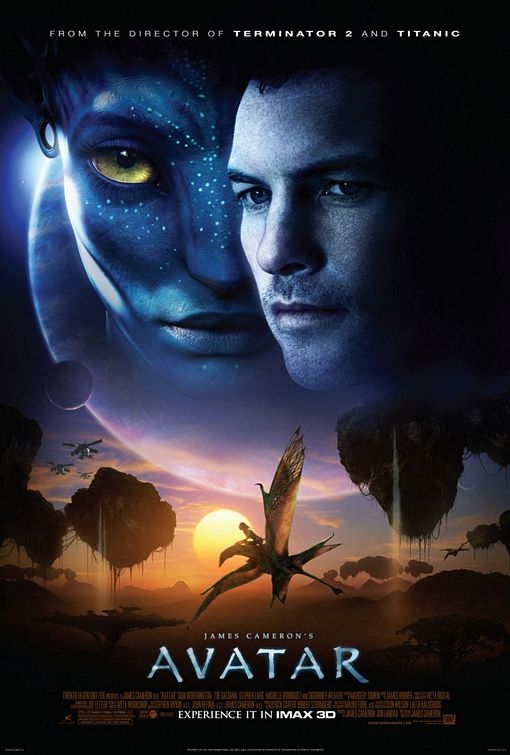
Paraplegic former marine Jake Sully (Worthington) arrives on the alien world of Pandora to join an ongoing military/industrial operation. As a genetic match for his dead twin’s “avatar,” a genetically-created alien body remotely controlled by a human operator, Jake will be part of a team of scientists, led by Dr. Grace Augustine (Weaver), whose task is to learn about the native Na’vi race inhabiting the planet. Secretly recruited by the ruthless Colonel Quaritch to spy on the aliens, Jake’s loyalties are soon divided after he is saved by Neytiri (Saldana), the daughter of a Na’vi clan leader, and begins to gain acceptance in the alien society.

To call Avatar a thinly-veiled parable about European exploitation of Native Americans, told by way of movies like Disney’s Pocahontas, would be misleading; the word “veiled” implies a cover-up, while Avatar wears its allusions (cliches?) proudly and openly (even as it subtly rewrites a few). Anyone who has seen a historical film involving Native Americans in the last twenty years will immediately recognize that Avatar isn’t going to win any awards for telling an original or unpredictable story. Nevertheless, this is arguably the most epic and immersive big-budget attempt at world-building since the final installment of Peter Jackson’s Lord of the Rings trilogy was released six years ago, and it compellingly demonstrates a large step forward for digital filmmaking technology. And it’s pretty darned entertaining, to boot.

There are plenty of complaints one could register about this film. In some ways it even invites them. But all of them miss the point. Picking on this movie’s thin plotting and flat character development is kind of like being a passenger on the first commercial airplane flight and complaining that the seats are too hard and the in-flight peanuts are too salty. You’re flying through the air in a giant man-made bird. How about taking a look out the window? James Cameron has literally dreamed up an entire planet, populated with fully-realized landscapes, flora, and fauna out of his imagination, and then invented the technology that would allow him to take the rest of us for a visit. I’m willing to forgive him for skimping a little on the story he tells us when we get there.

One of the amazing things about Avatar is its self-confidence and its complete commitment to the world of Pandora. A lesser artist, or one intent on cutting corners, would cover up imperfections with shadows, long shots, and quick cuts. Cameron, however, allows us time and time again to examine Pandora’s exotic inhabitants in well-lit, tight close-ups, and sometimes even in slow-motion. This is the work of a director who has nothing to hide and nothing to be ashamed of. He knows that audiences will want a good look, and he is more than happy to oblige. Similarly, Jake Sully, unlike many fantasy and science fiction heroes who find themselves in strange and unusual environments, doesn’t take his surroundings for granted. He gawks and gapes, and exhibits an infectious joy in the environment surrounding him. Pandora is unlike anything he has ever seen or experienced, and the same goes for the audience.

These scenes are the film’s greatest strength, fitting right in with other memorable moments of technologically-created wonders like the first glimpse of Steven Spielberg’s digitally-created dinosaurs in Jurassic Park, bullet-time in The Matrix, and the giant clashing armies of Lord of the Rings. To that list I would add Jake’s first flight on his “Banshee” mount, a scene that is glorious, exhilarating, and totally convincing. The high-flying action in Avatar is so immersive, especially in 3D, that it may invoke mild cases of acrophobia.

By the time Avatar moves into its third act, the storytelling is on autopilot. The movie delivers an action-packed final battle that perfunctorily hits all of the notes I came in expecting it to hit. But, if there are no surprises to be had in the final hour, it still can’t be denied that the movie delivered exactly what I paid to see. The finale is no less thrilling for being predictable. In fact, that description sums up perfectly my oxymoronic take-home feeling about this film as a whole.

Yet, despite the shallowness of the storytelling, audiences attuned to theological concepts will note a strange affinity between Avatar and the writings of the Apostle Paul. It would be a mistake to read too deeply, but as Jake slowly begins to put aside his old, crippled human body and take on the form of the graceful, athletic Na’vi, he also begins to reject his human vices (selfishness, dishonesty, pride) in favor of Na’vi virtues (compassion, respect, community). All of this puts me in mind of Paul’s advice to the early church to “put off the old self” and “put on the new self” (Ephesians 4:22-24, Colossians 3:9-10). Audiences will come to Avatar to experience the adventure and the excitement of visiting another world, but they may just leave with more than they expected.

Theological Moviegoings: Babette’s Feast

•October 20, 2009 • 4 Comments

babettesfeast

Babette’s Feast is so quiet and understated that it is easy to forget what a glorious little film it really is. There is beauty and a deceptive simplicity, but also great depth and meaning, in this story about the spiritual renewal of a fading sect of elderly Lutherans on the barren Jutland coast. Actually, the fable-like tale is rather slight, essentially providing important background information to set up the titular meal, which takes up the final third of the movie.

Two elderly sisters, Martina and Philippa, dutifully carry on the spiritual legacy of their father, a tradition built on asceticism, regularly convening his tiny congregation to discuss his teachings and serving their little community as best they can. They are aided in their task by a French servant named Babette, whose presence is explained through a series of flashbacks which briefly outline the sisters’ lives. Regarded as great beauties in their youth, each sister is courted by a glamorous visitor to their small village.

Martina is courted by Lorenz Lowenhielm, a dashing young soldier who has been sent to stay with his elderly aunt as a sort of punishment for his large gambling debts. Enticed by Martina’s beauty, Lowenhielm begins attending her father’s prayer meetings, but eventually he decides to return to his own world. As the years go by, he proves adept as both a military man and at court and rises to the rank of general. On the night of the feast, he has returned to visit his aunt (who must be well over 100 by now, but nevermind), and so he finds himself sitting at Martina’s table once again, this time under very different circumstances.

Meanwhile, Philippa is courted by Achille Papin, a celebrated French opera singer who is lured into the village church service by the sound of her voice. He immediately goes to her father and offers to give voice lessons, but it soon becomes clear that he is not interested in her for musical reasons alone. Eventually, Philippa grows uncomfortable with Papin’s romantic lyrics and promises of stardom in Paris, and she asks her father to discontinue the lessons. Papin returns to Paris, dejected. However, some years later, he sends Babette to seek shelter with the two sisters when she is forced to flee Paris.

With all of these elements in place, the stage is set for what is to come. The old minister has been dead for many years, but a loyal group of elderly villagers still meets faithfully to discuss his teachings. With his 100th birthday approaching, his daughters want to have a modest celebration in his honor. Their quiet plans are somewhat derailed, however, when Babette discovers that she has won 10,000 francs in the lottery and insists on treating the sisters and their friends to a proper birthday feast. Martina and Philippa feel that they cannot deny Babette this, the first favor she has ever asked of them, but they resolve (along with their father’s other disciples) not to take any pleasure in the decadent meal.

Babette’s Feast is constructed around this tension between the spirit and the flesh, a conflict most Christians understand all too well. The sisters and their friends live a very simple life, partially due to circumstances, but also by choice. The old minister has taught them that only the spirit is pure, while the flesh is evil and its  pleasures are wholly corrupt and sinful. As a result, they have rejected earthly comforts in pursuit of higher things. The world they inhabit is cold and gray and empty of joy, and director Gabriel Axel spends most of the film avoiding bright colors, even keeping scenes with candlelight to a minimum until the evening of the feast. As the guests arrive, the film is suddenly bathed in a warm, cozy glow, as if preparing us for the transformation of this small community. They take their places around the table, stony-faced and firm in their resolve not to enjoy themselves.

As dish after dish comes out and fine wine is poured, the guests chew and swallow mechanically, as though they encountered this sort of meal every day. As if to encourage one another and avoid temptation, they piously quote the minister’s words to one another: “Man shall not only refrain from, but also reject any thought of food and drink. Only then can he eat and drink in the proper spirit.” General Lowenhielm, the only one present who can genuinely recognize and appreciate the magnificence of the meal, is simultaneously baffled by their reaction and enraptured by the food in front of him.

Aside from Babette herself, Lowenhielm is the most intriguing character in the film. His brief experience with the minister’s sect in this remote outpost seems to have pushed him to the opposite extreme from the day-to-day life of the ascetics. Cynically using what he learned to manipulate the fashionable interest in religious piety at court facilitated his pursuit of wealth and power. There is a sense that he has lived every day to the fullest, experiencing everything that life on earth has to offer. He is a man who has accomplished everything he set out to achieve.

On the day of the feast, as he prepares to accompany his aunt to visit the woman he once loved, he stares at himself in the mirror and wonders whether he made the right decision all those years ago, believing that, somehow, his question will be answered during the course of the evening. “You must prove to me,” he tells his younger self, “that the choice I made was the right one.” In the end, his question will be answered, but in a way that he never expected.

As the meal goes on, the guests talk less and less, and they begin to beam at one another, quietly sharing the joy of the feast with a sense of true community that they do not seem to have experienced in some time. Meanwhile, Lowenhielm is deep in thought. At last, he taps his glass and stands to his feet to say a few words:

Mercy and truth have met together. Righteousness and bliss shall kiss one another. Man, in his weakness and shortsightedness believes he must make choices in this life. He trembles at the risks he takes. We do know fear. But no. Our choice is of no importance. There comes a time when our eyes are opened and we come to realize that mercy is infinite. We need only await it with confidence and receive it with gratitude. Mercy imposes no conditions. And lo! Everything we have chosen has been granted to us. And everything we rejected has also been granted. Yes, we even get back what we rejected. For mercy and truth have met together, and righteousness and bliss shall kiss one another.

The others likely do not fully understand the significance of his words, nor would they have been able to articulate their experience so well, but everyone seems to recognize that something profound has transpired. Lowenhielm has come to the table full of questions, and found that none of them matter in the light of divine love and grace. And, even though the others may not genuinely understand what has taken place that night, they are no less affected by it.

Throughout the film, the congregation is frequently shown singing a particular hymn about “Jerusalem, my heart’s true home.” Encapsulated in this line is the longing for Home keenly felt by this group of Christians. It is a longing for a place which, for them, cannot be experienced in their present life, but they obviously feel the lack of it. However, Babette, through the power of her artistic ability, brings the community together for a taste of precisely what they all desire. It is a profoundly spiritual experience which, unexpectedly, begins by satisfying fleshly appetites.

It is no surprise, then, to find that Babette’s character resonates so powerfully with Christlike significance. She is the source of the divine love, grace, and revelation felt and experienced by the twelve (yes, twelve) guests gathered for this symbolic meal. Her own pleasure (for she enjoys very little of the food she has prepared) is in serving those she has invited to the feast. And there are uninvited guest, as well. As the meal is served, Babette invites the General’s driver into the kitchen to partake of each dish, too. Her gift is not something which is extended only to a select elite, but to everyone.

In the final twist, as the sisters prepare to say farewell to Babette, they (and we) we learn that she has spent her entire winnings on the lavish feast, literally gifting the community with everything she has, and that she plans to stay on and serve the sisters as before. “But dear Babette,” they protest, “you should not have given all you owned for us.”

“It was not just for you,” Babette replies.

“Now you’ll be poor for the rest of your life.”

“An artist is never poor.” The film ends with the recognition that the sisters’ understanding of God was incomplete, and that Babette has blessed them and their Christian brothers and sisters with renewed fellowship through a kind of pleasure and joy which they had not expected to encounter in this life. As a film, Babette’s Feast offers similar blessings to any viewers who approach it with a willingness to receive its message of grace and community through artistic service.

Theological Moviegoings: The Mission

•October 13, 2009 • 1 Comment

themission

When I first saw The Mission a few years ago, I was shocked that I had not heard it spoken of more often. Here was a PG-rated (that is, “family-friendly”), Oscar-nominated film worthy of serious artistic and spiritual consideration. It beautifully and movingly tells the story of 18th-century Jesuit missionaries in South America, and of their struggle to protect indigenous people from enslavement and exploitation by greedy colonial governments with the tacit consent of the politically weak Catholic leadership.

Although it won the Palme d’Or at Cannes, The Mission lost a number of Oscars to Platoon, a film which is (among other things) far more uniformly critical of colonialism and its effects. By now, the conventional wisdom is that The Mission lacks the raw affective power of director Roland Joffé’s The Killing Fields (1984). Substantive criticism tends to focus on two things. First, that the film seems to sprawl across multiple loosely-connected storylines which never quite come together in a satisfying manner. Second, that despite its seemingly post-colonial point of view, The Mission still consistently privileges its European characters, in some sense effectively “othering” the natives as characters and as people.

The latter criticism is a fair one, in that it is well-worth being aware of the film’s priorities. Ultimately, though, what it amounts to above all is that Joffé has failed to make the movie that his critics would have made. Although The Mission ends with a call to action on behalf of the South American descendants of the natives in the movie, its central purpose is really to explore the choices faced by individual Christians when their spiritual values clash with the political needs of the institutionalized Church.

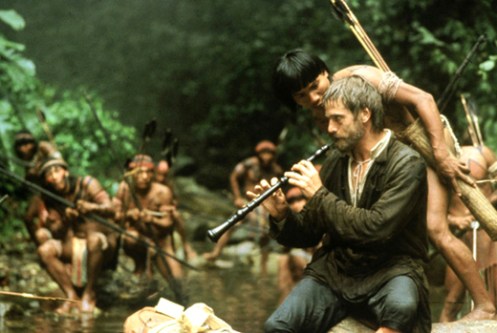
The former criticism is, more than anything, dependent on whether or not a particular viewer is caught up in the world of the film. There is, undeniably, a lot going on. Father Gabriel climbs a treacherous waterfall and treks deep into the jungle to plant a mission amidst a hostile tribe that has already made his predecessor a martyr. Meanwhile, Rodrigo prowls the same jungles, hunting natives to feed the profitable European slave trade while his lover carries on an affair with his brother. Finally, Altamirano arrives as the pope’s representative to decide whether or not the Church will continue to protect the Jesuit missions, although his choice seems predetermined. All of these subplots play out at a very deliberate pace, unfolding in their own compartmentalized segments before things begin to really come together.

From the opening moments of the film, we know the outcome of Altamirano’s visit. He dictates a letter to the pope which begins, “Your Holiness, the little matter that brought me here to the furthest edge of your light on earth is now settled, and the Indians are once more free to be enslaved by the Spanish and Portuguese settlers.” So much for suspense. Instead, the story becomes an extended flashback, with Altamirano’s voice-over to fill in period details. From amidst the web of thematic developments that weave their way towards resolution throughout The Mission, I would like to pluck three filaments as worthy of special attention: Rodrigo’s Pauline conversion, Altamirano’s dilemma, and the final philosophical clash between Rodrigo and Father Gabriel as the European soldiers advance on their remote mission.

Father Gabriel is the saintly hero of The Mission, but Rodrigo is its true protagonist. He is flawed character, and his spiritual struggles are easy to relate to. Not all of his actions are easy to sympathize with, perhaps most obviously the murder of his brother in a duel. It is this, at least, and not the ruthless enslavement of the native population, that leads him to a state of brokenness and ultimately salvation. Rodrigo’s temper leads him to do abhorrent things, but when it gets the better of him later, prompting him to challenge the lies of the Spanish and Portuguese colonial leaders, the audience secretly cheers.

We have a particular stake in Rodrigo’s spiritual journey, so potently symbolized by his struggle into the depths of the jungle dragging his weapons and armor as a burden behind him, because if even he can seek and find redemption, there is hope for everyone. The penance he undertakes is not suggested, or even encouraged, by the other Jesuits. In fact, one of the brothers even attempts to cut the burden free. From the standpoint of the Church, Rodrigo’s sins are already paid for, but he cannot be at peace with himself until he undertakes this task.

In doing so, Rodrigo at first rejects both the power of Christ’s atonement for his sins and the support of his Christian brothers, who stand ready to help carry him on his journey. However, when he reaches the top of the waterfall and confronts the people he has persecuted for so long, one of them steps forward and slices the armor free with his knife, pushing it off into the roiling water. Only then, as he weeps at this human reflection of divine grace, does Rodrigo realize that his own salvation is unconditional, not something to be earned through his own strength of body or of will.

However, Rodrigo’s journey from violent mercenary to Jesuit missionary is only half of the story. Complications arise with the arrival of Altamirano, who ought by rights to be the villain of this film. Instead, he wins our sympathy as it becomes more and more clear that he has no real power over the decision he was sent to make. His complacent cynicism, which had allowed him to rationalize that sometimes a limb must be hacked off in order to save the body, has left him completely unprepared for, as he puts it, “the beauty and the power of the limb [he has] come to sever.” Before his visit to the missions, he is detached and aloof; an impartial judge. Afterward, he is tormented, by turns delighted by what he sees, and horrified at what he must do to it.

Father Gabriel and the other Jesuits have come together with the jungle tribes to realize the Kingdom of Heaven on earth. It is the Church in its purest state, a peaceful commune devoted to worship and fellowship. Altamirano senses that perhaps he has not been sent merely to amputate a limb, but to carve out the very heart of the Church. Perhaps his very position shows that the heart of the Church has already stopped, and that what is left is a hollow shell made to dance, puppet-like, in support of the will of the State. In any case, although the outcome is inevitable, Altamirano begins to stall for time, praying for guidance even as he searches for a non-existent alternative.

The film’s last act centers on the destruction of the missions and the slaughter of their inhabitants. European troops arrive last at the smallest and most remote of the missions, where Father Gabriel and Rodrigo have argued heatedly over how to respond to their attackers. Rodrigo wishes to renounce his his vows and pick up his sword once again, while Father Gabriel is adamant that he must act as a priest, in love.

Although he refuses to endorse Rodrigo’s choice, Father Gabriel concedes that he must do what he thinks is right. “If might is right,” he says, “then love has no place in the world. It may be so, it may be so. But I don’t have the strength to live in a world like that, Rodrigo.” Ultimately, Rodrigo, along with some of the other priests and a large group of natives, make the advancing troops pay dearly for their victory, but it remains a resounding victory and all of them are slaughtered. Meanwhile, Father Gabriel leads the remaining natives in a worship service before they, too, are cut down by gunfire and bayonets.

When the Jesuits all stay behind to die at their posts, Altamirano is left to bear lonely witness to glory of the missions and the travesty that befell them, and to live with his own complicity in their destruction. (“Thus have we made the world,” he tells the colonial governors. “Thus have I made it.”) This is, in fact, the metanarrative of the film itself. It is Altamirano’s account, told for our benefit as a call to action. This is underscored by the film’s final frame, which appears after the credits have ended. Altamirano appears in close-up, staring solemnly out at the audience. Shattering the fourth wall, his gaze dares us to ignore what we have seen and challenges us with a vision of what the Church, for one brief moment in history, achieved when it genuinely undertook to live up to the radical teachings of the gospels.

Intermission: The Toy Story 3 Trailer

•October 10, 2009 • Leave a Comment

The Toy Story/Toy Story 2 double feature in 3D is about halfway through its theatrical run and I had a chance to catch it last night. I highly recommend the experience. I haven’t seen either film in several years, and I never actually saw the first Toy Story on the big screen. It was a fun and memorable night at the movies, and both films have held up beautifully on both a visual and narrative level. Definitely take the time to refresh your memory of these animated classics if you have the chance. It’s amazing to look back from here and remember that the first full-length CG film appeared just 14 years ago (I was 12). And yet, despite how far the medium has come (as Pixar continues to break new ground), that first foray still looks incredible.

Anyway, while you’re thinking, check out the new trailer for next year’s long-awaited continuation of the series: Toy Story 3. After watching the first two movies back-to-back, I’m really looking forward to whatever is in store for these characters next. Enjoy.

Vodpod videos no longer available.

more about “Movie-List – Toy Story 3 Trailer Page“, posted with vodpod