I’m Still Here

•March 7, 2014 • Leave a Comment

I’ve been allowing something silly to slow my writing on Moviegoings down to practically nothing for basically the past year. I can hardly believe it’s been that long, but it was hard not to notice, when I popped on to discuss this year’s Oscar nominations, that my discussion of last year’s nominations was still present on the “Recent Posts” list. Oy. Well, that simply won’t do.

It’s not like I have nothing to say, and nothing in mind to write about. In fact, it’s not even like I haven’t been writing. That’s the real culprit, actually. I’ve been writing, but what started out as a small project for this site, grew into a largeextensive project for this site, and then grew even more until it was well beyond that scope entirely. You’ll notice a few posts back that early last May, I wrote an introduction to a list of films that I was busily compiling, with the promise that the list itself would appear “in the coming weeks.” By that point, I’d already been working on the project for over a month, and it has continued to expand until I decided that it might be better-suited to an entirely different venue, unless I allowed it to completely take over this site.

But, while I worked busily on it (and other parts of my life kept me even busier), I allowed the promise of that forthcoming project to dangle in the doorway, blocking the ingress of any other creative work for months and months.

Oops.

Suffice to say, I haven’t stopped watching movies, and I have a number of ideas that I’m anxious to bring to Moviegoings, soon. I don’t know how soon, but for some reason I didn’t want to just reappear as mysteriously as I disappeared and carry on as though I didn’t leave things hanging here (literally with an ellipsis) in the middle of last year.

Meanwhile, the day-to-day chronicling of my film habit mostly takes place over on Letterboxd (find and follow me here!). I even write the occasional review. I’m anxiously waiting for the Letterboxd team to implement more cross-platform integration stuff so that I can have a running feed of my Letterboxd activity here on Moviegoings. And I have another brand-new Moviegoings venture that I’ll be unveiling soon, as well!

This site remains a good platform primarily for long-form, high-quality work that I can be proud of (at least that’s the goal), and that sort of thing takes a lot of time and effort and energy to write, all of which are severely-limited resources at this stage in my life. Nevertheless, it’s still something I love doing, and something I’m passionate about doing, so I plan to keep doing it, whenever and however I can. Even if it’s to a mostly-empty room, because no one reads a blog that never gets updated!

2014: An Oscar Commentary

•March 2, 2014 • Leave a Comment

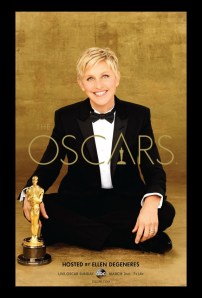
Well, here we are again, almost too tired to be happy about the final outcome, but at least content. This is the year that I begin to despair that the people behind the Oscars will ever figure out how to turn the awards ceremony into compelling television. I liked DeGeneres as a host, overall. Certainly she was better (and the show was better) than last year’s obnoxious MacFarlane catastrophe. But it was also bland and dull to the nth degree.

I detected far fewer attempts to appeal to a younger audience, which is always obnoxious, but also very little spontaneity. I mean, the point of spontaneity is that you can’t plan it in advance, but they couldn’t seem to get anyone up on the stage who was entertaining. And no, John Travolta butchering Idina Menzel’s name doesn’t count.

If I’m calculating this correctly, we’ve got 7 wins for Gravity, 3 wins for 12 Years a Slave, 3 wins for Dallas Buyers Club, 2 wins for Frozen, 2 wins for The Great Gatsby, and 1 win apiece for Blue Jasmine and Her. That’s a total shut-out for 5 of the Best Picture nominees. American Hustle is the biggest loser, with 0 out of 10 wins, but PhilomenaCaptain PhillipsNebraska, and The Wolf of Wall Street all departed empty-handed. I suspect history will judge the Academy the most harshly over that last.

The awards I’m most upset about are Her‘s win for screenplay and Gravity‘s win for score. I’d have liked to see 12 Years a Slave take  both of the awards that went to Gatsby, and at least a few of the awards that went to Gravity, but the important thing was that it be recognized as the Best Picture.

Anyway, I haven’t got much more to say this year. The lackluster energy of the show has left me similarly unenthusiastic, so I’ll leave it at this. We now return you to your regularly-scheduled film year.

Continue reading ‘2014: An Oscar Commentary’

2014: An Oscar Primer

•January 23, 2014 • 2 Comments

oscars2014posterWe have a very interesting group of nominees this year. At least, that’s my thought as I scroll down the list I’ve compiled of the various titles. I’ve seen about half of them (counting the foreign and documentary categories, of which I’ve seen three), and I’m excited to see many of the rest. (And mad about seeing one of them, but we’ll get to that.)

There are 9 Best Picture nominees again this year:

12 Years a Slave – Steve McQueen adapts Solomon Northup’s harrowing first-hand account of being kidnapped in the North and sold into slavery in the American South prior to the Civil War. The film is as sickening as it is compelling, a must-watch that is incredibly hard to watch. I was completely enthralled by it from start to finish, and I consider it clearly the best film of the year, but I’m not sure I’ll ever be able to watch it again. It’s obvious quality and prestige will serve it will at the Oscars, but I wonder if the difficulty of its subject will ultimately hurt it with Oscar voters. We shall see. The movie is nominated for 9 awards: Best Actor, Best Supporting Actor, Best Supporting Actress, Best Director, Best Adapted Screenplay, Best Editing, Best Production Design, and Best Costumes.

American Hustle – With great performances by Christian Bale, Amy Adams, Bradley Cooper, Jennifer Lawrence, Jeremy Renner, and many others, American Hustle is a smart, stylish romp based on the true story of how the FBI caught a small-time con artist, and then used him to run an operation designed to root out political corruption. Funny, poignant, and loaded with drama, American Hustle is a real crowd-pleaser, and its cast is one of the most charismatic I can recall. It has 10 nominations: Best Actor, Best Actress, Best Supporting Actor, Best Supporting Actress, Best Director, Best Original Screenplay, Best Editing, Best Production Design, and Best Costumes.

Captain Phillips – Tom Hanks plays the captain of a cargo ship who faced off against a gang of Somali pirates in 2009, leading to a tense hostage situation involving the US Navy. The story is very gripping, and director Paul Greengrass once again delivers an incredible true story so recent that most of the audience will remember hearing about it when it happened, with all of the raw intensity and attention to detail we’ve come to expect from him. Captain Phillips is nominated for 6 awards: Best Supporting Actor, Best Adapted Screenplay, Best Editing, Best Sound Mixing, and Best Sound Editing.

Dallas Buyers Club – With stellar work by both Matthew McConaughey and Jared Leto, Dallas Buyers Club takes us back to the  terror of the early days of the AIDS epidemic. It tells the true story of Ron Woodroof, a homophobic, womanizing Texan who splits his time between booze, drugs, working as an oil-field electrician, and scamming gamblers at the local rodeos. All of that changes drastically when he learns that he has AIDS, and he eventually ends up battling the DEA and the FDA as he attempts to supply the surrounding community with experimental treatments smuggled in from around the world. I’m not sure I’d call his story “inspirational,” though it has its moments. Mostly, it is an incredibly compelling character study of a two-bit hustler who not only refused to succumb to the odds, roll over, and die, but even managed to use his questionable talents to thrive for a time in a role that no one else could have filled. The film has 6 nominations: Best Actor, Best Supporting Actor, Best Original Screenplay, Best Editing, and Best Makeup.

Gravity – Alfonso Cuaron gave us the spectacle of the year with this intense, thrilling depiction of a space mission gone horribly wrong. What it lacks in plot and character development, it certainly makes up in sheer big-screen, 3D experience. For 90 minutes, you are in outer space, and that’s pretty cool. It’s a bit like 2001: A Space Odyssey, if 2001 were exciting and not about anything in particular. Gravity is up for 10 awards: Best Actress, Best Director, Best Cinematography, Best Editing, Best Production Design, Best Original Score, Best Sound Mixing, Best Sound Editing, and Best Visual Effects.

Her – Spike Jonze turns his unique perspective to the (perhaps) not-too-distant future where the devices that already rule our lives are connected even more seamlessly by an artificially intelligent operating system with so much personality that it is capable of friendship, and even romantic intimacy. A fascinating conceit presented in a style that generally appeals to me, something about the way the story was realized ultimately left me cold. The missing piece of this equation seems to be the genius of screenwriter Charlie Kaufman. I suspect he could have gotten the disparate elements of this story to play nice with each other. Or maybe someone besides Joaquin Phoenix could have brought something to the main character that inspired some emotion beyond annoyance. Whatever went wrong, some people apparently still managed to connect to this movie somehow, because it’s got 5 nominations: Best Original Screenplay, Best Production Design, Best Original Score, and Best Original Song.

Nebraska – In Billings, Montana, Woody, an old man sliding towards senility, mistakenly believes that he has won a million dollars when he receives a marketing scam in the mail. His stubborn insistence that the prize is real eventually leads his long-suffering younger son, David, to drive him to Nebraska to claim the money, but an unexpected detour lands them in his parents’ tiny hometown. The non-existent prize makes Woody an instant celebrity among family and friends he hasn’t spoken to in years, and reveals all sorts of things David never knew about his father. Shooting in stark black-and-white, Alexander Payne once again achieves a perfect balance between tragedy and comedy. Poignant and enjoyable and nominated for 6 Oscars: Best Actor, Best Supporting Actress, Best Director, Best Original Screenplay, and Best Cinematography.

Philomena – This is the lone Best Picture nominee that I haven’t managed to see as yet. It’s about a disgraced political journalist (Steve Coogan) who takes an assignment to cover a woman’s (Judi Dench) search for the son who was taken from her decades early when she was a teen mother placed in a convent. Philomena has the fewest overall nominations of the Best Pic nominees, with 4: Best Actress, Best Adapted Screenplay, and Best Original Score.

The Wolf of Wall Street – Martin Scorsese roars back in fine form with his first adult drama since 2006’s The Departed. I loved Hugo (2011) and Shutter Island (2010), but this is true Scorsese: an instant contemporary classic, a take-no-prisoners, kick-to-the-head indictment of the debauched, amoral Wall Street culture that brought our national economy to its knees while those responsible walked away unscathed. At the center of the madness is Jordan Belfort (Leonardo DiCaprio), the movie’s slick, soulless protagonist and narrator, who guides us, rather proudly, through a life lived without moral or financial boundaries. The Wolf of Wall Street has made a lot of people mad, and at least some of those people don’t seem to have understood the point: It’s supposed to. The Wolf has 5 nominations: Best Actor, Best Supporting Actor, Best Director, and Best Adapted Screenplay.

Continue reading ‘2014: An Oscar Primer’

Essential Southerns: Hollywood’s Forgotten Genre

•May 4, 2013 • 4 Comments

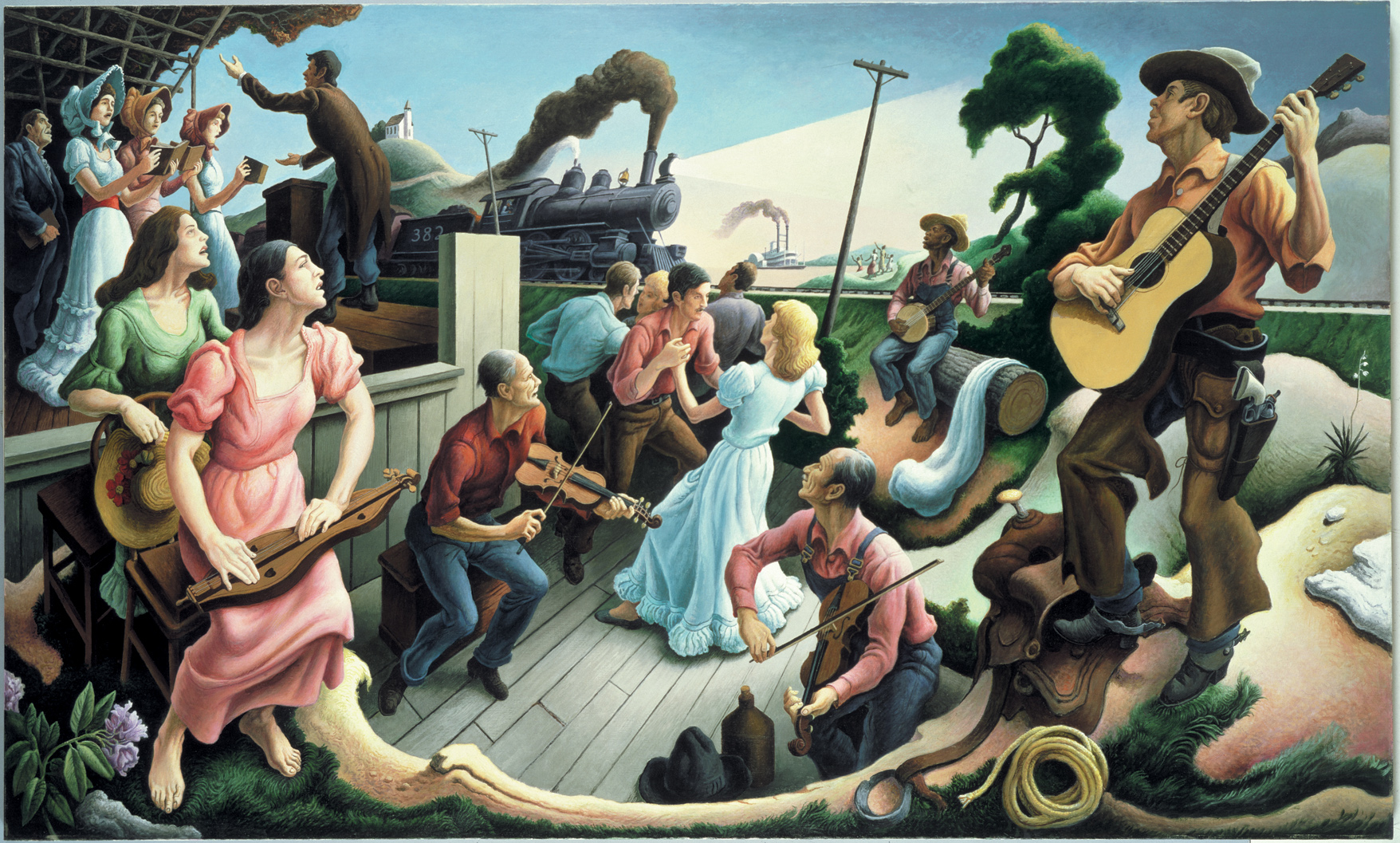
GWTW1“Film adaptations of Southern novels” was the little corner of scholarship I staked out as my personal territory while obtaining an MA in English Literature a few years ago (here’s my thesis). One of the many benefits that came from that time of intense reading, writing, and research (some of which involved watching movies, which was fantastic) was an appreciation for the “Southern” as a distinct genre of film.

The Southern is not discussed as frequently or appreciated as widely as its more popular regional cousin, the Western. Nevertheless, it is a rich and complex genre where labels like “good” and “evil” have nothing to do with the color of a character’s hat. Tragically, and to our society’s great shame, those labels don’t always run deeper than the color of their skin. But it is precisely this troubled and troubling approach to race, to religion, to politics, to gender, in short, to every contested corner of the American experience, that makes the genre so worthy of attention.
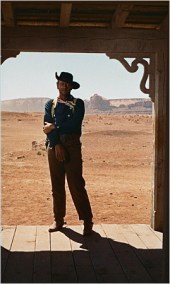
waynesearcherIn ideological terms, the Western and the Southern have frequently highlighted opposing views of American identity. It is the cowboy, not the damnyankee, that is the movie Southerner’s true opposite. The hallmarks of the Western are life on the frontier, society in its infancy, and characters who navigate a constantly shrinking space between wilderness and civilization. The cinematic West is a land of adventure, opportunity, and progress. Its spirit is the relentless drive to tame the frontier through ingenuity, entrepreneurial skill, and sheer hard work. Lawlessness abounds in the West, but so do virtuous men of action, ready to step up and defend the weak and innocent before riding off into the sunset, towards the horizon and the future. Temporally, the Western is all future. In fact, Western films are awash in ex-Confederate characters about whose past lives as Southerners we know little or nothing.

mudmanIn the South, by contrast, “The past is never dead. It’s not even past.” (Yes, that’s Faulkner.) There is no future in the Southern, everything is past and the past is everything. The role of the past is haunting, nostalgic, or both at once. The cinematic South is a land of ignorance, superstition, and, above all, racial prejudice. Its spirit is crushed by the weight of an inescapable history and unbreakable cycles of tragedy and violence. The hallmark of the Southern is lost innocence, which is probably why so many Southerns are coming-of-age stories. Where the West is lawless but virtuous, Southern law is rotten to the core, corrupted in its very nature by vice and inequality. Where the West is wide open and new, the South is claustrophobic: Gothic, suffocating in Spanish moss, full of sweltering swamps and creepy old plantation houses and dark, buried secrets. The South is a graveyard inhabited by the living, haunted by ways of life the rest of the nation has collectively attempted to reject for over 150 years.

Consequently, as a genre, the Southern has allowed us to observe the progress (or lack of progress) of this rejection. In addition, Southerns have questioned whether that way of life should have been rejected, reinforced the righteousness of its rejection, mourned the way of life that was lost, mocked it, and so on and on. The Southern does not depict life on the margins of society (like the Western) so much as life in a marginalized society, still overshadowed by a social order that is dead or dying.

The Western genre, in its heyday, basically existed to provide us with the shining example of what it means to be American. The Southern genre, at its heart, is a cautionary tale, an object lesson demonstrating what Americans shouldn’t and mustn’t be. This is certainly true of the many Southerns that communicate that idea deliberately, but even the many Southerns that set out to do just the opposite have ended up accomplishing the same purpose in the minds of the audience thanks to an ideology that is profoundly out of step with “modern American values.”
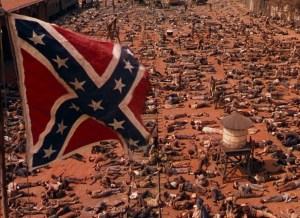
gwtwcasualtiesIn the 1950s, historian C. Vann Woodward called the South’s experience of defeat in the midst of America’s story of unbroken victory and success the “central irony of Southern history.” A decade or so later, Vietnam, the turmoil over civil rights, the threat of nuclear annihilation, and the rise of the counter-culture raised doubts and questions that Southerners had already struggled with for a century. One cultural product of those times was the emergence of a more nuanced “revisionist” Western sub-genre in which the white hat/black hat, cowboy/indian duality of previous Westerns could no longer be taken for granted. Revisionist Westerns have also been called “anti-Westerns,” but it is the Southern that has always been the true anti-Western.

In American culture (including in literature and elsewhere, but especially in film), the fictional South has performed the service of housing our nation’s heart of darkness. It is the societal scapegoat, and the repudiation of it permits the rest of the country to maintain the illusion of purity, progress, and virtue. This allows us to feel good about ourselves and our identity as Americans, and that arrangement works out pretty well for everyone … except Southerners, of course. The most obvious choices they seem to have are to either reject their Southern identity, contenting themselves to be mere “Americans,” or to defiantly embrace it. One needn’t look far to observe both of these choices in action.

It is important to understand, though, particularly out of fairness to those people who raise reasonable objections to the largely one-sided treatment the region receives on-screen, that the South of the movies is not the South. Well, of course it isn’t. The South of the movies does exist, in a sense, but one of the more unfortunate lies that the Southern genre has perpetuated (largely unwittingly and unintentionally, it should be stressed) is that it is the only South, when it is actually one of many.
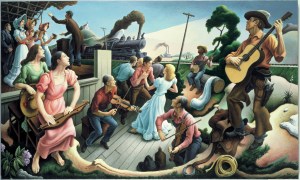
countrypeopleThe South is a vast region of some 115 million people, whose culture has, in one place and time or another, been influenced by English, Scotch-Irish, French, and Spanish colonization, as well as a significant Native American presence, an infusion of African slaves, and immigrant populations from everywhere else. The South’s best-kept secret (perhaps even from itself) is that, far from a homogeneous land of white Christian patriarchs, the region is one of the most diverse in the nation. Of the eleven states that seceded from the Union 150 years ago, three (Louisiana, Mississippi, and Georgia) are among the top ten in population diversity nationwide, and another six (Texas, Alabama, Florida, Virginia, and North and South Carolina) are in the top twenty.
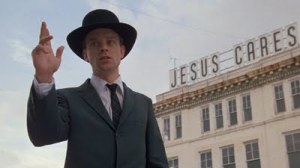
motesAll of this ought to be somewhat obvious, but it’s not. As Flannery O’Connor complained, “I am always having it pointed out to me that life in Georgia is not at all the way I picture it, that escaped criminals do not roam the roads exterminating families, nor Bible salesmen prowl about looking for girls with wooden legs.” There is certainly more going on here than a straightforward attempt to depict (or even to demonize) the South.

Once it is clear, then, that the South of the Southern is, like the West of the Western, merely another setting for American mythology (that is, of “ideology in narrative form”), it no longer makes much sense to be outraged on behalf of the geographic Southern states. There are still good myths and bad myths, well-made films and poorly-made ones, to be sure. However, the questions that are worth asking start to sound less like, “Does this adequately represent a physical location and its people?” and more like, “How does this regional drama/comedy/horror/whatever fit into the larger tapestry of American cultural identity?”

When I was younger, I took a certain regional pride in the obvious quality of good Southern literature (which I recognized as something distinctive long before I took notice of its cinematic counterpart), and I reveled in the richness of Southern characters and in Southern writers’ obviously intense connection to their homeland. My approach to these works was characterized by a childlike wonder and by the sheer pleasure of a good book, and this enjoyment, and my youthful innocence, overshadowed the dark side of the Southern experience so completely that the South became an idealized fantasy to me.
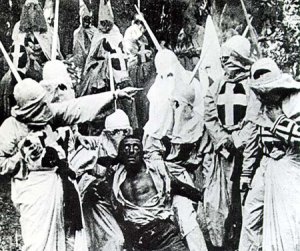
boan1Not surprisingly, it was a Southern film that finally broke that spell. 10 years ago, while I was in college, I saw D.W. Griffith’s profoundly racist epic The Birth of a Nation for the first time, and my youthful illusions withered away before my very eyes. I still have the brief reflection I wrote when I returned to my dorm that night, and it is startling now to observe my naive idealizations crumble as I process my thoughts in a few short paragraphs, assimilating this new perspective. And yet, far from either doubling-down or turning away in disgust, my fascination was assured for all time.

Naturally, Flannery O’Connor is the best person to explain why that is: “Whenever I’m asked why Southern writers particularly have a penchant for writing about freaks, I say it is because we are still able to recognize one. To be able to recognize a freak, you have to have some conception of the whole man, and in the South the general conception of man is still, in the main, theological. […] I hate to think that in twenty years Southern writers too may be writing about men in gray-flannel suits and may have lost their ability to see that these gentlemen are even greater freaks than what we are writing about now.” (From “Some Aspects of the Grotesque in Southern Fiction” (1960). Do yourself a favor and read it all sometime.) Half a century on, the Southern is still able to recognize a freak, and still able to take them seriously, and that’s important, because there is a little bit of the freak in all of us.

thesouth

What is a Southern, though? How are we to define this genre that I’ve been discussing? First, very few genres are as strictly limited by location as the Southern is. Even Westerns, despite their connection with the American West, have frequently re-located to other countries, and even other planets. A Southern absolutely must use as a setting some place within one of the 11-14 states (depending on who’s counting) of the American South. Fulfilling this condition, however, does not automatically make a film an example of the Southern genre, largely due to what filmmakers intend to convey when they set a story in a particular location.

The “Deep South” is used much as you might expect. Films that deal with racism are set in Mississippi. Southerns with more nostalgic feelings for the South take place in Alabama. Louisiana is sultry and sweaty and swampy and Gothic. Films about the Confederacy frequently involve Georgia. Tennessee is home to hicks and Arkansas to hillbillies, some singers and some psychopaths (and at least one who is both).

But as we move out, towards the edges of the South, things aren’t so straightforward. A film that is set in Virginia may be about the Civil War, but it may as easily involve the CIA or the colony at Jamestown. Far more Westerns than Southerns are set in Texas. A film in Florida might be a good Southern noir, or it might be about dolphins, like 1963’s Flipper, or about Cuban drug lords, like 1983’s Scarface. So, second, Southerns must be set in the South, but not all movies set in the South are Southerns.

Beyond those two very basic criteria, things become complicated enough that a really worthwhile discussion would range further than I am willing to here. For a more solid, scholarly discussion of the Southern genre, see Lucinda MacKethan’s excellent “Genres of Southern Literature” from “Southern Spaces” (2004), which is very accessible, and probably the best short-form attempt to delineate and qualify the boundaries of treating Southern literature as a discrete genre that you could hope to find.

Her categorization of the many sub-genres that lurk beneath the Southern umbrella, while obviously geared towards literature, is also a good primer for our discussion of individual Southerns. The sub-genres of Southern films are equal parts literature and Hollywood: There are Civil War films, serious literary adaptations, coming-of-age stories, Southern Gothic/horror, rural comedies, family dramas, musicals, and many more, all overlapping and intertwining at various points.

However, rather than mount a lengthy analysis and discussion of that list, I’ll just get on with my own list of the films that I would call “Essential Southerns.” Look for it right here in the coming weeks . . .
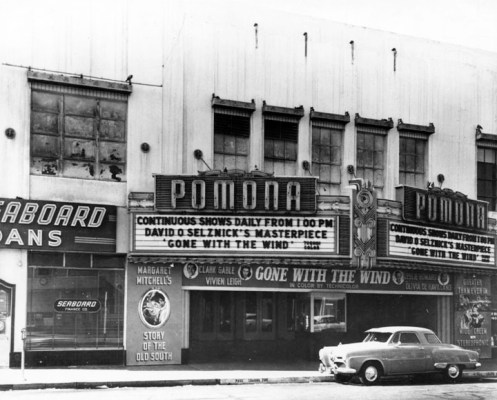
gwtw2

Movie Screen, Time Machine: The 1950s

•March 1, 2013 • 2 Comments

theblob

The 1950s are generally regarded as a time of domestic serenity and prosperity, a golden-age for traditional American values (or for the invention of them, depending on who you ask) and for American family life. The films of the decade tell a somewhat different story, revealing a seething cauldron of conflicting tensions, wild paranoia, and explosive passions boiling dangerously just beneath the surface. Perhaps the turmoil that struck the film industry in the 1950s helped inspire this revelation of America’s inner turmoil.

By 1949, the USSR had The Bomb, and the specter of global nuclear catastrophe began to loom ever-larger in the popular imagination. Joseph McCarthy bullied his way into the national spotlight, and cries of “better dead than red” spread rapidly in his wake. McCarthyism drove the House Un-American Activities Committee to launch an assault on Hollywood, spawning the infamous “blacklists” that devastated some of the industry’s brightest talent. But it was capitalism, not communism, that posed the greatest threat.

At the end of the 1940s, the major studios lost a decade-long anti-trust battle in the courts, and were ordered to sell off the chains of movie theaters that had previously exhibited their films exclusively. This put the studios in competition with each other for screen space, and forced them to share profits with the now-independent theater owners. And by then, the industry was already concerned that their profits were in serious jeopardy in the face of a new threat: Television. By 1954, more than half of the homes in America had a television set. And the overlap between TV owners and the moviegoing public was significant.

From the beginning, movie makers had relied on technological innovation to drive growth, and that was where they turned now, fighting fire with fire. If audiences could get filmed entertainment in their living rooms, the movies would have to give them new reasons to visit the theater: bigger films, louder films, more color, more stars, spectacle. Many of the “innovations” that emerged were mere gimmicks, and didn’t last, but some remained, most notably the ultra-wide screens of CinemaScope, which broadened the canvas of the filmmaking art.

I watched some of those “spectacle” films while I was in the ’50s, epics with large casts and large stories to match the larger screen. I watched teenage movies, a new kind of film for a new kind of audience that was suddenly emerging between childhood and maturity. I watched B-movies, western, sci-fi, adventure, and horror, as well as sexy comedy, war, courtroom drama, and just plain drama. A complex mix for a deceptively complex decade. And I’ll probably do best to leave it at that and get to the specifics:

Winchester ’73 (1950)

Jimmy Stewart is, nominally, the star of this unique little western, but the protagonist is the titular rifle: a “one in one thousand” flawless Winchester Model 1873, a firearm so popular it eventually became known as “the Gun That Won the West.” Stewart wins it in a July 4th shooting contest, but the gun is stolen by his criminal arch-enemy, Dutch Henry, and begins a long journey, passing from owner to owner and leaving a trail of death in its wake, with Stewart in vengeful pursuit. Aside from being a unique narrative device, the film is surprisingly stark in its depiction of the violence of the American frontier, making it an early example of the darker westerns and anti-westerns that began to creep onto the screen throughout the decade. The film’s success led to several more collaborations between Stewart and director Anthony Mann.

The African Queen (1951)

This film, directed by John Huston from a screenplay adaptation by James Agee, has the distinction of Humphrey Bogart’s sole Oscar-winning performance, as coarse WWI-era river boat captain Charlie Allnut. Katherine Hepburn is Rose, an iron-willed British missionary who ends up on board his boat (the African Queen) after German troops burn the small African village where she lives and conscripts the villagers. Rose persuades Charlie to journey down to a lake patrolled by a German gun-boat, which they will attempt to torpedo by rigging the prow with explosives. But first they must survive the perilous journey downriver, in a thrilling adventure shot in color largely on location.

Red Planet Mars (1952)

This ham-fisted propaganda piece is about as terrible as terrible can be by any standard other than “weird cultural artifact.” Scientists establish limited communication with Mars and are surprised to learn that the Martians are devout believers in the Christian God who have built a utopian society thanks to their faithfulness. These revelations send shock waves across the globe, and even the Soviets are caught up in a massive religious revival. But an evil ex-Nazi-turned-communist plots to undo everything with manufactured evidence that the whole thing is a hoax, and the heroic husband-and-wife team of American scientists can only stop him by blowing themselves up with him. And, oops, that’s the whole movie. Sorry. “Belated spoiler warning.” The film’s shocking final image hints strongly that God himself may be a Martian, or at least hangs out on Mars. And that’s just one of many nutty theological implications the story leaves us to ponder, but best not to think too deeply about it. The point is, God and capitalism are good, and communists will do anything to destroy them, thereby ruining things for all of us.

The Robe (1953)

Richard Burton plays Marcellus, the Roman tribune in charge of crucifying Christ, and winner of the titular robe in a dice game. The film (the first ever widescreen CinemaScope release) expands his story to multiple hours, beginning when Marcellus foolishly picks a fight with Caligula and gets himself transferred to Jerusalem, and ending much later, after Jesus’s robe provokes a crisis of conscience and an encounter with the early church. Burton is great as the prickly tribune, but less convincing as a new convert. The movie is quite good, overall, and very attentive to historical detail. If you want to see more like the mega-hit Ben-Hur of a few years later, this is the ticket. Historical fiction like the novel this was based on remains popular today, but big-screen adaptations of them are much scarcer. This movie will make you wonder why that is.

Secret of the Incas (1954)

You probably haven’t seen this movie, which stars Charlton Heston as shady adventurer Harry Steele, but I’ll bet you’ve seen the remake: Raiders of the Lost Ark. Sure, this film is quite different (and inferior) in a lot of ways, but the inspiration is utterly obvious. Harrison Ford’s iconic Indiana Jones outfit is practically a facsimile of Heston’s costume in this film, and their personas are strikingly similar. Unlike Raiders, this film takes place entirely in South America, and was the first to film on-location at Machu Picchu. Although it drags in spots, there are plenty of thrills, twists, and exotic locales around every corner. It’s a must-see for Indy fans.

Rebel Without a Cause (1955)

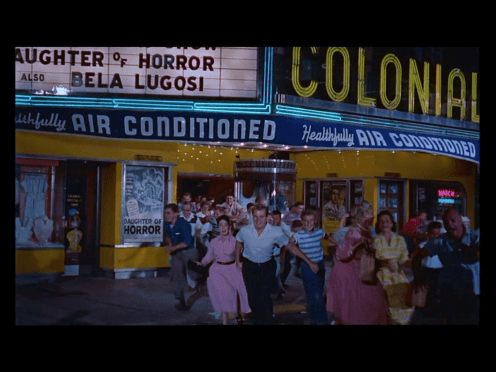
This is the grandfather of all great teen films, unapologetic in wearing its melodramatic, self-absorbed heart on its sleeve. The angst is so palpable, it’s practically a character in the movie. What sets it apart from earlier (terrible) youth films boils down to one thing: James Dean. He is as committed to his role as any actor I’ve ever seen, and he is truly a force of nature in it. The rest of the cast is great, too, but they’re all orienting themselves around Dean. Plus, it was Dean’s status as a rising star that prompted the studio to spring for the use of more expensive color film over black and white stock. This is a great film, and an important film. We should be showing it in high school classrooms alongside texts like The Outsiders and Catcher in the Rye.

Bus Stop (1956)

Even though she’s been dead for half a century, Marilyn Monroe is still practically a household name, one of the most famous women of the 20th century. Far fewer people have actually seen one of her movies, though, making her talents as a performer much less well-known. Bus Stop features one of her few dramatic roles, in a story that transpires on the margins of society, in the rodeo subculture of the western states. Beauregard, an obnoxiously immature and inexperienced cowboy, travels by bus from Montana to Arizona to compete in the rodeo and find a wife. He falls hard for Cherie, a singer at a popular cafe, and pursues her relentlessly, despite her lack of interest, culminating in an outright kidnapping. Matters come to a dramatic head when the bus is snowed in at a stop on the way back. Though its stage origins are obvious, this is a great little film that feels true to the lives of its characters and their region.

Paths of Glory (1957)

Stanley Kubrick followed the long-standing rule with this film: All WWI movies are also anti-war movies. The First World War is the go-to conflict for showing the brutality, tragedy, cruelty, and pointless wastefulness of war, or at least it was before Vietnam. In this movie, Kirk Douglas plays a French colonel who steps up to defend three men who are to be executed for cowardice. Sent on a suicidal attack, their entire unit turned and retreated back to the trenches. Unable to punish so many, the high command orders men to be selected at random to take the punishment. Shot in stark black and white, the movie pulls no punches in its depiction of the war, or of the heartless and foolish military bureaucracy that drove it.

The Blob (1958)

Some movies just have to be seen to be believed, and it’s hard to know where to start describing this one. Steve McQueen, a few years shy of breaking out as “The King of Cool” in the 1960s, plays a very unconvincing teenager (he was 28) struggling to warn his small town of the threat posed by a rapidly-growing mass of featureless but semi-sentient red Jell-O from outer space. It’s the weirdest of the weird in a pantheon of crazy movie monsters, oozing its way ponderously from scene to scene, devouring unsuspecting victims whole (though they pretty much have to be immobile to get caught). The real threat, if you’re paying attention, is that America’s older generation isn’t paying attention to its youth, a bit of social commentary which, perhaps, redeems the silliness a little bit.

Some Like It Hot (1959)

The AFI named this the greatest American comedy of all time, and they may just be right. Even now, it is still classic, still edgy, and still howlingly funny. Jack Lemmon and Tony Curtis are two jazz musicians forced to dress in drag and join a women’s group in order to escape Chicago after they accidentally witness the infamous St. Valentine’s Day Massacre. Also in the band is Sugar Kane (Marilyn Monroe), a sexy chanteuse, and both men fall for her. Curtis gains the edge when he assumes a second identity as a millionaire yacht owner (pulling a hysterical Cary Grant impression) to woo Kane, while Lemmon is stuck suffering the attentions of an eccentric Joe E. Brown. Hilarity ensues, in various forms, culminating in the ultimate movie punch-line. There’s no question that this is a must-see.

Coming soon(ish), the Swinging Sixties!

2013: An Oscar Commentary

•February 24, 2013 • Leave a Comment

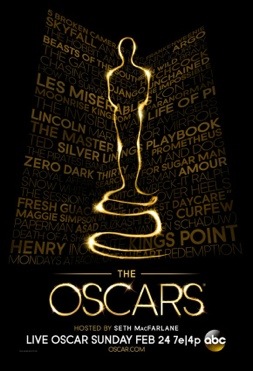
It’s time for a post-mortem, which is the appropriate term after Seth MacFarlane beat the show to death. MacFarlane is a versatile and talented performer, but he is also juvenile and self-promoting. All of those qualities were very much in evidence throughout his time on-stage, and it wasn’t exactly enjoyable waiting to hear his next tasteless joke or spot the next shameless plug for his own stuff.

Using the “Jaws” theme to cut off speeches was spectacularly unfunny, and went unused against the most egregious offenders late in the show . . . Are the “little people” experiencing their 5 minutes getting short-shrift just so we’ll have time to listen to Anne Hathaway gush tiresomely?

Meanwhile, the Oscars continue to grasp desperately and embarrassingly for relevance with a younger, hipper audience, trotting out lame gimmicks and youthful presenters by the bushel. Even more experienced talent fell flat, though. Rudd and McCarthy sounded like they planned their banter backstage in the 5 seconds before they walked out, having never met each other before. At least the musical elements of the show worked well.

That leaves me with the actual outcome. The night’s biggest winner was Life of Pi, with 4 awards, which I’m very happy about. I’m less happy that Moonrise Kingdom lost its only nomination, while Les Miserables (far and away the worst of the Best Picture nominees) won 3 and Beasts of the Southern Wild was the only Best Pic that got shut out entirely. Argo got 3 awards (including, of course, The Big One), Lincoln and Django Unchained each got 2, and Amour, Zero Dark Thirty and Silver Linings Playbook got 1 apiece. Other than that, only Skyfall (with 2), Brave, and Anna Karenina (with 1) walked away with Oscar gold.

I’d have redistributed all of Les Miserables‘s Oscars and probably given animation to Wreck-It Ralph, but I’m fairly happy with everything else. I’m certainly no less happy with the winners than I was with the nominees, and maybe slightly more. Could have been worse, and sometimes that’s the best that can be said. I feel a “Best of 2012” list coming on . . .

Continue reading ‘2013: An Oscar Commentary’

2013: An Oscar Primer

•January 31, 2013 • Leave a Comment

20130220-124555.jpgI didn’t post immediately this year because, once I saw the nominees, I realized that I was very close to having almost all of them checked off. It seemed worth waiting longer to see the several additional films I knew I could get to quickly. Not counting the difficult foreign and documentary categories, there are only 8 nominees I haven’t seen yet, and it should be down to 2 by Oscar night.
I remember being very irritated last year at nomination time because it had been impossible for me to see a significant number of the nominees. And, in particular, those included nominees with many nominations that had been showing in some parts of the country for months. That problem seems less pronounced this year, though I suspect (as I look at the list of nominees) that it’s because Oscar has made some abnormally middle-of-the-road selections. It is highly unusual for a list of nominees to emerge without any titles I haven’t heard of and only a tiny handful I’ve had no way of seeing.

Perhaps that explains why the pool of nominees feels so small, as well. I’m very much used to reading down the list and feeling that I really have my work cut out for me as I try to see as many nominees as possible. But that’s not so, this time. And that’s a little bit of a let-down, in some ways. I’m missing that feeling of discovery. I expect there are some great films from 2012 that I haven’t heard about and made note of to see, but I didn’t find much of that on the Academy’s list.

Speaking of which, there are 9 nominees for Best Picture this year:

Amour – A slow, French relationship drama about an aging couple? I don’t know, I’d need to be in a really specific mood to- Michael Haneke? Let’s do this! Haneke’s last film, The White Ribbon, was among the very best of the decade, and went all but ignored by the Academy. This one, which I may or may not be able to see before Oscar time, is nominated for 5 awards: Best Actress, Best Director, Best Original Screenplay, and Best Foreign Film. Every category dripping with prestige, but consequently hotly-contested.

Argo – Ben Affleck’s debut film, Gone Baby Gone, was fantastic, but hardly anyone saw it. His follow-up, The Town, got a lot more attention, well-deserved, but didn’t make the Oscar cut. Argo, Affleck’s first film set outside his native Boston, has exploded into awards season, scooping major nominations and wins all over the place, though Affleck himself has again been snubbed by the Academy. The movie is up for 7 awards: Best Supporting Actor, Best Adapted Screenplay, Best Editing, Best Original Score, Best Sound, and Best Sound Editing. The nominations are a testament to craftsmanship, and though it remains to be seen how many the film can win, Affleck is clearly (and deservedly) on the rise. I got a big kick out of Argo, and I can’t wait to see what he does next.

Beasts of the Southern Wild – Most films are prose, this one is poetry. Story is secondary to theme and emotion and art, but the performances and the writing and the way the film is put together are stunning. It is clear immediately, and the feeling never fades, that this isn’t just another movie. It’s doing unique things in a new way, and it’s a pleasure to see. It is nominated in 4 categories: Best Director, Best Adapted Screenplay, and Best Actress (for, I believe, the youngest performance ever nominated).

Django Unchained – Tarantino continues in his previous vein of gleeful revisionist history through the resurrection of neglected genres. A few years ago, he took on the Holocaust with a Dirty-Dozen-style war flick. Here he tackles slavery via the spaghetti Western, and if he is not quite as successful this time around, the result isn’t any less fun. His film invites multiple viewings, and I have indulged it in this case. Django Unchained, as Tarantino movies often do, grew on me the second time through, and it is a worthy addition to an already masterful filmography. The Academy has nominated it for 5 awards: Best Original Screenplay, Best Supporting Actor, Best Sound Editing, and Best Cinematography. The nominations are all solid, but I’m surprised it didn’t get any attention for the music. Tarantino’s soundtracks are second to none, and not all of the film’s music comes from outside sources.

Les Miserables – The backlash has been heavy and harsh against one of the last remaining nominees that I haven’t seen. I like musicals and I love the story and characters of Les Miserables, but I’ve always felt a bit ambivalent about this version. It doesn’t seem to justify the artistic choice to sing (“sing”) every word of dialogue, and emotions stay at such an exhausting fever-pitch throughout that I find it harder to feel anything at all. That said, I am looking forward to seeing this for myself, and I hope to enjoy it more than my fellow curmudgeons out there. Obviously someone likes it, since it has 8 nominations: Best Actor, Best Supporting Actress, Best Production Design, Best Sound, Best Original Song, Best Makeup, and Best Costumes.

Life of Pi – If you didn’t see this film in 3D on the big screen, you’re missing out on something truly breathtaking. Ang Lee tops even James Cameron and Martin Scorsese, who have directed the most significant 3D films to date. He plays with the size and shape of the frame and transports the audience into the middle of mystical, magical place without ever quite veering off into wholesale fantasy. This is an impressive achievement of adaptation and of filmmaking, and its 11 nominations are no surprise: Best Director, Best Editing, Best Adapted Screenplay, Best Cinematography, Best Production Design, Best Sound, Best Sound Editing, Best Visual Effects, Best Original Score, and Best Original Song. There is a notable absence of performance nominations, however, and I can’t help but think that if Suraj Sharma were better-known, or American/European, he’d have gotten some attention.

Lincoln – Steven Spielberg’s Lincoln movie has been on the horizon for years, and it turned out to be worth the wait, thanks in large part to Daniel Day-Lewis’ incarnation of the title character. Perhaps you have no trouble remembering that you’re not actually watching Abraham Lincoln himself on screen. But I couldn’t do it. The film has scored the largest number of nominations this year, with 12: Best Director, Best Editing, Best Actor, Best Supporting Actor, Best Supporting Actress, Best Costumes, Best Sound, Best Original Score, Best Adapted Screenplay, Best Cinematography and Best Production Design. At this point in Spielberg’s career, it makes very little sense to say that he has “outdone himself,” but this is certainly a very fine film.

Silver Linings Playbook – Such a wonderful, fun movie, the kind of movie that makes you want to gush, despite yourself. Bradley Cooper and Jennifer Lawrence are both fantastic in it, and the writing is full of life and humanity. I couldn’t help but enjoy this movie from beginning to end. It has 8 nominations: Best Director, Best Actor, Best Actress, Best Supporting Actor, Best Supporting Actress, Best Adapted Screenplay, and Best Editing. Prestigious nominations, every one, and the only film eligible to win a fabled “Grand Slam” of the 5 most significant awards. That won’t happen, but still, not too shabby.

Zero Dark Thirty – I am skeptical, always, of the urge to commit true events to film soon after they have transpired, but I’m always happy to be wrong. And, after all, this is Kathryn Bigelow, whose film The Hurt Locker is still the only good movie about the War in Iraq. Jessica Chastain delivers a wrenching performance, becoming a human vessel that holds and carries the American obsession with finding Osama bin Laden to its end. Along the way we get a contemporary intelligence procedural that is easily as riveting as the suspenseful raid on bin Laden’s compound. The movie is up for 5 awards: Best Actress, Best Original Screenplay, Best Editing, and Best Sound Editing.

Now, more briefly, the other nominees, beginning with the ones I’ve seen:

Continue reading ‘2013: An Oscar Primer’

Movie Screen, Time Machine: The 1940s

•December 10, 2012 • Leave a Comment

Gilda

I have long been under the mistaken impression that the 1940s were a slow decade for film production, at least during the war years. Wrong. Fewer feature films were produced in the United States during this transitional decade than in the 1930s, but more films were produced than in any subsequent decade until the 1980s. And, while there was a noticeable drop in production beginning in 1943, it certainly was not as sharp as I had suspected. There were various reasons for this drop in production, but that’s a topic for other decades. The important point is that, in the 1940s, America was still a nation of moviegoers, and that meant a big market for stories that could be filmed. Adaptation, always a significant source of film material, rose to even greater heights in the wake of the success of Gone With the Wind, riding a wave of technological innovation that perfected the use of sound in the 1930s.

During my time in the ’40s, I watched comedies and tragedies, a western and a gangster film and a war movie, but mostly melodrama. Oh, it was a great decade for melodrama! Noir was born in the 1940s, as well, and I watched some, as it is a style that is dear to me. It is always interesting, as well, to see what period each decade is nostalgic for, through the times it portrays with a rosy hue. The past few years, the 2010s, have looked back fondly on the 1980s, and they looked back to the 1950s. In the 1940s, that love seemed to go to the turn of the century. I assume this nostalgia for 30-40 years in the past has a lot to do with how long ago the producers, directors, and screenwriters who are getting movies made were children themselves. Just a thought.

There is also a new sophistication, a definite feeling of maturity and gravity, that was certainly not there in the previous decade. Some, though certainly not all, of the idealism of the 1930s has been replaced by a healthy dose of cynicism and a sharper, meaner wit. But the emotion behind this more realistic view of the world is still geared toward making the world a better place. If these films are less optimistic about the chance of success, they and their characters certainly haven’t given up trying. But now I’m getting a bit too abstract, perhaps. Time to discuss the films.

The Great Dictator (1940)

Charlie Chaplin stubbornly continued making silent films for years after the introduction of sound, but one man finally got him to break that silence: Adolf Hitler. Before the United States was at war with Nazi Germany, at a time when the rest of Hollywood was largely maintaining a diplomatic silence, Chaplin’s first talkie was a hilarious and heartbreaking kick in the teeth of the Third Reich. He mocks Hitler relentlessly and mercilessly, but treats the plight of the Jews under Hitler with complete seriousness. It is a powerful balancing act between laughter and tears that perhaps only the talent and passion of a genius like Chaplin is capable of maintaining. And when he breaks character at the end to appeal directly to the audience for peace and goodwill, you’ll wonder what effect he might have had if more people around the world could have seen it, and seen it a few years earlier.

How Green Was My Valley (1941)

Winner of the Academy Award for Best Picture if 1941 (along with 4 other awards), this was a labor of love for John Ford. He is best remembered for the many westerns he made with John Wayne (see below), but a number of other Ford regulars, like Maureen O’Hara, populate this one. It’s hard to imagine an appropriate role for Wayne in this wistful portrait of turn-of-the-century Wales. The nostalgia inherent to the title inhabits every frame of the film with a longing for a place that no longer exists. In retrospect, it’s hard to believe this film beat out contenders like Citizen Kane, but it is a sentimental adaptation of a prestigious novel by a well-regarded director with a talented ensemble cast. The definition of Oscar Bait has changed very little in 70 years. Watch for a great performance by a very young Roddy McDowall.

The Magnificent Ambersons (1942)

Speaking of Citizen Kane, Orson Welles followed his much-lauded masterpiece with a turn-of-the-century adaptation of his own. Famously, he delivered the final cut of the film to the studio and trotted off to Latin America to work on a new project as part of the United States “Good Neighbor Policy” during World War II (Walt Disney engaged in a similar venture). While he was away, the studio, concerned about the film’s dark final act, edited out some 40 minutes and reshot the ending. The result is about what you’d expect: a weird, wonderful American masterpiece for the first hour or so, with an incongruous shift in tone and character for the last 20 minutes. Welles’ original cut will forever remain one of the “lost treasures” of film aficionados, but the film we ended up with is still really good and well-worth seeing. Welles’ flair for character and ambience shows through just fine, and Joseph Cotten is always fun to watch.

For Whom the Bell Tolls (1943)

Speaking of adaptations and prestige, they don’t get much bigger than this star-studded version of Ernest Hemingway’s novel of the Spanish Civil War. Gary Cooper throws off sparks as an American saboteur who joins a fractious band of rebels under orders to blow a key bridge and prevent reinforcements from repelling a major offensive. Ingrid Bergman is an amazing actress, but the Swedish blonde is not exactly well-cast as a young Spaniard. The actress to watch is Katina Paxinou as Pilar, whose brilliant performance earned her the film’s sole Oscar win out of 9 nominations. The film is strong, but like the original novel, the story drags heavily going into the third act. That said, this portion takes less time to watch than it does to read, and soon gives way to the tense and action-packed finale. Its status as a classic is as well-deserved as the novel’s.

The Miracle of Morgan’s Creek (1944)

What can I say about Preston Sturges? I love his films, particularly his comedies, slight as they often are. This may be my favorite, an uproariously funny screwball comedy of life on the homefront while the nation is at war that will make you wonder how on earth it slid past the censors. Betty Hutton plays Trudy Kockenlocker, a girl who is adored by the mousy Norval Jones (Eddie Bracken). Unfortunately, Trudy is fascinated by men in uniform, and Norval can’t get into the army. Matters are complicated further when, after a night of hard partying to see the boys off to war, Trudy ends up married to a soldier she can’t remember and pregnant, but her father (Sturges regular William Demarest) thinks Norval is to blame. Hilarity ensues, but I’ve said too much already. The laughs and surprises fly thick and fast from start to finish, and I watched this movie three times before moving on.

A Tree Grows in Brooklyn (1945)

This is probably most notable as the first film directed by Elia Kazan, who would go on to win an Oscar for Gentleman’s Agreement a few years later, and then produce a decade-defining string of great films throughout the 1950s. It is an adaptation of a best-selling novel from 1943, depicting the ups and downs of a poor family in turn-of-the-century Brooklyn, told through the coming-of-age eyes of daughter Francie Nolan. A pleasant enough film, mixing warmth and humor and a tempered nostalgia, populated with familiar (but not mega-famous) faces playing likable characters, it is very much of its time. I have read the novel, and even seen this film many years ago. The book has proved more memorable, but the movie is worth seeing, too.

Gilda (1946)

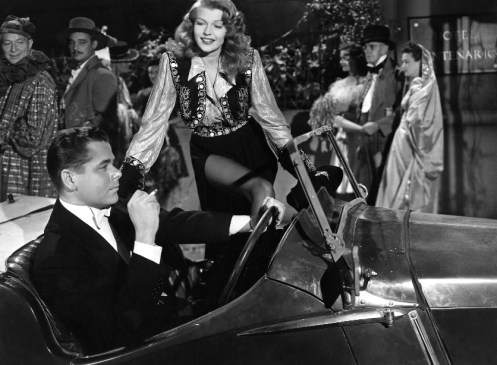
I filled another disgraceful gap in my film knowledge with this one. I knew the Rita Hayworth shot, of course (you know the one, this one). But somehow I didn’t know that this was grand hard-boiled postwar noir. Hayworth is as electrifying in every scene as she is in that famous shot. It’s one of the few femme fatale performances I’ve seen that renders the actions of the men around her entirely believable. Glenn Ford is the classic noir protagonist, a cynical cipher of dubious moral rectitude, and George MacReady’s patron/villain is a fascinating third wheel not quite like any character I’ve seen in other noirs. After having seen it, my biggest question was why I hadn’t heard more about it. It is obvious even on first viewing that this is essential noir, and very, very good.

Black Narcissus (1947)

This is a weirdly mesmerizing film that made me want to read the novel it’s based on. Deborah Kerr stars as an English nun tasked with leading a group from her order to establish a school and hospital high in the Himalayas in an ancient building that once housed concubines. The mission implodes, however, as the nuns begin to mentally and emotionally unravel, succumbing to the wild, sensual spirit of their surroundings. Matters come to a head in explosive fashion, and the ending is nothing short of perfect. The real star of the film (the magnificent Kerr notwithstanding) is the cinematography, which, along with the spectacular art direction, won the film its Academy Awards. The movie is shot in rather glorious technicolor, and the vistas are really quite breathtaking. The camera succeeds admirably at making the atmosphere of the place another character in the film, which is (obviously) essential to the story.

Fort Apache (1948)

The first of John Ford’s “cavalry trilogy” stars John Wayne, Henry Fonda, and Shirley Temple (in one of her last film roles, as the improbably named Philadelphia Thursday). Fonda plays Colonel Thursday, a proud officer who regards his appointment to a remote fort out West as a slap in the face. His new second-in-command, the more experienced Captain York (Wayne), feels the same way, having expected the command himself. The two men lock horns over how to deal with the local Indians while Thursday’s daughter falls in love with a young officer. The movie more or less balances romance and action as Thursday’s stubborn foolishness results in an Indian uprising, and it is left to York to stop it. This is certainly not Ford’s best Western (nor is any of the cavalry trilogy), but it’s an entertaining bit of genre fluff.

White Heat (1949)

“Made it, Ma! Top of the world!” Maybe you’ve heard that famous James Cagney line from this movie’s fiery climax. The title aptly describes Cagney’s energetic performance. Well, “energetic” is understating it a bit. Cagney, here as always, lights up the screen. Watching how he plays murderous gangster Cody Jarrett, you really don’t know what he’ll do next. He embodies a man who might do just about anything, not just out of desperation, but out of something violent and twisted inside himself. Gangster films often depend on their central performance (think of Edward G. Robinson in Little Caesar and Al Pacino in Scarface), and certainly Cagney is the reason to see this movie. I’m not sure that there’s another reason, but this isn’t really my genre.

Next up, the Nifty Fifties!

Introducing Letterboxd: Social Networking for Cinephiles

•November 30, 2012 • Leave a Comment

Letterboxd

My time-travel project and a temporarily unusual schedule have led to record-breaking levels of movie-watching for me. I managed to average over a film a day throughout the duration, culminating in an insane final month that blew my previous “high score” away. However, I realized early on that, much to my dismay, I was going to have to choose between completing my project in something like a timely fashion, and documenting it here.

It’s the Catch-22 of film blogging (indeed, most interest-based blogging). Unless you’re blogging about blogging, doing more of what you love restricts the time you have to share it with others through writing, and vice-versa. I’ve accepted that, for the foreseeable future, I will always have much more to write about than I will have time to write, but I keep all of my ideas floating around as drafts of posts, and occasionally I peck away at one or another until it’s ready to post.

On this site, I want posts to be somewhat substantial. I want to share insights or information that are unique to me or meticulously researched, rather than just posting a couple of lines about something I just watched, or a string of links to what I’m reading, or to the latest morsel of movie news. I follow sites like that, and enjoy keeping up, but the Internet doesn’t need another one. The problem is that I want to really share my movie-watching habits and tastes, but there isn’t a way to do that effectively here, where I prefer to elaborate formally and avoid off-the-cuff randomness.

I’ve tried to post about general movie-watching previously through regular features like “Film Round-Up,” where I briefly discussed a few randomly chosen films from the list of what I’ve seen, but that was more filler material than I wanted. The same is true of the thrice-yearly lists of “best” films I had watched during the preceding months. And then there’s the “Movielogue.” Not even I am interested in scrolling through a series of dry lists of pure data . . . And using it to link to posts about particular movies was only a depressing reminder of how bad my watching-to-writing ratio is.

I’ve known all of this for a long time, but there wasn’t anything to do about it. And then I discovered Letterboxd, which is not only something to do, it is the thing to do. As an avid reader, I have long enjoyed the website “Goodreads” as a place to keep a public record of what I’m reading, and of my opinions about different books. Letterboxd is a brilliant adaptation of that idea for the film buff crowd.

I have been quietly and happily using Letterboxd since I secured an invitation to the beta in early September. Letterboxd is relatively new (the site went live in April, I believe), and accounts can be opened by invitation only, which is one of the reasons I haven’t talked much about it yet. That said, it’s not a long wait for an invite, if you put yourself on the list, and if you want one, I believe I have a few invitations that I can give out, as well.

And you should want one. Here’s a link to my profile so you can take a look at what I’ve done. There are several pieces of information that are immediately obvious. You can see the 4 films I’ve selected to display as favorites. You can see the four films I watched/logged most recently and how I rated them. You can see a small calendar list off to the side with the last 10 films I watched and the dates I watched them. You can see my two most recent reviews and my two most popular reviews (by number of likes from other users). And there are several other cool things, which I’ll get to in a moment.

It took some time to set everything up the way I wanted to, since I wanted to import my complete log of 2000+ films, with the date I watched them, etc., but that process was also kind of fun. And now I have a handy, public, aesthetically-pleasing, easy-to-update record of every film I’ve seen in the past several years. I can sort them alphabetically, by year of release, by rating, by when I watched them, and by the nebulous metric of popularity (among other Letterboxd users). There are several cool ways for me to display the list, depending on what I want to see.

As I mentioned earlier, Letterboxd allows you to review films as you log them, with an unintimidating comment box that can accommodate anything from a few passing remarks to a lengthy screed of praise or criticism. I have close to 300 reviews posted so far, most just a few paragraphs long. They’re a great way to start or expand conversations about a particular film, and to share your opinions quickly and easily with an interested audience. All reviews show up on that film’s official Letterboxd page for everyone to see.

I also have a “Watchlist.” Every film poster has an icon that you can press to add it to a page of the films you want to see. The film is automatically removed for you after you log it. I am currently using this feature to keep track of films from the current year that I still want to see, and it has been very useful for reminding me to find them. And, now that I’ve connected with my Netflix account (see below), I can actually set the Watchlist to show me all of the movies on it that are available to Watch Instantly. How cool is that? I could be tracking every film I’d like to see, of course, which is more or less how I use my Netflix queue, but I haven’t yet. It would be a very long list, and for several years I have been adding movies much faster than I have been taking them off.

Perhaps my favorite feature, though, and one which I am only just beginning to use, is the “Lists” feature. That should come as no surprise to anyone. Lists can include films grouped in any way you can think of, and I can think of many. Lists can contain any number of films, as far as I know, but only 100 will be displayed per page. You can sort lists easily by clicking and dragging, and choose whether to discuss them individually or not. You can also introduce each list with a post, long or short, explaining what’s going on. Lists can be kept private until you are done working on them, and then shared with the world.

I have already used the list feature to display a few of my projects from this blog, including the top 100 films of the last decade, my ranking of the Disney animated canon (both of which I rearranged a bit as I was building them), and my time-travel project. I’ve used it to rank the films of Alfred Hitchcock, and to list and rank collections of what I call the “essential” Westerns and horror films, and I’m working on other lists by genre and director, as well. I also have a list of “five-star favorites” for movies that I’ve given highest marks, and I used the list feature to record my opinions of the James Bond films after I finished seeing all of them in preparation for the release of Skyfall. I’ve just begun to scratch that surface.

Obviously the Letterboxd team is still rolling things out at this point, and the site continues to improve as a social resource. I was recently able to connect my Letterboxd profile to my Twitter, Facebook, and Netflix accounts, for example, and they have promised mobile apps at some point in the future. I’ll also be watching anxiously for an official WordPress widget to appear, so I can integrate more seamlessly with this site. Meanwhile, you can continue to follow my writing here and follow my movie-watching over there. I’ve added a link to my Letterboxd profile in the sidebar in anticipation of something better to come. Exciting times, and I look forward to seeing more people join the Letterboxd community soon!

Movie Screen, Time Machine: The 1930s

•October 15, 2012 • Leave a Comment

At first glance, the 1930s appear to be a decade that is as hard to love as any in the history of American film. The revolution of sound set the development of the art of film back at least a decade, confining the camera to an immobile box and flooding the screen with mediocre, unimaginative “pictures of people talking.” The Production Code went into full effect in 1934, locking filmmakers inside a strait-jacket of petty, and even offensive, restrictions that lasted for decades. And Depression-Era upheavals drove artistic considerations far behind commercial ones.

Nevertheless, this was the beginning of what is now thought of as “Hollywood’s Golden Age,” and by the end of the decade, it’s clear where that label comes from. 1939 is often referred to as the Annus Mirabilis of cinema because so many timeless classics were released. It was a decade of new personalities, big-name stars (Marlene Dietrich, John Barrymore, Errol Flynn), famous producers and directors (Frank Capra, Leo McCarey). New genres, like the musical and the screwball comedy, developed naturally out of the introduction of sound, and older genres, like horror movies and gangster films, adapted.

In a nutshell, I’ve just described the cross-section of films I experienced as I glided through the ’30s. I witnessed the famous escapism that brought audiences in, and the edgy themes that threatened to drive them away. I saw glamour, and I saw idealism, but I didn’t see a whole lot of social commentary or realism (but they were out there). I saw sentimentality, and even cynicism, but also a kind of open sincerity that has slowly drained out of the movies, replaced by a need to wink slyly at the audience lest they think you manipulative or preachy.

The Blue Angel (1930)

A pedantic, middle-aged professor falls pathetically in love with Lola Lola, a cabaret singer (Marlene Dietrich in her breakthrough role), and throws his dignity completely aside to be with her. Tragically, he soon feels the loss of his self-respect more keenly than the dubious pleasures of a seedy romance. This movie catapulted Dietrich to international stardom and bought her a ticket to Hollywood, launching a lengthy American career of sultry screen roles. Like a number of early talkies, this was filmed simultaneously in both English and German. The international world of silent film died out, but it did not go quietly. I watched the German version which might have made the poor quality of early sound less distracting, and highlighted the considerable poignancy of the story. Good movie, or at least as good as early talkies get.

Svengali (1931)

This film is about as moribund as the term “Svengali” is as a cultural reference. John Barrymore plays the titular creeper in classic stage drama mode. His performance is hypnotic, but the movie is, too. I found myself getting very sleepy at several points as the story dragged weirdly onward toward its conclusion. Aside from Barrymore’s dream-haunting stare, this one is rather forgettable.

Scarface (1932)

One of the early notable gangster talkies, renowned for its grittiness before the Production Code cracked down a few years later. Discussions of film noir rarely involve films this old, but the roots of noir’s hard-boiled, no-holds-barred examinations of crime and the people who enter its world are certainly visible, if primitive. This film is probably best-remembered today as the inspiration for the 1983 film starring Al Pacino. I’m not sure I’d call myself a fan of either, but this is certainly worth checking out.

Duck Soup (1933)

I had never seen a Marx Brothers movie all the way through before I sat down for this one, and I was totally unprepared for the total anarchy transpiring on the screen. I literally had no idea what any character might do or say next, except that, whatever it was, it would almost assuredly be zany, funny, completely nuts, or some demented combination of all three. I paid attention, and I laughed, but I felt like I was just skimming the surface, bereft of contemporary context, knowledge of other films, and a true understanding of the depth of their comedy. Must see again. Must see more.

The Gay Divorcee (1934)

Astaire and Rogers are the brightest fixture in the firmament of ’30s musicals, cranking out 9 classic films together during the decade. This one is pretty funny and has a cute plot: Astaire is looking for love, and falls for Rogers, who is looking to extricate herself from an undesirable marriage by feigning infidelity. She is initially attracted to Astaire, but mixes him up with the man she has hired as her pretend lover, an occupation she (somewhat hypocritically) has nothing but disdain for, briefly complicating the plot. The movie is pure fluff, but the music is great, the dance numbers are spectacular, and Rogers is out-of-this-world.

Werewolf of London (1935)

Hollywood’s rather abortive first attempt at establishing werewolf lore in a film is more than a little dull, and lacks the hallmarks of the genre that are so iconic today. Those emerged some years later in the vastly superior The Wolf Man, featuring a far more interesting character in the title role, and a much better backstory than “lycanthropy-inducing flower.” Chalk this up as another failure by early sound horror to generate the same level of thrills as their silent predecessors. Without the benefits of novelty and some decent pacing, the whole experience becomes a bit pedestrian.

Mr. Deeds Goes to Town (1936)

I don’t think it would be overstepping to suggest that Frank Capra was the defining director of the ’30s. His snappy blend of impassioned idealism and pure sentimentality produced classic after classic, popular with audiences and critics of his time and ours. I think I saw all or part of Mr. Deeds Goes to Town many years ago. Certainly I was quite familiar with the plot, which deviates very little from Capra’s established formulas. What I didn’t remember or expect was the mean streak running through heroic Longfellow Deeds, who always seems to be on the verge of taking a swing at somebody if he finds them rude or unlikable. It’s a weird quality for an idealized protagonist, and the film seemed to regard it as a virtue. The discomfort of that along with the fairly humdrum retread of tired Capra themes put me off of this one. I’d prefer almost any of his other films.

Make Way for Tomorrow (1937)

The inimitable Orson Welles once said that this film would “make a stone cry.” I’m not a stone, so I can’t attest to that, but having seen this masterpiece, I can hardly imagine anyone who wouldn’t be similarly affected by it. The film is a totally heartbreaking and totally magnificent tragedy of old age, displaying more subtlety and more maturity, perhaps, then I’ve seen in any film from the 1930s. Its story is inherently melodramatic, and yet the performances are remarkably human and restrained. I would not hesitate to see this film again, or to recommend it to anyone else.

The Adventures of Robin Hood (1938)

I like to think of this as the Star Wars of its day. It must have just knocked every kids’ socks off when it came out, in glorious, swashbuckling technicolor, back in 1938. The costume and set design are truly spectacular, and Basil Rathbone is such a great villain. Errol Flynn “Fairbanks” it up quite well, jumping around and throwing his head back whenever he laughs, but he’s nothing like a match for the acrobatic silent star in his prime. This grand old Hollywood-style adventure, and it shows its age, but its status is well-deserved.

The Wizard of Oz (1939)

There is very little worth saying about The Wizard of Oz that can be said briefly. It is one of those few films that has transcended movie status and joined an elite pantheon of cultural touchstones. As such, whether one enjoys it or not is somewhat irrelevant before its awesome presence in the popular imagination. Watching it again, now, many years after I last saw it as a child, I was struck by the extent to which it still felt completely familiar, as though I had just seen it the day before. Every moment has some famous quote or song, and I could imagine a viewer who had never seen it still feeling as though they had practically memorized it in advance.

Now we soar into the Flying Forties!