
Film History Essentials: Mosquinha (1890)
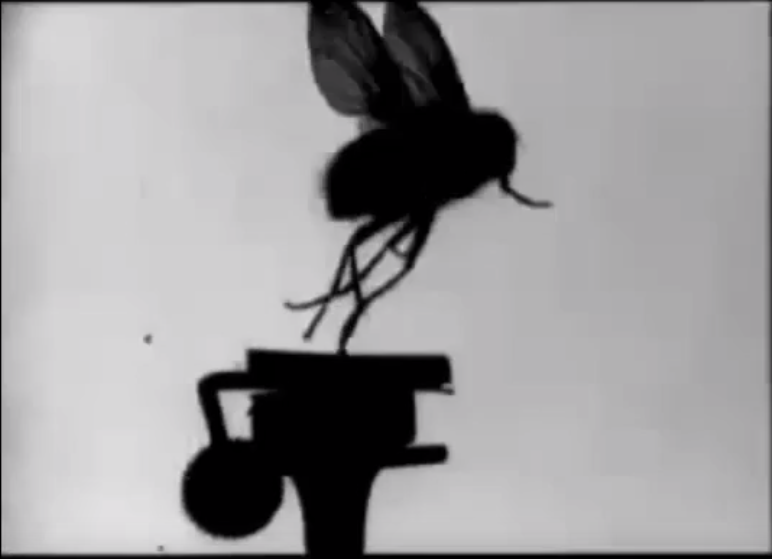
Update: As pointed out below by Zepfanman, this film appears to be mistitled and misattributed to Marey. As he rightly points out, the technology needed to capture this footage was beyond Marey’s capabilities in 1890. I believe he has correctly identified this film as Série 1 (vols d’insectes) (1905), by Lucien Georges Bull. Bull became Marey’s assistant in 1895, shortly after Marey parted ways with Georges Demenÿ. When Marey died in 1904, Bull became the new head of the Marey Institute and continued his predecessor’s pioneering work in motion photography with photographic studies like the one seen here.
(English: Fly)
Ever the consummate scientist, Étienne-Jules Marey continued to push the boundaries of cinematography throughout this period in pursuit of studying a wide variety of subjects. During the early 1890s, he adapted his camera to a microscope to photograph the movements of vorticellae (the very small), took time-lapse photographs of a starfish gradually turning over (the very slow), and, in this case, filmed a fly in slow-motion (the very fast).
I wish I knew more about the exact circumstances and methods surrounding these incredible images, but unfortunately I haven’t been able to find any additional information. Still, the images themselves tell quite a story on their own. Even for a modern audience, they are stunning. An average housefly beats its wings around 200 times per second, so it’s not hard to tell how astoundingly short the intervals of Marey’s photography must have been to capture this.
If you watch closely right at the beginning, a flicker illuminates a ruler to the far right of the frame, which provides scale. I don’t know what the object that the fly is launching from is, so this is purely speculative, but I suspect that it is either a trigger for the camera or a scale measuring mass, or both. You can see it rock ever so slightly as the fly flaps away, and in the second shot, you can see some sort of needle in the bottom left (casting a shadow against the light backdrop) that seems to be bobbing back and forth in response to the fly having launched itself skyward.

Marey must have been thrilled. His fascination with the flight of insects went back decades. Over 20 years before, he had designed a device that included an artificial insect capable of demonstrating how their wings move in flight (pictured at right). He had also conducted a few other experiments to try and break down the details of insects in flight. But none of his earlier efforts could have come close to the level of detail he managed to capture here.
Screening:
Every detail of this brief film speaks to the care and precision of its creation. The lighting, the angle, and the proximity of the camera have all been chosen with a great deal of skill. Watching this, it’s no wonder Marey has been called one of the fathers of cinematography. Modern viewers have also remarked a great deal on how startling it is to see this ordinary fly enlarged and depicted in such detail. It seems monstrous, even terrifying to a few. The title, the Portuguese word for “fly” (again, the explanation for this choice is a mystery to me), strikes many as reminiscent of the names of Godzilla’s rivals. It’s a connection that is far from anything Marey could have imagined, or intended, but it speaks to how his work still captivates our attention and imagination.


 Moviegoings
Looks like another “lost in translation” error of early motion pictures. This should be attributed to Bull, c. 1905! https://boxd.it/6nZSPT
LikeLike
Wow, great catch! I’ll need to make a note of this at the head of the post. In retrospect, it’s clear that it makes more sense that the technical skill required didn’t exist until some years later. Any idea whether this misattribution was based in motion studies Marey actually performed? Clearly he had an interest in the subject, as seen above, so I wonder if there is another (lost?) film from the 1890s in which he attempted some insect photography, or if it was always just this footage from 1905, badly mislabeled and misidentified.
LikeLike