Film History Essentials: Blacksmith Scene (1893)

•January 23, 2023 • 3 Comments

Summary:

A blacksmith brings a piece of metal from the forge and places it on the anvil. His assistants begin rhythmically hammering it, one after the other, in sequence, as the blacksmith picks up a smaller tool and begins to hammer alongside them. They pause, and the blacksmith returns the metal to the forge while the assistant on the left retrieves a bottle of beer. They pass it around, each taking a drink, then the blacksmith brings the re-heated metal back to the anvil and all three recommence their work.

Essentials:

During the winter months of 1892-93, Thomas Edison had a new building constructed in his lab complex at West Orange, NJ. It must have stood out, even before it was completed. The whole structure was covered in black tar paper and had a roof that could swing back to let in the light. Most unusual of all, the building was mounted on a circular rail so that the whole thing could be rotated to follow the sun no matter where it was in the sky. William Dickson and the others who worked in it nicknamed it the “Black Maria,” a slang term for police vans, due to the dark exterior they had in common, and because (they claimed) they were equally uncomfortable to occupy.

This was the world’s first film production studio, and Dickson and his team got straight to work producing material in preparation for the launch of the kinetoscope. They shot hundreds of films there over the next several years, and all of them have a distinct look. The subjects are usually filmed in a wide shot that frames them head to toe. The deep black background reveals no visible details behind action, absorbing the light and providing a high contrast for any performers in front of it, who are themselves brightly lit by the sunlight coming in from overhead. Viewed through the kinetoscope’s peephole, surrounded by featureless darkness on all sides, I imagine it almost seemed to the viewer as though they were miniature people, inhabiting the box and performing for nickels.

On May 9, 1893, Edison traveled to the Brooklyn Institute of Arts and Sciences for the first public exhibition of the kinetoscope. Blacksmith Scene was the very first film to be publicly shown. This is yet another sort-of-but-not-quite arrival of cinema as we know it: The show was an actual live-action film this time, but it wasn’t projected for an audience because the kinetoscope was designed for a single viewer. America’s first movie audience lined up to watch it, one at a time. Before Newark Athlete made the list in 2010, Blacksmith Scene (added in 1995) was the oldest film on the National Film Registry. It’s still the oldest surviving complete film, both on the list and in existence that we know of.

Screening:

I don’t know a thing about blacksmithing, but this certainly looks like the real deal. The outfits and equipment are clearly authentic, and the three men swing their hammers quite convincingly. The way they work as a team stands out particularly. With very little communication between them, they all seem to work in tandem, and not a motion is wasted. It’s almost like choreography. This, it turns out, is a result of planning (and perhaps rehearsal) rather than on-the-job experience. No one in this scene is actually a blacksmith. They’re all employees of Edison’s lab, drafted to be early movie stars. Among its other list of firsts, that also makes this the first filmed performance by actors playing a role (again, that we know of).

You may miss it if you aren’t looking for it, but there’s a 4th person in the scene, as well. I didn’t notice it at first because I’m so used to film deterioration and damage obscuring a part of the image, but the dark area on the left side, partially covering one of the assistants, isn’t that at all: It’s perhaps the first movie blooper. For several seconds at the beginning, someone is standing in front of the camera with their back to it before suddenly stepping out of frame. Whenever I see something like that happen in a very early film, I wonder if it wasn’t reshot because they didn’t think it mattered or that audiences would care, or if the process was too painstaking and expensive to repeat for any but the most disruptive issues. In this case, it may have been both.

Film History Essentials: Pauvre Pierrot (1892)

•January 22, 2023 • 2 Comments

(English: Poor Pierrot)

Summary:

Harlequin scales a courtyard wall to woo Columbina. When Pierrot knocks at the gate, he quickly hides. Pierrot presents Columbina with a bouquet of flowers. He returns later, seemingly drunk, and begins to serenade Columbina, who is inside the house. Harlequin continuously pops out from his hiding place to work his mischief, distracting Pierrot by poking him with a stick and stealing his bottle of wine. Eventually, Pierrot runs away in fright, and Harlequin triumphantly enters the house to join Columbina.

Essentials:

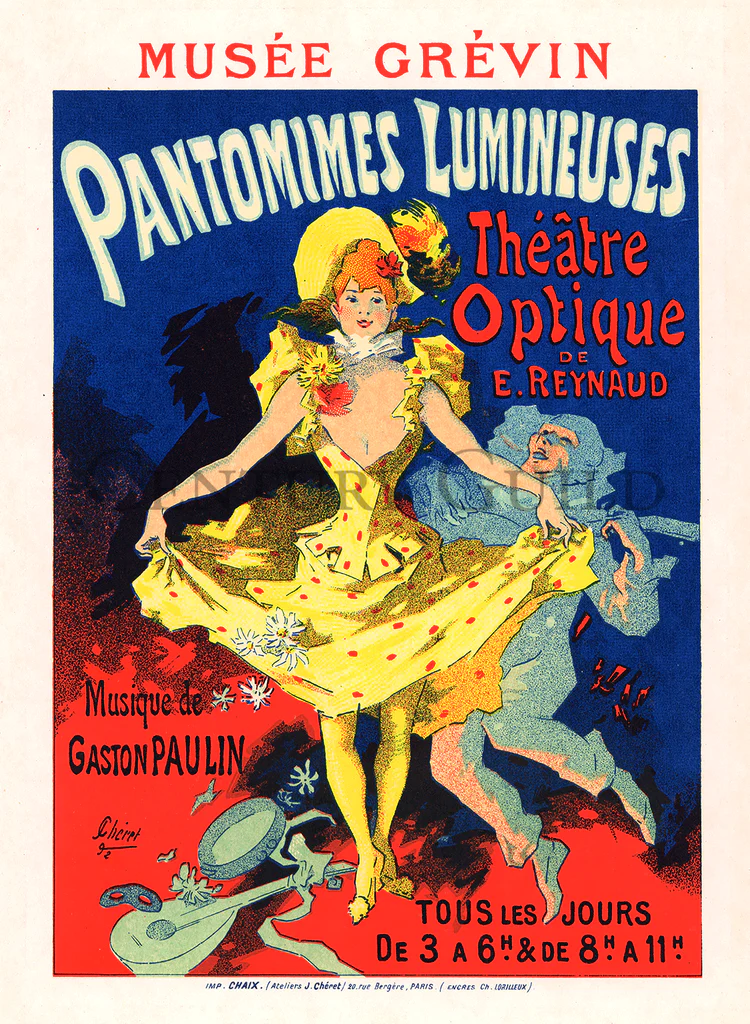
By the 1890s, Charles-Émile Reynaud had come a long way from the 2-second animated illusions of his praxinoscope in the late 1870s. He had already played a small cameo in Edison and Dickson’s creation of the kinetoscope, as the first person to use perforations to draw a strip of images rapidly through his projection system in order to exhibit a moving picture. That system was a part of his magnificent Théâtre Optique, patented at the end of 1888 and likely seen by Edison during his Paris trip the following year. On October 28, 1892, Reynaud gave the first performance of the “Pantomimes Lumineuses,” a program of multiple animated films projected for an audience by the Théâtre Optique.

I don’t think I can overstate the significance of Reynaud’s work. This October 28 show marks the first-ever theatrical exhibition of a motion picture. It’s significance has been sadly downplayed in film history because Reynaud was an animator rather than a cinematographer, and his films weren’t photographed. But the sophistication of his shows was incredible in contrast with the first live-action films.

The first thing you’ll probably notice is that it’s in color, it has a story and characters, and in a time when motion pictures are at most several seconds long, its 4 minutes feels like a marathon. Reportedly, when originally performed before an 1890s audience, it would have included a specially-composed live score and a song, synchronized sound effects, and even some spoken dialogue (also performed live). It would be years before live-action cinema offered most of these things (including plot and characters!), and decades before it offered all of them.

Reynaud’s initial program included Pierrot alongside 2 other films, each one consisting of 300-700 hand-drawn images. Reynaud performed the show himself, and the way he worked the machine was a performance. Through skill and showmanship, he would work the strips of images not only forwards but backwards, prolonging scenes such that a typical showing of Pierrot could last as long as 15 minutes! It was some 20 years before another animated film came close to matching Reynaud for length.

Unfortunately, this very sophistication was ultimately Reynaud’s greatest weakness as well as his greatest strength. His first program ran for about a year and a half, and then closed for 10 months while Reynaud created new material: two brand-new, hand-drawn shorts. Over the next few years, he incorporated an additional two films, these live-action shorts that Reynaud painstakingly hand-colored and adapted for his projection system.

Adding an average of one short film a year was fine for awhile, but by the time he completed that final short in 1897, some of his competitors were changing their programs weekly, rushing new material to screens at an incredible rate. Reynaud couldn’t hope to keep up with the demand for fresh content, and eventually the novelty of his productions wore off for audiences. His show limped along for a few more years, but by the turn of the century, despite his best efforts to adapt to changing tastes, he was done. During nearly eight years in operation, Reynaud’s Théâtre Optique had projected 12,000 shows for half a million viewers.

Embittered by the fickleness of the public and depressed at his own seeming obsolescence, Reynaud destroyed his Théâtre Optique with a hammer and threw almost all of his wonderful films into the Seine River, where they were lost forever. Only this and one other survived the purge, having been hidden by his son Paul. According to film scholar Glenn Myrent, a few days later, Reynaud was approached by Léon Gaumont (who had worked with Georges Demenÿ before founding the hugely successful Gaumont Film Company, the oldest film company that still exists today). Gaumont wanted to buy the Théâtre Optique and donate it to a museum, but he was too late. Reynaud, meanwhile, spent the next few years pursuing further technological innovations, but none were successful. He died, impoverished and all but forgotten, in 1918.

Screening:

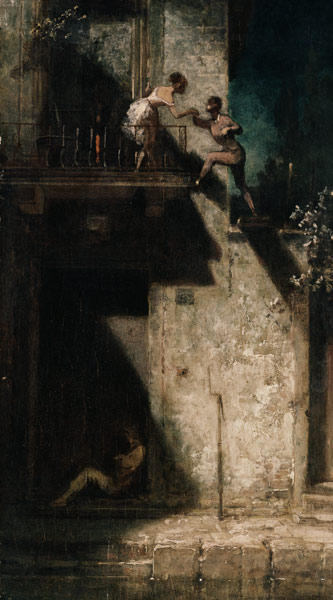
“Pierrot and Columbine (rendezvous)” (Spitzweg, 1875)

Many of the subtleties of Pierrot‘s action and characters may seem opaque to modern viewers, but to a contemporary audience, this was quite familiar. You may have noticed in my description that all the characters have names even though the title names only Pierrot. This is because all three are well-known stock characters from the popular Italian stage tradition commedia dell’arte. These characters are usually identified by standard costumes, and are depicted with established personalities and relationships to each other.

All three are of the character type known as “Zanni,” servants who usually play a comedic role, either through being especially sly or especially dim. The love triangle of Harlequin, Columbina, and Pierrot enjoyed a particular popularity in Parisian theater traditions. Columbina, often portrayed as sneaky and coquettish, was sometimes married to Pierrot, a sad clown type, but mistress to Harlequin, a witty, charismatic trickster. Add to that built-in audience familiarity the fact that a common characteristic of these performances, particularly by the Harlequin character, was pantomime, and you can see why this was a perfect choice of subject for a story that had to be both brief and silent.

“Pierrot and Harlequin” (Cezanne, 1888)

One notable break with tradition here is that Harlequin’s costume (though recognizable thanks to his hat, stick, and mask), is all white rather than covered in a bright, colorful pattern as was typical. Presumably, including this element would have significantly increased the labor required for Reynaud to complete the film. You may also notice that at times, particularly when the characters are in motion, they appear almost ghostlike, not quite transparent but certainly translucent. This likely has something to do with the way the characters are the only animated element of the show, projected via mirror onto a static background that remains fixed throughout. Although I wonder if it has anything to do with the method by which the show was reproduced for our viewing here, and what it might have looked like in-person.

Like his title character, Reynaud’s story ends tragically, as the fickle object of his desire turns her attentions to another. It was an all-too-common story, particularly in the earliest years of film. He deserved better back then, and he deserves to be appreciated now. I think if you give this a chance, you’ll find that isn’t hard to do.

Film History Essentials: La Vague (1891)

•January 21, 2023 • 1 Comment

(English: The Wave)

Summary:

An ocean wave crashes and breaks against a strangely-shaped rock formation that juts up from the water, dissolving at its base.

Essentials:

Étienne-Jules Marey apparently photographed this wave during his annual trip to Naples in 1891. Recall that while he was away, his assistant Georges Demenÿ was working on the lip-reading project (which included Je Vous Aime) for the Institut National de Jeunes Sourds de Paris that would eventually lead to the fracturing of their working relationship. But that was in the future, and meanwhile Marey continued to be absorbed in his science-focused academic work.

What’s particularly interesting about this brief example of Marey’s signature chronophotography is that it is of the natural world, but not of a living thing. This is a departure both for Marey and for early pre-cinema. We have one earlier example, our very first, of motion photography capturing the passage of Venus across the sun in 1874. But this is, perhaps, the first film of a non-living subject.

Both Muybridge and Marey, the pioneers of this sort of motion photography, seem to have focused entirely on human and animal movements to this point. And of course, the pioneers of early cinema most often turned their cameras on whatever human subjects happened to be nearby for their early experiments. What, I wonder, prompted Marey to aim his unique photographic device at this scene? Was it planned, or was it taken spontaneously when something about the way the water met this particular obstacle caught his eye?

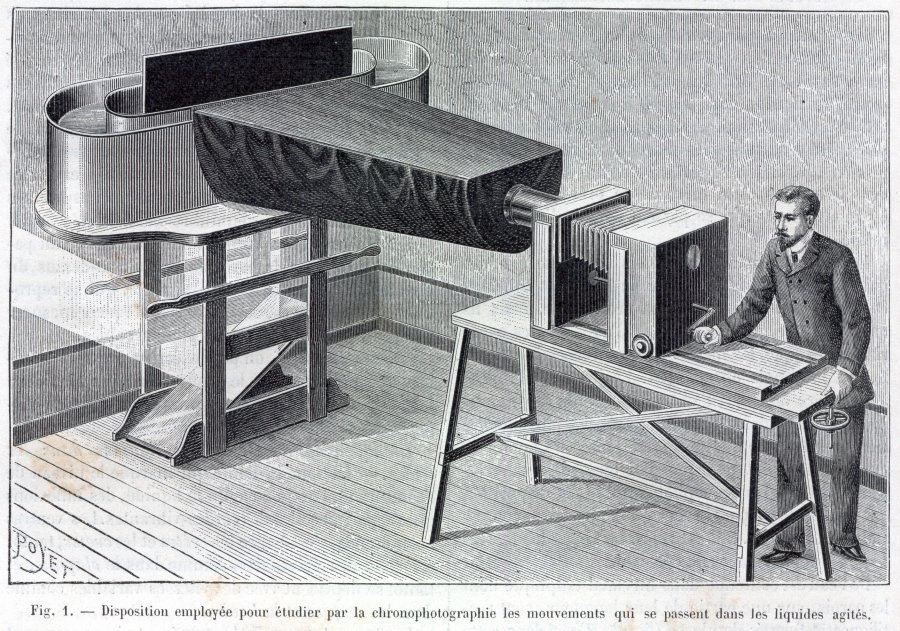
I don’t know whether this was symptom or cause of a new interest for Marey, but in 1893, he published an article in La Nature titled “Le mouvement des liquides étudié par la chronophotographie.” The article doesn’t include any of the photographs he took for the study, but he does include a fascinating drawing of the device he created for his purposes (shown at right). I note particularly the way he has shrouded the lens from outside light, while lighting the tank of water from below using sunlight and a mirror. The beginning of the article also makes reference to a study by Marey detailing the phases of movement of fish from a few months earlier, and seems to suggest that a study of liquid motion is the natural progression for further research.

Marey wasn’t done with living subjects by any means, but towards the end of his life (he died in 1904) he did a similar chronophotographic study involving trails of smoke rather than waves. The experiments rendered air currents visible to the camera as he caused streams of smoke to blow past different shapes in order to observe their aerodynamic properties. You can see some of those photos here. I haven’t seen any indications that Marey considered himself anything other than purely a scientist, but he was undeniably also an artist with his camera.

Screening:

There’s something about this shot that is so hypnotic and spontaneous. So many of the motion pictures to this point have been photographed under carefully and rigidly-controlled circumstances. The lighting and background are just so. The movements of the people precise and deliberate. Even (actually, especially) the photographing of animals in motion are the results of a perfectly-orchestrated plan. And this is particularly true for Marey, the consummate methodical scientist. The wild beauty of this shot is that it isn’t any of those things.

Film History Essentials: Dickson Greeting (1891)

•January 20, 2023 • Leave a Comment

Summary:

A man, William K. L. Dickson, stands illuminated by a bright light in a medium wide shot that extends to somewhere around his knees. In the footage that survives, he closes his eyes and passes his hat from his right hand to his left.

Essentials:

Thomas Edison and the kinetograph graced the front page of the New York Sun on May 28, 1891, announcing the arrival of his “Latest and Most Surprising Device.” Edison had debuted it publicly for the first time several days earlier for an audience of 147 women’s club presidents hosted by his wife, Mina. As the paper recounted:

[H]e showed them the working model of his new Kinetograph, for that is the name he has given to the most wonderful of all his wonderful inventions.

“The surprised and pleased club women saw a small pine box standing on the floor. There were some wheels and belts near the box, and a workman who had them in charge. In the top of the box was a hole perhaps an inch in diameter. As they looked through this hole they saw the picture of a man. It was a most marvellous picture. It bowed and smiled and waved its hands and took off its hat with the most perfect naturalness and grace. Every motion was perfect. There was not a hitch or a jerk. No wonder Edison chuckled at the effect he produced with his Kinetograph.”

In the midst of thinking that Edison sounds a bit like Willy Wonka there, you might notice something conspicuously absent from the reporting: The name of the guy who actually made the 2 inventions Edison was demonstrating, who was probably the “workman” referenced, and who, in fact, even appeared in that motion picture to greet the visiting women! I’m referring, of course, to Dickson, who for some time was barely a footnote in the legend of Edison’s creation of motion pictures.

The article carries on at some length (you can read the whole thing beginning here, and continuing onto page 2 here), with Edison monologuing about his ambitious plans to combine the phonograph and the kinetograph to bring, say, both the sights and sounds of an opera performance directly into America’s living rooms. It reads like prophecy now, though Edison wouldn’t live to see everything he predicted come to fruition. The article goes on to imply that he sees the entire project as a toy that he just occasionally tinkers with when the mood strikes him:

All the work and time which he gives to the kinetograph he counts as his amusement. He took up the idea for amusement, and now that he has so far succeeded as to have gotten over being angry at the people who insinuated that he talked too much when he first spoke of his idea, he only works at [it] for amusement’s sake. […] It does not seem likely that the kinetograph will ever be put to a practical use, that is, for commercial purposes.

Maybe I have a different understanding of what “commercial purposes” means, since just a few sentences later Edison is outlining a plan (which he would soon carry out) to publicly install kinetoscopes that charge a nickel per show for people to see a motion picture. But I’m in danger now of being sucked down the Edison rabbit hole along with this 19th-century reporter.

Do you like how Edison not only takes sole credit for the idea and its construction, but also suggests that he did it on the side, just to prove a point, while allocating most of his mental resources on more important projects? That’s how you build a personal myth . . . at the expense of your employees making things happen behind the scenes.

You may also have noticed the description of the motion picture (Dickson Greeting) that the women saw inside the “small pine box” (kinetoscope) is a bit different from what we have today. In fact, you can see at the top a frame that is missing from the fragment of the film that we have. Edison attached that frame (1 of 5) to his August 24th patent application (my birthday, by the way!), and it was discovered several decades later, then lost again after being misfiled, before finally being found again quite recently. But much of the action that account describes is simply lost. Thankfully (and no thanks to Thomas Edison) the identity and contributions of the man who appears in the film are not lost along with it.

Screening:

On May 20, 1891, motion pictures said “hello” to the world for the first time, but Dickson did the waving, the bowing, and the smiling on the medium’s behalf. Although Dickson directed well over a hundred films during the next decade, he only appeared in a very few himself. But I think he deserves the spot he took in this one. He was perhaps more intimately involved with the birth of what motion pictures became in the United States, and later his native England, than any other single figure, and he was all but forgotten for decades. Just take a moment to appreciate him here, greeting us from the very beginning.

Film History Essentials: Newark Athlete (1891)

•January 19, 2023 • 1 Comment

Summary:

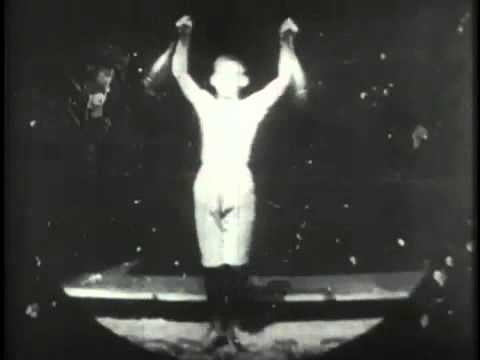
A boy who looks to be somewhere between 12 and 15 holds up a pair of Indian clubs (specially-weighted exercise equipment that originated in India). He hoists them above his head, then lets the clubs twirl in his palms, continuing as he drops his arms to waist level.

Essentials:

Once Dickson abandoned the experiments with a phonograph-like cylinder for the kinetoscope and transitioned to film, he seems to have progressed much more quickly. (At least, if the work with cylinders did continue into late 1890, as some believe.) Dickson produced a series of experimental films during the next few years as he continued to perfect both the kinetoscope and the kinetograph.

This one, taken in the early summer of 1891, is one of the first successful experiments. Or, at least, it’s one of the oldest surviving successful experiments. It is also, as of 2010, the oldest film selected for preservation by the National Film Registry. (Each year, the NFR inducts 25 films deemed “culturally, historically or aesthetically significant” from a pool of nominees that can be submitted by any member of the public.)

As with many of the earliest film performers, we know little or nothing about the star of this brief motion picture beyond what the title states and what we can see. He is an athlete and he is from Newark, the next town over from Edison’s labs in West Orange. Who he is and how he was selected to appear are a mystery. However, in the tradition of both Muybridge and Marey, the majority of Dickson’s films shot during this time are of a man or men engaging in some kind of exhibition of athleticism.

Perhaps Dickson was following their lead, either consciously or unconsciously, or perhaps he chose from the subjects that most interested him for his tests. Or maybe he simply judged that these sorts of activities would provide the best test material. Certainly when making a motion picture as a test, the one thing you want to be sure of is that there is motion. The Newark Athlete, whoever he was, certainly delivered that.

Screening:

Filming something that is effectively test footage as an experiment, there’s no reason for it to be artistic, or entertaining, or engaging. And certainly this isn’t really any of those things, to a modern audience. It’s more interesting to us now because of what it is than because of anything in the experience of watching it (though it’s not like you’ll get bored when it’s over after about 10 seconds). Still, Dickson could have pointed the camera at anyone or anything for his test, and he seems to have made choices that were very deliberate, even though we don’t know the reasoning behind many of them. I think he must have known how important it was, not just to be able to film something and then play it back for a viewer, but to choose specific subjects that an audience might actually be interested in viewing. He was developing, not just the technology of motion pictures, but their appeal.

Film History Essentials: Je Vous Aime (1891)

•January 18, 2023 • 1 Comment

(English: I Love You)

Summary:

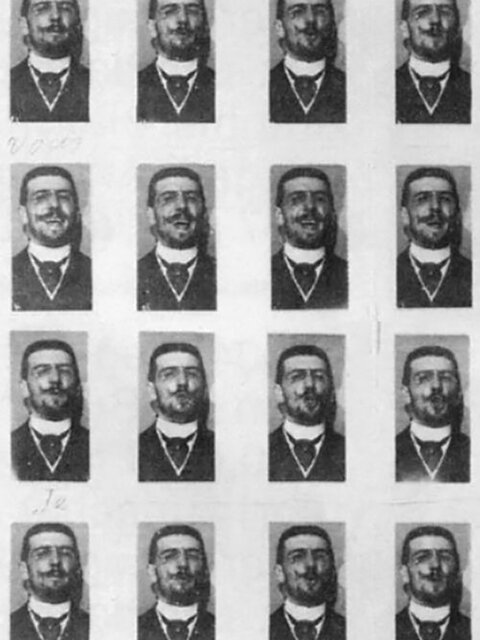
The camera frames a man’s head and shoulders in close-up. Keeping the rest of his face immobile (with even his eyes closed as though to focus attention on one place only), the man exaggeratedly mouths the words “je vous aime.”

Essentials:

The man in this film is Georges Demenÿ, who worked closely with Étienne-Jules Marey for 20 years, beginning when he enrolled as a student in one of Marey’s courses in 1874. In the early 1880s, the Municipal Council of Paris subsidized a lab site for Marey that was called the “Physiological Station.” Here, he was able to create an area that could accommodate the chronophotography of a large number and variety of subjects. However, he often spent part of the year living and working from Naples, leaving Demenÿ to run operations at the station as his trusted assistant.

Sometime in 1890 or 1891, Marey was approached by Hector Marichelle, director of the Institut National de Jeunes Sourds de Paris. The Institute was the first public school for the deaf in the world, and had already been in existence for well over a century. Marichelle had the idea that it might be possible to use moving pictures of people speaking to teach his students to speak and to read lips. It was a radical notion considering the state of development of motion photography at the time, and a project with some potential for prestige. Marey assigned it to Demenÿ.

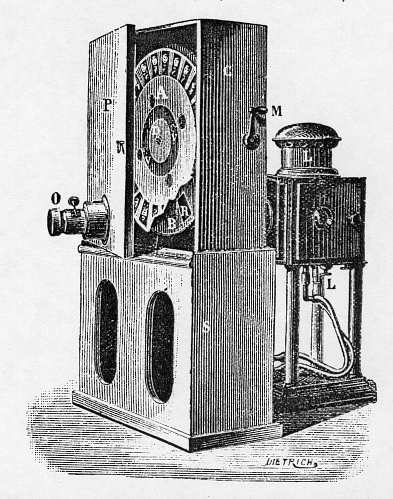
I can’t find any further information about the results of the project for Marichelle’s school, which suggests that it wasn’t very successful, but for Demenÿ it was life-changing. In addition to photographing speech, he developed an invention that he called the “Phonoscope” (pictured at right) in order to allow people to view his photographs in motion. The invention relied on a disc with images placed around the edge in sequence and rotated past the viewer in front of a light source. Of course, disc-based motion picture viewing was extremely limiting and could only accommodate durations of a second or two before repeating or changing out the disc. Still, the phonoscope had a certain versatility. It could be used by a single viewer through a peephole, or it could project images for a larger audience.

Demenÿ demonstrated the device at the Académie des Sciences in July, 1891, and showed a whole series of his motion pictures to an audience of over 1000 at the Conservatoire National des Arts et Métiers in December. These exhibitions were successful enough that Demenÿ patented the phonoscope in March of 1892, and in April he showed it off at the Exposition Internationale de Photographie. The phonoscope began to get attention in a variety of publications, and Demenÿ became fascinated by the possibility of commercializing his work. He asked Marey to order an additional six cameras to be sold, but Marey, ever the scientist and never the businessman, refused.

At the end of the 1892, Demenÿ went ahead with forming his own company, the Société de Phonoscope—a move which seems to have infuriated Marey. The two men, once such close partners, finally parted ways permanently in 1894, with Marey continuing his scientific work, and Demenÿ pursuing his dreams of fame and fortune in the burgeoning field of motion pictures.

Screening:

Je Vous Aime may have had a greater impact on the course of Demenÿ’s life than it did on the course of film history, but this is the most detailed motion picture we’ve seen of a human face. In fact, though there are exceptions, it would be many years before motion pictures would regularly incorporate shots taken this close to their subjects. I don’t know how many of these Demenÿ made, or who chose their content, but out of all the words or phrases that exist, it’s interesting that the one we have is of him saying “I love you.”

Incidentally, although I can’t confirm this independently, one source suggests that Demenÿ’s eyes are closed here, not to focus attention on the movement of his lips, but due to the lighting required to make those movements visible: a set of mirrors reflecting sunlight directly into his face. This certainly seems plausible, given how studios set up for film production in the coming years would be designed largely to provide as much access as possible to plenty of sunlight.

Film History Essentials: Monkeyshines, No. 1 & 2 (1890)

•January 16, 2023 • 1 Comment

Summary:

A blurred, indistinct figure, shot from around the knees up, engages in some sort of performance for the camera that involves moving their arms. Then, a somewhat clearer, but still blurry, figure goes through a series of more exaggerated movements for the camera, waving their arms and twisting and bending their body before removing what appears to be some kind of hat.

Essentials:

In early 1888, Eadweard Muybridge (Sallie Gardner at a Gallop, Buffalo Running, etc.) visited Thomas Edison at his New Jersey laboratory and talked with him about combining the Muybridge zoopraxiscope with the Edison phonograph to create motion pictures with sound. This was the same idea Wordsworth Donisthorpe already had (albeit using his own kinesigraph, rather than the zoopraxiscope) a decade earlier. Edison didn’t take Muybridge up on the proposal. Instead, he waited several months and then filed a patent for a device that would be the visual counterpart to the phonograph. He called it the “kinetoscope,” and he assigned a team headed by William Kennedy Laurie Dickson to develop it. (The kinetoscope, unlike the phonograph, ended up just being the “playback” device. The corresponding camera, developed during the same period, was called the “kinetograph.”)

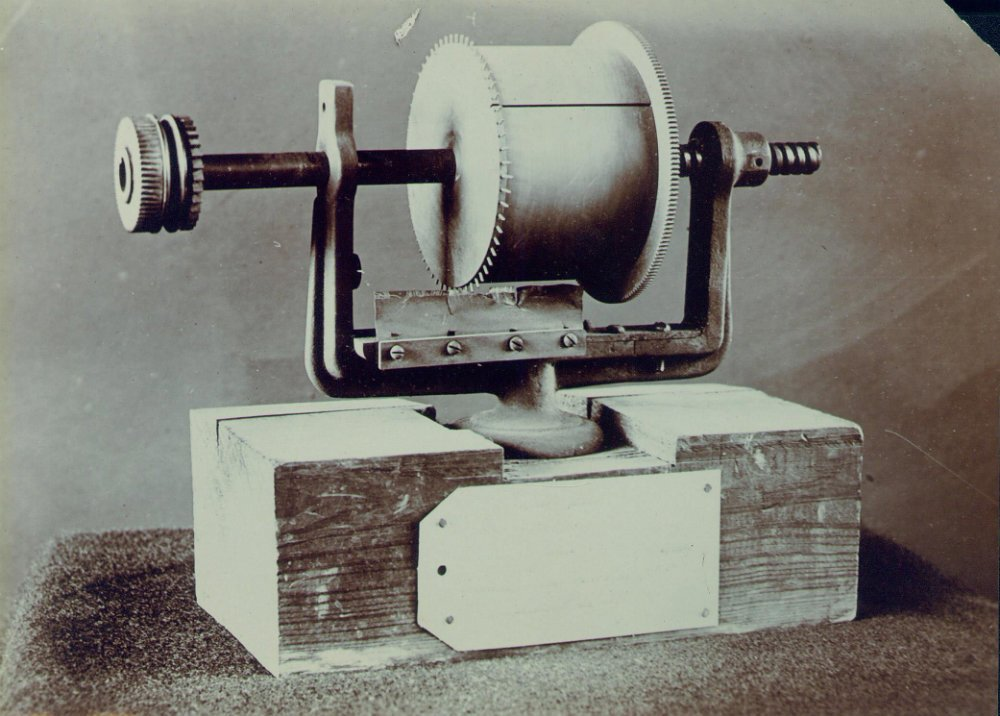
At first, work focused on recording images on a rotating cylinder (as seen at right), an idea that was presumably rooted in its similarity to the wax cylinders used by Edison’s phonographs. That idea ultimately proved unworkable, but the team continued to pursue it into the following year. Nevertheless, it did produce the first ever motion pictures recorded in the United States. Monkeyshines, No. 1 and No. 2 (and a lost No. 3) were experiments, never meant to be seen by an audience. It’s notable that both of these surviving examples are an obvious step backward from almost everything else we’ve seen. These were not successful experiments, though their significance is undeniable (in part because they weren’t successful).

Meanwhile, late in the summer of 1889, Edison traveled to the Paris World’s Fair, where the just-completed Eiffel Tower had been unveiled. While Edison was in Paris, he met Étienne-Jules Marey (L’Homme Machine, Mosquinha, etc.) and learned of his use of celluloid film strips to capture sequential images. He also witnessed the Théâtre Optique and the electrical tachyscope in action. The former was a system invented by Charles-Émile Reynaud (La Rosace Magique, Le Singe Musicien) for turning a strip of hand-drawn images into animated moving pictures by drawing them rapidly past a system of lights and mirrors using a series of perforations between each image. The latter was a different projection device invented by German photographer Ottomar Anschütz that relied, in part, on an intermittent light source to produce the illusion of a moving image. When Edison returned in the fall, he filed a patent caveat for a system that incorporated perforated strips of film that could be drawn through the system by means of sprockets, and ultimately the design incorporated intermittent light as well.

So, if Edison returned with fresh ideas in the fall of 1889, why was Dickson still experimenting with cylinders in 1890? There is actually a disagreement over whether these were produced in June of 1889 or November of 1890, with evidence that supports both claims. It certainly makes sense that they could be from before Edison’s Paris trip. On the other hand, some sources suggest Edison’s initial idea was to record the images directly onto the cylinder, and that they experimented with different materials for the cylinder and different coatings. But the surviving Monkeyshines actually consist of images on photosensitive paper (as seen at left) wrapped around a cylinder rather than recorded directly on it, suggesting that they spent additional time on successive iterations of the cylinder idea.

Also, in From Peep Show to Palace, David Robinson says: “Despite […] the new possibilities offered by flexible film, the cylinder experiments seem to have been carried on to the bitter end.” (pg. 29) And it’s not as if they were struggling along with cylinders during that entire year. For a full 6 months in the middle of 1890, Dickson seems to have abandoned the project entirely in order to work on another, more-pressing venture. Robinson further suggests that it was actually the obvious failure of Monkeyshines (after almost 2 years of work, albeit sporadic) that finally convinced them to give up their stubborn attempts with cylinders entirely.

You may have noticed that I’ve name-checked almost every photographer or inventor we’ve discussed so far at some point above. Thomas Edison would spend the next quarter century aggressively establishing and maintaining control of the entire concept of motion pictures as his own intellectual property, so it’s worth pointing out that he stole the idea itself and many of the elements that made it work from men who had already been working in the field for several years, and then handed off the actual development of the technology to someone else.

He made all sorts of utterly ludicrous claims in later decades that we know to be outright fabrications, including that he had “invented the modern motion picture in the Summer of 1889” and that he had been “able to perfect the motion-picture camera” in 1887, in order to claim that he was the man who had, all on his own, invented motion pictures. However, his own initial idea, to simply rework the mechanism of the phonograph for sight instead of sound, was a total dead-end, and it seems unlikely in the extreme that anyone working under his direction would have cracked the problem if the solution were dependent on him alone. (You can see the completed experimental kinetoscope on the right, and watch it in action here.)

There’s no question that Edison was a brilliant inventor, but in some ways he was an even more brilliant entrepreneur, and if there was a limit to his utterly ruthless shamelessness, I’m not sure what it was. A more charitable reading might point out that for almost 20 years, several different innovators had been circling around a breakthrough in creating and exhibiting motion pictures, but for various reasons no one had actually managed to bring it about. Edison was the man who had the vision to put all of the pieces together, and both the resources and the killer instinct to build it into a successful business venture. But he was also a man who played for all the marbles, and that had consequences.

There’s a strange irony to Edison’s (“Edison’s”) first experimental films being called “Monkeyshines,” an old-timey word that means “playful, mischievous behavior” . . . The one thing Edison wasn’t doing here was just playing around.

Screening:

It’s strange to watch the Monkeyshines because they look exactly like what you’d expect a “first-ever motion picture” to look like: barely developed and incredibly primitive . . . an idea that is in its infancy. They look, in fact, very much like the “indescribable blur” that Sir George Newnes’ pair of “experts” predicted would be the result of any attempt to photograph motion. But we know, and Edison and Dickson certainly also knew, that it had already been done quite successfully. It’s just that they were starting on the problem entirely from scratch without reference to any of the advances that had been made already. They had to fail their way before they could succeed someone else’s way. But it’s an interesting failure, and I can see why Edison found it an attractive idea to pursue. You can also see from the picture above that this was an idea for exhibition of motion pictures, but not an idea for projection. With this invention, one person watches at a time, and that feature of the kinetoscope, as we will see, remained.

Film History Essentials: Mosquinha (1890)

•January 15, 2023 • 2 Comments

Update: As pointed out below by Zepfanman, this film appears to be mistitled and misattributed to Marey. As he rightly points out, the technology needed to capture this footage was beyond Marey’s capabilities in 1890. I believe he has correctly identified this film as Série 1 (vols d’insectes) (1905), by Lucien Georges Bull. Bull became Marey’s assistant in 1895, shortly after Marey parted ways with Georges Demenÿ. When Marey died in 1904, Bull became the new head of the Marey Institute and continued his predecessor’s pioneering work in motion photography with photographic studies like the one seen here.

(English: Fly)

Summary:

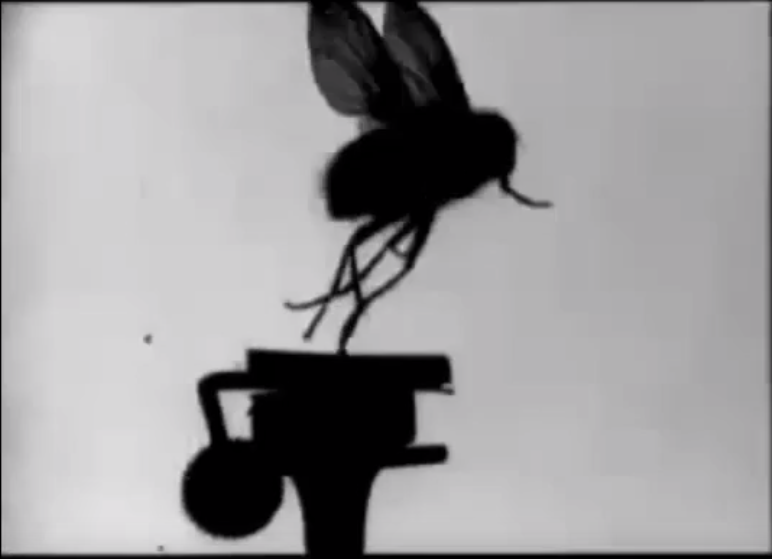
In extreme close-up, a fly launches itself into the air and beats its wings several times as it flies out of the top of the frame. Various measuring devices placed in the margins record additional data for further study.

Essentials:

Ever the consummate scientist, Étienne-Jules Marey continued to push the boundaries of cinematography throughout this period in pursuit of studying a wide variety of subjects. During the early 1890s, he adapted his camera to a microscope to photograph the movements of vorticellae (the very small), took time-lapse photographs of a starfish gradually turning over (the very slow), and, in this case, filmed a fly in slow-motion (the very fast).

I wish I knew more about the exact circumstances and methods surrounding these incredible images, but unfortunately I haven’t been able to find any additional information. Still, the images themselves tell quite a story on their own. Even for a modern audience, they are stunning. An average housefly beats its wings around 200 times per second, so it’s not hard to tell how astoundingly short the intervals of Marey’s photography must have been to capture this.

If you watch closely right at the beginning, a flicker illuminates a ruler to the far right of the frame, which provides scale. I don’t know what the object that the fly is launching from is, so this is purely speculative, but I suspect that it is either a trigger for the camera or a scale measuring mass, or both. You can see it rock ever so slightly as the fly flaps away, and in the second shot, you can see some sort of needle in the bottom left (casting a shadow against the light backdrop) that seems to be bobbing back and forth in response to the fly having launched itself skyward.

Marey must have been thrilled. His fascination with the flight of insects went back decades. Over 20 years before, he had designed a device that included an artificial insect capable of demonstrating how their wings move in flight (pictured at right). He had also conducted a few other experiments to try and break down the details of insects in flight. But none of his earlier efforts could have come close to the level of detail he managed to capture here.

Screening:

Every detail of this brief film speaks to the care and precision of its creation. The lighting, the angle, and the proximity of the camera have all been chosen with a great deal of skill. Watching this, it’s no wonder Marey has been called one of the fathers of cinematography. Modern viewers have also remarked a great deal on how startling it is to see this ordinary fly enlarged and depicted in such detail. It seems monstrous, even terrifying to a few. The title, the Portuguese word for “fly” (again, the explanation for this choice is a mystery to me), strikes many as reminiscent of the names of Godzilla’s rivals. It’s a connection that is far from anything Marey could have imagined, or intended, but it speaks to how his work still captivates our attention and imagination.

Film History Essentials: London’s Trafalgar Square (1890)

•January 14, 2023 • Leave a Comment

Summary:

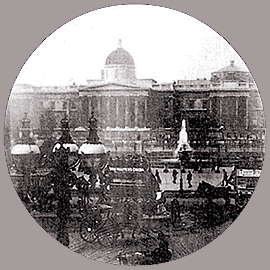
Enclosed by a round frame, traffic moves through a shot of Trafalgar Square. A street lamp occupies the foreground, with the National Gallery dome occupying the background. In-between, a number of people pass by in vehicles and on foot, and a fountain is clearly visible in action on the righthand side of the frame.

Essentials:

Wordsworth Donisthorpe, in addition to having an incredible name, was one of the first people to attempt to make a motion picture camera. He patented his idea for one in 1876, a full two years before Muybridge’s photographs of a horse in motion were publicized! He called his idea the “Kinesigraph.” His Kinesigraph would, he said:

facilitate the taking of a succession of photographic pictures at equal intervals of time, in order to record the changes taking place in or the movement of the object being photographed, and also by means of a succession of pictures so taken of any moving object to give to the eye a presentation of the object in continuous movement as it appeared when being photographed.

Read carefully and you’ll notice that he’s describing, not only the recording of motion pictures, but also their presentation.

Although there were a few people working on motion photography by this time, connecting it specifically with exhibition was pretty unique. But Donisthorpe didn’t stop there. In 1878, he suggested that his Kinesigraph could be combined with a brand-new invention called the Phonograph to produce talking pictures. He immediately saw that potential over a decade before Edison himself tried the same idea. He does not, however, seem to have produced a working camera until many years later. In 1889, Donisthorpe took out another patent for a device he was also calling the Kinesigraph, but by now he had a partner: his cousin, William Carr Crofts.

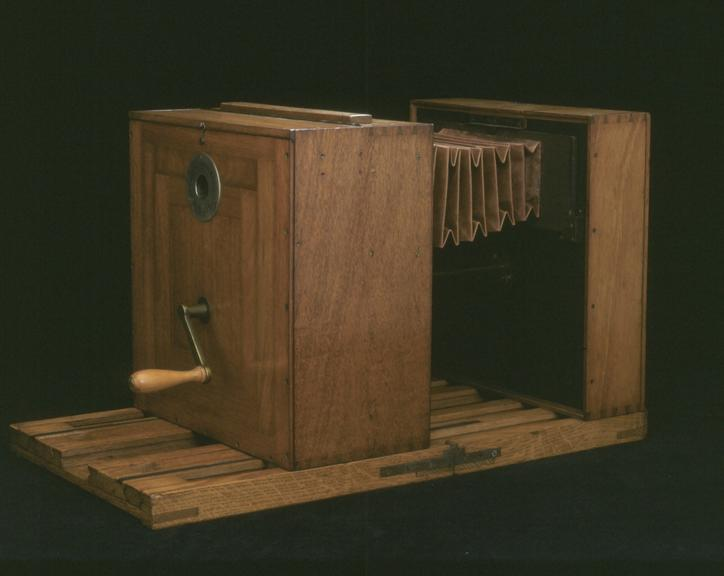
Donisthorpe had big ideas, but Crofts seems to have had the technical skill to actually realize them. He, like some others who were working on this problem during this same time, saw the significance to his project of celluloid film, which had just been introduced. By the summer of 1890, Donisthorpe and Crofts had a working model that they used to film this view of Trafalgar Square, the oldest surviving motion picture of London. (A replica of their Kinesigraph appears at right.) They hadn’t beaten Le Prince, but no one knew about Le Prince’s achievements yet, and they were way ahead of almost everyone else. Unfortunately, it turned out they were a little too far ahead.

The two men had made a motion picture, but they couldn’t crack the problem of how to project it for an audience. Donisthorpe approached Sir George Newnes, a wealthy publisher with a known fascination for cutting-edge technology, to ask for funding. Newnes consulted his own “experts” as to the viability of Donisthorpe’s idea, and they judged it to be “wild, visionary, and ridiculous,” and opined that “the only result of attempting to photograph motion would be an indescribable blur.” Their assessment was surprisingly short-sighted considering that there were people who had already been successfully photographing motion for several years (perhaps they’d seen a few of Marey’s single-plate experiments).

Unfortunately, between Newnes’ refusal and Crofts’ death just a few years later, Donisthorpe’s hopes of being the one to realize his prescient vision of the future were over. His foresight, however, remained as keen as ever. In a book published (by Newnes!) in 1898 (a slightly-fictionalized account of a trip around the Mediterranean with Newnes), Donisthorpe reflected, rather bleakly:

Shall we never be able to glide back up the stream of Time, and peep into the old home, and gaze on the old faces? Perhaps when the phonograph and the kinesigraph are perfected, and some future worker has solved the problem of colour photography, our descendants will be able to deceive themselves with something very like it: but it will be but a barren husk: a soulless phantasm and nothing more.

-Down the Stream of Civilization, p. 32

By 1898, everyone could see that motion pictures had potential. In fact, Newnes himself invested in a motion picture syndicate that year. But they were still very much in their infancy. It would be nearly 40 years before motion, sound, and full color would be regularly combined to make feature films, but Donisthorpe (who died in 1914) foresaw the possibilities, what they would mean, and also what they wouldn’t.

Screening:

I don’t know if it’s the round frame, the picturesque shot composition, or some other factor, but London’s Trafalgar Square almost puts me in mind of an animated postcard. The static elements dominate the shot, drawing our attention even as people and carriages hurry by in the bottom third of the frame. The fountain is the one exception, an immobile object that nonetheless teems with motion. The water tumbles and flows, animated and full of life, but confined to one spot, just off-center, as everyone around it enters from one side of the frame and exits out the other. It’s a contradiction that feels appropriate to the only surviving piece of film by a man who was bursting with such incredible ideas, but who was stuck watching from the sidelines as others gained immortality by turning his ideas from speculative concepts into concrete realities.

Film History Essentials: Escrime (1890)

•January 13, 2023 • Leave a Comment

(English: Fencing)

Summary:

Two men standing against a dark backdrop demonstrate several different fencing techniques and positions.

Essentials:

Through most of the 1880s, Étienne-Jules Marey continued his experiments with photography and motion, but by the end of the decade he’d made a few upgrades. The most significant of these was replacing the glass plates inside his cameras with strips of film, a change he apparently made within only a few months of Le Prince’s successful experiments with film. Of Marey’s many chronophotographic works, though, very few are considered “motion pictures,” and even fewer depict actual humans.

Marey was particularly interested in flying and falling animal bodies, but this isn’t to say he didn’t photograph people at all. He also had a great interest in the motions of athletes, particularly runners and jumpers. In fact, in 1900 he was specially commissioned to photograph the athletes at the Paris Olympic Games. His photographs breaking down the movements of America’s champion hurdler, Alvin Kraenzlin, changed the way future runners approached that event.

Despite his innovations, Marey, like Le Prince, doesn’t have the same name recognition as the other leading luminaries associated with the birth of cinema. This is for the very simple reason that he had no interest in commercial public exhibition of his work. He was a scientist, not a showman. Nevertheless, unlike Le Prince, Marey’s contributions served as a known source of inspiration for those later innovators. His achievements were widely reported by the global press, and he published multiple books in the early 1890s about movement and the photography of movement, considered by some to be the earliest works on cinematography. His mechanism for advancing the strip of film as the shutter opened and closed formed the principle that all of the later cameras followed (each in their own patentably-unique way).

In Escrime, we can see all of those advances fully in action. Marey is shooting under much more controlled surroundings than Le Prince. As a result, the two men fencing show up with a clarity of image and of motion that we haven’t seen before, even where the film has degraded badly. Marey’s set-up here, with the action contained on a small stage, very well-lit (usually by direct sunlight), against a black backdrop, would become the standard practice for filming motion pictures over the next several years.

Screening:

The video below is a collection of several different shots of the same two men fencing, ranging in length from a few to a few dozen images. Each is shown first at “full speed,” then slowed down to emphasize Marey’s purpose of studying the fencers’ motions. Neither man is wearing the standard fencing “uniform” (and it was standard by then . . . I checked). That’s an interesting choice (by Marey?), and it makes it quite easy to tell the two apart, even when they switch sides in some clips.

It’s not quite suggestive of narrative intent, but making their faces visible is certainly more compelling than the anonymity of fencing masks. Unlike the raw athleticism of Marey’s later photographs of mostly-nude runners and jumpers, there is an elegance to these shots that is representative of the sport. But I also see, in these brief thrusts, ripostes, and parries, the shadows of a thousand swashbuckling duelists who would one day thrill the audiences of future films.