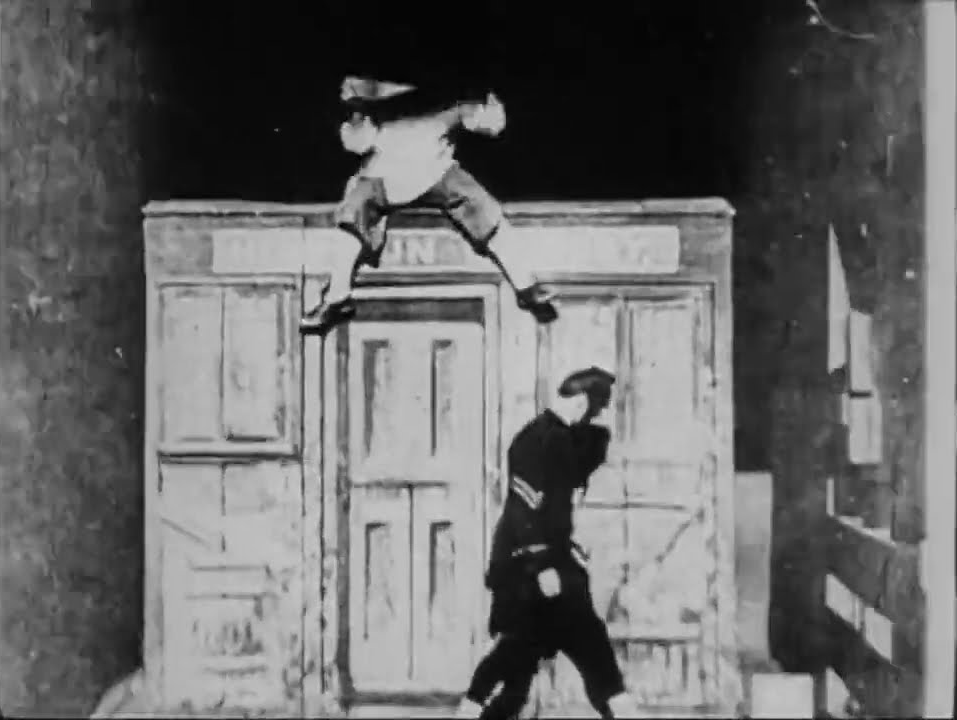
Two men stand facing each other in front of a small building under a sign that reads “Heap Fun Laundry.” The man on the right, “Hop Lee,” smashes something (possibly a wooden bucket) over the head of the policeman on the left, causing his helmet to fly off. As the policeman struggles to regain his balance, Hop Lee turns and dashes through the right-hand door. The policeman recovers and gives chase. There is a series of gags where Hop Lee evades his pursuer by manipulating the building set and displaying a flair for acrobatics. He also pelts the policeman some more from above, and then seems to escape behind a door that locks after him as the film ends.
Essentials:
Filmed in late November of 1894, this is probably the oldest surviving example of slapstick comedy on film. It stars a vaudeville duo who went by the stage names of “Robetta and Doretto,” and I can’t find any additional information about their lives or careers, except that Doretto’s real name may have been Phil Lauter. This was the second of two shorts they filmed that day. The first, apparently concerning a Chinese opium den, is blessedly presumed lost.
It’s unfortunate, and I wish it were more surprising, that this early foray into screen comedy centers around a broad racial stereotype . . . A stereotype of a group who, as far as I know, had not yet even appeared on film. So yes, it would seem that Chinese stereotypes in movies are literally older than any appearance by actual Chinese people in movies. It might be easy for a modern viewer to miss this without the cue of the title, but it’s not difficult to spot if you know to look. There is, of course, the element of a Chinese laundry service (evident from both the title and the sign), and there’s also the “Chinese” character’s costume, and a mask that is somewhat obscured by the quality of the film (probably for the best).
What I haven’t been able to ascertain is whether there is any significance to the act’s choice of the name “Hop Lee” (as stated in the film’s catalog listing). I see that there was at least one (regionally) well-known “Hop Lee Laundry” that had been operated by a fairly successful Chinese immigrant in the city of Salem, Oregon for many years by this point. Perhaps “Robetta” and/or “Doretto” were from that area or had toured there at some point. More likely, though, the name was selected for its “humorous” suggestion of the character’s sprightly agility.
What’s particularly baffling is that there’s nothing evident in what we see that suggests either character’s ethnicity is important to any of the action or the jokes, nor that it matters that the set is meant to represent a Chinese laundry. You could remove the sign and put both characters in their street clothes and it wouldn’t change anything about this film except that it wouldn’t be racist. Obviously this is only a very small excerpt of a much longer stage act that likely developed those elements more. But it seems certain that to the extent that it was important that one of the characters is pretending to be Chinese, it would have been to leverage the character’s exaggerated otherness for laughs.
Screening:
I don’t know if I’d call this set “sophisticated” when it seems so flimsy (and so obviously a set), but it clearly took some engineering and its construction supports the gags well. Notice how the first entrance changes abruptly from a swinging double door that opens in the middle, to a revolving door that spins from the middle, connected where it used to open and opening where it used to connect. The other entrance begins by opening like a regular door, but then its bottom half operates like a separate swinging double door. And the construction is not so flimsy that the mischief-maker can’t swing himself up and perch on top of it.
I can’t say that I was really inspired to laugh at any point while watching this, and I doubt most modern audiences will either. Still, there is a visual inventiveness to the physical comedy here that hints at the link between vaudeville traditions and the development of cinema comedy over the next few decades . . . and perhaps even foreshadows gags that became common in classic animation. As for the racism, well, it’s important to acknowledge that that’s a tradition in American entertainment as well.
Annie Oakley, facing away from the targets on the far side of the frame, drops something and then spins and opens fire with her rifle. She quickly hits all 7 targets, cocking the rifle between each shot. As soon as the last target falls, she drops into a crouch and exchanges her rifle for another that is lying ready on the ground. Meanwhile, her assistant (likely her husband, Frank Butler), crosses quickly in front of her and then squats down. He begins tossing small items (possibly glass balls) into the air, and Oakley fires at each one. The film ends as she triggers the 7th shot.
Essentials:
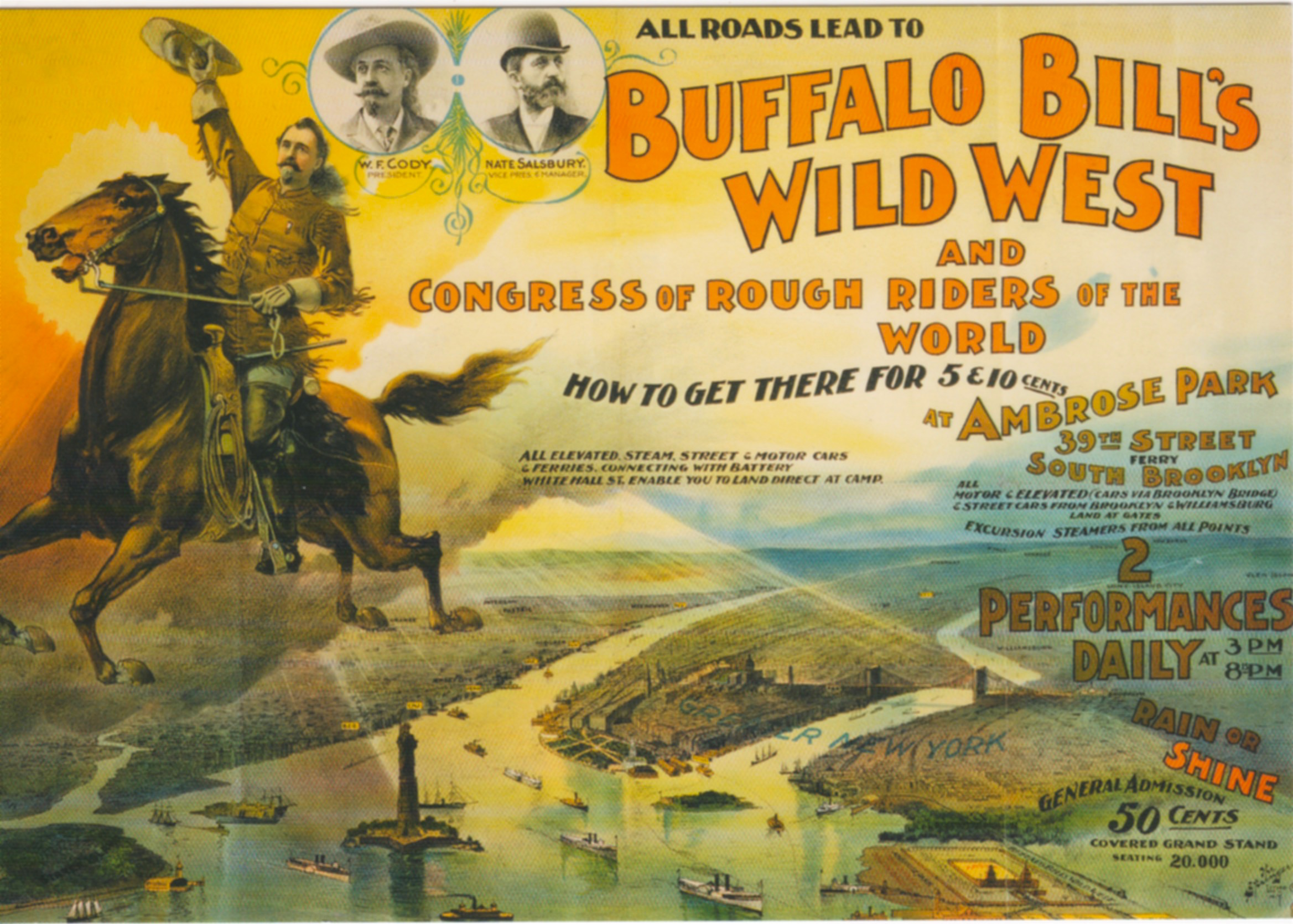
Annie Oakley was born Phoebe Ann Mosey (there are conflicting records regarding the spelling of her surname) in August of 1860. She learned to shoot during a difficult and impoverished upbringing, but famously met her husband, a traveling performer, when she beat him in a shooting competition at the age of 21. They were soon married and performed together for a few years before joining “Buffalo Bill’s Wild West,” where Annie Oakley (as she now called herself) rapidly became one of the most popular performers.
During her first tour with Buffalo Bill, she became good friends with Chief Sitting Bull, who so admired her prowess with firearms that he nicknamed her “Watanya Cicilla.” This translated to “Little Sure Shot,” which became a title she would advertise and use frequently over the following decades. Through her show business career she became deeply associated with the American West, and was something of a model for the archetypal Western “cowgirl.”
This is ironic given that she was born in Ohio, and never traveled West except as a performer, but she struck an appealing balance between jaw-dropping skill in a male-dominated activity and “proper” Victorian femininity. Even though she could outshoot virtually anyone, and once offered President William McKinley a regiment of women sharpshooters if the United States went to war with Spain, she also sewed her own costumes (which always included skirts, never pants), was by all accounts a consummate hostess, and opposed women’s suffrage. She combined spunk and skill that earned her the respect and admiration of her male peers without threatening their masculinity or appearing interested in upending societal gender roles in any alarming way.
By the time she arrived at the Black Maria to be filmed, she already had over a decade of experience touring and was quite well-known. But she also remains quite well-known to this day, and I would hazard to say that this is the earliest surviving appearance on film of a celebrity who is still something of a household name. Of course, Buffalo Bill himself also appeared in front of the kinetograph at around the same time, but the film featuring him is currently believed to be lost.
Screening:
Oakley is noticeably ill-served by the Black Maria set-up. The stage is so confining that she appears to be about 10 feet from the targets she’s shooting, and most of the targets thrown up into the air end up outside of the camera frame when she fires. However, the quality of the picture also makes it difficult to tell whether she hits even the ones that are on the screen.
And yet, even so, her performance is thrilling. She moves so quickly, but with such precision. It’s not easy to tell, as the film moves a bit slower than real-life, but she is fast. Even at slower than actual speed, she turns, shoulders the rifle, and drops 7 targets in under 10 seconds. 3 seconds later, she’s holding a different rifle and is prepared to fire again. And yet all of this is tame compared to her other reported feats: Shooting from horseback, shooting the end off of a cigar that someone is smoking, shooting backward while looking in a mirror . . . No, the kinetograph doesn’t come close to doing her justice, but I feel lucky that this exists, nonetheless.
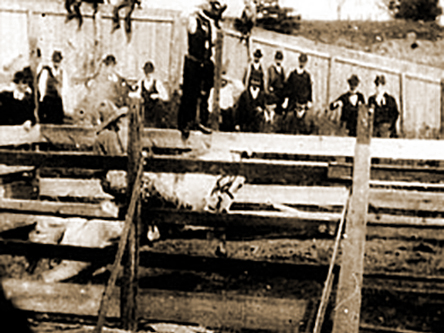
Inside a small corral, a cowboy fights to maintain his seat atop a white horse as it pitches and bucks and spins. A man standing on the fence holds a revolver, which he fires into the ground inside the corral before twirling it jauntily on his finger. The cowboy holds on with one hand, then uses the other to take off his hat and wave it defiantly (and precariously). After about 20 seconds, he dismounts with a twisting leap and sprints out of the frame. Meanwhile, an audience of a dozen or so, arranged behind the corral facing the camera, cheer and clap throughout the performance.
Essentials:
In October of 1894, a few weeks after the first group’s visit, more members of “Buffalo Bill’s Wild West” arrived at Edison’s studio to be filmed. This one immediately stands out because, for reasons that should be pretty clear, it wasn’t shot inside the Black Maria. Dickson found a way to accommodate almost any act inside of the studio, but there are limits.
On top of the change in venue, this must have been an unusually difficult shot to set up. The camera can’t move if the two go out of frame (which they do a couple of times), and the entire premise of the feat is that the horse is not under the rider’s control. In addition, the other player in the act (wielding the six-shooter) is stationed well above the action, another challenge for framing.
In the version of this footage that we have, his head appears to be cut off. However, you can clearly see in the image above (from The Progressive Silent Film List) that it wasn’t shot that way originally. There have been several instances where I’ve noticed that some version of a film from this period appears slightly cropped around the edges compared to a different version. This could be connected with the process of converting the Library of Congress’s paper collection to film during the 1950s-60s.
Depending on how you define such things, this might be the oldest existing Western film. Certainly we can say that it is one of the earliest films to include classic Western genre elements like cowboys and horse- and gun-related stunts. In doing so, however, it isn’t creating or establishing any film conventions, or using them to tell a story. These elements would eventually develop great significance to American film, but it’s important to remember that 1894 exists (just barely) inside the time period most often associated with the “Wild West.” For audiences of the time, although these were performers with a traveling show, this was a depiction of contemporary life as much as anything (albeit still somewhat novel and exotic to the kinetoscope’s urban audience).
Screening:
There’s a lot of action packed into this short scene. I watched it at least three times to get a sense of everything that’s going on. The focus, of course, is on the rider, and he’s certainly putting on a show. I also like the way the man on the fence idly twirls his gun, almost absently, like that’s not part of the show, it’s just something he does. But notice in particular the audience, definitely a bunch of city slickers, all lined up to watch in their nice hats and coats. Notice the very large man on the left, who waves a cane excitedly throughout, and the man just to the right of center who stops to wave at the camera as everyone else is applauding.
There was a small audience for the earlier boxing match that Dickson filmed, just to lend it that extra sense of being an actual fight. But why is this audience here? They certainly don’t fit the Western theme of the rest of the scene. Is it to give the viewer the feeling of being present for a performance of “Buffalo Bill’s Wild West?” Did Dickson somehow sense, even in the days of the single-viewer kinetoscope, that movies are a communal experience that people would want to share with other spectators?
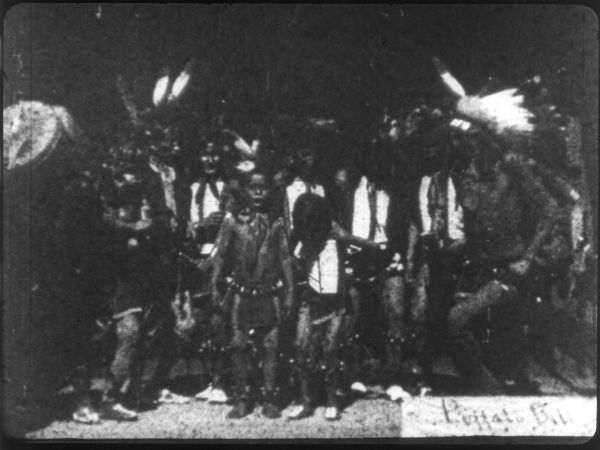
A group of about 8-9 men stand lined up across the frame facing the camera, with 2 children standing in front of them. After a moment, they all begin to dance together, raising and lowering their feet in unison. The rightmost dancer crosses to the far left, with each adjacent person following until the men are dancing in a small circle. Some of the men spin place, and as the film ends the children seem to have begun weaving in and out of the circle in the opposite direction from the other dancers. In the bottom right corner of the frame, a sign is visible with the words “Buffalo Bill” inscribed on it.
Essentials:
In late September of 1894, a group from “Buffalo Bill’s Wild West,” touring nearby in Brooklyn, paid the first of a series of visits to the Black Maria. This is one of two Native American dances performed for the camera that day. The potential value of the new technology to anthropologists must have been evident immediately, and this is one of several examples of Edison’s early kinetoscope shorts that highlights a diverse range of cultural subjects. But of course it’s much more complicated than that. A lot of these films exoticize their subjects, and you won’t see non-white performers presented in any but stereotypical roles.
It’s significant, for example, that these first appearances by Native Americans in a film establish a mode of portrayal that was rarely if ever broken for many decades. The film’s description claims authenticity in both its subjects and their dance, and that’s likely true as far as it goes. But what is this dance, and who are the people performing it? Records suggest these were Lakota Sioux from the Oglala and Brulé sub-tribes, and they were also, of course, “Wild Westers.”
Sitting Bull, one of the most famous “Wild Westers,” alongside Buffalo Bill
“Wild Westing” was a term referring to Native Americans embarking on tour with traveling shows, most famously alongside Buffalo Bill. At a time when many white Americans believed that Native Americans were a “vanishing race,” Wild Westing exploited a surge of interest in Native American culture. In doing so, it created welcome financial opportunities for members of some tribes who were struggling to survive after decades of punishing warfare and one-sided treaties with the United States. But of course, in exchange, white audiences wanted to see a portrayal that matched their own expectations and preconceptions, and the resulting perpetuation of stereotypes was not looked upon kindly by all native groups.
However, there’s an even more troubling subtext to this film in particular. The “Ghost Dance,” as it had come to be known, was a label applied to two successive 19th-century religious movements among various tribes throughout the western half of the United States. The second was begun by a man named Wovoka (see below), a Paiute religious leader living in northwestern Nevada. In 1889, Wovoka had a supernatural vision of a future where American tribes would be reunited with their resurrected dead, and of an end to the occupation of western lands by white settlers and their influence. To see this vision realized, Wovoka called for virtuous living, an end to inter-tribal conflict, and observance of certain rituals and ceremonies, in particular a traditional circle dance.
This practice, and Wovoka’s message, spread rapidly throughout many tribes of the American West during the next several months, with each tribe incorporating it in different ways into their own already-existing beliefs. The message was quick to find purchase among groups of Lakota Sioux in South Dakota who were in a critical situation after years of encroachment by white settlers backed by the American military had forced them off their lands and into ever-smaller reservations. With once-plentiful herds of bison devastated through overhunting by white settlers, these tribes had been expected to feed themselves by farming the land they had been allotted. However, drought conditions in 1890 failed to produce sufficient crops. The Bureau of Indian Affairs (BIA) blamed “laziness” and severely cut the rations they had been providing to the Lakota. Starvation seemed like a real possibility.
Their desperation intensified their observance of the ceremony that was translated as the “Ghost Dance,” and although Wovoka’s message was strictly a non-violent one, the version of it adopted by the Lakota had elements that came across as more apocalyptic and militaristic. Their practice of the ritual alarmed skittish white settlers and BIA agents. Local officials decided to arrest several prominent tribal leaders in an effort to end the practice, and an altercation during one such attempt led to the killing of Chief Sitting Bull on December 15, 1890, which of course only enflamed the situation further.
Photos of the aftermath of the massacre exist, but this image is from a 1913 reenactment.
Cooler heads who counseled a conciliatory approach were ignored. Two weeks after Sitting Bull’s death, around 500 US cavalry surrounded a Lakota encampment of 350, around a third of them women and children. The soldiers moved in to disarm the men of the tribe, but one man, who was deaf and was also in possession of a rifle that was particularly precious to him, briefly resisted. Reportedly, before anyone around could intervene to explain the situation, the soldiers scuffled with him and the gun fired into the air. Immediately, the commander of the cavalry unit ordered his men to open fire on the mostly-disarmed populace. Nearly half of the encampment was killed, including 60 women and children, in an atrocity that became known as the Wounded Knee Massacre.
All of this took place not even four years before members of “Buffalo Bill’s Wild West” arrived in New Jersey to perform a dance for Edison’s kinetograph. One of the child dancers who appears in this film was a survivor of the massacre. His name was Johnny Burke No Neck, and he was 7 years old when the US Army murdered his parents in front of him. He is 10 or 11 years old here. I’m not sure whether it’s known that the dance in this film is actually an excerpt of the Ghost Dance (does it sound like something that would be performed on command for just anyone?), but you can see how it would be marketable to call it that, exciting curiosity among white viewers to see something that had created such a stir as part of recent events.
And lest there be any ambiguity about how white people saw this film at the time that it was made, the following day’s New York Herald had this to say:
RED MAN AGAIN CONQUERED
A party of Indians in full war paint invaded the Edison laboratory at West Orange yesterday and faced unflinchingly the unerring rapid fire of the kinetograph. It was indeed a memorable engagement, no less so than the battle of Wounded Knee, still fresh in the minds of the warriors. It was probably more effective in demonstrating to the red men the power and supremacy of the white man, for savagery and the most advanced science stood face to face, and there was an absolute triumph for one without the spilling of a single drop of blood.
quoted by Scott Simmon in The Invention of the Western Film, pp. 6-7
Screening:
I don’t think this history makes Sioux Ghost Dance any less of an important document. If anything, it becomes more important. But I’d argue that an awareness of this film’s context is vital to viewing it. The dancers in this film appear a bit cramped, their movements confined by the small square of space that the camera requires them to occupy for the convenience of the viewer. As a metaphor, that’s perhaps a bit on the nose, and not a particularly cheery note to conclude on. So I’ll just add that, despite contemporary assumptions about Native American tribes as a “vanishing race,” their story does not end with the “Wild West” and the closing of the frontier.
Two fighters face off in a small boxing ring. They are Mike Leonard (in white) and Jack Cushing (in black). A group of 4-5 spectators watch from behind the ring, facing the camera, and a referee stands in the corner on the far left side of the frame, carefully observing the fight. Most of the hits landed in this brief clip seem to come from Leonard, who is fighting much more aggressively. Cushing seems to be on the defensive, dodging when he can and grappling when he can’t.
Essentials:
In the summer of 1894, kinetoscope parlors were beginning to open all over and customers were flocking to see Dickson’s slate of films. But there were some obvious constraints on what these machines were capable of. A few years earlier, Edison had bragged that there was no limit to the length of what he could film on the kinetograph: “I can put a roll of gelatine strip a mile long into it if I like.” As it happened, though, however much was filmed, the finished kinetoscope was only designed to hold 50 feet of film, meaning that the movies they showed couldn’t be longer than about 20 seconds. Obviously this would create all sorts of creative limitations for storytelling and for the artistic vision of—just kidding. No one cared about any of that. The problem was that the kinetoscope couldn’t show a whole boxing match.
In 1894, boxing was actually illegal in much of the United States. However, it was not illegal to look at a photograph of a boxing match, and in the eyes of the law, moving pictures were just photographs (a whole lot of photographs). This legal loophole represented a financial opportunity for men of vision in areas where an audience could not legally attend a live fight . . . places like New Jersey and New York. The owners of the newly-formed Kinetoscope Exhibition Company had just such a vision, and approached Edison about helping them realize it. He accommodated them with machines that were specially built to run 150 feet of film at a slower framerate, which allowed a boxing match to be exhibited, one round at a time, as long as the rounds were limited to 60-90 seconds.
The enterprising gentlemen of the Kinetoscope Exhibition Company lined up a couple of fighters, and on June 15, 1894, the match was recorded inside the Black Maria. The men danced and sparred for a few minutes, and then Leonard knocked out Cushing in the 6th round. The film debuted in Manhattan at the beginning of August, with one round apiece played on 6 machines at a double cost of 10 cents per round to view. Leonard-Cushing Fight was the first commercially-exhibited sports film, and by far the longest film that had been made to that point: Nearly 6 minutes in length, between 750 and 900 feet of film (with the final round ended early by the knockout).
Reports are mixed on exactly how profitable this was, particularly given that the fighters were not that well known, and patrons were free to pay to see only the knockout round, skipping the first five. But it was successful enough (or perhaps enough of a proof of concept) that productions continued. A month later, Dickson filmed Corbett and Courtney Before the Kinetograph, featuring world heavyweight champion James “Gentleman Jim” Corbett. Boosted by Corbett’s celebrity, the result was one of the most profitable films ever produced for the kinetoscope, and remained in circulation for years.
Profitable or not, the entire enterprise forced Edison to walk an extremely fine line when the films were being promoted. The fights, of course, taking place in a too-small boxing ring and with such extreme time constraints, were nothing close to whatever passed for regulation at the time, and in fact were basically all but staged bouts. But the advertising naturally pitched them as genuine, authentic fights. That was what patrons wanted to see, and what they would pay for.
Promoting the existence of a film of a “genuine” fight that apparently took place in a state where such fights were illegal, however, attracted unwelcome attention from the authorities. Edison, when approached, simply disavowed all knowledge that any real fight had taken place and suggested that he certainly wouldn’t have allowed anything illegal to happen on his watch. This somehow seems to have worked, although it probably also helped that the technology involved was much too new for the law to have caught up to its use.
Screening:
Only about 37 seconds of Leonard-Cushing Fight survives, as far as we know. Because the first five rounds of the fight were more or less interchangeable, Edison and Dickson didn’t bother to send in a complete copy for copyright purposes. It is unknown even what round the surviving footage is from, except that it likely isn’t from the final round. I feel like it’s enough for us to get the general idea. I don’t feel like we’re missing much in those other 5 minutes . . . but then, sports entertainment and the business model that is driven by it aren’t areas that interest me a great deal. I am, however, a fan of films being longer than 20 seconds, and on that front I can appreciate this for what it represents, if nothing else.
A woman wearing an elaborate costume, including a wide, billowing hoop skirt and white dance shoes with high heels, performs an intricate, balletic dance for the camera. She gestures exaggeratedly with her arms and hands, and kicks and twirls in a way that causes her skirt to whirl and flutter.
Essentials:
Carmen Dauset Moreno, better known by the stage name “Carmencita,” was a native of Andalusia, Spain. During the early 1890s, she rose to fame across the United States performing traditional folk dances of her home region, a style known as flamenco. Although she had already performed around Europe for several years, she was induced to come to America by a theatrical agent who saw her perform at the Paris Exposition Universelle in the summer of 1889 . . . The same world’s fair visited by Thomas Edison, where he collected many of the concepts that led to success with the kinetoscope.
Meanwhile, nearly five years later, Carmencita had made a name for herself in America and Edison was looking for film subjects. The kinetoscope was about to become a business, but to attract customers it would need something for them to watch. Dickson filmed a wide variety of different types of motion pictures over the next few years, but one obvious choice was to capture well-known stage performers doing whatever they were best known for.
And that’s how Carmencita ended up in the Black Maria studio in mid-March of 1894, dancing the flamenco for Edison’s kinetograph. In doing so, she likely became the first woman to appear in a film in the United States. You may recall that women were a common subject for Muybridge’s motion photography, and that two women appear in Le Prince’s Roundhay Garden Scene in England. However, after some four years of work on the kinetograph, and even though women were its first outside audience, as far as we know no woman had ever stepped in front of it before.
This would prove to be a small source of trouble, actually, when Carmencita also became the first film ever to be censored (that we know of). In mid-July, James A. Bradley, a New Jersey state senator, devout Methodist, and prominent citizen of Asbury Park, was appalled to find that motion pictures revealing a woman’s ankles, along with perhaps some hints of her underthings, was being shown publicly in his hometown. He complained to Asbury Park’s mayor, who ordered the kinetoscope’s operator to cease showings of the film. Carmencita was replaced by a film showing two cats boxing. Carmencita’s popularity on the stage, however, seems to have been unaffected, and if there was truly any widespread controversy surrounding the film, I haven’t found any mention of it.
Screening:
If you’ve ever seen a flamenco dance before, you’ll know that a couple of important elements are absent here. Perhaps most notably is sound. That may seem obvious, but it’s certainly possible to appreciate many dances without their accompanying music. Flamenco, with its strong rhythms tapped out by the dancers’ heels and by the castanets they often wield in their hands (Carmencita’s hands seem to be empty), definitely suffers from the absence of sound.
Nevertheless, the dance is still quite engaging, and she makes the most of the movements of her skirt to draw the eye. Well, of course she does. That was part of the problem in Asbury Park, right? One more minor note of (maybe) interesting trivia: With a database number of tt0000001, Carmencita seems to have been the first film ever entered into the Internet Movie Database. For a certain kind of completionist, it might be worth watching just for that!
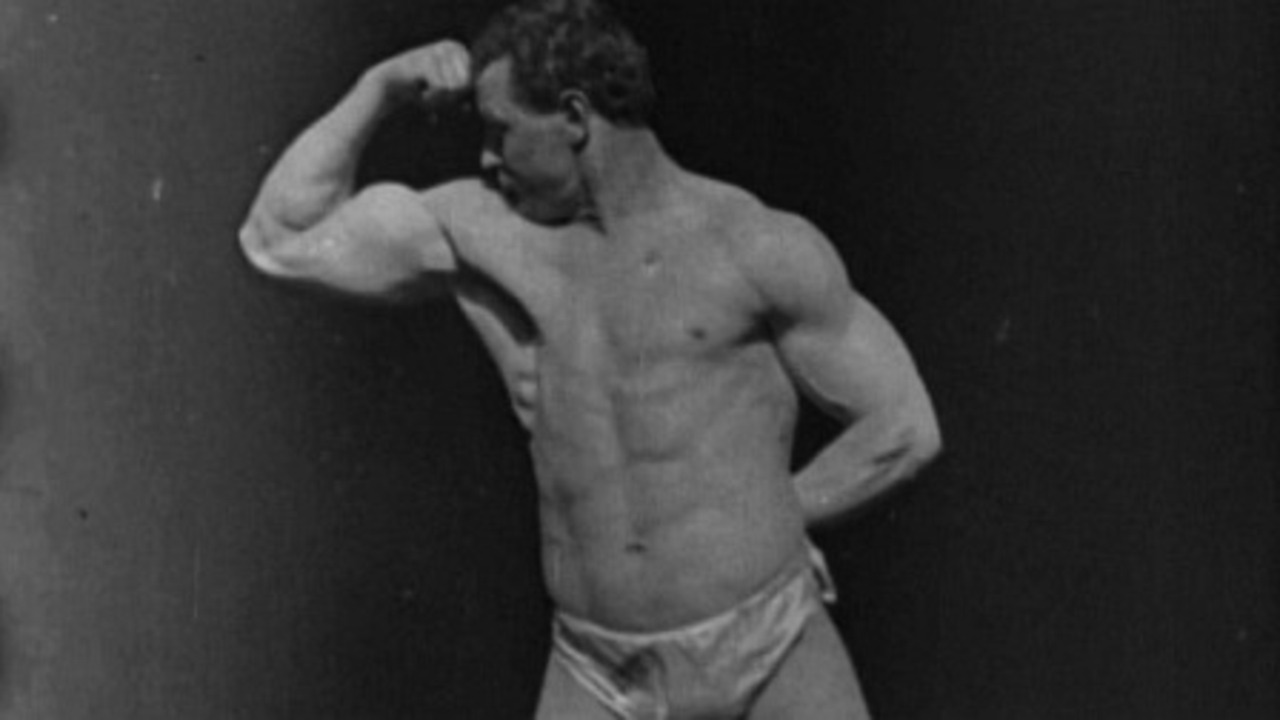
Bodybuilder and professional strongman Eugen Sandow, framed from the knees up, stands before the camera in only a small pair of white shorts and demonstrates his prodigious musculature through a series of several poses.
Essentials:
Born in Prussia in 1867, Friedrich Wilhelm Müller became interested in bodybuilding at an early age. After fleeing his home country at the age of 18 to avoid military service, he became a circus performer under the name Eugen Sandow (modifying his Russian mother’s maiden name, Sandov). After working with a celebrated personal trainer, Sandow won a strongman competition in London in 1889, and leveraged the publicity of his win to bolster his career in entertainment.
Having toured all over Europe, in 1893 his fame spread to the United States when he was enticed by future Broadway producer Florenz Ziegfeld Jr. to perform at the Chicago World’s Fair. Purportedly, it was Ziegfeld who suggested Sandow incorporate “muscle display performances” as a regular part of his strongman routine. After the fair ended, Ziegfeld put Sandow on the vaudeville stage.
However, he was more than just a performer. He also opened gymnasiums, put out a magazine, and published books. His programs of exercise, diet, and weight training had a significant influence on fitness culture, and he organized the first major bodybuilding competition in 1901, establishing a tradition which helped cement his legacy as the father of bodybuilding.
In the midst of all that, he performed for Edison’s kinetograph on a few different occasions during the mid-1890s, beginning with this one, on March 6, 1894. Sandow was one of the first batch of films to premier when kinetoscope parlors began opening that April, and it was an immediate sensation with audiences. Sandow was probably the first “star” to appear on camera, as a performer whose established celebrity was a selling-point for the film in which he appeared, but which also reciprocally bolstered that celebrity through its popularity.
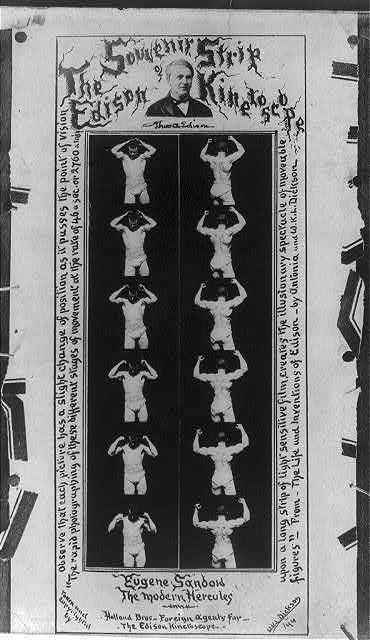
Bizarrely, the film was apparently never given a title during its initial kinetoscope run, and though it has variously been known as Sandow: The Strong Man, Sandow, the Modern Hercules, and Sandow, No. 1, images from it were copyrighted in late May of 1894 under the title Souvenir Strip of the Edison Kinetoscope. This suggests that prints of images from the film were popular enough to be their own commodity (see right), and indeed people (notably young women) are apparently known to have purchased and displayed pictures of Sandow. Edison must have been quick to recognize that the pictures he had were worth something even when they weren’t moving.
Screening:
It’s quite interesting to see someone do what Sandow is doing and know that, in 1894, this was a performance that people would pay money to see in a theater, and that it was a complete novelty for someone to pose in such a way as to display the muscles. Generations later, Sandow’s ritual is practiced at some point by practically every adolescent male with access to a mirror, and to engage in it in public may make an impression but is just as likely to invite ridicule. At least, bodybuilding and bodybuilders have often been the subjects of parody and even outright mockery, even as it continues to enjoy a certain popularity among its adherents. In any case, watch it. It may not do for you what it apparently did for its 19th century audience, but it’s . . . well, it’s certainly something.
A man enters the barbershop from the left side of the frame and takes off his coat and hat before sitting down. The barber is busy shaving a customer. On the right side of the frame, a waiting customer is reading a paper. Finding something amusing, he steps across to hand the paper to the man who just came in, pointing something out. The other man reads and then slaps his knee with merriment as the barber finishes the shave and begins the haircut.
Essentials:
This feels like another step up in complexity for Dickson’s early filmmaking. I believe this is the most people we’ve seen occupy the screen at once in a Black Maria scene, and there are two different spheres of action taking place in the frame simultaneously. You might have to watch it more than once to really comprehend both. Plus, the set is more elaborate than the one in Blacksmith Scene. There’s a reclining barber’s chair and the barber is in costume. His workspace has a whole collection of what appear to be hair tonics, creams, a razor, scissors, shaving mugs and brushes, etc. There’s even a barber pole! Given the constraints of an extremely confined space, a camera that can’t move, and no editing, this is about as complex as filmmaking can get.
We know this was filmed sometime during the first few months of 1894, because it was one of the 10 films available to audiences when the first-ever public kinetoscope parlor opened on April 14, 1894, in Manhattan. Each film was available on a different machine and could be seen for a nickel, or 25 cents to watch all 5 in one row, or 50 cents to watch everything in the parlor. That’s about $17 in today’s money, and sure it got you 10 movies, but remember that each one was around 20 seconds long. Suddenly, modern movie tickets don’t seem so overpriced.
Nevertheless, the movies were a hit and the business model was a success. Soon, kinetoscope parlors were opening up across the country from New York to Chicago to San Francisco. Within 6 months, there were kinetoscopes in South America, Europe, and Australia. Now the race was really on to supply them with fresh offerings. Up to this point, most of Dickson’s films had starred amateurs who just happened to be around, but the few exceptions featuring trained performers and name-recognition proved to be among the more popular kinetoscope parlor offerings. Future productions would show that Edison and his team clearly took note.
Screening:
Edison’s 1894 catalog (entitled “Edison’s Latest Wonders”) described The Barbershop as “Very funny.” Mildly amusing seems more apt, given that we aren’t even in on whatever joke the two men with the paper are sharing. However, there is a little inside joke for the viewer hidden in plain sight. The sign above the barber’s station reads:
~THE~ LATEST WONDER SHAVE AND HAIR CUT FOR A NICKEL
Even in 1894, a haircut and a shave cost more than 5 cents. But a nickel could buy you that trip to the barbershop through the magic of The Latest Wonder: the Edison kinetoscope.
A man framed in a medium close up shot and holding up a handkerchief in his right hand inhales a pinch of snuff from his left hand. He leans back and sneezes, then immediately sneezes again.
Essentials:
Sometime during the first week of 1894, William Dickson and Fred Ott, one of Edison’s engineers, were in the Black Maria to shoot a motion picture. Dickson was directing and Ott was the star. This motion picture, oddly enough, wasn’t intended to be viewed on the kinetoscope. It’s purpose was closer to something we’d expect from Étienne-Jules Marey’s chronophotography: The pictures were requested by Harper’s Weekly for an article called “The Record of a Sneeze.” Edison, no doubt seeing an opportunity for free publicity, was happy to oblige, and the article was published in the March 24, 1894 issue. You can see it here, complete with all 81 frames of the sneeze itself. Meanwhile, the complicated history of Fred Ott’s sneeze was just beginning.
On January 9, 1894, this became one of the first motion pictures to be registered for copyright. In fact, for over a century it was believed to be the oldest surviving copyrighted motion picture, and that’s how you’ll still see it described virtually anywhere you look. Leaving that aside for the moment . . . Because it was among the first images people saw of motion pictures taken by Edison’s new kinetograph, the sneeze became somewhat famous and was forever associated with the birth of motion pictures in the United States. The strangest thing about it was that, because it had never been intended for viewing, no one actually even watched it for 60 years.
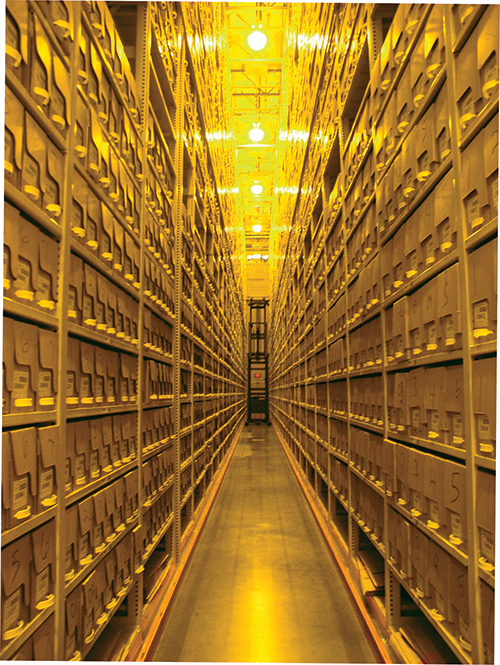
When Edison began producing films for commercial purposes in the mid-1890s, there was no provision in copyright law to protect the works of this new medium, but there were copyright protections (dating back to 1865) for photographs. Copyright law would not be amended until 1912, and until then, filmmakers produced paper prints of every frame of their motion pictures and submitted them to be copyrighted as photographs. This arrangement had other advantages as well, as early motion pictures were mostly made on nitrate stock, a highly-flammable substance that requires special handling to be stored safely. In 1894, the Library of Congress simply didn’t have a way to do that.
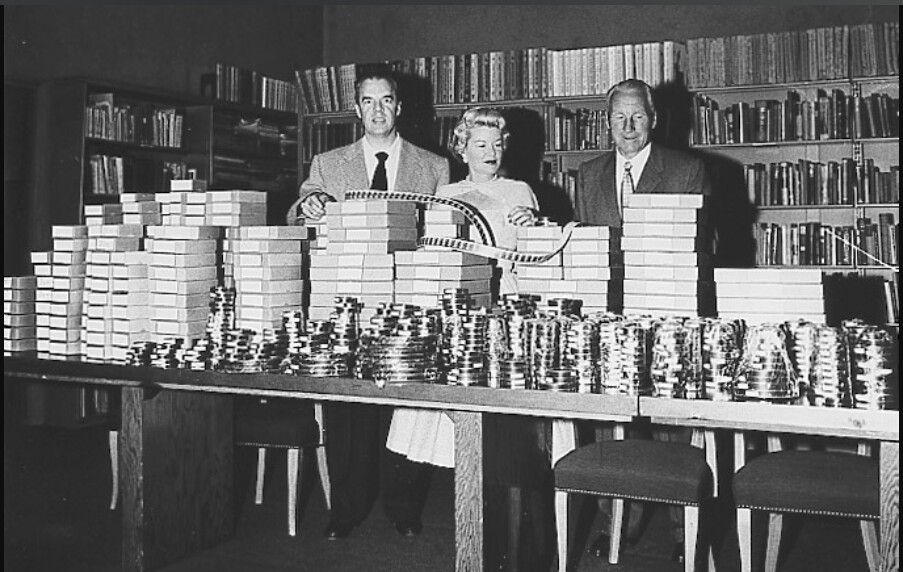
Over 5,000 films were archived this way, and then apparently they were mostly forgotten. The collection was rediscovered in the 1930s, and eventually the Academy of Motion Picture Arts and Sciences (AMPAS) was able to fund a restoration project. In 1953, they hired a man named Kemp Niver, a private detective, to convert these paper prints back into film (that’s him on the far left of the photograph). Ultimately, he was able to salvage 3,600 of the stored films, but it took him over a decade.
And that’s how, sometime in 1954, Fred Ott’s sneeze was finally seen as a moving image for the first time (although many film histories mistakenly say otherwise). Niver was awarded a special Oscar in 1955 for his restoration work, and after completing the work he naturally became a film scholar and professor of film history. But just listen to this description of his early years from his obituary:
Niver was a teenage Navy aviator, commander of a Navy destroyer during World War II, a homicide detective in the Los Angeles Police Department, an investigator for the Los Angeles County district attorney, an actors’ bodyguard and a traveling photographer for President Dwight D. Eisenhower before he settled into becoming a film historian.
It turns out, the copy Dickson sent in to be copyrighted in 1894 consisted of 45 images, in which Ott sneezes only once, and these were the images that Niver turned into film. This is the version you’ll see almost everywhere online. But as I said above, the original work consisted of 81 images, and Ott sneezed a second time. This discrepancy went unnoticed until 2013, when it was discovered by film historian Dan Streible, and the Library of Congress produced a 35mm print of the film that incorporated the missing 36 frames. And that is how the almost first motion picture to be copyrighted was never seen in its entirety by anyone until almost 120 years after it was filmed. 2 years later, in 2015, it was added to the National Film Registry.
But about that “almost the first” that I’ve danced around twice now. Edison Kinetoscopic Record of a Sneeze was copyrighted by name in January of 1894, but for many years scholars have wondered about an official entry in the copyright record book that is a few months older, listed only as “Edison Kinetoscopic Records” with no additional title or information. Was this first copyright a now-lost Dickson film from 1893? With no title and no additional information, it was impossible to know for sure, which made Sneeze the oldest surviving copyrighted film. However, a registration letter along with paper copies of the film in question ought to have existed somewhere, they’d just never been found despite decades of searching through the library’s mountains of material.
Then, in the summer of 2022, Dr. Claudy Op den Kamp of Bournemouth University received a 6-month fellowship with the object of locating the missing documents, and she had a previously-untried idea about where to start looking. She decided to search the correspondence of Ainsworth Rand Spofford, the Librarian of Congress from 1864 to 1897, and in fact, the man who successfully argued for the 1870 law that required, among other things, copies of all copyrighted material be deposited with the Library of Congress. This angle of research presented Dr. Op den Kamp with 250 boxes of correspondence to sort through, with records relating to somewhere around half a million copyright registrations.
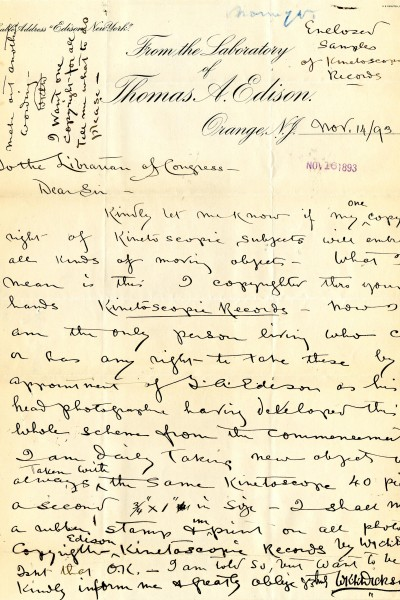
She had just one week left in her 6 months when she found it: a November 1893 letter from William Dickson (pictured at left), asking for an update on a copyright application from October. And, most importantly of all, the letter included 18 attached images from the film in question. The images were unmistakably from Dickson’s Blacksmith Scene, now confirmed as the first film ever copyrighted in the United States. Her discovery, only a few months old as of this writing, marks another first on Blacksmith Scene‘s already long list and bumps Sneeze to second place. Though I’d say the latter’s time in the spotlight across its long and unusual journey through film history still speaks to its significance.
Screening:
The version of Edison Kinetoscopic Record of a Sneeze that I’ve included below is the complete version that was finally restored in 2013, and you’ll notice a significant change in quality between the frames that already existed on 16mm film (from 1954) and the frames that only existed as halftone prints from Harper’s Weekly 60 years earlier. But the story of Niver’s restoration has its own points of interest. In 1964, Niver published an article entitled “From Film to Paper to Film: The Story of the Library of Congress Paper-Print Conversion Program” describing the process of his work and the many challenges he and his team had to overcome. Niver is an engaging writer, and his account is as funny and entertaining as it is fascinating:
We can now say that there are some 27 separate and distinctly different problems which might occur in any roll of paper, but the conversion program had been in existence for nearly 2 years before we discovered as many as 15; 13 of these seemingly unsurmountable ones confronted us in the first 3 weeks!
Just about the time we would become smug in our security, a roll of paper print made by some little man with a moving picture camera of his very own, constructed from a cigar box, some spare parts from a plow, and pieces of his grandmother’s sewing machine, would present us with another problem that might have us stumped for as long as 5 weeks.
The Quarterly Journal of the Library of Congress, Vol. 21, No. 4, pp. 251-252
The Sneeze (as he calls it) is one of the few films whose conversion process Niver explains in detail in the article. He and his colleagues realized that the frames they had would produce only just over a second of footage when run at modern speeds, as the original film seemed to have been exposed at a much faster rate than normal. They solved this problem by reproducing each of the 45 frames 4 times, so that Ott’s movement would appear normal when projected at the standard 24 frames per second.
And if none of this information inspires you to want to see this famous sneeze for yourself, then . . . Well, that just shouldn’t be possible.
A white cat is dropped, upside-down, from 3 or 4 feet above a cushioned surface. It rights itself in midair and lands on all four paws, dropping into a crouch.
Essentials:
Étienne-Jules Marey never ran out of subjects for his innovative chronophotography. He began, long before he turned to photography, with a keen interest in anatomy and physiology, studying the inner workings (and movements) of the body’s systems. He studied the flight of insects and of birds, which eventually led to the development of his famous techniques, and he used trails of smoke to study aerodynamics. He studied the motions of countless animals on land, sea, and air, fast and slow, large and microscopic. He studied athletes competing at the peak of their respective sports. He studied the motions of waves of liquid. And, near the end of 1894, he turned his attention to something that had been troubling physicists for years: The Falling Cat Problem, or how do cats always land on their feet, no matter how you drop them, or from where?
The question seems trivial, even frivolous, but finding the answer interested physicists of the time because a cat appearing to rotate independently in free-fall seemed to violate the law of conservation of angular momentum. Many were of the opinion that the cat was “cheating” by “kicking off” from the hand of the person dropping them, while others suggested that it was somehow using air resistance to push off of, but it was a conundrum that couldn’t be resolved with the naked eye. Enter Marey and chronophotography.
On November 10, 1894, La Nature published perhaps his most clunkily-titled article: “Des mouvements que certains animaux exécutent pour retomber sur leurs pieds, lorsqu’ils sont précipités d’un lieu élevé” (“Of the movements which certain animals perform in order to fall back on their feet, when they are thrown from a high place”). You can see the article and his attached photographs here. In it, he explains why both prevailing theories are incorrect, and offers the true explanation: That cats move the front and back halves of their body independently, twisting their torsos and extending and tucking in their front and back legs in order to generate the momentum needed to turn over as they fall.
Incidentally, Marey mentions early in the article that he had tried the same experiment with dogs and rabbits (and we also know that he tried it with chickens) and observed that they were able to accomplish much the same feat, although it’s cats that are famous for it. Despite the explanation and the photographic evidence, some physicists were not convinced. A full scientific explanation, with attendant diagrams and mathematical formulae, did not come until 1969 . . . and even with that question definitively answered, some might say that cats remain as mysterious as ever.
Screening:
Happily, curiosity did not kill the cat in this instance, but it did lead to what seems to be the first appearance by a cat in a motion picture, and you’ll find many people hailing Marey’s chronophotographic study as the first-ever cat video. You’ll notice that, although the photographs printed in the article clearly show a complete picture of the cat being held upside down, being dropped, and turning over, the footage that has survived (or, at least, the footage that is available online) shows a great deal less. It really is just of a cat dropping onto a cushion. By the time the cat has fully entered the frame, it has already reoriented itself, and there are only about 2 frames right at the beginning where you can see part of the rotation happening. You can see a fuller image in this “restoration” here.
Understand that all original content in Moviegoings is my property under copyright.
"Everyone has the right to the protection of the moral and material interests resulting from any scientific, literary or artistic production of which he is the author." -- Univ. Decl. of Human Rights
Unless otherwise noted, all original content in Moviegoings is licensed under a Creative Commons License.
Comment Policy
Commenting here is a privilege that may be revoked. Visitors to Moviegoings are allowed to post comments only for noncommercial purposes. Unsolicited advertising ("spam") may be altered or deleted at any time. Violation may result in appropriate countermeasures, including but not limited to IP banning, IP publishing, notification of ISPs, and civil and criminal legal action.









 Moviegoings