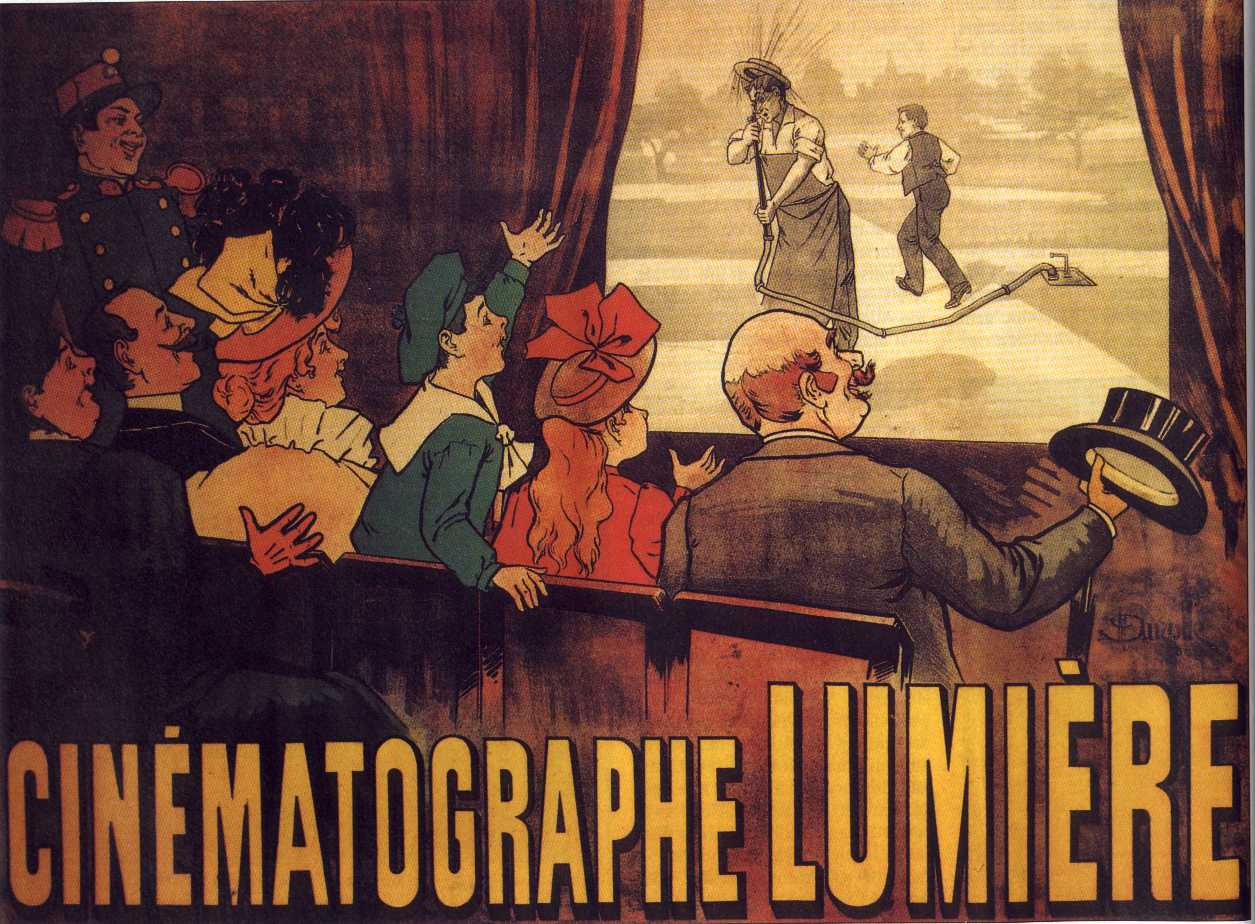
A gardener is using a hose to water when a boy sneaks up behind him and steps on the hose, causing the water to stop flowing. The gardener, confused, shakes the hose and looks directly into the nozzle. The boy steps off and the gardener is sprayed in the face. Turning, he catches the boy attempting to flee and drags him back by the ear for a spanking.
Essentials:
Although a few of the films in the Lumière brothers’ first program of 10 are worth discussing for special reasons, basically all of them are either “actualities” of some kind, or filmed performances. However, the sixth film on the program, L’Arroseur Arrosé, stands out from the rest as something else entirely. It is often referred to as the first narrative or fiction film, and the first film comedy. These are claims that are worth unpacking a little.
The film is clearly comedic, but it’s surprisingly difficult to precisely define terms like “narrative” or “fiction” with respect to the earliest films. That is, it’s tricky to identify what elements that all earlier films supposedly lack, but this film clearly has, make it “fiction.” It’s a staged scenario . . . Well, most of these films are “staged” in some way, including some that don’t appear to be, like the version of La Sortie de l’Usine Lumière à Lyon that appears on this program. All of Edison’s films by this point were, quite literally, staged.
What about the fact that the people in front of the camera are performing a series of scripted actions? Actually many other, earlier films are also of scripted actions, particularly those that feature people performing their stage acts. But where all the other films on this program are recordings of people either engaged in everyday activities or of people performing a skill for an audience, this film features two actors playing out a scene where each action leads to further actions, structured with a beginning, a middle, and end. That makes this a narrative.
L’Arroseur Arrosé was featured in one of the first movie posters.
What makes it fiction isn’t that these aren’t real events. They are. We see them happen. The boy actually steps on the hose and the gardener actually gets sprayed in the face with actual water. The boy is really a boy, and the gardener, apparently, was actually a gardener. But the characters are pretending to think and feel things that they aren’t actually thinking or feeling. The gardener pretends not to know why his hose stopped working. The boy pretends he actually wants to get away. The gardener pretends to discipline him (though not all that convincingly, if we’re being honest). And, perhaps most important of all, they’re pretending they don’t know that this is a performance that will be seen by an audience. That’s fiction.
So, what earlier films might qualify as any of these things? 1893’s Blacksmith Scene features three men, who aren’t blacksmiths, pretending to be blacksmiths. That’s a sort of fiction, though there isn’t any narrative. 1894’s Chinese Laundry Scene is certainly a comedy, and definitely a fiction, since the actors are pretending to quarrel (and one is pretending to be Chinese while the other pretends to be a police officer). It also technically has almost as much of a narrative as L’Arroseur Arrosé (and a very similar one, besides), though it ends without a clear resolution. But the Chinese Laundry Scene is also ostentatiously fake. I would say it’s not a fiction film, it’s simply a recording of what is visibly a stage act.
However, I think 1894’s The Barbershop might qualify. It has a narrative (of sorts) with a beginning, a middle, and an end. It’s fiction. And although I would say that it’s a stretch to call it a comedy, the Edison catalog describes it as “Very funny” which suggests that it was at least intended as a comedy. I think, as with many of the Lumière brothers’ other achievements, we have to say that L’Arroseur Arrosé is one of the first, but not technically the first. Though I hope it’s clear just how open a lot of this idea of “firsts” is to interpretation, in addition to always being constrained by the caveat that we just can’t know that there isn’t something out there that hasn’t been discovered yet (or that did exist, but is truly lost forever, even from memory).
Nevertheless, L’Arroseur Arrosé is still significant as a step beyond what Dickson and others had already done. A distinguishing feature of film is that, when people are sitting in a theater watching, whatever is on the screen is not constrained by only what could physically be staged within that space. The Lumière brothers’ audience sat in their seats in the basement of a café, and watched a scene that takes place outside in an actual, real garden.
So many of the films of Edison and the Skladanowsky brothers, and even many of the motion studies by Muybridge, are shot against a blank background, all-black or all-white. Many of these images were even taken outdoors, but you’d never know it because everything behind the subject is blocked from view. Here we see, not only the action of the scene play out, but the full depth of the garden behind, all the way back to the wall, and with lines of trees visible behind that. This attention to setting, as much as any innovations that it may or may not have made in the areas of storytelling and genre, is genuinely notable.
Screening:
L’Arroseur Arrosé is magnificent in its simplicity. The angle and framing of the shot are well chosen, as they have to be when the camera cannot pan, move, or zoom. It perfectly captures the main action, but is also able to capture the brief pursuit since the prankster (somewhat illogically) runs past his victim and is grabbed right at the left edge of the frame. The key moment is so perfect, with the spray of water so powerful that it knocks the gardener’s hat off of his head, that it makes me wonder if it was practiced beforehand.
Early cinema found inspiration everywhere: everyday life, newsworthy events, the stage, etc. Some of those sources of inspiration are less obvious to a modern audience, and this is a perfect example. Here you can see a collection of cartoons that were printed in various publications, mostly German or French, from 1885 to 1889, and beyond. Some of them look like they could be a storyboard for L’Arroseur Arrosé, right down to the hat coming off. This was clearly already a well-known gag by 1895, and once you see it, you can’t unsee it: The narrative has a classic comic strip structure. It may well also be the first adaptation from print to film, though there could easily be more as-yet-undiscovered sources of inspiration for even earlier films.
(English: The Photographical Congress Arrives in Lyon)
Summary:
A group of passengers attending a gathering of photographers walk off of the boat that has brought them to their destination. Most hurry past the cinematograph without acknowledging it, but a few seem to take notice.
Essentials:
The Lumière brothers’ inaugural motion picture program of 10 films was:
Most of these films could be classified, in one way or another, as “actualities” (including one that is reminiscent of a popular Reynaud animation that was still playing across town). Then there are a few that are filmed performances such as we’ve seen before, plus one that seems like a direct rip-off of probably inspired by Dickson’s Blacksmith Scene. However, there are a few besides the opening film that are worth discussing at greater length. One is the fourth film on the program: Le Débarquement du Congrès de Photographie à Lyon.
On June 11, 1895, the Société Française de Photographie (French Photographic Society, which still exists today) gathered for their annual congress. That year it was held in Neuville-sur-Saône (a small commune in Lyon), and you can clearly see the Neuville Suspension Bridge behind them in the film. The bridge stood for over 100 years on the Saône river before being demolished in 1934. Established in 1854, the society achieved such prestige that, in 1892, it was recognized by the French government as a public utility, so it is no exaggeration to say that this was a gathering of many of the most important figures in photography in the world at that time.
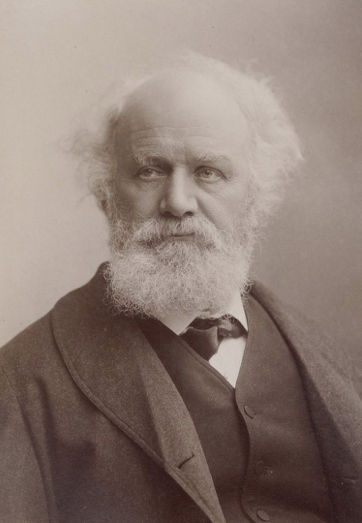
In fact, two of those figures should be familiar. Though I can’t definitively identify them in the film, both apparently appear in it. In 1895, the president of the society was Étienne-Jules Marey, one of the most important figures in chronophotography. Also accompanying the group was the previous president, Jules Janssen (see right), whose “Janssen revolver” captured the transit of Venus in 1874, and later inspired Marey’s own “chronophotographic gun.” At about 0:02 in the film, you can see an older, bearded man, all in black with a bowler hat, and carrying a number of different bags as he debarks. I believe this is Janssen, but I’m not sure where Marey appears.
Meanwhile, Louis Lumière was there to capture the moment in order to pull off a stunning proof-of-concept stunt: After filming the congress arriving by boat, the result was developed and then shown at the close of the congress the following day, June 12. It’s difficult to imagine a gathering better suited to appreciating the significance of what they were seeing, and it was the earliest illustration of a very specific capability that the Lumière brothers invention had. Namely, unlike Edison’s kinetograph, the Lumière cinematograph could go out into the world and capture significant, and even newsworthy events as they happened. They could then rapidly put those events before an audience in a way that made the audience feel that they had actually been there to witness what transpired. (Of course, this audience was actually there.)
I don’t know how the congress reacted to the film, or whether any of them was prescient enough to really grasp what they were seeing. But it’s at least possible someone realized that, while the novelty of simply seeing a picture move couldn’t last, the potential for motion pictures to disseminate news could (and of course did) have an enormous impact on the world of the future. I would argue that future in some ways begins with this film.
Screening:
It’s no surprise to see so many of the passengers carrying photographic equipment of their own, but I wonder how many of them were aware of the exact nature of the camera that was filming their arrival. Many, particularly at the beginning of the film, seem to be in a hurry and appear to barely be aware of the cinematograph at all. But notice at about 0:11, a man stops and appears to take his own photograph of the device. It would be quite something to learn that a copy of that picture still exists somewhere. Then, towards the end, the last few people off the boat pause long enough to look directly at the camera and tip their hats. But are they being polite to the cameraman, or do they somehow know this is a film in which they will appear? Whatever they knew, I doubt any of them suspected that there would still be people in the 21st century watching them come ashore.
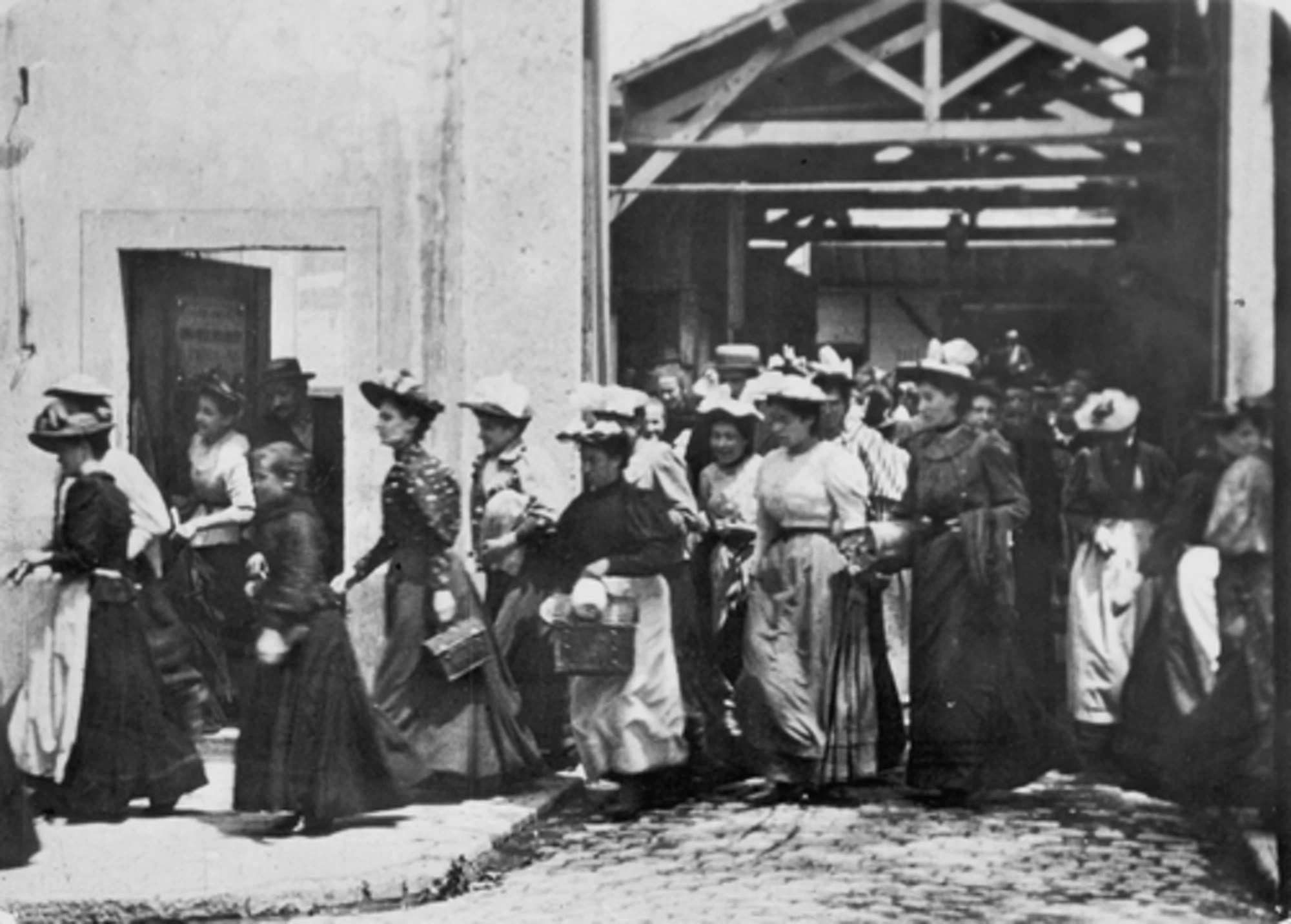
A wide gate stands open and several dozen people stream out, each going their separate ways to the left or right as they depart the factory. A small door next to the gate opens, and people emerge from that as well. Additional traffic includes a large carriage, a few people on bikes, and the occasional dog.
Essentials:
It is December 28, 1895, and a ticket-holding Parisian audience has gathered in a basement room of the Grand Café known as “Le Salon Indien.” They are about to watch a program of 10 films that are both filmed with and projected by the Cinématographe (or “cinematograph”), a new invention of the Lumière brothers, Auguste and Louis. In an irresistibly poetic accident of history, their name means “Light,” and in the glow of the projector, their audience is spellbound as the first moving images, of a crowd of people leaving work, appear on the screen. It is the very first projection of a film for a paying audience in France. It is the birth of cinema. It changes everything.
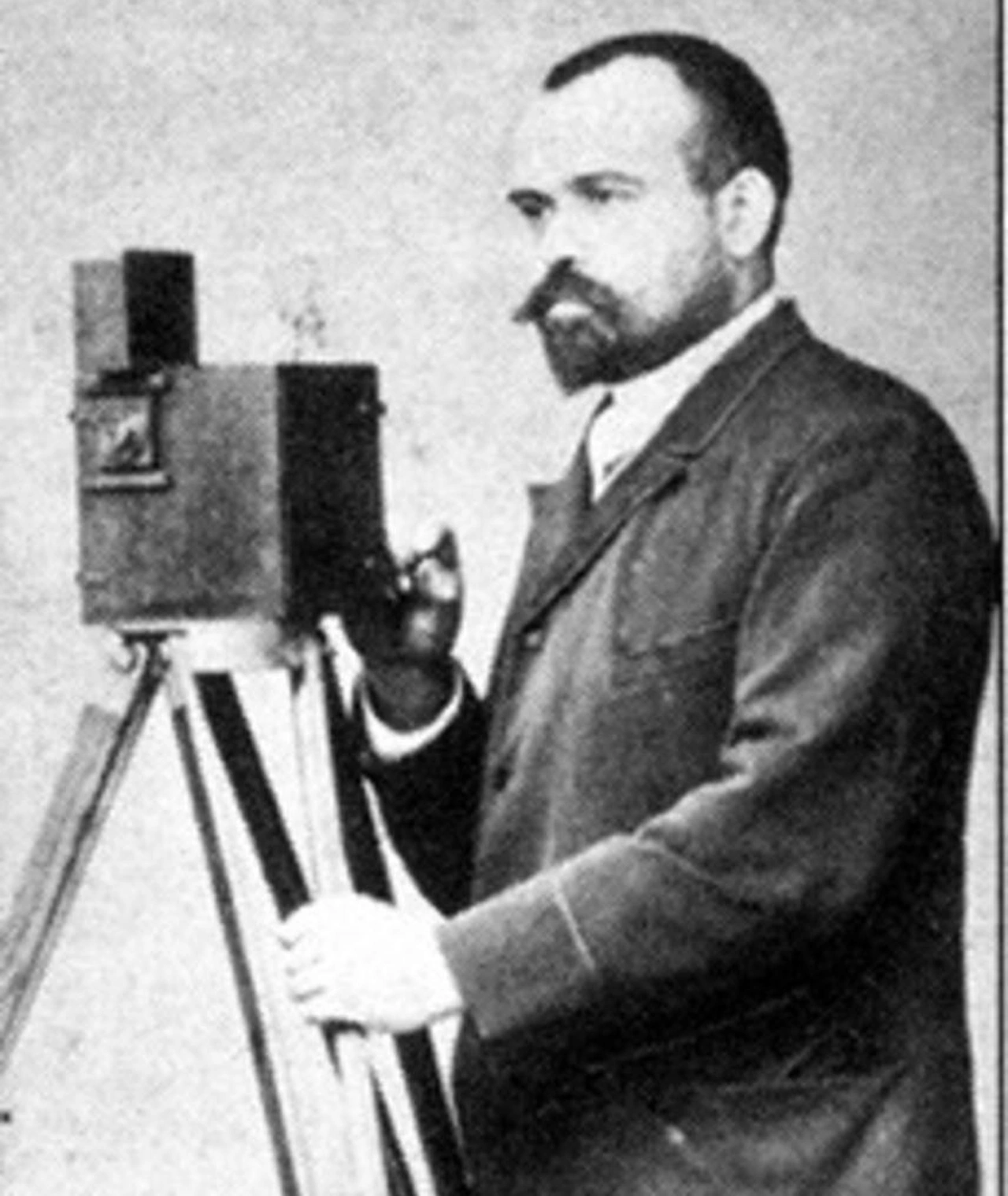
Or at least so the story goes, though there are a few details missing from this telling. Charles Moisson (see right), chief mechanic at the Lumière factory, worked on the design with the brothers, and he was the one who built the first working model. He was also operating the projector at that first December show. (“Moisson,” incidentally, means “Harvest,” though he seems to have reaped very little of the credit that he was apparently due.)
We also know that this famous, momentous screening by the Lumière brothers was not as unprecedented as the hype that surrounds it would suggest. It was not the first device in the world to project a film for a commercial audience, but the third or fourth (that we know of). The brothers did not conceive of their idea out of nowhere, but were inspired to enter the field of motion picture exhibition by Edison’s kinetoscope. They even used the same dimensions of film and image. Chronophotography, of course, had existed for decades already. So can we truly call this the beginning?
I would say, if nothing else, we can call it the end of the beginning. No one can really say precisely when “the movies” were invented, or name anyone as the one person who deserves the credit for inventing them. But as far as I know, although you might get a lot of answers (or no answer) to the question of when movies came into existence, everyone agrees that by December 29, 1895, they did exist. Sometime between 1874 with the production of the first motion pictures that you can see in action (or perhaps some even earlier landmark!) and the Lumière’s first show, after 21-plus years of labor (pun intended) the movies were born.
And the Lumières’ first show does mark the birth of cinema, if for no other reason than that there was no such thing as “cinema” before there was a working “cinematograph.” Oh, and incidentally, to give the brothers their full due, I should note that although public commercial screenings of films had already taken place elsewhere in the world, the brothers gave a private screening of La Sortie de l’Usine Lumière à Lyon on March 22. This was probably the first projection of a film for an audience anywhere in the world, almost exactly one month before the Eidoloscope was previewed for the New York press.
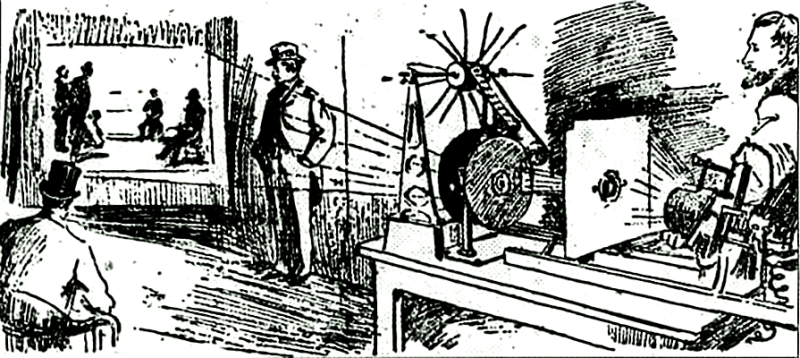
Plus, the cinematograph was quite a machine (see left). It was a camera, developer, and projector, all in one, and it only weighed about as much as a vacuum cleaner. It was powered manually, rather than by electricity, so it could go anywhere, and as a result it was soon going everywhere. At this point, if Edison wanted something on film, he still had to bring it to the set-up at the Black Maria. The Lumières could send their cameras where the action was. It’s not a mystery at all why they succeeded and were remembered, where so many others failed and fell into obscurity. (It also helps that virtually every film the Lumière brothers ever made, over 1400 of them, still survives today.)
Just as the Lumières were incited to action by Edison’s kinetoscope, the Lumières’ Cinématographe ignited the imaginations of many in their audience, some of whom would go on to play their own roles in film history. But for a few, it was life-changing in a different way. In a stunning example of unlucky timing, the Skladanowsky brothers had arrived in Paris on December 28 to prepare for their engagement at the Folies Bergère showing films with their bioscop projecter. Reportedly, the manager of the venue took them to the next Lumière showing, on the 29th, and then cancelled their booking. At least he still paid them in full.
With patent in hand, the Lumière brothers had France staked out as their legal territory for exhibition, but even if they hadn’t, there was no denying that their device was superior to the bioscop in virtually every way. The Skladanowsky brothers would just have to move on to their next booking, in London. Meanwhile, the cinematograph continued to thrill audiences in France. By the end of 1896, cinematographs had also delighted people throughout Europe and in North America, South America, Africa, and Asia. It was a global phenomenon, introducing the people of the world to the cinema.
Screening:
There are actually three different versions of this film, and you can see all three in the video linked below, one after the other in the order they were made. One way you can tell them apart is by the number of horses that appear in each: one in the first version, two in the second, and none in the third. However, there are other elements that differentiate them.
The first one was filmed on March 19, 1895, just three days before it was shown at that first private screening. It was filmed as workers were leaving for lunch, and you can feel their sense of purpose as they march out. Notice the woman who hurries across the street just past the camera about 20 seconds in. These are people who have something to do and a limited amount of time to do it. They also seem completely oblivious to the camera’s presence.
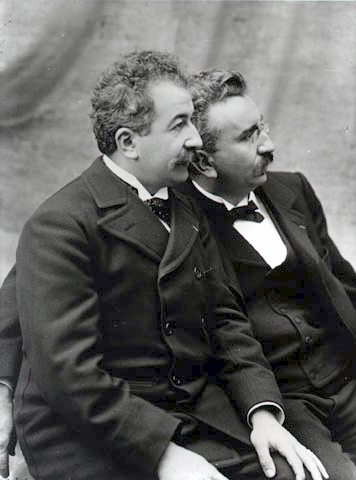
The Lumière brothers, Auguste (left) and Louis (right)
For some reason, the Lumière brothers decided to remake La Sortie de l’Usine Lumière à Lyon during the summer of 1895. It has been suggested that perhaps the negative was deteriorating on the first film, or perhaps they had made some improvements to their equipment and wanted that reflected in a film they intended to exhibit publicly. But I think there’s a better explanation.
Both the second and third versions were filmed on a Sunday, the workers’ day off, and they were called in to “perform” the act of leaving the factory. You may have wondered, as I did when seeing the last version for the first time, whether many of the workers had changed clothes after finishing their shift before leaving for home, because so many of them seem to be dressed in nice clothes, with dresses, suits, and hats that suggest leisure and fashion. Turns out, it was because they were in their Sunday best.
There are a few key things that set the second and third versions apart. First, in version two, the workers seem very self-conscious in a way that they didn’t in the first version. It doesn’t feel natural because it isn’t, and they don’t seem to know how to act naturally under the circumstances. Notice the woman on the right-hand side of the frame about 45 seconds in. She comes wandering forward almost in a daze, gazing off to her right, and then makes as if to walk that way. Suddenly she stops, seeming totally lost, then suddenly catches herself, grabs the hand of the woman who has come up next to her, and darts off in the opposite direction as though getting out of the shot as quickly as possible.
Somehow, the mood has completely shifted in the third version. The atmosphere feels festive. There is a spring in the workers’ step. Some talk animatedly to each other. Several appear to be smiling. Notice at about a minute and 26 seconds, a woman leans over and playfully grabs at another woman’s skirt before running away. A dog appears in all three films, but whereas in the first two it seems to be totally ignored by the people, in this version a man seems to be playing with it as he bounds through the gate.
Notice also how the first two films begin with the gates standing open, and there are still people exiting as the film ends. The third film begins much more cinematically, with the gates swinging open to reveal the exiting swarm of people. The last person exits and the gates begin to close behind them just as the film ends. This likely was pre-planned and timed, and may be why the horse-drawn cart that blocks off the entire entryway and snarls up the foot traffic in the first two films is absent from the third. Like Edison’s kinetograph, the cinematograph had a very limited recording time—about 50 seconds—so the entire action had to be accomplished within that limit in order to get the desired shot.
All of these clues point to deliberate choices and a filmmaker’s vision. If the original film was remade due to deterioration or merely to showcase improved equipment, there would have been no reason to call the workers in on their day off. They presumably left the factory twice a day, every day of the work week and could have easily been filmed doing so at any of those times. There also would have been no reason for the third version to apparently be made so soon after the second version that they hadn’t even had a chance to wear it out by screening it for any audience. Calling the workers in on Sunday had the added benefit of ensuring that everyone looked their best, which would be a boost for the factory’s image, and it would have allowed time to direct the “performances” along with the other elements of the scene.
I suspect that they made the second version with some of this in mind, but were dissatisfied with the results, and did it again, perhaps after some direction for the workers or even a practice run. And indeed, the third film was the one audiences saw in December. Watching these three versions back to back with those details in mind almost feels like witnessing the beginnings of learning how to make a film rather than simply point a camera at something as it happened. Of course, they did that, too. And though they weren’t the first to do it (that would probably be Louis Le Prince), they coined the term “Actualité” (or, “actuality”) to describe this genre of filming real events as they transpired. But it seems that, right from the beginning, they sometimes blurred the line between what was real and what was staged.
A series of 9 short films featuring a variety of different types of performances, including athletes, dancers, acrobats, and jugglers, presented together as one complete program for an evening’s entertainment (as detailed below).
Essentials:
Between mid-1894 and early 1895, a German named Max Skladanowsky designed and built a film camera and a projector that he named the “bioskop” (anglicized as “bioscop”). Skladanowsky was already an experienced showman, having toured throughout Central Europe for many years with his brother, Emil, giving dissolving magic lantern shows. These shows involved a magic lantern simultaneously projecting two overlaid images, gradually reducing one and increasing one so that they “dissolved” from one to the other. This experience formed the basis of the bioscop, not only because the Skladanowskys were well-versed in existing screen practice, but because Max’s projector actually used two loops of film, with a mechanism that alternated projection between them.
In May of 1895, two months after the arrival of the first Edison kinetoscopes and the final show by Ottomar Anschütz and his projecting electroytachyscope, the Skladanowsky brothers began shooting films. Their choice of subjects seems to have been inspired both by the films that were showing on the kinetoscope, and by whatever acts were readily available in Berlin at the time. Without a designated studio space, they had performers go through segments of their acts outside of the theaters they were performing in, against a blank background, so as to have sufficient sunlight for filming.
In July, they held a private screening at a restaurant in Berlin, and among the attendees were the directors of the Wintergarten Theater, who contracted the brothers and their device for a series of performances. The program they prepared was several minutes long, part of (as was often the case in the early days of motion pictures) a much longer slate of live performances totaling some 3 hours. However, at a time when movie-length was still generally under half a minute, even as little as a quarter of an hour or less could be a daunting time slot to fill.
Each of the eight films they showed (which concluded with a 9th clip of them both bowing to the audience) was repeated multiple times. This probably wasn’t done simply to pad out the time, but to give the audience a better opportunity to appreciate the novelty of what they were seeing, and actually be able to take it in. There was also a specially-composed, live musical score accompanying the show, which supposedly helped drown out the noise of the projector. The Wintergarterprogramm:
German Title
English Title
Performer(s)
Length
Italienischer Bauerntanz
Italian Peasant Dance
Kindergruppe Ploetz-Larella
0:18
Komisches Reck
Funny Bar
Milton Brothers
0:20
Das Boxende Känguruh
The Boxing Kangaroo
Mr. Delaware
0:17
Der Jongleur
The Juggler
Paul Petras
0:19
Akrobatisches Potpourri
Acrobatic Potpourri
Family Grunato
0:16
Kamarinskaja
Kamarinskaya
Brothers Tscherpanoff
0:19
Die Serpentintänzerin
The Serpentine Dancer
Mademoiselle Ancion
0:18
Ringkampf
Wrestling Match
John Greiner & Eugen Sandow
0:20
Apotheose
Apotheosis
Brothers Skladanowsky
0:16
Their first show was on November 1, 1895. It was the first-ever projected film in Europe to be shown before a paying audience, and the second in the world. The bioscop remained at the Wintergarten Theater throughout the rest of the month of November, and then moved on for a brief engagement in Hamburg. On December 28, 1895, the Skladanowsky brothers arrived in Paris to prepare for an opening at the Folies Bergère on January 1st, but that show never took place because of another famous arrival that happened the same day as theirs.
Screening:
There’s something for everyone in this variety of acts, and if you don’t care for one show, just blink a few times and the next one will be on. The dances don’t do much for me, particularly without musical accompaniment, though the ever-popular serpentine dance is quite nice. The jerkiness of the motions in that particular segment suggests how much lower the Skladanowskys’ recording framerate was than that of other filmmakers. All of the other acts are fun, but in particular the Milton Brothers and their acrobatic antics had a surprise ending that caught me off-guard and got a laugh. You may also notice a familiar name buried in the program: One of the wrestlers is the celebrated Eugen Sandow, who apparently was in Berlin at some point between filming for the kinetoscope in America in 1894 and in 1896.
Overall, this is a charming and novel program, and it’s particularly interesting to be able to see it all cut together, as it would have been in 1895. The transition from a movie audience moving between several individual coin-fed machines to simply sitting in a room with a projector meant that many early projected programs kept that same format of a series of extremely short clips all strung together. And even though films would soon get somewhat longer, it would be many years before any film was long enough to carry an entire program by itself.
In the fragment that survives, two women wave farewell to the camera-as-audience as they move to depart out of the frame in opposite directions. The woman on the left skips energetically straight out of our line of sight, while the one on the right begins to sidestep a bit more gracefully but does not reach the edge of the frame.
Essentials:
For 20 years after Passage de Vénus captured the first known sequence of images of a body in motion, development of motion picture technology had advanced steadily and inexorably, but not always with an obvious direction. A lot of different people had worked on the problem with equally varying results. Some (like Muybridge and Marey) had solved the particular angle they were working without actually inventing “the movies.” Others had toyed with the idea, even tackled it seriously, but for one reason or another their efforts had come to nothing. Some simply lacked the skill, but others had poor luck, poor timing, or were just . . . poor. Or at least, they were too poor to finance their big idea until they could make it work.
Most importantly, there were two inciting elements missing during these pre-movie years: First, no one had done it yet, so no one really knew for sure that it could be done. Second, even a lot of the people trying to do it didn’t seem to have a solid plan for what they would do with it if they succeeded. What would even be the point of a moving picture? Then, in 1894, Edison lit a fuse when he started manufacturing kinetoscopes and films, simultaneously demonstrating that it could be done, and that if you did it, you could sell it.
In 1895, the fuse reached the powder, and motion pictures exploded worldwide. One thing Edison hadn’t done yet—the last missing piece of the motion picture as we know it—was projection onto a screen for an audience. That was the peak that a lot of people, inspired by the kinetoscope, had set out at once to conquer, and several of them succeeded in 1895. One of the American teams that went to work on projection, as it happened, had already been in on the ground floor of the kinetoscope.
Those enterprising financial visionaries of the Kinetoscope Exhibition Company, who had prevailed upon Edison to build them modified machines that they could use to record and show prize fights like the Leonard-Cushing Fight, had been successfully riding that business model to a whole chain of kinetoscope parlors in major cities across the country, all showing fights they’d arranged. But it was clear to them that Edison’s whole one-viewer-at-a-time arrangement was placing severe limitations on their cash flow potential. They once again went to Edison to prevail upon him to work out a means to project motion pictures onto a screen, but Edison was firmly married to his kinetoscope “peep show” model. So they decided, fine, maybe they’d just do it themselves.
These two go-getters were the Latham brothers, Grey and Otway, and actually they weren’t going to do it themselves, because they were salesmen, not engineers. But they had connections. They went first to their father, Major Woodville Latham (see left), a veteran of the Confederacy who was also a professor of chemistry. Together, the three men formed the Lambda Company (as in the Greek letter “L”) in December of 1894. They also brought on Enoch J. Rector, a former classmate and their partner in the Kinetoscope Exhibition Company, and (most importantly) a man with some technical skill. And, last but not least, they made a play for the man behind the kinetoscope himself, William K.L. Dickson.
Dickson knew better than to join the project openly. His conflict of interest was clear, and Edison would have zero tolerance for it. Nevertheless, he was as interested in the project as anyone, so he agreed to work with them in secret. He also recommended that they hire Eugene Lauste, a former Edison employee who had worked on Dickson’s kinetoscope team until 1892. The engineering team of Latham (the elder), Lauste, and Rector set to work, with some quiet help from Dickson.
Knowing they had very different goals from Edison’s, they started the design process completely over from scratch. They wanted a camera that would be more portable, and of course that could record much longer films than the kinetograph. They were also thinking in terms of projection onto a large screen, not a tiny image viewed inside of a box. One of their first innovations was to use a much wider filmstock, basically the equivalent of a modern widescreen aspect ratio. Within just a few months, they had initial solutions to the other problems as well, and were ready to demonstrate a device they were calling the Panoptikon. They gave a demonstration of it to the press on April 21, 1895, marking the first projected motion picture in America (see right).
Less than 3 weeks earlier, on April 2, Dickson had been confronted by Edison’s bulldog of a vice-president, William Gilmore, over his work with the Lathams. According to Dickson’s account of the exchange, Gilmore accused him, in front of Edison, of conducting himself dishonorably. Edison jumped in to assure Dickson that he didn’t believe that, and Dickson confidently seized the opportunity to present an ultimatum: Either Gilmore should leave the company, or Dickson should. Apparently Edison hesitated in replying until it became awkward, and Dickson resigned on the spot. Multiple historians have suggested that Gilmore’s power plays (both here and in other instances) were a significant contributing factor to the issues with patents that would soon emerge and keep Edison tied up in court for over two decades.
Meanwhile, on May 4, on the roof of Madison Square Garden, the team recorded their first actual film that wasn’t just a test. It was, of course, a boxing match: Young Griffo v. Battling Charles Barnett. And reportedly it was as much as 12 minutes long, a staggering achievement in itself. See, all of these cameras worked by yanking the film strip down so that one frame was exposed, then yanking it again to move onto the next frame, over and over up to dozens of times per second depending on the frame rate. Pulling jerkily against the entire weight of a roll of film would place too much strain on both the film and the mechanism unless the roll was fairly short (i.e. Edison’s 50-150 feet). The solution to this was to design an additional mechanism that would steadily draw out the roll of film and feed it into a small loop (see above) so that the mechanism that yanked each frame into place was only ever pulling against that small loop of film rather than the entire roll.
Major Latham patented this mechanism the following year. It was extremely important to both motion picture cameras and projectors, and it would forever be known as the Latham loop, although the matter was extensively litigated. One thing that every film historian seems to agree on is that Latham probably didn’t deserve the credit for it, though who did is a bit murkier. Lauste, Rector, and Dickson likely all contributed to some extent, but as almost everyone involved eventually ended up with competing business interests, things got contentious. For what it’s worth, Lauste, whose claim was backed by Dickson, seems to have the strongest case. But they were the two who continued working together, so it was also somewhat in Dickson’s interest to support Lauste’s claim.
However, all of that legal wrangling was in the future. For now, things were still going well, except that “Panoptikon” was too similar to “panopticon,” a term that already existed in several different contexts (architecture, philosophy, etc.). So before unveiling their new inventions publicly, they decided to rebrand. They drew their inspiration from a science fiction short story, by a Scottish immigrant named Robert Duncan Milne, about an invention that can visually replay past events. The story was called “The Eidoloscope,” and that was the name the Lambda Company adopted for their projector. The camera was labeled the Eidolograph.
On May 20, 1895, the Lathams premiered Young Griffo v. Battling Charles Barnett projected onto a screen in a little storefront in Manhattan, before an audience who had paid 25 cents a ticket. It was the first-ever commercial presentation of a projected motion picture film, in America and in the world. The Eidoloscope had just made history.
It would be hard to understate the significance of this landmark, except that the achievement was barely noticed and was soon practically forgotten. The Eidoloscope burned brightly, but all too briefly . . . Well, in actuality, the Lathams had the opposite problem. Apparently some technical aspect of the projector’s construction (that I don’t entirely understand) meant that it required a tremendous amount of light to operate effectively. Due to a combination of limitations of the design and of contemporary technology, as exhibitors began to do shows around the country, the availability and brightness of the light source was frequently an issue.
Long before those issues could be resolved, the enterprise had more or less disintegrated. Rector and Samuel Tilden (another partner from the original Kinetoscope Exhibition Company) left to forge their own path making boxing movies. Dickson departed, and took Lauste with him. Within a year, the Eidoloscope was also facing stiff competition from other movie projectors, and a series of legal battles with America’s most litigious inventor was just beginning.
But for the relatively brief period during which it operated, the Lambda Company generated a unique slate of films. The most notable of these was an adaptation of Carmen that incorporated scenes of a real bull fight shot in Mexico by Gray Latham and Lauste. This would have been one of the earliest, and possibly the earliest, multi-scene narrative films ever made. Unfortunately, all of the Lambda films are presumed lost. Every. Single. One.
The one Eidoloscope production you can watch is a segment of about 20 frames of the Nicholas Sisters Split Dance that a filmmaker recently discovered in a women’s magazine and reconstructed. It’s a tantalizing glimpse at a kind of moving image that’s very different from what we’ve seen of the kinetoscope films (even accounting for the print-quality images, which seem to be even more lacking in detail than those used to reconstruct the missing portion of Fred Ott’s Sneeze). It’s almost like a glimpse into an alternate history of motion pictures, similar yet slightly different from our own.
Screening:
This incredibly brief fragment that is almost the sole surviving representative of an entire production company’s output is almost as intriguing for what I don’t know about it as for what I do. I haven’t been able to discover what a “split dance” is, other than that it’s some type of skirt dance and was likely meant to be at least mildly titillating. I also don’t have any additional information on the sisters (or “sisters”?) who starred in this act, including their first names. There’s so little visible detail that I don’t even have a guess as to their ages.
Actually, I’m not even completely sure I have their last name right. The filmmaker who discovered this fragment identifies them as the “Nichols” sisters, and I assume he has a reason for believing that to be correct. I don’t have any primary sources that say one way or another, but their name is given as “Nicholas” in the “Who’s Who of Victorian Cinema,” in Terry Ramsaye’s seminal A Million and One Nights, and in this film’s index listing on “The Progressive Silent Film List,” so that’s what I went with.
But as interesting as it would be to know literally anything more than the basically nothing that I know, I doubt it would add much to the singular experience of seeing this bit of Nicholas Sisters Split Dance. In the briefest of moments, they give off an air of being savvy and charismatic performers who know how to play to a crowd, even one that isn’t present. Whether this was actually true at the time or not (and for the Eidoloscope itself it evidently was not), it’s at least certain that for us, they’ve forever left their audience wanting more.
Acknowledgement: What I do here is meant to be completely factual and historical and I strive for accuracy, but this is not a rigorous, formal academic project, so I generally haven’t cited sources unless I am quoting them directly. I consult primary sources as much as I can, and otherwise I stick to information that I feel I have been able to somewhat confirm myself, or that is more generally-known/corroborated by various reliable secondary sources. However, this particular post would probably not exist at all without the work of Peter Domankiewicz, which gave me a foothold into how I could frame the story of the Eidoloscope in a way that fit my own vision for this project. So I wanted to credit him with that . . . but also I think he deserves a lot more credit for the work he’s done in early film history on his site. You can check that out here.
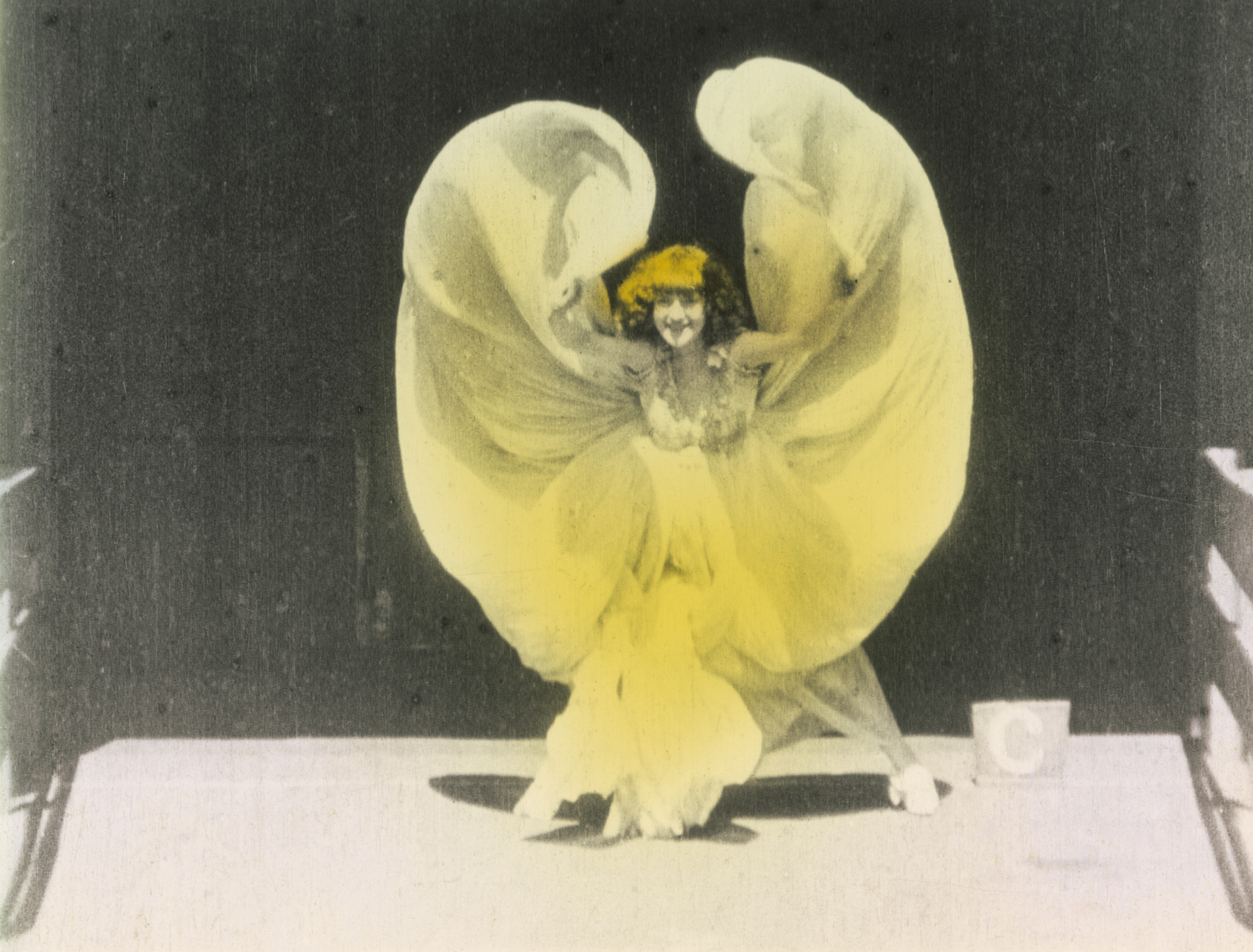
Annabelle Moore performs a dance in a flowing dress, twirling and swinging the fabric to create a hypnotic pattern, and then prancing in a circle with the costume spread like wings behind her.
Essentials:
A Chicago native, Annabelle, like several of the earliest Edison kinetoscope performers, made her name in America at the Chicago World’s Fair. However, at barely 15, she was certainly the youngest of that group. Born Annabelle Whitford, she would later go by Annabelle Moore, but she was often billed only as “Peerless Annabelle.” Like Cher, Madonna, or Beyoncé, she was widely-known by her first name alone. She is likely only 16 in this film, shot in the summer of 1895, but she was already a familiar face at the Black Maria studio, and this is her 5th or 6th appearance before the kinetograph.
All of her films include her name and the name of the dance she is performing for the 15-20 second standard kinetoscope runtime. None of them particularly stands out from the others, except (for obvious reasons) this one. The third of her four filmed “serpentine dances” is in glorious, hand-tinted color. Her dress is all yellows and oranges at the beginning and the end, with flashes of crimson appearing here and there, and changes in the middle to a striking lavender. Each print of this film that went out would have been painstakingly colored by hand, one image at a time, for all 45-50 feet of film. There are some indications that this may not have been the first film to apply this process, but as far as we know, it is the oldest surviving example of a live-action film with color.
At first glance, it may seem as though this is also an early example of a film employing a visual effect that could not be reproduced in a live performance. After all, a dress would not change colors on-stage before the audiences’ eyes, right? The serpentine dance, it turns out, was developed in 1891 by actress, dancer, and choreographer Loie Fuller (see right). Fuller developed her own system of multi-colored stage lighting that not only made the billowing fabric seem to change color, it also reportedly produced effects that suggested the appearance of flames, flowers, and other images from nature.
Annabelle was one of many popular imitators of Fuller’s signature dance, and when Fuller failed to get the legal or artistic recognition for her creation that she deserved, she departed to tour in Europe. She eventually settled in Paris, where she continued to develop the serpentine technique as well as many other celebrated dances. Meanwhile, the serpentine dance remained hugely popular, and was featured in a few dozen film throughout the next decade and beyond.
As for Annabelle herself, I’ve seen it suggested that the popularity of her films was due to her involvement in a headline-grabbing sex scandal late in 1896. In brief, one of P. T. Barnum’s grandsons attempted to hire her to dance nude at his brother’s bachelor party, and her scandalized agent (who was also her stepfather) reported the party to the police. The police raided the restaurant where this debauched event was taking place, which led to a highly-publicized court case that pitted the attendees’ right to privacy against moral policing standards of the day. (Curious about the outcome? Recall that the defendants were rich and well-connected.)
So, did Annabelle enjoy a sudden surge in popularity because everyone wanted to get a look at the girl who turned down this notorious proposition? It’s possible. But as I said above, by this time Annabelle had already done multiple versions of both the butterfly dance and serpentine dance films, which implies that they were already among the most popular of the kinetoscope’s early films. In fact, she no longer appeared in any new films after 1897, though she continued to enjoy an illustrious career on the stage until her marriage in 1910.
Screening:
Annabelle’s dances, at least those that appear on film, seem to rely more on her energy and charisma than any real technique or skill. I’m no expert on dance, certainly, and all of these examples are, of course, quite short. The style that is on display here is perfectly well-suited to the novelty of early motion pictures, and clearly audiences loved her. However, the contrast between this and other recorded serpentine dances of the era is striking, as we will see. Still, there is something to being the first (on film), and the addition of color makes this something truly special.
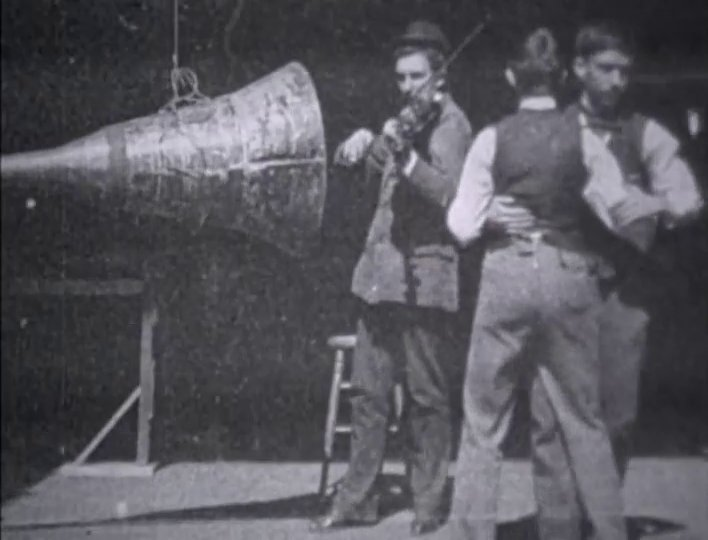
A device that looks something like a giant ear trumpet hangs from the ceiling to about chest-height on the left side of the frame. A man in the center of the shot plays the violin into the device, and we can hear the tune he is playing. Two more men on the right hold each other and dance in a tight circle in time to the music. As the scene ends, a fourth man enters carefully from the left side, behind the device.
Essentials:
When Edison first went public with the kinetoscope in 1891, he talked extensively about how it was the visual counterpart of the phonograph. His plan was always to marry the two technologies in order to produce moving pictures with sound, and at some point after the kinetoscope had successfully launched in 1894, and film production was well underway, Dickson turned his attention to the task. Sometime in late 1894 or early 1895, he produced this, just about the only artifact we have of his work on the process.
Of course, we know that he didn’t succeed, since talking pictures didn’t fully arrive until over 30 years later, but it’s unclear at what point he and Edison set the project aside definitively. The task that defeated them was the hurdle of synchronizing the sound to the picture. The problem of exactly coordinating recorded audio with recorded film proved too difficult to solve in the mid-1890s. Edison finally succeeded at producing talking pictures nearly 20 years later, long after his association with Dickson had come to an end, but that’s another story.
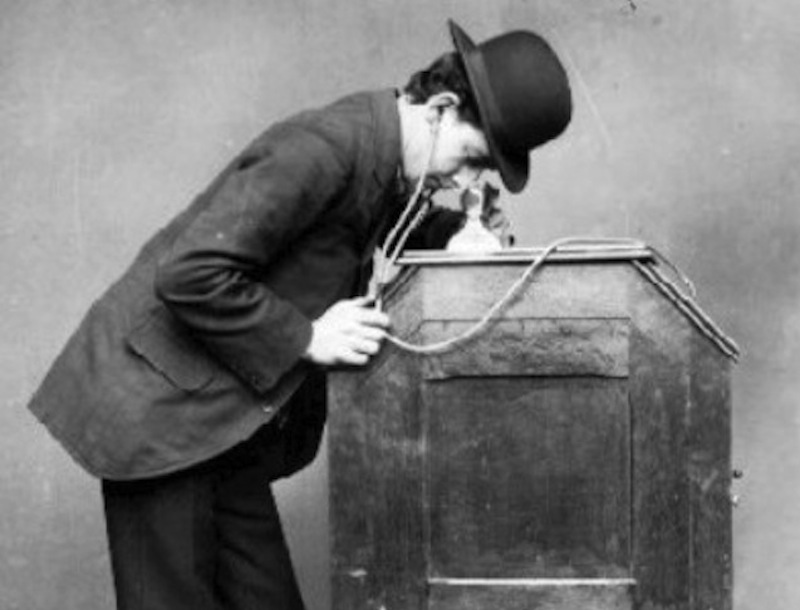
Meanwhile, back in 1895, here’s what we know: Edison called the invention that combined audio and visual the “kinetophone,” and it went on sale in March of 1895. It was just a kinetoscope with a phonograph also built into the cabinet. A tube fed out of this part of the cabinet and up to where the viewers could put the ends into their ears, like primitive earbuds (see right). Edison also sold kits that owners of kinetoscopes could use to modify them into kinetophones. However, none of the productions created for the kinetophone successfully incorporated anything like synchronized sound. They merely featured films shot without recorded sound, but sold with an appropriate “soundtrack” to accompany them; say, a march to be played along with a film showing a band, for example.
Only 45 kinetophones were ever made, and the endeavor was not financially successful. That, as much as anything, may have been the impetus that led Edison to abandon the project at that time. In any case, what we now refer to as the Dickson Experimental Sound Film was the only film produced with a live recording to accompany it, as far as we know, and it was unseen (and, in fact, unknown) outside of the Edison labs until its re-discovery in the 1940s. It was clear from that footage that this was an experiment in trying to create a film with sound, but the wax cylinder recording that went with it remained lost, and so for decades it was merely an odd little mystery from the earliest days of motion pictures.
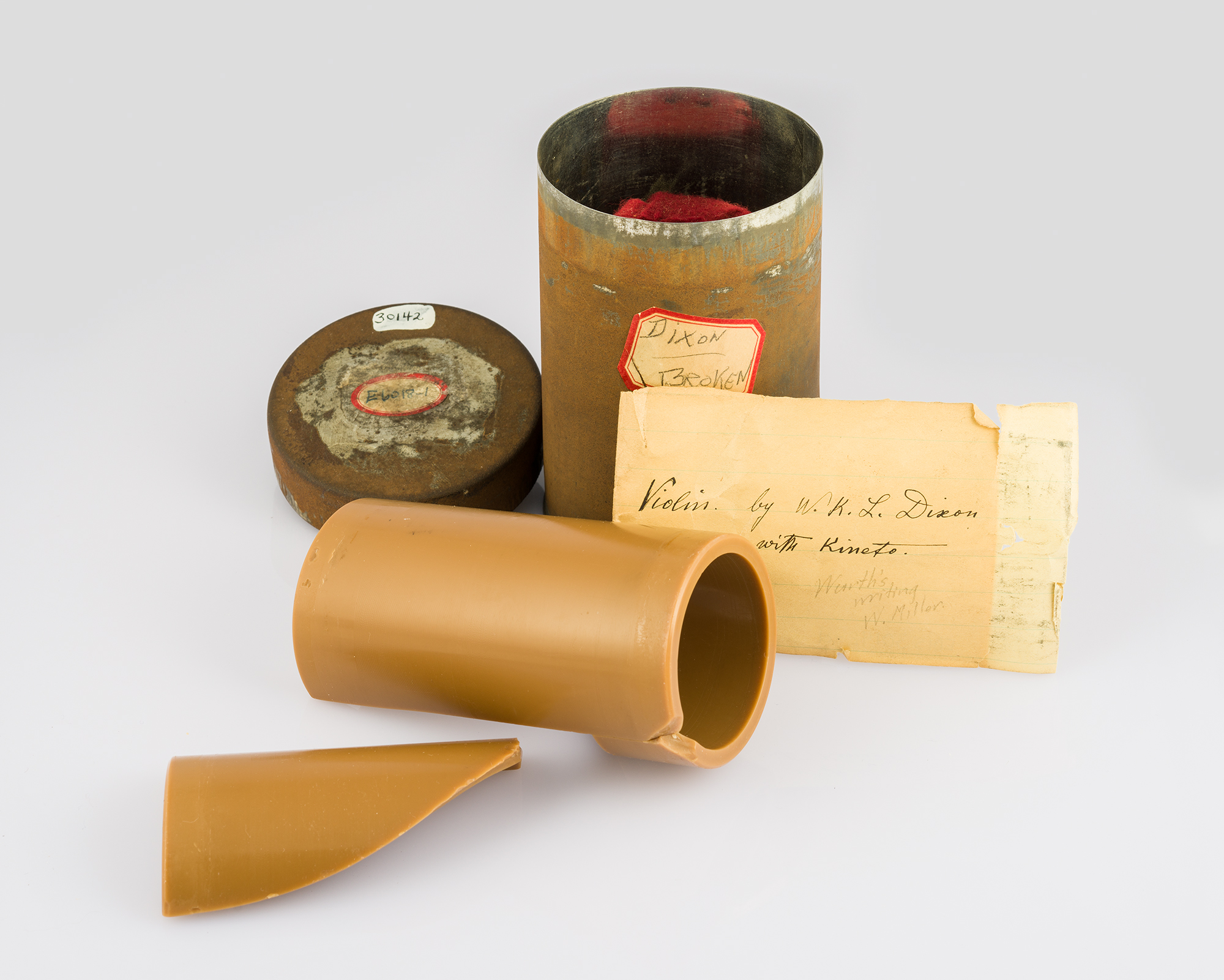
In the 1960s, someone found the wax cylinder that was meant to be paired with this film, correctly labeled and everything. But the cylinder was broken, and no one made the connection between the cylinder marked “Violin by W.K.L. Dixon [sic] with Kineto” and the film (by that time archived at the Library of Congress) titled Dickson Violin for almost 40 years. In 1998, a joint restoration effort was undertaken, and the people and methodology involved are a fascinating story unto themselves. A complete, synchronized version was finally played for an audience in 2002, well over a century after its production. It was added to the National Film Registry the following year.
Screening:
This film is a pretty incredible find. Incredible that we have it, and in a form that we can both see and hear, but also incredible to see this almost forgotten chapter of early film history restored to the narrative such a relatively short time ago. Its restoration answers many questions. For instance, we now know what tune Dickson (yes, that’s him) is playing on the violin. It’s from the French opera Les Cloches de Corneville, a massive hit that first premiered in 1877, when Dickson was still living in Europe. You can hear the original French version of the excerpt he is playing here, and the English version here. Dickson was born in France, but emigrated from Britain in 1879, so I’m not sure which version he would have had in mind.
However, many questions remain. One question that is foremost in the minds of viewers is whether the two men who are dancing in this clip could accurately be construed as one of the earliest examples of LGBT representation on screen. As with Muybridge’s The Kiss, I’m not here to declare definitively what does or doesn’t count as queer imagery, but I’ll just point out a few things. There’s a possibility that some might have objected to a film of a man and a woman dancing together, but I find that unlikely for several reasons. And I find it unlikely that Dickson would have been concerned by that for several more reasons, the most prominent of which is that this film was never intended for release, and was never seen by anyone outside of Edison’s employ, probably at any point during the lifetimes of the people appearing in it.
But, therein lies another clue: This was an experimental film, and the dancers are simply there to provide some movement that can be synchronized with the sound. They are almost certainly two members of Dickson’s team who were already present and at hand to step in front of the camera. How many women engineers do you think were employed by Thomas Edison in 1895? Given that you could count all of the women engineers on the planet at that time without running out of fingers, I would guess zero. But, again, these are not mutually exclusive explanations for what we see on-screen. Here, too, all we are left with are the images themselves, and, of course, the sound that goes with them.
Several people enjoy a day at the beach, including some divers, a couple with a small dog, and a rather rude peeping tom. A man in a boat signals the end of the film with his sails.
Essentials:
By the first few months of 1894, Charles-Émile Reynaud and his Théâtre Optique had been presenting the same three animations five times daily for almost a year and a half. In March, the show closed while he worked on new material, and one of the two new animations he produced was Autour d’une cabine ou Mésaventures d’un copurchic aux bains de mer (or, in English: Around a Cabin or Misadventures of a Couple at the Seaside). This new work was composed of 636 individual, hand-painted images, and although it lasts about 2 minutes when played straight through at regular speed, just as with Pauvre Pierrot, Reynaud turned it into a performance, extending the runtime to 10 minutes or more.
During the months he was closed, Edison’s kinetoscope arrived in Paris. These live-action moving images had the benefit of novelty, but the films that were produced for them still lacked the length and sophistication of Reynaud’s work. Plus, the kinetoscope only allowed one viewer at a time, while the Théâtre Optique was projected for a whole audience. It would be another full year before Reynaud’s animations faced competition from actual projected motion pictures, and he didn’t give his final show until February 28, 1900.
Aside from Pauvre Pierrot, Autour d’une cabine is the only other one of Reynaud’s works to survive his destruction of his own work in a bout of depression after the closing of his show. It’s certainly interesting to see an example of his second group of films for the Théâtre Optique, to observe how his technique has developed, and how the medium hasn’t. There are a lot more characters and events in Autour d’une cabine, and the scenery is more elaborate. In particular he’s got to deal with characters entering and leaving the water, which is tricky as the water is part of the static background scenery, but the characters are not.
The various little devices that make up the whole thing are more clever, and the ship that sails out to declare that the show is over is a particularly nice touch. But it’s still essentially the same thing as his earlier work. The fundamental technology behind it hasn’t advanced in any way that allows for innovations that might compete with what’s coming.
Screening:
It’s strange to watch this in the context of the early kinetoscope films. When Pauvre Pierrot was first exhibited, the handful of people who had access to a motion picture at all might have seen a few seconds of someone waving and bowing. Edison and Dickson were barely past the Monkeyshines days of images blurred beyond recognition into a shapeless blob. But by the time of this release, sure the motion pictures were less than a minute long and in black and white, but you could watch actual moving images of world-famous performers like Annie Oakley, or watch a dance from Spain, or the Native American West, or Japan.
Autour d’une cabine hasn’t lost any of the charm of Pauvre Pierrot. If anything, it’s a better and more engaging film, particularly to a modern audience. But somehow, where its predecessor felt vibrant and alive, this feels like the last rally of something that has lost its relevance and just doesn’t know it yet. The ghostly translucence of Reynaud’s characters in the scene has taken on a different tone entirely, like they are haunting a space that is no longer theirs to inhabit.
Three women in what appears to be Japanese garb stand in a line before the camera. The one in the middle holds out a fan which she twirls on her finger before spinning in a circle, dropping into a crouch, and then standing and continuing to dance. Meanwhile, the two women next to her hold handles in each hand with long streamers of gauzy cloth attached. The left streamer each one holds is light, and the right streamer is dark. The two turn in unison, first facing right, then left, then forward, etc. As they turn, they wave their arms, causing the streamers to create a mesmerizing pattern in the air in front of them.
Essentials:
Filmed late in 1894, this is likely the first film to feature Japanese people, and possibly the first appearance by any Asian in a motion picture. I say “likely,” not just for the usual reason that it’s hard to be certain when so many early films are lost, but because in this case, it’s difficult to be sure of the women’s actual origins. In general, we have to take the claims from the Edison catalog regarding what we see in a particular film on a certain amount of trust. This may or may not be justified, but when the information from the catalog can be corroborated with additional information from outside as to the nature of the act and its participants, then it seems reasonable to accept it.
In this case, I can discover very little about these dancers, except that they were performing on the vaudeville stage as the Sarashe Sisters. This is certainly a stage name, taken (according to art historian Hsuan Tsen) from the Japanese word sarashi, a reference in this case to the streamers being waved by two of the dancers. In another blow to its purported authenticity, the catalog description of the film states that it is: “A charming representation of the Mikado dance by three beautiful Japanese ladies in full costume.” This probably refers to The Mikado, a hugely popular Gilbert and Sullivan comic opera from a decade earlier, rather than to an actual Japanese dance. But at the same time, it’s hard to know whether the word “Mikado” was used here simply to connect the dance to something the audience might recognize, which would not be unprecedented.
All of this suggests that, whatever its level of authenticity, the film was calculated to meet the general demand for all things Japanese that existed throughout this time. After Japan was forced to open itself to Western trade in the 1850s, Japanese style and culture experienced a period of significant popularity as a source of inspiration in the Western visual and performing arts. This trend came to be called Japonisme. Today, of course, we would call it cultural appropriation. However, just as with Native American “Wild Westers,” this demand seems to have created at least some opportunities for actual Asian performers that may not have existed otherwise.
Screening:
There is just something about this film that I find absolutely fascinating. I think at least in part it’s just how well-suited this act is to the constraints of early silent film. It doesn’t feel as though the sound is “missing,” and you can watch it on an loop almost without noticing when it has started over again. My favorite bit comes about 14 seconds in, when the central dancer’s fan catches on the white streamer next to her without either her or the dancer on the left noticing until she has spun around and wrapped it around her body. For a moment, it seems that the dance is about to end in a tangle, but then the central dancer drops into a crouch and flips her fan up with a flourish, and the other dancer, watching carefully, detaches the streamer with a single deft flick, and they continue. This suggests that, as with many of the acts filmed in the Black Maria, the performers were used to considerably more space in which to perform.
Incidentally, the BFI have published a much higher-quality version of this footage that also eliminates the vertical “jogging” that is visible throughout this clip, but their version cuts off before the end of the film. If you’re interested, you can see it here. The Edison catalog listing states that hand-colored prints of this scene were made, but none have been found.
Three men engage in a friendly dance competition, with each taking his turn in the center while one plays the harmonica and the others keep rhythm by clapping along.
Essentials:
Shot in mid- to late-fall of 1894, this film is believed to be the earliest appearance by African Americans in a motion picture. The three performers are Joe Rastus (the first dancer, in the light shirt), Denny Tolliver (the second dancer, in the dark shirt), and Walter Wilkins (the final dancer, on the harmonica). Rastus, Tolliver, and Wilkins were three members of an eleven-member dance troupe that performed a number, alongside a white woman in blackface (Lucy Daly), called “The Pickaninny Dance.”
This act was part of a larger program called “The Passing Show,” which was purportedly the first successful musical revue on Broadway. It was a sort of topical variety extravaganza composed of loosely-connected acts. Its success launched a trend that would persist in popularity, on both stage and (eventually) screen, for decades. As to the nature of the act itself:
The general designation for tap dancing at the turn of the century was “buck.” The term can be traced back to the West Indies, where Africans use the words po’ bockorau as a corruption of the French word boucanier to refer to rowdy sailors, and to the Carolinas, where Africans spoke of the “po buck” jig dancing of unruly Irish immigrants. […] While the jig and clog dance of the Irish moved from the knees down, its art being purely auditory, the buck dance of African Americans was more robust and full bodied, allowing the rhythms to move up into the body […] [T]he earliest example of buck dancing on film is […] a trio of professional dancers engaged in the rivalrous camaraderie of a buck challenge dance, alternately performing for and accompanying each other.
Constance Valis Hill, Tap Dancing America: A Cultural History, pp. 22-23
It’s impossible not to notice that, while this film depicts a prominent tradition in American dance, it also illustrates a powerful strain of racism that runs through American entertainment. The title, of course, contains an ugly slur that refers to black children. This may seem particularly confusing, given that the performers in the film are all very clearly full-grown men. The title comes from their stage act, in which the title role was played by Daly, made-up (according to one newspaper reviewer’s description) as a “little mad-cap negro girl.”
To add further insult, a catalog listing for the film describes it as: “A scene representing Southern plantation life before the war. A jig and a breakdown by three colored boys.” On top of its use of the condescending diminutive “boy,” this description posits that the performers are meant to be portraying enslaved people in a way that suggests slaves were contented and carefree. Recall, too, that anyone in their 30s at this time was old enough to have been alive at a time when slavery still existed.
It’s important to understand that, while the Confederacy lost the Civil War, the South and its cornerstone of white supremacy won the ensuing culture war, with consequences that continue to be powerful forces in our society even to the present day. The historical narrative that came to dominate white Americans’ understanding of the Civil War and its aftermath was of an intrafamilial strife that tragically destroyed a courtly and noble way of life. Nostalgic fantasy versions of antebellum culture and society, strongly rooted in a rigid racial hierarchy, came to be both mourned and celebrated as lost ideals in all forms of American art and entertainment, and the movies were fully complicit in that mythmaking process.
Screening:
I think some historical films whose production is marred to a greater or lesser degree by overt racism are important to watch, or at least important not to ignore or forget, because they remind us of how much and for how long white supremacy has existed as a persistent theme running through our culture, and of the long shadow it casts. Although some people don’t need to be reminded, because they exist under that shadow every day. But I think this film is worth watching because its stars transcend the racist framing of the film’s producers, displaying in a very brief period of time an infectious energy and a level of artistic skill that are a genuine pleasure to watch. The title and description given to their performance by others cannot rob them of their ability to impress and to make their own mark on cinema history.
Understand that all original content in Moviegoings is my property under copyright.
"Everyone has the right to the protection of the moral and material interests resulting from any scientific, literary or artistic production of which he is the author." -- Univ. Decl. of Human Rights
Unless otherwise noted, all original content in Moviegoings is licensed under a Creative Commons License.
Comment Policy
Commenting here is a privilege that may be revoked. Visitors to Moviegoings are allowed to post comments only for noncommercial purposes. Unsolicited advertising ("spam") may be altered or deleted at any time. Violation may result in appropriate countermeasures, including but not limited to IP banning, IP publishing, notification of ISPs, and civil and criminal legal action.













 Moviegoings