
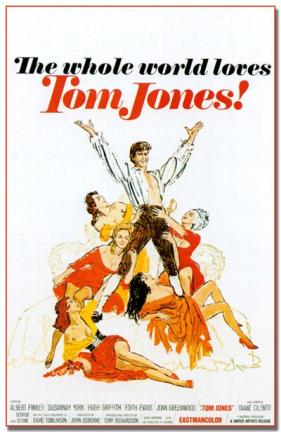
Tom Jones: Best Picture, 1963

•March 19, 2007 • 1 Comment

tomjonesposter.jpgWhat an incredibly strange batch got hauled in at the 37th Annual Academy Awards (hosted by Jack Lemmon). Tom Jones was nominated for 10 Oscars: Best Picture, Best Director (Tony Richardson), Best Original Score, Best Adapted Screenplay, Best Actor (Albert Finney), Best Supporting Actor (Hugh Griffith), Best Art Direction (Color), and 3 for Best Supporting Actress (Diane Cilento, Edith Evans, Joyce Redman). It won the first 4. Ironically, the winners were not present for the first 3 of those 4 awards, and they were accepted by someone else.

As for the rest, Best Actor went to Sidney Poitier for Lilies of the Field, Best Supporting Actor to Melvyn Douglas for Hud, Best Art Direction to Cleopatra (starring Elizabeth Taylor and Richard Burton) and Best Supporting Actress to Margaret Rutherford for The V.I.P.s (also starring Elizabeth Taylor and Richard Burton). 1963 was one of those years where Oscar didn’t pick many movies that people would remember favorably (if at all) . . . an off-year (awful year?) if you will.

Tom Jones is based (heavily or loosely, I do not know) on Henry Fielding’s massive 18th century novel of the same title. Clocking in at just over 2 hours, the movie maintains a relentlessly frenetic pace as much for slapstick effect as to cover even just the bare bones of the original plot. Squire Allworthy, a bachelor living with his spinster sister, retires to his bedroom one evening and discovers an illegitimate infant boy occupying his bed. Blame for the child’s existence quickly falls on Jenny Jones, a household servant, and she is promptly exiled along with the local barber accused of being the father. Squire Allworthy adopts the baby, dubbing him Tom Jones and raising him as his own (sort of).

Before long, the squire’s sister marries and has a son of her own, Blifil, and the two boys grow up together. Tom is a rollicking, lusty lover of fun and sport, while Blifil is a model student and a prim, stuck-up prig. Both men love Sophie Western, but she only cares for Tom . . . this is unfortunate since he can’t seem to keep his pants on around a large segment of the local female population. Blifil soon exposes Tom’s wicked ways and he is exiled, leaving Blifil the logical choice to marry Sophie and unite the estates and fortunes of Squires Western and Allworthy. Sophie, horrified, runs away with her cousin, Mrs. Fitzpatrick, and half the major characters follow in hot pursuit.

Meanwhile, Tom falls in with all sorts of entertaining people, and starts bed-hopping again. Everyone winds up in London for a long interlude of dancing around social conventions and whatnot. Tom carries on more affairs and gets in more trouble, and finally all sorts of revelations are made just in time for a climactic last-second rescue from the gallows and a happy ending for Tom.

Tom Jones is chaotic and unfocused, and its pacing is a disaster. It has definite flashes of genius, and a good deal of honest hilarity. However, by the time the ending rolls around, it is difficult not to feel that the film has long since worn out its welcome. Far too much screentime is taken up by material that is either boring or irritating.

Albert Finney is fantastic in the title role, charismatic and fun throughout. His performance here is certainly far better than the one that would get him his next acting nomination over 10 years later (as Hercule Poirot in Murder on the Orient Express). Finney inhabits and possesses his character completely, and it is difficult not to find at least a little enjoyment whenever he is on screen. Tom Jones is also blessed with some magnificent set pieces, including an enormous, rollicking and elaborately-staged fox hunt featuring some great aerial shots of the action and a rich and magnificent costume ball full of rich and fantastical outfits of all kinds.

The movie further benefits (occasionally) from a style that rarely takes itself seriously, lampooning older movie conventions along the way. Tom Jones opens like a silent film, complete with melodramatic music and title cards, and isn’t above frequent slapstick and “Keystone-esque” sped-up chase scenes. Like much of the repertoire of Monty Python (which Tom Jones almost seems to foreshadow from time to time) some of this works extraordinarily well while some is just too silly or outrageous to elicit more than a groan . . . and it is often not clear why some things work and others don’t.

Ultimately, though, it’s all just too much. Tom Jones drags too often, and in all the wrong places. Perhaps if an additional half-hour of subplots had been shaved off, or if the characters weren’t so constantly interacting at a fever pitch, it would be an easier movie to watch and enjoy. There are certainly plenty of glimmers of a much better movie showing through beneath its exhausting and campy tone.
Continue reading ‘Tom Jones: Best Picture, 1963′

Happy Reading

•March 14, 2007 • 3 Comments

One of my favorite websites used to be theforce.net; the place for everything Star Wars. I discovered it back in 1998, and it had everything (it also looked a lot better . . . the site was “revamped” sometime between Episode II and Episode III, and I don’t like the change). One of its several dozen features was periodical editorials about all sorts of topics. The first one was about the superiority of Star Wars over Star Trek, but there were all sorts of topics: merchandising debates, endless thematic analyses.

Then, during darker times, there were defenses of, and predictions for, the prequel trilogy. They had titles like “Why Episode I is Brilliant.” Never underestimate the power of denial. I don’t know whether the people involved ran out of topics or ran out of enthusiasm, but either way the last editorial was posted in April of 2003. My own rabidity towards the subject flickered and went out a little over a year later, and I haven’t thought about those editorials at all in a few years.

I don’t remember what I was doing at Strange Horizons. Just one of those things you stumble across when you’re wandering the interwebs. On the site, I found this essay . . . a smart, funny, and scathing critique of the prequels that should be read by everyone who either enjoyed them or was vaguely bothered by them (I guess I was both). The author addresses too many points to summarize, and references everything from Oedipus Rex to Dune along the way. Great essay. Check it out.

And while you’re at it, take a stroll through the article archives. Just this afternoon I’ve read several fascinating essays on such disparate topics as the variety of “megastructures” in science fiction, the use of maps in modern fantasy, firewalking, a scale for assessing horror flicks, linguistic misconceptions in constructed languages. Happy reading.

Perfume: The Story of a Murderer

•March 7, 2007 • Leave a Comment

starring Ben Whishaw, Dustin Hoffman, Alan Rickman and Rachel Hurd-Wood
written by Andrew Birkin, Bernd Eichinger and Tom Tykwer and directed by Tom Tykwer
rated R for aberrant behavior involving nudity, violence, sexuality, and disturbing images.
98%

This film was an enrapturing story full of thought-provoking beauty; a moving fable on the power and meaning of love, prone at times to displays of what many might consider profoundly disturbing excess. Perhaps they would be right, perhaps not. But I doubt that I shall be allowed the experience a second time, and so, like Jean-Baptiste Grenouille (the title character), I will try to preserve it here.

Unlike Grenouille, I don’t think I’ll need to kill anyone, but it will be necessary to reveal the ending. I don’t think that should stop anyone from reading this. For most, you will finish reading about the movie here and know that you’re never going to go see it. For the rest, I don’t believe that knowing how the story plays out in advance has any effect on the enjoyment of this particular movie. I went in knowing all about it because I felt the need to read up on it heavily before deciding whether to go see it. I should note one source in particular, this essay from from Metaphilm. Its observations on Grenouille as a Christ figure heavily informed my viewing. However, aside from that guiding framework, the thoughts here are my own unless otherwise noted.

Perfume was directed by Tom Tykwer, director of Run, Lola, Run. In terms of style, I don’t think any two movies could be more different. Where Lola‘s frantic, music-video pace leaves audiences gasping for breath as they struggle to keep up with the mad dash, Perfume lingers seductively amidst breathtaking sets and locations. The film is based on Das Parfum, a 1985 novel by Patrick S? that filmmakers have been begging to adapt for two decades. Stanley Kubrick declared it to be completely unfilmable.

Tykwer’s Perfume is the most expensive German movie to date (it’s in English, by the way), with a total unknown (Ben Whishaw) in the lead role. John Hurt provides his always reliable narration skills, Dustin Hoffman appears as aging Italian perfumer Baldini, and Alan Rickman shows up as Richis, Grenouille’s self-appointed arch-nemesis. John Hurt narrates. The only other player American audiences are likely to have seen before is Rachel Hurd-Wood, who played Wendy in 2003’s Peter Pan, and here portrays Richis’ daughter and Grenouille’s prime target, Laura.
Continue reading ‘Perfume: The Story of a Murderer’

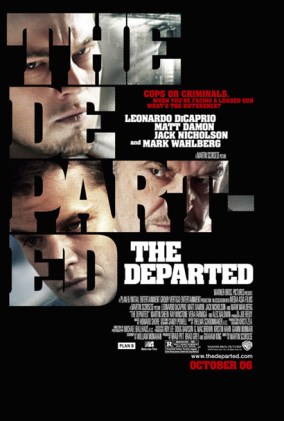
The Departed: Best Picture, 2006

•March 7, 2007 • 2 Comments

thedepartedposter.jpgThe Departed was nominated for 5 Oscars at the 79th Annual Academy Awards: Best Picture, Best Director, Best Editing, Best Adapted Screenplay, and Best Supporting Actor (Mark Wahlberg). It lost only the last, to Alan Arkin for Little Miss Sunshine. It is the 4th Martin Scorsese film that I have seen. I really thought Taxi Driver, an urban story of isolation and twisted virtue, was an excellent and amazing film. It was nominated for 4 Oscars and won none. Gangs of New York, a sprawling historical tale of rival Irish gangs and political corruption set against the backdrop of the Civil War, was pretty good, but perhaps overlong. It was nominated for 10 Oscars and also lost every single one. The Aviator, as I’ve mentioned recently, I disliked a great deal. A vast biopic of wealthy eccentric Howard Hughes, it was definitely overlong. It was nominated for 11 Oscars and took 5.

The Departed is the story of two men of Irish descent, Billy Costigan (Leonardo DiCaprio) and Colin Sullivan (Matt Damon), who join the Boston Police Department at around the same time and become involved in an investigation hoping to take down Irish mobster Frank Costello (Jack Nicholson). Costigan is recruited by Dignam (Wahlberg) and Captain Queenan (Martin Sheen) to go undercover and get as close as possible to Costello. Meanwhile, Sullivan, befriended by Costello at a very young age, is busily feeding him information from inside the force. Naturally, it is only a matter of time before the two moles become aware of each other’s existence and each is forced to attempt to be the first to discover the other’s identity. Meanwhile, unbeknowst to them, they have both fallen in love with the same woman.

This is really an excellent and carefully-crafted set-up, with an equally great cast. It is truly surprising that Wahlberg was the sole acting nominee, because there is fantastic work here all around. Nicholson, as usual, is outstanding, as are both DiCaprio and Damon. In fact, I think this may be my favorite DiCaprio performance to date. I’m surprised Nicholson didn’t get a nomination for his performance. Maybe they thought, with 12 previous nominations and 3 wins behind him, why bother? Then again, Meryl Streep got nominated. In any case, I found the characters very believable and compelling, and I was very caught up in what was going on. I didn’t get bored or feel the need to check the time at all.

Of course, part of that strength lies as much with the screenplay as the performances. There is a lot to like here with the slow building of very palpable tension, several surprise twists scattered liberally throughout, and cat-and-mouse antics that are as original as I’ve seen in recent memory. The ultimate fate of the characters is unpredictable, not because the ending cheap-shots the audience out of nowhere (it doesn’t, really) but because the movie appears willing to let the story play out naturally instead of contriving a particular ending.

Nevertheless, it has its failings. They are, perhaps, not very significant alone, but together they make this film far from perfect. As great as the story is, I got the very distinct feeling as it drew to a close that the manner in which things played out would fall apart if I were to watch the movie again. A few things didn’t quite add up. I was never sure, for instance, how Costigan wound up seeing the same woman that Sullivan was dating. I’m willing to overlook the improbability of it because it added so much to the story, but it seemed much too convenient. I can’t discuss other developments in detail for fear of giving away the movie, but there were a number of inconsistencies and one or two major events that didn’t seem plausible to me. These occurred mostly in the last 20 minutes of the movie.

I’m not sure where fault for my larger complaint should lie: with the editing, the directing, or the screenplay. Perhaps it is a combination of all three. Gallagher walked in and joined us after the movie had been going for about half an hour, and he said at the end that he didn’t feel like he had missed anything. In a movie where so much depends on character development and small details, being able to miss a good 20% of the runtime with no loss to understanding seems to me to indicate self-indulgence on someone’s part. Leave more on the cutting room floor.

Actually, the movie had been playing for at least fifteen minutes already and we felt we were “in the thick of it” ourselves when suddenly the screen went black and “The Departed” flashed in front of us. Someone observed that that was one heck of an opening sequence. Waiting that long to announce the film’s title is stupid, and I can think of no good reason for it. It breaks the flow. Really, thinking back, it’s a testament to the movie’s excellence in other areas that I wasn’t more distracted throughout.

There were a number of weird, almost dreamlike breaks that cut in on the actual narrative here and there and disappeared just as quickly; things like Nicholson’s character spraying cocaine through the air while a scantily-clad hooker looked on. These brief cuts were irrelevant to whatever was going on before, were gone as quickly as they appeared, and didn’t seem to relate to anything that came after. Sloppy and surreal, a bad combination. They didn’t happen often, but they shouldn’t have happened at all.

That brings me to my final praise/complaint: the music. The music was great. It really was. The main theme was a haunting piece that came across as The Godfather with Celtic overtones, and a lot of the other music was fun Irish punk rock type stuff reminiscent of Flogging Molly. So, it sounded good and it fit very well with the mood and tone of the film. Props to the composer. But I have seldom heard music used so ineffectively and intrusively in a movie. At completely random times for no reason at all the music would fade out, grow suddenly louder, or cut off completely and abruptly (mid-note and mid-scene) for a few seconds before jumping back on at full volume. It was incredibly annoying and distracting, and I thought it was tacky and pretentious.

I would call The Departed a truly high-quality film experience that doesn’t stand up well under very close scrutiny. Gallagher wondered aloud at the end how this movie stood up against Snatch and The Boondock Saints. At first I thought he was talking about general quality or something similar . . . he was actually talking about f-bombs. I guess there were quite a few. Randy and I didn’t really notice after the first few, and I still don’t have vivid memories of there being a great many, but there were. I guess that’s a testament to how comfortable I am watching movies with everyone that was in the room (I only notice things like that if I feel like someone in the room is noticing . . . and disapproving).

Anyway, Gallagher was inspired to check, and discovered that there were 237 uses of the f-word and its various derivations. That’s approximately one every 40 seconds for two and a half hours. In case you were wondering, The Boondock Saints has 246 f-words, or one every 28 seconds or so, while Snatch weighs in with a paltry 153 for an overall concentration comparable to that of The Departed. I was quick to point out that Gallagher has never seen a Quentin Tarantino movie. Pulp Fiction has 271 (1 every 34 seconds), and Reservoir Dogs has 252 (1 every 24 seconds).

Having since investigated the matter on the internets, I find Casino with 422 (1 every 25 seconds) and Twin Town with 320 (1 every 19 seconds). Both are blown completely out of the water by Nil by Mouth with 470 (1 every 16 seconds), which (incidentally) stars the guy who plays Nicholson’s right-hand man in The Departed. I should point out, in closing, that 2005’s documentary F*ck contains an astounding 857 f-words (no, I don’t know if that is counting the title), cramming in 1 for every 7 seconds of runtime . . . but that’s not really fair. As the word is the subject of the documentary, the uses can’t be considered completely gratuitous. In any case, point taken. The Departed definitely holds the record number of f-words for a Best Picture winner, since Pulp Fiction lost to Forrest Gump in 1995. But really . . . who’s counting?

Continue reading ‘The Departed: Best Picture, 2006′

Collecting Oscar

•March 6, 2007 • Leave a Comment

I’ve had something, a bit of an informal undertaking if you will, taking shape slowly somewhere in the back of my mind for some time now. During the past week and a half or so, that shaping has built and accelerated rapidly into a full-blown project to which I expect to devote my resources and a fair portion of the free time that I have. I don’t want to overstate things . . . I’m not going all-out. But it seemed like a fun thing to do, so I’m going to do it for as long as I care to and as much as I feel like.

Of course, I discussed here my plans to watch the Best Picture winner and other nominees for this year and write down my impressions. Then, somewhere between receiving Babel from Netflix and watching The Departed this weekend, my plan to someday mark all of history’s Academy Award for Best Picture films off of my “to see” list went from vague ambition to active pursuit. And naturally I’ll want to blog the experience.

If you pay attention to that sort of thing, you’ll already have noticed that I’ve grabbed an Oscar-winner here and there (as the opportunity arose) over the course of the past semester and a half. I picked up the pace in the last month, and in-between waiting for this year’s nominees to come in from Netflix I had accrued quite a little pile from the library. Plus, I own several myself.

On the day The Departed arrived, I started counting and discovered that I had 20 Best Picture winners sitting in my apartment. Bright and early Monday morning, I started combing shelves and nearly doubled that. I was further inspired by this fun feature from Rotten Tomatoes. Pretty cool. I then used Netflix to easily check off which films I had already seen and which I was still lacking.

Meanwhile, I fiddled with my Netflix queue and had 22 more winners lined up at the top (they were all already on there, but a lot of them had clumped near the bottom). That covers over 75% of the total, right there. A few more should be coming back in over the next few weeks. There are a handful that I have both seen before and would probably be too much trouble to bring back in that I may not bother to re-watch (I’ve seen Gladiator and The Sting several times, and I just saw American Beauty, for instance). On the other hand, depending on the breaks, I will try to re-view as many as possible.

Because this was in part an exercise to see how many I could easily bring together under one roof, I grabbed several that I’ve seen just in the past weeks and months (All Quiet on the Western Front, Bridge on the River Kwai, All About Eve, Ordinary People, etc.). These I probably also will not rewatch unless I feel that I didn’t “soak them up” effectively. Read: okay, maybe I will. On the other hand, Rachel might go for my jugular if I try to watch The English Patient again. Hmmm . . . Tied with the above for “lowest priority.”

As for the rest: There are 36 Best Picture winners that I’ve never seen at all, nearly half from before 1950. They obviously have top priority, and include Patton, Rocky, Tom Jones, Titanic, Dances with Wolves, One Flew Over the Cuckoo’s Nest, In the Heat of the Night, and Million Dollar Baby. Needless to say, I’m more anxious to see some of these than others.

Then there is the mid-level priority: movies that I’ve seen before, but haven’t seen since I started keeping track. These range from A Man for All Seasons and Chariots of Fire, which I’d want to rewatch anyway, to Ben-Hur, Gone with the Wind, and Lawrence of Arabia, which I’m still kicking myself about. I watched those almost right before I started the movielist, and while I don’t necessarily object to watching all of them again, that kind of time is hard to come by when you want it all in one lump sum.

Nevertheless, it’s been long enough for most of these that they deserve a rewatch before I write anything about them, and I want them on the list anyway. Oh, yeah, there are also a few that I saw some time ago and loathed. In all fairness, they get a rewatch . . . The two that come to mind are On the Waterfront and Gigi.

And, finally, there are the ones I’ve seen within the past few years, possibly more than once, that I’m always willing to see again: My Fair Lady, The Sound of Music, both parts of The Godfather, Schindler’s List, Amadeus, even Return of the King. However, since I’ve seen them so many times, and I own most of them, they may have to wait awhile before I get to them.

If you’re around and you’d like to join me for any of the watching, let me know. I’ll try to keep you up-to-date on what and when. And, hey, if you’re not around, join me anyway long-distance. You might be able to get ahold of a fair number of the candidates yourself. It’ll be fun.

Chivalry in Technicolor: Sir Lancelot and the One-Eyed Monster

•March 2, 2007 • 3 Comments

The Introduction

As the 1950s began, the Cold War between the United States and the Soviet Union took center-stage. After news of the first Soviet nuclear detonation broke in late 1949, America’s ideological commitment to oppose communism rose to a fever pitch motivated by fear of annihilation. President Truman’s doctrine of containment led to American involvment in the Korean War, and President Eisenhower and his secretary of state, John Foster Dulles, were quick to raise the stakes with “brinkmanship,” a diplomatic game of chicken played with the threat of nuclear warfare.

Meanwhile, Joseph McCarthy, senator from Wisconsin, led a veritable witch hunt for communist spies and sympathizers in all levels of government and the armed forces. His influence and popularity peaked in 1953. The House Un-American Activities Committee (HUAC), was simultaneously in the midst of its own war on Soviet propaganda in Hollywood films. They launched investigations into the communist sympathies of people in the movie business in late 1947 and again in early 1951, spawning the infamous “blacklist” that put hundreds out of work. The Hollywood blacklist was most prominent between 1952, when the Screen Writers Guild authorized studios to deny screen credits to anyone who had not been cleared by HUAC, and 1957, when a few victims of the blacklist finally started to fight back.

But while HUAC was busily hunting for communist infiltrators in Hollywood, the motion picture industry’s real enemy was the little box of tubes rapidly infiltrating America’s living rooms: the television set. The manufacturing freeze on televisions was lifted after World War II, and by 1954 commercially-licensed television stations existed in all 50 states. During those years, the percentage of American households with television sets went from 0.5% to over 55%. Televised entertainment was clean, cheap, plentiful, and only as far away as the living room. Something would have to be done if the American public was to be lured back out of their homes by the lucrative flickering shadows of the movie theater.

And this was not the only financial problem faced by Hollywood’s major studios. Even as one branch of the federal government sought to root out communism, another swooped in to halt unbridled capitalism. Prior to the 1950s, all of the major film studios also owned the theater chains where their movies were shown. Each theater showed only the movies put out by the studio that owned it. Vertically-integrated studios controlling production, distribution, and exhibition of movies prompted the Federal Trade Commission to launch an investigation for possible violations of the Sherman Antitrust Act.

Eventually, in 1938, the U.S. Department of Justice sued all of the major studios for unfair trade practices. In the landmark “Hollywood Antitrust Case of 1948,” the U.S. Supreme Court ruled against the studios. However, the “Big Five” studios implicated in the lawsuit (20th Century Fox, Metro-Goldwyn-Mayer, Paramount Pictures, RKO, and Warner Bros.) had already fought off the inevitable for a full decade, and likely would likely have held out much longer but for an unforeseen turn of events.

Floyd Odlum, owner of RKO, had decided to leave the movie business in 1948, in part due to the HUAC investigations that were running roughshod through the industry, and Howard Hughes gained control of the studio. RKO was by far the weakest business competitor of the five, and Hughes quickly saw a way to turn the court’s decision to his studio’s advantage. He believed that a decision forcing studios to cut loose their theater chains would put RKO back in the game as serious competition. With this in mind, he agreed to settle in November 1948, splitting RKO into two corporations and relinquishing control of one.

Hughes’ decision seriously undermined the arguments of the other studios, and by early 1949 Paramount was ready to fold. The other three studios eventually followed suit. Already struggling to get Americans to go to the movies at all, the studios would now have to compete with each other as well as independent producers and distributors in order for their films to be exhibited by the now independent theater owners. Meanwhile, Hughes’ gambit failed to pay off and RKO bounced from owner to owner for several years, its situation going from bad to worse, until it finally stopped making movies for good in 1959.

For the rest of Hollywood, the immediate answer to the crisis was simple: bigger budgets and innovations. Give the audience something they couldn’t get from television, and they’d be sure to come for the experience. Moviemakers could film on location at all sorts of exotic destinations, and they could tackle grittier subjects than television would tolerate. The big screen already held the advantage of color, which wouldn’t see widespread use on television screens until the late ’60s and early ’70s. Costumes and sets got more expensive, extras numbered in the thousands and tens of thousands, and (naturally) big-name stars were a necessity.

Meanwhile, the technological “innovations” that flourished during the early ’50s were mostly novelty gimmicks that quickly lost their appeal (like 3-D glasses and “Smell-O-Vision”). A few, like drive-in theaters, lasted much longer, but eventually died out. One in particular has continued to define the way movies are made today.

In 1953, 20th Century Fox introduced a new screen format called “CinemaScope,” (having bought the rights to the process from French inventor Henri Chr鴩en). It allowed movies to fill a screen twice as wide as before. In the ongoing battle with television, bigger was definitely better. Fox wasted no time releasing its first CinemaScope production: The Robe. The film, a biblical epic about the Roman who won Jesus’ garments before his crucifixion, was a great success. Almost immediately, several movie studios were clamoring to license the process from Fox while others scrambled to develop their own.

MGM, declining to develop their own method, licensed CinemeScope from Fox. Their first CinemaScope offering (and the first CinemaScope film not made by Fox) was Knights of the Round Table. The film was released just a few days after the new year, 1954. MGM had gone all-out, throwing their best people at the project with plenty of money behind them.
Continue reading ‘Chivalry in Technicolor: Sir Lancelot and the One-Eyed Monster’

2007: An Oscar Commentary

•February 25, 2007 • 1 Comment

Well, just a few final thoughts, I guess. The Departed won 4, and that was the maximum number of awards tonight. 3 wins for Pan’s Labyrinth (it really should have been tonight’s big winner, honestly, and I submit that it would have been without the “foreign film” kiss of death). 2 apiece for Little Miss Sunshine, Dreamgirls, and An Inconvenient Truth (which was ridiculous). And 1 award apiece for everything else, including a very sad 1 out of 7 for Babel. Talk about a scattershot . . . but it was obvious from the nominations that there were no overwhelming favorites this year, and no movie could have won more than 6 awards tonight, what with redundant nominations.

Ellen DeGeneres made me laugh from time to time, yes. But she was largely unfunny, and when she fell flat, she fell very flat. I saw maybe 5-10 minutes of Jon Stewart’s stuff last year, and he was funnier than her whole show tonight . . . but from what I hear the people at the show hated him, so there’s just no way to win, I guess.

One final thing . . . I’m going back to my predictions of a month ago to see how I did. I guessed on 8 of the categories, and got 5 right. Not bad. I straight-up missed on director and supporting actress (although I knew my choice there was unlikely at the time, so I’m not quite sure why I made it). I struck out on the foreign film front, as well . . . but that’s a hard one to pick. Maybe if I’d seen more of the nominees. It really didn’t go the way I hoped, or thought it should have, in any case. And that wraps up the Oscars for this year. I’m not sure how well this worked. I’m gonna bump the last few paragraphs up to the top, drop the running banter beneath the fold, and then keep experimenting next year. Adios!
Continue reading ‘2007: An Oscar Commentary’

Breach

•February 21, 2007 • Leave a Comment

starring Chris Cooper, Ryan Phillippe and Laura Linney
written by Adam Mazer, William Rotko and Billy Ray and directed by Billy Ray
rated PG-13 for violence, sexual content and language.
89%

On February 18, 2001, FBI agent Robert Hanssen was arrested for selling secrets to the Soviet Union over a period of nearly two decades. Breach is based on the true story of the last few months of the Hanssen investigation, which succeeded in part thanks to Eric O’Neill, who was assigned to watch Hanssen while pretending to be his aide. The movie is a spy thriller that gives away its own outcome in the very first scene, and works backward from there. Chris Cooper (The Bourne Identity, Adaptation) plays Hanssen, Ryan Phillippe (Gosford Park, Crash) plays Eric and Laura Linney (The Truman Show, Mystic River) plays Kate Burroughs, the career-obsessed agent running the investigation from behind the scenes.

These actors and their performances are the film’s strongest point. They have to be, because the factual framework of the film’s story and the decision to reveal the story’s outcome in the opening scene ensure that the plot will generate no tension of its own. Cooper delivers magnificently, effortlessly navigating between sneering superior, warm mentor and slightly-unhinged paranoiac without seeming schizophrenic. However, tying the movie’s perspective to Ryan Phillippe’s character (Eric O’Neill served as a consultant to the filmmakers) means that we never really see a side of Hanssen that is willing and able to commit espionage. We only see the facade he must maintain to succeed (and survive).

Hanssen’s letters to the Soviets seem written by someone with a highly-sophisticated, sardonic sense of humor, amused by the child-like fumblings of his country’s intelligence services. Cooper does not have the opportunity to reveal this aspect of the character in his performance, and Hanssen’s motives are only briefly and superficially explored. This is unfortunate because we are left with a relatively shallow (though expertly-drawn) portrait of an obviously deep and complicated character.

This is not to say that Eric’s character is uninteresting. His struggle to hold a young marriage together while the secrecy and uncertainty of his job drive a wedge into it add a well-grounded human side to the spy vs. spy shenanigans. The unique nature of his assignment requires him to allow certain aspects of his work to invade very sensitive areas of his personal life (such as his shaky commitment to Catholicism).

Hanssen, ultimately the villain, encourages Eric to attend church and make God and community a part of his family life. Burroughs, struggling to see justice done, pressures him to shut out his wife, put his job first and maintain an elaborate deception that threatens his relationships and his sanity. Eric’s commitment and ability point to a successful career in his chosen profession, and yet, the audience wonders, whose example should he be more wary of: Hanssen’s or Burroughs’? The answer is, of course, both. Eric must find and follow his own path.

Questions and concerns like these hold additional interest, but Eric’s character simply cannot compete with the fascination Hanssen’s inspires. But, unlike Eric’s, Hanssen’s family life is woefully underdeveloped, particularly his relationship with his children. How much does his family know or suspect about his double life? What are there reactions to the arrest? What does he say to them, and they to him? There are many badly missed opportunities where the answers to these question are ignored.

The necessary limitations of Eric’s perspective and knowledge of the final outcome make the cat-and-mouse games amusing and entertaining instead of gripping and satisfying. But in a movie where so much is certain so early on, it is strange to sense a distinct lack of closure by the time the final credits roll. There is a great deal of skill and potential, but the film settles for far less than it should have.

  • Co-reviewed with Randy

A Triple Feature

•February 21, 2007 • 6 Comments

This is rather an interesting piece (albeit a few years old now): Juxtaposed interviews on faith and film with Michael Medved, Jeffrey Overstreet, and Todd Rendleman (if you don’t know who they are, their credentials preface the interview). I especially liked this question:

Q: What do you think is at the root of the historical tension between people of faith and Hollywood? Why are some people of faith threatened by film?

MEDVED: It goes right to the fundamental difference between cinematic and religious communication. Movies are a visual medium; psychologists who have analyzed the way they reach audiences estimate that films rely on visual images for 70?75 percent of their impact. Judeo-Christian faith, on the other hand, relies on words. Whenever God has communicated to his people, he has used spoken or written words, not images. Neither Moses nor Jesus drew pictures or created visions for their followers. Movies that appeal to the eyes touch us on an emotional level, while faith messages that appeal to the ears reach for the mind and soul.

OVERSTREET: Christians are quite accustomed to preaching. Art seems threatening to us because it is more about exploration than exposition. We hastily look for “the message” of a movie, failing to understand that art is for reflection, contemplation, discussion and discovery. Further, in categorizing as “Christian” versus “secular,” we prescribe where and when God can be revealed. A beautiful photograph of a mountain becomes “Christian art” when a verse is printed on the sky above the peak. Then we think we know what it means, and we do not have to think for ourselves. This cultivates an environment of lazy and reactionary intellects, and we fail to train ourselves to discern evidence of God in the excellence and beauty of art outside the walls of the church.

RENDLEMAN: Historically, this debate has always been a question of sex. Movies have the potential to move and excite us ? emotionally, intellectually and sexually. Since the birth of film, a key factor in its appeal has been the promise of sexual excitement. For Christians, this is often at odds with Christ’s warning to not look lustfully at others. This has created a strange, conflicted relationship between many religious persons and the movies. Art needs to thoughtfully address all aspects of human life, and the issue of sexuality in film remains a sensitive one. I can’t think of an issue that merits greater discernment and reflection from people of faith.

Medved’s response is dumb dumb dumb. The more I think about it, the dumber it sounds. Of course, my opinion of Medved is not generally high, but there it is. He actually surprised me with a few of his responses, though. Seems he can actually be reasonable when he’s not pushing a . . . oh, what do they call those? . . . Oh, yes. An agenda. Rendleman’s response is both true and thought-provoking, but too limited, I think. There’s more than just that at work here, and I would have liked for him to keep going. Overstreet’s response, however, is what prompted me to post this interview. Awesome stuff.

Dissed and Dismissed (Updated)

•February 13, 2007 • 5 Comments

Well, isn’t this interesting: Christian filmmakers bite back at the critics who spurn them (great headline there). Peter Chattaway reviewed The Last Sin Eater a few days ago for Christianity Today, and on the same day he got a rather whiny e-mail from one Brian Bird, the writer/producer of the movie.

Chattaway then discovered that a radio interview with the director, Michael Landon Jr., was also conducted last week by Paul Edwards of The Center for the Study of God & Culture. In that interview, Chattaway’s review was quoted at Landon, who also responded to it, though much more dismissively.

Chattaway responds politely, but without apology:

“I […] hope that ‘contemporary Christian filmmakers’ can avoid falling into the trap of insinuating that just because they make films with a Christian agenda, it necessarily follows that we are all now obliged to say nice things about their movies.”

Well said. I find that I have many thoughts on the subject, but that it would probably be just as worthwhile to send readers along to the link above to read for themselves. Go take a look.

*Update*
Feb. 15

It’s not over yet over there. The aforementioned Paul Edwards has floated into Chattaway’s comment section for a little back-and-forth action. Great reading, no matter whose side you’re on.