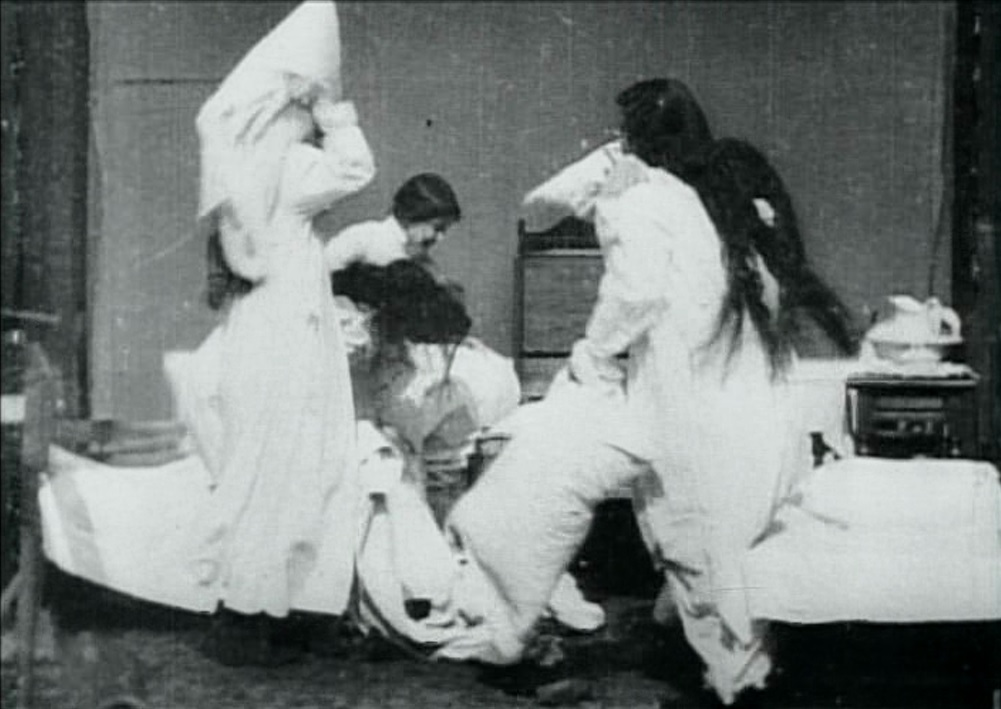
Six girls in a dormitory are having a pillow fight, laughing and frolicking around the room as they swing at each other. Suddenly, a teacher bursts in and the girls scatter. One throws a pillow at the teacher and then dives under the bed. The teacher grabs her by the legs and attempts to pull her out as the other girls attempt to hide.
Essentials:
James H. White and William Heise shot this film in the Black Maria in mid-spring of 1897. The use of props to set a scene had been a feature of films shot in the facility from the very beginning, but this scenario also required a wall with a door in it, blocking the view of the studio’s distinctive black backdrop. (It’s still visible behind the door after it is left ajar partway through.)
In case it isn’t evident, film historian Charles Musser describes the shenanigans of this film as a “more oblique [way] of displaying female sexuality,” in contrast with serpentine dances, the coochee-coochee, or even kissing. As tame as it appears now, a scene of girls frolicking in their nightgowns after hours offered a window into a world that was entirely closed to the intended audience. Further, the scene is carefully engineered so that one girl’s legs (stockinged though they may be) are revealed all the way above the knee, kicking from beneath the bed as the furious teacher tries to drag her out.
In addition, what may not be noticeable if you don’t specifically look for it, is that the girl who dives under the bed is clearly smoking a cigarette at the beginning of the film, when she is the leftmost person in the shot. She pulls it out of her mouth with her right hand, blows some smoke, and then replaces it between her lips before turning her back to the camera for several seconds. By the time she turns back, it is gone, likely knocked to the floor.
Although “seminary” today refers to religious education, and specifically training for ministry, in the 19th century, female seminaries were part of a growing trend in formal general education for girls and young women. Over 3000 such institutions flourished around the country, and although their specific missions varied some by region, the movement as a whole was a significant driver of female literacy. Many of these institutions eventually became women’s or co-ed colleges as women continued to pursue the goal of educational equality with men.
All that to say, in this context, Seminary Girls is effectively Girls Gone Wild: 1890s Edition. In addition, there is perhaps an element of skepticism towards women’s education expressed by that choice of title. The girls in this film are not shown fulfilling the seminaries’ promise of preparing them to take up their expected roles in society. They are not displaying the “feminine” virtues of their culture, including respect for authority. One of them is even smoking. What are they teaching them in these schools? Male viewers (at least some of them) could simultaneously enjoy peeping in on a private scene, and have their regressive views on women’s schooling affirmed at the same time.
Whatever the appeal, the idea was popular enough that several more “pillow fight” movies (without the “seminary” context) followed over the next several years, from various studios. In fact, Heise filmed one for Edison only about a month later. Musser claims that this second film was a remake of an American Mutoscope Company film, but doesn’t give a title or production or release date, and doesn’t mention Seminary Girls at all. It may or may not be an earlier film than Seminary Girls, but as virtually all of the later pillow fight movies have “Pillow Fight” in the title, it is distinctly possible that this one began the trend.
Screening:
This is a reasonably well-choreographed scene, and the set is simple but competently arranged for the purpose. The problem is that the Black Maria was increasingly a poorly-suited facility for the scenarios that were being filmed in it. The girls lack space to move around much, and most of the girls in the back are often blocked from view by most of the girls in the front.
Notice also that it’s very clear where sunlight coming in from the roof reaches, and where it doesn’t, and that it isn’t able to directly light the entire set. This is particularly noticeable when the teacher bursts in holding a candle aloft that, in the darkness, is very clearly unlit. Of course, the teacher also then proceeds to wield the candle in a way that would light the bed on fire. Technical limitations aside, the overall effect of the film has come full circle, and lands precisely as the purely innocent fun that the filmmakers pretended was their intent all along.
A group of passengers struggle to carry on as normal while traveling by ship across La Manche (the English Channel) from France to England. As the ship pitches back and forth, several passengers fail to remain upright, a seasick woman throws up repeatedly, and an Englishman who is determined to have his tea battles the very forces of nature to keep the refreshment on the table.
Essentials:
Georges Méliès’s innovative cleverness as a filmmaker did not begin and end with camera tricks. In addition to a natural flair for showmanship before the camera, Méliès excelled at set design. In this case, the ship set was constructed atop a special platform in Méliès’s garden that rocked the entire thing back and forth to simulate an ocean voyage. Some viewers have wondered whether this platform rocked the ship itself, or the just camera. Close observation reveals a few points where the table rocks with the motion of the ship. (The performers definitely cause it to move in spots, but it unmistakably moves on its own at 0:38.) However, based on how little it moves, it is evident that the motion of the set is not so violent as to cause issues for the actors. Instead, they are able to react in unison, and exaggerate their reactions as necessary for comic effect.
Méliès had originally constructed the platform for an earlier film, Combat Naval en Grèce, depicting a fictional naval battle in the brief Greco-Turkish War, fought that spring. This appears to be functionally the exact same ship set, but with a different paint job, props, and backdrop. One notable addition is the sign designating the ship as part of the “Robert-Houdin Star Line,” in reference to the Théâtre Robert-Houdin (where Méliès still performed his magic act) and to the “Star Film Company” (under which Méliès produced his movies).
The girl seen disappearing through the doorway right at the start of the film is Méliès’s daughter, Georgette. She is more clearly visible in the production still at right, along with many other details from the set that are difficult to make out in the film. The round man in the checkered suit is Méliès himself, with his vest stuffed to make him appear larger. He seems to be parodying a particular sort of Englishman, insisting on continuing with his tea even as the ship tosses violently and waves splash over the sides.
Screening:
For such a short film, on such a tiny set, there are a surprising twelve characters that appear, and ten of them are all on-screen at once as the film begins. The crowd of people on-deck, combined with the motion of the ship, gives an instant sense of jumbled confusion. Soon, though, half of the passengers go below and our attention is divided between the large Englishman, who is wrestling with the table, and the priest trying to minister to the seasick woman on the other side of the ship. The motion of the ship itself draws the audiences’ eyes back and forth between them. (This may make any viewers who are prone to motion-sickness, as I am, feel a little queasy.)
The remainder of the film is punctuated, at roughly equal intervals, by three big falls: The priest tips over and drops down the hatch, the Englishman goes face-first over his tea and onto the deck, and then the Englishman topples backwards into the hatch. They’re spaced just far enough apart to allow the audience a big laugh and recovery before the next one. Out of the seeming mayhem of the scene, it is possible to discern a well-rehearsed spectacle of comedic timing. Once again, without the use of camera movements or editing, we see a 19th-century filmmaker finding other ways to draw viewers’ eyes to each successive gag.
Twenty or so people standing on either side of a roadway engage in a free-for-all snowball fight, pelting each other with abandon. Soon, an approaching cyclist comes down the road and finds himself riding directly between the two lines of people. Suddenly, all attention is on the cyclist, and he is bombarded mercilessly by all until he falls off of his bike. Jumping up, he scoops up some snow and dumps it on a man who has taken hold of his bike, then he quickly gets on it and hurries back the way he came, leaving his hat behind on the ground. The combatants continue their furious battle in his wake.
Essentials:
While teams of trained filmmakers traveled all over the world, introducing the cinematograph to a global audience and sending films home for French audiences, Louis Lumière continued to film “views” wherever he happened to be. Sometimes he traveled, mostly around France (though internationally as well), but often his films were set closer to home. This snowball fight, filmed in late January 1897, took place around the corner from the Lumière factory in Lyon.
The immediate question, of course, is whether the snowball fight was a genuine, spontaneous event that Louis just happened to capture, or was it at least meant to appear that way? At the beginning of the film, there are already snowballs flying through the air, but no one seems to have much, if any, snow on their clothing. As a result, it looks like we are dropped into the middle of the action, but the fight has actually just begun. The camera is set up and rolling in a position to capture the battle, but also to foreshadow the arrival of the cyclist, who we can already see approaching from the beginning. The people appear carefully split on both sides of the roadway, which makes it seem like they’re divided into opposing “teams,” but of course, they’re really forming a gauntlet for the cyclist.
The Lumière brothers are certainly known to have presented films as “actualities” that in reality contained elements that were staged. In fact, this practice was not uncommon for any number of filmmakers throughout the early years of cinema. Not only did “non-fiction” films often contain staged elements, but some films that were entirely artificial were presented as genuine, claiming to depict current events, usually in some far-off location. In this case, however, the snowball fight was described as a scene comique when it was exhibited, and whether anyone thought that it was staged or not was really beside the point.
The approach, arrival, and rapid departure of the cyclist could almost qualify as a dramatic arc. The moment when he enters the fray is certainly the highlight of the film. Still, storytelling was almost never really a priority in Lumière films. Even in their films that could be described in narrative terms, the events on screen were usually meant to appear as natural and spontaneous as possible. Across many hundreds of films, there are of course some notable exceptions to this norm. However, in general, they sought to entertain the audience by showing them scenes that could be recognized as belonging to everyday life in the world around them, rather than to construct obviously fictional scenarios.
Screening:
Looking closely at how the scene unfolds, almost everyone stays on their side of the road, at least at first, and they don’t stray far from their initial positions. Immediately, everyone is throwing snow at everyone else, the people next to them as much as the people across from them. The effect of this is that snow seems to be flying everywhere, in all directions and from all directions.
Meanwhile, the one person that moves is the well-dressed man in the mustache, who runs up the road towards the camera, and then crosses over just in time to hit the cyclist point-blank with a snowball (which is really what knocks him over). At that point, several people advance out into the road, mostly to hit the fallen cyclist. As the cyclist leaves, the scene becomes a bit more active, with a few more people crossing back and forth, and some chasing others.
It’s impossible to know how much of the general action was directed or planned, and how much was ad-libbed. Either way, the result looks like a real snowball fight rather than a performance, but the action is still very easy to follow. It gives the impression of chaos without being truly chaotic. More than anything else, though, it just looks like a group of people having fun. I somehow doubt the snow stopped flying the moment the camera stopped rolling.
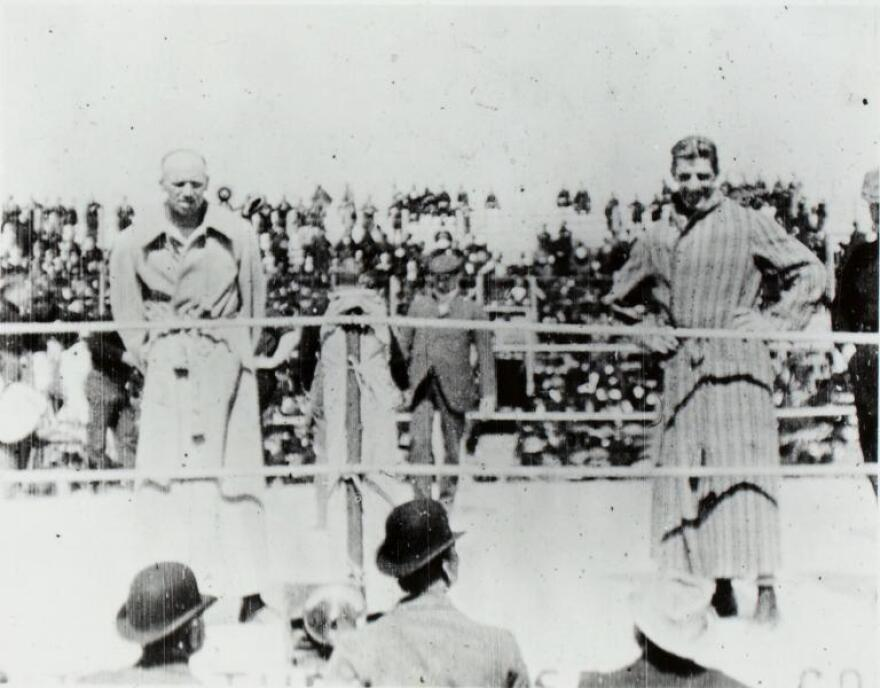
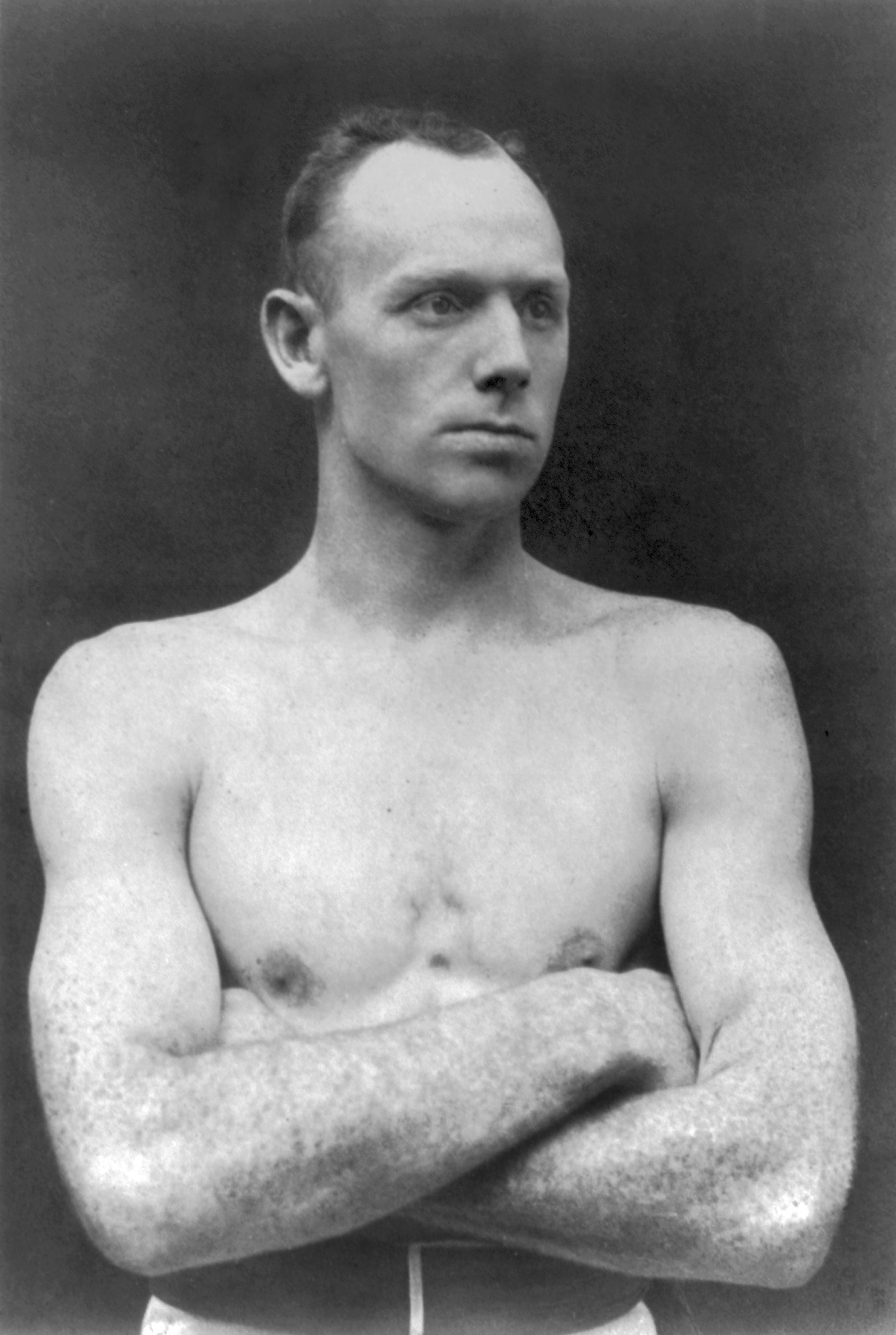
James J. “Gentleman Jim” Corbett defends his World Heavyweight Champion title against challenger Bob Fitzsimmons in Carson City, Nevada.
Essentials:
During the early days of motion pictures, there was perhaps no one else with as much purity of vision and purpose as Enoch J. Rector (see below). The man just wanted to make boxing films. In 1894, he was one of the members of the Kinetoscope Exhibition Company who lobbied Edison to modify the kinetoscope so it could be used to exhibit an entire boxing match (and he may even have helped modify it). Then, in 1895, he was part of the Lambda Company when they exhibited a boxing match as the first film ever projected for a commercial audience. But as Lambda succumbed to bad management and technical problems, he was one of the first to jump ship and pursue a new course, knowing he still had not achieved his singular goal of filming and then exhibiting an actual prizefight.
Woodville Latham had patented the “Latham loop” used by the Lambda company to allow for filming with larger film reels, but it had been developed collaboratively with William Dickson, Eugene Lauste, and Rector. Once all these men had gone their separate ways, it became a matter of some dispute (involving several years of litigation) as to who was most responsible for the device. But regardless of whose claim was the most valid, there’s no doubt that Rector put it to its most ambitious use. The Latham loop would be key to his ability to film and then project an entire official boxing match. All he needed to do was arrange one.
This proved to be an incredibly tricky problem, even without the technological difficulties of a year before. All of the filmed fights to this point had either been “re-enactments” or unofficial sparring matches. They were staged for the camera in venues that were set up to facilitate filming rather than to satisfy sporting regulations regarding things like ring size or round length. An additional benefit of this was that it apparently didn’t count as an actual boxing match for legal purposes, which was important as boxing was illegal in most states. Due to such restrictions, most champion boxers leveraged the celebrity that came with winning a title into a career on the stage in order to actually make a living. But a film of a boxing match, which was not illegal, offered the potential to profit from a match more directly, if it could be arranged.
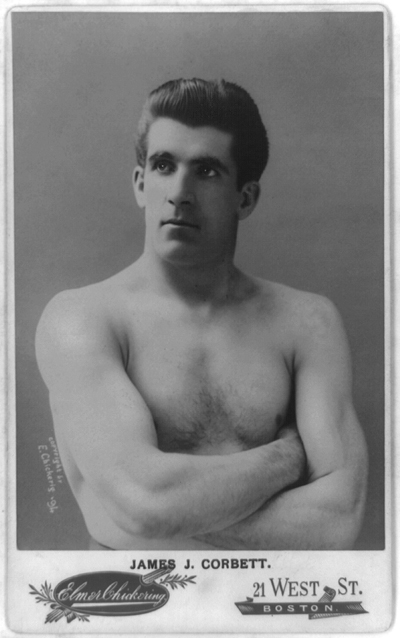
James J. “Gentleman Jim” Corbett
Rector and his associates spent the summer and early fall of 1895 arranging a fight between Corbett and Fitzsimmons in Dallas, Texas. A legal challenge went their way in September when the Texas chief justice ruled that the fight would be allowable under state law. However, within two weeks the governor of Texas, Charles Culberson, had called a special session of the legislature and passed a new bill outlawing the fight. An attempt to move the fight to Arkansas met with the same result. No state, it seemed, wanted to be the one to allow the fight to happen within its borders. Plus, a powerful and vocal anti-fight lobby managed to wield considerable influence as it followed the fight promoters from state to state.
When they tried instead to move the fight into the New Mexico territory, the anti-boxing crusaders simply took their case to the US Congress, which outlawed fighting in all federal territories in a bill passed in early February of 1896. The federal bill was modeled after the Texas bill by Governor Culberson’s father, a member of the House. By then, Corbett had dropped out, announcing his retirement, which passed the heavyweight title to Peter Maher. A few weeks after the bill passed, on February 21, an illicit bout between Maher and Fitzsimmons took place, just across the Mexican border from the little town of Langtry, Texas, about 200 miles west of San Antonio.
With authorities closing in, the fight was forced to go ahead on schedule, but Rector couldn’t film it because the day was completely overcast. It wouldn’t have made a great film, anyway. Maher went down in the first two minutes. Rector offered a prize of several thousand dollars if they would fight again for the camera the next day, but Fitzsimmons wanted too much. After months of planning and effort, the entire enterprise was a complete wash.
Still, Rector wasn’t ready to give up yet. News of Maher’s defeat brought Corbett out of retirement, and Rector began to work on a plan for the original match between Corbett and Fitzsimmons that he had wanted to begin with. Finally, after several more months, things began to come together. At the beginning of January, 1897, Corbett and Fitzsimmons signed an agreement to fight, with both to receive an equal percentage of the profits from the exhibition of the film. About three weeks later, Nevada came through for boxing fans everywhere, and passed a law legalizing boxing in the state over the loud objections of many of the nation’s political and religious leaders.
The Carson City arena, with a clear view of the shed housing the film cameras at ringside.
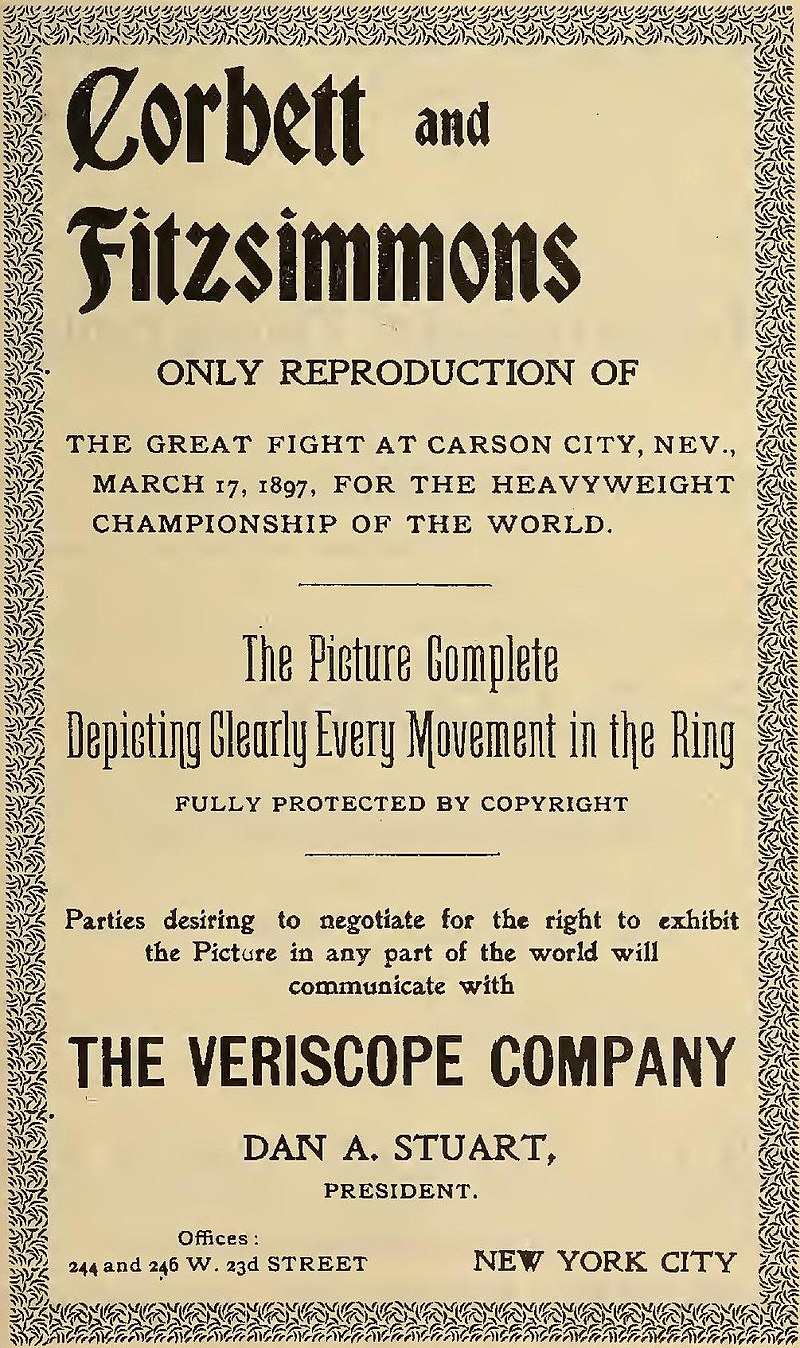
The fight was to be held in Carson City on March 17, in an arena specially built to accommodate Rector and his filming apparatus. Rector constructed three new cameras, which he called “Veriscopes,” especially to film the event, all with a high capacity for film stock. The film he used was also wider than the Edison standard so that he could capture the full view of the ring. A special wooden shed was built at ringside, with its back to where the sun would be during the fight, and arrangements were made for other fighters to be on standby to give spectators a show in case the main event had to be postponed for filming due to weather.
Meanwhile, those opposed to the fight had not been idle. They got a bill before the US House of Representatives that stated no images or written descriptions (including in a newspaper) of any boxing match could be transmitted across state lines. To get a general idea of the tone taken by the bill’s proponents, this was a speech given on the House floor by Massachusetts representative Elijah Morse on March 1:
Mr. Speaker, I want to say that I believe in this bill. I believe it is a just and proper bill, and I hope it will pass both Houses and be signed by the President and become a law. Every State in the Union, save three, makes prize fighting a crime, and the suppression of the details and of pictures of this degrading, brutal, and disgusting business is in entire harmony with the laws of the States, with the laws of United States, and with the sentiment of our people. The brave stand taken by Governor Culberson, of Texas, whose father, Judge Culberson, has been an honored member of this House for many years, won for him the praise of all the right-minded people throughout this great country.
For a year or two past two big brutes named Corbett and Fitzsimmons have been looking for a place to pound one another. Up to this time they have done most of their fighting with their mouths. One after another, where they have attempted to have a meeting, the States have taken action to prevent it. In Louisiana, in Mississippi, in Florida, in Minnesota, in Texas, in Arkansas, and New Mexico. Then it was proposed to have the fight outside the country, in Mexico. The Mexicans are not particularly pious. They do not object to a bull fight, but they drew the line on these brutes, and the Mexican Government said their country should not be disgraced by this brutal exhibition. Now, to the everlasting shame and disgrace of the State of Nevada, the legislature of that State has passed a bill, and the governor has signed it, to legalize this brutal, disgusting exhibition. My district contains 200,000 inhabitants, and has the misfortune to be represented on this floor by so humble an individual as myself, and has only a piece of a Senator at the other end of the Capitol; while the State of Nevada, with 40,000 inhabitants, has one Representative in this House and two Senators at the other end of the building.
If there was any constitutional method by which Statehood could be taken away from that State, which is little less than a mining camp, I am sure a vast majority of the people of this country would favor such action, and would be glad to remand the State back to the condition of a Territory, especially since this last disgraceful, humiliating, and shameful act of the legislature of that State.
A 1910 political cartoon frames the opposition to boxing films with a familiar cry.
Ultimately, Morse and his allies were sunk by their own zeal. The wording of the bill was deemed far too broad, and opponents worried that it would have unintended consequences (such as preventing newspapers from reporting on crimes). With only a few days left in the legislative session, they failed to amend the bill sufficiently to gain the necessary support, and it failed. A new Congress, along with president William McKinley, was sworn in on March 4, and Morse returned home to Massachusetts, having not stood for re-election. The fight would go forward as planned, and without a new federal law in place to prevent the distribution of Rector’s film.
All the stars had finally aligned in Rector’s favor. On the appointed date, he achieved his dream of filming an entire boxing match from start to finish. The fight lasted 14 three-minute rounds, with one minute rests in-between, plus several minutes of introduction at the beginning, and several more minutes of footage of activity in the arena after the fight’s end. All in all, the final film was between 90 and 100 minutes long, making it the first-ever feature length film in movie history.
Corbett seemed to dominate Fitzsimmons for much of the fight, but it was Fitzsimmons who finally landed the knockout blow, a devastating strike to his opponent’s solar plexus, to become the undisputed Heavyweight Champion. However, there was some controversy over whether Fitzsimmons had landed a second punch to Corbett’s jaw as he was going down. If so, the foul should have invalidated the win. The ambiguity was yet another selling point in Rector’s favor, as audiences would have to pay to see the fight with their own eyes if they wanted to judge what had really taken place.
But Rector’s headaches hadn’t ended yet. After the US Congress failed to pass its bill banning dissemination of the film across state lines, a number of states attempted to ban the film itself from being shown. In an effort to forestall any legislation being passed before the film could be shown, Rector publicly claimed that the film’s negatives had been ruined. And some generous, under-the-table “lobbying” may have taken place as well. In the end, only a few places banned the film. It played to packed houses on tour in major cities throughout the United States, as well as in London, and was still continuing to circulate in less populated areas as late as 1900. It was every bit as profitable as Rector had hoped, earning the equivalent of several million dollars in today’s money. Unfortunately, he ended up having to sue the fight’s organizer for his share.
As far as I can tell, Rector did not follow up the success he had finally achieved with any future efforts to film or exhibit boxing matches, though others certainly did. By this time, he was likely tied up in the patent dispute over the Latham loop, but even without that, I suppose it isn’t surprising. Considering everything he had gone through to achieve his goal, and everything he continued to experience afterwards, maybe walking away made the most sense. Although he lived for another 60 years, whatever else he may have done, he seems to have completely vanished from film history after this point. His film was added to the National Film Registry in 2012.
Bob Fitzsimmons
Fitzsimmons continued an illustrious career in boxing for another ten-plus years. He was the lightest boxer to ever win the heavyweight championship, and one of only two men in history to win titles in three different weight categories. Corbett’s best years as a boxer were behind him, and he had a somewhat less-illustrious record for several more years before returning to show business. He was the pioneer of a new kind of boxing that relied on technique rather than brute force, and his training regimen became the standard for the entire sport. Both men are remembered as boxing legends.
Screening:
Only around 20 minutes of the film survives. You can see about three minutes of it from the Library of Congress, in quite good condition, below. If you are so inclined, you can watch the rest of it, in extremely poor condition, here. Corbett is the darker-haired fighter with the shorts that seem to be riding way up. Fitzsimmons is the lighter-haired fighter who appears to be balding. At the film’s premier, an expert in boxing stood by to offer commentary on the fight throughout, but about halfway through the fight, the audience, in its excitement, got too loud and no one could hear what he was saying. Perhaps most of them could tell what was going on, but the exercise is more challenging for a modern audience.
Notice that, although it is obscured for most of the fragment that we have, the bottom of the ring reads “Copyrighted The Veriscope Company 1897.” This presumably kept competitors from cutting the owners of the footage out of profits with duplicates of the film, but it didn’t stop anyone from filming their own “re-enactment” of the fight and presenting it in a way that suggested a closer kinship with the real thing than was strictly honest. One company had their knock-off Corbett-Fitzsimmons fight film out on tour a week before the real thing debuted. Veriscope couldn’t do anything legally to stop it, but audiences who felt duped by the deception were harder to ignore.
It is no surprise that films of the fight attracted audiences who had never, and never would have, attended a live boxing match. This included many members of the upper-classes, but most especially it included women. In some locations it was reported that women made up more than half of the audience—a fact that both shocked and baffled many men at the time. For women, of course, this represented a socially-acceptable opportunity to experience something that had previously only been acceptable for men, and perhaps also to appreciate a couple of athletic men wearing very little clothing (one of whom, Corbett, was already something of a sex symbol). With this increased exposure came a decrease in the calls for restriction, and at least for a time, the anti-boxing movement found far less purchase for their efforts.
Although Rector had shown that it was possible to make a film of feature length, no other filmmakers at the time had a vision yet that could fill that space. The majority of films were still actualities, and the growing genre of narrative fiction had not yet moved past the stage of stringing a succession of simple gags or tricks together for a few minutes. The Corbett-Fitzsimmons Fight was almost ten times the length of the longest film made by any other filmmaker in the 19th century (aside from a few other boxing films), and it would be another decade and a half before feature film production began to outpace shorter films in motion picture programs.
A large bat flies into a castle and transforms into Mephistopheles. He performs several conjurations, but then hears someone coming and vanishes. Two cavaliers enter, and immediately strange things begin happening. One flees in terror, but the other stays and confronts Mephistopheles when he appears. Mephistopheles summons forth many terrors to torment the brave cavalier. The cowardly cavalier returns as a group of witches menace his friend. The witches give chase to the cowardly cavalier and he throws himself to his likely death from the balcony. As Mephistopheles himself advances on the brave cavalier, he snatches up a large cross that he sees hanging behind him, and Mephistopheles cowers in terror before him.
Essentials:
On December 2, 1896, Georges Méliès officially created the Star Film Company as a producer of motion pictures. Le Manoir du Diable, which debuted on Christmas Eve as part of his show at the Théâtre Robert-Houdin, was likely one of the first films created under the “Star Film” label. Notice the white star shape attached to the bottom of a wall near the center of the frame. It became commonplace throughout this period for studios to place a logo somewhere clearly visible in their films as an anti-piracy measure.
This is the earliest surviving film by Méliès that is truly characteristic of the style for which he is best-known. It is a narrative fiction film, full of magical elements that are executed by means of special effects and camera tricks, deployed frenetically but also playfully, all brought to life using sets, costumes, and props that are noticeably stagey. In particular, it’s clear in this film that the “castle” is a thin, painted backdrop (it was actually set up in Méliès’s garden as he had not yet built a studio). You may notice, at about 2:58, the hero backs into the wall and nearly knocks it over!
The identities of much of the cast are unknown, but the woman who emerges from the cauldron is Méliès’s frequent collaborator Jeanne d’Alcy, and Mephistopheles may be played by another magician who performed at Méliès’s theater. Méliès himself is frequently listed as Mephistopheles, but it’s hard to miss his distinctive performance style (and goatee) in the heroic cavalier. In the just over three minutes of the film’s runtime, Méliès uses the stop trick to edit objects and people in and out of the scene over two dozen times, or an average of once every eight seconds. But in contrast with the stage magic of his previous known use of the technique, these are done in support of an actual story, and three minutes is actually quite long for a film from this time.
On the surface, the components of the story bear many of the hallmarks of the horror genre, and this is often (and probably correctly) cited as the earliest example of a horror film. However, it is unlikely that it ever frightened any audiences, and may not have even been intended to, as the tone is decidedly comedic in spots. The only really dark moment is when a character appears to leap to his death. Despite that overreaction, no one ever seems to be in real peril from the castle’s menacing inhabitants. Many viewers have also pointed to characteristics that Mephistopheles seems to share with vampires, suggesting that this could also be considered the first vampire film. It’s worth noting that some of the cited characteristics were not specifically part of vampire lore prior to Bram Stoker’s Dracula, which was not published until several months later.
In over 15 years of making films, Georges Méliès made over 500 films. Unfortunately, only around 200 of them have survived, that we know of. During World War I, the French army took possession of many of his original prints and had them melted down as war materiel, using the celluloid to make boot heels for soldiers. In the early 1920s, Méliès, bankrupt and embittered, lost control of his film studio, and (much like Reynaud after his Théâtre Optique show closed) his reaction was to burn all of his film negatives, and many of his sets and costumes. It was an incredible loss.
Thanks to his earlier success, however, many copies of his work survived, and films long believed gone continue to be found unexpectedly around the world. Le Manoir du Diable was among the films thought to have been lost for several decades, until it was discovered in New Zealand in the mid-1980s, having been sold at a junk shop some 40 years before. As a result, though, many of Méliès’s films are not in the great condition of more carefully-preserved films like, for instance, those of the Lumière brothers. Still, we are incredibly fortunate to have access to so many of them today, including this one, and we can continue to hope that even more will be found.
Screening:
Not only were there still very few narrative fiction films being produced in 1896, but contrast this with any of them and it’s evident how sophisticated and proficient Méliès had rapidly become as a filmmaker and a storyteller. The pacing alone is remarkable, particularly given its length, as there is something happening every second throughout. There are a few edits that happen without anything appearing or disappearing from the scene, presumably because the camera needed a fresh supply of film. But these are so seamless that I’m not even sure I spotted them all. Méliès’s camera also seems to have already had a larger capacity than most of his competitors.
The one element that seems particularly underdeveloped is the ending. It not only raises the question of why there is a cross inside Mephistopheles’s home to begin with, it also ends so abruptly that it fails to really resolve anything. But recall that this is really a piece of brief entertainment that was presented as an interlude in a longer stage act, and that it is entirely built on gimmicky camera tricks. Having used all of the tricks that he could think of to drive the story forward, Méliès simply ends the film.
Two men face off in a wooded field and level pistols at each other. They fire, and one man falls. The doctor and seconds attend to the fallen man. The other combatant steps forward, but the doctor waves him off and his seconds hurry him away to a waiting carriage while the others continue their ministrations.
Essentials:
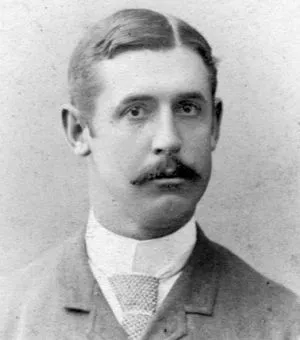
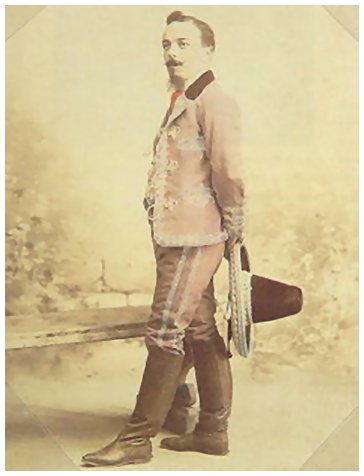
Gabriel Veyre (see right) was working as a pharmacist in a small village south of Lyon when motion pictures first debuted in France. Seeing an opportunity for travel (and a pay raise), Veyre got a job with the Lumière brothers as a cameraman. In the summer of 1896, he was dispatched to Mexico along with a partner, Claude Ferdinand Von Bernard. The two men were immediately embraced by both the country’s ruling elite and the general public. They not only gave regular showings of imported motion pictures, to widespread acclaim, but also recorded and showed the first films to be taken in Mexico. Several of these included films of the Mexican president, General Porfirio Díaz.
The pair spent nearly six months in the country, and their activities were enthusiastically reported on by several newspapers. Their stay was, however, not entirely without controversy. In mid-December they visited Chapultepec Park and filmed a re-enactment of an actual duel. Veyre reportedly had the permission of authorities to film the scene. This may have been necessary, not because of the subject, but because the actors were playing two real-life political figures. Or it may simply have been because the filming took place near the presidential residence in Chapultepec Castle. However, despite the official approval, some journalists worried in print that the film would give a bad impression of the country to an international audience.
Dueling was officially outlawed in Mexico in 1871, but authorities had often looked the other way when it happened, and in the early 1890s it had reached a peak. The practice was governed by a complex system of social norms that were, for some, a source of national pride as a sign of Mexico’s modernity, and of its kinship with other European nations like France. But in the case of a filmed duel, without context, would other nations recognize it as an honorable, dignified ritual, or simply see it as a sign that everyday life in Mexico was characterized by violence and barbarism? Would they see a kindred culture and society, or a more southerly version of the Wild West?
Several sources claim that this was a re-enactment of a duel that had taken place the day before the filming, between two government officials, but give no additional details. This seems unlikely to be correct for several reasons. It was most probably a recreation of a famous duel that had taken place in September 1894, between Colonel Francisco Romero and Jose Verástegui, the postmaster general (see left). Romero, approaching the house of Juan Barajas, a mutual friend, for dinner, had supposedly overheard Verástegui inside, insulting him to Barajas’s wife, Natalia. He later sent Verástegui a letter, accusing him of carrying on an affair with Natalia, and of having gained a foothold with the family by using his influence to get Barajas a government job.
The two men fought a duel next to the Panteón Español cemetery in Mexico City, and Verástegui was killed. A number of high-ranking officials were involved, and the duel received a great deal of attention. Ultimately, Romero was put on trial and actually sentenced to prison, signaling an end to tacit government tolerance for the practice. This may have been another reason some Mexicans were uncomfortable with Veyre’s film as a representation of their country—because it was no longer accurate. Then, too, many of them would have been familiar with the details of the actual events, and how they may have differed from what is portrayed on-screen.
However, in the end, the film apparently wasn’t shown publicly in Mexico. Veyre sent a print back to France, and traveled on to Cuba, and then to Venezuela, where he did show the film several months later. It had debuted in France early in 1897, under the title Mexique: un Duel au Pistolet. For what it’s worth, the inclusion of “Mexico” in the film’s title confirms that the Mexican journalists’ fears concerning the portrayal of their country were at least partially justified.
Screening:
The print that exists of this film is absolutely pristine, but it genuinely stands out in a few other ways. Many viewers have commented on the naturalism of the duelist’s death, one of the first to be depicted on screen and very much in contrast to the melodramatic style that was more typical of this time. The victim doesn’t throw up his hands, clutch his chest, or stagger or roll around in the agonies of death. He simply falls over, letting the pistol drop. It’s no wonder, then, that some viewers might have mistaken this for the real thing.
Veyre also displays an excellent eye for camera placement here. The norm would still have been to frame this symmetrically, from the side, with the duelist facing each other from opposite sides of the screen. Instead, he places us almost in the line of fire, and with a close view of the fallen man and of the efforts to tend to him. But at the same time, the shot also captures the departure of the winner as he is rushed towards the carriages. He, too, seems affected by the outcome, stumbling forward mechanically as his friends hold him up and one places his hat back on his head for him. It’s an incredibly effective and impressive use of a single shot to tell this story.
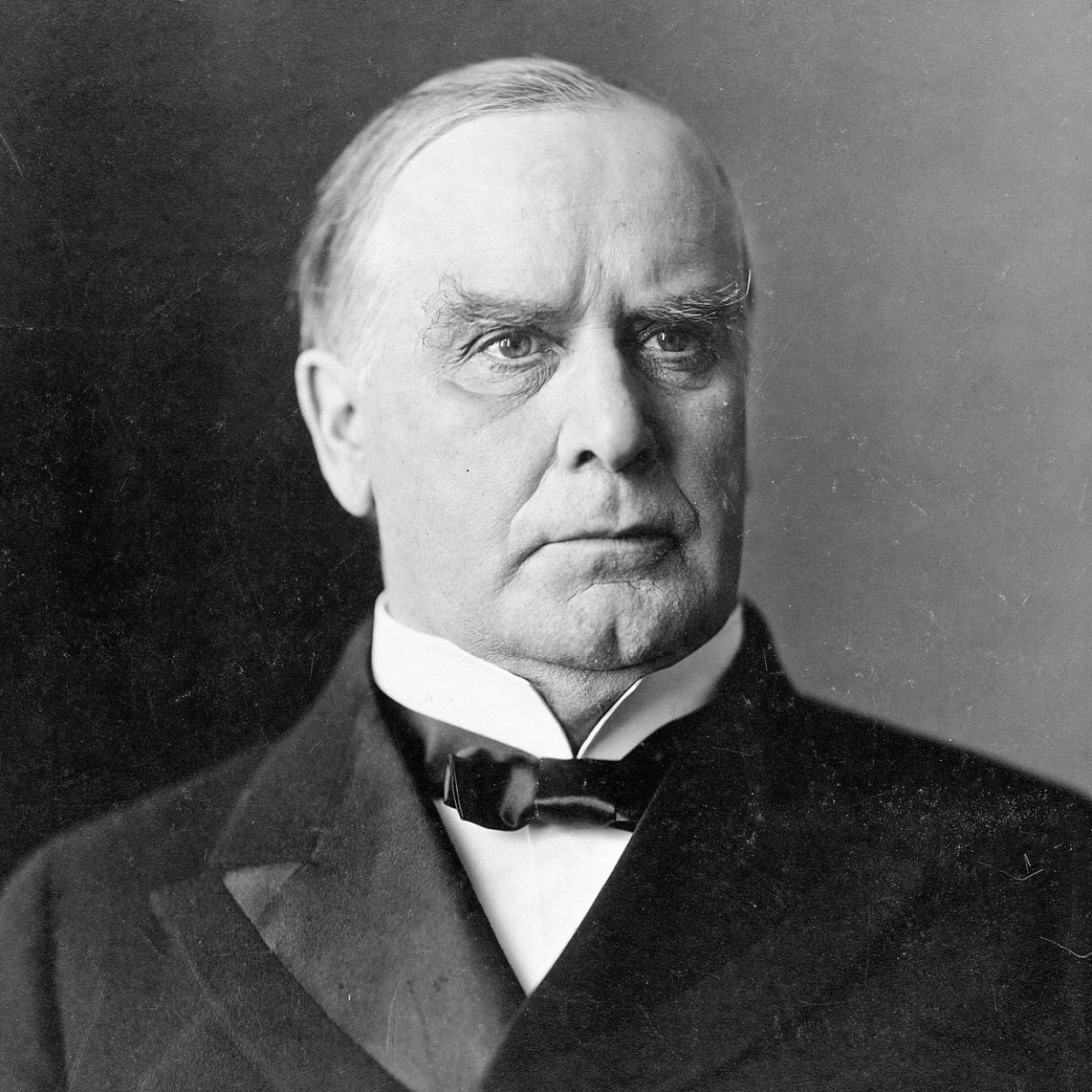
William McKinley walks outside his home accompanied by his secretary, George Cortelyou. McKinley’s wife watches from a rocking chair on the porch as Cortelyou hands McKinley a telegram and he pauses to read it before resuming his stroll.
Essentials:
In September of 1896, William Dickson set up the Biograph camera in the yard of Major William McKinley, a Civil War veteran, former Congressman, former governor of Ohio, and current candidate for President of the United States. Dickson’s timing was excellent, for as the camera started rolling, McKinley’s secretary arrived to give him a telegram containing news of his nomination as the official candidate of the Republican party. Attendees at the Biograph’s show could experience an exclusive look at this historic and momentous occurrence, and get a glimpse of the candidate’s quiet dignity and gravitas on full display prior to election day.
Of course, Dickson’s presence was not actually an extremely fortuitous coincidence. McKinley had been officially nominated at the Republican convention three months earlier, and the entire exercise before the camera was instead probably the first-ever political stunt to be captured on film. McKinley and his party, it turns out, had some important connections: Both Benjamin Harrison (the Republican president prior to Democratic incumbent Grover Cleveland) and McKinley’s brother Abner were Biograph investors. Though by far the most modern, this was only one of many ways that McKinley and the Republicans sought to leverage the power of the media in the election of 1896.
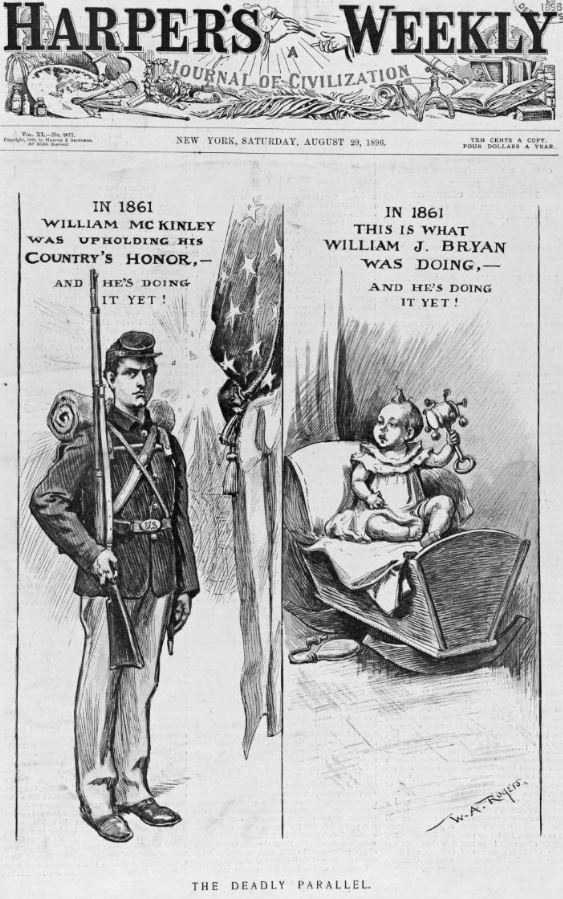
The key issue of the election was McKinley’s support for the gold standard. His opponent was William Jennings Bryan, a fiery populist who had won the Democratic nomination after he stood up at the convention and delivered his famous “Cross of Gold” speech in support of free silver. Bryan’s radical economic vision for the country terrified many of the wealthy elites of his day, and virtually every major newspaper in the country supported McKinley. This allowed McKinley to conduct a dignified “front porch campaign” that relied on coverage slanted in his favor to gild his remarks to visiting members of the press and others. Bryan, meanwhile, was forced to try to appeal to the public directly, crossing the nation on a “whistle-stop campaign” and giving several hundred speeches.
Meanwhile, the Biograph was taking McKinley on a tour of his own while he remained comfortably at home. After filming McKinley at Home:
Dickson and his team continued on their travels, which included the filming of West Point cadets, Niagara Falls, and the flagship train of Cauncey Depew’s New York Central Railroad, the Empire State Express. These provided the kinds of subject matter that would be used to frame the scene of McKinley at home: symbols of American military might, American culture, American technology, the nation’s natural grandeur, and Republican parades.
Charles Musser, Politicking and Emergent Media: US Presidential Elections of the 1890s, p. 92
Biograph’s McKinley program played for about a month before election day. It was seen by tens of thousands of voters, and read about by many more in the papers:
Enjoying a certain amount of press coverage, these screenings underscored Republican energy and innovation. Clearly McKinley and the Republicans were up to date: they knew how to move boldly and to connect with new technological innovations of the highest quality. These screenings demonstrated a “can-do” attitude that was needed in order to renew the nation’s economic prosperity. […] Rhetorically powerful, the Biograph’s McKinley program contained compelling symbolic value.
Musser, p. 104
McKinley won the election handily, making him the first president ever to appear on film . . . basically. He appears here as a candidate (and the first presidential candidate to appear on film), but technically Grover Cleveland became the first US President to appear on film while in office due to his presence in films of McKinley’s inauguration the following March. This also places McKinley among the first world leaders to appear on film, though not the first. The Lumières had their cinematograph capturing images of royalty all over Europe throughout the summer of 1896, and the first film of Mexican president Porfirio Díaz was likely taken just a month earlier. The following month, Queen Victoria was filmed at Balmoral during a visit from her distant relative, Tsar Nicholas II of Russia.
Devices like the Biograph, the cinematograph, and the Vitagraph were present several times over the next few years to capture images of McKinley engaged in public activities. They were there when he was inaugurated to his second term in March of 1901. Six months later, one of Edison’s cameras was present outside the Temple of Music at the Pan-American Exposition when McKinley was shot by anarchist Leon Czolgosz, and recorded the crowd that gathered upon hearing the news. And, after McKinley died of his wound eight days later, cameras were there to film his funeral procession, just as they had filmed Queen Victoria’s funeral several months earlier. By the turn of the century, it had become common for people to experience many of the significant historical events and figures of their day in a whole new way: At the movies.
Screening:
The company catalog entry for this film reads: “This view was taken upon Mr. McKinley’s lawn at his home in Canton, Ohio. Mr. McKinley appears walking across the lawn in company with his Secretary, who hands him a telegram, which he reads with apparent satisfaction. The characteristic walk and gestures of Mr. McKinley will be noted with interest by his friends.” Notice how it merely implies (without outright saying) that the film shows McKinley receiving the nomination.
It’s a subtle touch that seems decidedly lacking in the next sentence, which feels like a copywriter casting about desperately for something, anything to say about a film in which not a whole lot is really going on. The result feels like damning with faint praise. It’s hard to imagine a more deliberately tactful way than that to describe McKinley’s incredibly stiff performance here. Then again, maybe that isn’t the subtext at all. After all, in 1896 this is apparently what “presidential” looked like.
A group of drunkards stroll boisterously through a park, sowing chaos in their wake. Pedestrians collide, several people drop things or fall down, and fights break out as the whole scene descends into anarchy.
Essentials:
After arriving in both Paris and in London for engagements with their bioscop, only to find newly-invented (and somewhat superior) projectors had already appeared just ahead of them, the Skladanowsky brothers must have felt at least a little unlucky. The poster to the right shows that they leapt into action while they were still in France. It gives the date as December 31, 1895 (a mere three days after their arrival), and launches into a brash bit of personal mythmaking, bragging about how their invention has solved a problem that stumped the likes of Muybridge and Edison.
They talk for awhile about how amazing and lifelike their projections are, and then relate how they learned on the very day of their arrival in Paris that the Lumières (“imitators!”) already held the patent for operating a projection device in France. They explain that this is the only reason why they’re now free to be engaged in February and March (presumably they were still anticipating an engagement in London for January), assure everyone that they do have full legal patent protections in Germany, and then advertise a bioscop ready for sale for 2500 marks, and are ready to manufacture more.
Emil, the promoter of the two, found them engagements back in Germany. They stayed busy giving shows in the center of the country through the end of March, before departing to spend the rest of the spring and summer months touring Northern Europe. By August they were in Stockholm, where they used a new and improved camera to shoot the Comic Encounter in the Djurgården, the first film ever made in Sweden.
A troupe of professional actors from the Victoria Theatre performed in the film, at a time when this was still uncommon. The Djurgården is a nearly four square mile island park in the middle of Stockholm that has various attractions, amusements, and leisure areas. It is a place where, even in 1896, people would go to stroll and relax, as is evident from the activities we see being disrupted in the film.
They were back in Berlin once more by early 1897, and they concluded their final show in Stettin, Germany (now Szczecin, Poland) on March 30. Their trade license to exhibit films had expired, and (their status as early adopters notwithstanding) they failed to get a new one due to authorities claiming there were already too many film exhibitors in operation. In fact, an actual dedicated movie theater had opened in Berlin the previous April. The brothers’ brief career in film was effectively over.
A few months later, when their father died, Emil was accused by the rest of the family (the brothers had at least 3 additional siblings) of attempting to cheat them over the inheritance, and they all turned against him. Max and Emil never reconciled, though both stayed in the entertainment business. Emil went back to managing theater tours, and Max began producing flip-books from his film footage, engaging in several other photography and projection-related projects over the years.
The Skladanowsky story has one final, dark chapter. When the Nazis came to power over 35 years later, the Skladanowskys and their early success with film projection was recast as a success story illustrative of German supremacy. Max was plucked from semi-obscurity for a series of events including galas, a private screening for Hitler, a speaking tour around the country, and a celebratory 40th-anniversary film festival.
Max was near-broke by the time of his rediscovery, and whether opportunistically or sincerely, he appeared to whole-heartedly embrace the Nazi message and cause. He became something of an embarrassment, however, when other German filmmakers accused him, apparently with some accuracy, of having greatly exaggerated his achievements over the years. By the time of his death in 1939, the parties were long over.
Screening:
This film feels notable for a few reasons. First, of course, is the absolute madness and confusion that consumes the entire screen for most of its brief runtime. It’s genuinely impossible to tell what’s going on in the first scene without carefully rewatching it several times, and the second scene still baffles me entirely. There are almost always at least 3 or 4 things happening at once, weaving in and out of each other, as the actors all seem to try and upstage each other with pratfalls, boisterous gestures, and broad posturing.
Speaking of the second scene, this is also one of the first films to contain more than one scene. Again, much of the language of cinema had yet to develop, and there is no clear connection between the locations of the first and second shots, or any of the events or people that appear in them. It’s just the same force of random physical comedy, but unleashed against a different backdrop. It feels almost surreal in its commitment to pure pandemonium.
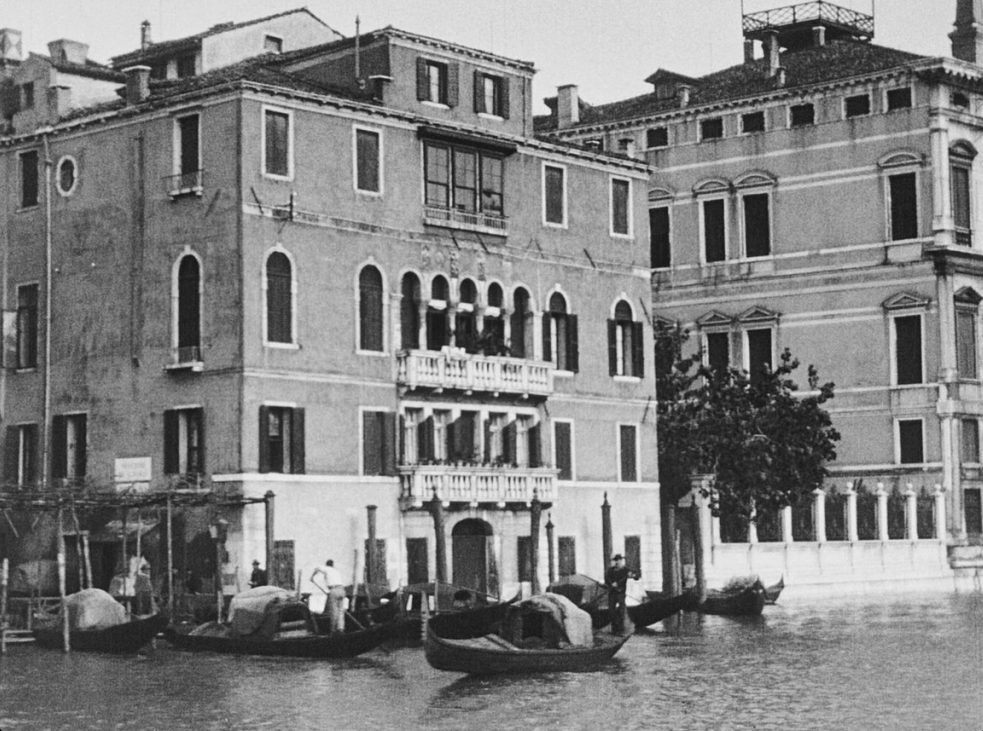
(English: Panorama of the Grand Canal Taken from a Boat)
Summary:
A camera on-board a boat captures a view of the waterfront as it floats down the Grand Canal of Venice, passing other boats and several picturesque buildings.
Essentials:
Alexandre Promio was working for an optician in Lyon when the Lumière brothers demonstrated their cinematograph for the Société Française de Photographie in June 1895. He may have first glimpsed the magic of motion pictures then (as he later claimed), or he may have seen them later, but either way, he knew immediately that he wanted to be involved. He soon left his job, and by March of 1896 he had a job with the Lumières, training people in how to operate cinematographs.
After less than two months, he was dispatched to travel around Europe, presenting the cinematograph to the elites and the public of every country he visited. His job was both to introduce this new technology and to market it. Within a 6-month period in 1896, he had visited Spain, Russia, England, Germany, Hungary, the United States, and Italy. Along the way, he gave presentations to such luminaries as the Queen of Spain and Tsar Nicholas II. And everywhere he went, he filmed.
It’s almost possible to track his travels throughout 1896-97 by reading through his filmography: Boston, Chicago, New York, Niagara Falls, Tunis, Cairo, the Great Pyramid, the Nile River, Jaffa, Jerusalem, Constantinople, Stockholm, London, Belfast, Saint Petersburg . . . And many more destinations before, after, and in-between. He sent or brought well over 200 films back to France from this world tour. He was also very well-funded, always staying in luxurious surroundings and meeting with the rich, the famous, and the powerful. It must have been a dream assignment.
Promio shot this view of Venice in October of 1896, and it premiered in France in December. It’s somewhat noteworthy both for the beauty of this glimpse of the city at this moment in time, and as one of many records of Promio’s travels. However, it’s particularly remarkable as perhaps the first-ever moving camera shot. It was so unprecedented, in fact, that Promio supposedly telegraphed back to France and secured the approval of the Lumière brothers before shooting it. There would soon be many more of these, mostly filmed from moving trains rather than boats (and some of them shot by Promio, as well), but this is believed to be the first of its kind.
Screening:
Several sources claim that the camera was mounted aboard a gondola, but if so it’s quite incredible how little the shot seems to be affected by the motion of the water, even after a large boat passes very close-by. Actually, the vantage point of the camera seems to be considerably higher up than that of the people standing in the gondola that is visible at the beginning of the film. When that larger boat passes by, it’s clear that the camera, which does not seem to be angled up at all, is on a level with its deck, suggesting that Promio was actually filming from a similar vessel. Plus, you can even see a different gondola rocking heavily in the wake of the other boat after it passes by. Filming from a gondola makes for a much better story, though.
Regardless of where Promio filmed from, it doesn’t diminish the greatness of the images he captured. There’s so much to see in this brief film, and so much more to see than we would have had in a typical stationary shot. The buildings are in such varied condition, and they look so large and empty as we float past. But look closely, as many details are easy to miss, like the two lounging figures dressed all in white in the cavernous entryway of a building at 0:31. Every time I watch this, I spot something new.
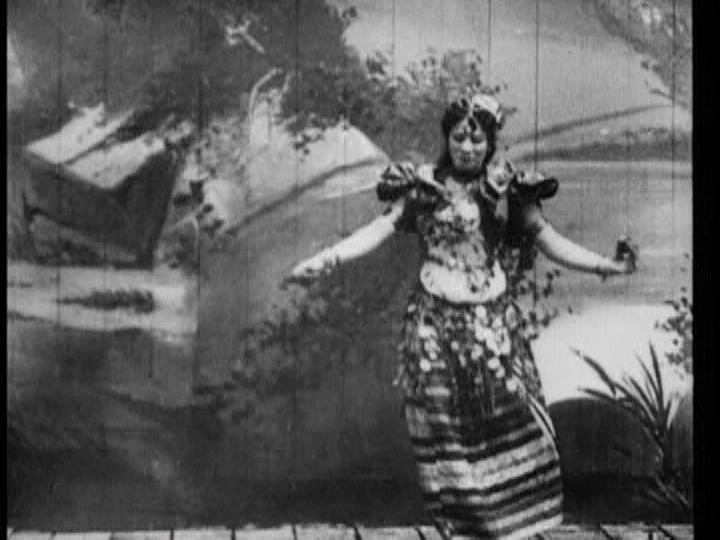
Fatima twirls around a few times and then begins gyrating and clapping her finger cymbals together, performing the famous “muscle” or “coochee-coochee” dance. The dance then repeats, this time with most of her chest and waist areas partially covered by fence-like white bars.
Essentials:
Sometime in the spring of 1896, James H. White began to fill the role previously occupied by William Dickson and Alfred Clark as producer and director of Edison’s films, with William Heise continuing as the company’s designated camera operator. Once a phonograph salesman, White had just spent the previous few years promoting the Kinetoscope. He would spend the next few, the last of the century, as the man responsible for many of Edison’s most popular films. Some of these have aged quite well, while others, films like Chicken Thieves and Watermelon Contest, are among the more overtly-racist titles to have survived from that time.
Wherever it may fall on that spectrum, Fatima’s Coochee-Coochee Dance certainly shows White’s eye for a subject that would sell. The film was released in early May of 1896, but I can tell you very little else that is for certain. Discussions of the film are rife with speculation, poor research, contradiction, and outright misinformation.
The dancer, Fatima, likely also performed under the name “Little Egypt,” and also was likely a performer in the 1893 Chicago World’s Fair. Many performers either launched successful stage careers, or gained increased national fame (or notoriety) from their appearances there, and Edison’s films drew regularly from that pool throughout the mid-1890s. There are a number of sensationalistic stories about Fatima’s performances at the World’s Fair, their popularity, and the scandal they may have caused, including possible police intervention. There are also some rumors that some of those performances may have involved a man performing in drag, and it’s an interesting rabbit hole to go down, but ultimately one that is short on solid confirmation.
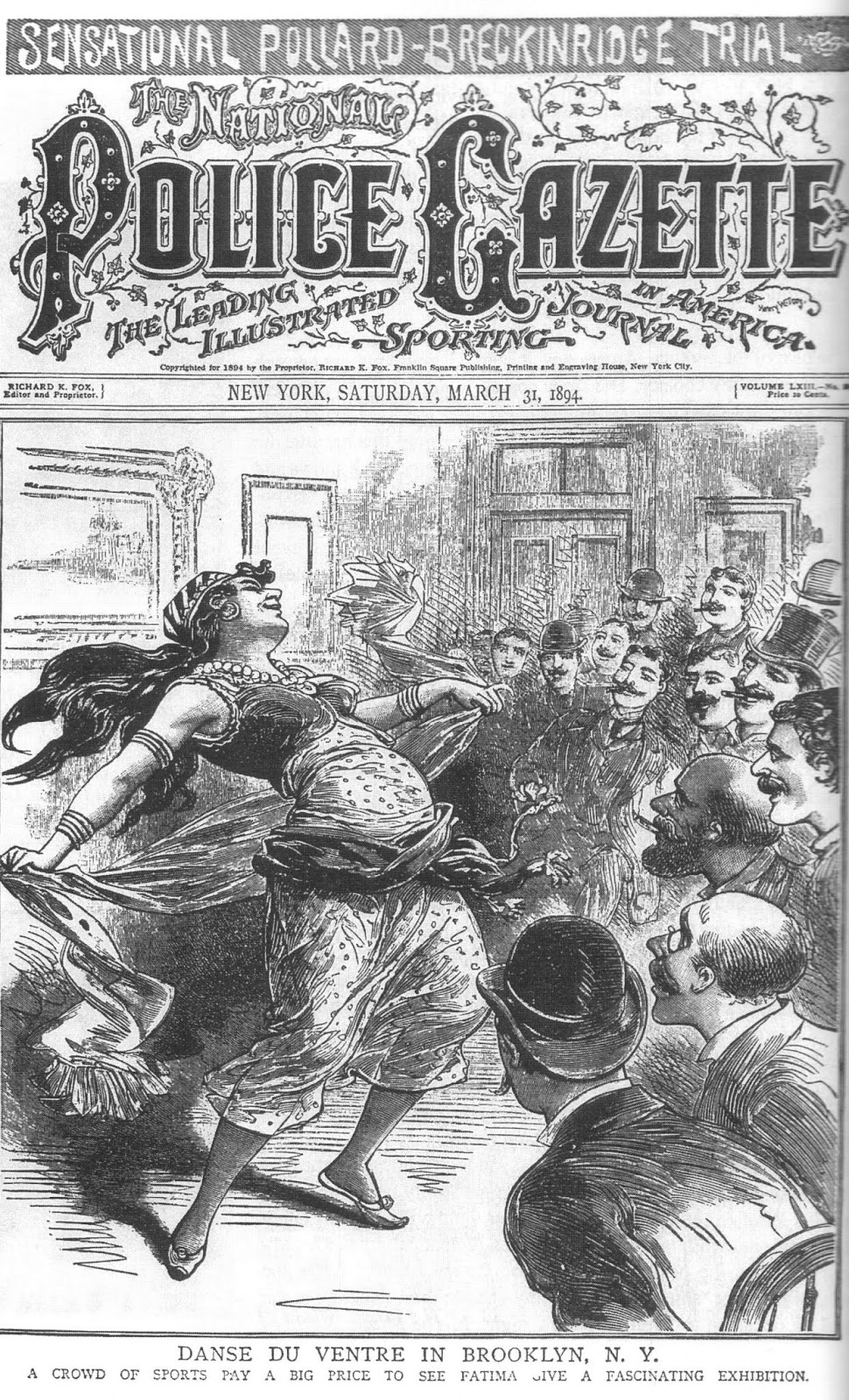
A depiction of “Fatima” in the media . . . but of which one?
The Chicago World’s Fair included several exhibits featuring orientalism or oriental subjects. One of these, the “Persian Palace,” did have a contingent of actual Persians who had traveled from Shiraz with artifacts of their trades and culture to demonstrate and sell. However, they were overshadowed by an invasion of lascivious dancers from Paris, which local authorities attempted unsuccessfully to shut down. There apparently were authentic Middle-Eastern dancers featured in the Turkish, Egyptian, and Algerian exhibits, and at least a few women performed at one (or more) of these who would also go on to appear under the name “Fatima” and/or “Little Egypt.”
The name Little Egypt gained a great deal of notoriety at the end of 1896 when Ashea Wabe, a Canadian dancer who performed under that name, agreed to perform in the nude at a high-society bachelor party in New York City that was raided by police. The party was reported to police by the step-father of dancer Annabelle Moore, who had been approached with the same proposition. The name was subsequently adopted by a number of performers, several of whom claimed to be “the original Little Egypt,” and the title also became something of a by-word for the suggestive displays that Wabe was famous for. Wabe, however, was not the dancer who appears in this film.
Neither, it seems, was it Fahreda Mazar Spyropoulos, who also performed under both stage names, and also appeared at the Chicago World’s Fair. Spyropoulos was possibly Syrian, and was married to an immigrant from Greece. She is often credited (although others are, as well) with popularizing the style of dance seen in the film, what we would now call “belly dancing” (from the French “danse du ventre”). Such performances were also variously known as a “muscle” dance, or “hoochie-koochie” or “coochee-coochee” (with seemingly endless spelling variations for the latter two). Spyropoulos may also have been one of the first to associate this type of dancing with “The Streets of Cairo,” a song whose title you may not recognize, but whose music I guarantee you have heard many times in this and similar contexts.
The woman who appears in Fatima’s Coochee-Coochee Dance is most likely Fatima Djemille (or possibly Djamile, but likely not her real name anyway), who may have been working as a performer at Coney Island and in other places around New York City in the years after the World’s Fair. If she is indeed the woman White and Heise filmed in 1896, surprisingly little else is known about her for certain, but it’s not difficult to see how the details surrounding these contemporary dancers who shared so many things in common have gotten confused over time. Similar errors are common even when the details are not murky and overlapping.
Whoever the woman in this film actually is, and whatever the details surrounding her origins and her career, she was part of a trend in popular entertainment that seems to have begun in 1893 with the introduction of raqs sharqi and similar North African and Middle Eastern dances in Chicago. The trend ultimately stripped these dances of their context within those cultures, exoticizing and fetishizing the dancers for a (mostly male) Western audience. This may explain the odd censorship bars that appear across the second half of the film, though the reality there is perhaps more complex as well.
A bank of kinetoscopes inside a bar, mostly showing rounds of a boxing match. “Muscle Dance,” an alternate title of this film, appears on the 2nd from right.
Just like everything else about this film, the origins and purpose of that apparent censorship are shrouded in uncertainty. It’s possible that it may be exactly what it appears to be: An attempt to cover up Fatima’s suggestive movements imposed by an outside authority or authorities. However, if that’s the case, it is strange that the uncensored and censored versions continue to exist side by side. Furthermore, at this time it was far more common for would-be censors to pursue the outright banning of a film they considered offensive rather than adopt such ineffectual half-measures. Also, if this were the case, surely some record or account of that fact would exist.
Some have also suggested that the bars are meant to satirize calls for censorship. This is a joke that the film’s target audience (e.g. the male patrons of a bar stocked with kinetoscopes) might certainly have appreciated. The very fact that the “covering” is so ineffective would certainly seem to support this possibility. Again, though, there isn’t really anything in the way of evidence for or against this explanation, which seems curious.
A third, and I believe quite compelling, possibility is that this is an example of self-censorship. By adding the bars themselves, the company could have helped forestall objections to the film that they must surely have expected. The film industry would, a few generations later, fully embrace self-censorship as a necessary measure in order to avoid the threat of outside censorship.
In this case, they may also have provided exhibitors with an alternate version upon request, to screen in more conservative areas. By offering a fig leaf of plausible deniability that would still allow an audience to enjoy a titillating spectacle, it could open up markets for the film that would otherwise have remained firmly closed. This, too, could explain why both versions remain paired in this way: because they were both products of the company itself. Still, this is as much a matter of speculation as the other two, and ultimately the correct explanation remains as mysterious and elusive as the film’s other details.
Screening:
Other production companies were beginning to slowly innovate and evolve throughout 1896, but films released by Edison were slower to deviate from what had worked in the past until other, more daring producers had shown the way. Also, it was only around this time that Edison’s technicians successfully produced a portable camera, and just a few weeks after the release of this film, Heise and White began putting it to use on a trip to Niagara Falls.
The most notable evolution of this Edison production is the painted backdrop, a significant contrast to the blank vacuum of the Black Maria. Otherwise, this is still the same very confined, static shot of a stage performance that had been typical of the company’s films for over two years by this point. Despite a lack of innovation in the filmmaking, the dance itself is very dynamic and engaging. The dancer’s motions of course draw the eye, but also her costume is designed in a way that emphasizes and heightens the rhythms of the dance. The choice of subject was clearly a good one, and guaranteed to attract an audience.
Understand that all original content in Moviegoings is my property under copyright.
"Everyone has the right to the protection of the moral and material interests resulting from any scientific, literary or artistic production of which he is the author." -- Univ. Decl. of Human Rights
Unless otherwise noted, all original content in Moviegoings is licensed under a Creative Commons License.
Comment Policy
Commenting here is a privilege that may be revoked. Visitors to Moviegoings are allowed to post comments only for noncommercial purposes. Unsolicited advertising ("spam") may be altered or deleted at any time. Violation may result in appropriate countermeasures, including but not limited to IP banning, IP publishing, notification of ISPs, and civil and criminal legal action.













 Moviegoings