
KFF: Little Children

•April 27, 2007 • 1 Comment

The Kilgore Film Festival’s 3rd film, Little Children, is probably the most graphically explicit film I have seen at a KFF, but it is also easily among the most excellent. What an intensely powerful and disturbing film this is; how richly-layered with meaning and metaphor. A former professor of mine would call it “quite a ride:” smartly-written, well-acted, beautifully-shot and, of course, featuring the music of perhaps my favorite big-screen composer, Thomas Newman.

The composer is not the only thing Little Children shares with American Beauty, another excellent film that takes a long, hard look at “lives of quiet desperation” in modern suburbia. Little Children lacks American Beauty‘s razor-sharp wit and glib cynicism, but it is an ambitious, serious-minded effort with more characters and fewer caricatures.

Sarah (Kate Winslet) has given up her pursuit of a PhD in English to raise her difficult 3-year old, Lucy (Sadie Goldstein), but doesn’t really seem to know why. She doesn’t fit in with the other mothers, whose conventional lives revolve around their children and their gossip. Her marriage is almost non-existent. Her husband, Richard, has less than 5 minutes of screen-time, just long enough to establish his infatuation with an internet porn star. There is nothing between them, and it is hard to imagine that there ever was.

Brad (Patrick Wilson) is a self-confessed failure. He is a stay-at-home dad who has failed the bar exam twice and is working hard on failing it a third time. His wife Kathy (Jennifer Connelly) is a successful professional (she makes PBS documentaries) with a tight grip on the family purse strings. She is the responsible one, which means she gives the orders. She dotes on their son Aaron to an almost unhealthy degree. Aaron spends most nights in his parent’s bed, which has put rather a strain on their love life.

Ronnie (Jackie Earle Haley) is a pedophile who has served time for indecent exposure and is now out of prison and living in a quiet neighborhood with his mother. However, the local residents for blocks in every direction are frightened and outraged by the presence of a pervert in their midst. Ronnie is a creepy, repellent character, but he is also a human being (a fact which only his mother seems to recognize).

Larry (Noah Emmerich), an ex-cop with anger management issues and a blot on his past that he desperately wants to redeem, has started a “Committee of Concerned Parents” which plasters every available surface with pictures of the sex offender. Larry himself has taken charge of the late-night hazing sessions, parking his van outside Ronnie’s house, blowing the horn, screaming threats and insults and covering the sidewalk and door with graffiti and fliers. Ronnie seems to expect this sort of behavior, perhaps he even think he deserves it. His mother does not accept the persecution so passively.

We suspect that Ronnie engenders such intense hatred not just because he represents such a visible threat to “the children,” but because he is an even more potent threat to the carefully-maintained illusion of propriety and decency that enables his neighbors to live near each other. Behind closed doors these people are porn addicts, adulterers and transvestites, but even the existence of these vices cannot be acknowledged in the open.

At the first hint of sexual sin, the outraged cries fly in from all sides. Those who scream the loudest are the ones who have something to prove, not only to their friends and families, but to themselves: Look, everyone. I am a good, upstanding member of our community. This is most apparent of all in Larry’s bullying of Ronnie, and it comes as no great surprise when Ronnie’s mother shuts Larry up by throwing his own personal shame in his face.

Similarly, when Sarah jokingly allows Brad to kiss her in front of the other mothers, they respond rather comically, bleating like startled sheep as they gather up their children and sprint away from the playground. But we know that Sarah has only dipped her toe in the pool of cool water that they, parched and sweaty, have eyed hungrily for months. Of course, what they all sense (and only Sarah chooses to ignore) is that this pool is infested with hungry sharks. Having tested the waters and found herself thirsty for more, she buys a new bathing suit and gets ready to dive in.

There is a pervasive motif in Little Children of trains rushing headlong down the tracks, unable to get off, slow down, or change directions. Some may be on a collision course with each other, and the closer we get to the climax, the more imminent a train wreck of some sort seems to be. Sarah and Brad are caught up in a seamy affair which steadily gathers steam, placing them on a path to destruction. It begins with seemingly innocent and harmless flirtations, but they are both playing with fire, and we know it (as do they, although they both pretend not to).

As we hurtle towards the climax, everything seems about to go very wrong for these characters, and I mentally steeled myself for a very tragic and uncomfortable finish. But then a very unexpected (some might say unlikely) and very undeserved window of grace opens up in front of Sarah, Brad, Ronnie and Larry, and they stumble miraculously through it. It is as though some benevolent force has reached down and thrown the switch at the last possible second, allowing the trains to hurtle harmlessly on, passing within inches of one another.

I’ve almost forgotten to even mention the narration, which is actually rather a compliment. Will Lyman’s periodic interjections effectively add an extra dimension on to a number of scenes, granting a depth of understanding that would otherwise be impossible to achieve. There is a certain literary quality in this expository element. The grandest thing about it is that it is not in the least intrusive, as narration so often can be.

Little Children is artfully made, but seldom have I seen sin look so ugly, destructive or dangerous as it does here. This is serious, and it is scary: an effect that would be impossible to achieve if the movie were not so well done. So many scenes will stay with me (for various reasons), remaining fresh in my mind for days and resurfacing periodically for much longer: the afternoon when Ronnie pays a visit to the town pool; the group discussion of Madame Bovary; that outrageously self-aware football game.

Most of all, though, I think audiences will struggle with the ending. Some may feel that it betrays the entire tone of the film, or resolves a complex set-up too easily. I’m not so sure that’s true. As I mentioned above, the more I consider it, the more amazing the ending seems. We know exactly what these people deserve, we all know the wages of sin. It is expected, almost necessary, here. Instead, the viewer is surprised by the joy of grace unlooked for.

When we consider it honestly, the possibility of receiving grace does seem unlikely, implausible even, for all of humanity. Nevertheless, grace is abundant and available to all, sometimes even those who don’t know enough to be on the lookout for it. The power of this film may lie in its startling, revolting depiction of sin, but its beauty is in the grace forced upon its characters. What an incredible gift.
KFF: The Painted Veil

•April 23, 2007 • Leave a Comment

The Kilgore Film Festival’s second movie, The Painted Veil, is actually a remake of a 1934 Greta Garbo film with the same title (both based on a novel by W. Somerset Maugham). I haven’t seen the original, so this may not be quite fair, but I imagine it is an exceedingly melodramatic and stagy production filmed on what is obviously a back-lot (I’m not really a Garbo fan). The plot, however, is the same.

In the 1920s, Dr. Walter Fane (Edward Norton) falls in love with spoiled socialite Kitty (Naomi Watts). She doesn’t love him and he knows it, but he convinces her to marry him nonetheless and takes her to China where he works as a civil servant. Before long, feeling bored and neglected, Kitty begins an affair with a charismatic diplomat (Liev Schrieber). But Walter is not as oblivious as she thinks. He is deeply wounded by her unfaithfulness, but too proud to show it.

Walter, now cold and distant, volunteers to take charge of the battle against a raging cholera epidemic deep in the Chinese interior and manipulates Kitty into accompanying him. Setting out together, they seek to hurt each other as much as possible until one of them is killed, either by the cholera or by increasingly anti-British Chinese nationalists.

Of course, it is only a matter of time before sheer boredom drives Kitty outside her own selfish concerns and into the middle of the growing crisis. For the first time in her life, she is paying attention to others, but Walter is doing his best not to notice. Is relational healing even possible between two stubborn people who had no common ground to begin with?

The Painted Veil, like the magnificent films of David Lean, has an intimate relationship with its landscapes. The scenery in China is nothing short of breathtakingly gorgeous, and it is used to full effect here. The characters seem so small amidst the wide-open splendor of this foreign countryside. We do not know whether Walter and Kitty’s marriage is salvageable at this point, but we sense that the beauty of this place certainly won’t hurt their chances.

Kitty develops an interesting relationship with the Mother Superior in charge of the French nuns who run the orphanage and hospital. The Mother Superior has seen a lot in her life, and she probably suspects more about Walter and Kitty than she is letting on. In a conversation she and Kitty have late in the film, the Mother Superior describes her journey of faith. She began as an impassioned teenager, eager to commit her life to serving God, but now, decades later, she finds herself simply going through the motions.

She describes her relationship with God by comparing it to a dutiful wife who continues to endure her husband because they have been married for so long. The spark is gone, but she toils on out of a sense of commitment. But, she wisely notes, this is not a healthy state for a relationship. It is only “when love and duty are one,” she says, that “grace is within you.” Days later, I am still turning those words over in my mind.

The Painted Veil is lovingly shot and the performances of the lead characters are powerful. The historical backdrop provides a fascinating setting, but it is ultimately developed very little. Indeed, it is largely superfluous to the larger concerns of the story’s central relationship. This couple’s struggle is both universal and timeless, and it is handled very sensitively and admirably here. It acknowledges (as so few stories seem to) the pain and the damage that adultery causes, but offers hope for redemption as well.

KFF: Miss Potter

•April 21, 2007 • Leave a Comment

The Kilgore Film Festival strikes again, and just one short semester after the last one. I don’t know what the reason is, but as this is currently the only film festival I have the pleasure of attending, you can bet I’ll be there for all of it with no complaints.

To give you an idea of the feel of Miss Potter, the last major project its director (Chris Noonan) took on was 1995’s Babe. Here again is a film that takes an unabashed pleasure in concocting the sort of scenes that prompt less cynical viewers to hug themselves with glee. The characters are so full of joy that they often have difficulty speaking through barely-supressed grins. Even when a character is irate, it often serves as comic relief.

Miss Potter stars Renée Zellweger as Beatrix Potter. Ewan McGregor is Norman Warne, her publisher and bashful but earnest inamorato (think McGregor’s character from Moulin Rouge with a ‘stache), and Emily Watson is Warne’s sister Millie. All three are top-notch performers, and they are a pleasure to watch here.

Miss Potter is a biopic of Potter’s life, after a fashion, but I almost hesitate to call it that because it seems to imply that there is a certain degree of plot involved. The movie begins in media res with Beatrix paying a visit to a publisher in 1902 to see if she can finally get The Tale of Peter Rabbit in print. This is quickly and easily accomplished, and almost before we know it she is a best-selling author and falling cutely in love with her dashing young publisher besides.

All of this is randomly interspersed with flashbacks to Beatrix’s childhood, which do little to illuminate her character beyond establishing that she had a flair for both art and storytelling even at a young age. There is really very little in the way of a story arc for almost the entire length of the movie: no rising action, no real tension or conflict, and certainly no climax.

When the happy train is eventually derailed, it happens off-screen. The ending is very abrupt and there is little in the way of resolution or closure. The story is obviously far from over, because we have not yet ascertained precisely what the story is, but all we get are a few words flashed on the screen to fill in some gaps and then the credits begin to roll.

However, despite this lack of depth, almost none of these thoughts will necessarily occur to an audience while the movie is going on. Miss Potter is sweet and full of life. It is funny and charming and very difficult to dislike. The scenery of the country scenes is breathtaking. The animation of Beatrix’s drawings as she interacts with them is fun, but not overdone. The characters may be conventional, but their familiarity makes us comfortable.

Miss Potter is a movie that wants very much to be the next Finding Neverland, and anyone who enjoyed that excellent film should certainly find a great deal to like here. However, Miss Potter ultimately lacks both meaning and substance, and although it manages a winning sentimentality without any melodrama, it fails to leave a lasting impression.

Branagh Strikes Again

•April 19, 2007 • Leave a Comment

I’ve got a bit of a weakness for Shakespeare, on the page, on stage, or on screen. My favorite of the Shakespeare films is probably (probably) the delightful adaptation of A Midsummer Night’s Dream from a few years ago. Well, the Looking Closer Journal points me to this trailer for Kenneth Branagh’s latest effort: As You Like It People can get a bit carried away with choosing strange locations, and I have to wonder about setting this in Japan without casting Asians in the lead roles . . . but I really like the actors that were cast. Of course, who knows when it will come to a theater or video store near me.

The Lives of Others

•April 15, 2007 • Leave a Comment

Rear Window
The set-up is simple and elegant: L. B. Jeffries, a globetrotting photographer (Stewart), laid up in his tiny apartment for several weeks with a broken leg relieves his boredom and restlessness by watching his neighbors out his only window. Soon he begins to suspect that one of them (Burr) may be harboring a sinister secret and he recruits his girlfriend Lisa (Kelly) and his nurse Stella (Ritter) to investigate.

The location is limited but rich: an apartment building full of colorful characters. There’s the party girl, the lonely spinster, the struggling composer, the newlyweds, the busybody, the eccentric couple and their yappy dog. Jeffries keeps tabs on them all, piecing their stories together for his own amusement and guessing to fill in the gaps. Stella disapproves of Jeffries penchance for invading the privacy of others, while Lisa is just annoyed that he’s not paying more attention to her.

The camera never leaves Jeffries’ apartment, using this limitation to ratchet up the suspense (there’s only so much the audience can see or hear) while showcasing Hitchcock’s usual genius with subtly effective camerawork. Between drifting lazily among the distant windows of people busily going about their business to zooming tensely in on the face of a killer as he locks eyes with you from afar, the view is captivating. But Rear Window is, in the end, less about what is going on outside the window and more about the people watching from inside.

The movie has a lot to say, not only about voyeurism and what it implies about the decency of the voyeur, but also about how people behave when they think no one is watching them. Sure, the guy across the way may have murdered his wife, but larger questions take center-stage for most of the film: Should I be watching with a high-powered lens to make sure he doesn’t? Which is the more freakish, a freak show or the person who enjoys watching it? In asking these questions of its main characters, Rear Window slyly aims the same queries at its audience, staring with safe anonymity (and presumably enjoyment) from the darkness of a theater or the comfort of a sofa at home.

In a time when privacy is increasingly harder to come by and more and more people seem willing to do just about anything in front of a camera, the questions raised here may seem a bit anachronistic. Perhaps, though, that makes them far worthier of serious consideration. Meanwhile, Rear Window remains a top-notch classic and one of Hitchcock’s greatest films.

Disturbia
The set-up is clunky and contrived: Kale (LaBeouf) is behind the wheel when a serious accident takes the life of his father. He’s a good kid, but troubled, and this eventually leads him to punch out his Spanish teacher just before summer vacation. The judge sentences him to three months house arrest. If the transmitter on his ankle gets farther than 100 feet from the house, the police will show up in seconds to cart him off to jail.

Before long his mother (Moss) has cancelled his X-Box Live and iTunes accounts and boredom drives him to spy on the neighbors with all of the technology at his disposal. There’s the creepy guy who mows his lawn twice a day (Morse), the hot girl that just moved in (Roemer) and that’s about it. The latter would seem to provide a far more interesting spectacle for our high-school hero, but once the girl next door comes over to join the fun (and its only a matter of time), there’s just one person left to spy on.

Suspicion mounts. Kale gets to first base. The young people use their new-fangled hi-tech gadgetry to gather evidence. With the standard number of setbacks and sidetracks, its a paint-by-numbers journey to the outrageously insulting climax. There isn’t an original minute in the last fifteen. Disturbia wants so badly to be the mother of all genre cliche’s that it drags in far more material than it can convincingly handle, sloppily stitching incongruous elements together. It’s like the filmmakers think they can show you something you’ve never seen before simply by showing you a larger amount of what you have already seen.

Disturbia is Landon’s first major screenplay, and the possessive is used loosely in this case. Unfortunately for everyone involved with this project, screenwriting talent is not as easily plagiarized as movie ideas are. In any case, the themes of Rear Window are potentially more relevant now than they have ever been before, but Disturbia is far more interested in giving every voyeur in the audience something to gape at than it is in exploring the darker side of natural curiosity.

  • Co-reviewed with Randy

It Happened One Night: Best Picture, 1934

•April 12, 2007 • Leave a Comment

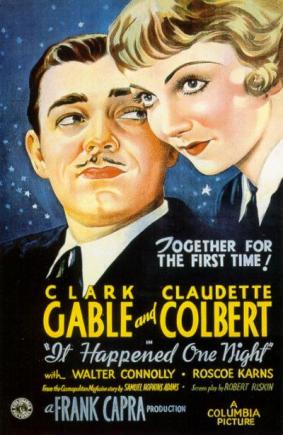
onenightposter.jpgWhen you go back as far as the 7th Annual Academy Awards, things get a bit interesting. You often find yourself dealing with established classics, which are frequently surrounded by fascinating and entertaining trivia. Additionally, the Academy had yet to fully establish many of the standard features of the ceremony, so some things look pretty weird. It Happened One Night was the first of three movies to win an Oscar “grand slam.” It was nominated for Best Picture, Best Director, Best Adapted Screenplay, Best Actor (Clark Gable), and Best Actress (Claudette Colbert), and won all five. The other two films which have accomplished this feat are One Flew Over the Cuckoo’s Nest and Silence of the Lambs.

That year there were a full dozen nominations for Best Picture (including another favorite of mine, The Thin Man, and several that I’ve never seen or even heard of), but only three apiece for the other four categories in question. Frank Capra won his first director award for this movie. He would go on to win for Mr. Deeds Goes to Town and You Can’t Take It With You and be nominated for Mr. Smith Goes to Washington and It’s a Wonderful Life.

Clark Gable, meanwhile, never won again, nor did Claudette Colbert. Both of them hated the script for this movie, and Colbert in particular was convinced that it was terrible. That year there was a significant protest when neither Bette Davis (Of Human Bondage) or Myrna Loy (The Thin Man) received Best Actress nominations. The outcry was enough that the Academy allowed write-in candidates that year. Colbert, convinced that Bette Davis would take the award on a write-in vote, was boarding a train to leave on vacation when her victory was announced. The studio head sent someone to chase her down and haul her back to make an acceptance speech.

In It Happened One Night, Ellie Andrews (Colbert) has eloped with a golddigger and famous pilot, King Westley, against her father’s wishes. Westley is in New York, and Ellie’s father is holding her on his yacht off the coast of Florida. She escapes and embarks on a cross-country trip back to her husband, hoping to evade the veritable army of private investigators trying to track her down amidst a whirlwind of national publicity.

She hasn’t even made it out of Florida when her path crosses with that of Peter Warne (Gable), a tabloid reporter who is in the midst of a tiff with his editor that has left him without employment. Ellie needs an escort, being none too good at taking care of herself (her luggage is almost immediately stolen and she misses her bus at a connecting stop). Peter needs a big story to get back in his editor’s good graces. He thinks she’s a spoiled, stubborn snob. She thinks he’s a rude, vulgar cad. Neither of them will get what they want without the others help, and it’s a long way to New York City.

Do I even need to take this summary any further? Over 70 years later, movies are still endlessly recycling this basic story development. It Happened One Night helped invent the romantic comedy, but that wasn’t all it helped event. This was a favorite movie of Friz Freleng, and largely inspired the character of Bugs Bunny. Perhaps the most interesting features of the whole movie, though, are its fairly scandalous elements. It Happened One Night was released four months before the restrictions of the Production Code became mandatory, and it is highly likely that the censors would have demanded a significantly altered product.

The two lead characters share a private room for the night on multiple occasions. Peter undresses in front of Ellie and threatens to drop his pants. Ellie strips down to a skimpy negligee twice and shows a large chunk of leg to stop a passing car for a ride. An odious character on the bus makes crude insinuations loaded with innuendo. And, of course, the right hon. institution of marriage is generally weakened when Ellie ultimately ditches her husband to (literally) run away with Peter.

I’m not trying to give a Plugged In review here (but you have to admit, I could easily get away with writing for those schmoes). I liked this movie, and the stuff I’m discussing here is obviously quite mild and certainly would never ruffle my feathers . . . but I’ve read the Production Code, and this stuff doesn’t make the cut. I just find it fascinating that by the time It Happened One Night received its 5 Oscars, it was no longer fit to be released in American theaters.

This movie is a true classic, remaining one of the best-known, most influential and most widely seen Best Picture winners of its decade (with the possible exception of Gone With the Wind). It is entertaining and rather funny, a well-constructed composition of great individual scenes. Things may drag a bit towards the end, as the filmmakers pretend that they aren’t going to reach the clearly inevitable outcome, but this is a forgivable flaw.

Claudette Colbert is always charming, and even the minor characters are lots of fun. I, for one, have never really understood Clark Gable’s appeal. I generally find his characters obnoxious, and I understand that he was a rather odious character in real life as well. Nevertheless, he fits pretty well in this role (and in the one or two others for which he is still famous). It Happened One Night has an enormous respect for ordinary, hard-working Americans that worms its way frequently into the dialogue just so we’ll know it’s there. Its disdain for the rich and powerful is nearly unbounded . . . an attitude typical even when there wasn’t a Depression on, but probably all the more pronounced when there was. Fascinating.

My favorite thing about the whole film, though, would probably be its snapshot of the early 1930s: people singing popular songs together on cross-country bus trips (accompanied by the traveling singers with guitars in the back), highway camps for weary travelers complete with cabins and outdoor showers, the art of hitchhiking, sleeping in haystacks by the road . . . In short, an entire lost culture of cross-country travel that has evolved into something very different now. I don’t miss it, but I do enjoy visiting.

Chariots of Fire: Best Picture, 1981

•April 5, 2007 • Leave a Comment

chariotsoffireposter.jpgThe 54th Annual Academy Awards ceremony was hosted by Johnny Carson, and introduced the Best Makeup category (thanks to the outstanding work done on The Elephant Man the year before). Chariots of Fire was nominated for 7 Oscars: Best Picture, Best Director, Best Editing, Best Original Screenplay, Best Original Score, Best Costumes, and Best Supporting Actor (Ian Holm). It lost Best Director to Warren Beatty for Reds. Reds was also nominated for Best Costumes, which is rather ironic. Chariots of Fire had a number of Edwardian costumes reserved for use after Reds (set during the same period) had finished with them. When Reds went over schedule, the costumes became unavailable and other arrangements had to be made. Chariots went on to win the award.

Meanwhile, Best Editing went to Raiders of the Lost Ark (Reds and Raiders were also both Best Picture nominees). Ian Holm lost to John Gielgud for his performance in Arthur. Interestingly, Gielgud also played a minor role in Chariots of Fire as a character who regards Ian Holm’s character somewhat disdainfully. Chariots won its other nominations for a total of 4 awards.

The movie follows two very different men, Harold Abrahams and Eric Liddell, who both ran and won gold medals for Great Britain in the 1924 World Olympics in Paris.

Abrahams is an Englishman of Jewish descent attending Cambridge. He is obsessively competitive and cannot conceive of losing. All his life he has felt that he has something to prove, seeing prejudice (real and imagined) against his race all around him. He believes that victory on the racetrack will not only cement his right to be called an Englishman, but that it will justify his very existence. “If I can’t win, I won’t run,” he forcefully declares. But later, in a moment of doubt, he admits to a fellow athlete: “That is your secret, contentment; I am 24 and I’ve never know it. I’m forever in pursuit and I don’t even know what I am chasing.”

Liddell is a Scottish Protestant whose parents are missionaries to China. He feels called to follow them there, but first he wishes to glorify God by racing in the Olympics. His sister, Jenny, worries that spending time racing instead of attending to his ministry will damage his commitment to the Lord. His response: “I believe God made me for a purpose, but he also made me fast. And when I run I feel His pleasure.” He is truly not interested at all in personal glory. When he wins a race, he capitalizes on the gathering of people to reel off an impromptu sermon (and what a handy metaphor to go from!).

Abrahams finds his perviously unshakeable confidence faltering after he loses a race to Liddell, and recruits a coach to improve his form. As the big race nears, he finds himself intimidated. “I’ve known the fear of losing but now I am almost too frightened to win,” he says. We see the elation of victory rush to his face as he crosses the finish line, but his success leaves him feeling strangely empty. Having achieved his purpose, he begins to feel keenly the void it left behind. Victory for self-glorification has failed to give him meaning.

Liddell faces a very different problem when he discovers that the heat for his race is to be held on Sunday. He will not run on Sunday, standing firm on that principle even when pressured by a small group of the nobility and the prince of Wales himself. He recalls not only the worries of his sister, but also his privileged position as a very public representative of his faith. And, most of all, he believes in the importance of following his convictions about God’s law, even if no one is watching. People are watching, though, and soon his principled stand is receiving world-wide press.

His countrymen and his fellow Christians have every reason to be proud of him, but there is still the matter of his being able to run. This is solved when a fellow member of the British team offers Liddell his spot in a different race. Just before the race, one of the American runners hands Liddell a paper with 1st Samuel 2:30 scrawled on it: “He who honors Me, I will honor.” Liddell goes on to win the race in his own strange way: head thrown back, mouth wide open, hand clutching the note. And then, elated but without missing a beat, he goes on to become a missionary to China. His entire life’s focus is to glorify God, and there will always be ways to do that.

Abrahams lived until 1978, and stayed involved in athletics throughout his life. His funeral bookends the flashbacks that make up the bulk of the movie. Liddell died in a prison camp in China near the end of World War II. As Chariots of Fire informs us just before the credits, “All of Scotland mourned.”

My one complaint would have to be directed at the music. Shocking, right? I mean, the opening theme of Chariots of Fire is legendary, and the score won an Oscar. There are parts of it, indeed, that are quite excellent, but overall I found it intrusive. More than anything else, the score grounds this movie solidly in the decade in which it was made. So much synthetic music; so very 1980s. If they had just done the same things with more conventional instruments, there wouldn’t be such a jarring sense of anachronism. I have always felt that with a historical movie like this, the music playing over scenes should not be something that the characters would be confused or baffled if they heard. It ought to fit somehow with their time and place, either in style or instrumentation.

Nevertheless, this is a pretty good movie, made all the more excellent by its thematic elements. It manages to come across more as historical fiction/biopic material than as inspirational sports movie, which is all to the good. This may be the closest thing to a Christian movie that has won or ever will win an Oscar, with the possible exception of A Man for All Seasons (in fact, producer David Puttnam was searching for a story about conscience in the same vein as that film when he stumbled across the story of Eric Liddell in an Olympic trivia book). The lead actors get completely lost in their characters, and all of the performances are marvellous. Chariots of Fire also truly evokes its period setting, and I was particularly impressed by the difficulty of reproducing so convincingly the Olympic games of 80 years ago.

Continue reading ‘Chariots of Fire: Best Picture, 1981′

To Days of Inspiration

•April 3, 2007 • Leave a Comment

Rent was magnificent. I own the movie and the abridged movie soundtrack, but I thought this was much better in some ways. It wasn’t quite as good in others . . . Mainly, if I hadn’t seen the movie first, some things might have been difficult to follow. But I had, so that wasn’t really a problem. The movie version also cut out several numbers, including a really great song called “And It’s Beginning to Snow” that is one of my favorites. I thought the actors really got into their roles more on-stage, and there was an emotional electricity that was lacking in the screen version.The musical is based on La Vie de Boheme. It follows a group of starving artist types living in New York City as they struggle to survive and create over the course of a single year. It is not the sort of musical that I think a conventional Christian worldview incorporates easily, with what could easily be perceived as a glowing endorsement for Bohemianism (a rejection of society’s values in all forms), open approval of homosexuality, advice to live by the whims of the moment without regard for consequences, and so on.

In spite of this, or perhaps because of it, I think Rent has a great deal to offer a Christian audience: artistically, intellectually, spiritually, and (of course) thematically. Allow me to explain.

First, Rent is a really good musical. It’s not my favorite ever, but it’s one of them. It has a well-developed cast of likable characters and a rich setting. The songs are all horribly catchy, and there are several real show-stoppers mixed in amongst many are just pure fun. Just about anyone should be able to appreciate its merits on an artistic level alone, to say nothing of the rest.

Second, Rent has a great deal of valuable insight into the culture it is examining. I think all too often we dismiss the value of understanding cultures that we should be reaching out to. It is perhaps easier to recognize the importance of this when in a foreign country, since we have to learn a whole new language with its own idioms and history in order to even communicate. But why would anyone suppose that those principles don’t apply just as much when reaching across worldviews as when reaching across the world itself?

As such, if you’re interested in the philosophy and subculture represented in Rent, the musical is a great place to begin. At the least it would be worth experiencing as a point of entry with the show’s large and growing following. A whole lot of people are attracted by something that they see here. Maybe it’s worth figuring out what that is.

Third, if you watch Rent and come away (like the Plugged In reviewer did) with only the sense that you’ve just watched a commercial for a lifestyle you don’t agree with . . . Well, congratulations on your ultra-shallow analytical skills. This may be an expression of the Bohemian lifestyle, certainly, but it is hardly a glorification of it.

These people’s choices have not been affirmed by society or circumstances, by any stretch of the imagination. They’ve obviously had a lot good times in the past, but by now they are definitely on a downward spiral. They live, starving and freezing, in the worst conditions. Two of them suffer from the consequences of destructive addictions. Four of them are dying of AIDs. Almost all of them carry the scars of fractured or fracturing relationships. This willingness to take such a raw and honest look at the realities of this life smacks of a certain commitment to truth.

This is a commitment sorely lacking in a good 99% of Christian movies, which do not care to acknowledge the fact that, regardless of your lifestyle or religious affiliations, life is not all cotton candy and faberg頥ggs. In fact, Rent‘s gravest misstep comes when it succumbs to that same hollow formula at the very end. The moment rings incredibly false, all the more so because it has rung so true up to that point. We are happy that the story has ended well, but really, who could see it for the first time without rolling their eyes when Mimi invokes the hackneyed “light at the end of the tunnel” gag. It cheapens everything the musical has accomplished. Despite that, there is a great deal of value in the truth of what we have seen before this.

Finally, I would say that the central narrative tension of Rent (although it is rife with subplots) is the question of relationships (especially the one between Mimi and Roger). Angel and Collins have the perfect relationship: a selfless commitment to the other person that doesn’t dwell on the past or the future. They serve as a contrast to Roger’s fear and Maureen’s unwillingness to give up playing the field. Mimi and Roger meet just after Roger has declared his deepest desire: to leave behind just one song to be remembered by, so his life (a mess of drugs and death and AIDs) won’t have been a complete waste.

Throughout the couple’s long coming to terms, he hangs on to that desire as he has first expressed it, unwilling to give it up. The creative process is a convenient excuse for him to insulate himself from more painful relationships. But what he finally realizes (almost too late) is that he has not only cut himself off from a relationship that is more fulfilling even than an artistic legacy, but in so doing, he has cut himself off from the source of his art itself.

Take a chance on love first and everything else will be added unto you. Tomorrow is not soon enough, because today might be the last day you have. It’s not so much about disregarding consequences for impulsive behavior as it is about taking advantage of every fleeting moment you have. We may not have a system by which to measure the value of how someone spent their life, but if they have at least truly loved and been loved, then they haven’t wasted their time.

A Double Dose of Dopey Derring-Do

•March 29, 2007 • Leave a Comment

It’s high time for a real post. I have been throwing all of my writing energy in other directions for the past week and a half, but now I’m back again. I saw two movies . . . when was it? Gosh, two weeks ago now . . . that I wanted to write about, because they were basically from the same genre and shared some of the same flaws from that genre. I rather enjoyed the first and squirmed uncomfortably during most of the second. They were Curse of the Golden Flower and 300.

Curse of the Golden Flower was just an outrageously fun movie in the vein of Crouching Tiger, Hidden Dragon and Hero (but not as good as either of those) in terms of genre conventions (but without any flying). If you can’t deal with the silliness inherent in the outrageous (but frickin’ cool) acrobatics and ridiculous overkill (like the arrows in Hero), then this really isn’t for you. I think that’s a shame, personally, since I believe the heavily stylized should never be judged by its resemblance to reality. It’s like hating a piece of modern art because it doesn’t look like what it’s supposed to be. You can hate the style if you must, but don’t complain that it’s unrealistic.

Anyway, Golden Flower is a sumptuous production, beautiful to behold. The costumes got an Oscar nod, and the sets and art direction are rich and ornate to match. It wouldn’t be hard to sit and drink that in and enjoy it without paying any attention to the plot or the dialogue.

As for said plot, it basically boils down to this: The emperor of China won’t be dead anytime soon, but he’s got his eye on the question of succession. He brings the whole family (three sons and an estranged wife) together on the eve of an approaching holiday to have a little fun (sound familiar?). Golden Flower basically combines the scheming and intrigue of The Lion in Winter with the violence and high body count of Hamlet and tosses in a dash of the madness of King Lear and plenty of Oriental flair to produce something that is less satisfying than any of them, but still a heck of a lot of fun without taking itself too seriously.

See, the emperor is slowly poisoning his wife with a medicine that will eventually drive her insane. The empress has been having an affair with the oldest son (who is a product from an earlier liason of the emperor’s). This earlier liason is now the wife of the ingratiating court physician, who is working with their daughter to produce and serve the empress her medicine. Said daughter, meanwhile, is in love with the oldest son (both being completely unaware of the looming shadow of incest).

The second son, oldest child of the empress, will soon be receiving the title of crown prince now held by his older half-brother, but feels compelled to join his mother in a rebellion against the emperor in an effort to save her sanity. And on and on it goes as the intrigue swirls in tight circles, revelations and counterrevelations are made, and the whole Forbidden City becomes a giant battlefield in reflection of the chaotic relationships between the members of the royal family.

Golden Flower in a nutshell: Imagine Ophelia going crazy and getting killed by ninjas instead of by a pond.

As for 300, well, that’s a very different story. I’ll try not to let my critique of the movie turn into a critique of the movie’s fans. However, if I do and you are one, understand that I’m not talking about anyone I know, I’m talking about a vague, hypothetical “average movie-goer.” With that disclaimer in place, I will accuse anyone who takes offense of having a guilty conscience . . . but feel free to defend the thing, if you can.

For those of you who are spelunkers, 300 is a movie based on a comic book inspired by a ’60s movie about the Battle of Thermopylae (during which a ridiculously outnumbered Greek force held off the Persian army for three days). As such it would be fairly disingenuous to engage in a rigorous historical critique, since none of the filmmakers are officially pretending that this is historical. At the same time, there is a definite historiographical perspective at work here, and it is none too subtle (or, to me, palatable).

I’d be lying if I said I didn’t think the movie had some pretty cool parts, but there were much longer stretches during which I was fantastically bored. And, over and above everything else, I had a distinct sense throughout that somebody was coming after my brain to scour it with lye soap and steel wool. 300 is intellectually idiotic and ideologically iniquitous, and for things I hate it’s hard to beat the festering combination of dumb and preachy.

Nearly every spoken word in 300 is so disconnected from its actions that one would almost suspect it of having been completely redubbed by the studio months after production wrapped. Imagine walking into a movie theater of the future and seeing a member of the KKK in full regalia stand before a burning cross and give an impassioned recitation of Martin Luther King’s “I Have a Dream” speech as the soundtrack swells gloriously. That is how confused this movie is. Picture flipping through channels and seeing a televangelist fornicating on-stage while he preaches a sermon on sexual immorality. That is how revolting this movie is. There is a values system at work here that is outrageously simplistic, deeply offensive and fantastically off-base.

Morality in 300 is literally only skin-deep. If you are a good person, you are also a good-looking person . . . If you are an evil person, you look like a freak of nature . . . or vice-versa. The looks may well be the cause and the behavior may be the effect as far as we are given to understand. What is completely disorienting, though, is that what sane, civilized people recognize as good and evil are mixed together like a chocolate and vanilla swirl, and every Spartan gets to snack on a tasty scoop of ambiguity.

Let’s review: The Spartans stand for truth, justice and the American way. Their government is some sort of happy enlightened monarchial republic thing where women have a voice. They prize freedom and courage and masculine virtue. They also have legalized baby murder. Their male children are torn from home at the age of seven, brutalized and brainwashed in preparation for a lifetime career based on the idea that there will always be someone to dismember. Meanwhile, the most beautiful females get shipped off to spend their lives in a drug-induced haze of sexual exploitation at the hands of the corrupt, diseased and lecherous priesthood. But hey, at least they hate faggots.

And those are just the heroes. I’ll choose to ignore the Persians as a sodden mass of underdeveloped cannon fodder. They aren’t villains, they’re target dummies. For the most part, their sins are no different from the sins of the Spartans, they are merely carried out on a much grander scale. Seriously, the Persians don’t do anything that the Spartans don’t do, they just do a lot more of it and it looks wierder. Perhaps their only unique crime is in being too inclusive. Anyone can join the Persian Empire; true Spartans insist on racial purity.

So, forget the Persians. Let’s talk for a moment about the only two interesting characters: Theron and Ephialtes, the Spartan traitors. Theron is a namby-pamby peacemonger. This is reason enough to hate him, certainly, but we find out later that this is actually because he has cannily sold out the Spartans to the Persians. In the end, it seems that he is an evil hater of freedom because he is a thinker and a talker instead of a fighter. I couldn’t shake that feeling everytime he slunk onto the screen.

Ephialtes looks like some sort of hideous hybrid of Quasimodo and the Elephant Man. He is an outcast whose parents were forced to flee Sparta rather than have their infant child dashed against the rocks (now there’s an enlightened free society to give your life for). His father taught him how to fight, and he is nothing if not courageous. But King Leonidas won’t accept his service . . . he’s too short to be of any use in a phalanx. Ironically (moronically?), the Spartans go on to break formation during virtually every battle sequence so they can grandstand solo, so there was really no reason to shut Ephialtes out.

Rejected outright by the Spartans, the bitter Ephialtes naturally goes straight to the Persians and delivers the tactical weak spot to them. The muted implication surrounding the character is that he stands as a vindication of the policy of infanticide. If his parents weren’t so weak and compassionate, his tragic existence would never have brought about such an unfortunate outcome.

There was a rather “healthy” discussion about which of the two movies was better (worse?) after we saw them. For me it boils down to this: Curse of the Golden Flower has a charming literacy going for it, whatever its flaws. 300 relentlessly subverts its own perverted logic while affirming the most loathsome elements of jingoistic machismo.

Reign Over Me

•March 23, 2007 • Leave a Comment

starring Adam Sandler, Don Cheadle, Jada Pinkett Smith and Liv Tyler
written and directed by Mike Binder
rated R for language and some sexual references.
93%
Where will you and your roommate be in a few decades, once you’ve gone your separate ways? Questions like that may be running through your mind during Reign Over Me, a movie that stars Adam Sandler without turning into the recycled puddle of infantile dreck that is “an Adam Sandler movie.”

Sandler takes a turn for the dramatic here as Charlie Fineman, a New York City dentist who descends into depression and madness when the tragic events of 9/11 claim the lives of his wife and three daughters. Quite a few big-name comic actors have managed a solid presence in dramatic roles. Jim Carrey did excellent work in The Majestic and Eternal Sunshine of the Spotless Mind. Robin Williams has a long list of such performances, including his roles in What Dreams May Come and Good Will Hunting. Even Will Ferrell, darling of the ultra-lowbrow crowd, impressed us last year with the more serious Stranger Than Fiction.

So, how does Adam Sandler fare in his latest foray into dramatic territory? In short, he seems both comfortable and capable with this character, and it certainly doesn’t hurt to be paired with a talent like Cheadle. Don Cheadle co-stars as Alan Johnson, Charlie’s old roommate from dental school. Alan has a successful practice and a loving family, but he is chafing a bit from the demands of responsibility. In a well-worn (but effective) set-up, a chance meeting between them will lead to big life-changes for both.

The two spend long nights jamming in Charlie’s music room, bingeing on “Shadow of the Colossus” (Charlie’s PS2 is permanently hooked up to a projector) and laughing uproariously through Mel Brooks movie marathons. Charlie latches onto Alan because he has no associations with the family life that Charlie lost. Alan leaps at the chance to help Charlie as a convenient, guilt-free escape from caring for his squabbling parents, suffering through hobbies only his wife is interested in and ferrying his daughters around the city.

Both of them are invigorated by the chance to relive their carefree college days, but this can’t last forever. Charlie is not well. He endlessly remodels his kitchen and lashes out at anyone who accidentally triggers painful memories. Meanwhile, Alan is allowing Charlie’s problems to drive a wedge between him and his family.

Reign Over Me transitions quickly (and usually well) from emotional intensity to sudden hilarity to moments of quiet profundity as its story plays out. The shifts relieve tension without cheapening the impact. Subplots abound, but the film stays focused and keeps moving. There is a bit of a third-act slump late in the movie; a failure of pacing perhaps. Just as things seem to be coming together and winding down, the story starts to drag its feet and drops in a new snarl that takes its time playing out.

The weakest link in Reign Over Me, however, is not the charaters but the characterization. Writer/director Mike Binder doesn’t seem to know what to do with the women in the story. It’s not that their presence is marginal to the main plot; after all, this isn’t their story. But every significant female character is one-dimensional at best, and an offensive stereotype at worst. This is unfortunate because it is distracting to have so many characters (however entertaining, and even meaningful, the performances) that are so difficult to envision as actual people.

This sort of thing doesn’t kill a film, it just noticeably pulls it out of reality, sticks it in a contrived movie world and requires a conscious suspension of disbelief from the audience. Happily for Reign Over Me, there is still plenty of genuine warmth and entertainment to justify a little tolerance for the shallower elements. It’s not a great movie, but it makes for a great evening at the movies.

  • Co-reviewed with Randy