Hitchcock Homage in Vanity Fair

•February 11, 2008 • Leave a Comment

A friend tossed me a link a few days ago to these sweet shots from a Vanity Fair photo spread paying tribute to some of Hitchcock’s greatest and best-known films. They’ve got nearly two dozen of Hollywood’s biggest celebrities recreating scenes from the various films; 11 pictured here: Rebecca, Lifeboat, Strangers on a Train, Dial M for Murder, Rear Window, To Catch a Thief, Vertigo, North by Northwest, Psycho, The Birds and Marnie. Ingrid Bergman kind of got the shaft, the absence of all three of her Hitchcock films being the most notable omission that I see.

Nevertheless, the effect is quite impressive overall . . . a most enjoyable series. I believe my favorite is Lifeboat, not just because of the way it’s shot, with the crew visible in the background, but because that’s a very intriguing cast. I’d go see them in it. I just have one complaint . . . Seth Rogen as Cary Grant? Are you kidding me? I mean, I don’t want to deny the guy his fun, but it just doesn’t look quite right, on several levels. Considering most of the stars featured here are Oscar nominees (or performers in Oscar nominees), why didn’t they just get George Clooney? He’s the closest actor I can think of to a modern Cary Grant, and he certainly would have done wonders for that North by Northwest pic.

Film Roundup VI

•February 8, 2008 • Leave a Comment

“Another one? Already? What’s your excuse this week?”

Well, my dad was visiting from out of the country and we were doing stuff, including but not limited to visiting my brother a few hours from here.

“And you couldn’t go to the movies with your dad?”

I did. We went to see No Country for Old Men (my 4th time!). He didn’t like it, and neither did my brother (who abhorred the ending for what he felt was a lack of closure). That’s okay, though, I like it enough for both of them. And I’m betting that Oscar will too. Anyway, don’t worry, nothing good came out this week anyway. Not to worry, next week is almost certain to have something of interest (quality not yet assured). Meanwhile . . .

Memoirs of a Geisha – 86%

Based on a novel about a young girl in pre-WWII Japan who is sold to a geisha house. She eventually rises through much hardship to become a geisha herself, but finds that the world she once inhabited is changing rapidly in the wake of Japan’s defeat. Directed by Rob Marshall (Chicago) and produced by Steven Spielberg, the film version is all style and not a lot of substance. The production is drop-dead gorgeous and was nominated for several technical Oscars, deservedly winning for art direction, costume design and cinematography. Despite the admittedly impressive spectacle, the film feels ultimately devoid of heart. It’s all just a bit too empty and lifeless, as though there were actually nothing beneath those pale, frigid masks of makeup the main characters hide behind.

Mulan – 92%

Mulan, a Chinese girl, is having trouble conforming to the role expected of her gender. An only child, she steals her elderly father’s uniform and rides to war against the invading Huns in his place, followed by an incompetent guardian dragon (Eddie Murphy) summoned forth by her ancestors, a “lucky” cricket, and her faithful horse. A fun, clever Disney effort, and one of the last really solid entries in their “official animated feature” canon to-date. Although it’s odd hodge-podge of Asian cultural and historical elements might irritate the knowledgeable, it has some catchy songs, much hilarity (mostly from Murphy’s dragon character), and an exciting plot (albeit wildly fantastical in more than one sense). One can certainly find far worse animated fare, both in terms of poor storytelling and non-existent research . . . Pocahontas or Anastasia, anyone? I thought not.

Spellbound – 92%

Not to be confused with the Hitchcock-directed Bergman/Peck psychological thriller of the same name, this is one of the best documentaries (and best movies) of recent years. It follows several kids from all different backgrounds and parts of the country as they prepare obsessively for the National Spelling Bee. They’re all great kids, but only one can be the winner, and the tension is unbearably thick as the final round approaches. Tells a fantastic and entertaining story that everyone can enjoy, although it ultimately lost the documentary Oscar to Michael Moore’s Bowling for Columbine.

Millions – 80%

Idealistic young Damian and his older brother Anthony have just had a bag stuffed full of pound notes dropped in their laps just a few days before England is scheduled to switch to the Euro. Anthony is all for enjoying the money, but Damian, more affected by the recent loss of their mother, wants to use it to do something good. Oh, and did I mention that Damian has an odd habit of talking to saints that no one else can see? I wasn’t quite tracking on the same wavelength as this movie. It was odd in ways that I didn’t expect. This isn’t quite a fair reason for saying I didn’t like it (I did), but it was often extremely weird for no discernible reason. To me, the hallucinatory nature of certain scenes (while sometimes hilarious and moving) mostly detracted from the story rather than adding to it.

Night at the Museum – 84%

Ben Stiller plays a guy who gets a job as a night guard at a museum that comes alive after everyone else has left. Various other famous actors add flavor, as well, including Robin Williams as Teddy Roosevelt, Steve Coogan as Octavius, Owen Wilson as a cowboy, and Dick van Dyke and Mickey Rooney as other guards. The whole thing turned out to be rather disarming, and I rather enjoyed it. Not a lot of depth, perhaps, but it’s very clearly meant as light, fluffy fare and it works spectacularly in that vein for most of the runtime. The final climax goes a bit overboard on the silliness, but fails to negate the fun of the rest of the movie.

Week 6: The Farmer’s Wife (1928)

•February 6, 2008 • Leave a Comment

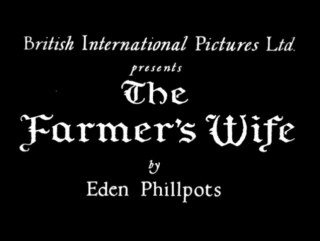
farmerswifetitle.jpg“. . . and don’t forget to air your Master’s pants, ‘Minta.”
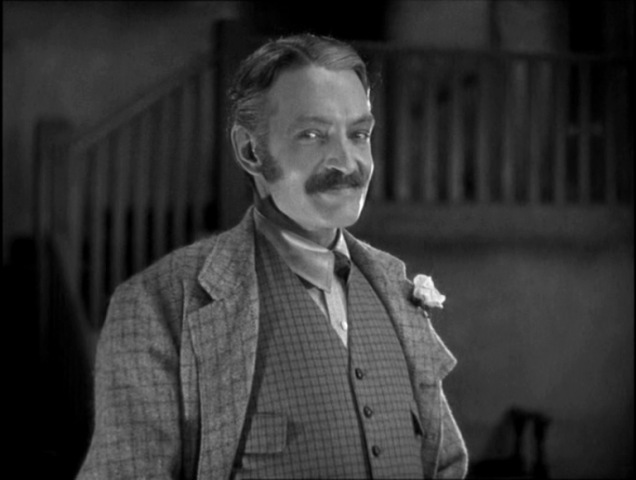
“Beer drinking don’t do ‘alf the ‘arm of love-making.”
“There’s a female or two be floating around my mind like the smell of a Sunday dinner.”
“A woman that’s a pillow at thirty be often a feather bed at forty!”
“Hang it, Thirza Tapper, I’m asking you to marry me!
“What be women made of nowadays?”
“They do say the next best thing to no wife be a good one. He has come out on top at last.”

The Farmer’s Wife

After The Ring Hitchcock inexplicably returned to the stage for his next story, a film based on Eden Phillpot’s romantic comedy The Farmer’s Wife (adapted once more by Eliot Stannard). It was not a genre Hitchcock visited often. However, this (his second film for British International Pictures) is one of the more purely entertaining films of Hitchcock’s silent period, a tale of farcical courtship with strong pastoral elements. During the shooting of this rather cheery adaptation Alma became pregnant with the couple’s only child, Patricia.

sweetland.jpgFeeling lonely after the death of his wife and the marriage of his daughter, farmer Samuel Sweetland enlists his pretty young housekeeper, ‘Minta (short for “Araminta”), to brainstorm a list of women he might convince to marry him. Stubborn, hot-tempered, proud and given to employing unfortunate barnyard analogies when he should be whispering sweet nothings, Samuel encounters unexpected (and, for us, hilarious) resistance as he works his way from name to name. Unfortunately for this film’s raison d’être, it should only take the audience five minutes (if that long) to realize that the perfect candidate has been right under the farmer’s nose the whole time.

The Farmer’s Wife truly is an odd mix of Hitchcock’s trademark economic storytelling and significant stretches that add little or nothing to the ongoing action. The result is unusually long for a Hitchcock film (and a comedy, for that matter). At 129 minutes, it is easily 20 minutes longer than any of his other British films, and one of the longest he ever made. Watching it, although it drags less than one might expect of such a lengthy silent film, it is easy to see where the story could have been told just as effectively with a good 40 minutes or more left out. Nevertheless, there are a variety of elements at work here that mesh together very well.

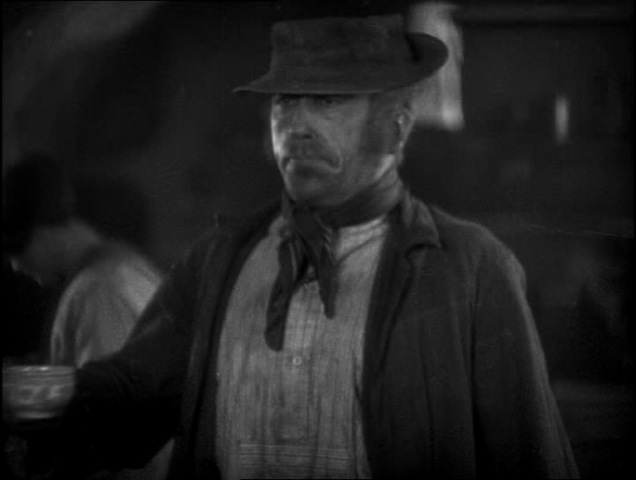
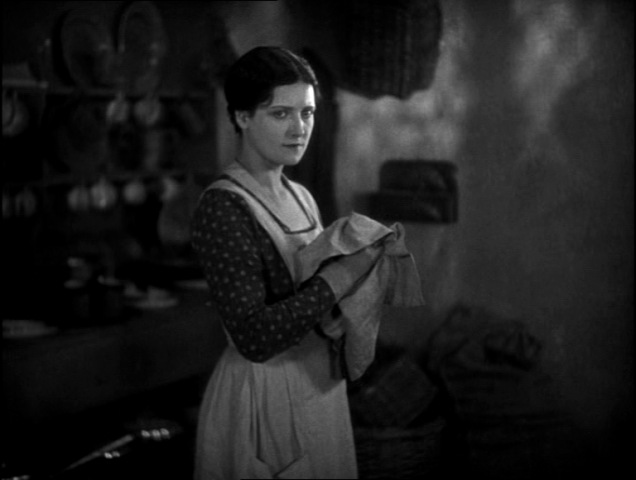
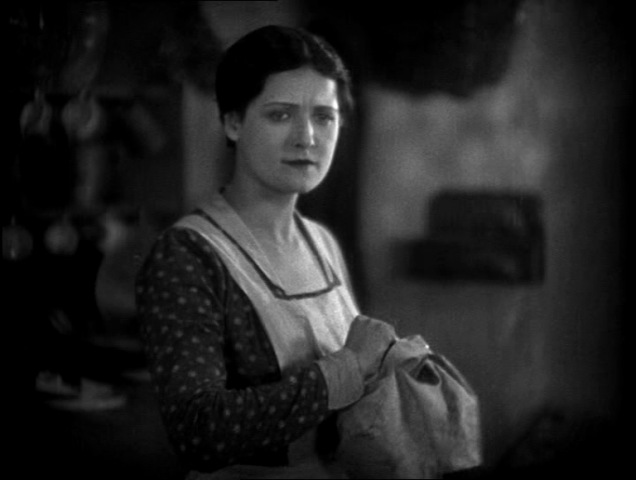
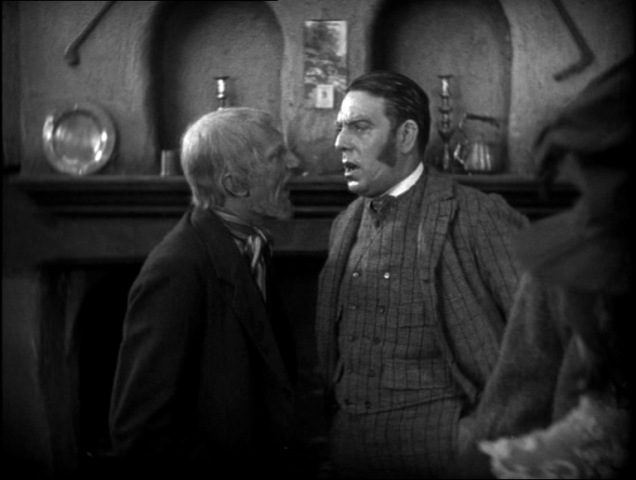
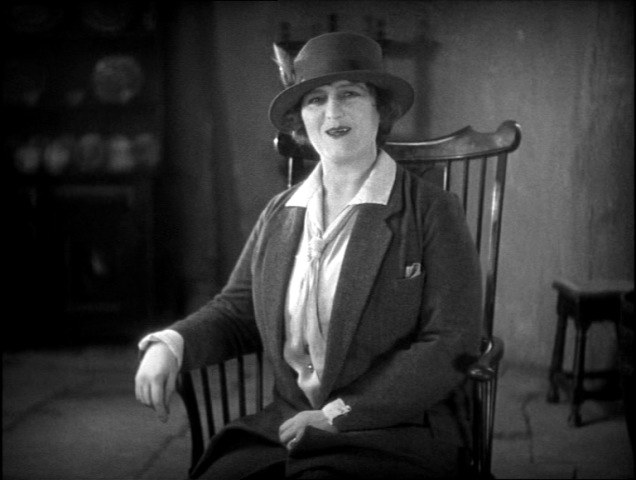
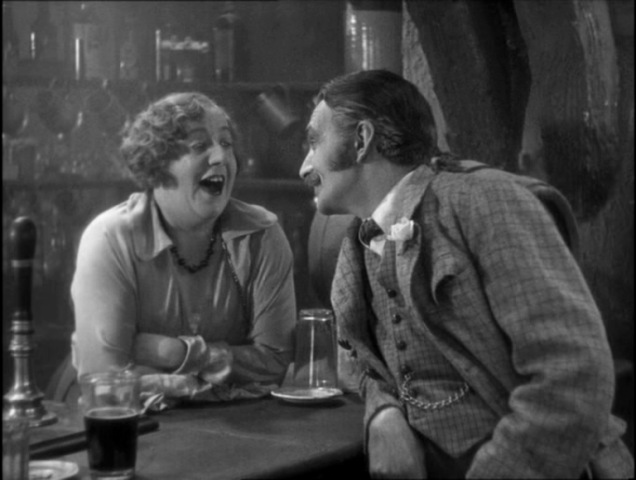
minta.jpgThe film has probably the strongest ensemble cast that Hitchcock had yet assembled. Lillian Hall-Davis fills the role of the sweet, practical housekeeper, a far better fit than in the poorly-written female lead of The Ring. Gordon Harker (of the priceless facial expressions) returned to work with Hitchcock, as well. He plays essentially the same character here as in The Ring, a sour-faced farmhand named Churdles Ash, to equally great effect. Jameson Thomas is perfectly cast aschurdles.jpg Sweetland, bringing just the right balance of sympathetic vulnerability and easily-wounded pride to the role. He is never unlikable, even when he is behaving badly, and delivers one of the best performances I’ve seen in a silent film. In addition to Sweetland’s four prospective brides, each a little odder than the last, there is a rich supporting cast of eccentric country caricatures that lend a concrete sense of community to anchor the proceedings.

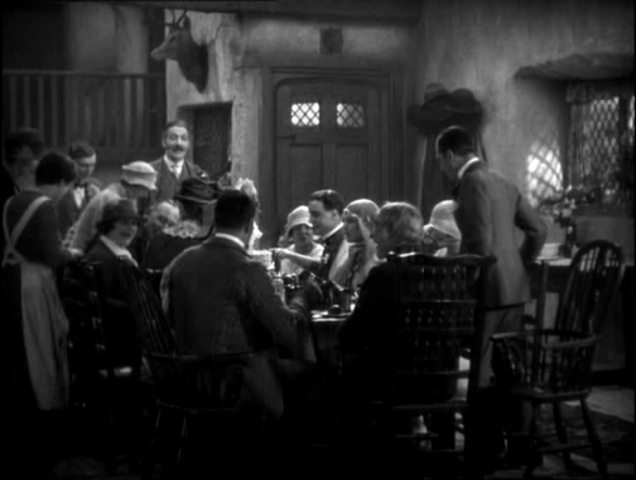
together.jpgCommunity plays a major role in the film; all of the most important scenes take place within the context of a social gathering. The wedding celebration near the beginning introduces all of the major characters and sets the stage for the tea party, which is the central scene in the movie. There are the social calls, a foxhunt, a rowdy gathering in the local pub, and so on. The film immediately communicates a charming rural atmosphere where everyone knows everyone and everyone belongs. This tight-knit atmosphere emphasizes Sweetland’s loneliness without a partner, perhaps even indicating that he is not a complete person without a “better half.” Incidentally, even barriers between social classes are thin and extremely mobile here. At the tea party, for instance, the first guest to arrive enthusiastically shakes Churdles’ hand, greeting him as a friend and equal even though Churdles is “the help.” (Churdles response is to shake his head grimly and say, “I ain’t the party, George.”)

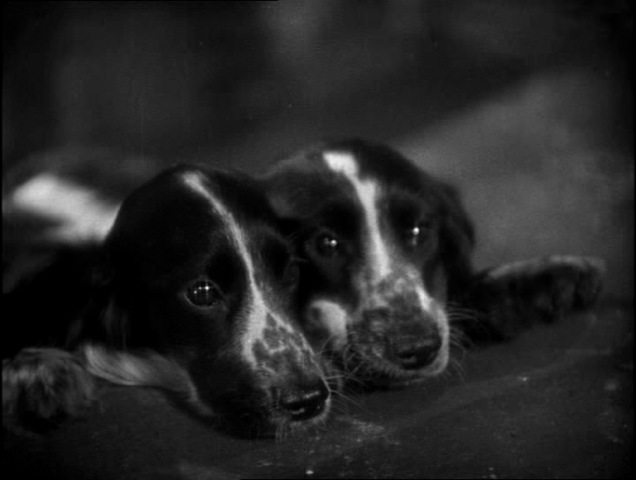
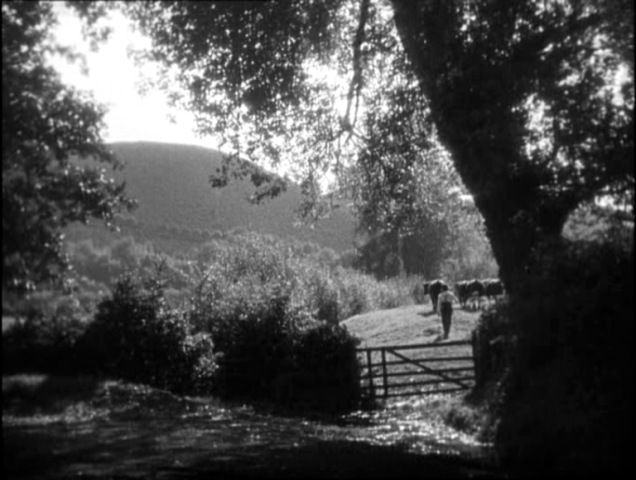
cutedogs.jpgSpeaking of rural, the camera shoots the gorgeous (even in black and white) English countryside with an almost Romantic reverence for the setting. The Farmer’s Wife was shot on location in Devonshire, and there are some truly fantastic landscapes in the film. There is obviously a great deal of respect and admiration for the simple lives of these country people. Naturally, animals feature prominently in this setting as well, at least on the periphery. Two adorable spaniels wander through the scene during the opening shots, tracking through the farmyard, into the house and up the stairs before settling together at the the top and staring dolefully at the door of the dying woman’s room. The foxhunt scene involves a truly impressive number of dogs and horses (quite the extravagance to shoot, considering the almost incidental nature of its appearance in the film).

countryside1.jpgcountryside2.jpgcountryside3.jpg

The story opens with the farmer’s wife lying on her deathbed, immediately introducing the central problem of the plot and establishing the major characters, ‘Minta and Sweetland. However, instead of a funeral, as one might expect, the deathbed scene immediately precedes a wedding. There isn’t even so much as a shot of a coffin being lowered into the ground. The Farmer’s Wife has little time for sorrow. Applegarth Farm is in an uproar as ‘Minta flies around the house in a whirlwind of preparations. After everyone finally leaves for the church, she continues to prepare the wedding feast in the kitchen while Churdles regales her with his dour views on marriage and love in general. (“Holy Matrimony be a proper steam roller for flattening the hope out of a man and the joy out of a woman.”)

Soon, ‘Minta looks up from her preparations in the kitchen, we see a shot of the church bell swinging back and forth in the steeple, then back to ‘Minta. In a sound film, we would simply have heard the tolling of the bell signaling the end of the ceremony, as she does. Hitchcock often employed these 3-shot sequences to convey something to the audience: first a close-up of a character’s face reacting to something, then a shot of what they are reacting to, followed by another shot of the reaction. In a discussion on the techniques of film editing, Hitchcock noted that the key to these sequences is the image inserted in that middle shot. The example he uses is the nature of an old man’s smile framing a shot of a cute baby playing with its mother in the park or one of a cute girl sunbathing in a bikini. The former is benign; the latter, creepy. In The Farmer’s Wife, however (and in other silent films like The Lodger), Hitchcock employs this technique primarily as a substitute for sound.

churchbells1.jpgchurchbells2.jpgchurchbells3.jpg

The wedding party soon returns for the meal and we are introduced to most of the locals. In a fantastically-filmed sequence, a tracking shot follows one hapless guest as he backs away from an extremely-talkative elderly gentleman, seeking desperately to join one of the small knots of conversation around him while feigning interest in whatever the other man is saying. Finally, he manages to dive into a small group and the old man wanders off in search of fresh prey. Another conversation sets up the later scene at the tea party, when a guest reminds Sweetland that he has promised to be at her “little affair” and asks that he loan her Churdles Ash to announce the guests (she’ll provide the get-up). Churdles signals his objection frantically from behind her back, but Sweetland ignores him and agrees.

escape1.jpgescape2.jpgescape3.jpglivery1.jpglivery2.jpglivery3.jpg

Finally, everyone leaves and Sweetland wanders contemplatively around the large, empty room. The wedding confetti on his lapel, his own wedding picture on the wall, and his wife’s empty chair by the hearth inspire him to call ‘Minta out to discuss his prospects for remarrying. Though it may seem odd to make special note of the dialogue in a silent film, the ensuing conversation is extremely funny as Sweetland and ‘Minta go back and forth on the pros and cons of the various “possibles and impossibles” (see above for some examples). As he considers each candidate, he pictures her sitting in the empty chair across from him, and we have the remainder of the movie laid out like sermon points in a church bulletin.

candidate1.jpgcandidate2.jpgcandidate3.jpg

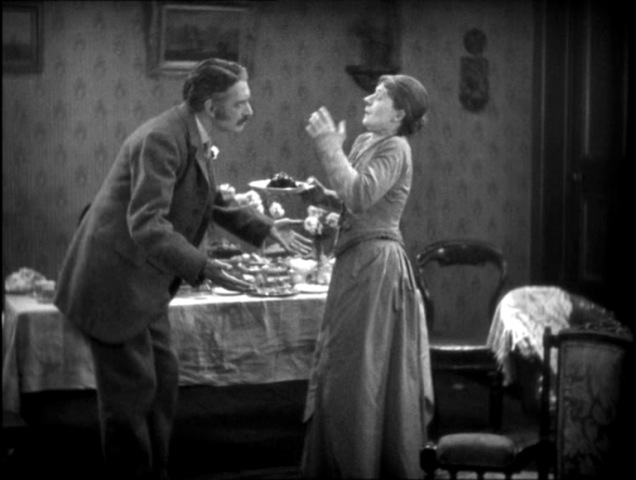
Sweetland manages to flub each proposal in epic fashion, thanks in part on his use of unfortunate barnyard analogies like “I come over . . . to pick up a big fat hen.” Despite his complete lack of tact, most of the women let him down pretty gently . . . not that it matters. The poor guy doesn’t handle rejection well, and generally rages around the room a bit, throwing out general verbal abuse before storming away. After being turned down by the Widow Windeatt, an independent woman who runs her own farm up the hill, he remembers Thirza Tapper’s tea party. Full of enthusiasm, he shows up at her house a full 40 minutes early with a basket of plums, hoping to pitch his woo before the other guests arrived.

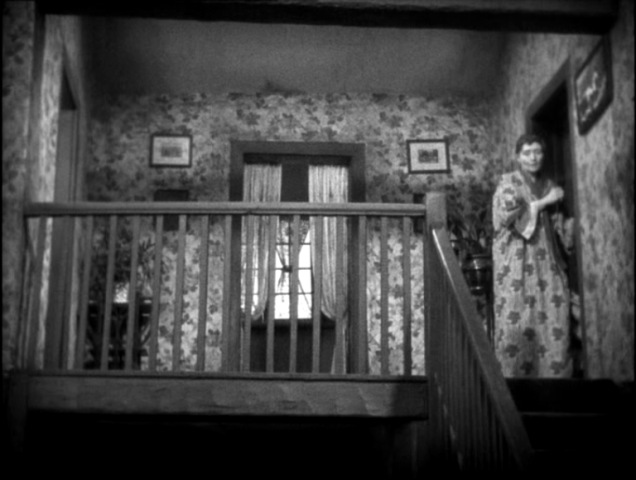
thirza1.jpgUnfortunately, Thirza is still getting ready, and she is suddenly trapped in her bathroom with no way to get to the clothing in the bedroom except by crossing the head of the stairs while Sweetland waits impatiently below. She is thrown into complete disarray when she attempts to sneak across, wrapped tightly in a dressing gown, only to get it caught in the bathroom door. Sweetland doesn’t seem to noticethirza2.jpg anything amiss, but the good lady is mortified. After she has dressed and come down, Sweetland attempts to lay out his proposal, but is continually interrupted by the servants and his own clumsy fidgeting. When he finally does get it out, Thirza happens to be holding a plate of some sort of gelatin dessert, which begins to quiver violently as she has a sudden attack of nerves. Ultimately, she turns him down too, and he exits in a huff.

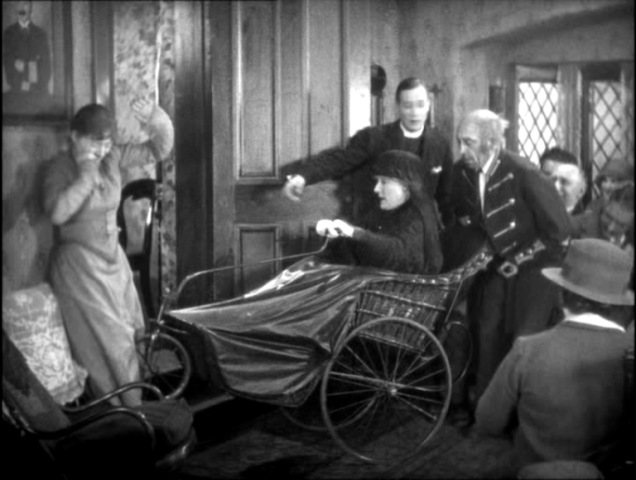
party1.jpgHe is still hanging around outside, however, when guests start to arrive, and the arrival of his third option, Postmistress Mary Hearne, lures him back in. At the party, Churdles is none too pleased with his duties, not least because the uniform Thirza has him dressed in is far too big and he is forced to hold his pants up with one hand at all times. As each guest arrives, he pokes his head out of the parlor, shuts the door in their faces, jerks a thumb over one shoulder and calls out the names, then lets them in. Everyone who is anyone seems to be at this gathering. A woman with several children sits as close as possible to the food table and seems poised to drink the lion’s share of the available tea supplies while she pesters the long-suffering village doctor for free medical advice. The parson arrives with his mother, who is seated in a large bath chair, and Churdles struggles gainfully to muscle the unwieldy thing down the stairs and into the already crowded room without dumping the old lady on the floor.

party2.jpgparty3.jpgparty4.jpg

Eventually a group of glee singers appears and everyone wanders out into the garden. Sweetland lures Mary back inside and goes about his now well-practiced routine of awkwardly proposing. She laughs at him outright and he lets loose an impressive stream of insults in her direction which sends her into hysterics and draws everyone back inside. Thirza, overwhelmed by the disastrous outcome of her party, faints right into Churdles, who for a moment can’t seem to decide whether he should let her drop to the ground, or his pants. Thirza’s emotional maid, not to be outdone, pitches a fit, and the whole room dissolves into chaos.

fit1.jpgfit2.jpgfit3.jpg

foxhunt1.jpgThe tea party is the comedic climax of the film, and at this point things should move swiftly to a satisfactory resolution, but there is still a third of the movie left. Upon overhearing Churdles tell ‘Minta how ashamed he is of his master’s behavior, Sweetland resolves to move on to the final name on his list: Mercy Bassett, barmaid at the village pub. Sweetland added her to his list “for luck,” and she is a character we haven’t run into thus far. This whole sequence feels like an afterthought all the way around. When he arrives in town, a large foxhunt is about to begin and his courtship is inter-cut with shots of the ongoing chase (clever, that). Dejected after the final rejection (which happens off-screen), Sweetland returns home to ponder everything that has happened. Once again he imagines each of the women he has courted sitting acrossfoxhunt2.jpg from him in his wife’s old chair, but this time, when they all disappear, he sees ‘Minta sitting right in front of him. It hits him like a thunderbolt that she was the one all along (finally). He hasn’t failed to learn a few lessons from the other women, and his proposal to ‘Minta is characterized by an uncharacteristic tone of humility.

duh.jpgHe sends her upstairs to put on a nice dress and several people just happen to show up (on her way, ‘Minta runs into Churdles, who is shocked by the news). Mary Hearne, upon hearing from Thirza Tapper that she wasn’t the only one Sweetland proposed to, changes her mind and comes to accept with Thirza in tow. The garrulous old man from the beginning arrives with a perfect candidate in mind. Sweetland shushes them all and invites them to sit down for a drink with his new intended. When ‘Minta appears, the postmistress goes into hysterics again and everyone shares a toast in honor of the bride-to-be.

wha.jpgThis synopsis is overlong, but so is the movie itself. It should be apparent that, while it possesses an undeniable charm, there is simply not enough substance to justify the runtime. Note that the events of the preceding two paragraphs take a full forty minutes to play out. With a tighter control on the length, this could be a recognizably great silent effort. As it stands, it is still a fine piece of work (if trivial) and worth seeing. This is Hitchcock finding ways to translate a dialogue-heavy stage play into a story that relies entirely on visuals without losing entertainment value, something he had largely failed to do with his previous adaptations for Gainsborough. Comedy is far more congenial than melodrama to a setting that is pruned of dialogue and to appreciation by audiences of both current and future generations.

cheers.jpgThe camerawork in The Farmer’s Wife is noticeably more mobile and free than in Hitchcock’s earlier films. Cameras during this period were still quite bulky, and many of the techniques and equipment that allowed certain types of shots had not yet been developed. However, Hitchcock was always pushing to be on the cutting edge of what could be accomplished technically with camera movement and positioning. One can see shots from interesting angles beginning even with his first films, but these still remain almost entirely static. In The Farmer’s Wife we begin to see some of the first hints of a more kinetic energy to the filming: some tracking, panning, zooming in and out. There isn’t a lot of it, but it’s there.

Next Week: Hitchcock breaks out the bubbly

Film Roundup V

•February 3, 2008 • Leave a Comment

I’ve been out sick since Wednesday, and while I’m still not feeling the best, I’m tired of doing nothing. Naturally I didn’t feel up to seeing a movie on Friday for review . . . “Oh, how convenient!” you say to yourself. He’s too “sick” to go to the movies on the bridge weekend between January and February. Well, yes. I agree . . . most convenient. I don’t know what the groundhog said yesterday, but it’s still winter in the multiplex for sure. On Friday, the new choices were: juvenile comedy starring Steve Zahn (Strange Wilderness), ghostly rom-com starring Eva Longoria (Over Her Dead Body), and the latest Asian horror rip-off starring Jessica Alba (The Eye). Brrr. Hardly the cure for what ails me.

AntiTrust – 72%

Released in the midst of Microsoft’s monopoly-related judicial woes several years ago, I can only presume this movie was meant to provide hip, topical, and highly-conspiratorial entertainment. Milo Hoffman (Ryan Phillipe, who, no offense, looks like no computer programmer I’ve ever seen) lands his dream job at NURV, a cutting-edge software company run by Bill G- err, “Gary Winston” (Tim Robbins). However, things are not as they seem, and as NURV draws closer to the launch date for Synapse, a global communication network, Milo finds himself caught in a web of all sorts of nefarious, cut-throat goings-on with no way to know who he can trust. A friend who would know told me the screenwriters got programming right on this movie, for which he gave it mad props. They didn’t do too badly on entertaining and suspenseful story-telling, either . . . although ultimately the final round of plot twists goes a bit overboard. Nevertheless, it’s a mindlessly entertaining thriller sure to satisfy the geekily-inclined.

Seven Samurai – 74%

Much-lauded (and imitated) Japanese classic about a group of unemployed samurai who band together to save a village from marauding bandits, by master filmmaker Akira Kurosawa. Don’t get me wrong, I love Kurosawa. Rashomon is one of my favorite movies . . . but at three and a half hours, Seven Samurai just plain outlasted me when I saw it. It struck me as too slow and too rough to be truly enjoyable, but I’ll readily admit it deserves a second viewing (someday) before I consign it to the pile of “just not my taste.”

Simon Birch – 71%

Joe (Joseph Mazzello of Jurassic Park) is an illegitimate child, little Simon Birch (Ian Michael Smith) is a dwarf, convinced that God has an important purpose for him. Outcasts together in their small town in 1964, they have a happy friendship until Simon hits the ball that kills Joe’s mother in a freak accident. The two set out together to find out who Joe’s real father is, and despite the tragedy, God may still have a purpose for Simon Birch. A bizarre mix of raunchy coming-of-age comedy and religious heartwarming nostalgia, Simon Birch is every bit as odd as it sounds. And the wild attempt to bring it all together in the climax feels extremely forced. As one critic pointed out, “If Simon’s fate inspired me to believe in God, I’d also be inspired about a second later to hate him.” It just doesn’t quite work, although it is occasionally quite fun along the way.

When Harry Met Sally – 88%

Harry (Billy Crystal) and Sally (Meg Ryan) meet just after graduating from college and build a no-strings-attached friendship that lasts for many years before romance enters the equation. Romantic comedies are, obviously, not really my genre, but this one has a certain disarming charm. Maybe it’s the lack of an overly-cute plot or the fondness for its characters or the weird little intermissions with old couples. I dunno, but it’s one of those movies that’s easy to like and pleasant to watch, even if you just flip to it while you’re channel-surfing.

Father of the Bride – 78%

No, not the original with Spencer Tracy (which I’m not entirely certain I’ve even seen all the way through!), the Steve Martin remake with Diane Keaton and an even-creepier-than-usual Martin Short. Martin is the overprotective father who provides droll voice-over narration to the zany proceedings surrounding his only daughter’s wedding. I have no sisters and no daughters, so I have very little frame of reference for this one. It has some funny moments, and some cheesy moments, and some touching moments, as you might expect it to. Nothing groundbreaking, but it’s not trying to be, either.

CTMovies Celebrates Awards Season

•January 31, 2008 • Leave a Comment

Jeffrey Overstreet announced that the Christianity Today movie critics have picked their “Top Ten Most Redeeming Films of 2007.” Take a look at the list, as well as the movies below (where each voter got to pick a favorite that didn’t make the top ten). I have seen exactly half of each list, and going from that I would have traded Gone Baby Gone up for either Bella or Freedom Writers. In any case, though, an excellent pair of lists and I look forward to seeing more of these selections in the weeks ahead.

And speaking of lists of ten, you have to check this out: ten totally geeked-out home theaters designed by the most bottomless of pockets to suit the nerdiest of tastes. These beauties seem to point to Trekkies as the wealthiest and most obsessive of fanboys. The Batcave is sweet, though perhaps not as inviting as I might prefer. The Titanic room is stunningly elegant, but perhaps a tad too intimate unless one simply had no friends (which would be a crying shame if one had such a room). That first Star Trek Enterprise theater is quite something, and how tantalizing is that description? “At last count, there were eight servers with 3,816 DVDs.” Then again, how long would it take you to even find that many things worth watching? And it’s a bit too uninvitingly plastic. No, the prize has to go to the Nautilus. It looks outrageously super-cool, comfortable, and just generally great . . . but who am I kidding. I would totally sell out and opt for a career writing those glowing blurbs for movies no one should ever watch just to possess any one of these rooms.

That reminds me . . . I’ve been watching the Rambo commercials on TV lately, and I noticed something rather amusing. All three of the”critical” blurbs praising the movie (which currently has a 36% on Rotten Tomatoes) were from the same source: the widely-respected “bloody-disgusting.com.” Pity the lazy fool that had to go hunting for favorable reviews to splice into the advertising.

Week 5: The Ring (1927)

•January 30, 2008 • Leave a Comment

thering.jpg“A friend of yours?”
“. . . a tall, rich man!”
“I think the prize at the booth should have been this charming bride.”
“It seems as though I shall have to fight for my wife, after all.”
“I’d be training for a divorce if I left her here!”
“The fight – did you lose, then?”
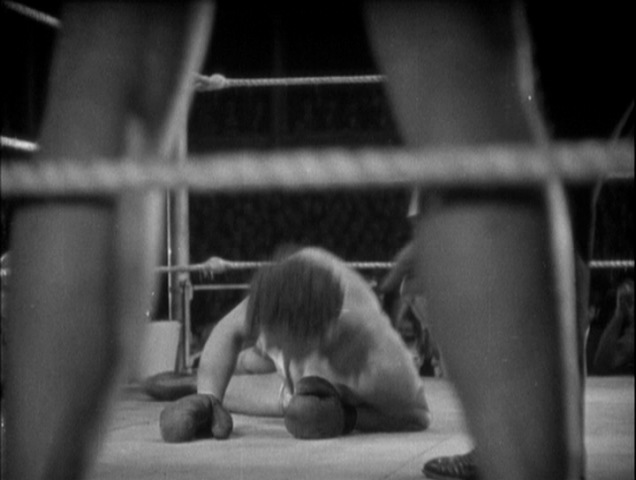
“Jack . . . I’m with you . . . in your corner.”
“Look what I found at the ring-side, Guv’nor.”

The Ring

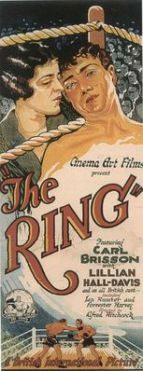
By the time Hitchcock had completed Downhill and Easy Virtue in 1927, Gainsborough was becoming the “B” movie factory while sister studio Gaumont-British (which started as a subsidiary of the prestigious French Gaumont Film Company) produced more quality fare. Meanwhile, a man named John Maxwell had just started a brand-new film company, British Internation Pictures, and one of his first moves was to bag Britain’s most famous up-and-coming director. After being assigned to two notably inferior stage-to-screen adaptations with Gainsborough in a row, Hitchcock jumped at a promise of higher budgets and greater artistic control. His first film for BIP was The Ring, which he not only directed but wrote himself (his only silent without Eliot Stannard). It is the only film of which he is the sole and original screenwriter (Alma, of course, contributed, but is uncredited). His last two movies for Gainsborough were held for release until after The Ring came out (hence Easy Virtue is a 1928 film, even though Hitch completed it before he began work on 1927’s The Ring).

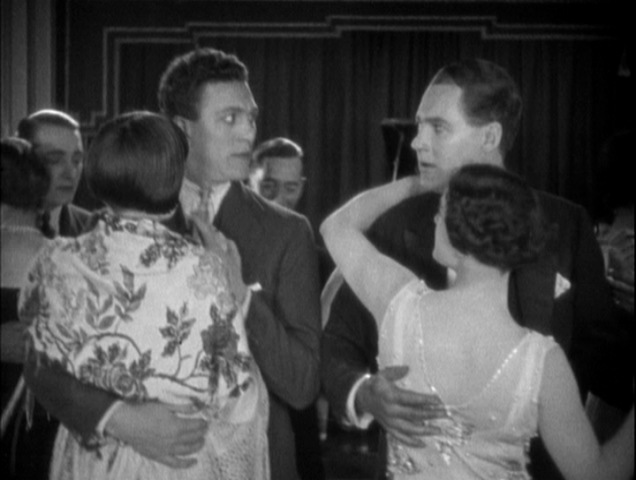
jackbob.jpgThe Ring is a melodrama in which the jealousy and petty rivalry of a love triangle plays out amidst the world of heavyweight boxing. “One-Round” Jack Sander (Carl Brisson, a genuine boxing champion) is a carnival boxer who earns his living by sparring (and winning) against all comers while his girlfriend Mabel (Lillian Hall-Davis) sells tickets at the door. One day, Australian heavyweight champion Bob Corby (Ian Hunter) shows up looking for a sparring partner. Without revealing his identity, he goes into the ring with Jack and beats him, but is impressed enough by the other boxer’s skillmabel.jpg (and by the beauty of his girl) to hire him. Jack, who now feels like he’s really going places, marries Mabel. What he doesn’t know is that Bob has already planted the seed of infidelity in Mabel’s heart, and the two become increasingly chummier under Jack’s broken-hearted gaze. To win back the love of his wife, Jack must enter the league himself and box his way to a climactic championship showdown with Bob.

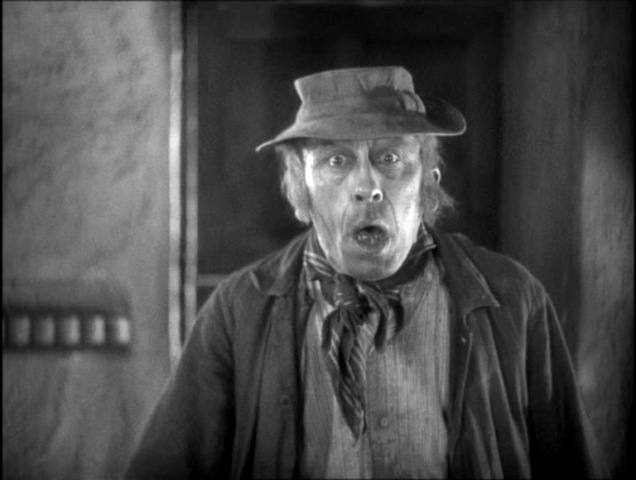
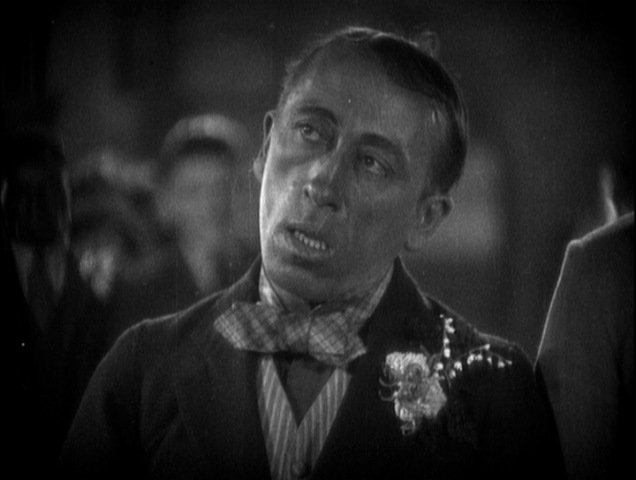
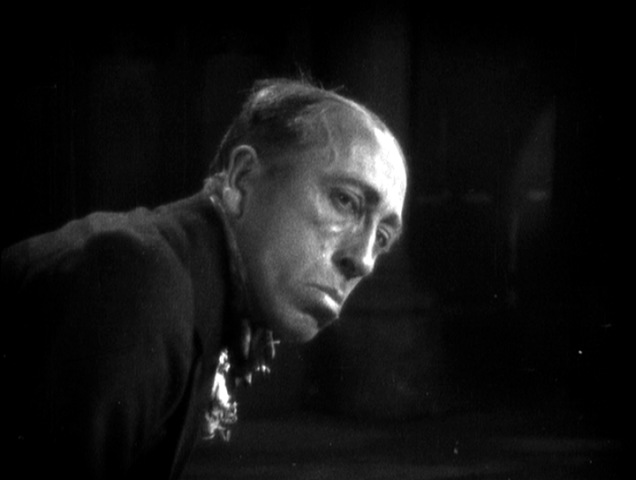
Humor plays such a large role in the movie that, during the first half, it is much more comedy than drama. A large portion of the film’s broad humor is concentrated in a single character: Jack’s trainer (played by Gordon Harker). This dour fellow (whose face is vaguely reminiscent of Buster Keaton) is hilarious whenever he is on-screen, though he also takes good care of Jack and frequently shows more common sense than his boss. The guy just looks funny, much like the great silent comedy stars of the day. I could discuss the humor of his scenes and the way they are filmed at great length (although a great deal of it rests in his priceless facial expressions), but I’ll settle for describing only two.

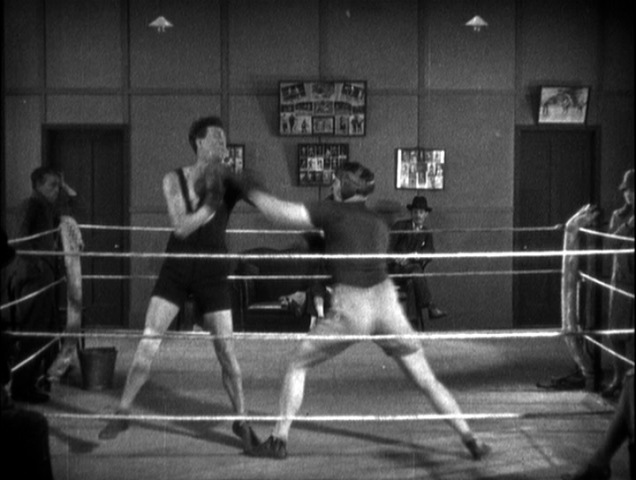
comicmatch1.jpgIn the opening fight sequence, Jack is shown beating everyone who steps into the ring with him quickly and easily. His first opponent, a tough-looking sailor, hands his coat to the Harker character and steps out of the frame. A few seconds later, he stumbles backward, almost too woozy to accept his coat and return to his seat. When Bob enters the ring, we watch from the same camera angle as Harker confidently places the coat on a hanger and Bob steps out of the frame. Without looking up, Harker immediately detaches the coat and holds it up with immense satisfaction to give back . . . only to see Bob giving Jack the business. His mouth drops comically open and he nearly drops the coat.

comicmatch2.jpgcomicmatch3.jpgcomicmatch4.jpg

comicmatch5.jpgAs the fight continues into the second round, Harker never bothers to rehang the coat, finally throwing it carelessly over a post and leaving the hanger dangling from the ropes nearby. When Bob returns, victorious, Harker removes his gloves sullenly, and hops the ropes to go see Jack. Bob, noticing the treatment his coat received, grabs up the hanger and slips the hook into the back of Harker’s pants, leaving it for him to discover a few moments later.

comicwedding1.jpgThe wedding sequence, too, is played heavily for laughs (perhaps a subtle reference to the fact that the marriage is a joke, but probably not). The reverend is humorously shocked by the odd assortment of people filing into his church (including a giant, who plops down directly in front of a much shorter fellow, and a pair of Siamese twins). Once the ceremony is underway, Harker becomes bored by the proceedings, staring slack-jawed off into space and picking at his nose. Unfortunately, he’s the best man and needs to provide the ring. As his friends from the carnival crack up behind him, he searches for it for several seconds, only to drop it on the floor (comically, but also portentously). At the reception, he proceeds to gorge himself on chicken and then literally drinks himself under the table.

comicwedding2.jpgcomicwedding3.jpgcomicwedding4.jpgcomicwedding5.jpgcomicwedding6.jpgcomicwedding7.jpg

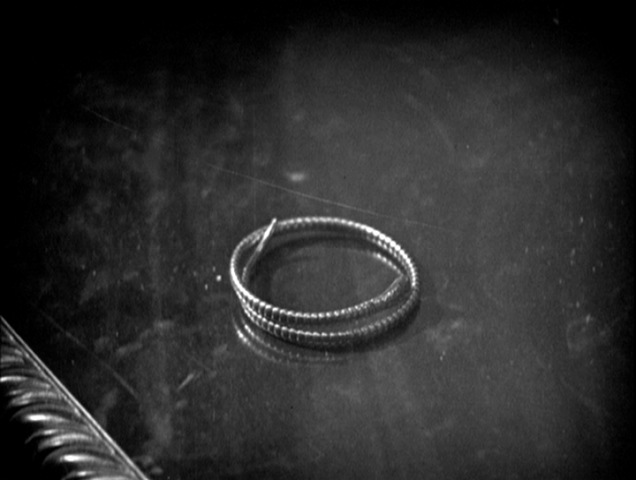
The most fascinating aspect of The Ring, however, is not its extensive use of humor, but its recurring visual and narrative references to various types of “rings.” In this respect it displays the most sophisticated degree of thematic unity that Hitchcock had yet achieved. The title most obviously refers to the boxing ring (which is, of course, square) where both Bob and Jack make their living and where they will finally face off over Mabel. However, it is also connected with two objects: the wedding ring which seals Mabel’s marriage to Jack and a fancy golden arm bracelet which Mabel wears as a sign of her commitment to Bob.

ring1.jpgring2.jpgring3.jpg

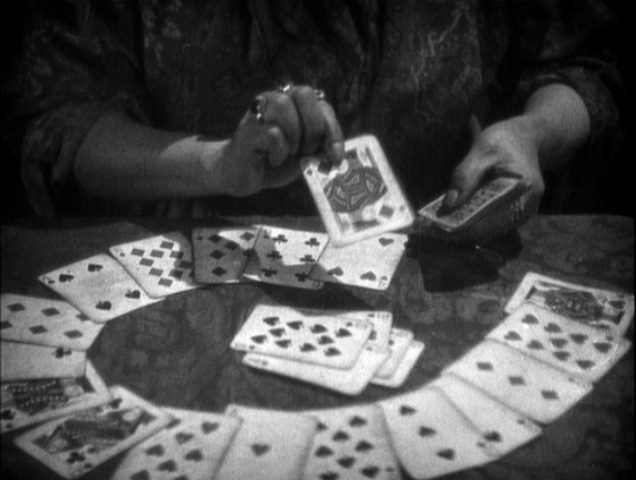
ring4.jpgFurthermore, rings and circular shapes of all kinds are key in nearly every scene. The film opens with a shot of a large circular drum, followed by one of a ride where people dangling from harnesses are swung round in a circle. In fact, the carnival is full of circular rides and tents. Mabel sells a large roll of tickets to the first boutring5.jpg between Jack and Bob. An old gypsy lays out a ring of playing cards to tell Mabel her fortune (that she can expect the attentions of a tall, wealthy man . . . of course, the crafty woman has already spied Bob presenting the bracelet just outside the window of her wagon). A gong (the bell that signals the beginning and end of the rounds) and a stopwatch are featured prominently in the suspenseful final match.

ring6.jpgring7.jpgring8.jpg

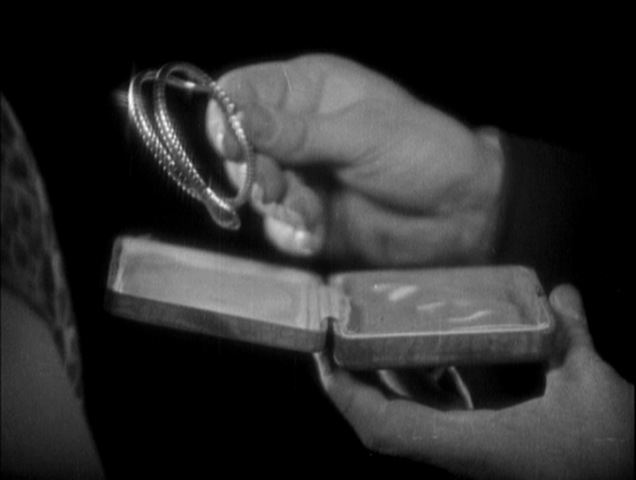
originalsin.jpgBob’s bracelet has the most ubiquitous screen presence of the various rings. Bob presents it to Mabel several hours after he beats her intended at the carnival, having bought it out of the money he won in the fight. The bracelet, shown in a close-up when Bob first pulls it out, is shaped like a coiled snake. As he slides this “bangle” nearly up to her shoulder (a nakedly sexual act), it is impossible not to think of original sin and the temptation of Eve by the serpent in the Garden of Eden. It is perhaps among the most subtle indicators of adultery to ever slip past the censors. There is a fantastic transitional shot in this scene as well; the camera films a close-up of Jack sealing the job agreement with Bob’s manager and the scene suddenly becomes a close-up of Bob slipping the bracelet onto Mabel’s wrist.

originalsin2.jpgoriginalsin3.jpgoriginalsin4.jpg

At first Mabel is ashamed of the present (but unwilling to take it off) and covers it with her hand when her fiance is around. When he eventually discovers it she tries to twist the truth, saying it is as though he gave it to her, since his loss provided the winnings from the carnival boss to pay for it. She never takes it off, and it is a constant visual reminder of her divided loyalties right up to the final scene.

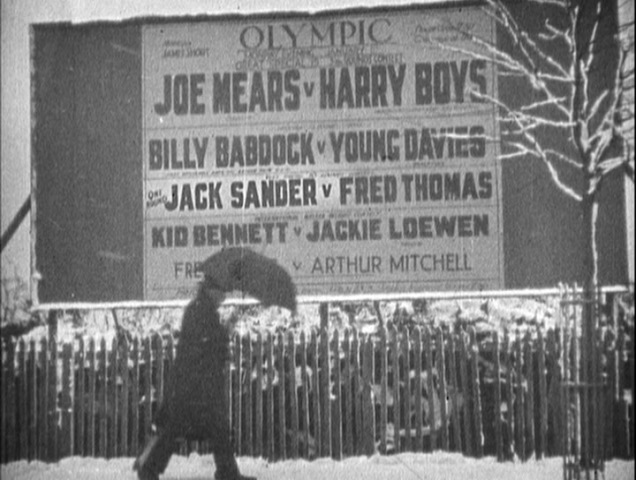
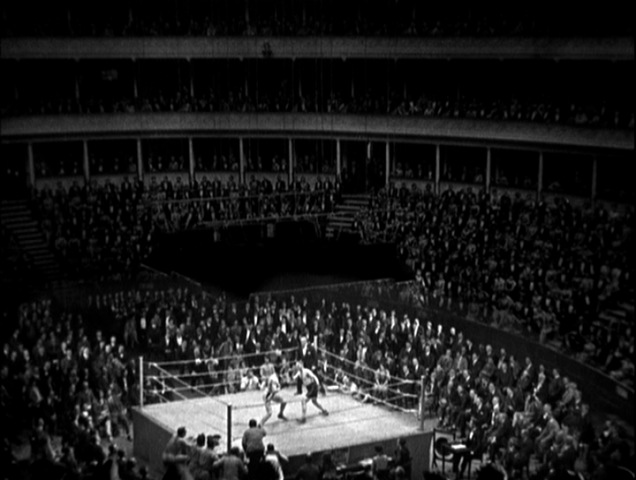
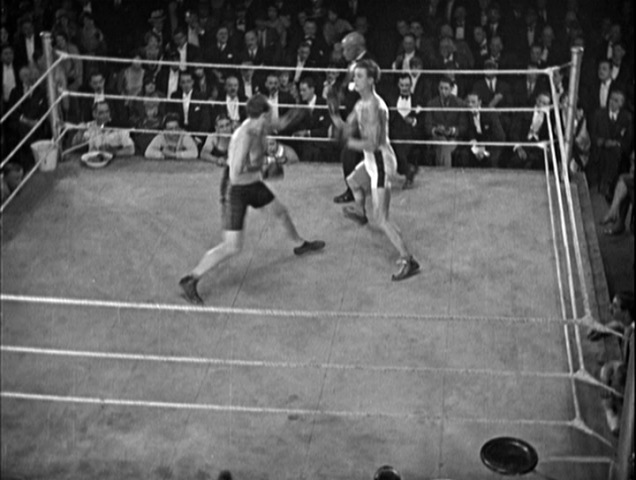
bigboard1.jpgThe boxing match between Bob and Jack at the end is (as it should be) the most impressively-filmed and exciting scene in the movie. It lasts about eight minutes, not counting the introductory build-up to the beginning of round one as the boxers prepare in their respective rooms and then emerge to the roar of the crowd. Hitchcock wisely avoids spending much time on any other fights until this point so that, by the time it arrives, we haven’t wearied of boxing already and he can concentratebigboard2.jpg his significant reserve of technical skill on bringing this one to life. After the initial match at the carnival (most of which is spent focused on the reactions of the onlookers) and some practice sparring, Jack advances to the championship off-screen. His rise in the ranks is displayed via a brief montage as his name climbs steadily higher in the fight listings.

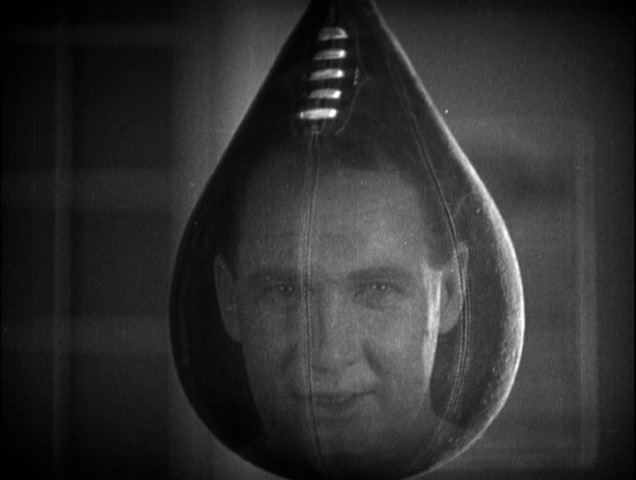
punchingbag.jpgThe closer Jack gets to the championship round, the closer his wife gets to Bob. Things come to a head between them on the night he wins the semi-final fight. Jack brings several old friends from the carnival home to celebrate, but finds that Mabel is not at home. Assuring the others she’ll be back soon, he pours the champagne but won’t let them drink until she arrives. Of course, he is mortified when she never shows and his friends finally leave. She finally comes home late from a night on the town with Bob, and she and Jack quarrel violently. He grabs at her and tears her dress, revealing once more the accursed arm bracelet, and she runs off to lock herself in the bedroom. Jack, infuriated and no longer content to vent by picturing Bob while he works out, goes out looking for his rival and decks him in a nightclub. When he returns home he finds that Mabel has moved out.

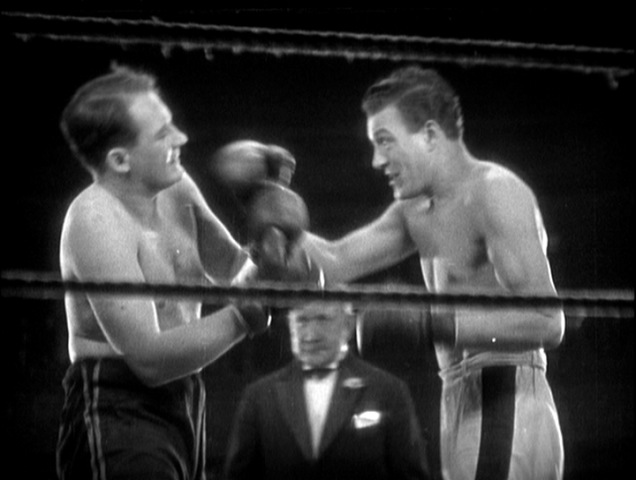
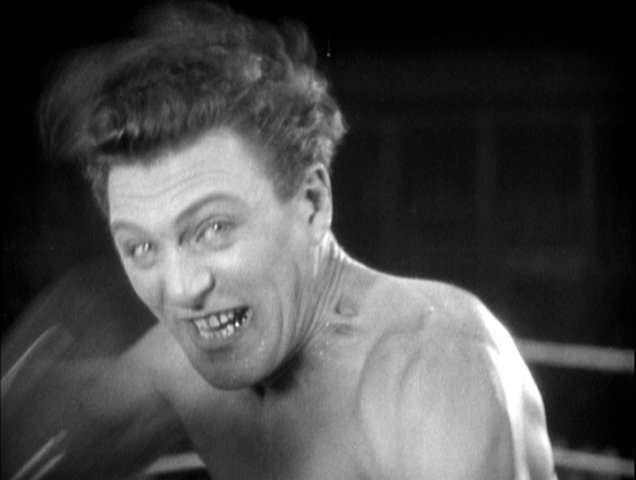
alberthall.jpgOn the night of the big fight, Mabel shows up to watch (unbeknownst to Jack) and sits ring-side in Bob’s corner. As the fight gets underway, Hitch uses a quick-cutting mix of shots to lend the scene a frenzied kinetic energy, jumping to a variety of distances and angles as the men swing at each other. A few times he employs a midst-of-the-action POV shot, replacing one boxer with the camera as the other swings and jabs at the screen. There are also several shots of the crowd, from the enthusiastic groundlings to the wealthier, better-dressed spectators in private boxes. There are even a few shots of cameramen, filming the fight from the rafters.

roundone1.jpgroundone2.jpgroundone3.jpgroundone4.jpgroundone5.jpgroundone6.jpg

The two opponents seem much more evenly matched than at their first meeting. Then, in the midst of a grapple, Jack locks eyes with Mabel over Bob’s shoulder (the camera zooming in dramatically on her face). Distracted and open, he takes a solid punch to the face and drops to the mat. We experience the fall from his perspective, with a slightly fuzzed shot of the bright overhead lights as he struggles to his feet. The second round goes much worse for Jack, who is obviously none too steady by this point. Before long he is down again, barely getting up in time. After narrowly staying in the fight, he collapses in the corner so his team can try to revive him. Mabel has been agitated since they first exchanged looks in the first round, and throughout round two she is involuntarily on her feet circling for a better view.

roundtwo1.jpgroundtwo2.jpgroundtwo3.jpg

As Jack swoons in the corner, she rushes to his side, kissing him and declaring that now she’s in his corner. He’s too out of it to notice until, sagging to the side, he spots her reflection in a pail of water. Her support completely revives him, and he returns to the fight with renewed strength and vigor. Now it’s Bob’s turn to be distracted. Spotting Mabel cheering from Jack’s corner, he leaves himself open to a knock-out punch. Jack is the victor! Knowing when he’s beaten, Bob smiles benignly as Jack reclaims his wife. Mabel finally gets rid of her bracelet before embracing Jack whole-heartedly. Cut backstage where Bob is getting dressed after the fight. An assistant walks in carrying the bracelet and hands it to him. He wryly tosses it back and finishes buttoning up his collar . . . the end.

roundthree1.jpgroundthree2.jpgroundthree3.jpgroundthree4.jpgroundthree5.jpgroundthree6.jpg

There is a great deal both to like and dislike about The Ring. The story is very uneven, and frequently allows itself to be distracted from the central narrative to take advantage of opportunities for irrelevant (if rather funny) comedy. Furthermore, the central premise (that anyone would feel the need to fight for a woman as shallow and unfaithful as Mabel) is crucially flawed. Her character, as the sole substantial representative of the gender, is portrayed so unfavorably and unrealistically as to border on misogynistic.

On the positive side, it is immediately obvious that Hitch is working with more resources than he had previously enjoyed. The images are crisp and clear, large crowds are employed in various scenes, and he is able to make use of a variety of locations, including the famed Albert Hall for the final boxing match. What this film lacks in its storytelling technique, it makes up in bravura technical skill.

The Ring was quite well-received, both by the public and the critical community, in contrast to Hitchcock’s previous two films. The British film business was just starting to boom, and he went on to make several more films for British International Pictures, continuing to hone his craft and trying out new ideas on a few more silent films before making the transition to sound.

Next Week: Hitchcock tries a new genre

Chicago: Best Picture, 2002

•January 28, 2008 • Leave a Comment

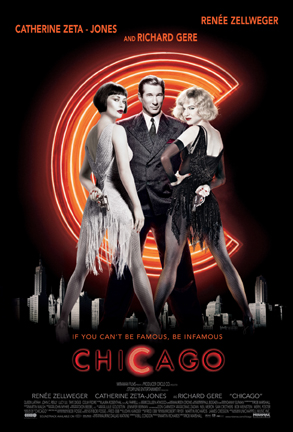
chicagoposter.jpgThe 75th Annual Academy Awards was hosted by Steve Martin. With an impressive 13 Oscar nominations, Chicago is tied with several other films for 2nd largest number of nominations: Best Picture, Best Director, Best Editing, Best Adapted Screenplay, Best Actress (Renée Zellweger), Best Supporting Actress (Catherine Zeta-Jones), Best Supporting Actress (Queen Latifah), Best Supporting Actor (John C. Reilly), Best Cinematography, Best Original Song, Best Costumes, Best Art Direction and Best Sound. After Moulin Rouge the previous year, Chicago was only the second musical to be nominated for Best Picture since Cabaret in the early ’70s.
The film faced stiff competition on multiple fronts, including Scorsese’s Gangs of New York (10 nominations), The Hours (9 nominations) and Roman Polanski’s The Pianist (7 nominations). In the end, The Pianist took Best Director and Best Adapted Screenplay (as well as a Best Actor award for Adrien Brody), Best Actress went to Nicole Kidman from The Hours (that film’s only win), Chris Cooper won Best Supporting Actor for his work in Adaptation, Road to Perdition won Best Cinematography, and an Eminem ballad from 8 Mile took Best Original Song. Chicago was left with the remaining six awards (with Catherine Zeta-Jones beating out Queen Latifah for Best Supporting Actress), a far cry from the possible record of 13. However, it still made out better than the competition. Gangs of New York didn’t win a single award. Chicago became the first musical to win Best Picture since Oliver! in 1968.

Chicago is a stylish, swinging story of jazz and murder in the Roaring Twenties. Famous showgirl Velma Kelly (Zeta-Jones) murders her husband and sister (who are having an affair) one month before would-be stage star Roxie Hart (Zellweger) murders her lover in a fit of pique, gaining instant celebrity which she must then parlay into a ticket away from the gallows with the help of Kelly’s slick lawyer, Billy Flynn (Richard Gere). Flynn, a master at manipulating the media and the justice system alike, puts on a show to remember as he engineers the acquittal of his two notorious clients. John C. Reilly plays Amos, Roxie’s naive stooge of a husband and Queen Latifah is Matron Mama Morton, the warden of the women’s prison. The film’s charming conceit is that Roxie, completely star-struck and obsessed with becoming a big-time performer, re-imagines all of the events transpiring around her as show-stopping musical numbers in an outrageously cynical tour de force.

Chicago, for reasons that I do not understand, is regarded by many as one of the poorest choices the Academy has ever made. Well, for my money, if that goes for Chicago then the same could be said for most of their Best Picture picks that year. Personally, though, I couldn’t disagree more. It may not have been the greatest film to come out in 2002, but it is still an incredibly catchy musical, full of inspired, eye-popping moments of pure entertainment. I’ve probably seen it seven or eight times now, and I’ve listened to the soundtrack countless times. I’m long past the point where I could sing along with every song in the movie. I just never get tired of it.

One of my favorite moments has got to be the song “We Both Reached For the Gun,” were Billy Flynn, controlling Roxie on his knee like a ventriloquist’s dummy, uses her to manipulate the press (who dance to his tune like marionettes as he pulls their strings from overhead) into turning public opinion in Roxie’s favor. The cast is fantastic, surprisingly so considering that many of the stars showcase enormous talents here that most of the public didn’t even know they had (Richard Gere can tap-dance? Really?).

At its heart, though, Chicago is more than just a wild, fun musical ride (although it certainly is that). As it happens, Chicago is only the latest version of one of the most adapted plays of the twentieth century, first written in the mid-1920s by Maurine Dallas Watkins. Watkins had been a reporter in Chicago (just like the film’s Mary Sunshine character) during the sensational murder trials of Belva Gaertner and Beulah Annan in 1924, and she soon adapted their story into a hit play, changing surprisingly little of the substance of their respective stories. 80 years later, it remains surprisingly (and disturbingly) relevant to contemporary society. The questions it raises about how we treat our criminals like celebrities, the lengths the media will go to hold its audience’s attention, and the incredible ease with which this country’s justice system can be manipulated prove that there is nothing terribly new about life in America. The technology and the names have changed, but the situations remain familiar.

Continue reading ‘Chicago: Best Picture, 2002′

There Will Be Blood

•January 25, 2008 • Leave a Comment

therewillbeblood.jpgstarring Daniel Day-Lewis, Paul Dano and Kevin J. O’Connor
written and directed by Paul Thomas Anderson
rated R for some violence.
98%

There Will Be Blood follows 30 years in the life of Daniel Plainview (Day-Lewis), a man who embodies pure ambition, competition and greed. Plainview’s drive and intelligence win him a private fortune in the oil business during the first quarter of the twentieth century, but he leaves an incredible human cost in his wake. His family, his closest associates, and everyone who crosses his path is in danger of having their lives drained from them as surely as Plainview drains his oil fields, but his most intense rivalry is with a charismatic young minister named Eli Sunday (Dano, in a masterful performance which more than matches Day-Lewis’s more hyped work). This is a more savage take on the themes of Citizen Kane: the life of a fictional American who embodies many aspects of the people who built this country. The ending of this film is just as bleak, only without providing any sort of cathartic half-answers to its own questions.

For most of its nearly 2 hours and 40 minutes, There Will Be Blood is magnificent, audacious filmmaking, as ambitious and volatile as its main character. It is a movie that doesn’t feel “safe.” This is not something that you have seen before a hundred times. It is in a class all by itself. The various elements that go into any movie are all here, but they form such a cohesive whole that it is difficult to discuss them one at a time. Paul Thomas Anderson has created a living, breathing work of cinematic art.

Filming (like another of the greatest films of the year) in the midst of the bleak West Texas landscape, the camera captures perfectly the feeling that these characters exist somewhere beyond the edge of civilization. Every performer, from Daniel Day-Lewis’s definitive lead down to the lowliest walk-on extra, matches the look of their surroundings. These are rugged, simple people living a life of bare survival that few of us today can imagine. I am not entirely certain what role visual effects play in the film, so seamlessly are they integrated into their surroundings. There must have been some to produce those geysers of thick black oil and the towering inferno of a gusher on fire, some of the most impressive sights I’ve ever seen on the big screen. But even beyond the large derrick, there are authentic trains, buildings, cars; a feast of images and sounds from life in another age. The score is amazing and organic. Enriching without intruding, it adds more to the mood of the film (and the viewer) than nearly any soundtrack I’ve heard in several years.

There Will Be Blood progresses gradually from order into chaos, descending (as the title promises) into madness and violence as it nears a stunning conclusion. The simple rivalry between Plainview and Sunday escalates, as the decades slip by, into full-scale warfare, and you think that surely the two cannot continue to co-exist forever. One of them will have to go. Sunday proves to be much more like Plainview than either man would care to admit. The two deserve each other. Plainview’s hatred for everyone around him, and especially for Sunday, festers in his mind until he is half-wild with rage and bitterness, even after he has accomplished everything he set out to do.

Unfortunately, the final scene is marred by overacting run amok (something the director really should have reigned in). The events and the ending are entirely believable and appropriate in the context of the movie, but Daniel Day-Lewis begins to almost literally chew the scenery. I was immediately pulled out of the movie by the inescapable observation, “That is someone acting.” The performance was such a contrast to most of his excellent work in the rest of the film, and that made it more jarringly noticeable. While this is the most obvious example, there were various points where everyone involved in putting the film together seems to have lost control of it; almost as though it were a wild bronco that they couldn’t quite stay on top of.

This is not a flawless film, but it is an important and meaningful one, iconic even, and made on such a grand scale that its problems are nearly negated. Absorbing on multiple levels, it is also apt to leave you feeling drained dry and wondering what, exactly, the purpose of all of that was (much as Citizen Kane did to me when I first saw it). It is a demanding film, but for those willing to dig deep and stick with it, also a potentially rewarding one.

Week 4: Easy Virtue (1928)

•January 23, 2008 • Leave a Comment

easyvirtue.jpg“I must ask you to repeat your statement with regard to this decanter.”
“Is that the notorious Mrs. Filton?”
“I love you – that’s all that matters.”
“It’s funny. I thought you’d be dark and foreign-looking!”
“Sarah’s here!”
“John – who is this woman you have pitchforked into the family?”
“In our world we do not understand this code of easy virtue.”
“Shoot! There’s nothing left to kill.”

Easy Virtue

Upon its initial release, The Lodger was of course regarded as a Novello picture rather than a Hitchcock film. Ivor Novello, star of Hitchcock’s first big hit, was much more than a screen actor during his heyday in the 1920s. Quite the fascinating character in his own right, he had written a hit patriotic song in 1917 entitled “Keep the Home Fires Burning” (odd, considering he is supposed to have had a brief affair with caustic anti-war poet Siegfried Sassoon, but that is neither here nor there). Novello proceeded to take both stage and screen by storm, and, as it happens, he was also a prolific playwright.

novellodownhill.jpgNovello’s play Downhill (co-written with Constance Collier) would be the source of Hitchcock’s follow-up to The Lodger. It is the tragic story of an honorable young man who comes to ruin after he takes the fall for a school chum’s scandalous behavior. As for Novello himself, the title aptly describes the remainder of his career. He went to Hollywood briefly a few years later, but couldn’t get a leading man gig (“too English”). MGM stuck him on script-doctoring work instead, where (among other things) he penned the immortal line “Me Tarzan. You Jane.” By this time, Hitchcock’s star was on the rise, and Novello’s was in decline. He died of coronary thrombosis in 1951, and is not much remembered today.

downhill.jpgUnfortunately, while not as lost as The Mountain Eagle, Downhill is currently devilish hard to come by in America. The only existing DVD releases to date have originated in Europe (which would require a special player). This is one of two “major” Hitchcock films which I will be forced to pass over for this reason. Fortunately, though I obviously have no intention of skipping “inferior” Hitchcock in favor of his better, more well-known films, Downhill is reportedly the one to miss if you had to pick. The movie was almost universally reviled upon its release, and it is among that select group that Hitch would have liked very much to disown when looking back in later years.

It’s probably not as bad as all that, but maybe believing that it is will help me get over the existence of a Hitchcock film that I have no opportunity to see. Should it someday become available on this side of the pond (likely) or should I stumble across a downloadable copy on the internet (not ideal, but quite likely), I will add an appendix (or perhaps an apocrypha . . . I like the sound of that) to this project. On a more positive note, skipping Downhill and its rare cousin allows me an opening for a discussion of Hitchcock’s television work later down the line. How’s that for a silver lining?

Downhill was not the last time Hitchcock would be talked into a flop by an actor. However, while he didn’t learn that lesson right away, one has to sympathize with what his feelings must have been when Gainsborough gave him his next assignment: an adaptation of Noel Coward’s Easy Virtue. From all indications, the film version of Easy Virtue played very much like the film version of Downhill, but with a tragic heroine rather than a hero. Now, I know nothing about Ivor Novello as a playwright, but I know Coward. The playwright is widely well-regarded for his razor-sharp dialogue, which makes his work a natural fit for silent film, right? Even Michael Balcon would later regret the decision to bring Coward’s plays to the screen before sound could accompany them.

larita.jpgEasy Virtue follows the trials and tribulations of Larita Filton (Isabel Jeans), an innocent woman who finds herself at the center of a scandal involving abuse, adultery, attempted murder and suicide. The whole sordid affair takes the British media by storm when it spills out in a messy divorce trial. Larita, disgraced and divorced but still fairly wealthy, flees to the south of France to hide from the fallout and try to forget everything. By the picturesque shores of the Mediterranean, she meets and falls in love with young John Whittaker (Robin Irvine), a fresh-faced young fellow whose family has a large country estate. They are married and return to the ancestral manse, where John’s mother develops an immediate distaste for Larita. Mrs. Whittaker (Violet Farebrother) makes her daughter-in-law’s life a living hell, but there is worse yet to come. The Whittakers have not yet connected Larita with her dark past.

monocle.jpgThe film begins in a courtroom, and most of the story it has to tell is packed in right here at the beginning. Hitch burns most of his fun camera tricks right up front, as well. As a very poor substitute for the presumably snappier dialogue of the stage version, Easy Virtue throws literal walls of text at the screen in its intertitles, not just here but throughout the production. In fact, the opening shot is of a densely-worded legal document. The judge presiding over the hearing looks up from the brief to stare grimly at the camera before we follow his gaze to the rest of the courtroom. Hitch employs the same gimmick here that he used at the beginning of The Pleasure Garden, although in this case it’s the nearsighted judge whose monocle brings images into focus. The subtext of this scene, in contrast to the creepy voyeurism of the earlier film, is an indication that justice is as blind as its presiding representative.

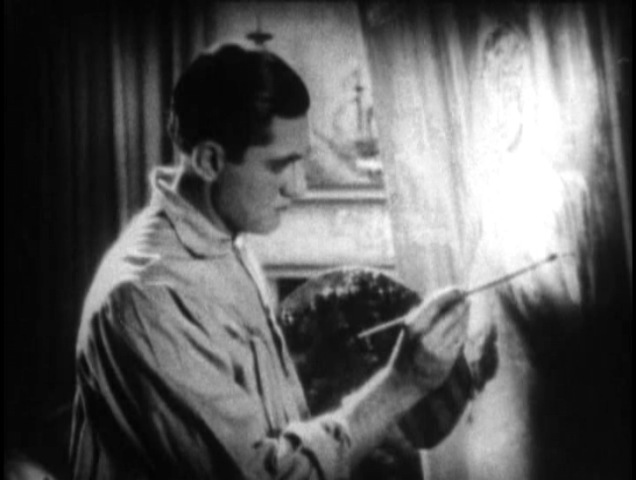
portrait.jpgLarita is in the dock, getting grilled by her husband’s counsel (Ian Hunter) and her story runs something like this: When it all began, she was sitting for a portrait by a young, famous and talented artist named Claude Robson. Over the course of the artistic process, he began to grow rather fond of her. Her husband is a drunken lout, and physically abusive besides, and Claude pities his client’s plight. Allowing his pity to grow into love, he writes her a passionate letter and the next time she comes to sit for him he makes advances.

drubbing.jpgShe is in the process of rejecting him gently when her husband appears at an inopportune moment. As Claude backs away, Mr. Filton advances threateningly with his cane. Here things get a bit crazy. Claude pulls a handgun out of a drawer and plugs Filton, who falls to the floor after whaling on the artist with his cane for a few seconds. Larita rushes to his side while the maid runs for help. As the police arrive, Claude (who seems to be pretty well out of his head by this point) shoots himself. Filton makes a full recovery, but is convinced his wife was two-timing him. Unfortunately for Larita’s credibility, Claude has left all of his money to her.

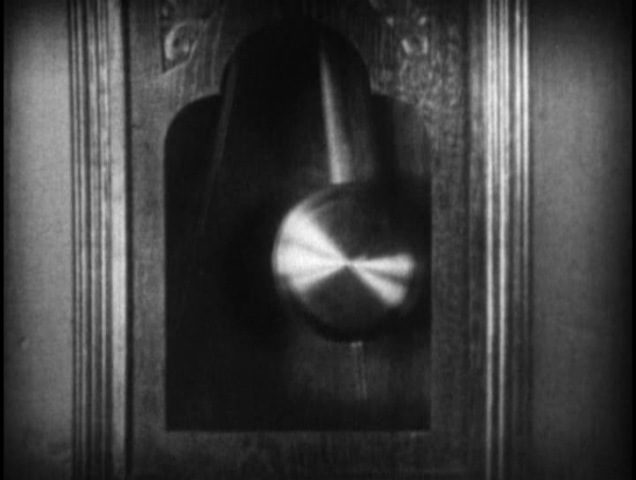
pendulum1.jpgThe story is told in several pieces, cutting between the lawyer’s questions (and the court’s reaction to the answers), and flashbacks to the actual events via a series of clever transitions. Most of the transitions hinge around various pieces of evidence, as though these objects maintain some sort of psychic link with the events of the past. However, the most skillfull visual device in the scene has thependulum2.jpg judge’s swinging monocle transform into a swinging pendulum and back again to indicate the passage of time in the story. Having heard all of the evidence, and all too willing to entertain the most scandalous of possibilities, the jury finds Larita guilty of misconduct. Her reputation in tatters, she exits the building and walks right into a pack of predatory paparazzi photographers.

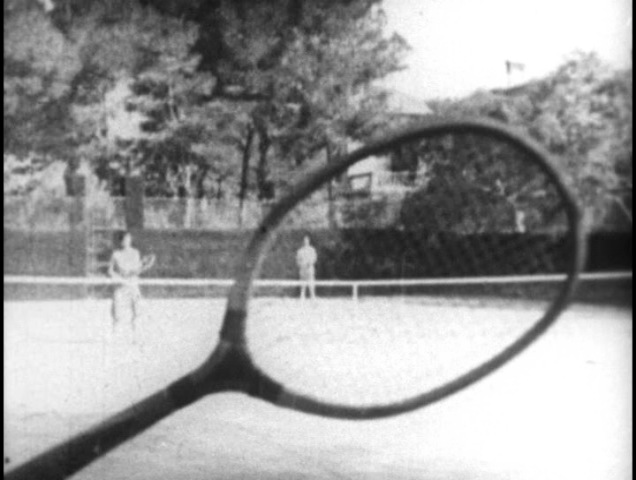
Speaking of feral cameramen, there is an interesting leitmotif attached to Larita’s character throughout Easy Virtue. Lenses of various kinds: monocles, cameras (note the silhouette behind the opening titles above), and even one unique shot through a tennis racquet all point to a warping of Larita’s true image by everyone around her. People cannot see her for who she really is, they can only see her through the distorting lens of their own presuppositions. The artificiality of outward perceptions is further reinforced by images of Larita’s portrait and shots of her reflection in various mirrors.

lens1.jpglens2.jpglens3.jpg


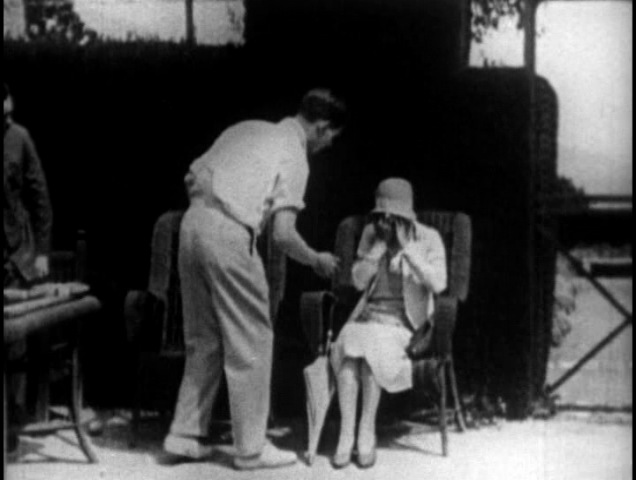
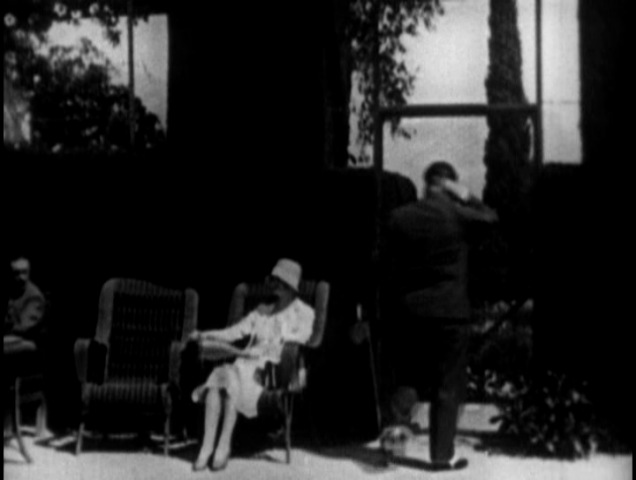
ballface.jpgUnwilling to face the attentions of the press, she leaves England and takes up residence in a hotel under an assumed name, praying that no one will recognize her and she will be left alone. However, as she suns herself by the tennis courts one morning (and, really, what a silly place to sit) John Whittaker beans her in the face with a ball. He is mortified and frightfully apologetic, and demands that she allow him to tend to her woundeasyvirtuecameo.jpg (an unsightly bruise). Hitchcock’s cameo zips by right before the meet-cute takes place. He strolls past Larita with a walking stick and slips out through a gap in the hedge next to her. Had he dawdled a few more seconds, the ball would have hit him instead and he might have been able to alter the course of the plot in a more interesting direction (but that’s hardly a productive observation, is it?).

Larita and John whizz through a whirlwind courtship, and before long, on a long carriage ride amidst the beautiful Mediterranean scenery, he pops the question. She declines to answer right away, promising to telephone him later on. This slight delay prompts my absolute favorite scene in the movie, and one of the most imaginative and unconventional touches Hitchcock’s early career had yet produced. Late that night, Larita calls John up to give him her answer.

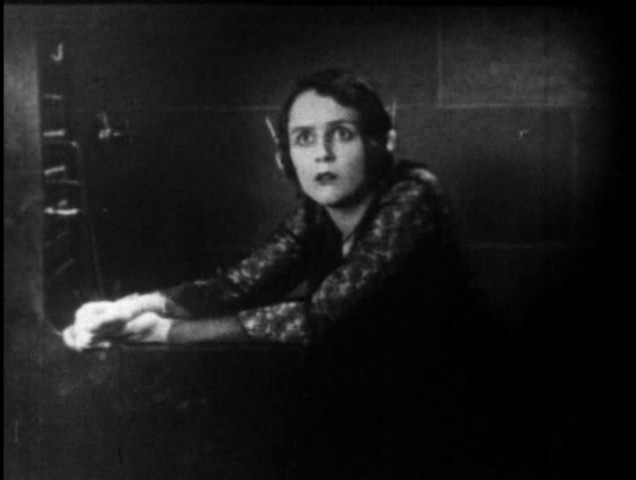
operator1.jpgNow, rather than show us the conversation by cutting back and forth between the two participants or resorting to a more complex overlay or split-screen shot and a crude “Yes” or “No” title card, Hitchcock relays the whole exchange through the reactions of the bored switchboard operator who connects the call. At first she barely looks up from her book, but after a few seconds she is staring off into space, wholly absorbed in eavesdropping on these two strangers. Her face changes from happy to surprised to anxious and back again so many times that one can hardly imagine what Larita can be saying , but the expressions are so priceless that one hardly cares. At any rate, an immensely satisfied look and a hand to the heart at the end of the scene tells us everything we need to know.

operator2.jpgoperator3.jpgoperator4.jpg

mother.jpgThe newlyweds head back to John’s “people” and Larita has great hopes for a new and happier life. Mr. Whittaker turns out to be all right and John’s two sisters are welcoming enough at first, but Mother Whittaker is a frightening hag of a woman whose severe gaze could curdle fresh milk. She is as menacing a mother-figure as appears (almost) anywhere in Hitchcock’s films. And just to add an extra layer of awkward to the situation, Mrs. Whittaker has invited Sarah, the woman she always wanted John to marry, over for dinner.

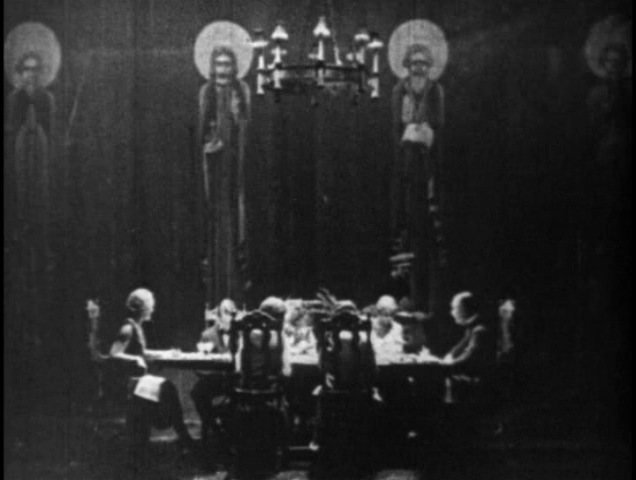
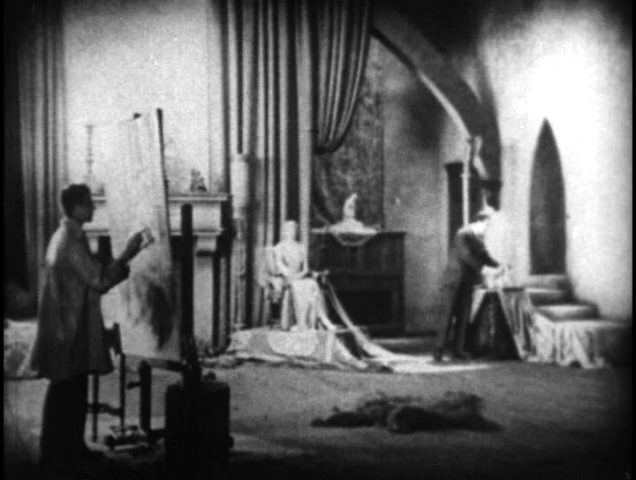
interior1.jpgThe dining room, decorated with medieval paintings of saints (possibly even Christ and his disciples), is terrifying. It’s a wonder anyone can eat in such a room. Actually, all of the interiors in Easy Virtue are noticeably minimalist . . . either extremely cheap or daringly expressionistic, take your pick. Knowing Hitchcock, he probably killed two birds with one stone by accommodating both. The courtroom, the artist’s studio, the French hotel, and even the Whittaker estate are all clearly low-budget sets, but they are undeniably striking and functional in a stagy sort of way.

interior2.jpginterior3.jpginterior4.jpg

scarf.jpgLife at the Whittaker home proves to be quite oppressive, and Larita is quietly miserable there, chain-smoking cigarettes as she buries herself in thick books whenever possible. Throughout these scenes at the Whittaker estate, Larita’s costumes feature trailing scarves, over-sized fans, and various other accessories that drag, dangle and trail in her wake. Despite her desperation to keep her emotional baggage under wraps, the truth about her past follows her everywhere she goes, both visually and psychologically. Mrs. Whittaker immediately suspects her of hiding something, and it is only a matter of time before these suspicions are confirmed.

Larita senses that her time is growing short when her ex-husband’s lawyer turns out to be an old family friend, but in the end he isn’t the one that rats her out. Mrs. Whittaker and one of her daughters make the connection themselves, digging up an old photo of her in the gossip rags they keep around the house. By this time, John has already been growing steadily indifferent towards Larita, his affections poisoned by his mother despite Sarah’s best attempts to talk him into standing by his wife. She turns out to be a rather decent sort, after all . . . either that or she’s just grateful to Larita for saving her from a mother-in-law worse than death.

The Whittakers make their fateful discovery on the afternoon before a big party, and Mrs. Whittaker all but orders Larita to keep to her room while the guests are around. The old crone peddles the excuse that her daughter-in-law has “one of her headaches” to any guest that inquires, but Larita has ideas of her own. She waits until everyone has arrived and then makes a grand entrance that stops the party dead in its tracks while everyone watches her slow, measured descent down the stairs. Mrs. Whittaker rushes forward quickly to cover her tail, “So your headache’s better, my dear?” But Larita is having none of it. “Headache? I haven’t had a headache,” she coolly replies before sweeping past.

party1.jpgparty2.jpgparty3.jpg

Crashing the party proves to be a final, meaningless act of defiance. Larita tells Sarah later that evening that she intends to go away and accept a divorce without making a fuss. Heartbroken once more and dressed in funereal black, she sits in the nearly empty balcony of the courtroom as the same judge presides over the case. A lone reporter recognizes her and rushes out to inform his colleagues that the “notorious” Mrs. Filton is present. The paparazzi is waiting when she comes out, but this time she reacts differently. Striking a ridiculous pose, she covers her heart with her hand and declares “Shoot! There’s nothing left to kill.”

nothingleft.jpg“The worst title I ever wrote,” Hitchcock would later observe in a famous and lengthy interview with French critic and New Wave filmmaker François Truffaut. I cannot but agree. It is an over-the-top ending to a rather purposelessly somber piece of filmmaking. But try this on for size: A romantic courtship with someone who wants to forget their past life. A scandalous secret that threatens the couple’s new-found happiness. A menacing old country mansion ruled with an iron fist by a severe older woman. Does any of this sound familiar? Well, it should. Easy Virtue bears a surprising resemblance to Hitchcock’s first American film, the wildly successful adaptation of Daphne du Maurier’s best-selling Rebecca (which wouldn’t even be written for another decade). Although, in addition to the sinister Mrs. Danvers, Mrs. Whittaker also anticipates Norman Bates’ domineering mother figure. The differences between the two works are more numerous than the similarities, of course, but one has to wonder what Easy Virtue might have looked like with the addition of sound and that extra decade or so of experience Hitchcock had when he made Rebecca.

As it is, the result is watchable, but by no means likable. Of the films Hitchcock had made by this point, this one is easily the most deserving of a mocking commentary track running constantly in the background to keep things entertaining (which I happily provided). Still, to his credit, Hitch didn’t select or particularly care for the material he was assigned. Happily (at least in some respects), his next film would give him the opportunity to really call the shots and put the technical knowledge he was continuing to amass to full use.

Next Week: Hitchcock puts up his dukes

2008: An Oscar Primer

•January 22, 2008 • 1 Comment

oscarposter80.jpgI was up bright and early this morning for the live Oscar nominations announcement, mostly because I had never seen it done before and I was curious. It was kind of exciting, that little extra bit of suspense as the nominees were announced one by one for each of the major categories. Now the countdown really begins for me: one month to see whatever I’ve missed thus far, if I can. Happily I’m much further ahead of the game than I was last year. Unfortunately, that means I have a lot more to say . . . but anyway, here’s how the nominees are stacking, starting with the five nominees for Best Picture (full list of all nominees here):

There Will Be Blood – Definitely not a surprise, this is one of the two that I have not yet seen. I discovered just last night, however, that it will be released in my town on Friday, and I will certainly be there. I’ve been excited about this film for a few months now. I was intrigued by the first trailer I saw, and when buzz started coming back that it was the best film of the year I became quite anxious to see it. There Will Be Blood has been nominated for 7 additional awards: Best Director, Best Actor (Daniel Day-Lewis), Best Editing, Best Adapted Screenplay, Best Cinematography, Best Art Direction and Best Sound Editing. None of those is particularly surprising.

No Country for Old Men – So far, this is my favorite film of the year and personal pick for Best Picture (but I’m open-minded about what I may say after Friday). This is, quite simply, a flawless film. I’ve seen it three times in the theater, and I look forward to bringing it home on DVD to see many more times. No Country for Old Men has also netted 7 more nominations: Best Director, Best Editing, Best Adapted Screenplay, Best Cinematography, Best Supporting Actor (Javier Bardem), Best Sound and Best Sound Editing. Again, no real surprises here . . . but how unfortunate, because no matter how excellent both of them are, chances are that one of these films will walk away with all of the shared awards leaving the other one pretty much high and dry (see last year, Babel took home one statue). This may just be one of those years that you wish could have spilled over into some year that had far less interesting entries. One example of that for me is 1984, when both the magnificent Amadeus and the excellent A Passage to India squared off with the former sweeping up all of the awards.

Atonement – This is the third film that had a definite lock on the category. Atonement is quite good, even great, and it too has a pretty good chance to win . . . it pretty well qualifies as Oscar bait. This would be the obvious, “safe” choice for voters what with its sweeping love story set against a compelling historical backdrop (always a favorite combination). However, I think it would be an unfortunate choice given the caliber of those first two. Atonement has 6 other nominations, mostly in “Ooo, how pretty” categories: Best Adapted Screenplay, Best Cinematography, Best Supporting Actress (Saoirse Ronan), Best Art Direction, Best Costumes and Best Original Score. I certainly expected four of those nominations, and hoped for the last (Atonement has a beautiful and unique score). As for Ronan, she is quite good . . . a young nominee, though three years older than Abigail Breslin was last year. I don’t think she’ll win.

Juno – As I said a few days ago, Juno is this year’s Little Miss Sunshine. I’ll be honest and say that, though I’ve seen this movie twice and enjoyed it both times, I hope that it doesn’t have a prayer to take the big award. I’m happy to see it nominated, but it would be a dreadful mistake to give this movie Best Picture, because it simply is not by a long shot. Juno has only 3 more nomations: Best Director, Best Actress (Ellen Page) and Best Original Screenplay. That list is also in order of most to least surprising . . . and almost in order of most to least deserving (I’d swap the first and second). Seeing Ellen Page nominated is fantastic, and I’d certainly like to see her walk off with the award. I’d be far less happy with Cody winning for her screenplay, which (despite its cleverness) is rather hackneyed in more than one spot. It’s just all over the map, and there are more deserving nominees (and that, in a nutshell, would be my objection to a Best Picture win).

Michael Clayton – This is the one film that I’ve just completely missed seeing . . . I let opportunities to visit it in theaters pass me by several times because I wasn’t certain I’d like it. Now it’s slated for DVD release about 5 days before the Oscars are aired, so I should be able to slip in a viewing at the end. However, from what I hear, this is by far the least likely nominee to take the award . . . it’s not even the dark horse candidate that a lot of people are secretly hoping will win (see Juno). It’s just there. It does, however, have 6 more nominations to its name: Best Director, Best Actor (George Clooney), Best Supporting Actor (Tom Wilkinson), Best Supporting Actress (Tilda Swinton), Best Original Screenplay and Best Original Score. That makes Michael Clayton this year’s big acting Oscar bonanza (no film has ever won more than 3).

Speaking of the actors, there aren’t many odd elements this year . . . no actors who have been passed over far too many times in the past (*cough*Peter O’Toole*cough*) or complete newcomers that have everyone buzzing. At least 5 of the acting nominations represent the only nomination that particular film received, and 5 more only have a single additional nomination, which seems unusual. 4 of the 5 Best Picture nominees have only a single acting nomination. And, of course, Cate Blanchett is double trouble this year, with a Best Actress nomination for Elizabeth: The Golden Age and the expected Best Supporting for I’m Not There. Multiple nominations in the same year are rare, but not unheard of.

The nominees that I’ve seen:

-Ratatouille, an astounding 5 nominations, including Best Original Screenplay . . . fantastic.
-Sweeney Todd, 3 nominations, all well-deserved (though it stands little chance of taking any of them home).
-Enchanted, 3 nominations, all for Best Original Song. It eats the category alive, and the songs are great (though I don’t think much of the generic “So Close”), but nominations like this can cancel each other out and lead to 0 awards (see Dreamgirls) even when one is richly deserved. Sad to see Amy Adams ignored for her performance, though. I don’t like to judge performances I haven’t seen, but for those of you who have, how much of the Elizabeth nomination is merely coasting on the coattails of the supposedly superior original?
Away from Her, 2 nominations, including a nod to Sarah Polley for her impressive screenplay.
The Savages, 2 nominations
American Gangster, 2 nominations . . . I thought it was a decent flick, but it just got lost in the mass of 2007 excellence. It certainly deserved some more acting nods, though.
Pirates of the Caribbean: At World’s End, 2 nominations
3:10 to Yuma, 2 nominations . . . I liked this a lot more than it probably deserved, but there it is.
Charlie Wilson’s War, 1 nomination, for Philip Seymour Hoffman’s hilarious, great character work (with 3 fantastic performances this year, he had a virtual lock on some recognition).
Gone Baby Gone, 1 nomination . . . No doubt the most criminally ignored film of the year. This movie was hard but rewarding, a great directorial debut that deserved a nomination more than, say, Jason Reitman.
-Lars and the Real Girl, 1 nomination . . . See above, redux. No love for Ryan Gosling’s truly transcendental work, and that’s a real shame.
Across the Universe, 1 nomination . . . About right, from where I’m sitting. I was underwhelmed.
Surf’s Up, 1 nomination . . . Frankly, I was very surprised to see this nominated. I’d forgotten it was even in the running. But I was even more surprised when I watched it during the holiday season and discovered a hilarious and surprisingly impressive cartoon mockumentary. I’d have liked to see The Simpsons Movie in its place, but I can’t say it didn’t deserve the spot. Neither of them should win, in any case, as the real contest is between the other two nominees: Ratatouille and Persepolis.

The nominees that I have definite plans to see:

There Will Be Blood . . . This Friday! Yes!
Michael Clayton . . . Just as soon as it gets to DVD.
The Bourne Ultimatum, 3 nominations . . . I had several opportunities to see this, but I let them pass me by because I was so disgusted by the style (though not the substance) of the second installment. It’s near the top of my Netflix queue, and hopefully a viewing on the small screen won’t give me a headache the way its predecessor did.
La Vie en Rose, 3 nominations . . . Ditto with the Netflix queue. I’ll probably see it pretty soon.
The Assassination of Jesse James by the Coward Robert Ford, 2 nominations . . . I’ve been wanting to see it since it came out, but the opportunity never arrived. It hits DVD in just a few weeks.
I’m Not There, 1 nomination . . . I’m not terribly anxious, but I’m intrigued. I’ll be waiting when it finally comes out on DVD, unless it somehow gets a theatrical release nearby first.
Persepolis, 1 nomination . . . Really want to see this, and really disappointed that opportunity hasn’t knocked yet.

The nominees that I have little or no interest in seeing (but may anyway):

The Diving Bell and the Butterfly, 4 nominations . . . I feel like a real philistine, but this just sounds excruciatingly boring.
Into the Wild, 3 nominations . . . Ditto above, but without the shame (I guess that would make me more of a philistine).
Transformers, 3 nominations
Elizabeth: The Golden Age, 2 nominations . . . Didn’t everyone pretty much hate this? Everyone but The Academy, it seems.
The Golden Compass, 2 nominations . . . I’m all for a good fantasy romp, this just didn’t end up sounding like it was one.
In the Valley of Elah, 1 nomination . . . Ho-hum, the only Iraq war film to be recognized.
Eastern Promises, 1 nomination . . . I was seriously underwhelmed by A History of Violence
-Norbit
, 1 nomination . . . Ha!
August Rush, 1 nomination . . . This looked outrageously cheesy to me from the get-go.
Once, 1 nomination

The Best Documentaries are generally worth a look, but I can’t really comment just at present because I haven’t seen any of them. No, not even Sicko. Likewise the Best Foreign Film nominees . . . I am ashamed to admit that I’ve only even heard of two of them. The nominated countries are Austria (World War II flick), Poland (likewise), Israel (anti-war war film), Kazakhstan (film about the early life of Genghis Khan, nice comeback after last year’s egregious Borat nomination) and Russia (adapted remake of 12 Angry Men). The titles, respectively, are The Counterfeiters, Katyn, Beaufort, Mongol and 12.

The non-minees, neglected movies that made me ask “What happened?” (this list is no doubt incomplete:

The King of Kong, weren’t people calling this the best documentary, and one of the best movies, of the year? I haven’t seen it yet, but I was expecting it to show up on the nomination list.
Zodiac, I can’t shake the nagging sensation that this film will ultimately have more staying power than many of even the rather prominent nominees. I’m a bit surprised it was so completely ignored, but then the Academy does have an extremely short memory and this movie did come out way back in . . . what, March? Nevertheless, I feel like I want to see it again right now just to confirm that an injustice has indeed been done (as I feel it has).
Hairspray, I guess Sweeney Todd came along and (rightly) stole all of the musical-to-movie thunder. But seriously, assuming Norbit was nominated for Best Makeup because it had a fat suit, why not give that nomination to Hairspray and save yourself the embarassment of forever after seeing “Nominated for an Academy Award!” on the Norbit DVD box?
Stardust, Sure it was mediocre in some departments (and became more so each time I watched it), but it had its moments and a few elements that were at least as worthy of note as several of the nominees in the technical categories. No props for makeup? visual effects? sound? music? Oh, well.
Before the Devil Knows You’re Dead, another one I haven’t seen, but it got some very positive attention, not least as the vehicle for one of the great performances that Philip Seymour Hoffman was not nominated for. I get the feeling I could just as easily be asking this question about Charlie Wilson’s War instead.

And now for my annual haphazard predictions and desires:

Best Picture: If There Will Be Blood doesn’t win (read: it was too dark), Atonement will (I don’t see that happening). I’d certainly love to see the award go to No Country for Old Men . . . Juno is capturing a lot of hearts, but I really don’t think it has a prayer.

Best Director: Pretty much a toss-up between Paul Thomas Anderson and the Coen Brothers. I’ll call it for the latter.

Best Actor: All indications point to Daniel Day-Lewis as having delivered a once-in-a-lifetime performance in There Will Be Blood. What little I’ve seen indicates Day-Lewis should get it, but I’ll go ahead and throw Johnny Depp out there as a personal favorite. The man’s much-deserved Oscar moment has yet to arrive, but I don’t think this is his year.

Best Actress: I’m calling this one for Ellen Page, both as a personal favorite and because I think she could/should win it.

Best Supporting Actor: This is a pretty rough call, but I’m going to go with Hoffman as the Academy favorite. Personal pick: Javier Bardem, both because he is outrageously good in the movie and because I want to see No Country for Old Men score as many awards as possible where it isn’t competing with the juggernaut-like power of There Will Be Blood.

Best Supporting Actress: The award will go to Cate Blanchett, I’m fairly certain. I’d really like to see Amy Ryan get it, again because her performance merits an award and because Gone Baby Gone deserves the recognition. Just see the movie, people!

Best Original Screenplay: The award will most likely go to Juno, possibly the only one that will. I’d like to see Lars and the Real Girl win its one crumb from the table, but this could well be a Ratatouille year. Either of them would be more deserving than Juno.

Best Adapted Screenplay: No Country for Old Men, as the perfect-storm adaptation that stays extremely faithful to its source while meshing flawlessly with the style of its directors.

Best Cinematography: A very rough call . . . I’ll go with There Will Be Blood with a hope and a prayer for No Country for Old Men. And no counting out The Assassination of Jesse James by the Coward Robert Ford.

Best Editing: I don’t think most of the people who vote on this award even know what it means, but I do know that roughly half the time the award goes to the Best Picture winner. As such, I’ll go with the odds and give it to There Will Be Blood, sight unseen. No Country for Old Men is edited extremely well, so I may swap out my prediction once I’ve seen my current pick. Incidentally, I haven’t seen The Bourne Ultimatum yet, but judging from The Bourne Supremacy I have to wonder if it was one of those movies that was nominated for most editing rather than best.

Best Art Direction: Atonement, as a consolation prize when it fails to win any of the really major awards. I’d prefer a Sweeney Todd win, though . . . that movie’s look was just delicious.

Best Costumes: Same as Art Direction, for the same reasons (though in this case, I think Atonement is slightly more deserving than Sweeney Todd).

Best Original Score: Atonement, see above.

Best Original Song: Enchanted, “That’s How You Know” . . . Fantastic song, beautifully-staged, catchy . . . the works. I love this song.

Best Animated Film: Will the popularity of Pixar and Ratatouille or the critical acclaim and exoticness of Persepolis win the day? I have no idea, but I’m sure both are very deserving. Only one thing is for certain: The award won’t go to Surf’s Up.

And that’s my take on the 80th batch of Oscar nominees, for what it’s worth. Discuss.