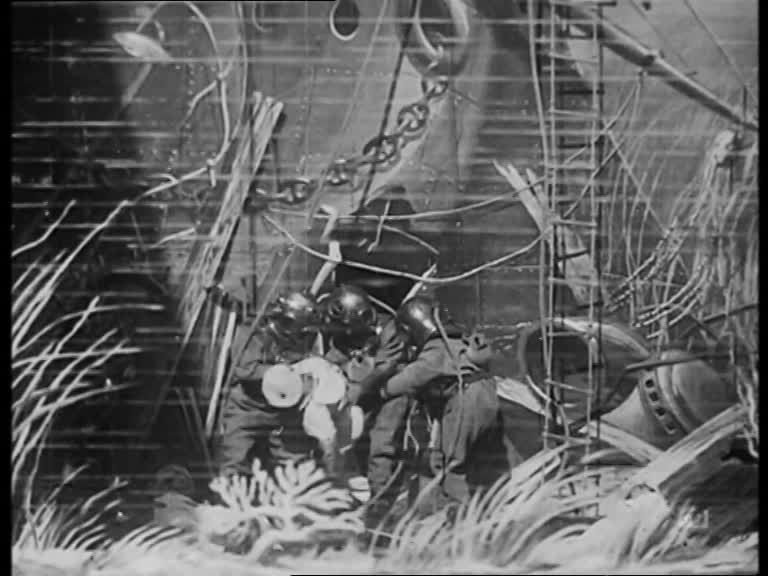
(English: Divers at Work on the Wreck of the “Maine”)
Summary:
Two men work in and around the wreckage of a ship on the ocean floor as a third man descends a ladder to join them. One removes the dead body of a sailor from the interior of the ship and they send it to the surface attached to a rope. The third man ascends the ladder again as the other two continue working.
Essentials:
The wreck of the Maine
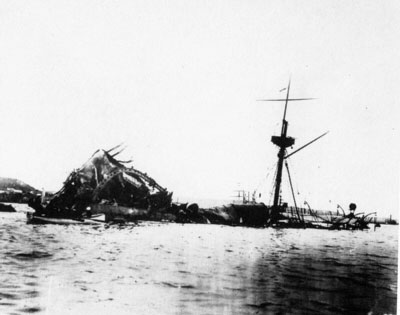
It was late evening on 15 February 1898 when a massive explosion erupted in the middle of Havana Harbor, shattering the stillness that had existed only moments before. The explosion ripped apart the forward section of the USS Maine, an American battleship that had arrived three weeks earlier, and the vessel sank rapidly to the bottom of the harbor. Three-quarters of the ship’s 355-member crew either drowned or died in the explosion, and of the survivors, only 16 were unharmed.
The cause of this tragedy was both mysterious and extremely consequential. The Maine had come to an island consumed by conflict. It was the third year of the Cuban War of Independence, and American sentiment was very much behind the Cubans, and in favor of supporting them in their fight. After Spanish loyalists began rioting in Havana, President McKinley, though resistant to calls for war, sent the Maine, ostensibly to “safeguard” American citizens in Cuba. Was the sinking of the ship the result of hostile action by Spain?
A Naval court of inquiry collected evidence and spoke to witnesses, and a month later returned a report that claimed the ship had been sunk by a mine. There were a number of problems with the Navy’s inquiry, and a contemporary Spanish report found, with a great deal of evidence, that the explosion had been caused by a fire in the coal bunker, which was located next to the ship’s munitions. Several subsequent investigations have been divided as to the cause, and there is still no definitive answer. However, certainly Spain had no reason to want the Americans involved in their conflict with Cuba.
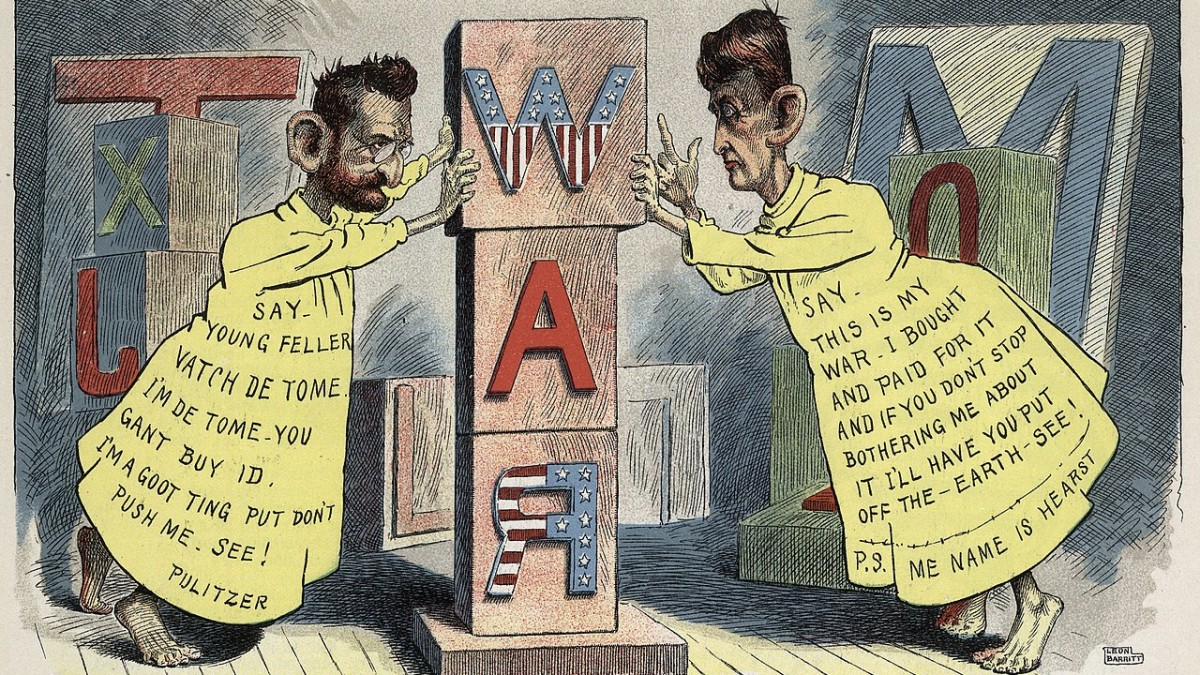
“Yellow journalists” Pulitzer and Hearst, dressed as “The Yellow Kid” from a popular comic they both featured, fight over coverage of the war they helped sell.
In the end, though, the truth behind what happened to the Maine didn’t matter at all. The incident became fodder for a circulation war between William Randolph Hearst’s New York Journal and Joseph Pulitzer’s New York World. They turned the incident into a rallying cry, and splashed sensationalized accounts of Spanish atrocities in Cuba across their front pages, whipping anti-Spanish public sentiment into a frenzy. By the end of April, Spain and the United States were at war.
Meanwhile, Georges Méliès recognized that the Maine tragedy would make an excellent subject for his own twist on the Lumière brothers’ “actuality” genre: actualités reconstituées (reconstructed actualities). These were, as the name suggests, staged reenactments of current events. Méliès had first experimented with this idea in 1897, making a series of films based on the events of the brief Greco-Turkish War. For one of these films, Combat Naval en Grèce, he constructed a ship set that actually pitched and rolled back and forth to simulate the motion at sea. He used this same set not long after for another film, as well. That same year, he made two additional reconstructed actualities about revolts against the British in India. Clearly, armed conflict was an excellent source of material for the genre.
Visite Sous-Marine du Maine is the last in what was likely a series of three films (the others are believed lost). These were probably released before war was even declared, and perhaps even before any of the investigations into the cause of the explosion were complete. If that seems a bit ghoulish, irresponsible, and opportunistic by modern standards, it was certainly well within the mainstream at the time. What wasn’t in the mainstream was Méliès’s innovative method for simulating an underwater scene.
Underwater photography was just beginning to be seriously developed, but the first film shot underwater was still many years away. Méliès achieved his effect by putting a strip of gauze over the lens, and then placing a fish tank directly in front of the camera. It’s an ingenious device that, even if it doesn’t quite pass muster, still creates the desired result, and looks great.
Although the effect is quite good, the resulting film likely didn’t deceive most audiences of the time, nor was it intended to. Other filmmakers were known to have staged fake events and then marketed them as the real thing (and it’s possible some less scrupulous exhibitors did the same with Méliès’s film), but Méliès himself did not. However, it would not be at all surprising to learn that many viewers, despite knowing they were not watching actual footage of the wreck of the Maine, did believe that Méliès had somehow divined a way to stage and film his reenactment underwater. Few people would have had any frame of reference for what such a scene might actually look like.
Screening:
Méliès’s method of filming “underwater” drew on existing stagecraft for depicting similar settings. Still, he must have been extremely pleased by how well the effect translated to film. In fact, he employed it several more times throughout his career, with the same success each time. The divers are quite convincing, as well, as are the diving suits. Even if they aren’t the real thing, they certainly look like they are. The hole in the ship’s hull is very small, and also seems to have been made to look like it has blown outward. This is probably due to a lack of information and the constraints of production limitations, rather than any political stance.
The one genuine weakness is the poor quality of the dummy representing a drowned sailor. Knowing that Méliès was absolutely capable of producing a much more life-like prop suggests that this may be at least somewhat deliberate. A more realistic depiction of a drowned body might, at best, be considered to be in very poor taste, and could have been off-putting to audiences. The goal here was to excite interest, not to shock or horrify.
An astronomer is alternately tormented by a devil and watched over by a benevolent fairy as he experiences a strange and incredible dream. The moon visits his astronomy tower, appearing in various different forms, but mostly as a ravenous, devouring face that threatens to consume him.
Essentials:
It would be easy to overstate the contrast between the increasing sophistication of Georges Méliès’s fantastical films and almost anything else that was being made at the time. By the beginning of 1898, a few other filmmakers were experimenting with some of the same ideas and techniques, but Méliès had been developing his style and skills for nearly two years. Fundamentally though, no one else was yet attempting the kinds of movies that Méliès was starting to specialize in, and certainly not on the same scale. He had a recognizable artistic vision unlike that of any other 19th century filmmaker.
This may have had something to do with Méliès’s unique role (among other filmmakers of his day) as someone who was primarily an entertainer, rather than primarily an inventor, or an engineer, or a photographer, etc. What’s more he already owned a theater, and had connections with (and even employed) other performers. Presumably he also already had facilities for, and experience in, making sets and props. In addition, as one of the few filmmakers who was also exhibiting his own films (in his own theater), he would have had direct insight into what audiences were responding to.
Given all of that, it should come as no surprise that La Lune à un Mètre is reportedly based on a magic act that he had staged several years earlier, called “Les Farces de la Lune ou les Mésaventures de Nostradamus.” Of course Méliès himself plays the astronomer with his characteristic animation and energy, and Jeanne d’Alcy is “Phoebe,” the good fairy. This adaptation (which may only have been “loosely inspired by” the earlier show) seems short for a magic act, but it was still long for a motion picture. At over three minutes, it was among the longest of the hundreds of films released in 1898, and its stage magic origins are fully visible in the many and varied tricks that it employs.
Screening:
Méliès continues to use the stop trick to great effect throughout this film. The trick is not really possible to disguise. It’s inherently obvious because the point of it is usually to make something visibly appear or disappear on the screen. However, Méliès’s execution of the trick is increasingly seamless. He has eliminated all but the smallest movements between edits, and often shoots the trick in such a way that any slight shifts are rendered invisible. For instance, there is a moment where the astronomer rushes forward to embrace the beautiful moon goddess, only to collide with a statue of a knight that suddenly appears in front of him. Any shifts that happened between one moment and the next are disguised, not only by the fact that the scene picks up with the completion of the astronomer’s motion after the stop, but by the fact that an entire section of the set changes behind him as well.
When Méliès made Le Manoir du Diable in 1896, it was little more than a showcase for a whole series of stop tricks. Here, though, the real spectacle is provided by the elaborate sets and costumes, and particularly by the enormous moon puppet, with a mouth that opens and closes (and both consumes and disgorges!), and eyes and eyebrows that move independently. There is also the smaller, and slightly less elaborate, moon puppet that gives the illusion of the moon having moved back from the balcony. And there is what seems to be the smallest puppet of all, near the beginning, when the astronomer’s chalk drawing appears to animate. This is a particularly good illusion, as it does actually at first look like it is an animation effect of some kind.
Of all the tricks the film employs, though, the final one is certainly the most impressive. After the astronomer has been chewed up and spit back out in several pieces by the moon, the good fairy reappears to banish the devil and rescue him. As the fairy throws each piece of the astronomer’s body back into the moon’s mouth, they reappear in the chair on the right side of the frame, reassembling him piece by piece until she walks forward to reattach his right arm herself and return him fully to life. The effect works because the fake pieces of the astronomer’s body are very lifelike (particularly the head), and because each piece appears in the chair with virtually no detectable change to the rest of the scene. It is either an incredibly skillful use of the stop trick, or a double exposure, but either way it is incredibly effective.
An unknown dancer, likely in Rome, performs a version of Loie Fuller’s famous Serpentine Dance. She spins and waves her arms, causing her dress to transform into various shapes before our eyes. Her dress, painstakingly hand-tinted, changes colors as she moves.
Essentials:
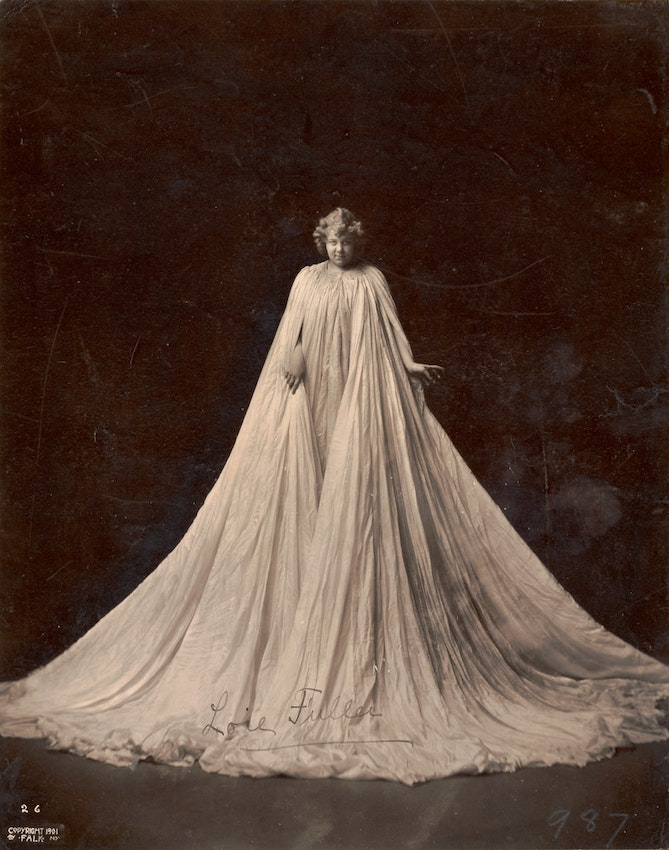
Loie Fuller began her career on the stage as a child, and by her late teens she had achieved a certain amount of success and recognition as a comedic actress. In her autobiography, Fifteen Years of a Dancer’s Life, she gives a fascinating account of how, while playing a role as the subject of a hypnotist, she happened to stumble into the effect that she would go on to develop into one of the most famous dances of the 1890s. All on her own she carefully practiced the dance, designed the costumes that would emphasize its movements, and planned the lighting effects that helped to distinguish it. Her only problem then was to convince any theatrical manager to take a chance putting her on the stage in a type of act for which she was totally unknown.
The result was a string of bad experiences. Her act, once she secured a venue, was popular with audiences, but she found herself working for a series of managers who exploited her, who ultimately stole her dance and gave it to other performers, and the last of whom left her stranded in Berlin with no work. The first of these men gave her dance the name that it would become famous under. In reality, Fuller’s varied movements simulated a number of things in nature: butterflies, orchids, clouds, and more. Nevertheless her style was to be forever known as the “serpentine dance.”
Fuller now resolved to make her way to Paris in the hopes that she might find more appreciation there. She was disturbed, upon her arrival in October 1892, to find that the serpentine dance had preceded her. In fact, it was already on the program at the Folies Bergère, the very theater she had hoped to dance at. According to her own account, she went in to watch the show, and found the imitation (by an American dancer she claimed to know, and to have loaned money to) so inferior that she was sure she could outshine it. After auditioning her version for the theater manager, he agreed to take her on immediately; although first she performed for a few days under the name of her rival while the program was changed.
Loie Fuller, in costume
This proved to finally be the break she had been looking for, and she went on to achieve great success and acclaim. She lived the rest of her life in Paris, some 35 more years, and was acquainted with, and reportedly beloved by, many of the artistic and social elite of her day. Her life, work, and legacy are quite incredible and worth reading about, though they are beyond the scope of a discussion of film history. For whatever reason, although many, many serpentine dances were filmed, she was never captured on film herself, either performing her signature dance or in any other capacity.
Many online film databases and video uploads claim, erroneously, that she is the featured dancer in a number of “serpentine dance” films. Danse Serpentine, filmed for the Lumière brothers by an unknown camera operator in 1897, is one that frequently misidentifies her as its star. However, the actual Lumière catalog makes no such claim. The dancer’s face is clearly visible, and is clearly not Fuller. Furthermore, the inscription above the stage (though it is cropped out in some available versions), reads “Via Due Macelli” (“Street of Two Slaughterhouses”) which is the name of a street in the heart of Rome.
Although it is just one of several examples of serpentine dances on film from these years, it is particularly notable for its use of color, reminiscent of the hand-tinting on Annabelle Serpentine Dance. Here, however, both the coloring and the dance are more sophisticated. It is much more evident here than in the Annabelle Moore version just why this technique so captured audiences’ attention and imaginations.
Screening:
The way the colors of the dancer’s dress shift subtly through an entire rainbow of hues is mesmerizing and beautiful, but it’s the dance itself that truly enchants. There are several points during the dance where only the dancer’s head is visible among the voluminous folds of her costume, and sometimes even that is obscured or blends in with the black background behind her. The effect is almost one of watching a completely alien creature moving independently, flowing and fluttering around the stage.
Fuller herself often performed parts of her dances with only a single light source, which must certainly have heightened the sense of a disembodied swath of animated fabric shifting and changing on its own. Unfortunately, it would have been impossible to film with so little light at the time, so we are forced to do our best to imagine it with the help of approximations like this. Still, it is quite lovely in its own right.
A woman returns to her chambers from an evening out. With the help of her maid, she undresses, and then rinses off in a tub before wrapping herself in a towel to get ready for bed.
Essentials:
Films like Carmencita and Fatima’s Coochee-Coochee Dance were certainly targeted primarily at an adult, male audience. Their subjects flirted with the edge of what was acceptable, titillating without entirely crossing the line into open indecency. 1896 saw the first productions (that we know of) that were openly erotic, adult films, though they were, not surprisingly, produced in Europe, not in the United States.
The first of these was A Victorian Lady in Her Boudoir, or simply A Woman Undressing. It was a British production by Esmé Collings, a member of the “Brighton school” of early cinema pioneers alongside men like G. A. Smith. Woman Undressing features a woman alone in a room, disrobing down to her shift before she settles into a chair and takes up a nearby mirror. This is one of the only films by Collings that still survives.
The second was Le Coucher de la Mariée, or Bedtime for the Bride. As the title suggests, this was a French production, produced by Eugène Pirou and directed and filmed by Albert Kirchner under the pseudonym “Léar.” The film was a recreation of a live striptease act of the same title, and featured the stage act’s star, Louise Willy, and her male co-star. The premise centers around a couple on their wedding night. The blushing bride coaxes her new husband to wait behind a screen while she undresses for bed, telling him not to peek. The audience, however, receives no such instructions.
As the woman slowly takes off her clothes, her husband pantomimes his nervous impatience, fanning himself, reading a newspaper upside down, and even occasionally sneaking a peek around the edge of the screen. The act once again ends with the woman down to her shift as she gathers her courage to summon her husband. The stage act, of course, would have been much longer, and it is believed that the film is also a fragment, though how much is missing and what it consisted of is unknown.
Reportedly, this film was quite successful in France, though its exhibition was shut down during an engagement in London. Naturally, success inspired imitation, and it spawned a genre of imitators, known in France as “scènes grivoises d’un caractère piquant” (“ribald scenes of a piquant character”). Neither Pirou nor Kirchner seems to have built a career in pornographic film out of this success, though both are believed to have been involved in the business of either making or selling pornographic pictures. Strangely, Kirchner went on to make La Passion du Christ in 1897, a 12-scene film that was the first to adapt a Bible story for the cinema. It is now believed lost.
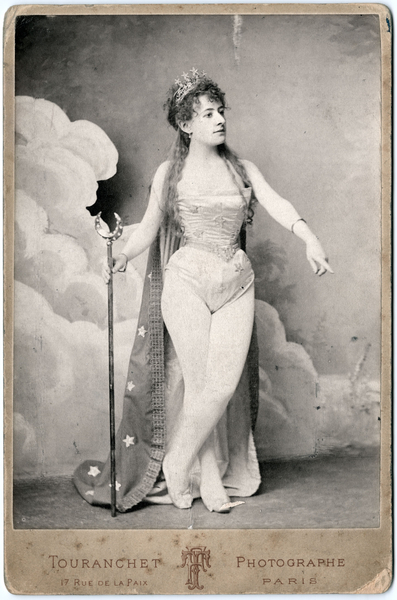
So, Après le Bal is not the first, or even the second, known erotic film. It is believed to be the third. But it has additional significance for a few reasons. After the success of Le Coucher de la Mariée, Georges Méliès himself got in on the trend with this film. The silhouette of a star, for Star Films, appears over the center of the image at the very beginning of the film. Méliès is, of course, best known for his success in the genres of fairy stories and science fiction, and for his pioneering work in special effects, but he truly did experiment with virtually every successful film formula of his day. What’s more, the star of his film (as she often was) is Jeanne d’Alcy (see right), his mistress and future second wife.
Après le Bal goes a step further than the previous known films, and is the earliest surviving film to feature simulated nudity. Unlike in the two earlier films, d’Alcy actually removes her shift, with her back to the camera. She is clearly wearing some sort of leotard covering most of her torso. Less obviously, she is also wearing a bodystocking that at least covers her legs.
Other, similar films that are lost were made around the same time, and Méliès himself may even have made others that we do not have. The nature of the subject matter, and how it was viewed at the time, means that there will likely be a great deal that we never learn. As the BFI puts it: “Erotica being what it is, it’s possible that other (and perhaps more explicit) examples exist in private hands.” The films that have survived are quite tame by modern standards, though that would soon change. Still, from these mild beginnings, the erotic film was born. For much of its history, adult film has existed largely outside of the mainstream of film history, but this film shows that that was not always a foregone conclusion.
Screening:
A modern viewer may be more fascinated by just how many layers d’Alcy has on, and how constricting they are, than by their removal. Her relief, in fact the relief of the women in all three of these films, when her corset is loosened is particularly visible. Other than that, this scene was apparently quite uncomfortable to film. As with all of Méliès’s films from this period, it was filmed outdoors in his garden against a painted backdrop. It was late in the year, and quite cold. It was much too cold, in fact, to use real water, so they filled the pitcher with dark sand instead. Overall, it’s quite a strange thing to watch, but the fact that it exists at all is not so strange.
A group of women wash clothes aboard a bateau-lavoirs (laundry boat), likely on the river Rhône or the Saône, in Lyon. As the women scrub furiously, a few men look on from mid-way up the bank. Meanwhile, traffic passes back and forth on the street above.
Essentials:
The Lumière brothers’ actualities are easy to take at face-value. They are brief, with no manipulation or movement of the camera, and they seem to simply capture a truly authentic slice of life. But we know there are levels of authenticity, and that the Lumières were not above staging elements to get a “more natural” shot. The choice of subject, too, can indicate a point of view, as are choices like how it is framed, from what distance, at what angle, who is included and excluded from the shot, when it begins and ends, etc.
From the beginning, the Lumières showed a consciousness of the significance of some of these choices, along with a particular vision for the scene they wanted to capture. Always very aware of what was happening inside the frame, with more experience they showed an increasing awareness of how to use the placement of the frame itself. Laveuses sur la Rivière has a painter’s eye for image composition. There are four different strata all layered atop each other, and each one clearly divided from the others. The lowest layer (the river itself) is the closest to the camera, and they get successively further back, with the top layer (the street and the houses along it) at the greatest distance. It’s a masterpiece of a shot.
Beginning with the renovations of Paris in the 1850s, free community wash-houses were constructed across the country. However, towns with access to large rivers, such as the Lumières’ hometown of Lyon, might have laundry boats along the riverbanks as well. These communal spaces were the ancestors of the laundromat, and served an equally important function in industrial-era urban life. As this shot’s purpose was not to document the boat itself (the functioning of which would have been well known to the intended audience) much of the boat is outside of the shot.
A fleet of laundry boats on the left bank of the Rhône.
As can be seen in the image at right, there would have been a whole row of similar boats along the water’s edge, serving the nearest of the city’s nearly half-million residents. Beginning in 1860, these boats were also equipped with boilers for steam and hot water, and the space for hanging clothes to dry are clearly visible in both the image and on the right side of the frame within the film.
The cinematograph had no zoom lens, and this shot appears to be too close to the boat to have been taken from the opposite bank. Observing closely, it is evident that there is a very subtle bobbing motion that causes the top of the image to visibly rise and fall slightly. Presumably, then, this scene was filmed from aboard a boat in the middle of the river. As is often the case, a film intended to depict for contemporary audiences sights that were commonplace in their everyday lives has, with the passage of time, become an artifact for modern viewers to experience a window into a past that no longer exists.
Screening:
The laundry boat is an absolute hive of activity as the whole row of women perform what is obviously very physically-rigorous work, without break or pause. A row of women working on the other side of the boat is visible, as well, and there is a third row: The women’s reflections, visible in the river below. The amount and variety of motion made this an excellent subject for filming. Not one of the women so much as glances up for a moment to see that they are being recorded. Their attention is fully absorbed by the work in front of them, unlike some others who are also in the shot.
The Lumières had a great aversion to their subjects staring at the camera while they were being filmed, believing that it distracted from the “naturalism” of the scene. It is likely, then, that they did not intentionally capture the stark contrast seen here, but it is a fascinating one nonetheless. As a few dozen women work furiously in the foreground of the shot, three men stand completely idle on the shore just above, staring fixedly towards the camera, no doubt interested to observe the cinematograph and its operator in action. (A fourth man, who is walking on the road, pauses to watch, then after a few seconds, lounges against a post before continuing on about his business by the end.) The juxtaposition between the working women and the inactive men, likely a difference of class as much as it is one of gender, immediately stands out. Their very stillness draws attention to itself almost as much as the frenzied motion below.
Several men in bōgu (training armor) engage in a practice session of the martial art of kendo. A boy repeatedly rings a gong behind them while a man next to him plays some sort of instrument. The master sits, fanning himself, and occasionally shouting directions to instruct the combatants.
Essentials:
Born in Kyoto, Inabata Katsutaro was 14 years old when he got a scholarship to attend La Martinière Lyon. Japan had been forced to end its isolationist policy and enter into treaties with the Western nations less than a decade before his birth. As a result, Inabata had grown up in a Japan that was changing rapidly from a feudal to an industrial society, and he would play a role in bringing about that change. Arriving in Lyon in 1877, he studied technologies related to weaving and dyeing for the next eight years. He also befriended a classmate: the young Auguste Lumière, 11 days his senior.
Inabata returned to Japan in 1885, and started a successful business that continues to exist (as Inabata & Co.) to this day. While visiting France in 1896, he learned of the Lumière brothers’ new cinematic enterprise, and soon became the Lumière representative for Japan. Upon his return home near the end of the year, he was either accompanied or soon followed by Lumière technician François-Constant Girel, a cinematograph, and 50 reels of film. Inabata and Girel gave the first exhibition of motion pictures in Japan on 15 February 1897, in Osaka.
An Edison kinetoscope had only arrived in Japan in 1896, around the time Edison was introducing his film projection system in the United States. However, a Vitascope exhibition began in Osaka only one week after Inabata’s exhibition, and he decided that the requirements of being competitive in show business were not to his liking. Inabata handed the cinematograph over to Yokota Einosuke, who had been touring the country putting on shows with an x-ray machine he had brought back from his travels in the United States. Yokota went on to be one of the major figures in Japanese film production and exhibition for the next 35 years, while Inabata returned to continued success in his own textile business.
Meanwhile, Girel stayed in Japan for the next few months shooting additional films for the Lumière catalog, 18 in all. Of these, nearly half are ostensibly of daily life unique to Japan. However, Daisuke Miyao, a professor of Japanese films, suggests that there are many signs that these scenes were staged (for instance, this scene was filmed outdoors, but kendo is traditionally practiced inside), and their subjects were selected in an attempt “to make Orientalist fantasy authentic.” In doing so, Girel used the first motion pictures filmed in Japan to perpetuate stereotypes popularized by the Japonisme trend that was in vogue in Europe and America at the time.
Screening:
Kendo, or “way of the sword,” is the modern name of the martial art seen here, but it does not seem to have been called that until 1920. At the time this was filmed, it was likely known simply as gekiken, or “hitting sword.” Whatever the term, I suppose this could be considered the first-ever martial arts movie.
The use of bamboo swords and protective armor, as seen here, was a practice already centuries-old as a method for Japanese warriors to train their swordsmanship. However, this specific form of gekiken as a martial discipline originated in the 1820s, prior to the fall of the shogunate and the opening of the country. It saw a rise in popularity during this period for a number of reasons.
One of the most significant social changes in Japan during the early years of Emperor Meiji’s reign was an end to the privileged status the samurai had enjoyed during previous centuries, and a consequent decline in their financial fortunes. This led to the Satsuma Rebellion in 1877, and the effective end of the samurai class. (A fictionalized version of this event is featured in 2003’s The Last Samurai.) The government banned the use of swords by samurai, and initiated both a voluntary surrender and a sword hunt to confiscate the remaining weapons.
Of course, there were many who wanted to ensure that the art of swordsmanship would not be lost amidst these upheavals. Such efforts became focused around standardization of sword fighting styles and sword training, particularly for police. It is possible, then, that the combatants seen here are police trainees.
It’s interesting that the melee on display is far more chaotic than might be expected from later filmed depictions of martial arts training. It’s unclear at several points who is supposed to be hitting who or exactly what is happening. But despite what appears to be a great deal of wild flailing, no one seems to hit anyone by accident, and if you watch closely, their movements are more tightly-controlled than they appear at first glance. (It may be particularly difficult to follow because the movements are so fast, likely due to some issue with Girel’s framerate. The movements look much more “normal” if you watch at 0.75 or 0.5 speed.)
A train pulls into a station and comes to a stop. A few employees walk quickly up to meet it as it rolls in. People on the platform rush forward to board, or to greet people who are getting off.
Essentials:
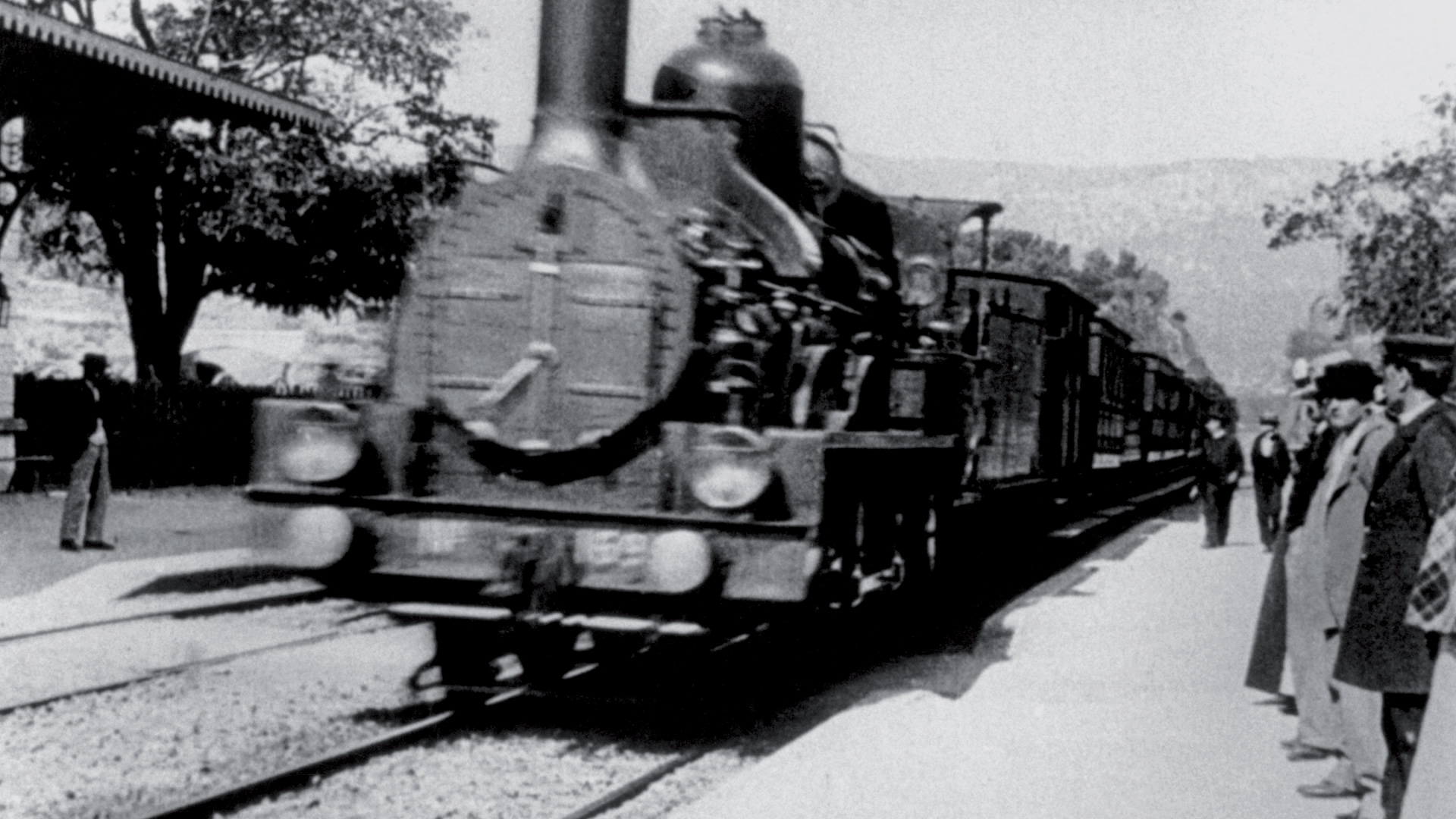
L’arrivée d’un Train à La Ciotat contains probably the most well-known single image from all of 19th century film. At the same time, I can think of no other film that is more obscured by myth and misinformation. As the story goes, in December of 1895, an audience gathered for the first-ever movie screening. Suddenly, a train appeared, barreling towards the screen. No one in the room had ever seen anything like this before, and many people jumped up and ran from the room in fear, certain that a train was about to crash through the wall.
The story is almost irresistible as a testament to the fundamental paradigm shift represented by the dawn of cinema, and of those first audiences’ hilarious inexperience with motion pictures. It’s no wonder that it has served as a starting point for many narratives of the history of film. Unfortunately, none of it is remotely true. We’ll discuss first the concrete parts of this story that just factually can’t be, and then address what to make of the more romanticized details, their origins, and what basis they might or might not have in reality.
First of all, the Lumière brothers inaugural program from December 1895 simply does not include a film of a train arriving at a station. The titles shown during those first screenings are well-documented, and this is not among them. Well, actually, this film couldn’t have been among them, anyway. It wasn’t even shot until sometime in the middle of 1897. It is frequently cited as a film made earlier because it is actually the third version that they shot of a train arriving at this particular station. It is also the only version with an official number in the Lumière commercial catalogue: No. 653. The other two exist in the archive, but do not have a number.
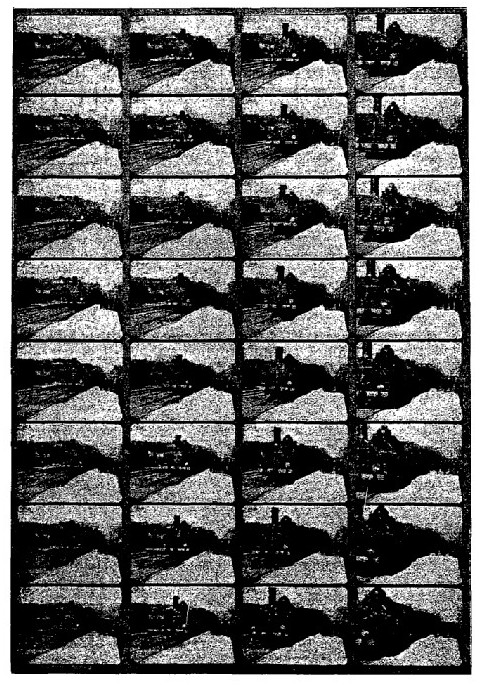
The first version is known to have been shot in early 1896, because 32 stills from it were published in the March 13 issue of La Science française (see right). This version may have been shown to audiences in late January. Historians have suggested that the second version may have been filmed around the same time as the third, from a different angle. Virtually any version you find online is the third version. Although it is often mislabeled, it’s easy to tell, as it begins with a man exiting the frame to the right pulling a luggage cart.
The first version definitely exists online, but is harder to find among the many duplicates of the better-known version. You can see it here under the title “The first movie ever made in history.” It is shot from a very different angle, and in this version, most of the waiting crowd is standing much further back from the arriving train, and almost no women are present.
This train station, as the title states, is La Ciotat, a small community on the south coast of France, about halfway between Marseille and the shipyards at La Seyne-sur-Mer. The reason the Lumières were often there, filming a train arriving at this particular station a few hundred miles from their home base in Lyon, was that the family owned a large estate nearby. Unlike with the first version of the film, many of the people in the third version are either related to the family or are employed by them.
In fact, this is primarily how historians have dated the film to 1897. The woman and small child in white who hurry past the camera at 0:24 are Auguste’s wife Marguerite and his daughter Andrée, previously seen in Repas de Bébé, filmed in early 1895 when Andrée was less than a year old. We can see here that she is around three, so this couldn’t have been filmed or shown as early as is often claimed. (And we know it wasn’t later, because it began appearing on programs starting in October of that year.)
The older woman in the plaid shawl who appears at various points is Josephine, Auguste and Louis’s mother (see left), and there are a few other individuals who have been positively identified as family members, as well. The Lumières likely used them in the film because they knew they could count on them not to look at the camera, as several people did in the first version. They knew that this “staging” would, ironically, make for a more natural-looking scene—a typical contradiction in many of the Lumière “actualities.”
Now, as to the claims about audience reactions to the film: Of course, this third version of the film was shown almost two years after the first motion pictures debuted, so it’s hard to imagine audiences still reacting as though an image were about to emerge from the screen. But what about the first version, which debuted perhaps a month after the first Lumière screening?
In a 2004 essay entitled “Cinema’s Founding Myth,” Martin Loiperdinger goes about systematically examining and debunking many of these claims. Most notably, he points out that the earliest accounts of terrified, fleeing audiences were published decades later, and then simply picked up and passed on by later writers. Writers of the time often gave detailed accounts, not only of the films shown, but of how audiences received them. It is almost unthinkable that the film could have affected an audience in the way described, and no one would have written about it at the time.
It’s also worth considering that every member of these early audiences would have been intimately familiar with trains. The entire point of the “actuality” view was to show a scene of everyday life, and the experience of standing on the platform as the train arrived was utterly commonplace. The members of the audience would certainly have been able to see that the train was not coming directly at the screen, but rather passing by it, just as it would when they themselves stood on a train platform (as they no doubt all had, many times).
But even more importantly, they would have been instinctively aware of all of the incredible noise (and other sensations) produced by a train arriving in a station and coming to a halt: The whistle to signal ahead, the hiss of steam and the puffing of smoke from the stack, the squealing of the brakes, and of course the deep, vibrating rumble of several hundred tons of metal rolling along a track. With none of those other sensory markers present, how could a 19th-century audience have really thought that a train was about to come bursting into their midst?
Now, having said all that, is it possible that some members of the audience might have involuntarily flinched or even ducked, as (lost in the magic of the moment) their bodies reacted to the thought of even something insubstantial about to flash silently by? I think it’s not only possible, but likely, and that those memories and stories perhaps grew in the telling as the years went by. People still get really into a movie and physically react to things that happen on the screen, even today. The biggest problem with this story is that everyone thinks it’s about the naivete of early movie audiences, when really it should be about the power cinema has always had over all of us.
Screening:
Even though the reality is quite different from the story, I have a strong mental association between L’arrivée d’un Train and the magic of the birth of cinema. And I’m fine with that. I genuinely find it delightful to watch this. There’s something warm and charming about this summer scene. That’s especially true knowing that it was truly a family project, probably filmed on a family trip. But also, there’s something specific and special about this film that might have prompted early audiences to react to it in ways they didn’t to earlier films: Perspective.
Consider any other film made prior to 1896-97. Virtually all of them are shot as though the action is transpiring on a stage, and the camera is watching from the audience. Any interaction between the figures on the screen and the people in the audience is limited to, at most, a wave or a bow. Even the early actualities are shot in a way that preserves distance between the camera and the subject. With one or two (very noticeable) exceptions, the workers leaving the Lumière factory turn right or left and come no closer than several yards away from the camera. Even the awe-inspiring Lancement d’un Navire is shot in such a way that the massive ship slides by at a safe, fixed distance.
In contrast, L’arrivée d’un Train à La Ciotat completely rotates the usual planes of screen or stage action and shows its subject rushing past the camera. It’s no wonder, then, to learn that Louis had a long-standing fascination with “stereoscopic vision” (3D). Several decades later, in 1935, he presented the results of some experiments he had done with 3D filmmaking to the Académie des Sciences (see left). A summary of his presentation, “Écrans colorés pour projections stéréoscopiques” (“Colored screens for stereoscopic projections), was published in the Academy’s weekly report. You can see it (in the original French) here. Had the technology existed in 1896, the stories of audiences’ panicked reactions to the image of a train about to emerge from the screen would certainly have more of the ring of truth.
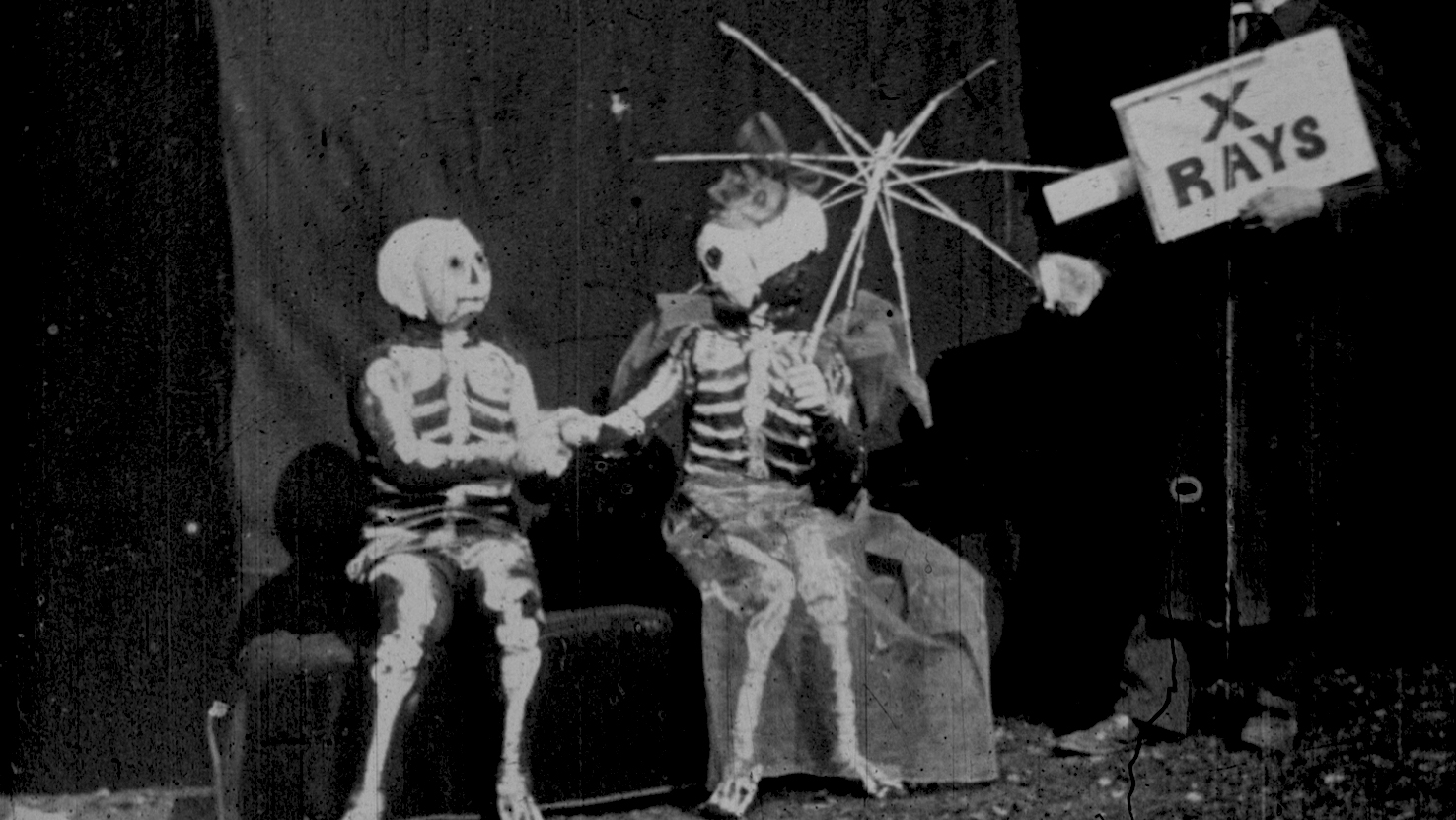
A man begins wooing a woman as they sit together on a bench. They are approached by another man carrying an x-ray emitter. He aims the emitter at the couple and removes the cap, rendering only their skeletons visible as they continue to flirt. He then replaces the cap and they are restored to normal. Soon, the woman takes offense at her admirer and storms away.
Essentials:
George Albert Smith began his career in show business as a stage hypnotist in the British seaside resort town of Brighton during the early 1880s, while he was still in his teens. Within a year or two, he had progressed to a mind reading and telepathy act with a partner, Douglas Blackburn. Smith’s claims of authenticity attracted the notice of the Society for Psychical Research, which confirmed that Smith’s abilities were genuine. (Many years later, Blackburn admitted that this was not true, but Smith never did.) Smith soon turned this foothold with the SPR into a job, becoming the personal secretary to Edmund Gurney, one of its leading members, for several years, and then continuing on in the same role for some time after Gurney’s death.
His next enterprise was to lease St. Ann’s Well Gardens in nearby Hove, turning it into a popular attraction by 1894. The park featured a number of recreations and entertainments, including (perhaps most relevant to Smith’s future) a magic lantern show consisting of “dissolving views.” Smith’s various roles as showman, exhibitor of projected images, and manager of a public attraction explain his keen interest when the Lumière brothers’ motion picture program debuted in London early in 1896, and when Robert Paul’s program arrived in Brighton that summer.
With his wife, Laura Bayley (herself a gifted performer and comedienne), his neighbor (chemist James Williamson), and some assistance from a local engineer named Alfred Darling, Smith soon had a working camera and a makeshift building for processing his film. By March 1897, he had begun including his own films in his daily shows. Many of them were comedies, but he also frequently incorporated special effects and fantastical elements with a playful style that was reminiscent of Georges Méliès, with whom he corresponded. The X-Ray Fiend, which employs Méliès’s signature stop trick twice, is a fine example of this influence.
X-rays were, themselves, quite a recent discovery. In fact, German physicist Wilhelm Röntgen submitted the first paper on his discovery of x-rays on December 28, 1895, the very day of the Lumière brothers’ first public film program in Paris. The discovery produced an absolute sensation, and was reported with breathless excitement by almost every newspaper in the world. Images produced by x-rays became a significant attraction in their own right, and the phenomenon extended into every facet of the culture. Studios were even set up to offer “bone portraits,” though many people found the exercise morbid and disturbing. Röntgen’s wife, upon seeing an x-ray he had taken of her hand that showed skeletal fingers wearing her wedding ring, said, “I have seen my death.”
A February 1896 cartoon that appeared in Life
Still, people were particularly fascinated by the possibilities of x-ray cameras or x-ray viewers. A few months after the discovery was announced, a company in London advertised “x-ray-proof” lead undergarments. A bill was introduced in the New Jersey state assembly that would outlaw the use of x-rays in opera glasses. Many spiritualists were profoundly excited by the possibilities of a technology that could “make the invisible visible.” Could x-rays be the key to finally proving the existence of a supernatural world? No doubt Smith’s former colleagues at the SPR were asking such questions at this time.
Röntgen worried that the popularity of x-ray photography as a novelty would obscure the actual scientific significance and pursuit of practical applications for his discovery. However, Thomas Edison began experimenting right away to find the most effective substance for exposure of x-ray images. Within several months he had produced the first commercial fluoroscope, which began to find its way into regular medical practice. In 1901, after President McKinley was shot, his staff sent to Edison for an x-ray machine to help locate the assassin’s bullet (although it ultimately wasn’t used). Later that same year, Röntgen’s discovery of x-rays won him the first Nobel Prize in Physics.
Screening:
Although the basic idea that this film is based on had clearly been present in the culture for some time before Smith released it in October 1897, there is a certain ingenuity to its execution here. The man in the scene is played by Tom Green, a local performer who appeared several times in Smith’s films. The woman is Laura Bayley herself, who also appeared in a number of Smith’s most memorable films.
The skeleton suits the two are wearing are nothing special, and the skull is particularly lacking in verisimilitude. But it’s a very clever touch to reduce the lady’s parasol to its metal skeleton. They’ve also dressed her in some kind of mostly-transparent facsimile of her dress and hat, which is a nice touch. It’s interesting that the man gets no such attention . . . Although it’s hard to say whether the woman is shown to still be wearing clothing for reasons of decency, or whether her clothing now being transparent is meant to titillate. The title suggests it is perhaps the latter.
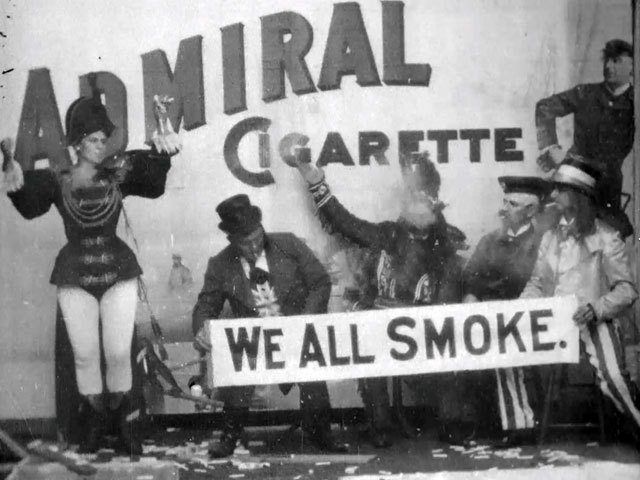
Four men in various costumes sit, talking animatedly, next to an oversized cigarette box and in front of a wall-sized poster that both read “Admiral Cigarette.” Suddenly, the Admiral Cigarette Girl bursts out of the box, smoking a cigarette, and hands out cigarettes to the four men. She grabs a double handful of cigarettes from a pile that one of the men is holding and scatters them across the floor as everyone begins smoking. The men unfurl a banner that reads “WE ALL SMOKE” and they all point to the sign above them.
Essentials:
Technically, the first film advertisements were traveling shots taken from aboard trains, like Black Diamond Express and Empire State Express (both 1896). These were made with the support of various railroad companies, and their production served to promote certain railway lines. They could be considered a sort of early product placement, but they were more than just commercials. They were also entertaining and engaging travel actualities in their own right. The first films that were explicitly ads began to appear in 1897, and one of the earliest of these was for “Admiral Cigarette,” filmed in the Black Maria by William Heise in July. The film is also an artifact of a little-known, but significant, chapter in American history.
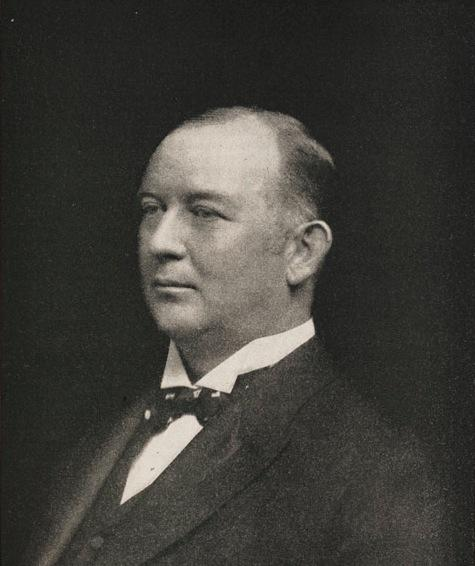
James “Buck” Buchanan Duke (see right) had taken over his father, Washington’s, tobacco company in 1880, and soon found that the company couldn’t compete with Bull Durham Tobacco, which had just become the first nationally-recognized tobacco brand. Rather than battle with Bull Durham for the shredded tobacco market, Duke transitioned the company into cigarette production instead. Prior to the mid-1800s, tobacco in the United States was almost exclusively smoked in pipes or cigars, or chewed or dipped. After the Civil War, cigarettes began to gain popularity in some areas, but they had to be rolled by hand, which bottlenecked production.
Duke began to hire on cigarette rollers at competitive wages, growing from 10 rollers in 1882 to over 700 by 1885. Meanwhile, the leading cigarette manufacturer in the country, Allen & Ginter, had offered the incredible sum of $75,000 to anyone who could invent a machine that rolled cigarettes. A young Virginian named James Bonsack dropped out of college to take up the challenge, and by 1881 he had a working machine and a patent for it. However, Allen & Ginter ended up rejecting his machine, concerned about its reliability, reluctant to part with the prize money, and above all, suddenly unsure whether consumers would accept machine-made cigarettes.
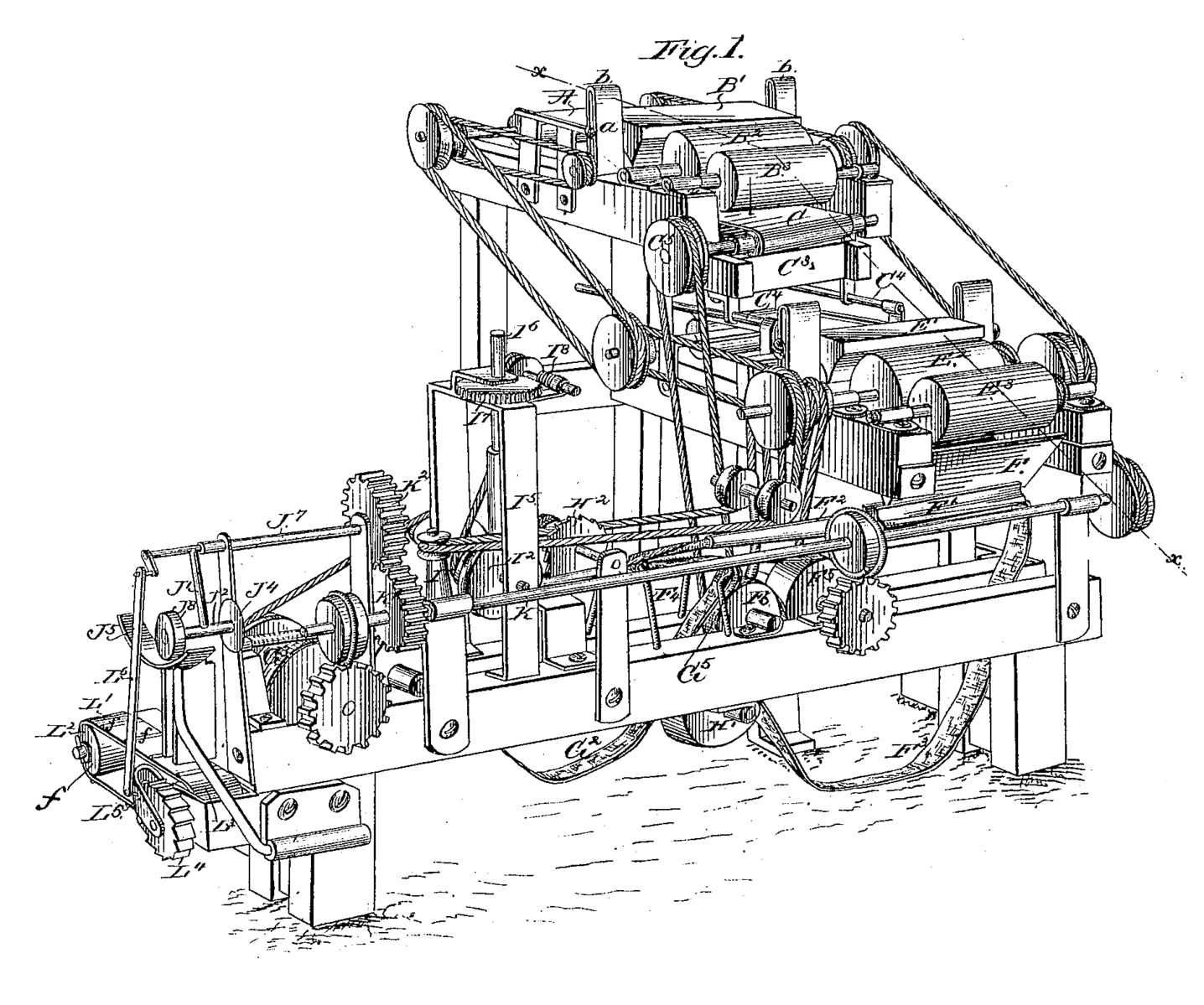
In the end, none of the other large cigarette manufacturers were willing to take a chance on a machine-rolled product. But Duke, newest to the industry and with an eye for innovation, signed a contract with Bonsack. One of Bonsack’s machines (see left) took three people to run, and could produce as many cigarettes as 60 experienced rollers while cutting production costs in half. By 1888, Duke had replaced all of his rollers with rolling machines. Bonsack’s machine heralded a revolution much like Eli Whitney’s cotton gin had almost a century before.
Duke also saw that his company’s capacity for production could soon outpace demand for the product unless he could create more demand. He began investing a huge percentage of his revenue into advertising. He also installed a print shop in his factory and began including collectible cards in packs of cigarettes that were immensely popular among his target market of boys and young men. Marketing to children had two advantages: They were not already consumers of other, more established tobacco products, and their continued consumption would be the industry’s future as they got older.
As he continued to aggressively advertise his products, and his competitors began to belatedly adopt machine rolling, he was able to undersell everyone thanks to a secret discount agreement with Bonsack. As a result, in 1890 (the same year as the passage of the Sherman Antitrust Act) he engineered a merger between his company and the other four largest producers of cigarettes which gave him control of 90% of the market. The new corporation was called the American Tobacco Company. Meanwhile, production of cigarettes had grown a hundred-fold.
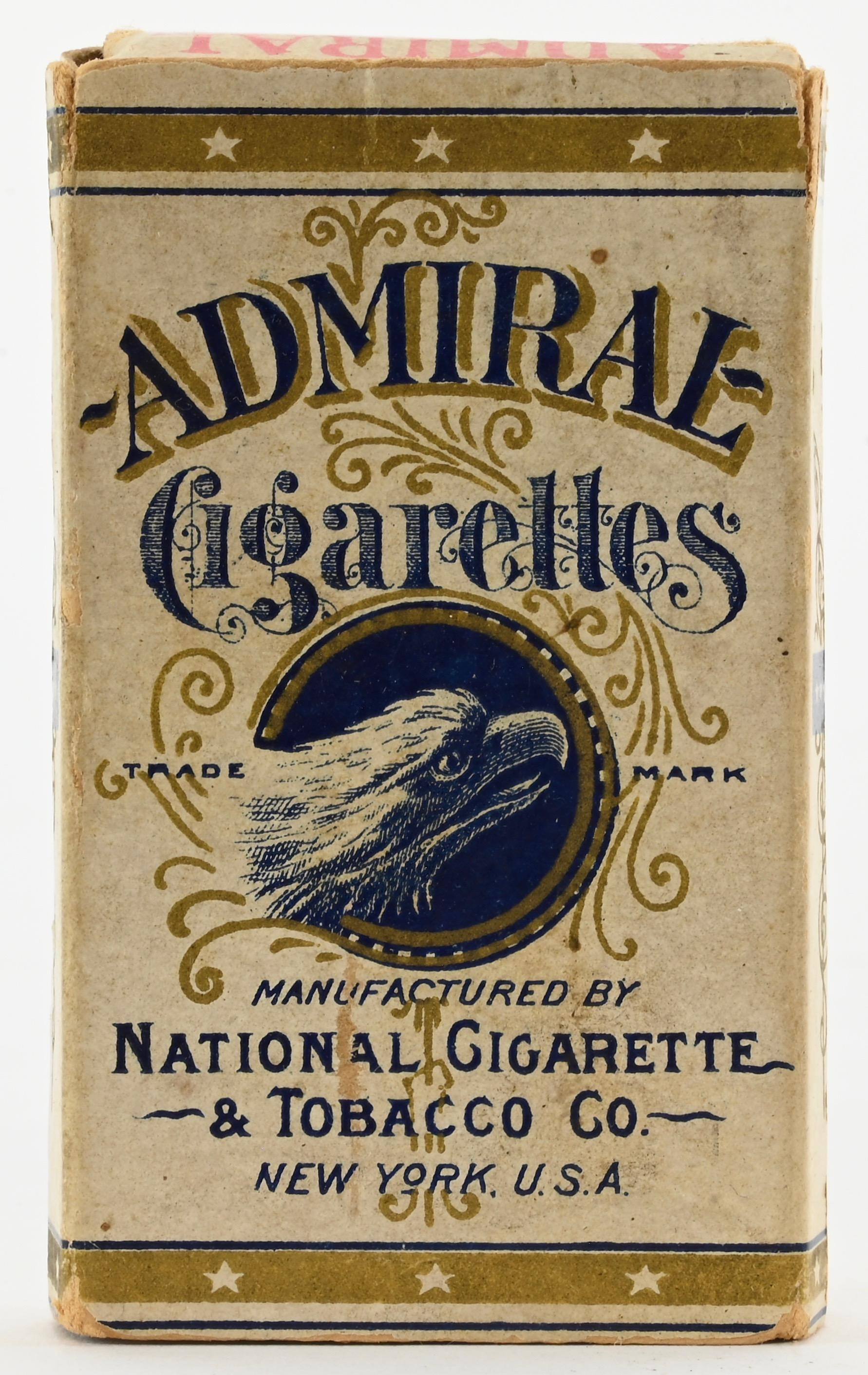
In June of 1892, the National Cigarette & Tobacco Company was formed specifically to challenge the ATC’s stranglehold on cigarette sales, in court if necessary. Working with the attorney generals of each state, they took the ATC to court in both New Jersey and New York during the mid-1890s, but these cases, and others like them, ultimately failed. National Cigarette, producers of the “Admiral” brand, would have to face off against American Tobacco in the marketplace.
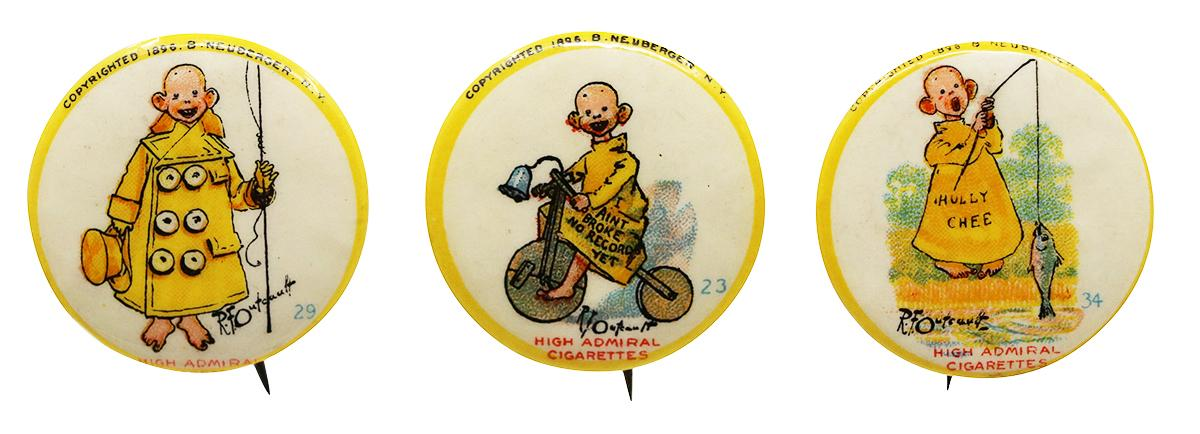
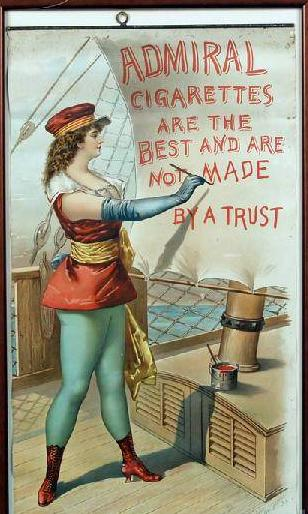
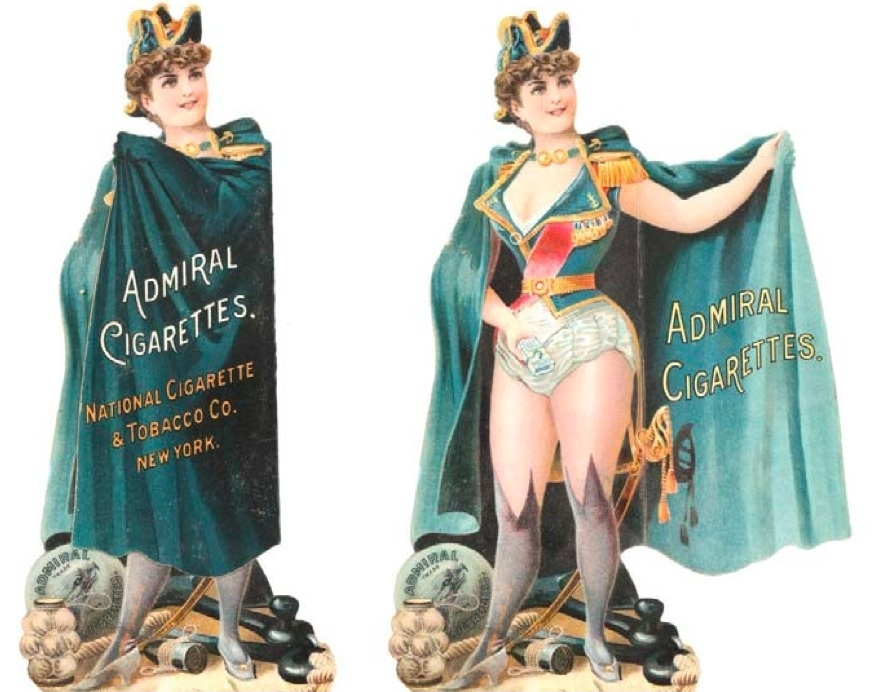
One of the major battlefields in this war, of course, was advertising. National had the Admiral Cigarette Girl, and her very revealing costume. They had a very pointed slogan: “Not Made by a TRUST.” They had collectible cards in their packs of cigarettes, and, in an early example of merchandising, also produced a promotional set of collectible buttons featuring the hugely-popular “Yellow Kid” character from a hit newspaper comic strip. (This strip, incidentally, was published in both Pulitzer’s and Hearst’s newspapers, which led to them being known as the “yellow kid papers,” which eventually spawned the term “yellow journalism.”)
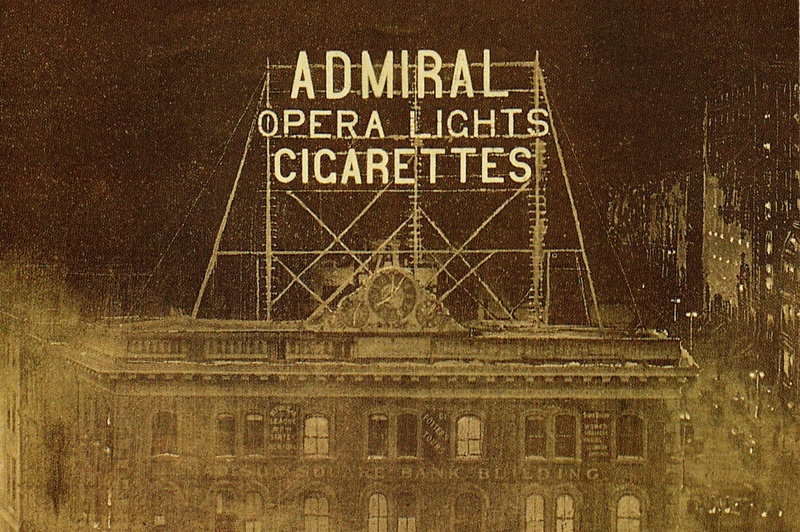
Of course, they also harnessed the power of the latest technological innovations, as well. A New York-based company, they had a large electrically-lit sign installed atop a building in the middle of Manhattan. And, in 1897, they had one of the first film commercials. This, too, made its way to a Manhattan rooftop, where it was projected on a loop for passersby. The display was so successful as an attention-grabber that the projectionist was detained by police for disrupting traffic on Broadway.
Throughout these years, National Cigarette continued to resist attempts by American Tobacco to buy them out and absorb them. American Tobacco was a genuine giant by now, becoming one of the original 12 members of the Dow Jones Industrial Average when it was created in 1896. They swallowed up hundreds of companies during the preceding years and the decade that followed.
Their growth, however, was not due only to cigarettes. They, of necessity, had begun diversifying their tobacco holdings. After all, by the end of the decade, cigarettes still made up less than 5 percent of all tobacco sales. Throughout the mid-1890s, American Tobacco was engaged in the “plug wars” as they sought to gain the same level of control over chewing tobacco. By 1898, they had absorbed every major producer of plug tobacco into the Continental Tobacco Company (president: Buck Duke) except for one large hold-out: Liggett & Myers, whose owner personally disliked Duke, and vowed never to sell to him.
Meanwhile, an ex-American Tobacco executive and a group of wealthy backers had started up the Union Tobacco Company as a major rival to Duke and Continental Tobacco. Union’s holdings included Duke’s old foe, Bull Durham Tobacco. In 1898, Union bought National Cigarette & Tobacco as well, adding Admiral Cigarette to their slate of products. And, finally, they talked Liggett & Myers into the fold late in the year.
Then, in March of 1899, Union sold to American and its financial backers were absorbed into the American and Continental Board of Directors. Rumors abounded that the “rivalry” had been a sham designed to draw Duke’s most stubborn competitors together, though Duke denied it, even as he now pivoted his attention to the snuff and cigar markets. The Admiral Cigarette slogan would presumably have to change to “NOW Made by a Trust” as it joined the over 100 cigarette brands that American Tobacco now controlled.
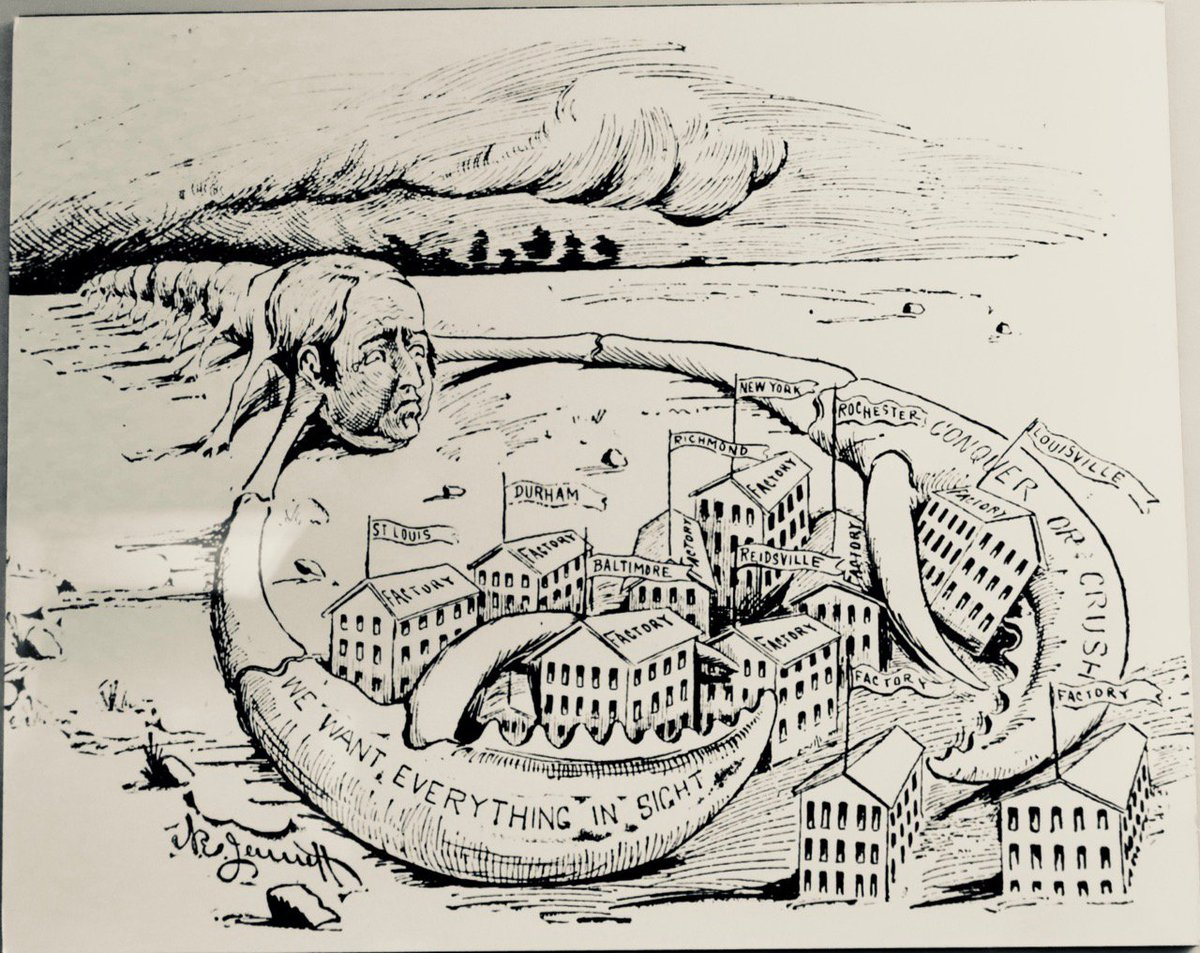
A contemporary political cartoon depicts Duke as a grasping insect: “Conquer or Crush.”
Duke’s holdings continued to increase for several years, both domestically and overseas, until finally the U.S. Department of Justice couldn’t ignore him any longer. In July 1907, they filed suit against the American Tobacco Company for antitrust violations. After a long legal battle, the Supreme Court ordered Duke to dissolve American Tobacco in 1911, on the same day they ordered John D. Rockefeller to dissolve Standard Oil. (U.S. Steel, the other of the three largest companies in the nation at the time, escaped unscathed from similar efforts.)
As for Duke himself, he all but abandoned the tobacco industry, devoting himself instead to the development of an electrical power company he had begun in 1904. In 1924, he established a large endowment, one beneficiary of which was Trinity College in Durham, North Carolina, an institution his father had also made several large donations to prior to his death. The college’s president, William Few, came to him with a proposal, and Duke agreed on the condition that it be done in honor of his father. So, Trinity College became Duke University.
In a final strange twist, Edison, a habitual cigar-smoker and chewer of tobacco, personally loathed cigarettes, despite holding the copyright for the first cigarette commercial. In 1914, Edison’s good friend Henry Ford asked him to write a letter, giving a scientific explanation of why cigarettes were harmful, as part of Ford’s anti-smoking campaign in his factories. Edison obliged, describing how, unlike with other tobacco products, cigarettes’ paper wrappers gave off toxic, brain-damaging chemicals when burned. He concluded by stating, “I employ no person who smokes cigarettes.” This, however, was not true. After the letter was sent, Edison hurriedly had signs put up in his buildings that read: “Cigarettes Not Tolerated. They Dull The Brain.”
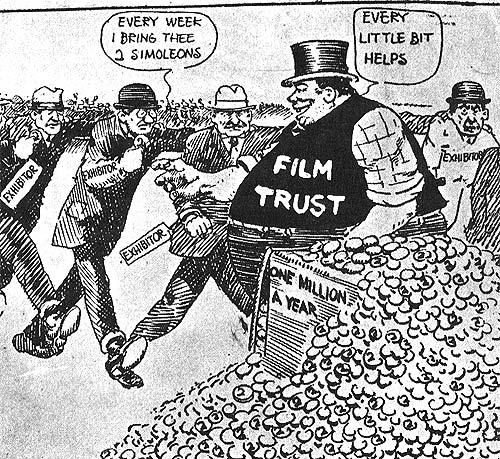
The letter, when published, ignited a firestorm of criticism in the press, largely driven by the powerful tobacco companies. Edison was derided for opining outside of his area of expertise, and Philip Morris Cigarettes even turned a comprehensive refutation of Edison and his claims into a full-page ad disguised as an editorial: “It Was Mr. Edison’s Mistake.” Edison, not used to being so questioned, weakly doubled-down, claiming that heavy cigarette smoking by Mexicans explained why they “as a race are not clear headed,” but he seems to have been eager to let the matter drop. By then, Edison was himself at the head of a trust that dominated an industry: the Motion Picture Patents Company, founded in 1908, included himself, Biograph, Méliès’s Star Film, and several others. The MPPC was found to be in violation of the Sherman Antitrust Act the following year.
Screening:
Admiral Cigarette features a fascinating gathering of characters, all offering the same testimonial, though their significance may not be readily apparent. On the far left is “John Bull,” the national personification of England and the English people (which, incidentally, was also a market targeted aggressively by Buck Duke). Next to John Bull is a man in stereotypical Native American garb. The “Cigar Store Indian” was an association that had existed in the marketing of tobacco since the 1600s, when Native Americans were actually the source of the tobacco being sold. Next in line is a man in some sort of uniform, perhaps military. The hat may be a Glengarry bonnet, but his relevance is a mystery to me. Finally, Uncle Sam appears at the end of the row.
They are joined by the Admiral Cigarette Girl, though her legs are covered in skin-tight leggings rather than completely bare, as in some illustrated ads. The message is a simple one: Admiral Cigarettes are for everyone, and everyone loves them, and hey, look at this attractive woman! Our cultural markers and (some) products have changed significantly in 125 years, but those basic components remain some of the most commonly seen in our advertising.
Thomas Alva Edison, the great inventor himself, putters around in his laboratory, clad in a white lab coat, pouring and mixing chemicals.
Essentials:
It seems surprising that Edison waited some six years after the successful development of motion pictures before appearing even once before the camera himself. Auguste Lumière appeared in several of the brothers’ first films, and Georges Méliès was generally the star of most of his films. William Dickson was in one of the first motion pictures to greet audiences. Even Eadward Muybridge used himself as a subject in his motion photography studies. The motion picture pioneers who didn’t appear in front of the camera, men like Louis Le Prince, Étienne-Jules Marey, and Louis Lumière, were invariably behind the camera instead.
The exception is Edison, a testament to his lack of involvement, and lack of interest, in the development of the technology apart from its connection to two things: His business interests, and his reputation as the greatest American inventor. Interviews and articles from the time of the development and introduction of the kinetoscope suggest that Edison took great pleasure in the gushing praise that surrounded the new “miracle” that he was credited with bringing into the world.
He reveled in that acclaim again in 1896, when he introduced Thomas Armat’s Phantoscope as his own Vitascope. But the field of film projection was soon crowded with competitors, the most successful of which benefited from the knowledge and skills of his ex-employee, William Dickson. Charles Musser suggests that, by 1897, Edison’s role in motion pictures “was no longer hailed in newspaper publicity and only rarely mentioned in amusement advertisements” and that appearing on film “reassert[ed] his presence in a new way (on the screen)” and “reinscribe[d] the inventor into the cinema process.”
The title, of course, is a lie. The catalog listing for the film doubles down on the falsehood, asserting that the film is “remarkable” in part because: “The scene is an actual one, showing Mr. Edison in working dress engaged in an interesting chemical experiment in his great Laboratory.” The glimpse of Edison “at work” was actually shot inside of the Black Maria, though to be fair, it likely wouldn’t have been possible to light Edison’s actual lab sufficiently to film inside of it. The deception is a fairly innocent one, particularly when placed next to the massive falsehood that was Edison’s claims of having invented the movies.
Edison once said something very telling when describing his philosophy:
Everything on earth depends on will. I never had an idea in my life. I’ve got no imagination. I never dream. My so-called inventions already existed in the environment — I took them out. I’ve created nothing. Nobody does. There’s no such thing as an idea being brain-born; everything comes from the outside. The industrious one coaxes it from the environment; the drone lets it lie there while he goes off to the baseball game. The ‘genius’ hangs around his laboratory day and night. If anything happens he’s there to catch it; if he wasn’t, it might happen just the same, only it would never be his.
Ideas, he seems to be saying, don’t belong to anyone but the person who steps in with the will and the drive to take possession of them. It’s hard to know how much self-awareness he said this with, but it certainly explains why he never balked at putting his name on other people’s work, as well as his own.
Screening:
Regardless of any artificiality in the staging of this scene, there is something genuinely remarkable about seeing an actual motion picture featuring Thomas Edison, perhaps the most famous figure in the history of American innovation. He is fifty years old in this film, and he seems to be a very natural subject. You would almost believe he is totally unaware that the camera is there, and that he actually is totally absorbed in some fascinating experiment. Chemistry had famously been a passion of Edison’s from childhood, so it would likely have been an obvious choice for a demonstration of the great inventor at work, even if it were not such an easy way to visually represent that someone is “doing science.”
Understand that all original content in Moviegoings is my property under copyright.
"Everyone has the right to the protection of the moral and material interests resulting from any scientific, literary or artistic production of which he is the author." -- Univ. Decl. of Human Rights
Unless otherwise noted, all original content in Moviegoings is licensed under a Creative Commons License.
Comment Policy
Commenting here is a privilege that may be revoked. Visitors to Moviegoings are allowed to post comments only for noncommercial purposes. Unsolicited advertising ("spam") may be altered or deleted at any time. Violation may result in appropriate countermeasures, including but not limited to IP banning, IP publishing, notification of ISPs, and civil and criminal legal action.











 Moviegoings