Week 9: Blackmail (1929)

•February 27, 2008 • 1 Comment

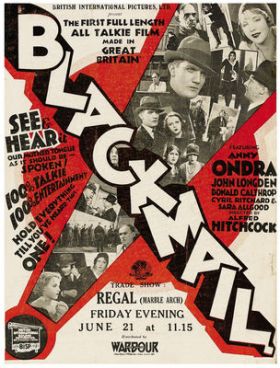
blackmailposter.jpg“Frank, I’ve lost one of my gloves. I think I left it at the other table.”
“Still, it’s about Scotland Yard. Might be amusing. They’re bound to get all the details wrong.”
“What do you think? There’s been a murder last night around the corner!”
“A good, clean honest whack over the head with a brick is one thing. There’s something British about that. But knives — No, knives is not right.”
“My dear, you ought to have been more careful. You might have cut somebody with that.”
“By the way, you’re a detective, let me give you a tip. Don’t wave important clues in telephone boxes. They’ve got glass doors. You know, detectives in glass houses shouldn’t wave clues.”
“Did she tell you who did it? You want to look out, you’ll be losing your job, my boy. I suppose we shall soon be having lady detectives up in the Yard.”

Blackmail

By early 1929, it was obvious to Alfred Hitchcock (as to most of the British film industry) that the addition of sound to motion pictures was just around the corner. Sound seemed so close, in fact, that he prepared in advance for his latest silent, Blackmail, to incorporate scenes of dialogue, ordering the shooting schedule to save talking scenes for last. As a result, he was quite prepared when, in April, British International Pictures announced that they had set up a sound studio. They asked the director (and advertised the request alongside announcements about their equipment) to add sound to the last reel of the film.

Hitch, of course, thought this was a perfectly ridiculous idea, and secretly made almost the entire film with sound, re-shooting a few key sequences where necessary. Knowing that not all theaters would be wired for sound, he cut a silent version of the film as well. Unfortunately, Blackmail starred Anny Ondra (of The Manxman), a central-European actress with a thick accent (as revealed by an early sound test, in which Hitch’s ribald sense of humor quite overshadows Miss Ondra’s broken English).

annyondra.jpgIt was promptly decided that the accent simply wouldn’t do, however, Anny was rather well-liked in the industry and no one wanted to simply cut her out. So, in a move startlingly reminiscent of the plot of 1950s musical hit Singin’ in the Rain, Hitchcock simply had Ondra mouth her lines while proper British actress Joan Barry spoke them off-screen (uncredited, of course). Of course, in what would become a recurring pattern throughout the film world, in England as well as Hollywood, Ondra’s career in English-language movies was effectively over. After Blackmail, she returned to Germany, where she continued to enjoy a highly-successful career that lasted for the next few decades.

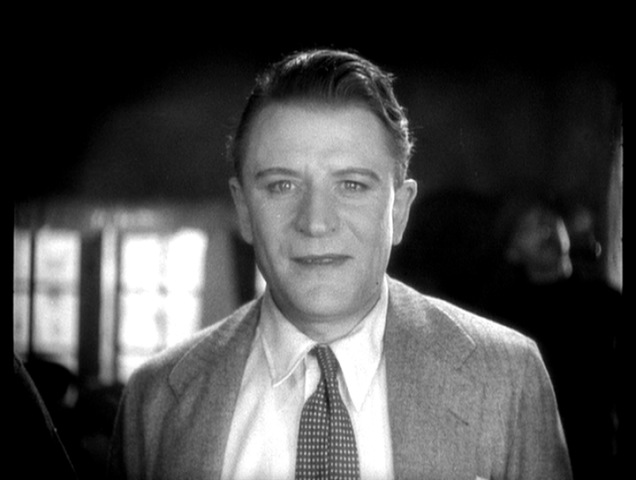
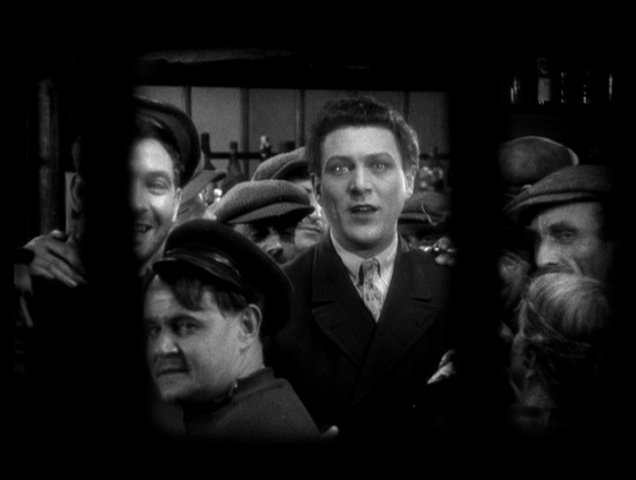
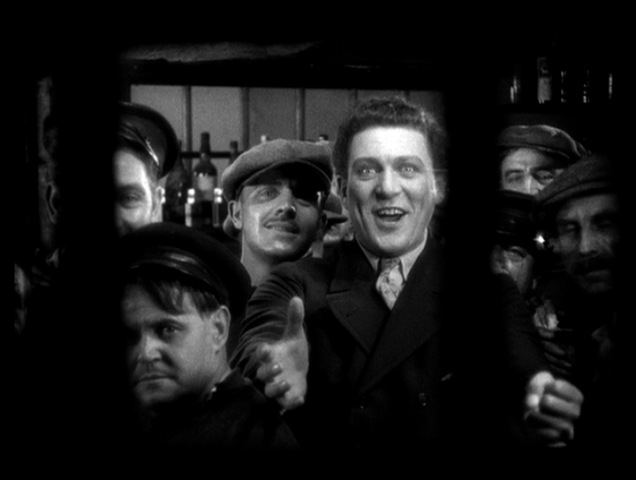
johnlongden.jpgIn Blackmail (adapted by Hitchcock from Charles Bennett’s original play), Alice White (Ondra) is the daughter of tobacconist in London, and dating a Scotland Yard detective, Frank (John Longden, who, along with the majority of the cast, was making his first of several appearances in Hitchcock films). One evening while they dine out together, the couple has a row and Alice ends up leaving with another man, an artist named Crewe (Cyril Ritchard).

donaldcalthrop.jpgThe two wind up in Crewe’s flat, where he attempts to seduce Alice. Failing that, he attempts to rape her instead, and she stabs him to death in the midst of the struggle. Fortunately for her, Frank is assigned to the investigation and (although he immediately links her to the crime) seems inclined to cover for his girlfriend. Unfortunately, a Mr. Tracy (Donald Calthrop) can also link Alice to the crime, and is more than happy to take financial advantage of the situation.

The film begins with a completely irrelevant (and completely silent — but brilliantly-shot) opening sequence, in which some Scotland Yard detectives apprehend, question, and book a suspect. The suspect in question never appears again, and the entire sequence seems to have nothing whatever to do with the plot, but it is a neat little bit of early police procedural. According to the director himself, the original intention was to have his main character arrested for the murder at the end, and to repeat every shot from the opening as a sort of “bookend.” However, he was forced to insert a happy ending instead, which does indeed feel quite forced and anti-climactic.
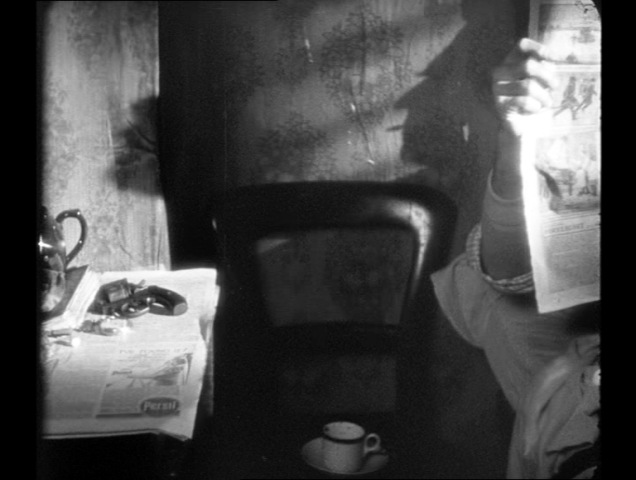
slygun.jpgThere is a particularly Hitchcockian moment when the detectives quietly enter the criminal’s room as he sits in bed reading the paper. The crook’s eyes shift to the left, and the camera pans and zooms in on a small mirror in which he can see the detectives at the door. His eyes then slide to the right and we see him eyeing a gun on the bedside table. Later, Hitchcock indicates the passage of time during the interrogation by the number of cigarette butts in an ash tray. Finally, there is an interesting little montage including a brief look at how police line-ups were conducted before two-way mirrors.
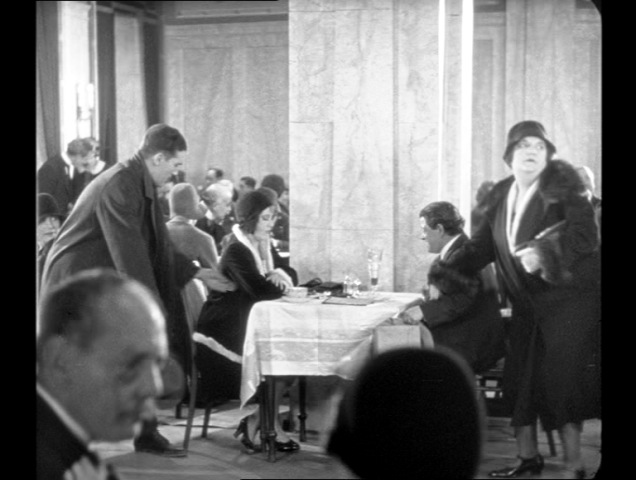
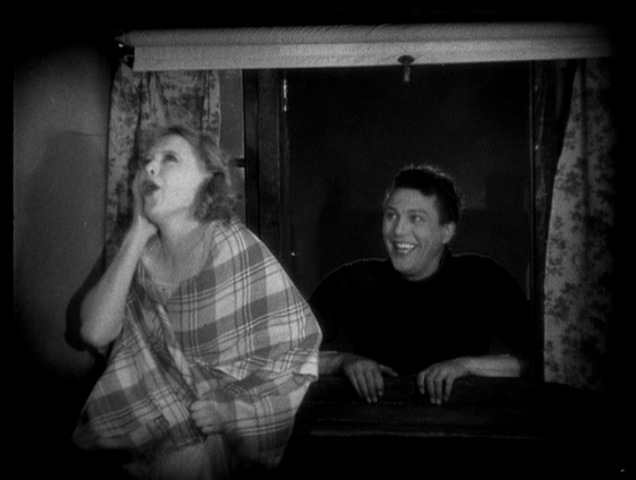
funnycouples.jpgThis sequence showcases some interesting techniques, but contains nothing of interest to the story. Similarly, the next sequence introduces characters and sets the stage for the rest of the film, but contains very little of interesting technique beyond the novelty of spoken dialogue, chiefly between Frank and Alice as they converse at the police station, on their way to dinner, and at the restaurant.

Hitch slips his cameo (the first since 1928’s Easy Virtue) in here. At 19 seconds, it is one of the longest of his career, and one of the most amusing. As the main couple rides the train to dinner, Hitchcock can be seen reading a book on the left side of the screen. A small boy climbs onto the seat and yanks his hat down over his eyes. Hitch yells at him and he retreats, then climbs up again, and the two eye each other suspiciously.

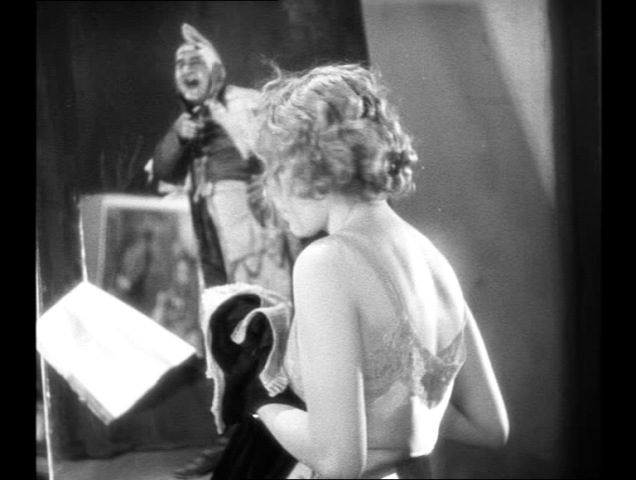
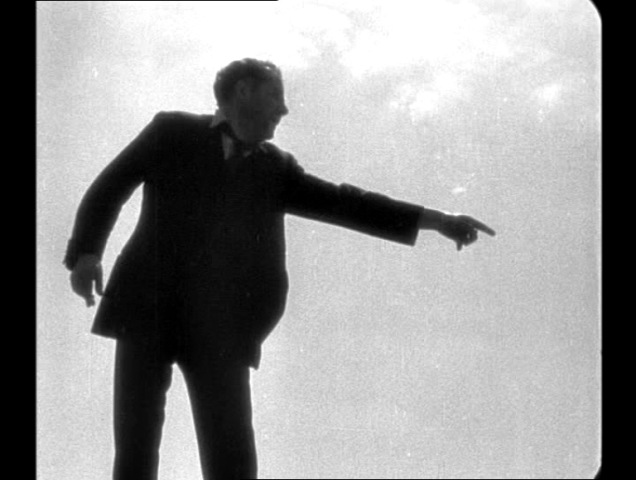
jester1.jpgOf far greater interest, however, is the memorable sequence in the artist’s flat. Alice is very reluctant to come up, due to the lateness of the hour, but Crewe pressures her until she agrees. When she first enters, she is clearly concerned, but, looking out of the window, she sees a Bobby patrolling in thesignature.jpg street and this seems to allay her fears. Glancing around the room, she almost immediately spots a rather creepy looking painting of an old jester, who looks out at the viewer, pointing and laughing. She flirts with Crewe, asking him to show her how to hold the paints and brush, and together they sketch out a crude portrait of a woman on a blank canvas, on which Alice signs her name.

immodest.jpgShe spots a small, frilly dress and Crewe deftly manipulates her into trying it on, saying he’d like to sketch her in it. He plays a light-hearted song as she changes into the dress, not bothering to try and catch a glimpse of her. The camera, however, is not so modest, and the audience gets an eyeful. Sheindiscreet.jpg flounces about a bit with the dress on, but the atmosphere quickly turns awkward when he forces a kiss. Clearly upset, Alice goes to change back into her own dress, but as she’s taking off the other one, Crewe takes her clothes and throws them across the room.
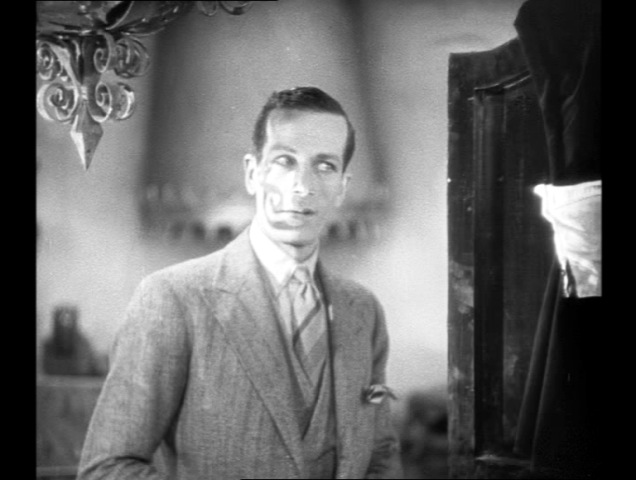
moustache.jpgJust before he does this, he is pacing about in agitated manner, and then he pauses, staring over at the screen she is standing behind as though an idea has just come to him. A shadow from a weird light fixture falls across his face, making him look almost as though he hadbobby.jpg a large, sinister moustache reminiscent of those worn by the villains of early melodramas. Hitch later referred to this shot as “my farewell to silent pictures.” Crewe grabs Alice and drags her over to his curtained bed. As they disappear behind the curtain, we see the shot of the patrolling policeman again. Far out of earshot, his presence seems to be of little use or comfort now.

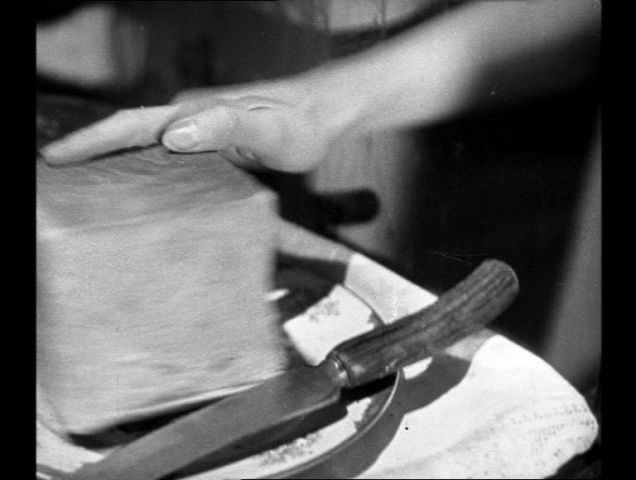
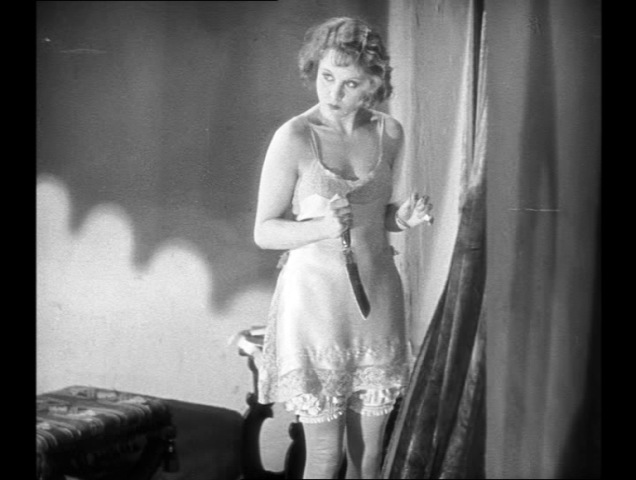
The struggle on the bed can only be seen by way of the violent rustling of the curtain. Alice’s frantic hand emerges, groping about on the bedside table before coming to rest on a large knife sitting next to a loaf of bread. She grabs it and the struggle behind the curtain subsides very gradually. Then, suddenly, the artist’s lifeless hands flops stiffly into view and Alice backs out, the knife still in her hand. Her eyes seem glazed over, wide open with shock, and her movements are clipped and jerky.
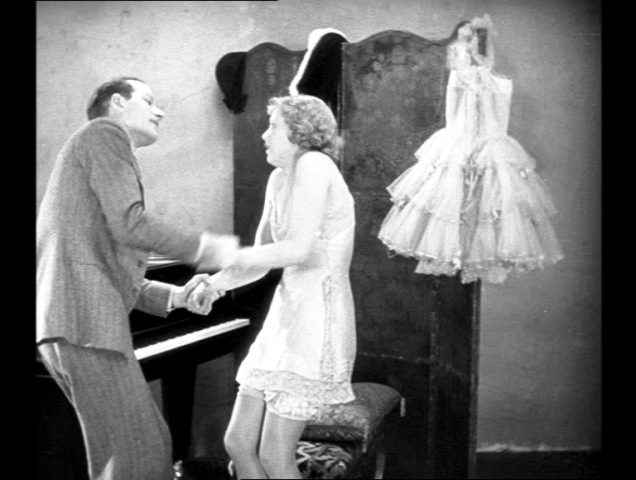
murder1.jpgmurder2.jpgmurder3.jpgmurder4.jpgmurder5.jpgmurder6.jpg

She replaces the knife and looks dazedly around, as though completely unsure of what to do. Her arms are held out awkwardly and stiffly, as though she is afraid to let her hands near her body. Finally, she spots her dress where Crewe had flung it, hung over on of his canvases. When she pulls it down, she reveals the painting of the laughing gesture, who now seems to be mocking her. She lashes out with her hands, tearing the canvas violently.

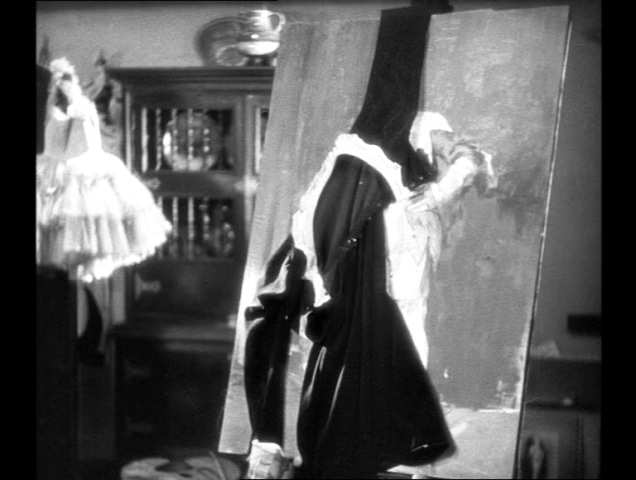
trance1.jpgtrance2.jpgtrance3.jpg

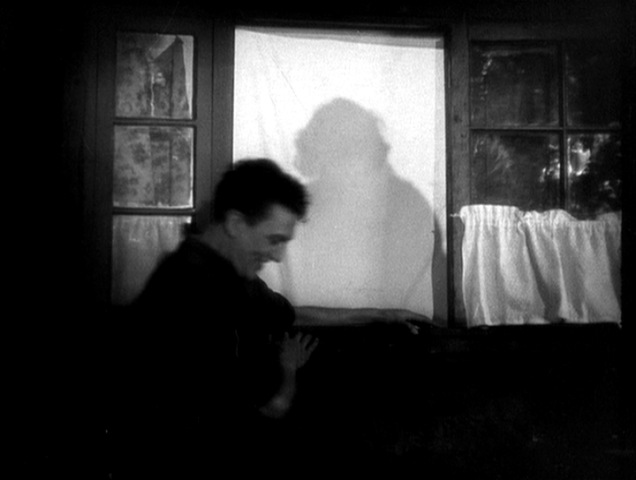
shadows1.jpgAs though coming out of a deep sleep, her movements slowly gain speed and purpose. She pulls her clothes back on, picks up her purse and glances frantically around the room. Has she left any clues? She snatches up a brush and blots out her name from the canvas she and Crewe collaborated on, thenshadows2.jpg turns out the light and creeps down the long flights of stairs. The rigid lines of the stairs and their rails cast harsh shadows like prison bars across the walls. As she flees into the street, the shadow of an approaching man falls ominously across the doorway she has just exited.

The scene is one of the most memorable movie murders Hitchcock ever staged, and definitely a worthy centerpiece to this film. The scene starts off light-hearted with barely a hint of menace, then suddenly and unexpectedly turns ugly after the slightest of foreshadowing (with actual shadows, in this case). The struggle is prolonged, but all the more frightening because it takes place off-screen (Hitch knew quite well the power over the imagination of that which we cannot see). The aftermath is affecting because the heroine herself is so obviously affected that she can barely even function.

scream1.jpgWalking aimlessly around London, everywhere Alice looks seems to hold a reminder of what just happened. A neon sign depicting a martini mixer shaking up and down suddenly becomes a stabbingscream2.jpg dagger. She walks silently all night long, until finally, the sight of a bum passed out in a doorway, his arm extended lifelessly, prompts her to scream in terror. The scene shifts quickly, merging Alice’s scream seamlessly with that of Crewe’s elderly housekeeper, who has just discovered the body.

Frank arrives at the scene of the crime and examines the room. Once again the painting of the jester is noted; he is laughing at the detectives and their fruitless search for clues. Almost immediately, he finds and recognizes one of Alice’s gloves, which he quickly stuffs into his pocket. Now the jester is laughing at something else entirely.
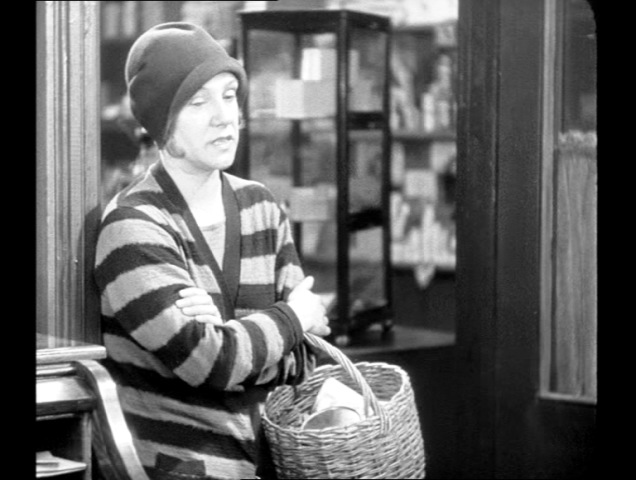
gossip.jpgMeanwhile, Alice makes it home and sneaks into bed just in time for her mother to come in and “wake” her. The poor girl pulls herself together and gets into a fresh outfit before descending for breakfast. A gossipy friend has stopped by the White’s tobacco shop to chat about the big news of the morning: the murder that has happened just around the corner. As the family sits down to breakfast, she stands in the doorway and goes on and on about it. It is clear from her expression that each mention of the word knife makes Alice feel as though she has been stabbed.

knife.jpgAfter a few seconds, the camera focuses in on Alice’s face and the gossip’s words become indistinguishable, except for “. . . knife . . . knife . . . knife . . .” which punctuates her droning speech likeknife2.jpg a shot, wearing Alice’s nerves away. When her father asks her to cut a slice of bread, she picks up the knife just as the friend says the word again, and drops it like a hot poker. “You might have cut somebody with that,” her father observes, much to her discomfort.
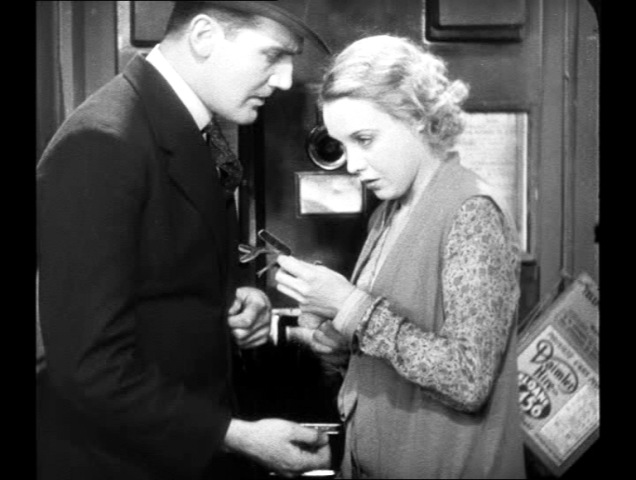
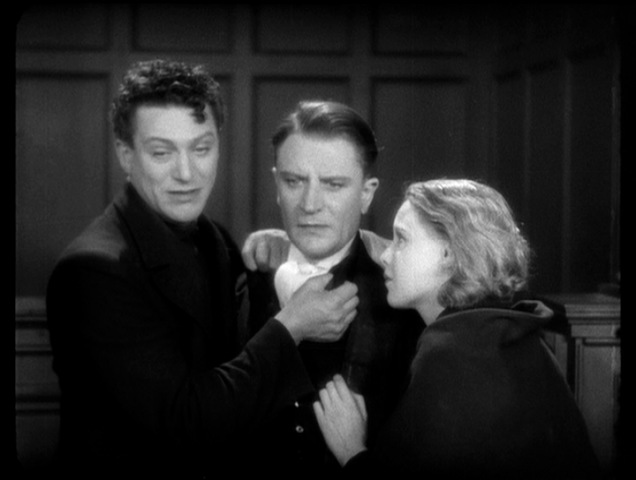
evidence1.jpgFrank arrives and draws Alice into the phone booth in her father’s shop for a private word. He shows her the glove he found, but before she can explain a man raps on the glass andevidence2.jpg interrupts them. His smarmy manner immediately rubs the couple the wrong way, and he makes insinuations that set them both on edge. After a few seconds of conversation, he reveals that he, too, knows what Alice did last night. And furthermore, he has her other glove in his pocket (how careless of her!).

This Mr. Tracy (as he introduces himself) oozes about the shop with a maddeningly self-satisfied air taunting the other two with innuendo that Alice’s father, minding the counter, doesn’t understand. He has Frank buy him a fine cigar, and soon makes it apparent that this is only the beginning. Before long, he has himself and Frank sequestered comfortably with the leavings of the White family breakfast so that he may gauge just how deep his targets’ pockets are.

Little do the blackmailer and his sweating victims know that Crewe’s landlady had spotted him hanging about the house the evening before, and she is currently ratting him out to the police. He had been there in an attempt to extort some money from the artist before the more lucrative opportunity arose. Since he has a criminal record, she is able to point to his picture in a book of mug shots, and the police begin their search. Eventually, Frank learns of this when they call the White’s shop looking for him, and he summons the cavalry.

escape.jpgSwaggering confidently back into the breakfast room, he bullies and blusters Tracy into a reasonable certainty that the murder can and will be pinned on him rather than Alice. Just as the police burst in, Tracy crashes through the back window and escapes over the rooftops. The chase across London is on, and the fugitive grows increasingly desperate as the police close in from all sides. As it happens, he finds himself cornered at the entrance to the British Museum and slips inside with a contingent of plain-clothes detectives in hot pursuit.

This is the first time Hitchcock would make use of a famous landmark as the scene for a climactic chase or final battle. It was a tactic which would serve him well many times, often with quite memorable results. In this case, the chase begins slowly, with a bit of cat-and-mouse as the crook creeps carefully among the displays. Before long, though, the police have spotted him and he begins a mad dash through the museum, including a scramble down some sort of rope or chain past what appears to be a gigantic artifact from Egypt.
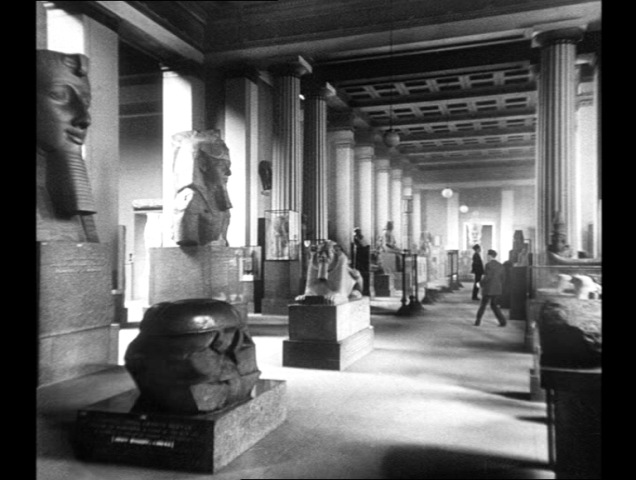
chase1.jpgchase2.jpgchase3.jpg

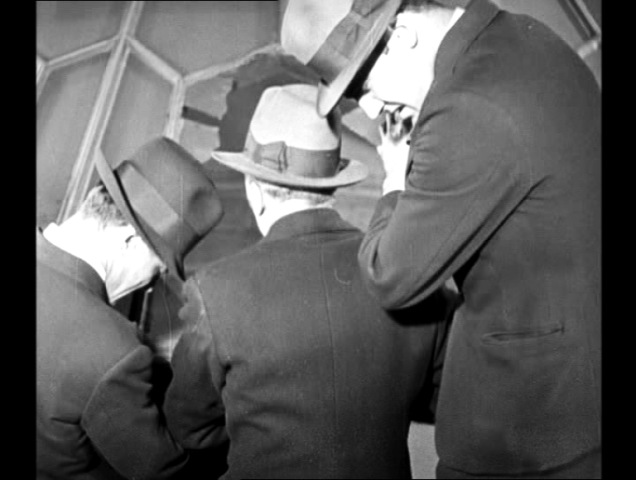
The chase continues into the library, and Tracy (either incredibly foolish or left with no other choice) winds up climbing onto the roof and scaling to the top of the dome over the library. Here, he pauses and turns to loudly proclaim his innocence to the approaching detectives, but his revelation is cut short when the skylight he is standing on shatters and he plummets to his death far below.
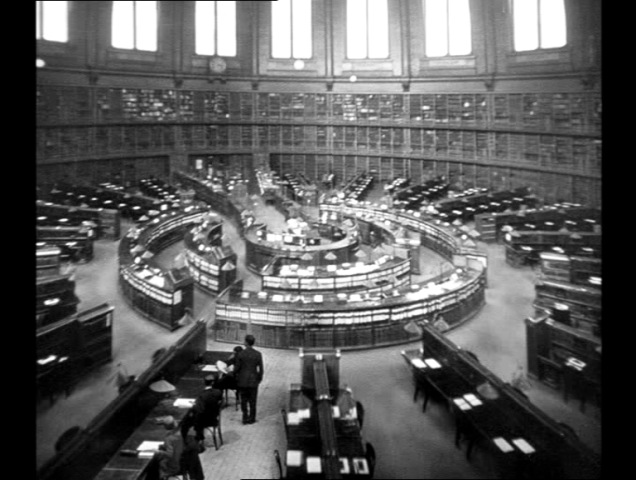
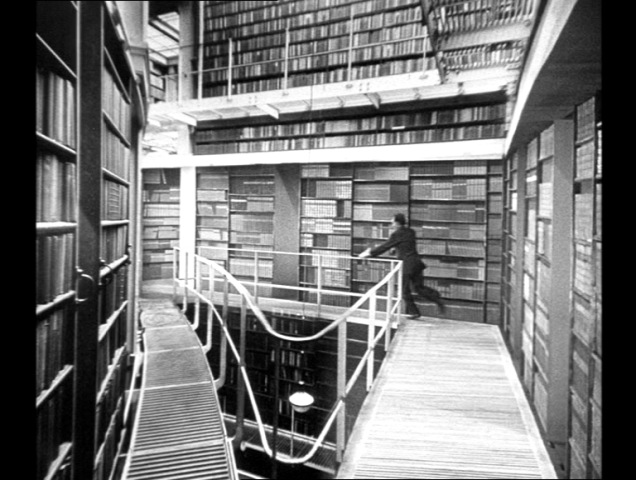
chase4.jpgchase5.jpgchase6.jpgchase7.jpgchase8.jpgchase9.jpg

At this point, the film should dwindle very quickly to a close, and it almost does. However, there is one more sequence of nail-biting (though frustrating) suspense. While the chase was going on, the scene has occasionally shifted to Alice, sitting anxiously at home. After Tracy falls, we return and find her writing a note to Frank, declaring that she cannot bear to see another man accused of a crime that she committed and is resolved to turn herself in. Oops.

laughter.jpgShe goes to Scotland Yard and gets into the chief inspector’s office, where Frank is waiting. He tries to interrupt her confession, but she seems determined to blurt it out when a phone call catches the inspector’s attention and he instructs Frank to take charge of hearing whatever she has to say. Hejester2.jpg draws her out into the lobby and, as the desk sergeant has a good laugh over Alice’s claim of knowledge about the case, the painting of that accursed jester (the only remaining witness to Alice’s crime) is carried past. The last laugh is truly his. The ending is appropriate enough in its way, but certainly not as good as Hitchcock’s proposed darker ending.

It is interesting to note the rarity in early films of a main character being allowed to get away with murder (or any other crime, for that matter). In fact, the American Production Code would officially legislate just a few years later that crime, at least in movies, must never pay. In any case, while we are obviously meant to have more sympathy for Alice and Frank than for Tracy, it is difficult to feel that his slimy blackmailing deserved death, or that Frank should keep his job as a policeman when he is obviously a bit corrupt (willing to withhold evidence and present false accusations when it suits his purposes). Though Hitchcock often seemed to want the heroes of his movies to come off as a bit underhanded, if not downright evil, this is one of the rare occasions where they actually kind of do. The need to suit the convention of the happy ending trumped the moralistic necessity of having the real killer behind bars.

Then again, beneath the surface Blackmail presents us with an examination of the mechanics of guilt as they operate on Alice. We repeatedly witness her agony at being unable to express the guilt she feels for what she has done, beyond the outlet of the scream early on. From that point, her feelings are noticeably suppressed, whether by her own choice, or by the presence and instruction of Frank. The ending, despite the fact that it is ostensibly a happy one, is uncomfortable because we see in Alice’s nervously smiling face that she is still carrying the guilt inside of her and may never be rid of it.

Blackmail was a hit, praised for its innovative and expressionistic use of sound (which is artful even by today’s standards) even among those who still primarily favored silent films. One writer for The London Times, in a lengthy 1929 article on the possibilities and potential pitfalls of the rise of sound, expressly praised Blackmail as an “instance of the right use of sound as an enforcement of silent technique.” This could well be said to generally describe the style which made Hitchcock so wildly famous and successful. His best films are most notable in the way he continued to employ a highly-developed sense of “silent technique” for several decades after the talkie had sounded its death knell.

Meanwhile, Blackmail marks a highly successful return to the thriller genre for Hitchcock, featuring a director cameo, a blonde heroine, his first chilling extended murder sequence and that exciting climax at a famous location. The 1930s would see Hitchcock deviate less and less often from the genre for which he had clearly exhibited the greatest talent.

Next Week: Hitchcock returns to the stage

Best Star Wars Review Ever

•February 25, 2008 • 1 Comment

Don’t talk back to Darth Vader.

2008: An Oscar Commentary

•February 24, 2008 • 2 Comments

Well, another Oscar night come and gone. As I’ve been telling people all day, “It’s my Super Bowl.” I was not disappointed, for the most part. Another great hosting job by Jon Stewart, but did he seem more toned down than his first time to anyone else? On the other hand, there was some brilliant stuff going on in the background (binocular/periscope montage, anyone?). Actually, in general, this show felt much less electric than last year’s in a lot of ways . . . just kind of a by-the-numbers affair. That’s odd, since the pool of nominees is, I feel, much stronger. Perhaps the ceremony felt it had to compensate last year. If that’s the case, give me the somber ceremony every time. Anyway . . . on to the show:

Best Costume Design: Very surprised to see Elizabeth: The Golden Age take this award. I felt pretty certain that Atonement would take it in this category, and I was personally rooting for Sweeney Todd.

Best Animated Feature: No surprise here. After seeing Persepolis on Friday, I felt pretty sure that Ratatouille would win this, and of course it did.

Best Makeup: La Vie en Rose, just saw this today. Great choice. Of course, I’m sure we’re all just glad that Norbit didn’t win.

Best Visual Effects: The Golden Compass? Seriously? I didn’t really have a guess in this category, but I did not expect this one to take it. Oh, well. What’re you gonna do? Really, none of the nominees did anything that demanded the award.

Best Art Direction: Hooray for Sweeney Todd, and really, what an amazing look that film had. It certainly deserved an award that acknowledged the extraordinary visual craftsmanship at work here. Great pick . . . the right choice, I think.

Best Supporting Actor: Javier Bardem, definitely excited to see No Country for Old Men knock down its first award of the night. I didn’t actually expect him to carry this, in the end. There just seemed to be a lot of strong competition in this field. Also, I’d have preferred to see Tommy Lee Jones nominated in this category for his role in the same film. Josh Brolin was pretty good, but I think Bardem was still a decent choice. However, as happy as I was to see this swell my favorite film’s numbers, I haven’t seen three of the nominated performances in this category, and I won’t say this was the best possible choice (I suspect, however, that it will prove to be the most iconic of the five by far).

Best Supporting Actress: What a shock . . . certainly the biggest of the night. Heck, you could just see Tilda Swinton herself was shocked. Looking at those choices, I could think of reasons why all 4 of the other nominees would win the voters over her, but perhaps they cancelled each other out. I look forward very much to seeing Michael Clayton now . . . I’ve heard great things about her role in it. Fantastic speech there. Swinton is definitely a class act.

Best Adapted Screenplay: This award simply begged to go to the Coen Brothers, and it did. Nothing more to say. There were 5 deserving nominees, but only one right choice. Two up, two down.

Best Sound & Best Sound Editing: Seeming even more like the same category this year than most, both awards are announced by the same people and get scooped up by The Bourne Ultimatum. Ho hum. Again, awards I am not qualified to sleep on, but would have liked to see swell the numbers speaking of the general excellence of No Country for Old Men.

Best Actress: Again, something of a surprise, but not nearly as big an upset here, I think. Having seen 4 of the 5 performances, this is the one I would have picked. Fantastic, truly definitive work by Marion Cotillard as Edith Piaf. The only reason I wouldn’t say that I “suffered” through that 135-minute biopic was the strength of her performance. Wonderful, glowing speech. By the way, isn’t it a bit early to toss that award out there?

Best Editing: After it so neatly waltzed away with both of the other technical awards for which it was nominated, it was no surprise to see The Bourne Ultimatum slum this one too. Great pair of movies, those last two of the trilogy, but the choppiness of the filmmaking is pure hackery. There’s nothing of merit to commend cutting the shot every 1.78 seconds. There can be no doubt about it, this film won for Most Editing, not Best. I’d have been happier to see it go to any of the other nominees.

Best Original Song: Fantastic pick, “Falling Slowly” from Once, a movie which charmed me most unexpectedly. Really great, though, to see this honored. The talent was right there, singers, songwriters, performers, playing their own instruments, the whole 9 yards. Glen Hansard and Markéta Irglová were so deserving. Cringe-worthy moment when the music cut off Irglová’s Oscar moment, which made it my favorite point in the show when they brought her back on-stage to deliver her speech. That was just really great. Undoubtedly the best part of the night. No one could be unhappy with that.

Best Cinematography: There’s Cameron Diaz, seeming rather thick, as she announces the award (and not just her pronunciation hiccup, which could happen to anyone). That snide comment about the characters in Sunshine not having actual names . . . she obviously doesn’t know that that was the common practice during the silent era. Ah, well. A bone for There Will Be Blood here; one of two if this goes as expected. I didn’t know how to call this one, though I’m sure you know whose corner I was in (again, very subjectively).

Best Original Score: Atonement, fantastic choice. If it did have to win only one award (and, it seems poised to pull a Babel) this was certainly the most deserving. I would say the music was the one feature of this film which (although I liked it overall, too) really distinguished it from the pack in any given category. A disappointing night for Atonement, but justice was done here.

Best Original Screenplay: This will be no surprise, and indeed it is not. Diablo Cody with what will hopefully be Juno‘s one win of the night. I don’t approve, at all, but this was inevitable. Nice to see Cody have her moment, though. Very happy for her, she seems quite overwhelmed. I’d have given the award to Lars and the Real Girl or Ratatouille, no question.

Best Actor: The other award with no suspense attached. Boring. Daniel Day-Lewis for his (literally) show-stopping performance in There Will Be Blood. I came away from that movie certain that I had witnessed something very much worthy of notice, and I have no problem with this award. Once again, would have liked to see Johnny Depp get a nod, but I suspect there might have been *ahem* blood if Daniel Plainview hadn’t carried the day. Depp’s day will (hopefully) come.

Best Director: The Coen Brothers, excellent. So deserving, both for this film and for their whole body of work . . . which I am woefully uneducated in, now that I look into it. I’ve seen only about half of their films. I have some watching to do, it looks like.

Best Picture: No Country for Old Men, no great shock by this point. Its fourth and final Oscar of the nigh. I expected it would take at least 5 or 6, but this is still a good number. Of course, my favorite film of the year . . . an amazing film; a perfect film. Certainly a worthy entry to a somewhat spotty list: Academy Award Winner for Best Picture.

As I look back at the predictions I made on the day the nominees were announced, I’m a bit surprised. Not only were a lot of them very spotty since I hadn’t seen several of the films that I have now, but in some areas I failed to make a clear prediction. You’ll just have to trust me when I say now what my intent was then. I called: Best Picture, Best Director, Best Actor, Best Original Screenplay, Best Adapted Screenplay, Best Cinematography, and Best Original Score. As personal favorites (rather than primary picks) I called Best Supporting Actor and Best Art Direction. And, I find that I had a sneaking suspicion about Best Editing back then, as well.

I was way off on Best Actress, Best Supporting Actress, Best Costumes and Best Original Song (although I later changed my mind correctly on the first and last of those). In a cowardly move, I failed to call Best Animated Film (though I later decided correctly). If we were being generous, I picked 9 out of the 16 I guessed on. Had I gone with my original guesses, plus the modifications I made after seeing certain films by Oscar night, I’d have had maybe 12. Not so hot, in any case.

Those are my thoughts for this year. As a closing note, here’s a fantastic little retrospective on the last year in movies:

Persepolis

•February 22, 2008 • Leave a Comment

persepolismovieposter.jpgstarring Chiara Mastroianni, Catherine Deneuve and Danielle Darrieux
written & directed by Marjane Satrapi and Vincent Paronnaud
Rated PG-13 for mature thematic material including violent images, sexual references, language and brief drug content.
89%

Based magnificently on Marjane Satrapi’s autobiographical graphic novels of the same name, Persepolis is the story of an Iranian girl trying to grow up amidst the turmoil experienced by that country during the last 3 decades. The story begins in 1978, shortly before the Iranian revolution, and continues into the midst of the 1990s, when Marjane finally leaves her country behind for good. In-between is not just an account of the cultural, political and religious landscape of the nation during that time, but Marjane’s extremely personal story of development through terror, oppression and heartbreak.

This film is not for the faint of heart. These are 90 of the bleakest animated minutes you may ever experience, including the most affecting, even frightening, depiction of clinical depression I have ever seen. However, it is also an impressive undertaking. The art, which as I understand it is lifted directly from Satrapi’s original print source, is almost exclusively a stark black-and-white, and largely more expressionistic than not. There is tremendous artistic talent at work here, not only in the quality of the images themselves, but that they convey so much with so little.

Marjane is, above all, a very three-dimensional character that is both sympathetic and real. The author’s depiction of herself feels open and honest. Marjane is extremely courageous, but she can also be callous and selfish. She is obviously intelligent as well as talented, yet she makes many very foolish choices and mistakes. The depiction is deeply human, and the warmth we feel as a result extends as well to Marjane’s family, particularly the strong women from whom she is descended. Marjane’s grandmother is undoubtedly one of the best grandmother characters ever.

I have little more beyond that to say about it. The film is not so much an entertainment as an experience; a highly-stylized window onto a world that most of us have no experience of. I am pleased to find it playing (on, no doubt, an extremely limited basis) in the slightly less urban venues which I inhabit and frequent. If you find that to be the case near you, give it a chance. It deserves the attention, and a little extra business can’t help but be good for the sorry state of limited-release film distribution.

Week 8: The Manxman (1929)

•February 20, 2008 • Leave a Comment

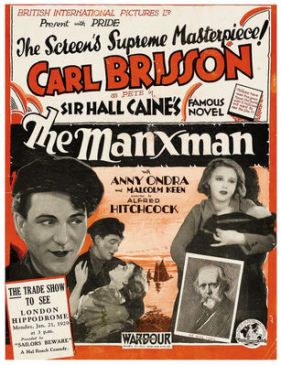
manxmanposter.jpg“What shall it profit a man if he gain the whole world and lose his own soul?”
“I’d do anything for Pete — his friends are mine.”
“When I come back, it’s a queen I’ll make of you — if only you’ll wait.”
“I’m glad Pete’s alive but it makes no difference. I don’t love him.”
“Whatever happens, Pete must never know.”
“But I’ve still got my baby.”
“Pete, we too have suffered.”

The Manxman

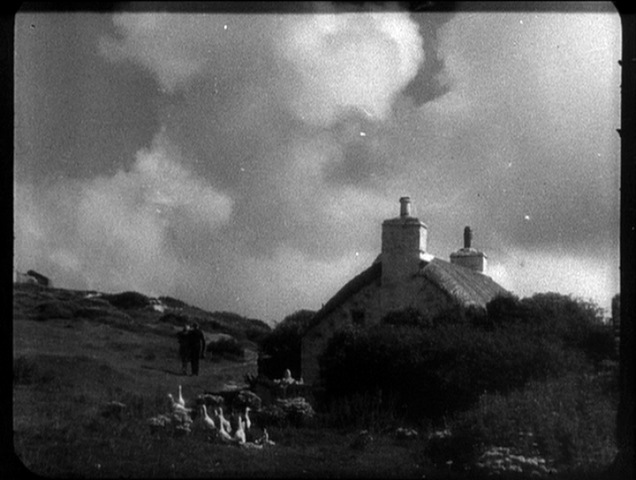
Continuing in a prolific vein, Hitchcock got started on The Manxman just two weeks after Patricia Hitchcock was born, unaware as he made it that this would be his final silent film. However, it was also his first remake. The film was based on a novel by Hall Caine, which had not only been a successful stage play, but had already been made into a movie in 1916. Set on the Isle of Man (the title refers to a denizen of that place) but filmed in Cornwall, the movie is more than slightly reminiscent of several of previous Hitchcock works while continuing to highlight the directing strengths that were keeping him in the business.

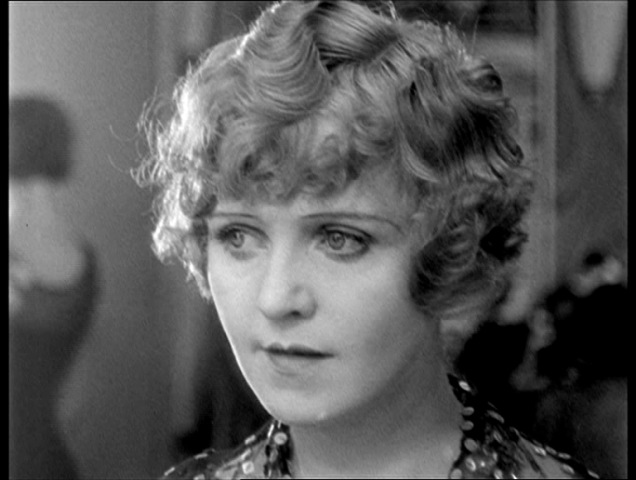
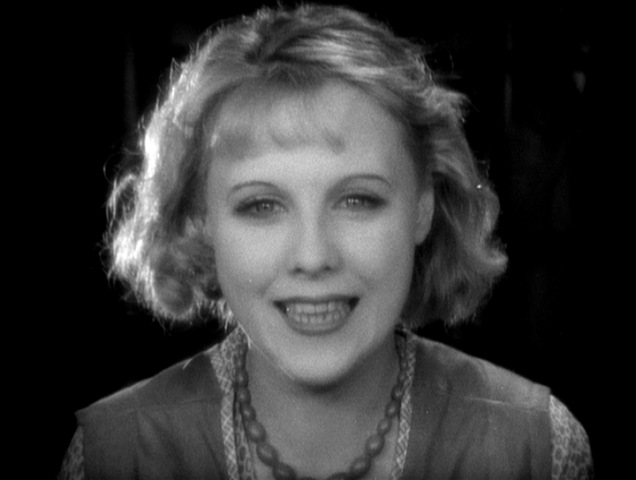
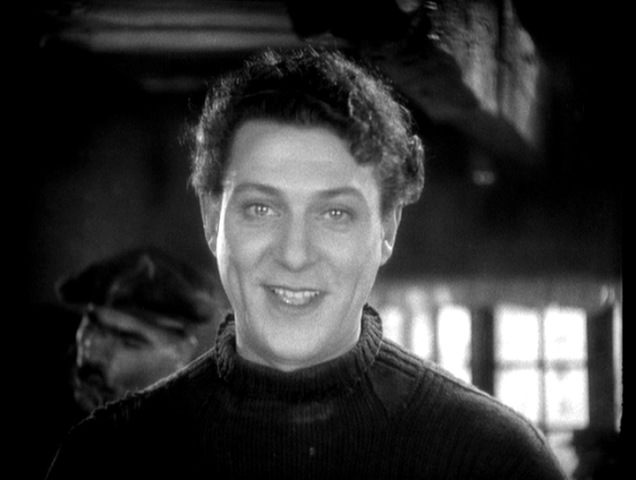
annyondra.jpgJust like The Pleasure Garden and Easy Virtue, The Manxman is a romantic melodrama, and like both The Lodger and The Ring, it features a troublesome romantic triangle. No great surprise, considering it was the eighth and final collaboration between Alfred Hitchcock and Eliot Stannard. The film is even more reminiscent of The Lodger and The Ring by virtue of the starring actors: Carl Brisson (the Danish actor who played Jack in The Ring) and Malcolm Keen (the hapless detective Joe from The Lodger). The lead female role went to Anny Ondra, an extremely popular and truly international Czech film star.

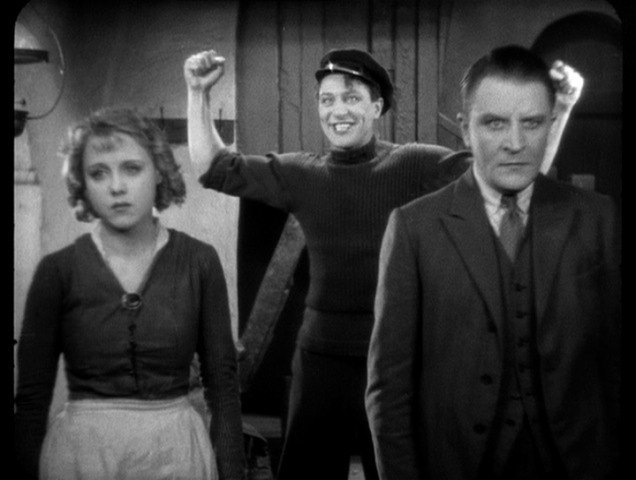
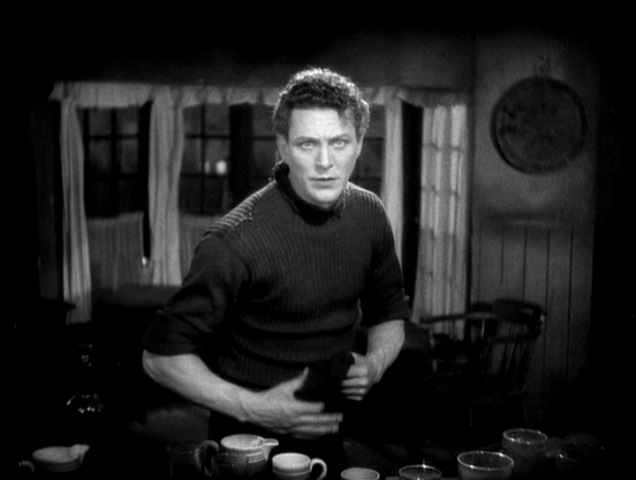
carlbrisson.jpgIn The Manxman, lowly fisherman Pete (Brisson) and up-and-coming young lawyer Philip (Keen) have been best friends since childhood. Pete has his sights set on Kate, the daughter of the local innkeeper. Philip is also in love with her, but due to his position and friendship with Pete, he says nothing of it, even when Pete asks him to talk to Kate’s father (a terrifying fellow named Caesar) about the possibility of marriage. Caesar refuses to hear of his daughter marrying a penniless fisherman, so Pete decides to set out and seek his fortune on the high seas. Before he goes, he secures Kate’s promise to wait for him and charges Philip with watching after her.

malcolmkeen.jpgIn his absence, Pete’s best friend and his girlfriend slowly fall in love with each other. They say nothing of it to each other until word reaches the island that Pete has been killed. Their passionate affair has barely begun, however, before Philip receives word that the rumors of Pete’s death were greatly exaggerated. He’s on his way home with enough money to marry Kate. Although Kate no longer loves Pete, she and Philip decide that he must never know what happened between them. Unfortunately for all involved, Kate turns out to be pregnant with Philip’s child, and events spin steadily towards a striking and cautionary finish.

placement.jpgWhile the film is often emotionally overwrought, and certainly overlong at 110 minutes, its well-managed individual elements complement each other nicely. The three stars are excellent in their various roles, good enough that they are allowed to convey a great deal simply through changes of expression and significant glances without having to rely on the clumsy intrusion of too many intertitles. The performances are further heightened by the way Hitchcock places them and frames the shots. The locations are top-notch, and are integrated very well into the setting to the point of helping tell the story.

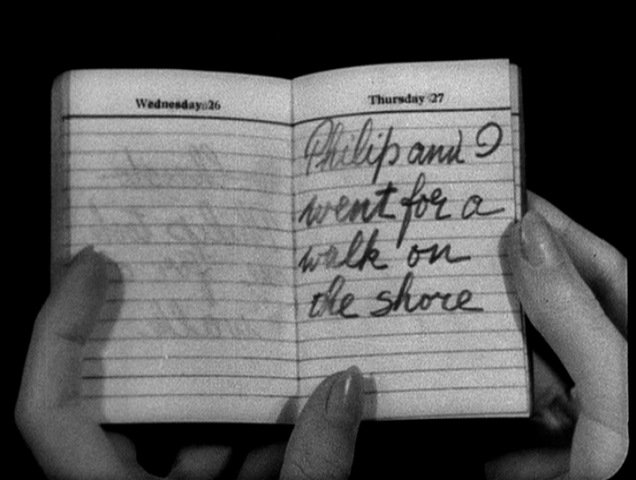
diary.jpgThere is an especially noteworthy device employed to streamline the story early on. After Pete ships out away from the island, the scene transitions to a shot of a small black book with “My Diary” on the cover. Kate’s hands flip the book open (her name is inside the cover) and then turn through the dated pages. The entries begin with “Pete sailed today” and then continue with a few entries consisting of “Mr. Christian called today.” Before long, an entry reads, “Mr. Christi Philip took me for a walk.” And then she begins calling him Phil, the levels of informality reflecting their growing intimacy and affection.

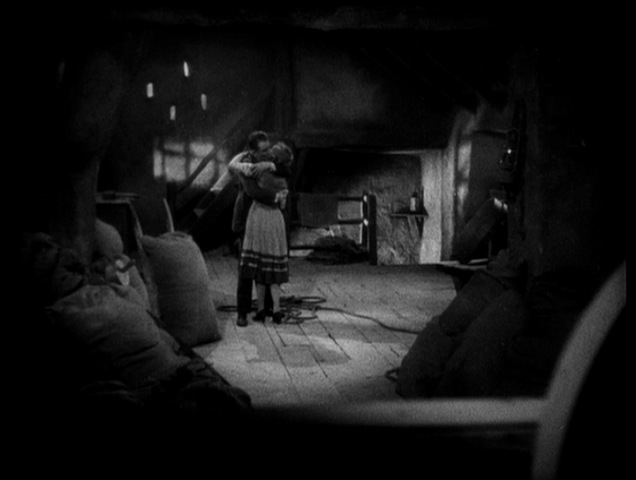
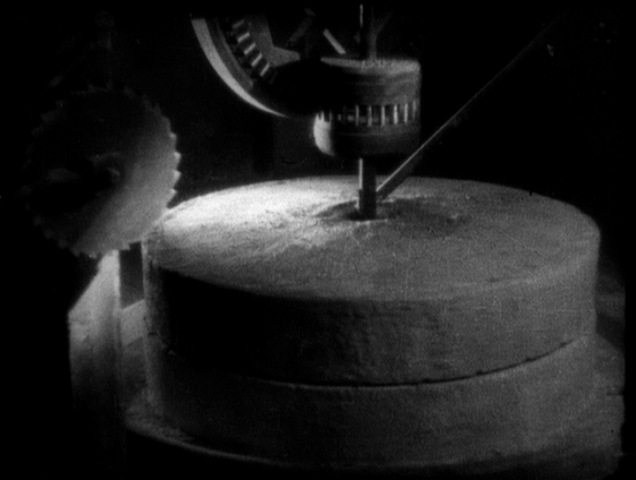
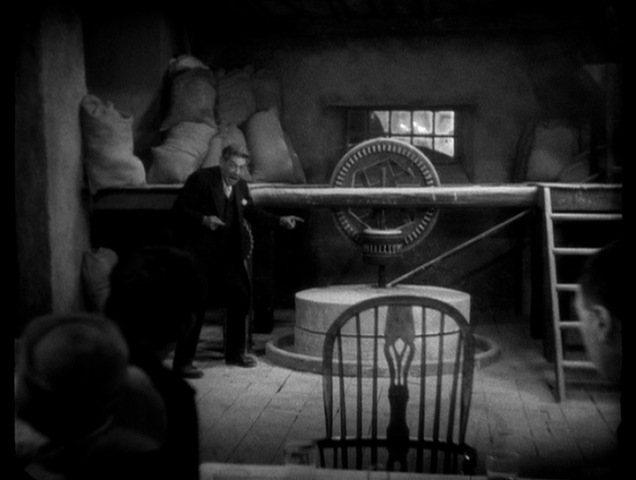
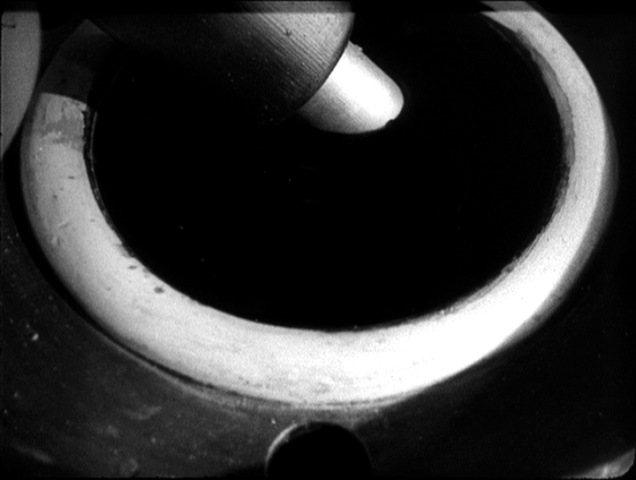
mill1.jpgShortly after Pete is declared dead, he appears standing outside some kind of shop, where he writes a note to Philip. He is alive and well, and coming home with money to burn. After Pete has written his note to Philip, but before it has arrived, Kate and Philip have a private tryst in an old abandoned mill.mill2.jpg Kate turns the crank, revolving the rod inserted in the hole of the grindstone, which causes the whole apparatus to turn. She seems quite surprised that it works, then goes over to Philip and they begin to embrace passionately. The shot switches discreetly back to a close-up of the grinding mill, in what is possibly the most oblique reference to sexual intercourse I have yet encountered in cinema.

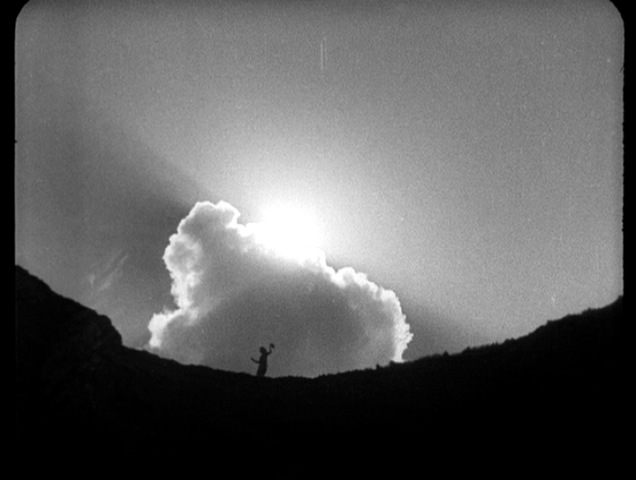
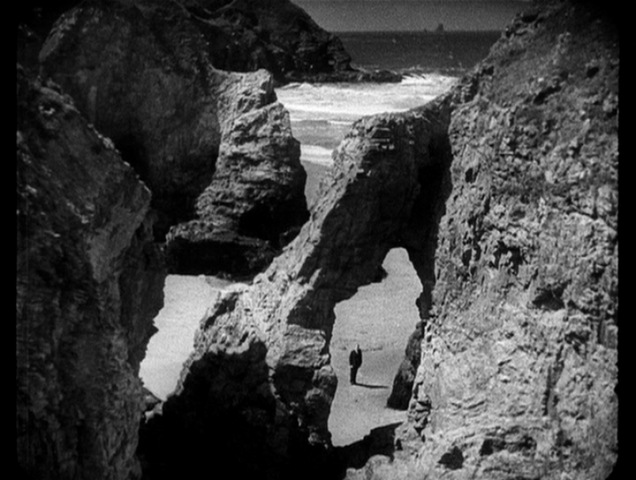
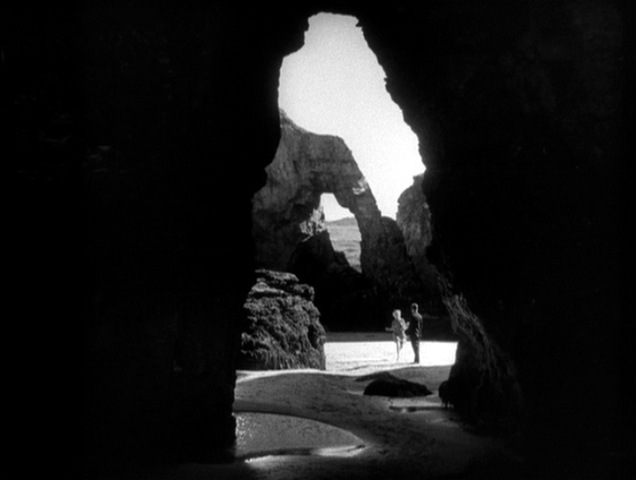
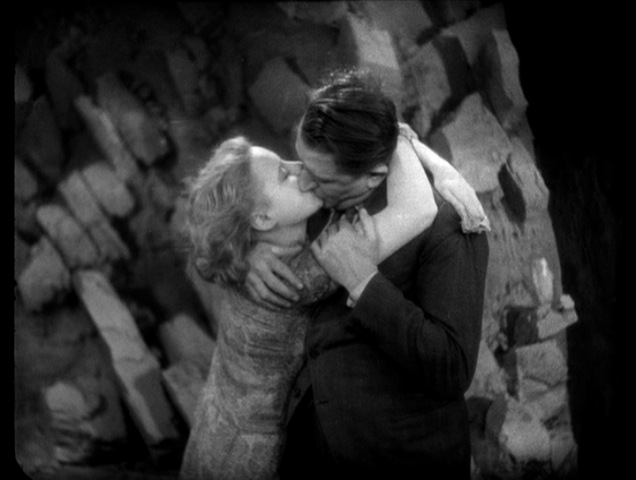
After he receives Pete’s letter, Philip calls Kate for a rendezvous at the “usual place.” This turns out to be a private beach. Hitchcock employs some of the most impressive exterior camerawork we have yet seen as Kate goes to meet Philip, including a striking silhouette shot that looks like something out of an Ingmar Bergman film and a series of shots framed by some particularly striking rock formations.

bergman.jpgrock1.jpgrock2.jpg

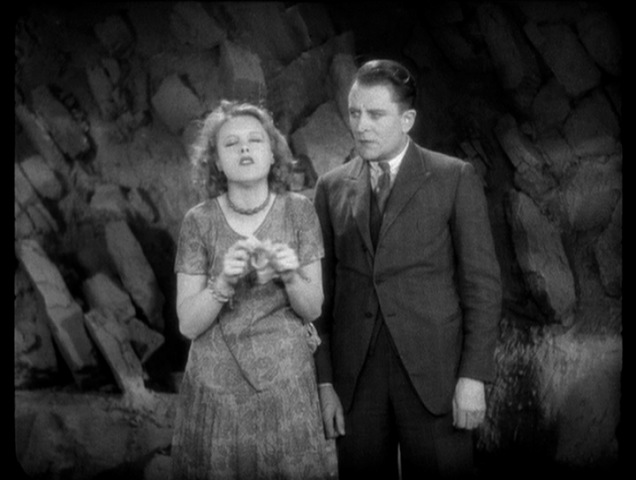
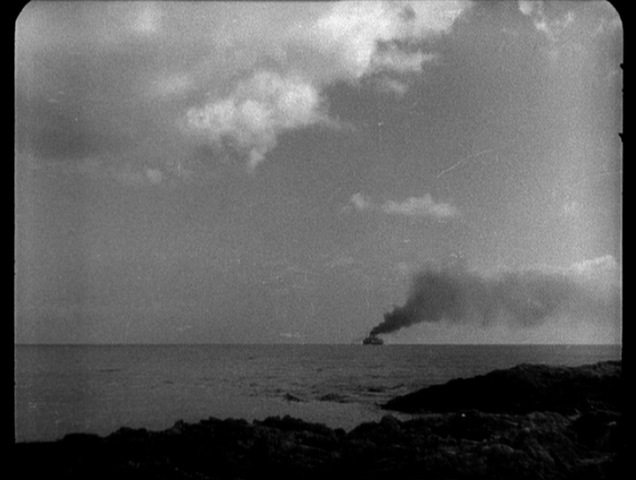
return1.jpgThe tension in this scene is palpable, as Kate and Philip argue over what to do out on the beach, intercut with views of Pete’s ship drawing closer and closer to port out on the horizon. A key element of the ensuing tragedy is set in motion when Kate doesn’t reveal her pregnancy to Philip at this point (it is unclear whether she knows yet), and they decide to say nothing to Pete. If Pete were more perceptive, they wouldn’t have to. Neither of them seem to crack a smile during the entire remainder of the film. However, Brisson plays the character with such a sense of delirious happiness that his obliviousness is actually believable.

return2.jpgreturn3.jpgreturn4.jpg

sermon.jpgEverything Pete says or does seems to inspire feelings of guilt and remorse in the other two, including the unfortunate choice to hold his wedding reception in the old mill. Caesar adds to the general dourness of the scene by taking the opportunity to make a solemn speech about the sanctity of marriage: “Marriage be a mighty reverent thing. All manner of punishment comes to them that’s false to its sacred vows.” Then, to illustrate his point, he sets the mill grinding. Harsh.

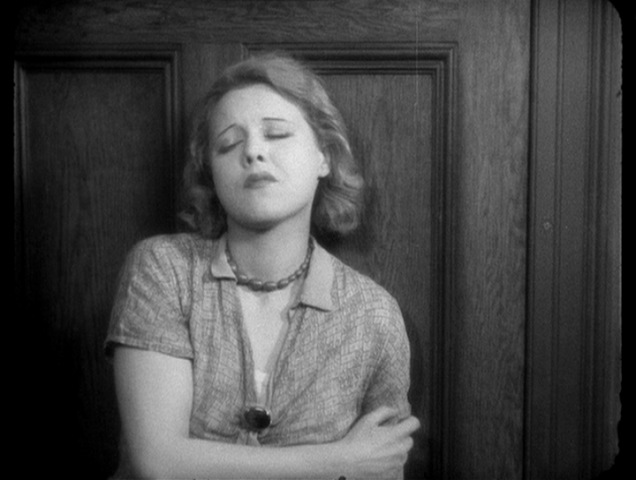
Philip cuts out as quickly as he can and takes a vacation. Kate is quietly miserable as a married woman, feeling she is living a life of deceit. As soon as Philip returns, she lets him know about the baby and once again they argue over whether to tell Pete. Kate wants to, while Philip demands that she do nothing of the kind. She seems determined to tell anyway, but only gets out the words, “I’m going to have a baby” before she loses her nerve at Pete’s ecstatic reaction. The wedding must have taken place within a matter of days after Kate’s fling with Philip, because no one (and certainly not Pete) ever suspects that the baby was conceived outside of wedlock, even once it is born.

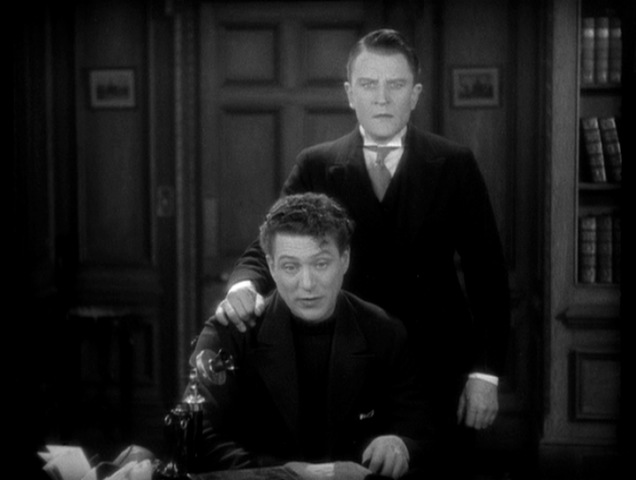
leftme1.jpgMeanwhile, Philip achieves his lifelong ambition of becoming a Deemster (which, we are informed, is what they call judges on the Isle of Man). His in-statement is marred, however, by Kate appearing in his new office to inform him that she has left her husband. She couldn’t take it anymore, so she left himleftme2.jpg a note and disappeared to hide out with Philip. Pete tries to cover for her by telling everyone that he sent her on a holiday to London, but he privately confesses the truth to Philip, not knowing his wife is listening through the door. Clearly at this point the objective of not breaking Pete’s heart is a total wash, and they ought to tell him everything, but, inexplicably, they don’t.

darkwater11.jpgShortly thereafter, Kate goes back to get the baby (it is unclear why she left it behind in the first place), but Pete won’t give it up, even when she tells him it isn’t his. Fraught with despair, Kate goesdarkwater2.jpg out and throws herself off of the dock. She is rescued by a bystander and arrested for attempted suicide. Poor Philip. Her case turns out to be the first (and last) he presides over as a judge. (There is a great transition from the bubbles rising out of the dark water where Kate disappeared beneath the surface to an extreme close-up of Philip’s inkwell as he takes his place at the bench.)

truth.jpgAlmost before Philip has a chance to fully realize whose case he is actually hearing, Pete and his in-laws crash into the courtroom and Pete begs Philip to let her return to him rather than face punishment. Philip agrees, but Kate suddenly pipes up, refusing to go. Right about here, Caesar suddenly realizes what Pete was too thick to get, and loudly proclaims it to everyone. Philip has no choice but to confess (and it seems from Pete’s expression that nothing less than a first-hand confession from his friend would have convinced him of such disloyalty — his honest, blind trust is commendable, if ill-advised). He resigns his new post on the spot and steps down to confront the consequences of his actions. Pete is too shocked and saddened to be angry.

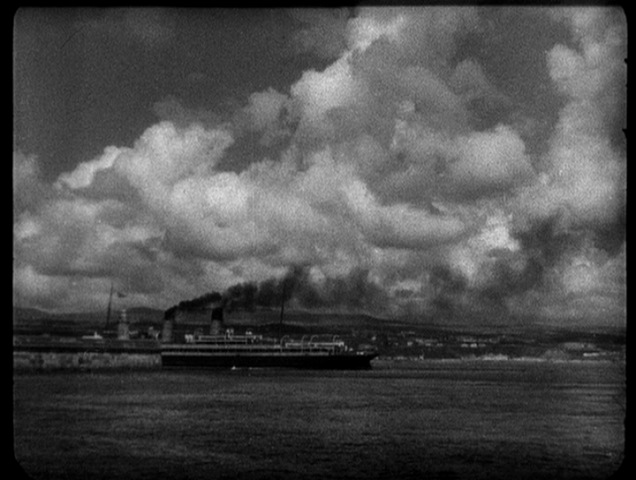
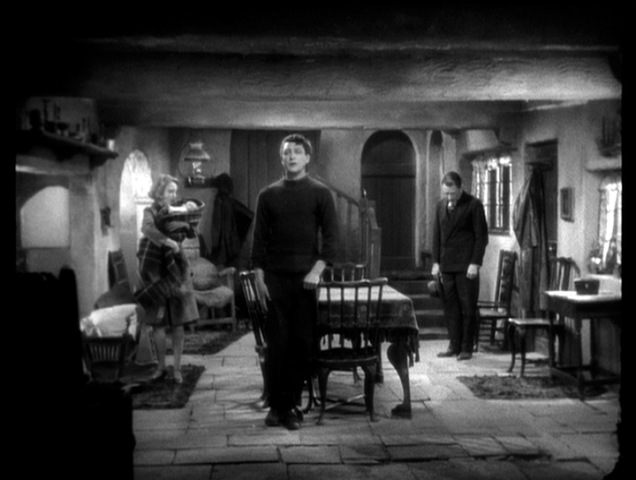
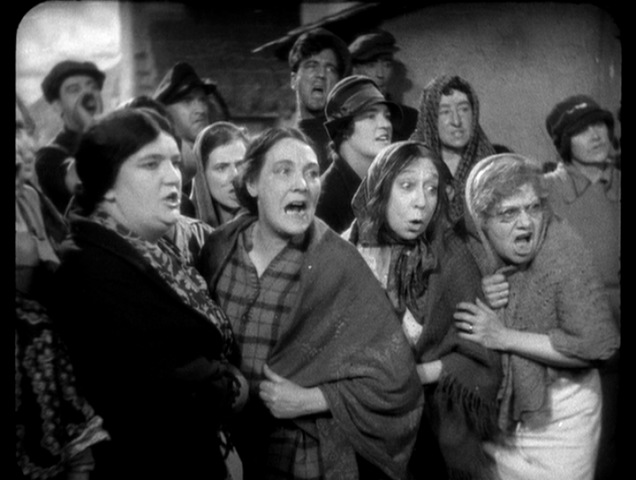
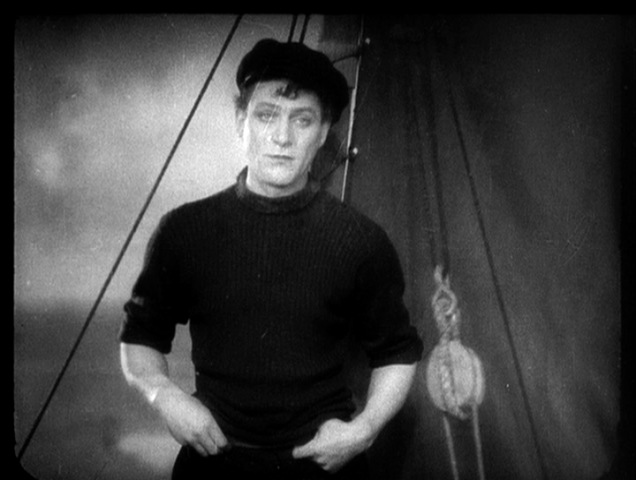
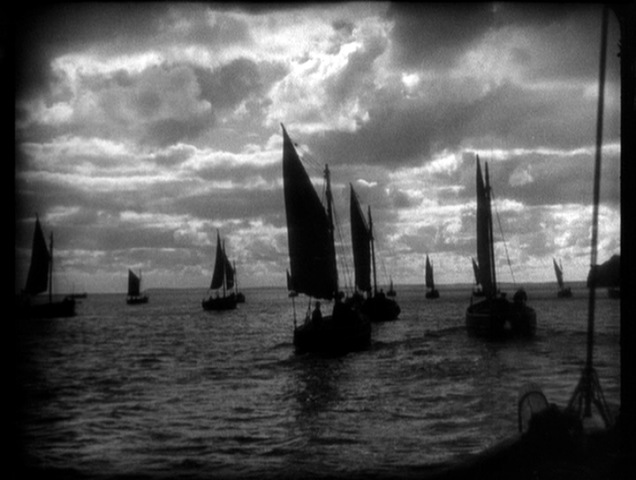
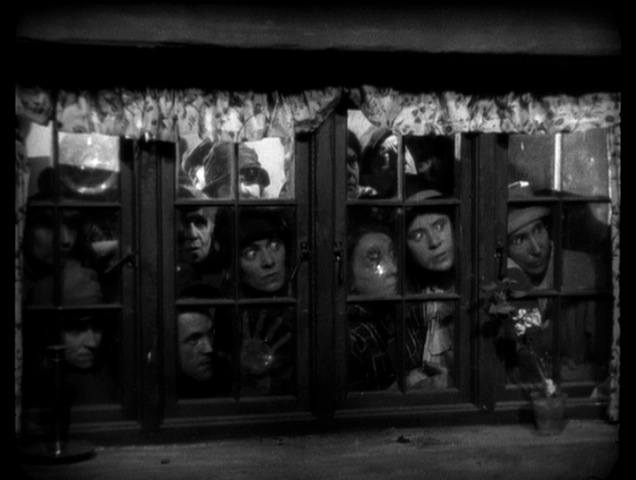
end1.jpgThe three return to Pete’s house, but don’t speak. The men stand awkwardly, avoiding looking at one another, as Kate gathers up the baby and its things and the whole village gawks through the windows, then the unhappy couple braves the gauntlet of the loudly disapproving village hags and walk awayend2.jpg over the horizon. They will leave the island in disgrace, probably never to return, but it is Pete who has really lost everything. In the film’s final seconds, he is seen standing in a fishing boat, staring out at nothing, and then we see the fishing fleet sailing out to sea (a reversal of the opening shot where they were coming in to port) before the scene fades completely.

end3.jpgend4.jpgend5.jpg

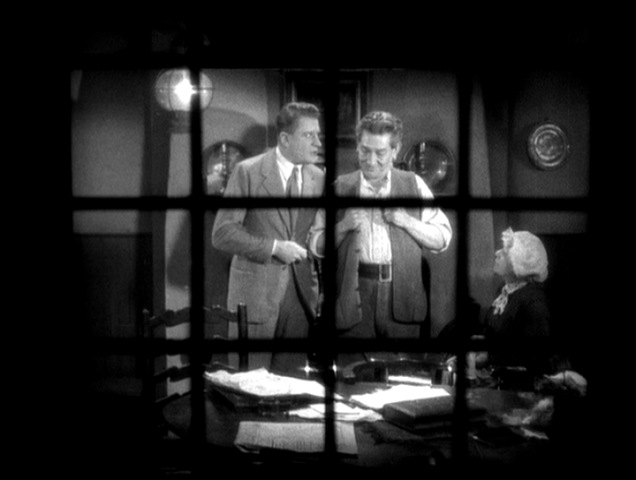
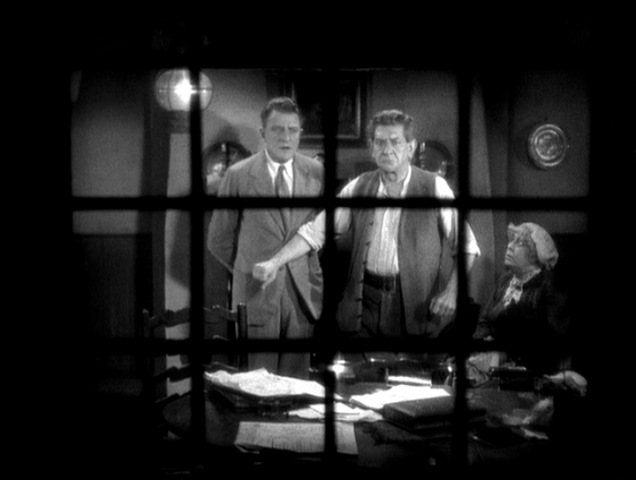
Interestingly, some of the film’s most important moments (particularly those involving Pete) are filmed through windows, as though indicating a distance or barrier between Pete and the other characters. Sometimes it makes him seem powerless and uninvolved in his fate, at other times clueless, as though he sees everything with a false tint. When Pete sends Philip in to ask for Kate’s hand, he watches closely through a window in the wall between the inn’s main room and a backroom. Just like the audience, Pete can’t hear what is going on inside. Caesar seems very pleased at first, and it is obvious he thinks Philip is about to ask permission to marry his daughter. Philip shakes his head and points out through the window. Caesar’s smile changes to a frown.

caesarwindow1.jpgcaesarwindow2.jpgcaesarwindow3.jpg

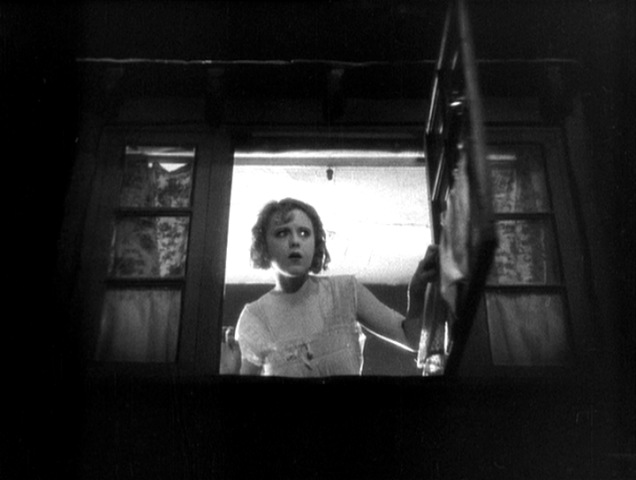
After Kate’s father turns him down flat, Pete and Philip walk around the side of the inn and Pete tosses pebbles at Kate’s window. When she sees who it is, she disappears inside to throw on a shawl, but Pete climbs up on Philip’s shoulders and sticks his head inside. Kate seems to think it’s all a joke, but Pete begs her to be serious and finally secures her promise to wait for him to make enough money to satisfy her father. She then pulls the window-shade down in his face and he climbs down, ecstatic.

katewindow1.jpgkatewindow2.jpgkatewindow3.jpg

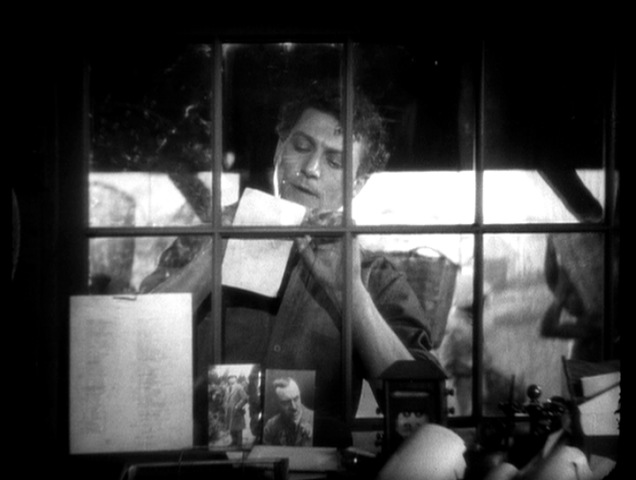
notewindow.jpgPete composes the note to Philip informing him that he is still alive using the window of a shop as a desk, shot from the other side as he writes. When he arrives back on the island, he goes straight to the inn. Philip walks up to the door and peers in to see him enjoying the attention of everyone who thought he was dead. As he looks, Pete glances out through the window and spots him, his face lighting up as he beckons Philip in.

homecomingwindow1.jpghomecomingwindow2.jpghomecomingwindow3.jpg

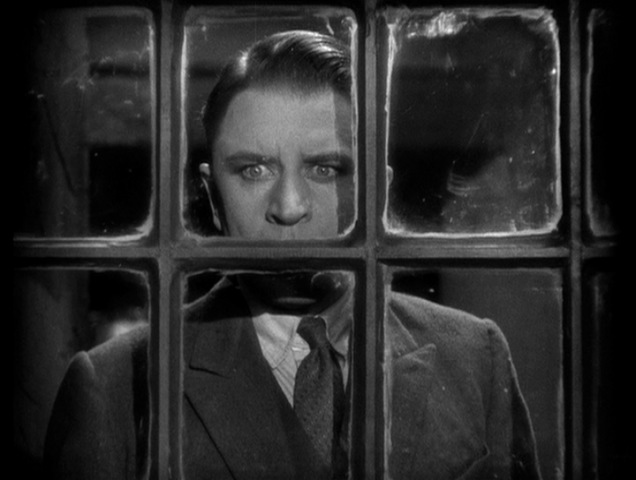
Coming home from a day with the fishing fleet, Pete spots his wife being a little too friendly with a man as he glances through the window. His face lights up when he gets inside and sees that it’s only Philip. When Kate returns home to collect her baby, she first watches Pete through the window as he tends to the child. Finally, as Philip and Kate prepare to leave the island in disgrace with their love child while Pete stands helplessly to one side, a shot reveals a crowd of the townspeople peering in with their faces pressed tightly against the glass.

affairwindow.jpgpetewindow.jpggawkerwindow.jpg

A grimly moralistic tone squelches all of the fun out of The Manxman, in the end. As with many of his earliest works, Hitch remained unsatisfied with the finished film, but it was a financial success. However, it was not released until after the success of his next film (much as his first two films weren’t released until after The Lodger). Hitchcock continued to distinguish himself visually, but the stories he filmed remained largely sub-par.

By the end of his silent period, he had only directed a single suspense thriller, and had also shown a certain flair for staging light-hearted comedy. However, he had largely been left to do what he could with thin melodramas of various stripes, with less than spectacular results with respect to lasting appeal. This would soon begin to change. Unfortunate material aside, Hitchcock had thoroughly mastered the technical aspects of his chosen art form when the silent era came to an end, and the techniques he had acquired of telling a story purely with visuals would continue to serve him well long after the transition to sound had been made. Indeed, sound would remain entirely superfluous to many of the most striking and famous scenes of his prestigious career.

Next Week: Hitchcock directs his first sound picture (sort of)

Conference Call

•February 19, 2008 • 1 Comment

If, for some inexplicable reason, you should find yourself in East Texas at the end of this week, I will be in Longview presenting a paper at LeTourneau University on Friday afternoon. The event is the South Central Conference on Christianity and Literature. The theme is “In Search of the Peaceable Kingdom: Studies in the Literature of Conflict, Struggle, and Hope.” My paper is entitled “The Violent Still Bear It Away: Finding Flannery in The Three Burials of Melquiades Estrada.” How’s all that for a mouthful?

If you can’t make it, don’t worry. I’ll likely be posting my paper on here sometime next week.

A Few Good Things

•February 17, 2008 • Leave a Comment

Nothing substantial today, just a few quick links to toss your way. First and foremost, if you’ve been living in a cave somewhere, I present to you the Indiana Jones IV trailer!

That action sequence that starts at about 1:05 had me cackling gleefully. Pure, classic Indy moment right there. If the whole movie can feel like that, then this is going to be great. Of course, I also saw a lot of things that looked very CG-ish and I thought they said they weren’t going to go that way. Potentially a very minor quibble, possibly a much larger problem. We’ll just have to wait and see.

On a far less serious note, here are some classic films dubbed with goofy voices. Or maybe it’s a very serious note, if you consider this sort of thing blasphemous. Actually, the only really effective one here is the first one, a scene from Casablanca. The rest isn’t nearly as amusing. Particularly with this scene from Singin’ in the Rain, changing the voices kind of defeats the purpose.

Meanwhile, IFC.com has published the first part of a guide to one of my favorite franchises of all time. That’s right, I’m talking about Planet of the Apes. What a great series . . . and the article seems to be doing them justice in just the right degree. Check it out.

We’re one week out from Oscar night, and I found myself (for no particular reason) at Diablo Cody’s MySpace. Guess who she thinks should win the award? Hint: A quote at the top of her page reads, “If I have a milkshake, and you have a milkshake…”

And that’s about all I have just at present. Gotta run, busy times.

The Spiderwick Chronicles

•February 15, 2008 • Leave a Comment

spiderwick_chronicles_poster.jpgstarring Freddie Highmore, Mary-Louise Parker and Nick Nolte
written by Karey Kirkpatrick, David Berenbaum and John Sayles and directed by Mark Waters
rated PG for scary creature action and violence, peril and some thematic elements.
90%

Based on the five books of the best-selling children’s series by Tony DiTerlizzi and Holly Black, The Spiderwick Chronicles is about a family and their discovery of the magical world that exists all around them. Helen (Parker) and her three kids, Mallory (Sarah Bolger) and twins Simon and Jared (Highmore), move onto the Spiderwick Estate in the midst of a family crisis. The Grace parents have separated, and Jared is siding with his dad and taking out his anger on everyone around him. Soon, he stumbles on a book (written by his great-great-uncle, Arthur Spiderwick) with a prominent warning on the cover (which he ignores) and unknowingly invites the attention of an evil ogre named Mulgarath (Nick Nolte) who needs the knowledge contained in the book to conquer the rest of the fairy world. With the help of his siblings and a few new friends, Jared must find a way to keep the book out of the hands of Mulgarath’s goblin army without losing his life in the process.

Not having read The Spiderwick Chronicles, I came in cold and was largely drawn in and entertained by the story. The movie often has a very “family film” feel to it in the way it deals with emotional issues, but at its heart it is simply a story for children and about children, nothing more. With respect to the more adventurous elements, it doesn’t minimize the peril. Quite the opposite in fact, and younger children may well find the result rather frightening. Everyone else should find the result exhilarating.

Freddie Highmore is a very talented actor and performs well in both of his roles, but I felt that perhaps too much was being asked of him here. The scenes where his two characters are forced to interact with each other did not feel as seamless as similar efforts have. Mary-Louise Parker is perfect in this sort of role (very similar to her wide-eyed-suburban-mom-turned-drug-dealer in Weeds, oddly enough), and Nick Nolte is always a good choice to channel gravelly-voiced menace. Perhaps the most pleasant surprises, though, are the celebrity voices of CG-characters Thimbletack (a brownie/boggart) and Hogsqueal (a hobgoblin). They are voiced by Martin Short and Seth Rogen, respectively, but the actors don’t allow their recognizable voices and personas to overwhelm the roles, as so often happens in such cases.

Best of all, though, in a market that is increasingly filling with eye-popping fantasy worlds, Spiderwick at its best manages to retain a true sense of wonder and discovery. As I understand it, the best aspect of the original books are DiTerlizzi’s eye-poppingly imaginative renditions of the elves, brownies, sylphs, griffons, and dozens of varieties of fairies that populate the series. If the movie has a serious flaw, it is the streamlining of the plot to a degree which cuts out most of the incredible variety that DiTerlizzi has created on paper. Nevertheless, the creatures that do make it to the screen are a visual treat to behold, and the plot (bare-bones though it may be) plays as an excellent metaphor for the real-life problems faced by the Graces and other families everywhere.

Combining tried-and-true conventions of this rapidly-expanding genre with a unique flavor of its own, to great effect, The Spiderwick Chronicles is a bright spot amid the gloom this season usually brings to the local theater. Without (probably) turning into a franchise itself (having used up the entire series at a single go), it should ensure that films like it continue to be made, and, hopefully, made well.

Week 7: Champagne (1928)

•February 13, 2008 • Leave a Comment

champagneposter.jpg“You’d better hurry, Miss, before she sinks.”
“I’ve always understood that simplicity was the keynote of good taste.”
“I baked these myself, Daddy.”
“You can’t live on pride.”
“We’re only interested in legs here.”
“I’m sorry, I thought you were a gentleman.”
“But what are you doing here?”

Champagne

Hitchcock’s 8th film, Champagne, was rushed into (and through) production shortly after he completed The Farmer’s Wife, and, in fact, was completed before Patricia Alma Hitchcock was born in early July. The finished product invites inevitable comparisons with the beverage for which it is named: a light, breezy concoction with little depth and no lasting impression. Small wonder considering the circumstances under which it was conceived. It started off as simply a title, suggested by studio writer Walter Mycroft. The idea, apparently, was to build an entire film around champagne somehow, presumably a popular-enough concept during the Roaring Twenties.

bettybalfour.jpgWorking with Eliot Stannard, Hitch came up with an idea that was very much in the same vein as some of his earlier melodramas: a girl who works in the cellars of a major French champagne producer daydreams about the glamour surrounding the outgoing shipments. Eventually she goes to the city herself and loses her innocence amidst the iniquities of alcohol consumption before finally returning to her old job. Now, every time she sees a shipment of champagne going out, she knows the trouble it is likely to bring with it. While Hitchcock and Stannard were concocting this idea, the head of the studio had already signed a girl to play the lead: Betty Balfour. Balfour was one of the major British stars of the day, known as “the English Mary Pickford.” However, like Pickford, she was most known for her roles in light, upbeat fare, and Hitch’s idea simply wouldn’t do.

Of course, this wasn’t the first or the last time that Hitch would find his creative control of a project subverted by the image of one of his actors. While his original idea hardly sounds terribly compelling, the more upbeat story Mycroft presented them with is truly devoid of any reason to exist. Stannard and Hitchcock (who took a writing credit on this film) were still struggling to piece the script together when shooting began, apparently staying just ahead of filming as production continued. Unfortunately, it shows. Aside from a few virtuoso visual touches, the film is rather dull and completely fails to engage the viewer with any reason to invest in the characters or their circumstances.

gordonharker.jpgChampagne takes place amidst the rich but shallow oeuvre of an F. Scott Fitzgerald novel, with the characters bouncing back and forth between New York and Paris, hitting every high-rolling party along the way. Betty Balfour essentially plays the Paris Hilton of the 1920s, a wealthy American heiress whose father (played with twitchy irritability by Gordon Harker in his third major Hitchcock role) is a big cheese in the champagne business.

When she steals one of his aeroplanes and crashes it in the middle of the Atlantic in order to catch a cruise ship carrying an “unsuitable” young man she plans to elope with, her father decides he’s had enough. He comes to meet her in Paris (where she has yet to tie the knot, thanks to her frequent quarrels with her beau) and claims that he’s been wiped out on the stock market and they are now penniless.

creepyguy.jpgHis lesson fails to have the desired effect when his daughter winds up getting a questionable job in a shady cabaret and nearly puts her virtue in question. Through it all floats a mysterious and extremely creepy older man with a sinister moustache, who seems to dog Betty’s steps from the moment she sets foot on board the cruise ship. It is as though he is simply waiting to catch her in favorable circumstances so that he can take advantage of her, and every clue points in this direction.

These suspicions seem to be confirmed when she rushes to his side in a fit of pique after her father reveals his ruse, only to have him lock her up. However, as the viewer may have at least half-suspected all along, this lascivious-looking character proves to be an old friend of her father’s who has been watching out for her all along. Everyone has a good laugh, the two young lovers are reconciled, and we all applaud the end of a blessedly brief 85 minutes.

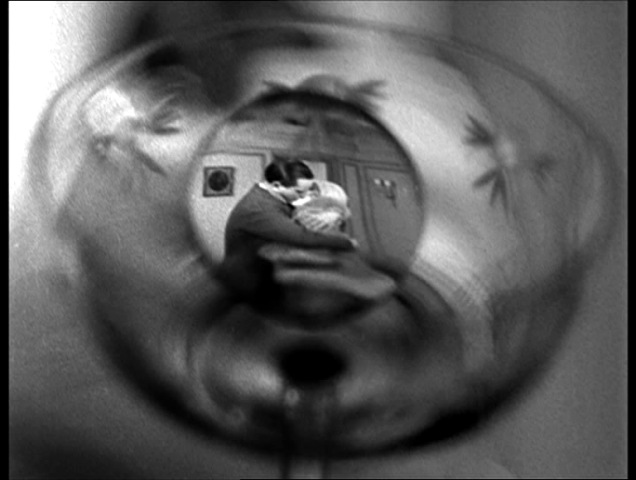
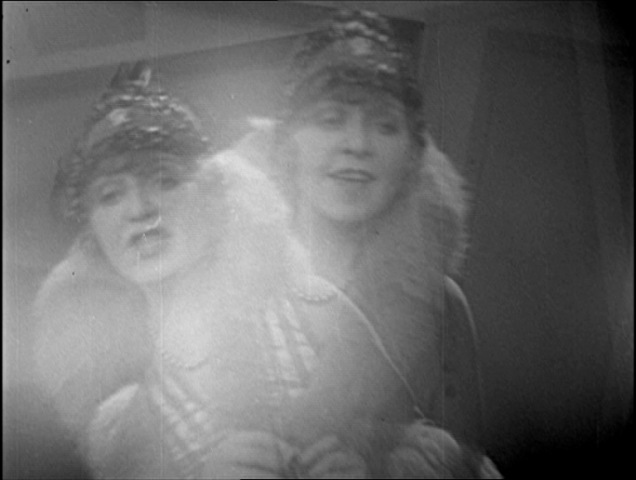
champagne1.jpgAlthough Champagne is ostensibly a comedy, and Hitchcock had previously shown a certain aptitude for filming humor, this movie is only rarely funny. The occasionaly guffaw aside,it is unlikely to inspire any mirth. The flat nature of the film only serves to draw attention to some of the interesting visual techniques used to tell its story. The film opens and closes with a shot of the room filmed through achampagne2.jpg champagne glass being held by the creepy-moustache guy (played by German actor Theo von Alten, listed as simply “The Man”). The effect was devised specifically for the film by Hitch himself using a special lens (despite being told that the focus effect he wanted was impossible), but he doesn’t make the mistake of overusing it. It simply bookends the film.

Moustache guy lowers his glass and we see that he is at some sort of party with a great deal of dancing and food. Suddenly, something catches the attention of the crowd, and they all rush out, practically stampeding the exits. Soon we see that they are on a ship, and at first we wonder if the ship is sinking, particularly when we see sailors clamber aboard a lifeboat. However, just that boat is lowered to the ocean below, and it seems that perhaps someone has fallen overboard.

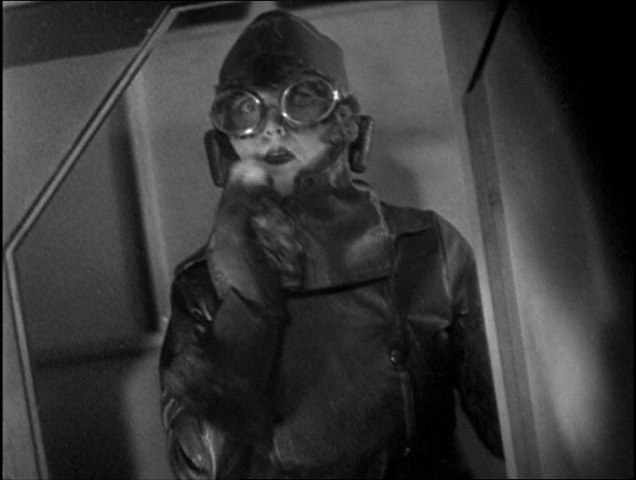
powderpuff.jpgThe reality is far more bizarre, of course, as they row out to meet Betty’s plane and rescue her and her pilot. She immediately reveals a great deal about her character when she appears, dressed in a leather pilot outfit, and immediately pulls a puff out of her slick and powders her nose. Here is a character who is always ready to party, and even when circumstances are at their worst, she seems to think that the best approach is to greet the situation with forced good-cheer.

seasick.jpgBetty is joyfully reunited with her fella (played by French actor Jean Bradin, simply called “The Boy”), and the voyage proceeds. A few days later, the ship sails into rough waters and everything on board is shown swaying violently back and forth. Betty makes her way into the nearly empty dining room, staggering entertainingly between tables, and is joined by moustache guy. The boy happens in shortly thereafter and is most put-out when he sees her with the man, but he is overcome by seasickness, particularly at the sight of fully-garnished dish containing the head of a pig. He turns and stumbles back out. Betty visits him later in his cabin, and we are treated to a camera effect that attempts to communicate his condition. It is quite successful, threatening to sicken the viewer as Betty’s image splits into three and sways blurrily in all directions.

The boy wanders in and out the film haphazardly from this point on, usually only walking on long enough to quarrel briefly with Betty before leaving in a huff. After each of these little spats, both of them have brief second thoughts, and turn to after the other to kiss and make-up, only to allow pride to overwhelm these reconciliatory instincts (a pattern that bodes ill for their future happiness, but does allow the plot to advance).

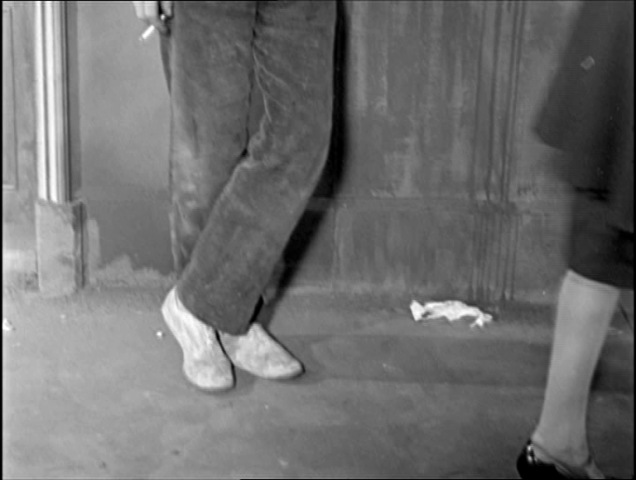
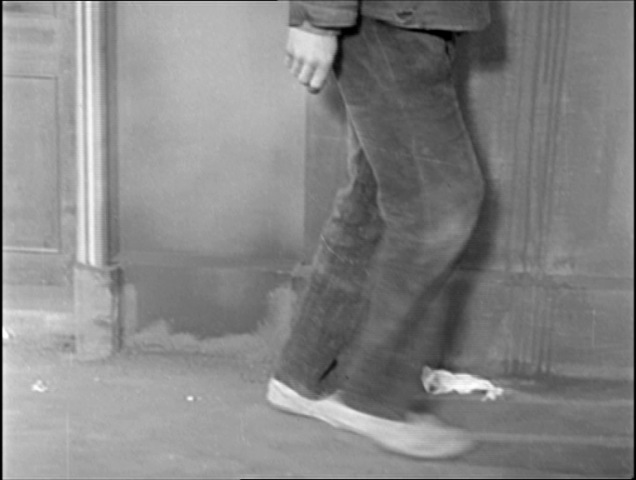
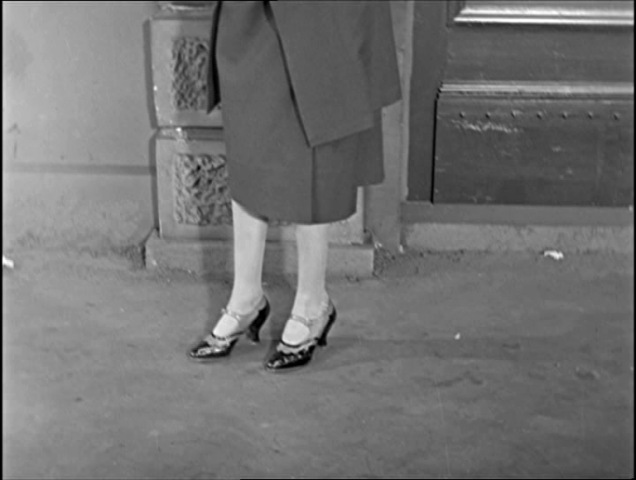
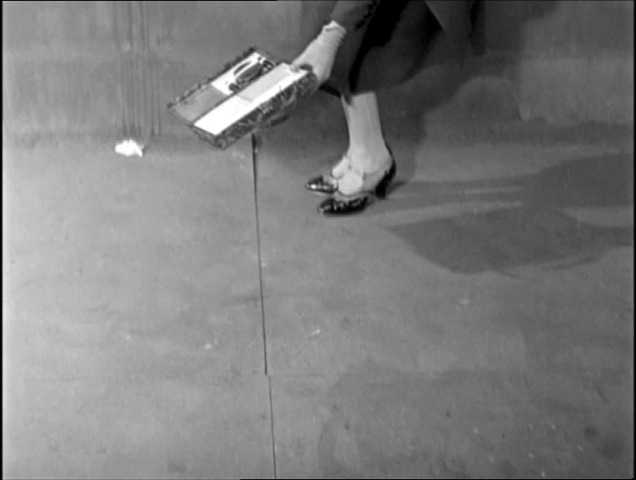
snatch1.jpgAfter Betty’s father delivers the bad news about their change of fortune, Betty resolves to sell her jewelry for money to live on. What follows is a true Hitchcockian sequence: Betty walks along the sidewalk, swinging her jewelry box at her side. She passes someone leaning against the wall, who quickly moves to follow her and snatches the jewels. She stops and looks after the retreating person, seemingly at a loss as to what to do, then walks back and picks up the box from the ground, only to find it empty. The entire scene is filmed from the waists of the characters down, using only their legs and feet to convey the action.

snatch2.jpgsnatch3.jpgsnatch4.jpg

skirt.jpgSome largely unfunny shenanigans follow as Betty struggles to adjust to her new station in life, learning to make a bed and so on. She tries her hand at baking for her father, and he makes a courageous attempt to eat what she’s made, but ultimately declares he isn’t hungry and sneaks out to order a large meal at a fancy restaurant. Sitting dejectedly back in their apartment, Betty notices an ad calling for beautiful teeth to demonstrate the effectiveness of “Minto” Tooth Paste. She rushes downtown, but goes to the wrong place. While the man behind the desk explains her mistake, the guy behind her reaches out with the toe of his shoe and carefully lifts her skirt to inspect her legs. He likes what he sees, and they offer her the cabaret job, which she accepts.

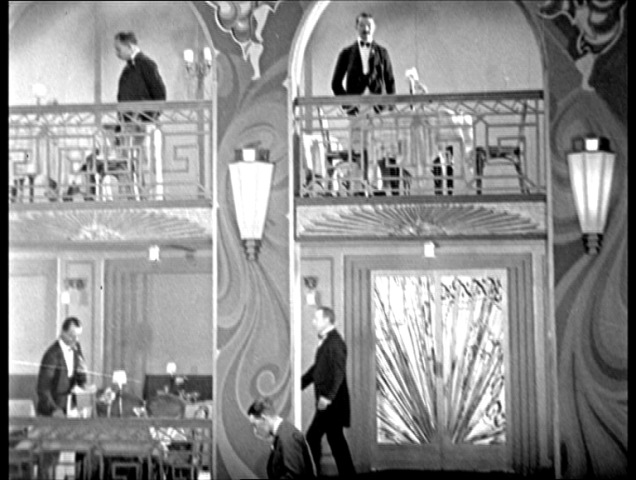
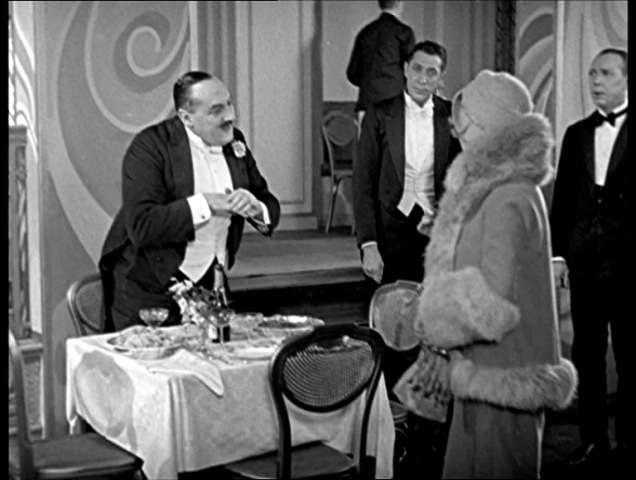
cabaret.jpgThe cabaret sequence is easily the longest and most elaborate scene in the movie (hogging probably a good quarter of the total runtime). The set is striking and elaborate: an ornate, two-story room full of arches and boxes that frame everything in sight. Betty is given exotic costume and put to work as a flower girl, providing complimentary buttonholes to the gentlemen customers. As she goes back to change, she spots one of several dark alcoves in the building, occupied by a couple passionately making out. The sight seems to shock her (although she has already proved adept at tonsil hockey herself).maitre.jpg From the moment she begins her new job, she seems destined to arouse the ire of the maitre d’hotel, an odious fat man who constantly dry-washes his hands. Of course, it’s no wonder he’s annoyed: First she gives flowers out to all of the musicians in the band, and then she spends most of the evening sitting at one of the tables, first with moustache guy, then with her boy.

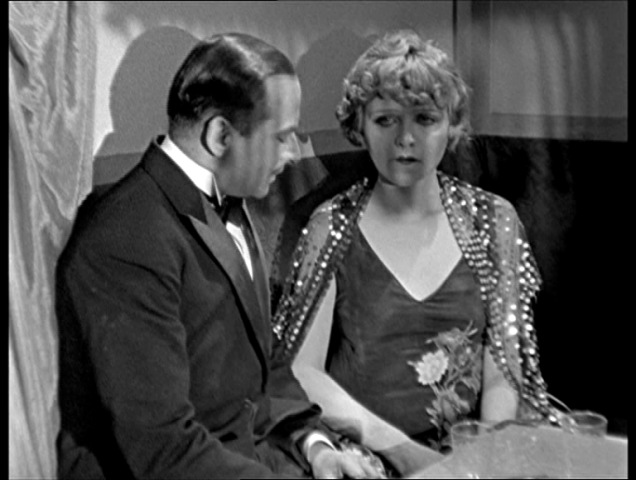
dream1.jpgAs she talks with moustache guy, who is looking as menacing as ever, the camera zooms in on her face, regarding him intently. He motions to her to get up, and together they leave the main dance floor and slip into one of the dark alcoves she noticed earlier. It takes on a very sinister outlook, and as they sit down, portentous shadows (foreshadows?) linger menacingly throughout the frame. He quickly forces himself on her, scoring a prolonged kiss despite her struggle to get free. As their lips remain locked together, the scene fades back to the close-up of Betty’s face and we realize that she just imagineddream2.jpg a possible outcome of the evening. The episode is vaguely reminiscent of the short story “Gas” that Hitchcock had written a decade before, and this tactic allows Hitchcock to have his cake and eat it too. He can inject a little suspense and terror into the scene and taking the heroine into darker territory without any narrative consequences to force him out of the light comedy genre.

dream3.jpgdream4.jpgdream5.jpg

What actually happens is that the man spots the boy on the second floor and motions him to join them, then takes his leave. Betty and the boy quarrel (yes, again) and he leaves, only to return with her father and the news that she has been tricked. The remainder of the film I have already described, but it is particularly notable that throughout the cabaret scene, there is more dynamic cinematography than in any previous Hitchcock film.

It is as though the camera is invigorated by the kinetic energy of the thick crowd of dancers on the floor as it takes us through several notable moving shots. There are multiple tracking shots which follow a character through the crowd, around the edges of the room, and up or down the stairs. One difficult shot swoops all the way across the room to zero in on an extreme close-up. All of this anticipates some of the increasingly elaborate camerawork that Hitch would require of his cameramen in upcoming features.

In terms of overall quality, Champagne is likely the least of Hitchcock’s silent pictures to this point, certainly among the worst of his career. As the director himself would later tell François Truffaut, “The film had no story to tell.” Audiences and critics at the time generally agreed. Nevertheless, as the rise of “talkies” drew near, Hitch continued to strengthen his talent for relaying narrative through visuals, even those that hardly seem worth the telling.

harker.jpgAs for Gordon Harker (because I know you’re dying to know), he worked with Hitchcock only once more, on the 1930 film Elstree Calling. This was the British movie industry’s version of Hollywood’s highly successful vaudeville “revues,” featuring a variety of comedy sketches and musical numbers strung loosely together by a thin narrative device. In this case, the “connective tissue” scenes were directed by Hitchcock and featured an inventor (played by Harker) struggling to watch the revue on his primitive television set, but continually losing the signal due to his obsessive tinkering. Harker went on to star in his own film franchise, as the humorous Inspector Hornleigh, in the late 1930s, and continued to appear in movies until 1959. He never worked with Hitchcock again, though, presumably because the director simply stopped making comedies almost entirely.


Next Week: Hitchcock directs his last silent picture (sort of)

Gentleman’s Agreement: Best Picture, 1947

•February 12, 2008 • Leave a Comment

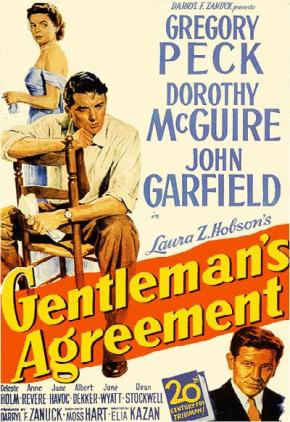
gentlemansagreement.jpgThe 20th Annual Academy Awards rounded up, let’s face it, a pretty dull bunch. Gentleman’s Agreement received 8 nominations, for Best Picture, Best Director, Best Editing, Best Actor (Gregory Peck), Best Actress (Dorothy McGuire), Best Supporting Actress (twice, Anne Revere and Celeste Holme) and Best Adapted Screenplay. Other Best Picture nominees included not one but two sentimental Christmas movies: preachy classic Miracle on 34th Street and unutterably dull Cary Grant flick The Bishop’s Wife. Also nominated were a British adaptation of Great Expectations with John Mills and Alec Guinness, and Crossfire, a noirish crime drama starring Robert Mitchum (I haven’t seen either one).

Ultimately, Best Actor went to Ronald Colman (who played an actor whose personal life is overwhelmed by the roles he takes in A Double Life), Loretta Young won Best Actress for The Farmer’s Daughter, Miracle on 34th Street got Best Adapted Screenplay, and Best Editing went to Body and Soul (a boxing movie). Celeste Holme beat Anne Revere for Best Supporting and the other two went to Gentleman’s Agreement as well. No film won more than 3 awards, a rarity which did not occur again until 58 years later, in 2005. Gentleman’s Agreement is an extremely preachy, self-righteous film about anti-Semitism in the United States. Interestingly, Crossfire was also about anti-Semitism (it hinged on the investigation of a murder which turned out to be racially-motivated), but even more interestingly, the original novel on which Crossfire was based was actually about the murder of gay man. In 2005, Best Picture went to Crash (regarded by some as a preachy, self-righteous film about racism) over Brokeback Mountain (a film about . . . well, you know). Significant? Not really, but there it is.

The story of Gentleman’s Agreement, such as it is, runs like this: Schuyler Green (Gregory Peck), a talented magazine writer, is assigned to do a story on anti-Semitism. After maybe 40-45 minutes of soul-searching and romancing Kathy (Dorothy McGuire), his editor’s niece, he finally figures out what angle to use in approaching the story: He changes his name to Philip and passes himself off as Jewish for eight weeks. The ruse has consequences he never expected, affecting every area of his personal and professional life, including his engagement to Kathy.

Even at under 2 hours, Gentleman’s Agreement feels padded with too much set-up and irrelevant subplots. Green struggles, as I said, for over a third of the movie to decide how to approach the article. When he finally decides he’ll pretend to be Jewish we find out that that’s his “thing.” For every successful article he’s ever written, he got down in the trenches and “became” whatever he was writing about. You’d think the idea would have occurred to him a bit earlier in the proceedings.

Overall, the film is self-absorbed and far from enjoyable to watch, full of stagy speeches and contrived tensions. Its message, though admirable, is clumsily rammed down our throats at ever turn. The characters question themselves and each other so much and with such serious intensity that it simply becomes exhausting. And yet, it all simply boils down to the fact that prejudice is bad and hurts everyone. Perhaps Peck’s character says it best when he asks at one point, “What can I say about anti-Semitism that hasn’t been said before?” The answer, apparently, is nothing. Certainly, in pre-Civil Rights America, it couldn’t hurt to get that message across as often as possible, but Gentleman’s Agreement hasn’t held up well beneath the passage of time.

Far more interesting than the movie itself is a quick look at its context. Most of the Best Picture winners of the late 1940s were heavy, socially-conscious fare, so this was certainly no exception. This was director Elia Kazan’s first Oscar nomination, and he went on to be nominated 4 more times for Best Director, with 1 win. However, just a few years after this, Kazan went before HUAC and “named names” as part of the ridiculous hunt for communists in Hollywood. Already disliked by the right for his socialist leanings, Kazan’s collaboration with HUAC earned him the hatred of the left, and his actions cast a pall over the rest of his career. Many saw his multi-Oscar-winning On the Waterfront (his 2nd directorial win) as an answer to the critics in 1954. However, even nearly fifty years later, controversy surrounded the Academy’s decision to give him a Lifetime Achievement Award, and many in the audience refused to even applaud when his name was announced. Meanwhile, Gregory Peck’s nomination for Gentleman’s Agreement was his 3rd of 5, though he only won once. His moment finally came over a decade later, when he played another man staunchly and courageously opposing racism: Atticus Finch in To Kill a Mockingbird.

Continue reading ‘Gentleman’s Agreement: Best Picture, 1947′