
What I Like About Serenity

•September 21, 2008 • Leave a Comment

For starters, it’s got space cowboys . . . in space! Joss Whedon (though not the first to play with the general idea) has taken elements of the quintessential American film genre, the Western, and teleported them into a compelling futuristic science fiction setting. The main character is even a ex-veteran, a Confederate war hero who now makes a living on the fringes of frontier society (and the law). There are six-shooters, rugged, dusty exteriors, seedy interiors, and the dialogue is a bizarre hybrid of folksy eccentricity and technobabble with a liberal dusting of Chinese profanity that somehow just works. The central theme is one of individualism and self-determination over centralized control, even if it is benevolent. The result, whatever else it may be, is a beautiful marriage of an exciting version of the past and a grim vision of the distant future.

Now, second, I know I just said the central theme is self-determination, and that’s more or less true, but a major part of that isn’t just political, it’s spiritual. I say “spiritual” rather than “religious” because the subject is dealt with in very vague terms in the movie. As one would expect from a civilization that speaks both English and Chinese, the primary religious influences are Christianity and Buddhism, or various blends of the two. Shepherd Book, the Christian-esque influence, says things like, “When I talk about belief, why do you always assume that I’m talking about belief in God?” and “I don’t care what you believe. Just believe it.”

Now, this may sound somewhat milquetoast in one sense, but belief is treated very seriously in Serenity. The heroes are relentlessly pursued by a sinister character known only as The Operative, who is universally described as a fanatic. He cannot be bribed, dissuaded, or discouraged from his goal because he is a true believer in the absolute virtue of his cause. Unfortunately for him, and everyone else, that belief happens to be unfounded. However, what we ultimately see is that the only answer to that sort of staunch fanaticism is an equally powerful commitment to the truth. Only when the characters discover the truth and decide to put everything on the line in its service do they manage to save themselves (and the day).

This plays out primarily through the character of Malcolm Reynolds, whose cynical pragmatism has served as a contrast to The Operatives unshakable faith, but who now reconnects with the believer he obviously used to be when he is reminded of the importance of belief in a cause greater than himself. His movement from someone who is motivated primarily by self-preservation because he has been burned by belief (“War’s long done. We’re all just folk now.”) to a reconnection with his broken idealism is the primary character arc in Serenity. It is as reminiscent of Rick Blaine’s transformation in Casablanca as it is of the character’s more obvious relation to Han Solo of Star Wars.

All of this leads back into the question of self-determination when it turns out that the Alliance’s efforts to forcibly create what The Operative longingly describes as “a world without sin” have had precisely the opposite result. Again, it is not the ideal or its pursuit that are called into question here so much as the means of achieving it (and perhaps even whether it can be achieved). In this case, the end does not justify the means precisely because the means the Alliance employs will never lead to the desired end. River Tam, who is a sort of parallel to The Operative, is the one character who has been denied the opportunity to choose her own way.

When Mal says, “You all got on this boat for different reasons” to his passengers and crew near the end of the film, River is the glaring exception that proves the rule. Not only does she not make any decisions for herself, she has no foundation on which to base even the simplest rational thought processes. All of that has been removed from her by the Alliance. In this sense, her struggle is the most heroic of all, because she is fighting against her own internal programming. She faces the same challenges as all of the other characters, but she has her own will to overcome on top of everything else. Significantly though, what she accomplishes (and she is, of course, the key to everything the heroes manage to do) is done in spite of the Alliances attempts to mold and shape her character, rather than because of them.

Third, as I’ve already hinted at, Serenity is very character-driven, and they are great, great characters. All of them are different, but there isn’t one I don’t like, from dim, surly meat-shield Jayne and gifted pilot Wash (the self-described “plucky comic relief”) to the always-cheerful mechanic, Kaylee, and stone-cold, whip-smart Zoe (second-in-command to Mal and married to Wash). These characters are easy to fall in love with, and fun to visit and revisit innumerable times. This is as good a point as any to note that Serenity is the continuation (and conclusion) of tragically short-lived television series “Firefly.” I saw the movie before I watched the series, and enjoyed it immensely as a stand-alone story. I have since gone back and watched the show, and I enjoy the movie even more on that level. That’s no small accomplishment.

There’s a lot to be said (and I’ve said it) for deeply cerebral science fiction like Gattaca and Sunshine, but some part of me can’t get enough of the flashy, effects-laden sci-fi that Serenity, like the original Star Wars movies, does so well (and most others of its type attempt so poorly). I wish there were more of it, but until there is, this is one movie I’ll be returning to again and again and again. I could go on, but in the end, it all comes down to that visceral and all-too-rare level of enjoyment. The rest is just gravy.

Lakeview Terrace

•September 19, 2008 • Leave a Comment

starring Samuel L. Jackson, Patrick Wilson and Kerry Washington
written by David Loughery and Howard Korder & directed by Neil LaBute
Rated PG-13 for intense thematic material, violence, sexuality, language and some drug references.
45%

Chris and Lisa Mattson (Wilson and Washington), a young interracial couple, move in next-door to Abel Turner (Jackson), a black policeman and widower raising his two children alone. Before long, Abel makes it painfully clear that he has a problem with Chris and Lisa’s marriage, and he has decided to make it his personal mission to drive them out of the neighborhood. As a wildfire draws closer to the homes on Lakeview Terrace, the battle of wills between Abel and Chris threatens to escalate out of control and destroy them and their families.

I’ve probably made that plot sound like it has more depth than it actually does. It begins well enough, building tension slowly and taking its time to allow the characters’ (good and bad alike) to discover that all is not well. Abel keeps his prejudice just under the radar, prompting Chris and Lisa to misdirect their annoyance towards each other rather than at him. It becomes obvious that events which under normal circumstances would appear very straightforward are here clouded by race, a failing all of the characters share at one point or another. The result, quite intentionally, is a deeply uncomfortable viewing experience.

The movie hangs on to our attention by its fingernails as it roars into act two, demanding involvement with a great deal of yelling, noise, and intense close-ups that threaten bodily harm to characters that we may not realize we’ve been given no real reason to care about. There is a somewhat lengthy sequence where Abel and his partner respond to a domestic disturbance which doesn’t seem to have much relevance to anything, until it prompts a semi-important plot development a few scenes later. It felt noticeably out of place because this is the sort of movie where everything on-screen is part of an inevitable flow of events forcing its characters down a particular path.

The script falters further when both Chris and Lisa begin to do things that we have trouble believing; stupid, ridiculous things that escalate tension pointlessly without adding anything of significance to the story. Have the writers really done such a poor job introducing us to these characters that we do not understand them yet? Or are they forcibly manipulating their behavior in order to manipulate the audience’s response?

By now is has become impossible not to notice the presence of a raging fire in the area. It has formed a part of the background noise of the movie from the very first scene, when Abel wakes up to a news report about it on the radio. Its thick clouds of smoke blocking out the horizon have achieved a visual presence. As it blazes inexorably closer to the characters’ homes, and begins to fortify a position in the dialogue, the audience has got to start wondering: Is this uncontrolled California fire a pervasive, clumsy metaphor for Abel’s burning, all-consuming and destructive hatred, or is it an openly-contrived plot device destined to play a role in the inevitable climax? Would you believe . . . both?

Jackson turns in a powerful performance in Lakeview Terrace, though when I saw “powerful” I am primarily referring to his intimidating screen presence. He makes an excellent villain. In fact, he is such a force in this movie that no other character stands a chance of holding our attention when he is around (and sometimes even when he isn’t). His characterization is so strong, particularly in comparison to the impotence of the others, that his villainy may even attract some sympathy. But when he finally reveals the true reason for his hatred of Chris and Lisa, and it turns out to be mind-bogglingly stupid, he loses almost all remaining interest Lakeview Terrace might have held.

Events move on apace from there, and Lakeview Terrace very quickly devolves into a plain-vanilla thriller (no pun intended). There is not a single second in the final ten minutes that you haven’t seen in a dozen movies just like this before. The behavior of the heroes in those final minutes makes so little sense, that I couldn’t help but throw up my arms in disgust. And when Abel finally does get what is coming to him, it is only because he betrays every rule of behavior that has governed his character for the preceding hundred-something minutes. He goes up in an eruption of stupidity. Though it may promise interesting characters, a taut story, and a hard-hitting look at an explosive issue, Lakeview Terrace is really only a somewhat tawdry thriller marred by its laborious enslavement to genre conventions.

100 Movies, 100 Quotes, 100 Numbers: The Centennial Edition

•September 18, 2008 • Leave a Comment

So, if you pay attention to the same sorts of things I do, you’ve almost certainly seen this video, which is still one of my favorite YouTube productions of all time. It counts down from 100 to 1 in quotes from different movies. Well, just a few weeks ago, the same guy did it again (but differently). Here is the amazing result:

Shakespeare in Love: Best Picture, 1998

•September 17, 2008 • 1 Comment

The 71st Annual Academy Awards were hosted by Whoopi Goldberg. Shakespeare in Love was nominated for 13 Oscars: Best Picture, Best Director, Best Original Screenplay, Best Editing, Best Actress (Gwyneth Paltrow), Best Supporting Actor (Geoffrey Rush), Best Supporting Actress (Judi Dench), Best Cinematography, Best Original Score, Best Sound, Best Makeup, Best Art Direction, and Best Costumes. Major competition included Elizabeth (7 nominations, 1 win), The Thin Red Line (7 nominations, no wins), the vastly-overrated Life Is Beautiful (7 nominations, 3 wins), and Saving Private Ryan (11 nominations, 5 wins).
The settings of all five of these films were confined to either World War II or Elizabethan England. This year’s nominations also represented the first time when two actresses were nominated for playing the same role in multiple films; in this case, Judi Dench’s supporting actress nomination as Elizabeth I (with a total screentime of eight minutes) and Cate Blanchett’s actress nomination as Elizabeth I in Elizabeth. Joseph Fiennes and Geoffrey Rush also play major roles in both movies.

Ultimately, Elizabeth got Best Makeup, Best Supporting Actor went to James Coburn for Affliction, and Saving Private Ryan won Best Sound, Cinematography, Editing, and Director. Shakespeare in Love got the remaining seven, making it the first romantic comedy to win Best Picture since 1977’s Annie Hall and the film with the most Oscar wins and no Best Director award.

The movie, purportedly set in 1593, re-imagines Shakespeare’s origins as a great writer, picturing him as a starving-artist type just trying to get by in the shadow of the rich and famous Christopher Marlowe. As the movie begins, Shakespeare is suffering from writer’s block and growing increasingly cynical about love. With an overdue play to write, he begins work on a throwaway comedy: Romeo and Ethel the Pirate’s Daughter. Before long, though, he meets Viola De Lesseps, a beautiful noblewoman who (unbeknownst to him at first) disguises herself as a man and gets herself a part in the play. Inspired by his relationship with Viola, Shakespeare’s newly retitled Romeo and Juliet begins to take shape, but the road to creating a masterpiece is not an easy one.

In treating a variety of historical events, Shakespeare in Love plays fast and loose with names, dates, facts, and anything else that might get in the way of a good story. Characters are invented from whole cloth, anachronisms abound, and the entire basis of the plot is a total fabrication. In short, The Bard would have loved it. The fact is, we don’t really know anything about the actual writing process behind Romeo and Juliet (except that it was based on an old poem, not a passionate love affair), but whatever the story behind it, it stands little chance of being as entertaining as this version.

The movie, full of clever references to all sorts of Shakespeariana, both obvious and obscure, is basically a work of fanfic by screenwriters Marc Norman and Tom Stoppard (yes, the author of Rosencrantz and Guildenstern Are Dead). I suspect that we have Stoppard to thank (or blame) for the breadth and depth of the trivia that is on display here. I only have one complaint: the murder of Christopher Marlowe as it is explained in the movie is the one aspect that is decidedly less interesting than the true story, or rather, the dense network of conspiracy theories that have grown up around Marlowe’s actual demise.

Of course, it really doesn’t hurt that the movie has a killer cast. Shakespeare and Viola are played by Joseph Fiennes and Gwyneth Paltrow, and then there’s Judi Dench as the Queen. Supporting players include the likes of Geoffrey Rush, Tom Wilkinson, Colin Firth, Imelda Staunton, Ben Affleck, and many more. Rupert Everett has a side-splitting cameo as Kit Marlowe. These players breathe even more life into what is already solid material with great production values, and the result is largely a really good time that combines mass appeal (there’s even a bit with a dog!) with highbrow in-jokes.

Continue reading ‘Shakespeare in Love: Best Picture, 1998′

Intermission: More Batman Philosophy, Ebert on Favorite Movies, The Beauty of Black-and-White, Netflix Rentals That Just Won’t Get Watched

•September 14, 2008 • Leave a Comment

A few items of interest that I’ve turned up over the past few days:

Metaphilm offers yet another rumination on what might have been on the Nolan Brothers’ minds when they sat down to write The Dark Knight. Could it have been The Three Versions of Judas by Jorge Luis Borges?

Roger Ebert discusses the question that plagues movie lovers everywhere: “What’s your favorite movie?” I was asked that question just recently myself by the vice-principal at the school where my wife works. I was carrying a book about the Oscars under my arm, so I was asking for it, but I was still caught a bit off-guard.

I started with my standard quick answer: “Oh, I don’t know . . . there are so many. It would be hard to choose.” Seeming to want to help me out, he asked, “Do you like Braveheart?” “Errr . . . yes, that one’s good,” (not on any sort of top favorite list, though). Feeling pressured to throw him some sort of bone, I offered, “Well, I really like The Godfather.” This got me a bit of an odd look which I couldn’t quite interpret and he moved on. *sigh*

I should note, for what it’s worth, that the man is from another part of the world entirely and English is not his primary language, so I really have no idea what sorts of cultural or linguistic issues I might have been dealing with in attempting to communicate. I’ve always felt that movies are great global uniters, as watching any given movie connects you with countless others who have also experienced it, but . . . there are complications.

Here is a nice little piece on the beauty of black-and-white cinema which manages to be fairly exhaustive in its range, particularly considering its brevity. I think it’s a mistake for the author to presume, of course, that color film is somehow inferior to black-and-white; they are simply different . . . like poetry and prose, perhaps (though that analogy is far from perfect). In any case, it’s a refreshing difference from the vast majority of people today who make the opposite mistake.

-My favorite link of the bunch comes from Slate, which a few weeks ago asked its readers to write in with the titles of DVDs from their Netflix queues that sit, unwatched, on their DVD players for appalling lengths of time. I thought about responding to the initial request, but I couldn’t think of any particular title that I simply froze on, at least not for more than a week or two. If it’s been around for more than a week, I start to get very agitated.

Now, having said that, it turns out that there’s a copy of Sophie Scholl: The Last Days that is going into its 4th week of sitting in my living room, but it turns out that that’s nothing compared to some of the stories on Slate. In this case my failing is due to three major factors: 1) My wife wants to see it with me, which means we have to find a time that works for both of us. 2) I just started graduate school and an assistantship and have not yet quit my other part-time job. 3) The fact that it’s a foreign film with subtitles means I have to put all other distractions aside for the duration. I’ll get to it this week, alone if necessary, and send it on its way. Anyway, the top three titles Slate was given are:

1. Hotel Rwanda
2. Schindler’s List
3. The Diving Bell and the Butterfly

Their story is put together in a surprising and highly amusing fashion. Check it out.

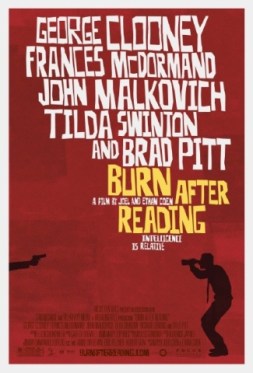
Burn After Reading

•September 12, 2008 • 1 Comment

starring George Clooney, Frances McDormand, John Malkovich, Tilda Swinton and Brad Pitt
written & directed by Joel and Ethan Coen
Rated R for pervasive language, some sexual content and violence.
87%

The plot of Burn After Reading rather defies description, or at least summarization, but here goes: CIA analyst Osborne Cox (Malkovich) is going through a rough time. He has just been fired from his job due to alcoholism, his wife Katie (Swinton) is having an affair with a Treasury agent named Harry Pfarrer (Clooney), and Linda Litzke and Chad Feldheimer (McDormand and Pitt), two hapless gym employees, have just stumbled on a disc containing the rough draft of his memoirs. And that’s just the first five minutes or so. Please don’t ask me to go on.

The Coen Brothers have followed the multi-Oscar-winning literary adaptation No Country for Old Men with one of their lightweight, trademark comedies. It would not be entirely unfair to compare Burn After Reading with the Coen’s radically uneven The Ladykillers (which I actually rather enjoyed) or their execrable Intolerable Cruelty in style and tone. The similarity is hardly surprising, though this is better than either of those.

There seems to be a lot going on during the first half of the film. Subplots just keep multiplying and new questions are raised. It is obvious that something is going on (or is it?), but we are as in the dark as everyone else. Long before the end, though, things begin to make a strange sort of sense as we realize that what seemed to be a large, orchestrated sequence of events is really just the result of a surprisingly limited circle of coincidence. It is as though plot lines are being cut, one by one, by Occam’s Razor and tied together into one massive knot of pure absurdity.

The characters in the movie aren’t terribly likable, but they are fun to watch. Clooney and McDormand (and, briefly, Richard Jenkins as Ted, the gym manager) are the only ones accorded any real depth. Both are in the midst of a sort of mid-life crisis and are looking for someone to fill a void. Even though Harry is already married to a successful children’s author and having an affair with a pediatrician, he still hooks up with random women through an Internet dating service. Linda, meanwhile, is also looking for love on the Internet. She also desperately wants to get some extensive (and expensive) cosmetic surgery, but her insurance won’t cover elective procedures. She’ll need an alternative source of funding in order to achieve her goal.

Special attention must go to Brad Pitt, though, whose airhead jock is the funniest character in Burn After Reading. Chad is a simpleton and a buffoon, long on enthusiasm but not very good at thinking on his feet (or at all). He is the sort of person who doesn’t even know just enough to get himself into trouble. That’s where Linda comes in. She knows more than enough to land them both (but especially Chad) neck-deep in hot water.

It took me a long time to find a character to anchor my sympathies with, but I finally realized that it has to be the nameless CIA superior, played wonderfully by J.K. Simmons. He, like the audience, is removed from everything that is going on in the film (although he understands even less than we do). He sits behind his desk and gets reports through an intermediary from agents in the field and gapes and wonders just exactly what is going on with these crazy people. And, at the end of it all, he summarizes the situation perfectly (and I paraphrase): “What did we learn? Well, we learned not to do this again. I just wish I knew what it was that we did.”

If Burn After Reading is about anything (a debatable proposition), it is about the fact that events that seem connected don’t always have a discernable meaning or a human intelligence pulling the strings. Sometimes things just happen, and, though they would never admit it, even the seemingly omniscient intelligence community can’t connect the dots.

American Movie: Broken Blossoms (1919)

•September 10, 2008 • Leave a Comment

When the enormous (and enormously expensive) spectacle of Intolerance failed dismally to recoup even a fraction of its budget, D.W. Griffith found that his career as an independent filmmaker had been dealt a mortal blow from which it never recovered. He would never again be able to create films on a scale to match his two most famous efforts, nor would he be able to work in the industry without the support of financial backers.
Throughout the next decade and a half he struggled to connect with a modern audience which was growing further and further away from his Victorian sensibilities. Among his last few modestly successful efforts of the late ‘teens and early ‘twenties is Broken Blossoms (or The Yellow Man and the Girl), a small romantic melodrama that stands in sharp contrast to the vast ambitions of Birth of a Nation and Intolerance. The result more than makes up in feeling and artistry what it lacks in scope and energy.

There are really only three characters of importance in the story, and we are first introduced to Cheng Huan, the “Yellow Man” of the title, as he is preparing to leave China and spread the peaceful message of Buddhism in the barbaric, violent West. Not surprisingly, Cheng is played by a white American actor (Richard Barthelmess), but both the script and the performance avoid tasteless Asian stereotyping, if not cliches (an important distinction).

The other two characters are Battling Burrows, a low-class British man, and his teenage daughter Lucy, played by Donald Crisp and the ubiquitous Lillian Gish. Burrows is a part-time prizefighter, part-time drunken lout. He is a volatile brute with a short fuse, and Lucy bears the brunt of his distemper. Meanwhile, three years after leaving China and settling in England, Cheng’s idealism is slowly withering away amidst the haze of opium addiction and thick London fog.

Lucy is one of the few things in Cheng’s life about which he seems to feel anything anymore, and he relishes her shopping visits in his squalid corner of the city. When, after a particularly severe beating, Lucy stumbles away from her home and collapses on Cheng’s doorstep, he takes her in and nurses her back to health. In the process, these two “broken blossoms” breathe a little color back into each other’s lives, but their happiness is not meant to last.

Just like Griffith’s other films, Broken Blossoms has a message, but it is developed artfully and with a certain subtlety that is lacking in the director’s earlier efforts. The film addresses major issues like racial bigotry and domestic abuse, but it refrains from preaching at the audience from the title cards. There is no tacked-on coda at the end. Griffith is finally allowing his films to speak for themselves. The result is not perfect, but it is effective.

The lion’s share of the credit for that effect rests with the performance of Lillian Gish, delivering what is generally regarded as her finest work for D.W. Griffith. It is rare in silent cinema to see such a skillful portrayal of raw emotion that does not tip noticeably into the realm of exaggerated melodrama. Lucy’s total lack of self-consciousness when she is alone reinforce her vulnerability in the minds of the audience which lends that much more weight to the naked terror in her eyes when she is confronted with yet another beating. And the tenderness of her scenes with Cheng (despite the fact that she nicknames him “Chinky”) are infused with touching sweetness, all the more so because Lucy exudes an aura of one who has not so much as heard a kind word for as long as she can remember.

It was around this time that Griffith, Chaplin, Pickford, and Fairbanks started United Artists together. When Adolph Zukor, head of Paramount, screened Broken Blossoms after it was completed, he was horrified by the downbeat ending. He demanded to know how Griffith dared to submit such a terrible film, and the director left in a rage. He was back the next day with a quarter of a million dollars in cash and an offer to buy Broken Blossoms from Paramount. Zukor accepted, and it became UA’s first release, winning acclaim with audiences and critics alike; and deservedly so, for it is one of the best silent pictures of the decade and a masterpiece of its time.

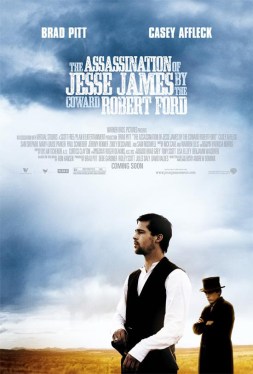
What I Like About The Assassination of Jesse James by the Coward Robert Ford

•September 7, 2008 • Leave a Comment

First, there’s that magnificent title. On top of its glorious unconventionality, it says so much about the film we’re about to experience. The movie itself is in the neighborhood of 160 minutes, but the entire plot is summed up in that title. This isn’t a story of suspense with a surprise ending, but a reflection on a specific event. More than a reflection, it’s history with an openly-slanted agenda. There is a world of meaning in that title, but the tip-off is in two of those words particularly. The first word is assassination. “Assassination” says something about both the killer and the victim. It implies that the killer was not deliberately provoked and acted in such a way as to prevent the victim from defending himself. It also implies that the victim was in some sense symbolic. He wasn’t killed at random, but because of who he was and what he stood for. The second word is coward. That word lays out who will be the hero and who the villain from the very beginning.
Second, the execution makes the story far more rich and complex than the title implies. As one might suspect from the runtime, the movie takes its time, meandering languidly through the lives of not only James and Ford, but of their families and associates during the months preceding the main event. We get a sense of the time and the people. In particular, we get a feel for James’ weirdly magnetic personality, and also begin to understand how Ford’s character makes the journey (a shorter one than we might expect) from fawning adulation to resentment and betrayal.

Throughout, Assassination never lets us lose sight of the fact that this, like every other piece of our historical record, is at best an imperfect construct. Like all smaller stories drawn from the vast, sprawling thing that is History, it begins somewhere and ends somewhere and carefully selects certain episodes to supply a comfortable, recognizable narrative reference frame to something that, in real life, is far more labyrinthine. Various portions are narrated by the quiet, sure voice of Hugh Ross, supplying details; names, dates, and other important, semi-important, and merely interesting particulars. Frequently during the narration, the images on the screen are filmed through a fish-eye lens. The technique draws attention to the presence of the lens, which reveals, but also distorts. The result is both brilliant and beautiful (Roger Deakins did the cinematography).

Third, at its heart, the movie is a profound rumination on the capricious, shallow, artificial nature of public opinion and collective memory. I’ve stated that in a very general way because it encompasses a couple of different themes. The first half-hour (and these times are purely from memory) introduce us to the title characters. James, played with an enticing aloofness by Brad Pitt, is a bit of an enigma. By the time the movie begins, he is already in the later stages of his career as one of the most famous outlaws in American history. A lot of people want to be close to him for a lot of reasons, but perhaps none so much as young Robert Ford, who has worshipped James since childhood and believes he knows everything about the older man. Given the opportunity to join his role-model on a train heist, Ford leaps at the chance and is quick to attempt to ingratiate himself with the James brothers.

Frank, the older brother, has no patience for Bob’s rambling praise, but Jesse seems part-flattered and part-pleased at having someone so willing to perform menial tasks for him. For his part, Ford believes himself to be destined for big things, and that can mean only one thing: fame or infamy. Ford wants to be a celebrity the way the James brothers are, and his first plan is to have his name associated with theirs. It’s not just that Ford wants to be like the James brothers, though. The key to all this is that he is nothing like them, and can never be. It may even be that his very adulation is what sabotages his desire. Over the course of the next hour or so, Ford becomes slowly disenchanted with his idol, and Jesse sinks into almost-psychotic paranoia. Their scenes together during this process are riveting and perfect.

By the time the film moves into its final hour, Ford has come up with a new plan to achieve the national attention he so desperately craves. Seeing the writing on the wall, he realizes that it is only a matter of time before someone gets the great Jesse James. Why shouldn’t that someone be him? Although the outcome is a foregone conclusion, the path to betrayal manages to generate more than a little tension, but it is during the film’s coda that the major themes really come into play.

Jesse’s death is big news, making national headlines just as Ford had hoped. Before long, both Ford and his brother have steady work on the big-city stage circuit re-enacting the famous deed over and over before full-houses, like some sort of freakish historical echo. As the narrator says, Ford estimated that he killed Jesse James more than 800 times. He was as responsible as anyone, perhaps, for the wide-spread notoriety of the event. It takes very little time, however, perhaps no time at all, for the tide of public opinion to turn against him.

Jesse James has become in death even more of a folk hero than he was in life; a mythic combination of Robin Hood, sharing the wealth, and a Confederate guerrilla, keeping the dream of the South’s cherished Lost Cause alive years after the surrender at Appomattox. Robert Ford, who, after all, betrayed the trust of a friend and literally shot him in the back, hasn’t a chance of standing up before this image. He eventually fades into a peaceful half-anonymity, running a business out on the Colorado frontier, until another fame-seeker comes looking to kill the man who killed Jesse James.

The narrator quietly informs us that, unlike Jesse, “There would be no eulogies for Bob, no photographs of his body would be sold in sundries stores, no people would crowd the streets in the rain to see his funeral cortege, no biographies would be written about him, no children named after him, no one would ever pay twenty-five cents to stand in the rooms he grew up in.” And so, Robert Ford fades into the background of history once more, though perhaps not quite so completely as does Edward O’Kelly, his killer.

The whole thing serves to underline how tenuous our grasp is, not only on the story of everything that is going on around us and what has happened before, but on our own stories. Memory is a tricky thing, and a treacherous one, and certain destinies are more elusive than we like to believe. Despite all efforts to the contrary, our legacies will ultimately be set down and assessed by somebody else, if they are remembered at all.

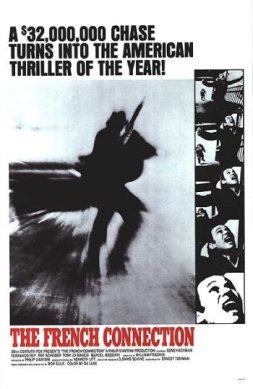
The French Connection: Best Picture, 1971

•September 5, 2008 • Leave a Comment

The 44th Annual Academy Awards were hosted by Helen Hayes, Alan King, Sammy Davis Jr., and Jack Lemmon. The 1970s, now regarded as a seminal decade in film history, had arrived with a newer, edgier sort of motion picture. The Academy responded with recognition for the likes of Peter Bogdanovich’s The Last Picture Show (8 nominations, 2 wins), Stanley Kubrick’s controversial A Clockwork Orange (4 nominations, no wins), and The French Connection, with it’s 8 nominations: Best Picture, Best Director, Best Adapted Screenplay, Best Actor (Gene Hackman), Best Supporting Actor (Roy Scheider), Best Editing, Best Cinematography, and Best Sound. Representing old Hollywood and the “tradition” of major Broadway musical-to-movie adaptations was Fiddler on the Roof (8 nominations, 3 wins), but a lot had changed in the years since the likes of Gigi, West Side Story, My Fair Lady, and The Sound of Music had swept the Oscars. Watching it all was was a symbol of old old Hollywood, 82-year old Charlie Chaplin, back after over two decades of HUAC-imposed exile in Europe to receive the night’s Honorary Award.

Ben Johnson won Best Supporting Actor for his performance in The Last Picture Show, and Fiddler picked up Best Cinematography and Best Sound, but the big winner of the night was The French Connection. The film won its five remaining nominations, making William Friedkin (at 32) the youngest winning director in Academy history and marking the beginning of the new era in American filmmaking. The French Connection was also the first R-rated film to win the award, though this was hardly a notable distinction as X-rated Midnight Cowboy had won just two years before.

The French Connection follows the real-life investigation of New York City detective Jimmy “Popeye” Doyle (Hackman) and his partner Buddy Russo (Scheider) as they crack a large-scale international drug-smuggling scheme. The story is told with a gritty, semi-documentary realism that showcases the faults and failings of its heroes as much as those of its villains. Doyle, the tagline explains, is “bad news–but a good cop.” He is a volatile bigot whose methods are the definition of police brutality, but he works with ruthless efficiency on the narcotics beat and always gets his man.

Hackman and Scheider establish a great working dynamic between two very different characters. While Hackman may steal the show, it was Scheider’s quieter support that I felt most drawn to. More than just a partner or even a conscience, Russo is Doyle’s ambassador to the rest of the police force. He smooths over the messes created by Doyle’s bullying, go-to-hell attitude and allows him to keep going out on the street everyday and do what he is good at.

If The French Connection has a genuine weak point it is in failing to interest us in its villains and their machinations. When the film drags (which it seldom does) it is inevitably while we watch the criminals’ conversational scheming, only some of which is important and most of which is incomprehensible on the first go-round. More often than not, however, a few seconds will pass and you will be perched on the very edge of your seat, riveted.

As I mentioned above, the stylistic focus is on authenticity, and even without knowing beforehand that this story was based on actual events, I sensed intuitively that it must be. It has a feeling of immediacy and careful attention to detail that drops the viewer into the midst of the action. Detectives Eddie Egan and Sonny Grosso, the men on whom the main characters are based, served as technical advisers, and also scored small roles as Doyle’s and Russo’s supervisors.

Of course, the movie’s centerpiece is the famous car chase, which has Doyle pursuing a hijacked train across the city, driving like a maniac and nearly totalling the car he is in. Friedkin later claimed that none of those accidents were planned, they were merely errors made by the stunt driver while performing some very difficult maneuvers, and were left in to add to the realism. Whether or not this is true, this element makes the scene, which at the time was widely considered to be the finest car chase ever filmed, surpassing even Steve McQueen’s famous chase across San Francisco in 1968’s Bullitt. Ironically, Steve McQueen had been offered the role of Doyle, but turned it down because he wanted to avoid duplicating himself.

Even without the car chase, however, there are plenty of magnificently tense sequences. These include the scene where Doyle chases a sniper on foot, and where Doyle, Russo, and a team of mechanics literally dismantle a car down to nothing (searching in places I didn’t know existed) in an attempt to find a stash of drugs. There are stake-outs, shake-downs, and roadblocks. There is a great little scene in a subway station where Doyle is frustrated when a suspect he is trying to tail keeps hopping on and off the subway, making his attempts at discretion (obviously not his strong suit) increasingly difficult.

Probably best of all is the film’s final moment, which arrives suddenly and without warning. A series of title cards follow, detailing the futures of all of the major characters (and several I didn’t remember seeing at all). Though it is nice in its way, this spoils the ending’s ambiguity a bit. However, it is still an amazing end to a striking film.

Continue reading ‘The French Connection: Best Picture, 1971′

Don LaFontaine, 1940 – 2008

•September 2, 2008 • Leave a Comment

Who?

“In a world . . .”

Thanks to commenter @ Looking Closer for pointing this out.