
W.

•October 17, 2008 • Leave a Comment

starring Josh Brolin
written by Stanley Weiser & directed by Oliver Stone
Rated PG-13 for language including sexual references, some alcohol abuse, smoking and brief disturbing war images.
39%

George Walker Bush, son of a prominent and wealthy Texas politician, coasts recklessly through the early stages of his adulthood, relying on his disappointed father to find him new employment when he tires of his latest occupation and, when necessary, bail him out of trouble with the law. Eventually he marries a librarian and runs an abortive campaign for congress in West Texas (“I’ll never be out-Texaned and out-Christianed again!”). Bush’s life takes a drastic turn, however, when he gives up alcohol and dedicates himself to following Jesus Christ. His new path ultimately leads him to become governor of Texas, and then President of the United States, where he hopes he will finally have the chance to earn the approval he craves from his father and avoid the mistakes that denied the older Bush a second term in the White House.

Oliver Stone, perhaps the most politically-controversial American filmmaker after Michael Moore (and just as prone to clumsy audience manipulation), turns his attention to yet another American president. I can’t say whether this ought to count as the last entry in even a loose trilogy, as I have not yet seen 1991’s acclaimed JFK or 1995’s flop Nixon. In fact, with that in mind, perhaps I’m not even qualified to comment. Nevertheless, I will state unequivocally that W. ranks among the emptiest cinematic exercises I have ever witnessed. It is a 2-hour Saturday Night Live skit without the funny (so, basically like the SNL skit-inspired movies, I guess).

The first half in particular is a chaotic morass of poor editing. The movie simply has no story to tell and no coherent point to make. It presents a greatest-hits, mixed-nuts approach to the life of its subject, trotting out scenes at random that we (who have lived through his administration) will recognize and understand, but which will soon become incomprehensible. Consider, for instance, a scene in which the president nearly chokes to death on a pretzel, sandwiched arbitrarily between scenes from the ’60s and ’70s. It conveys nothing of plot, character, or thematic relevance. It simply is. When a well-crafted, interesting scene finally pops up, about 45 minutes in, it is unprecedented enough to be worth noting . . . but it is soon gone again.

If W. has a mission (which, really, it doesn’t) it is to demythologize a president that has never really aspired to or achieved mythic proportions. Nevertheless, the movie toils gamely to bring Dubya down to earth among regular folk, treating us to scenes in which he struts around in his tighty-whities or wipes his presidential posterior at the end of a session on the toilet. The effort is transparent, belabored, and tiresome. And speaking of transparent and belabored, the movie’s midpoint conversion scenes and virtually everything else dealing with faith, feels lifted (whether sincerely or with sly irony it is impossible to tell) directly from a c-grade Christian evangelical movie.

The cast provides a point of some interest here, and it is an excellent one. In the hours after I watched the movie I found it difficult to conjure up the real-life faces of the principal players in the Bush administration. They had been temporarily displaced by their big-screen counterparts. Wherever the actors attempt slavish impersonation, the effort tends to go awry (Thandie Newton’s Condi Rice is the most egregious example). In the land of the tiresome political biopic, the caricature is king: Toby Jones’s weaselly Karl Rove and especially Richard Dreyfuss’s hilariously over-the-top take on Dick Cheney. In a class all by itself is the casting of Rob Corddry (formerly of The Daily Show) as press secretary Ari Fleischer, which I can only hope was an in-joke.

More on the level of sick joke is the tortuous musical accompaniment, which ranges from seedy renditions of “The Yellow Rose of Texas” and “Mommas Don’t Let Your Babies Grow Up to Be Cowboys” to “The Battle Hymn of the Republic” and back again. All of these, of course, intrude at a point calculated for maximum hokeyness, as though determined to drain every drop of serious impact from the scene.

Not that one would be inclined to take this spectacle seriously, of course. The take-home message seems to be that George W. Bush became the president of the United States because he had massive daddy issues, a cartoonish supposition. Stone gives the appearance of working hard to win our sympathy for the man (if not for the leader), but he fails most of all in winning our sympathy for the movie. Only time will tell if W. stands a chance of becoming (at best) a cult classic, a campy cultural oddity revisited by the bored and the curious, or whether it will simply fade into a more-deserved obscurity. In either case, contemporary audiences will find little to recommend the experience of witnessing the phenomenon on the big screen during election season 2008.

Intermission: Ebert on Bette Davis & Smoking, Wall Street Sequel, Summer ’09 Movie Preview, Pixar’s Up

•October 14, 2008 • Leave a Comment

Bette Davis got her own postage stamp last month, but there was a funny thing about her picture. The portrait was adapted from a screen grab out of All About Eve, and I say adapted because, although Davis is clearly holding her hand so as to accomadate the lit cigarette in it, the cigarette itself is missing from the picture. Ebert comments.

It looks like someone is writing a script for a sequel to Wall Street which will again feature Gordon Gekko. The current title is Money Never Sleeps. Apparently greed is good . . . there’s just one question: Why? (From Hollywood Reporter.)

Daily Plastic brings us a glorious preview of next summer’s bumper crop of fantastic sequels, prequels, remakes, and movies based on old TV shows in, not one, but two jam-packed parts. Don’t miss it!

Finally, what you really don’t want to miss (if you haven’t seen it already . . . it’s been around) is the teaser for Pixar’s next: Up.

Vodpod videos no longer available.

City of Ember

•October 10, 2008 • Leave a Comment

starring Saoirse Ronan, Harry Treadaway and Bill Murray
written by Caroline Thompson & directed by Gil Kenan
Rated PG for mild peril and some thematic elements.
85%

Far beneath the surface of the earth lives a small remnant of human survivors, escapees from some long-forgotten devastation of the world above. When they went underground, the plan was to return to the sun-lit lands after 200 years. Unfortunately, something went terribly wrong. No one remembers the plan anymore, while the city, not meant to sustain life for so long, is slowly running out of food and power. However, teens Doon Harrow (Treadaway) and Lina Mayfleet (Ronan), facing a bleak and uncertain future, are about to discover a clue to a world whose existence no one has thought about in generations.

City of Ember plays like an adaptation of a young adult sci-fi novel, which is good, since that’s exactly what it is. The premise sounds like someone took the end of Dr. Strangelove as their jumping-off point, but the similarities end there. A couple of plucky youngsters living in a dystopian future rebel against a corrupt, authoritarian system and unravel a neatly-plotted mystery that changes everything. There are shades here of the likes of The Giver, Futuretrack 5, Uglies and the Shadow Children series, to name just a few. In short, this is a crowded subgenre in the world of books. In movies, however, it remains relatively unexplored. Dystopian films aimed at kids and teens are rather rare (in fact, I can’t think of any outside of Japanese anime).

This is one of the movie’s greatest strengths, and it gets a lot of mileage out of the Ember setting. As the movie begins, it is Assignment Day, when the graduating youths get randomly assigned jobs around the city. Lina becomes a messenger, darting rapidly from the greenhouses on the outskirts of town to the mayor’s office in the central square and everywhere in-between. Doon, meanwhile, labors away in the tunnels of the pipeworks, patching leaks that have been patched a dozen times before and dodging giant mutant moles. Both of them, along with nearly everyone else, are worried by the increasingly long blackouts that signal the failure of Ember’s enormous generator.

The design, half-steampunk, half-crumbling ruin, has a great lived-in feel to it and loads of personality. City of Ember unwinds at a reasonably brisk pace, dragging only rarely as the pieces of the puzzle fall into place and our heroes get closer to answering questions almost no one is asking. A few of the effects sequences during the climax are a bit much, and look rushed in terms of quality, but overall the movie shows admirable restraint.

The young stars (particularly Ronan) are sympathetic, intelligent, and well-played. They largely manage to steer clear of the Achilles heel of characters in these stories: lapsing into frustrating obtuseness whenever it suits the plot to stretch things out or add artificial tension. The adult support is strong and fantastic. Bill Murray is perfectly cast as the umpteenth mayor of Ember, a fat, complacent, seemingly-benign dictator who is not terribly bright. You can see the gears grinding in his head as he tries to piece new developments together, but he’s just not up to the challenge. And, in true Murray style, he is far too laid back to completely lose his cool, even when he’s upset.

The rest of the cast, to name just a few: Martin Landau is almost unrecognizable as the ancient pipeworker who shows Doon the ropes, when he can manage to stay awake. Mary Kay Place is Lina’s kindly next-door neighbor, a devout believer who blindly believes that “the builders” who originally created Ember will return to lead them to safety. Tim Robbins is Doon’s Rube Goldberg-like father, a designer of dangerous-looking gadgets of questionable usefulness (though, in retrospect, his character is criminally underdeveloped).

I also really felt that far more could have been done with the threat of darkness during the blackout scenes. Whenever the lights flicker and go out, a bright flare is quickly launched up over the city, briefly illuminating everything once more before it is extinguished, leaving darkness until the generator is restored. These brief descents into darkness are sometimes moments when plot developments take place, and sometimes simply emphasize the desperation of the characters.

There is a major missed opportunity here, though. The director chooses to light these scenes so that we can see what is going on, even though the scene ought to be pitch black. The result is a bit hokey, and so much more could have been accomplished, and more tension created, with a creative use of sound and the inclusion of moments when we actually can’t see what is happening, just as the characters can’t. Ah, well.

In closing, I should note that there is obviously more going on in this story than the average member of the target audience might pick up on. It is ably translated for the screen by Caroline Thompson, screenwriter of classic Tim Burton flicks like Edward Scissorhands and Nightmare Before Christmas, and, as one would expect from a dystopian work, there is a lot of thinly-disguised allegory lurking just beneath the surface. It is a movie about things like the foolishness of never questioning and the danger of blindly following tradition or authority, no matter what. There are all sorts of other interesting considerations, too, like how a human colony forced underground for hundreds of years might really look, and what life back on the surface would be like for them. These elements, while they may be worth teasing out in discussion later, are also pretty easy to ignore in favor of just having a good time. Whether that counts for or against City of Ember will be for you to decide.

Film Roundup XV

•October 9, 2008 • Leave a Comment

I swear there is a conspiracy to keep me out of the multiplex on Fridays. I am not pleased. This week it’s a conference out of town which may or may not keep from a new release. We’ll see. I know that a certain someone will want me to take her to City of Ember at some point, and I’m vaguely interested in Body of Lies and The Duchess. I’m also feeling a strange urge to go see Quarantine, but it will probably pass once the reviews start hitting. Besides, going to a horror movie alone is such a waste. And, amidst everything else, I’m not entirely certain that I don’t just want to go hit up WALL-E again, now that it’s playing in the dollar theater. Someday very soon (perhaps late next week) I’m determined to set aside a day or two to play catch-up on whatever seems worth catching up to. Meanwhile, you know the drill:

The Majestic – 91%

Peter Appleton (Jim Carrey) is a screenwriter on the verge of his big break when he gets blacklisted in McCarthy-Era Hollywood. Drunk and nearly suicidal, he takes off into the night with no particular destination in mind, when a freak accident leads to him washing up on the beach near a small town with no memory of who he is or where he came from. Soon, the townspeople recognize him as Luke Trimble, the son of the local movie theater owner, who went missing in action during World War II years earlier. Peter soon slips comfortably into Luke’s old life, connecting with Luke’s father, falling in love with Luke’s fiancee, and breathing new life back into The Majestic theater. But, as a suspected communist who has mysteriously disappeared, a lot of people from his past are looking for him, and his idyllic new life can’t last forever.

The Majestic is a movie that I come back to again and again when I want a feel-good experience with a lot of humor and heart and character and very little in the way of schmaltz or sentimentality (at least not the painfully corny kind). Perhaps its greatest failing is that it is ultimately pure fantasy, a piece of escapism for an industry that wishes it had been able to stand up to HUAC and the 1950s red scare with little more than a rousing speech and the overwhelming support of media and common people alike. Alas, that was not the case, but it is still a fascinating time, lovingly-evoked, and one of my favorite “movies about the movies.”

Onegin – 83%

Based on the classic Pushkin poem, starring Ralph Fiennes in the title role and directed by his sister Martha, Onegin is the story of a manic-depressive city aristocrat who woos an innocent country girl, Tatyana (Liv Tyler). Ultimately, the relationship takes a tragic turn and ends badly, in a violent duel. It’s a rather sparse story stretched over what will be, for many, an unbearably long 106 minutes. The production is gorgeous, and Fiennes is excellent as always, but probably very little beyond a few particularly striking images and the fantastic duel scene will stay with the viewer for very long.

Fellini Satyricon – 74%

The always-challenging and enigmatic Fellini presents a faithful adaptation of the early Roman work Satyricon by Petronius. Make no mistake, though, as the title indicates, this is very much a Fellini production. The film is choppy and episodic, beginning and ending at random, just like the surviving portion of the original. In the story, two gay lovers, Encolpio and Ascilto, quarrel over their young servant Gitone and then split up. Gitone follows Ascilto and we follow Encolpio across a grim and disturbing landscape of disconnected adventures. Most of these involve varying degrees of Roman debauchery, including Bacchanalian revelry, orgies, gladiatorial combat, cannibalism, etc.

Obviously this relic of late-60s Italian arthouse will not be to all (or even most) tastes. It should be fairly clear from my description whether or not you might have any interest in taking this in. This was my first Fellini film, and to be perfectly honest, I watched it (in college, of course) purely to pad my resume of cinematic literacy. I don’t regret the experience by any means, but I’d definitely have to have an actual reason before I’d see it again.

The Great Mouse Detective – 72%

Basil of Baker Street, the greatest rodent detective the world has ever known, shares lodgings in Victorian London with his more famous human counterpart. In this, his greatest adventure, he gains a stalwart companion (Dr. David Q. Dawson), and investigates the mysterious disappearance of a brilliant toymaker. The kidnapping ultimately draws him into the midst of a fiendish plot by Professor Ratigan (voiced by the inimitable Vincent Price) that threatens the very highest levels of mouse government.

This Disney animated classic, the last to be released before the renaissance of the late-80s/early-90s, is nowhere near as good as it was when I first saw it at the age of 5 or 6. The animation is often second-rate and the dialogue is frequently cheesy (ouch. no pun intended . . . really). But Price is a fantastic villain, as always, and I’ve got a particular soft-spot for Sherlock Holmes (and homages to him). Great light entertainment for the kiddies, but Disney could have done far better.

Be Cool – 79%

In this sequel to Get Shorty, mobster-turned-movie producer Chili Palmer decides to take a swing at the music industry, latching onto a talented singer and guiding her in his own unique way through a series of madcap encounters with a host of bizarre characters on the road to pop stardom. Various members of the Pulp Fiction cast (John Travolta, Uma Thurman, Harvey Keitel) reunite for a manic, character-heavy comedy that, frankly, had me laughing far more often than it probably deserved. There are some wonderful moments in this PG-13 movie, including a scene near the beginning which uses up the film’s one f-word in an explanation of how any more than that will provoke an R-rating from the MPAA. Dwayne “The Rock” Johnson is hilarious as a gay bodyguard who wants to be an actor, and Vince Vaughn also has some extremely funny moments. This is definitely worth a look if you’re in search of some ultra-light, late-night entertainment. Twinkle twinkle, baby, twinkle twinkle.

Intermission: Changeling, Role Models, Pictures at a Revolution

•October 6, 2008 • Leave a Comment

It’s trailer time:

This trailer has actually been around for awhile. I’ve a bit behind, I guess. I’ll make up for it with an early review that’s hot off the presses. It takes the comprehensive approach, discussing Clint Eastwood’s entire career before launching into a discussion of the movie which may (or may not) surprise you.

I’m not entirely certain why I’m posting this next one. Is it because one of the characters shares my name? Could it be the first appearance of LARPing (to my knowledge) in a mainstream movie? Or is it that brief but kind of funny send up of romantic comedy cliches towards the end? Judge for yourself.

Finally, movies that I know are great are always more exciting to contemplate than the movies I suspect might be terrible. Tomorrow night (and, I guess, tomorrow night only), Turner Classic Movies will be airing a marathon based on Mark Harris’s excellent cultural history, Pictures at a Revolution: Five Movies and the Birth of the New Hollywood. The book examines the five Oscar nominees for Best Picture of 1967 and discusses them in the context of a major shift in both the industry and the art of filmmaking in America. The TCM celebration seems to be cutting out the representative of Old Hollywood, the big-budget musical disaster Dr. Dolittle, but it will be airing the rest back-to-back starting at 8:00 (EST).

They’ll get things started with The Graduate, a star-maker for Dustin Hoffman and one of my favorite movies. Next up at 10pm is Bonnie and Clyde, which I still have not seen but really, really should (perhaps I will take advantage of the opportunity tomorrow night). After that, at midnight, they’ll air the ultimate winner of the award, In the Heat of the Night. It’s a murder mystery starring the great Sidney Poitier as a black police detective from the north who gets picked up on his way through a small southern town because his color arouses suspicion and ends up remaining to help solve the case, forming a tenuous bond with the racist sheriff. Finally, from 2 to 4, they’ll show Guess Who’s Coming to Dinner?, one of the first major films to seriously tackle the issue of interracial marriage sympathetically. It also start Poitier, along with Spencer Tracy in his final role.

If you have the means, and there are any of the above that you haven’t seen, I would definitely recommend making an effort to catch some or all of them. 1967 was an exciting year in many respects, Pictures at a Revolution is a great book (at least what I’ve read of it), and I’m looking forward to watching the presentation. I’ll probably try to leave the TV running in the background most of the evening, and hopefully have a chance to settle in for the entirety of Bonnie and Clyde, at least.

Film Roundup XIV

•October 3, 2008 • Leave a Comment

I was very much looking forward to today, as it feels (here, at least) like the first day of the Fall movie season. There are three new releases that I am very much interested in seeing, and three more which I want nothing to do with. Quite a haul. I find, however, that I am unfortunately too broke to take in three flicks at the multiplex, or even one. In consequence, I will pretend to not be saddened and dejected and look back on some previously viewed items for solace. If you should have a chance to catch Appaloosa, Flash of Genius, or Nick and Norah’s Infinite Playlist, let me know how they were.

Ocean’s Twelve – 86%

Danny Ocean (George Clooney) returns with his crew of thieves and con artists for a second adventure. Making good on his promise to track down the gang that ripped off his casino in the last movie, Terry Benedict (Andy Garcia) is twisting their collective arm to return his money. Unfortunately, they’ve already spent a lot of it. To make good, Ocean’s eleven (and one extra) will have to pull an even bigger job, this time in Europe.

Ocean’s Twelve got a lot of undeserved hate because it was a mediocre sequel to an exceptional heist movie (which was itself a remake). That said, it is quite a bit of fun in its own way, certainly comparable to, say, The Italian Job. It’s also worth noting that the Ocean movies decidedly got their act back together for the third movie, Ocean’s Thirteen, but I wouldn’t skip this one.

Who Framed Roger Rabbit – 93%

A Hollywood private eye who hates toons finds himself investigating the murder of practical joke king Marvin Acme by jealous cartoon star Roger Rabbit. Soon, it becomes clear that someone else is behind the killing, pulling the strings of a much larger, much darker conspiracy. Who Framed Roger Rabbit represents one of the happiest confluences of technical innovation and quality material. While the mixing of live-action film with animation was certainly nothing new, this movie took the level of human/cartoon interaction into places it had never been, and it did within the bounds of a relentlessly-entertaining, side-splittingly hilarious story. This is also, perhaps, the only time you will see the beloved Disney and Warner Bros. characters share the screen together.

Taxi Driver – 96%

Travis Bickle (Robert De Niro), a young Vietnam vet, works as a late-night cab driver in New York City, and is disgusted by the decadence and filth he sees around him. Meanwhile, he tries to court Betsy (Cybill Shepherd), an idealistic campaign worker, and feels driven to rescue Iris (Jodie Foster), a child prostitute. His failure on both fronts ultimately leads him closer and closer to a violent mental imbalance.

Taxi Driver is, in my not-yet-complete experience, Martin Scorsese’s finest film. It is a disturbing, but thought-provoking masterpiece of madness and isolation, but also a strange idealism and ambiguous sense of hope. Scorsese brilliantly draws us into sympathy with Travis before turning the screw that unhinges him from reality and flips our perspective on its head.

The Aviator – 63%

Leonardo DiCaprio stars as enigmatic billionaire Howard Hughes in this star-studded, Oscar-bait biopic. On the flip side from the previous entry, this represents a low point for Scorsese in my opinion; the height of his desperation to finally get his hands on the Academy Award that he had richly deserved for almost three decades. DiCaprio is miscast, though not nearly as grating as Cate Blanchett attempting the inimitable Katharine Hepburn (to be fair, the problem is not really Blanchett, who is a fine actress). The film is long, pretentious, and almost unrelentingly dull, despite a number of very impressive effects and sequences. Unlike the Spruce Goose, the final result is just too clunky to get off the ground.

The Emperor’s New Groove 2: Kronk’s New Groove – 35%

Kronk, the likable villain-cum-comic relief in Disney’s Emperor’s New Groove, returns as the star of this direct-to-video sequel. Kronk, now the owner and operator of the restaurant from the previous movie. As the story begins, Kronk is desperately trying to prepare for a visit from his disapproving father, who is coming to see Kronk’s wife, kids, and home (none of which he has). Kronk then explains via flashback how his father came to be under this false impression and what went wrong along the way.

Why, oh why, did I watch this? And why am I writing about it here? I believe, in answer to the first question, that it was my wife’s idea. As the second, well, to warn you away, of course. Naturally, I’ve already said all that I need to, cleverly working it into the synopsis (note the careful mention of “Disney direct-to-video sequel”). I suspect that you could do worse than this, considering the genre, but happily I have thus far successfully avoided all other such sequels, and therefore cannot say for certain. If you enjoyed Kronk’s antics in the first movie, you’ll find him amusing enough here, but this is definitely a movie aimed at a juvenile audience which makes few concessions to any viewers over the age of 10.

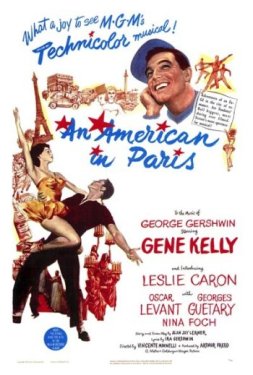
An American in Paris: Best Picture, 1951

•October 2, 2008 • Leave a Comment

The 24th Annual Academy Awards were hosted by Danny Kaye. An American in Paris was nominated for 8 Oscars: Best Picture, Best Director, Best Original Screenplay, Best Editing, Best Cinematography, Best Music, Best Art Direction, and Best Costumes. The top competitors that year were A Place in the Sun (9 nominations, 6 wins), an inter-class romance-cum-social drama starring Elizabeth Taylor and Montgomery Clift, Tennessee Williams’s electrifying A Streetcar Named Desire (12 nominations, 4 wins), and John Huston-directed Hepburn/Bogart classic The African Queen (4 nominations, 1 win).
At the time, the Oscars still split multiple awards into subcategories for color and black-and-white films, separating the more serious Place in the Sun and Streetcar from direct competition with An American in Paris in those categories. Ultimately, A Place in the Sun scooped up both Best Director and Best Editing, while Streetcar all but swept the acting awards (in a clash of the titans, Humphrey Bogart beat out Marlon Brando for Best Actor; it was Brando’s first of eight nominations and Bogie’s first and only win). An American in Paris (which had no acting nominations) coolly collected the other six awards. Its Best Picture win was considered a major upset, even at the time, and many speculated that Place in the Sun and Streetcar had split the vote, allowing the dark horse to move in. On Oscar night, an additional special award was presented to Gene Kelly, the film’s star, for his magnificent choreography. It was presumed to be a consolation prize for his movie’s defeat, which failed to materialize.

When it is about anything at all, An American in Paris is about the romantic ups and downs of Jerry Mulligan (Kelly), an American GI who has stayed on in Paris after World War II to pursue his former career as a painter. Jerry, who mostly paints Parisian cityscapes, is “discovered” and adopted by Milo Roberts (Nina Foch), a wealthy American woman of leisure, who quickly falls in love with him. Jerry does not share her feelings, and makes no secret of the fact, and their relationship soon becomes awkward, as Jerry’s pride makes him reluctant to accept her help and his lack of affection for her makes him leery of further involvement. Meanwhile, Jerry is good friends with Adam Cook (Oscar Levant), a brilliant pianist who lives across the hall, who is, in turn, good friends with famous French singer Henri Baurel (Georges Guetary). Henri is in love with Lise Bouvier (Leslie Caron), a 19-year old French girl that he sheltered from the Nazis during the war, and she is affectionate and dutiful in return.

Without being aware of the connection, Jerry runs into Lise and talks her into a date. Soon, they fall in love, but only Lise knows that she’s got two irons in the fire. None of this is as complicated as it sounds, which is fortunate as the movie spends as little time as possible on character development and plot movement. After all, stuff like that would only get in the way of the film’s lush and elaborate musical numbers, all of which, incidentally, were written by George and Ira Gershwin.

The movie begins clumsily, with all three male leads introducing themselves in hackneyed, gratingly-similar voice-overs, and it never manages to shake that tone of artificiality and general laziness until the music starts. The song-and-dance routines, for their part, often seem to exist in a totally different movie and lack even the most tenuous connection to story or characters (think “Broadway Melody” from Singin’ in the Rain). The film’s inability to decide whether it is a traditional movie love story or an abstract work of performance art rapidly grows tiresome. I found myself feeling the most in tune with Adam, who has the sourest face I’ve ever seen in a musical. He’s a cynical, cranky fellow who spends most of his screentime winsomely glowering and brooding until prevailed upon to tickle the ivories so that his annoyingly cheery friends can sing and/or dance. This he seems to do just because it is the quickest way to get them to leave him alone. Right on.

If one can ignore how poorly An American in Paris functions as a film, there are some things to like. I’ve always loved the music of Gershwin, and it is put to excellent use here. There has never been a dancer like Gene Kelly (no, not even Fred Astaire), and he is in top form in this movie. Leslie Caron’s acting skills are no better in this (her first film) than they would be seven years later when she played the title role in another Best Picture travesty: Gigi. But, at least here she’s actually playing a character her age. She is also a trained ballet dancer (Kelly discovered her himself), and well-suited to the role in that respect.

Of course, one cannot discuss An American in Paris without mentioning the final big musical number after which the film is named. The sequence, which is set to an arrangement of Gershwin’s “American in Paris,” runs an astounding eighteen minutes, or more than 15% of the total runtime. Yet another scene that effectively exists in a completely different movie, the number is a sort of daydream Jerry drifts into while the plot is being resolved elsewhere off-screen. After the number ends, the film concludes happily in under a minute without the need to resort to any further dialogue.

The sequence is, overall, extremely impressive in scope, design, staging, choreography, and (of course) melody. It is, effectively, the climax and raison d’etre which the conventional portion of the film has completely failed to deliver. An American in Paris never really manages to transcend the musical genre, or even function in movie terms, as the far superior Singin’ in the Rain would just a year later. While not without its charms, it joins the likes of Gigi in the ranks of empty fluff musicals which can function as entertainment on some level but are woefully unworthy of the attention and praise they have received.

Continue reading ‘An American in Paris: Best Picture, 1951′

American Movie: Judith of Bethulia (1913)

•September 30, 2008 • Leave a Comment

There is really no way to reasonably select a single definitive event with which to begin a discussion of the beginnings of cinema, the beginnings of the American film industry, or even the beginning of the American feature film. The history of the developing technology which ultimately led to “the movies” stretches back surprisingly far, even into the 18th century, while the latest stages of pre-cinematic and then pre-Hollywood development become impossibly broad. The emergence of cinema was truly an international phenomenon, and the full story of its origin is as much one of economic and socio-cultural forces as it is of technological and industrial innovation. During a period of about 20 years, from roughly 1895 to 1915, cinema underwent a dramatic (though hardly unique) shift from existing as a sort of novel curiosity to occupying an enviable niche as a rather lucrative and well-established industry.
If a lengthy, detailed examination of that story sounds ridiculously dense and technical, do not be alarmed. It probably would be (certainly could be), but its absence need not prevent a much briefer discussion of the immediate circumstances of the beginnings of the American feature film. A significant piece of the story would have to do with the ultimately unsuccessful war waged by Thomas Edison for monopolistic control over the technology which made the medium possible. Another piece would involve the limitations of early cinema as a storytelling device, both in terms of its reliance on totally different art forms such as stage drama for stylistic cues and its confinement to single, ten- to fifteen-minute rolls of film. A third piece would describe the rise of venues constructed specifically for the purpose of showing films to paying audiences, from cheap nickelodeons of questionable reputability to extravagant, elegant movie palaces. And, finally, there would be a piece describing early concerns about the dangers of the new medium and efforts at censoring or severely restricting the exhibition of film in American cities.

The sum of all these parts would be a picture of the formative years of an American institution, the art form of the 20th century, and its development from the first successful national attempt to regulate and control the industry in 1908 (the Motion Picture Patents Company, or “The Trust”) to about 1913, when its back was finally broken by the sheer weight of pressure from the decentralized independent studios, whose spirit of freedom and innovation had succeeded in claiming the best talent in the industry. By 1914, the first American feature films were crowding into theaters as Europe descended into the darkness of the First World War. Hollywood was left to claim the title of movie capital of the world, which it has managed to retain ever since.

Neatly spanning this period is the early career of D.W. Griffith, who directed his first film, for Biograph, in 1908 and whose first feature film was released by the company in 1914, after he had moved on to greener pastures to begin adapting a popular Civil War epic. During these years, Griffith directed nearly 500 films, and assembled, piece-by-piece and film-by-film, an indispensable lexicon of the language of movie storytelling. The differences between that first short film, The Adventures of Dollie and the full-length Judith of Bethulia are, to say the least, dramatic enough to be worthy of further comment.

The Adventures of Dollie is a rather conventional 12-minute film in which a young girl is kidnapped by an evil gypsy who has been angered by her parents. Dollie’s father immediately suspects the gypsy when the girl disappears, but when he arrives at the gypsy’s wagon, Dollie has been hidden in a barrel which the gypsy is sitting on. After the father is gone, the gypsy and his wife load the barrel into the wagon and move out, but as they are crossing a river, the barrel tumbles out of the back and floats away. After winding along the river for a bit and tumbling over a short waterfall, the barrel is fished out by Dollie’s father and a Huck Finn look-alike and the girl is restored to her parents.

The story, or rather the scenario, is simplistic in a way that is quite typical of the period. The entire film is composed of static “tableau” shots; that is, shots which contain the entirety of the actors bodies as well as the space above and below them. The camera is set up so as to take in the whole of the action of the scene, and remains fixed in one spot while that scene plays out before cutting directly to the next tableau. Editing shots within scenes, camera tracking, and the dramatic close-up would not become commonplace for some years. Not, in fact, until shortly before Griffith moved into feature-length film production.

Throughout his years at Biograph, as Robert Sklar attests, Griffith gradually “moved the camera closer and closer to the players […] increased the number of shots in his one-reel films […] increased the complexity and variety of movements within his frame […] gave more detailed attention to natural and artificial lighting […] improved his skill as a director of actors […] found new ways to increase the tempo and build the tension” (Movie-Made America, 54). He also assembled an impressive slate of loyal performers at a time when no one (neither the director or the stars) received screen credit for their work.

By 1911, Italy was exporting impressive multi-reel productions that caught the attention of critics, audiences, and industry artists alike. However, the men who belonged to Edison’s Trust, including the leadership at Biograph, continued to restrict its directors to churning out one-reel shorts at a high rate. Griffith grew increasingly frustrated with this policy, and during the early winter months of 1913, as he and his crew retreated to sunny southern California, he went behind his employers’ backs and began to plan an ambitious multi-reel feature. Griffith and his crew constructed a large set, hired extras, and started shooting Judith of Bethulia, a biblical epic based on the apocryphal (in the Protestant Bible) Book of Judith.

The result filled four reels of film, nearly an hour in length, and stood as Griffith’s answer to both the Biograph management and the Italian imports. In it he employed every device he had developed in his extensive cinematic repertoire, bringing the story to life with impressive battle sequences, dramatic character development, and a kinetic editing style that builds the action towards its climax.

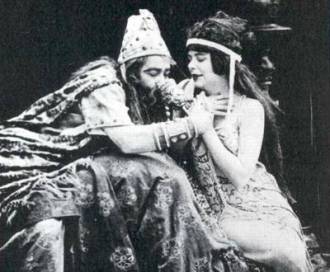
In the movie, an Assyrian general named Holofernes (Henry Walthall) leads his army out to conquer the kingdom of Judah. His access to Jerusalem is blocked by the city of Bethulia, which guards a narrow pass to the capital. Holofernes settles his army in for a siege, cutting off the Bethulians’ access to their water supply. As the situation grows desperate, a brave and well-respected widow named Judith (Blanche Sweet) takes her maid and goes out to the Assyrian camp.

Once there, she employs her considerable feminine wiles to ingratiate herself with him. In the process, she actually begins to fall in love with him. However, driven by her sense of duty to her dying countrymen, she arranges to be alone with him one night and lops off his head with his own sword. She then bundles up the head and takes it back with her to Bethulia, where she is welcomed with much rejoicing. The Bethulian army immediately launches an all-out attack on the Assyrian camp, and when the Assyrians discover their general’s headless corpse, they quickly disperse and run for the hills.

The selection of subject here is a good one. Judith of Bethulia has a lot going for it: action, intrigue, drama, pathos, romance (particularly in a sub-plot involving a captured Israeli woman and her frantic suitor inside the city). Nearly all of Griffith’s usual suspects can be spotted here and there among the cast. Mae Marsh is the Israelite captive, Naomi, Lillian and Dorothy Gish are both present inside the city, and even Lionel Barrymore and Mary Gish (mother of the other two) have minor roles.

The battle scenes, in particular, are brilliantly staged and choreographed, involving relatively large armies, including a number on horseback or driving chariots. The idea of having Judith develop feelings for Holofernes (borrowed from the 1904 stage play to which the film is directly indebted) allows some welcome complexity to creep into the proceedings. The one genuine complaint I feel constrained to offer is in reference to Blanche Sweet’s performance as Judith. She is, frankly, awful. She is rarely on-screen without emoting histrionically in a display that is totally devoid of subtlety. In all other respects, however, Judith of Bethulia provides a fascinating and rewarding introduction to the infancy of the American feature film.

Paul Newman, 1925-2008

•September 27, 2008 • Leave a Comment

The first presidential debate has been trumped on news pages all over the Internet by word of the death of Paul Newman yesterday. He was 83.

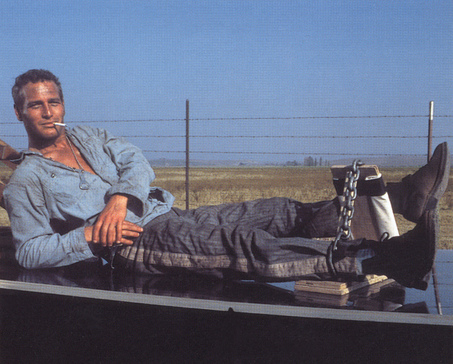
On top of being a great actor, Paul Newman undoubtedly had one of the coolest screen presences in movie history, as exemplified by his title (and perhaps most iconic) role in films like Cool Hand Luke (pictured above). He first hit it big in the late 1950s, with starring roles in William Faulkner’s The Long, Hot Summer and Tennessee Williams’ Cat on a Hot Tin Roof (both 1958). He went on to play likable rogues in movies like The Hustler (1961), Butch Cassidy and the Sundance Kid (1969), and The Sting (1973). However, he appeared in a variety of other films as well, including Exodus (1960) and Hitchcock’s Torn Curtain (1966).

Later in his career, he finally won a performance Oscar for his work in The Color of Money (1986) after seven unsuccessful nominations. He was nominated again (but failed to win) twice more: for Nobody’s Fool (1994) and Road to Perdition (2002), one of the finest performances of his career. His last role was as the voice of Doc Hudson in Pixar’s Cars (2006). However, I think it’s fairly obvious that he leaves behind him more than a few movies that will (actually, have) stand the test of time.

Film Roundup XIII

•September 26, 2008 • Leave a Comment

High Noon – 93%

On the day of his wedding and retirement, Marshal Will Kane (Gary Cooper) is on his way out of the small western town of Hadleyville when he receives word that Frank Miller, a notorious outlaw he sent to prison years before, is on his way back to town on the noon train and looking for revenge. Kane decides that he must stay and face Miller, but finds no one who will help or support him anywhere he turns, despite his years of service protecting and serving the people. One by one, the citizens of the town abandon him, and when Miller finally rides into town with his gang, Kane must face them all alone.

High Noon is fascinating because it is an iconic American Western which is ostensibly not about the Old West at all. In fact, the film, released in 1952, is an allegory about the blight of HUAC and the blacklisting going on in Hollywood at the time. The movie unfolds with the illusion of real time (actually, it is about 15 minutes shorter than the 100 minutes that pass in Hadleyville), increasing the tension all the more by prominently featuring various clocks as the time grows closer for Miller’s arrival. The soundtrack, which essentially consists of a single song played almost ad nauseum in the background, will drive some people bananas, but in every other respect this is a must-see of the genre.

The Gods Must Be Crazy – 85%

When a Coca-Cola bottle mysteriously falls from the sky (out of a passing airplane) and into the laps of a primitive African tribe, it is first hailed as a gift from the gods and put to good use for a variety of tasks. However, the tribe, formerly a totally harmonious family, soon dissolves into quarreling and contention over the new technology. Disgusted, Xi resolves to take the accursed “gift” of the gods to the end of the world and throw it off. His journey brings him into contact with a variety of characters and zany situations, including a new schoolteacher in a rural village, an incredibly clumsy biologist, and a violent revolutionary leader.

This is a bizarre South African comedy which frequently dissolves into pure silliness, but is just original and funny enough to be quite enjoyable. The role of Xi was played by an actual African bushman named N!xau (sic) who had had almost no contact with modern civilization before he was cast in the lead role. N!xau went on to reprise the role in no less than four increasingly shoddy sequels during the next 15 years, but only the first sequel received the sort of global attention the first had.

Wall Street – 79%

Bud Fox (Charlie Sheen) is a stockbroker, a young hotshot driven by ambition to seek out a relationship with the ruthless and successful Gordon Gekko (Michael Douglas) who becomes his mentor. Gekko shows Fox the ropes of unethical insider training, and the two men are soon colluding on a variety of shady business deals sure to bring them the sort of wealth that Fox has always dreamed about. However, a connection to Fox’s blue collar family in one of the deals lands him in the middle of a crisis of conscience and he is forced to face the consequences of his uninhibited greed.

“Greed, for lack of a better word, is good. Greed is right. Greed works,” Gekko preaches to a stockholder meeting, and we almost believe him. Douglas is particularly good in this film, which really captures a large part of the spirit of the 1980s (it came out in ’87). The result can be more than a little dry at times, particularly to those who, like me, have little understanding of the intricacies of high-powered economics. However, if you can hang on through the dense technical discussions of corporate finance without getting lost, the experience will be far more rewarding.

Intolerable Cruelty – 72%

Skilled gold-digger Marilyn Rexroth (Catherine Zeta-Jones) seeks revenge on Miles Massey (George Clooney), the divorce lawyer whose ironclad pre-nup screwed her out of a fortune. Their game of one-upmanship soon devolves into a war of attrition as the two scramble to beat each other to the next new low. Speaking of lows, this tired and largely-unfunny comedy is certainly not the brightest spot in the Coen Brothers’ impressive filmography. Fans could hardly go wrong by randomly selecting almost any one of their other movies to satisfy any need for a Coen fix.

Wallace and Gromit: The Curse of the Were-Rabbit – 92%

The eccentric British inventor and his sensible dog (and partner) return almost a decade after their massively-popular claymation shorts for a feature-length outing. This time, the intrepid pair are running a humane pest control service to protect the area’s gardens from the scourge of rabbits in the lead-up to the celebrated annual Giant Vegetable Competition hosted by local aristocrat Lady Tottington (Helena Bonham-Carter). All is not well, however, when a giant rabbit mysteriously appears and begins ravaging the competitors. While competing with snooty big-game hunter Victor Quartermaine (Ralph Fiennes) for Lady Tottington’s affections, Wallace (with the help of Gromit . . . or is it the other way around?) must solve the mystery of the were-rabbit in time for the competition to go on as planned.

The Wallace and Gromit stories continue to be endlessly fun and inventive, small masterpieces of plotting that also boggle the eyes with their sophisticated claymation techniques. Fans of the original shorts will not be disappointed by this outing, and anyone new to the phenomenon will enjoy a lively introduction to two of the most endearing characters in the history of animation.