earth

•April 22, 2009 • 1 Comment

earthstarring James Earl Jones
written & directed by Alastair Fothergill and Mark Linfield
Rated G.
94%

Jones narrates this edited-to-feature-length version of BBC’s Planet Earth miniseries. The assembled footage primarily documents a year in the lives of a few animal families, polar bears, elephants, and whales, as they move across the globe. The remaining gaps are filled in with larger glimpses of climates and environments all over the planet, from waterfalls to mountaintops, and short vignettes involving such diverse creatures as birds of paradise and great white sharks.

I have not actually seen any of Planet Earth, though I’ve heard great things. On the strength of this excerpt, I would certainly be interested in seeing more. More importantly though, I suspect that, had I seen the miniseries, I would have been all the more eager to experience these images on a giant movie screen. I really have no choice but to fall back on superlatives to help me describe the breathtaking beauty captured by this amazing project. This release provides a rare opportunity to go see something very different at the local multiplex.

Although hardly necessary to hold my attention, there is something of a narrative arc to earth as the film moves in mostly southerly direction from one pole to another as the months slide by from January to December. And there is certainly no need to inject artificial moments of drama along the way. This is one movie where the “characters” are in genuine danger, and may literally not survive to the end. The polar bears have only a short window to make it out onto the ice while conditions allow them to hunt for food, and then return to solid ground before the ice has melted into the ocean. The elephants trek for weeks across a dry wasteland in search of an abundant water supply. The whales brave thousands of miles of dangerous open waters to reach their feeding grounds. Meanwhile, we also get exciting segments such as the migration of vast herds of caribou as they are stalked by packs of wolves, and a species of bird whose annual journey takes them over the tops of the Himalayas.

Perhaps my favorite element, however, was the incredible use of time-lapse photography to create some of the most impressive sequences I’ve ever seen. Some of these bits came in close on blooming flowers and the branches of trees, capturing the almost sentient movements of some beautiful plant life. More amazing still, though, were the satellite images that showed changes across enormous tracts of land, such as the change from winter into spring as the white snow retreats from the onslaught of new growth across the whole of northern Europe and Asia. There was also some spectacular use of slow-motion that allows viewers to analyze the movements of a cheetah as it closes in on its prey or prompts them to renew their resolutions to stay out of the ocean as a great white leaps completely out of the water in order to capture and devour an entire seal in a single bite.

A few segments focused on the environment itself, covering areas such as rain forests and deserts. By far the most glorious of these, though, was an incredible montage of waterfall footage that begins with a jaw-dropping, top-down shot of Angel Falls, the world’s highest waterfall, that gives the audience an idea of what it would look like to go over the edge. (For the curious, a series of behind-the-scenes clips plays over the end credits to give the audience some idea of how the crews were able to capture such great material.)

Finally, although I obviously don’t know what the narration of Planet Earth is like, James Earl Jones is a great choice here. Occasionally the writing tries a bit too hard to be “cute,” but on the other hand this is meant to be a film that can entertain children as well as adults, and I would certainly say that it succeeds. Audiences may also wonder at the ideological underpinnings (if any). After all, although the movie has been released in various countries around the world beginning in 2007, it has just now made its way into American theaters on “Earth Day.”

Some conservative viewers may regard isolated references to warming climate conditions and shrinking rain forests with suspicion, but I felt that these issues were handled with subtlety and restraint. Prescriptions and calls to action are avoided entirely, and the material is allowed to speak for itself; this is powerful stuff, and we hardly need to be told that we ought to try and conserve the natural and delicate beauty on display here. Furthermore, I would argue that the emphasis placed on the exceptional and precise calibration of elements which allows our planet to support life could be seen as a gentle nudge towards contemplation of the possibilities of divine design. I certainly couldn’t keep my mind from wandering there. This earth, like the one we live on, is a beautiful gift and an open invitation to come appreciate the the wonders that exist all around us. Take advantage of the opportunity.

A Few Words about Evil

•April 16, 2009 • Leave a Comment

Dr. Greg Garrett, with whom I am currently taking  a class on theodicy, has just written an article on “Evil in Contemporary American Film” for the Society of Biblical Literature. It’s a good read, particularly as I hope to have something to say about evil in film myself in a few weeks. I particularly like his take on The Bourne Ultimatum near the end. Here’s an excerpt:

The Bourne Ultimatum, also released in 2007, was the third film in the series starring Matt Damon as repentant US government assassin Jason Bourne. Jason carried out kill missions on behalf of the American people; in the last film, we’re told that the program that began with Bourne has gone on to assassinate American citizens as well. In one of the movie’s final scenes, Jason Bourne, repentant man that he now is, pursues his past to the place where he became Jason Bourne, cold-blooded killer, and regains his memories: that he voluntarily submitted to the program of brain-washing and training that made him an unstoppable assassin, that he executed an unknown man as a demonstration of his willingness, and that although he had entered the program out of patriotic motives, he himself was to blame for the person he became.

In this film, we can see all three of the human forms of evil displayed vividly: the personal choice that Jason makes when he decides to become a killer, the wheedling and urging of extra-personal evil in the persons of his handlers. But in images reminiscent of the Abu Graib photos, in the clear visual references elsewhere in The Bourne Ultimatum to water boarding, and in the patriotic notion that sometimes the good guys have to do really bad things to defeat the bad guys, we can see the last few years of American history come to life and our societal sins laid bare for all to see. Jason chose, yes, but his individual choice is given its impetus by the resources and the training he is given by a society willing to do anything to maintain its power and security. His choice is magnified by his inability to see that he serves a corrupt and corrupting system.

I talked about The Bourne Ultimatum with audiences in Munich and Stuttgart in the summer of 2008, and while my largely agnostic audience didn’t always relate to the spiritual impulses I was describing, they certainly understood the idea of societal evil; Germany has seen how that looks. When a system rewards individuals for doing evil or punishes them for not doing evil, we are dealing with a society that is complicating the individual decision in ways almost beyond bearing. But, as we see dramatically at the end of The Bourne Ultimatum, one can still choose good over evil, even in a flawed system. When Damon’s character announces, “I’m not Jason Bourne any more,” we are witnessing another stirring example of metanoia, that rejection of evil and movement in the direction of something radically different.

Film Roundup XXII

•April 11, 2009 • Leave a Comment

Saw – 85%

Two strangers wake up in a room together. They are chained to pipes by their ankles and there is a dead body and a handgun on the floor in-between them. A tape recording instructs one of them that, unless he kills the other by a certain time, his wife and daughter will be murdered. The two also discover a pair of hacksaws, but are unable to cut through their chains. Eventually, one of them realizes that the hacksaws will have to be used on their legs if they wish to escape. Various flashbacks reveal that this is the work of a twisted serial murderer known as the Jigsaw Killer, a man who takes pleasure in putting his victims in situations where they will have to make drastic moral choices or inflict extreme pain on themselves in order to survive.

Although I’ve never quite felt up to any of the Saw sequels (there are currently four), the first one was a decent thriller. Despite rather obvious budget constraints, the proceedings held my interest with a smart combination of plot twists and a succession of blood-curdling thought experiments. I had the distinct feeling that I would need to see it again to completely understand the game that had been played, which is unfortunate, as it’s not the sort of thing I would necessarily want to see a second time. Still, it was nowhere near as gruesome as I understand other entries in the series (and the genre) to be. Any given person will know best whether this sort of thing is their cup of tea or not without needing to see it and find out.

The Da Vinci Code – 80%

“Symbologist” Robert Langdon (Tom Hanks) is drawn into a centuries-old mystery protected by a global conspiracy when he is called in to assist police at the scene of a murder committed in the Louvre museum in Paris. Soon, Langdon’s knowledge of art and history lead him and Sophie Neveu (Audrey Tautou), the murdered man’s granddaughter, on a quest for the Holy Grail. Their search is complicated, both by the devilish clues which guard the Grail, and by the interference of Opus Dei, a shadowy, sinister Catholic organization that will stop at nothing to prevent the secret of the Grail from being revealed.

The movie is based on Dan Brown’s best-selling novel, which concocts an infallible recipe for success: a Grail Quest, secret societies, a “double chase,” intriguing clues, and a sloppily-researched alternate history stolen from Holy Blood, Holy Grail. Brown is fortunate indeed to have been gifted with such a flair for “borrowing” other peoples’ interesting and controversial ideas, because he certainly can’t write. His characters are flat and wooden, his dialogue is jarring and painful, and his plot development is predictable and patently absurd.

Happily, the worst of these defects can be ironed out by a competent screenwriter and a large production budget. The movie version can’t help but retain some of the silliness of its source, but is otherwise such a vast improvement over the excruciating experience of reading the book that I had rather a good time. Tom Hanks is usually worth watching, Ian McKellen pops in to lend gravitas to the inevitable exposition, and Paul Bettany is delightfully campy as Silas, an albino monk-slash-assassin. Still, if it’s excitement and a modern Grail quest you’re craving, I’d recommend revisiting Indiana Jones and the Last Crusade instead.

CSA: Confederate States of America – 88%

This irreverent mockumentary explores the history of America after the Confederacy won the American Civil War and proceeded to conquer the northern states. The movie combines doctored photos, fake historical footage, interviews, and hilarious commercials and film clips to create a portrait of a nation where slavery didn’t end 150 years ago. Ultimately, it uses this conceit to question whether America today would look much different, particularly with respect to racial issues, if the South had won the war, and comes to the disturbing conclusion that it would not.

I thought this was a very interesting and original idea, even if the execution can’t quite live up to the premise. I found it to be quite entertaining and funny, albeit not for the easily-offended. I especially enjoyed the various made-up film clips representing various periods of Hollywood film-making. What the minds behind this movie lack in production values they almost make up in sheer creativity. This is a must-see for anyone interested in the South or cultural history.

¡Three Amigos! – 79%

Dusty Bottoms (Chevy Chase), Lucky Day (Steve Martin), and Ned Nederlander (Martin Short) are the Three Amigos, a trio of actors who play the intrepid heroes of a series of popular silent Westerns. After they get themselves fired and kicked off the studio lot, they decide to accept what they think is a performance gig in a small Mexican village. The confused villagers, however, have taken their on-screen exploits literally and want the men to stand up to El Guapo, a cruel bandit leader. Although their first impulse is to run straight back to Hollywood, the three are eventually inspired to step up and bungle their way through the most important roles they will ever play.

This plot is almost as old as the movies themselves, but Chase, Martin, and Short are funny guys and they do it credit. The movie staggers drunkenly between genuinely amusing and just silly, but it doesn’t fail to deliver anything that it promises before eventually succumbing to the tropes of the genre it is parodying. Good for a laugh or three, but hardly a classic.

Déjà Vu – 34%

ATF agent Doug Carlin (Denzel Washington) investigates the explosion of a ferry that killed hundreds of people and the death of a mysterious woman found shortly before the incident. Before he can get far, he is invited to join the efforts of a secret surveillance team who possess technology allowing them to look back exactly four days (give or take) in time. As they search the past for clues, Carlin grows more interested in, and concerned for, the dead woman. With the time of the explosion drawing near for the observers, Carlin impulsively adapts the technology to allow him to travel back to the day before so he can try to prevent the events from ever happening.

There’s no denying that Washington is a talented actor who brings a lot of presence to any project, but even he can’t save this stinker. An intriguing set-up with an interesting premise (the limited surveillance of the past) takes a turn for the incredibly stupid when Washington’s character decides that he can just hop inside the gizmo and launch himself back in time. The story never really recovers from that idiotic leap, but it’s all paint-by-numbers anyway, as any halfway-conscious viewer will have no trouble anticipating that Carlin is doomed to become part of the events leading up to everything turning out exactly as it did before. The only question is whether Washington wished he had access to a time machine when he saw how poorly the whole thing played out.

Going My Way: Best Picture, 1944

•April 6, 2009 • Leave a Comment

goingmywayposterThe 17th Annual Academy Awards were hosted by John Cromwell and Bob Hope, and the proceedings were broadcast nationally over the radio for the first time. Another first this year: The Best Picture category was restricted to five nominees. Going My Way was nominated for a total of 10 Oscars: Best Picture, Best Director, Best Screenplay, Best Original Story, Best Actor (Bing Crosby), Best Actor (Barry Fitzgerald), Best Supporting Actor (Barry Fitzgerald), Best Editing, Best Cinematography, and Best Original Song. That isn’t an error up there. For the first and last time (prompting a rule change), an actor was nominated for two awards for the same role.
Going My Way is rather light fare, particularly in comparison with the competition (with the exception of Meet Me in St. Louis, 4 nominations, no wins). Heavy contenders included the stridently-patriotic, wartime biopic Wilson about President Woodrow (10 nominations, 5 wins), the thrilling Gaslight starring Ingrid Bergman (7 nominations, 2 wins), the Wilder-directed noir masterpiece Double Indemnity (7 nominations, no wins), Preminger-directed noir masterpiece Laura (5 nominations, 1 win), and Alfred Hitchcock’s gimmicky but interesting Lifeboat (3 nominations, no wins).

Laura won Best Cinematography (Black-and-White), Wilson won Best Editing, and Crosby beat Fitzgerald for Best Actor, leaving the latter to claim Best Supporting. Going My Way also scooped up the remaining awards, for an impressive total of 7 wins. It was a major coup for the lone comedy, but hardly surprising; Going My Way was also the top box-office draw of the year. Speaking of impressive, director McCarey became the first person to win awards as a producer, director, and writer for the same film. McCarey’s Best Director win sent Hitchcock home empty-handed for the second (but not the last) time.

Going My Way is about an extremely hip and sympathetic young priest, Father Chuck O’Malley (Crosby), who is sent to bolster the floundering financial situation of a parish run by the stodgy, irascible Father Fitzgibbon (Fitzgerald). Although the two men initially clash over their different ideas about the church, O’Malley eventually wins Fitzgibbon and his elderly parishioners over, puts some straying sheep back on the straight-and-narrow, turns a group of juvenile delinquents into a talented choir, and saves the church with a hit song (the catchy, award-winning “Swinging On a Star”).

There’s no denying that this movie is schmaltz in its purest form. That unabashed sunniness, coupled with the fact that the film’s popular appeal rocketed it to victory over darker, more-deserving nominees, left me (unfairly) ready to hate it from start to finish. Imagine my surprise when Going My Way turned out to be, not only enjoyable, but a good deal better than the sentimentalist dreck I had expected. The film’s cheerful rosiness proves infectious by virtue of an irresistibly charismatic performance from Crosby, the occasional intrusion of sobering reality, and more than a few sly winks at the audience to implicate us in the happy conspiracy. Of course, the proceedings aren’t without their share of eye-rolling, groan-worthy moments, but I just don’t have it in me to scowl at anything so relentlessly good-natured, particularly when my grouchiness has been anticipated and headed off at the pass.

So, yes, Fitzgerald is good, and Crosby is better. The music is pervasive and enjoyable, and I defy anyone to actively dislike “Swinging On a Star” (leaving aside the wooden performances of the young soloists). Charming opera star Risë Stevens also appears, in one of her few screen roles, as, well, an opera star. Jean Heather (who also shines as Lola Dietrichson in Double Indemnity) is adorably naive as a girl who has run away to find a singing career, and gets off much more lightly than she ought to after meeting a charming young man who rather suspiciously allows her to live in an apartment free of rent.

Perhaps the highest praise that I can bestow on Going My Way is that it is one of the better and more memorable entries in a genre that has produced few films I can even bear to sit through. They literally do not make them like this anymore, because the only people trying are long on good intentions and short on artistic integrity. It’s still not the best movie of 1944, but I’ll be jiggered if it isn’t well-worth seeing after all.

Continue reading ‘Going My Way: Best Picture, 1944′

Learning to Love the Bomb: Sex, Laughter, and the End of the World in Dr. Strangelove

•March 31, 2009 • 1 Comment

drstrangeloveposterOn the day after its release in 1964, Bosley Crowther, the irascible film critic for The New York Times, described Stanley Kubrick’s Dr. Strangelove as “beyond any question the most shattering sick joke I’ve ever come across.” Clearly, whether his scandalized assessment of the film is fair or not, Crowther had failed to absorb the significance of Strangelove‘s rather unwieldy subtitle: How I Learned to Stop Worrying and Love the Bomb. This is not terribly surprising, for, as Sigmund Freud observed, “[J]okes that have a purpose run the risk of meeting with people who do not want to listen to them.” Freud, as it happens, is precisely the right name to invoke in connection with Dr. Strangelove. His theories play a significant role in the film, both in its barely-disguised subtext and in the very fabric of its formation.
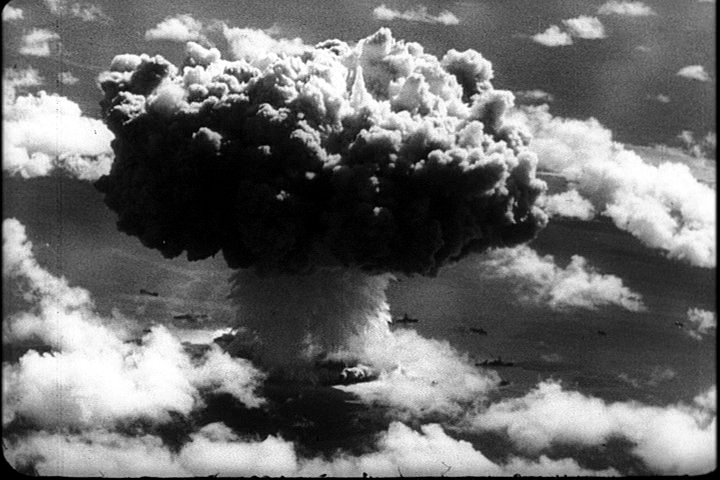
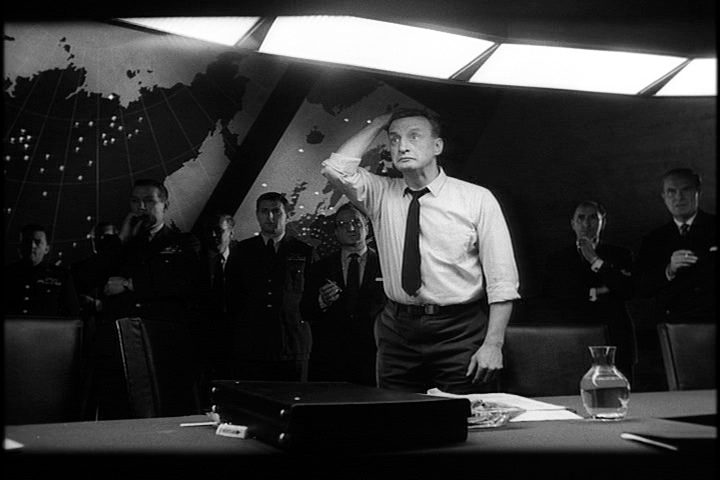
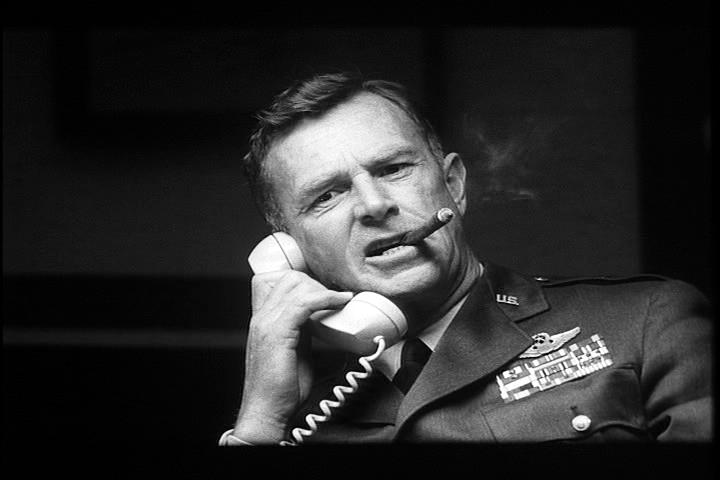
According to James B. Harris, Kubrick’s producing partner on a number of his early films, in 1962 “Stanley became terribly interested in the thermonuclear dilemma, and when we finished Lolita, this was all that was on his mind: the possibilities of a nuclear holocaust.” So obsessive was Kubrick’s interest that he read some 50 books on the subject during this time, and eventually acquired the film rights to Peter George’s Red Alert, aka Two Hours to Doom with the intention of crafting a grim, realistic thriller about the possibility of nuclear war. However, as Kubrick and Harris worked on a screenplay for the film, tentatively titled The Delicate Balance of Terror, a strange thing occurred.

In sessions that lasted late into the night, the two found that a certain farcical levity tended to creep into their conversations about the story, growing increasingly sillier as the hour grew later. Then, in the wake of the Cuban Missile Crisis (during which the United States arguably came closer to open nuclear conflict than ever, either before or since), Kubrick was increasingly struck by the public’s fatalistic acceptance of the probability of nuclear annihilation. In the end, he decided that his material worked better as comedy than as tragedy, and the real seeds of what would eventually become Dr. Strangelove finally began to take root.

mushroom1In fact, comedy or not, Strangelove displays a very well-grounded understanding of the geopolitical nuclear stage, showcasing a surprisingly meticulous depiction of the nuclear tactics, policies, and capabilities that were available to the public at the time of production. The film effectively combines this rigorously-researched material with a very playful (one might even say juvenile) understanding of Freudian psychosexual development to satirically suggest that global military and political power rests in the hands of a group of overgrown adolescent males who are both motivated and inhibited by their sexual insecurities. For these men, the hydrogen bomb becomes a symbol of sexual potency and orgasmic release.

comedyMeanwhile, in resorting to comedy to drive home the point about nuclear war, Kubrick works out his nuclear neuroses, thereby illustrating the Freudian conception of humor as a socially-acceptable means of expressing sentiments which society otherwise suppresses. By gleefully mocking his characters’ love of the bomb as a source of sexual release in Dr. Strangelove, Stanley Kubrick shows his Cold War audience how they, too, can learn to love the bomb: as a source of humorous release rather than repressed anxiety.

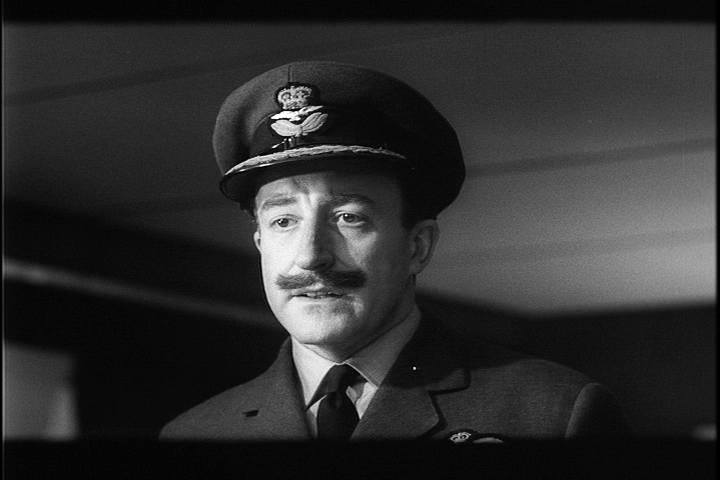
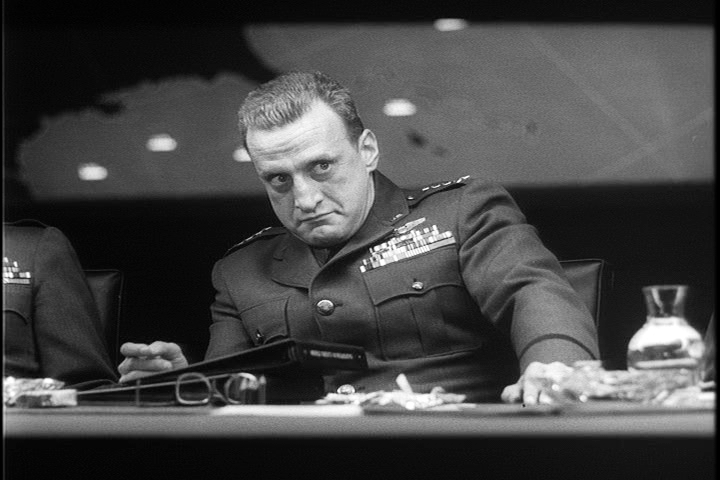
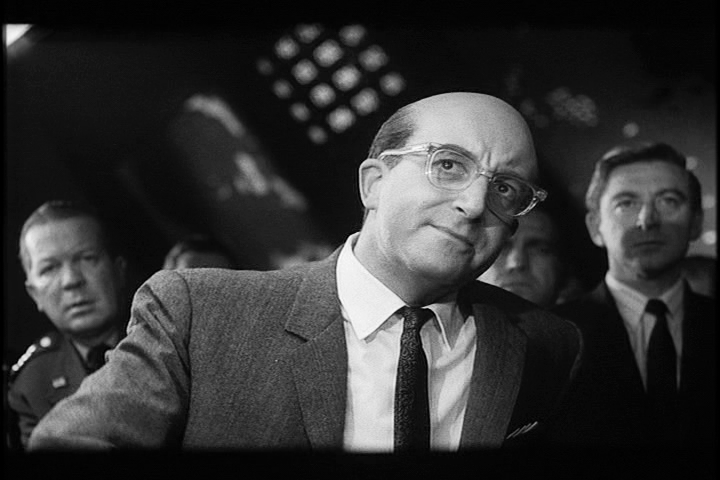
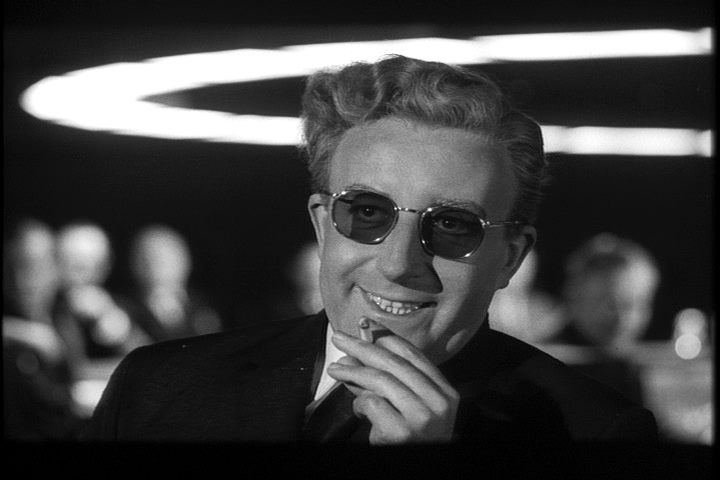
There are six major characters in Dr. Strangelove, divided evenly between two types: emasculated males and hypermasculine males. The hypermasculine characters are oversexed, and their appetites reveal them to be psychologically unstable. All three are American military men, and they share a deep distrust of communists and communism which leads them to contemplate unthinkable actions. Meanwhile, the emasculated characters are sexually impotent and unable to prevent the fallout which results from their counterparts’ misplaced sexual energy, finally opting to join them instead. All three emasculated characters (two of whom are foreign) are played by Peter Sellers.

sterlinghaydenpetersellers1slimpickensgeorgescottpetersellers2petersellers3

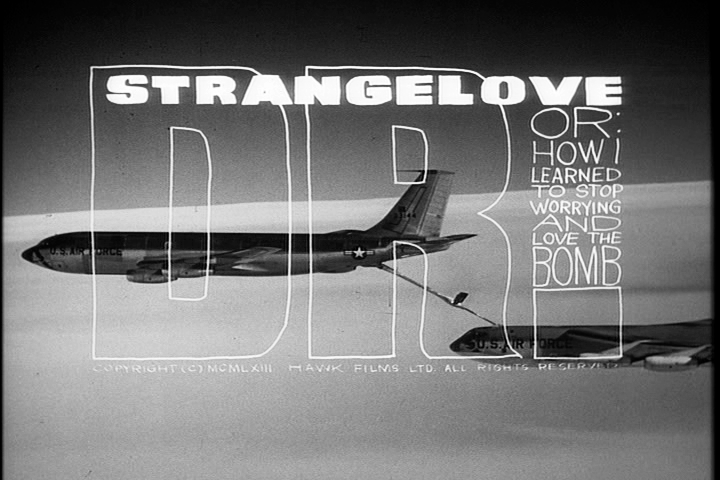
planes1The film sets its tone during the opening credits by using stock footage of a midair refueling operation, edited to imply that the two planes are copulating as romantic music plays over the scene. The insinuation is funny, but it also immediately establishes a connection between martial and sexual imagery. Theplanes2 American bomber being refueled is presumably one of the nuclear-armed B-52s assigned to constantly hold a position just outside Russian radar coverage, ready to attack at a moment’s notice. However, this watchful image is ridiculed and somewhat undercut by the implied sexuality of the scene.

Continue reading ‘Learning to Love the Bomb: Sex, Laughter, and the End of the World in Dr. Strangelove

Monsters vs. Aliens

•March 27, 2009 • Leave a Comment

monstersvsaliensposterstarring Reese Witherspoon, Seth Rogen, Hugh Laurie, and Will Arnett
written by Maya Forbes and Wallace Wolodarsky & directed by Rob Letterman and Conrad Vernon
Rated PG for sci-fi action, some crude humor and mild language.
83%

When Susan Murphy (Witherspoon) is hit by a meteorite on her wedding day, she is suddenly and mysteriously imbued with enormous size and strength. These newfound abilities lead to her imprisonment by General W.R. Monger (Kiefer Sutherland), who has been collecting and containing monsters since the 1950s. Renamed Ginormica, Susan joins Insectosaurus, mad scientist Dr. Cockroach (Laurie), the reptilian Missing Link (Arnett) and an amorphous gelatinous mass named B.O.B. (Rogen). Before long, earth is invaded by an evil alien menace named Gallaxhar (Rainn Wilson), and when conventional weapons fail, General Monger convinces the President (Stephen Colbert) to send in his team of monsters to do the job.

Monsters vs. Aliens has three really obvious things going for it. First, it has a fantastic premise, almost inspired in its silliness. The concept combines some of the most hackneyed ideas out of old B-grade monster flicks into an affectionate parody that really manages to bring the laughs. This is a movie that is simply full of ideas, and even when they don’t quite work, there is a palpable sense of fun and zany creativity behind them.

Second, the movie has a really great cast. There are definitely bad ways to stack celebrity voices into an animated feature, but here they seem to have been selected with an eye towards character first, and name-recognition second (if at all). Seth Rogen seems to have suddenly become the go-to guy for voice acting. I count five voice-overs in the past two years, and I, at least, have felt that more than a few of those were lacking something. Here, however, he seems to bring something other than his name to his character.

Laurie is magnificently funny as Dr. Cockroach, and it would not be difficult to watch the movie without connecting the voice to the actor. And casting Stephen Colbert as the President of the United States is just fun in a very obvious and entertaining way, a good joke in itself, even if doesn’t turn out to be quite as side-splitting as I had hoped. Witherspoon is the real stand-out, though. She navigates Susan flawlessly through a somewhat complex character arc in a way that both invites sympathy and interest, and makes it easy to ignore the elements of her development that don’t quite seem to make sense.

Finally, the movie showcases some glorious computer animation, providing a genuinely eye-popping 3D experience. The use of 3D is all the more appropriate as it hearkens back to the gimmicky use of the format during the 1950s (a fact which becomes fodder for one of the movie’s early gags). The new resurgence of 3D releases seems less obsessed with flashy invasions of the audience’s personal space (although there is still a bit of that), and more interested in providing a compelling environment for our eyes to hungrily explore. It is as though the screen were a window through which to see the action taking place on the other side rather than the flat projection of an image.

So, as I say, Monsters vs. Aliens has a great deal to recommend it. It’s greatest shortcoming is the failure to really live up to the wacky brilliance that seems to be within its reach. A few of the running gags fall rather flat, even before they are taken a bit too far, particularly elements involving B.O.B. and some of his schtick, and the interactions between General Monger and the President. I guess the chief problem is that so many of these ideas are funnier in theory than in practice, which is unfortunate. Still, perhaps a movie called Monsters vs. Aliens has no business being a masterpiece. It certainly kept me laughing, and I left feeling that I had gotten the good time that I paid for. I can’t think of anything more I might have reasonably expected.

Intermission: Where the Wild Things Are, Coens to Remake True Grit

•March 25, 2009 • Leave a Comment

Jeffrey Overstreet catches the first trailer for Spike Jonze’s adaptation of Where the Wild Things Are. It looks very interesting. Very interesting, indeed.

And, in other news, it seems that Variety has reported the Coen Brothers next project will be a remake of Charles-Portis-novel-turned-John-Wayne-vehicle True Grit, due to come out in 2011. It’s an interesing prospect. True Grit is one of my favorite classic Westerns, with early appearances by Robert Duvall and Dennis Hopper, and an awesome showdown scene. Honestly, I’m a bit curious as to what the Coens (as great as they are) will bring to the story. According to the article, the remake will adhere more closely to the novel and tell the story from the girl’s point of view . . . but that’s pretty much what the original already does. In fact, I’ve read True Grit, and it is one of the most slavishly faithful adaptations I’ve ever come across. I’ll be watching for this one.

Film Roundup XXI

•March 20, 2009 • Leave a Comment

The Return of the Pink Panther – 82%

Peter Sellers reprises his role as bumbling French Inspector Jacques Clouseau for the third time. Once again the priceless Pink Panther diamond has been stolen, and all evidence points towards a notorious jewel thief called The Phantom (Christopher Plummer). No one is more surprised than The Phantom himself (Sir Charles Litton), however, who is innocent and trying to enjoy his retirement. While his wife diverts Clouseau and Clouseau’s Oriental manservant Cato (Burt Kwouk), Sir Charles sets out to track down the real thief and clear his name.

Return is the best of the wildly uneven Panther sequels, and perhaps even the most successful comedy of the series. It features all of the “classic” elements of the typical Pink Panther movie (introducing for the first time the Chief Inspector’s insane homicidal rage at Clouseau), while cobbling together a roughly coherent plot and an enjoyable experience.

Walk, Don’t Run – 86%

In Cary Grant’s final screen appearance, he plays matchmaker as Sir William Rutland, an English businessman who travels to Tokyo shortly before the 1964 Olympics. With no housing available anywhere, Rutland snags an add from a bulletin board at the British embassy and talks his way into the apartment of Christine Easton (Samantha Eggar), a strait-laced young British woman who is engaged to an equally stuffy British official. When Rutland befriends Steve Davis (Jim Hutton), an American athlete with nowhere to stay, he sublets his portion of Christine’s apartment, much to her annoyance. In-between business meetings, Rutland impishly devises ways to throw Steve and Christine together, with hilarious (if predictable) results.

This is a thoroughly charming and funny romantic comedy that I could watch over and over again. It has a smart and engaging script built around Grant’s fun and effortless charisma. In fact, Grant is so good in the role, that it makes me wish he hadn’t retired simply because he felt that he had aged beyond the point of plausibly playing a romantic lead. Still, no one can argue that he didn’t quit while he was ahead.

Secret Window – 78%

Best-selling mystery writer Mort Rainey (Johnny Depp) is stalked by an angry man named John Shooter (John Turturro) who claims that Rainey stole his story and ruined the ending. While Rainey struggles to prove that this is not the case, events around him take a sinister turn, and he is certain that Shooter is responsible. Despite a decent cast, this is fairly rote thriller material. Rather ironically (for a story that is so obsessed with good endings), the final reveal is a bland and overused shocker-twist, and I was left wishing that the screenwriter had dug a little deeper into the creativity file.

The Incredible Mr. Limpet – 64%

Don Knotts is a near-sighted, timid bookkeeper who is obsessed with fish. One day, as he peers down into the water from the end of a dock, his fondest wish is granted when he falls in and is transformed into a talking animated fish. Even though life under the sea is not exactly as he had imagined, he finds peace and contentment there; until, that is, he finds that his old country needs his undersea expertise to aid them on the Pacific front during World War II. This fun little flick, which combines live-action with animation, is pure entertainment. The fantasy wears a bit thin at points, but fans of Knotts’ usual schtick should find nothing to complain about.

Rosencrantz and Guildenstern Are Dead – 95%

Gary Oldman and Tim Roth fill the title roles in this screen adaptation of Tom Stoppard’s delightful retelling of Shakespeare’s classic Hamlet from the perspective of two of its most minor characters. Rosencrantz and Guildenstern find themselves summoned by the King of Denmark and assigned to discover the source of his melancholic madness. However, from the moment they arrive they find themselves caught up in a sequence of events that they cannot understand, let alone control. Richard Dreyfuss is great fun as the mischievous and enigmatic figure of “The Player.”

I’ve thoroughly enjoyed this film every one of the several times that I’ve seen it, and it has inspired some of my academic endeavors. It is a great movie version of a great play. On top of being a playful deconstruction of Hamlet, it examines a whole range of existential philosophical questions in a very powerful and thought-provoking way. It is certainly unlike any treatment of Shakespeare you’ll have seen before, and likely unlike anything else you’ve seen, either. Offhand, I can’t think of any comparable examples.

FFCC Recognizes Favorite Films of 2008

•March 15, 2009 • 1 Comment

The votes have been cast and tallied by the Faith & Film Critics Circle, and the results are in. Silent Light has been chosen as the Most Significant Exploration of Spiritual Themes (the “flagship” award). Slumdog Millionaire, At the Death House Door, and WALL-E were selected as Best Narrative Film, Best Documentary, and Best Film for the Whole Family, respectively. Here is a list of the nominees and a short blurb about the winning films. As usual, I highly recommend those that I have seen, and look forward to catching up on the few that I have not.

Race to Witch Mountain

•March 13, 2009 • Leave a Comment

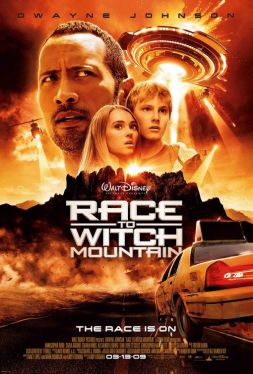
racetowitchmountainposterstarring Dwayne Johnson, AnnaSophia Robb, and Alexander Ludwig
written by Matt Lopez and Mark Bomback & directed by Andy Fickman
Rated PG for sequences of action and violence, frightening and dangerous situations, and some thematic elements.
64%

Jack Bruno (Johnson) is a Vegas cab driver with a shady past that he is trying to leave behind him. His quest for normalcy is complicated considerably by the unexpected appearance of two teenagers with a fat roll of cash who need a ride out into the desert. The two are siblings, Seth (Ludwig) and Sara (Robb), with some very unusual abilities. In fact, as Jack will soon discover, they are aliens on the run from both the United States government and an intergalactic assassin, and if he doesn’t help them recover their ship from the depths of a top secret facility at Witch Mountain, the fate of the human race will be very much in question.

This movie’s biggest asset is undoubtedly Dwayne Johnson, who has come a long way (at least in my estimation) from his days as “The Rock” playing roles like the title character of Mummy prequel The Scorpion King. Props to whoever first had the idea of handing him comedic roles. The man is a master of dry self-deprecation. His charisma keeps Race to Witch Mountain afloat when it feels like it should be sinking. Ludwig and Robb are also somewhat endearing as the alien children, but they feel a bit crippled at first by wooden “not-of-this-world” dialogue (which means that they are teenagers who speak English well).

Unfortunately, despite a strong effort from the cast, Race to Witch Mountain seems to be banking on a young, undiscriminating audience to compensate for lazy, shoddy production values. Director Andy Fickman must have been picked for the ability to bring movies in under budget, because his choices seem built around cutting corners. For an action-driven science fiction film released by a major studio, this has some of the shoddiest effects I have witnessed in recent memory, poorly disguised by shaky camerawork, lots of close-ups, and choppy editing.

The goal here was clearly to get the audience in, race (ha!) through the story, and move them out for the next group. This movie can’t be troubled to slow down for anything, setting up the story and characters in record time and then moving full-speed ahead for the duration. Even the rare moments of character-developing dialogue have tense music underscoring them or must be prematurely interrupted by yet-another chase sequence. This is not entirely a bad thing. After all, the movie is as long as it needs to be and it never drags. Still, I was hyper-aware of the economy of its storytelling throughout.

Johnson, the kids, and their supporting cast (which includes Carla Gugino, Ciaran Hinds, and Garry Marshall) go a long way towards deflecting these shortcomings, and the script is sporadically clever. Race to Witch Mountain may be cheap, forgettable entertainment, but it is undeniably entertaining. I suppose that’s all I would have asked of it, and as long as no one expects something more this will be a satisfying, painless experience.