
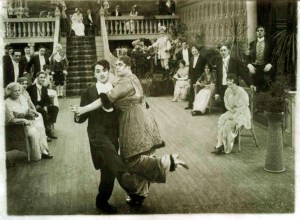
American Movie: Tillie’s Punctured Romance (1914)

•June 1, 2009 • Leave a Comment

TilliePuncturedRomanceOnce the sheer novelty of motion pictures had given way to filmed narratives produced regularly for public exhibition, questions of genre became important. While some filmmakers were concerned with producing films for purely artistic or didactic reasons, the largest audience, then as now, could be found for movies that offered pure entertainment. And, of course, few genres are as purely entertaining as comedy. In America, the success and proliferation of movie comedy dates from 1912, with the foundation of the Keystone Comedy Studio by Mack Sennett. Dubbing himself the “King of Comedy,” Sennett enjoyed immense success during the next several years. His film production mill churned out hundreds upon hundreds of comedy shorts with the help of a stock group of typecast actors including the fantastically popular Roscoe “Fatty” Arbuckle.

The studio name remains best-known today for Sennett’s “Keystone Cops,” an ever-shifting group of incompetent policemen who starred in a number of shorts in addition to playing supporting roles. These characters exemplify Sennett’s violent, vulgar, almost anarchic brand of slapstick comedy. His movies are models of entropy run amok, degenerating from sense and order into chaos and incoherence. Sennett’s life followed a similar trajectory as he declined steadily from wealth and success as head of his own studio to the loss of his foothold in the movie business shortly after his studio folded in 1933, a casualty of the Great Depression. When Sennett received an honorary Academy Award for “his lasting contribution to the comedy technique of the screen” five years later, he was already well on his way into personal semi-obscurity (despite the lasting fame of his name and contributions to the industry).

In the early ‘teens, however, Sennett was still at the top of his game. His comedies are exaggerated portraits of the everyday life of the time, riffing on contemporary American values, fears, occupations, and past-times with ease and fluidity. Of course, short one-reel films were the natural medium for Sennett’s fast-moving multitude of comic ideas and players, as for all other American comedy of the time. However, in 1914, as the idea of feature-length multi-reel films continued to make headway among American moviemakers, Sennett displayed his ever-present willingness to experiment with the production of the first ever full-length comedy: Tillie’s Punctured Romance.

The film starred 46-year old vaudeville comedienne Marie Dressler as the title character, a naive country girl who is seduced by a slick city con-man, played by 24-year old newcomer Charlie Chaplin. Chaplin was on his second tour of America in late 1913 when he was spotted by Sennett and Mabel Normand (one of Sennett’s stars, and his lover at the time). Based on Normand’s recommendation, Chaplin was hired, and Normand is believed to have persuaded Sennett to keep Chaplin on after his first appearance proved less than successful. Normand is the third star of Tillie’s Punctured Romance, playing Chaplin’s con-artist girlfriend.

After Charlie has lured Tillie away from Yokeltown to the big city, Mabel spots him and believes that he is cheating on her. The two women quarrel, but eventually Charlie has a chance to explain himself to Mabel. Now working together, they manage to get Tillie drunk and abscond with the pocketbook containing a large amount of money which Charlie had persuaded her to steal from her father. Shortly thereafter, Tillie is arrested for her disorderly behavior, but she is bailed out by a very convenient millionaire uncle and gets a job waiting tables at a small restaurant. Various hijinks ensue until the rich uncle dies in a freak mountain-climbing accident in the Alps, leaving her all of his money.

Catching wind of Tillie’s good fortune before she does, Charlie rushes back to her side and quickly marries her before word of the inheritance can reach her. However, after a number of misadventures in high society, it is revealed that rumors of the uncle’s death had been greatly exaggerated and he returns to have them arrested for destroying his house. A wild chase ensues involving the famous Keystone Cops which ends with a lot of people going off the end of a pier, and the film concludes as Tillie and Mabel realize that Charlie is no good and decide to become friends instead.

Throughout Tillie’s Punctured Romance, Sennett and his cast poke fun at contemporary anxieties while subtly reinforcing them, particularly tensions over growing urbanization. The attitude is best illustrated by a title card that announces, “From the pure breath of the open spaces to the fetid atmosphere of the wicked city is but a step—but what a step!” However, Sennett’s comical critique of city life is apparent throughout the film, not by way of contrast with the country (which is not particularly idyllic), but by virtue of the situations which the characters encounter. The city is a place of danger, dehumanization, and decadence.

When she first arrives, Tillie encounters the usual difficulties involved in crossing a busy street. She is, of course, plied with alcohol and subsequently arrested while the real criminals are left to roam free. Once she has been released (thanks to the financial influence of her uncle), she is forced to take the first job she can find; a position that eventually finds her serving the very people who imposed this hardship on her.

None of this is particularly grim, of course. Everything is played for laughs, and the characters are meant to amuse rather than evoke sympathy. They are never seen to feel sorry for themselves, and nothing too bad can happen, so it is acceptable for them to be the brunt of the joke. In fact, one might successfully argue that Sennett’s intention was to lampoon rural fears and prejudices towards life in the big city. The criminals are as bumbling as the police officers, and Tillie always manages to land on her feet.

The best, funniest, and most interesting scene in the film arrives about halfway through, when Charlie and Mabel, having just purchased new clothes with their stolen money, decide to go the movies. They slide in next to a severe looking gentleman, and are horrified to discover that the first short is a morality play called “A Thief’s Fate.” This movie within the movie plays out a condensed version of the exact crime they have just committed, ending with the arrest of the con man and his girlfriend. Just as the short ends, Mabel happens to notice that the man sitting next to them is wearing a badge, and the pair flee the theater in terror.

The scene offers a hilarious metanarrative commentary on film as art imitating life. Additionally, by inserting a scene in a movie theater into a story about the foibles of the everyday world, Sennett shows that the new medium of cinema has already become a part of the current American scene. Here, film art (even of the lowbrow comic variety) is both legitimate and relevant to the modern experience. Comedy as a film genre, though frequently devalued for its lack of seriousness, can be the most informative about contemporary attitudes and activities because it is designed to appeal to the ordinary mass and they must be able to relate to it in some way. The value of this perspective is apparent throughout Tillie’s Punctured Romance.
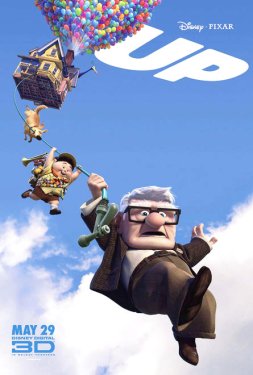
Up

•May 29, 2009 • 2 Comments

upposterstarring Edward Asner, Christopher Plummer, and Jordan Nagai
written by Bob Peterson & directed by Pete Docter and Bob Peterson
Rated PG for some peril and action.
97%

Faced with being torn from his house to live out his days in a nursing home, geriatric widower and retired balloon salesman Carl Fredricksen (Asner) uses thousands of his helium-filled products to carry himself and his home out of reach. Once airborne, he sets sail for Paradise Falls, a magical lost world in Venezuela that Carl and his dead wife always dreamed of visiting one day. Just as he settles in, however, Carl is perturbed to discover an accidental stowaway: Russell, an 8-year old Wilderness Explorer who only needs to complete his “Assisting the Elderly” merit badge to make “Senior Wilderness Explorer.” Before Carl can set down to return the boy, the house is swept away in a storm, launching the two unlikely companions on a series of wild and increasingly implausible adventures.

Up takes the the phrase “flights of fancy” and makes it startlingly literal. Despite ostensibly being set in “the real world,” the movie pointedly and persistently ignores logic (but not storytelling logic) in favor of a sustained and terrifying balancing act of pure whimsy. The insanity begins with an elderly man who wants to relocate his entire house to a remote jungle on another continent using only a large number of ordinary balloons, but that truly is just a beginning. The audience will repeatedly be faced with a choice between whether to ask why in the world there is, say, a trio of talking dogs flying World War I biplanes or simply to roar with laughter at the imaginative absurdity of it. If you choose as I did, your sides may ache a bit by the time the film is over.

Up might have you laughing until you cry, but unless you have a heart of stone it is also likely to have you holding back tears of a different sort. The opening scenes of the movie, which follow the protagonist from childhood to old age with a marvellous economy, include what is among the most deeply-affecting five minutes I have ever encountered in cinema. I’m not sure there was a dry eye in house by the time it was done, and there was audible sniffling coming from all around the theater. You know the cliche about actors who think about their dogs dying in order to generate tears? I could think about this sequence in Up and cry right now. Pixar’s ability to evoke vast ranges of audience emotion, as well as communicate story and character personality, with just a few simple images is almost frightening.

As Pixar’s storytelling ability continues to mature, it has grown less sophisticated, not more. This is a deceptively simple story, in part because the writing and the animation are blended so flawlessly and efficiently together in service to one great vision. I would almost argue that Up is the first Pixar film that is not for kids at all. They will enjoy it, certainly, but thematically this is a movie written entirely for adults. Among other things, it is about mourning and loss and dreams deferred, all thinly disguised beneath a fun, noisy layer of 1930s adventure serial mayhem. The film’s destination is so subtly and skillfully woven into the fabric of the action that, when we reach Carl’s sudden epiphany in a lovely quiet moment just before the climax, I was caught emotionally off-guard by the beauty of its message.

Up is Pixar’s tenth feature-length film, and by now it is pointless and reductive to attempt to establish how much they have “outdone themselves” this time or to effectively rank the latest masterpiece in relation to the previous ones. Up is magnificent, but it is not my “new favorite” of Pixar’s films. It is not their most visually-impressive film to date, nor their most thrilling, nor even (astoundingly) their most imaginative. It may very well be, however, the most touching story they have yet told, and I have a strong feeling that it will be a sentimental favorite for many of the studio’s fans. Meanwhile, it is visually-impressive (and great fun as the first Pixar offering in 3D), it is thrilling, and it is imaginative, certainly more-so than the vast majority of films (animated or otherwise) that will be released this year. The latest Pixar release has been a highlight of my summer for the past few years, and this is no exception.

Film Roundup XXIII

•May 22, 2009 • Leave a Comment

The Truman Show – 94%

Truman Burbank (Jim Carrey) is the unwitting star of the most successful, longest-running reality television show in history. Officially adopted by a studio when he was still in the womb, every second of his life since birth has been broadcast on live TV. His entire town and the area around it are part of a giant, carefully controlled set, and everyone he interacts with, from his parents, spouse, and best friend to his boss, co-workers, and the people he passes on the street, are actors. Everything that happens to Truman is scripted, except for what he does himself, but cracks are beginning to form that may just bring his entire world crashing down around him.

Like Groundhog Day, The Truman Show works magnificently on two levels: First, it is a light, intelligent comedy based on a thoroughly original premise. Second, it has a brilliantly communicated cinematic subtext. Released in 1998, it is an astoundingly prescient look at the phenomenon of reality television and our cultural fascination with making celebrities out of ordinary people. Much more than that it is about the relationship between art and life, and about a rebellion against the banality and artificiality of modern life. Truman, despite being the only character not aware that his entire world is merely a small and shallow copy of the real world, somehow senses this truth, and believes it in a way that none of the others even has the capacity to experience. This is a sharply-written film with a rewarding depth tucked underneath the charming exterior.

Mystic River – 93%

Three childhood friends, Jimmy (Sean Penn), Sean (Kevin Bacon), and Dave (Tim Robbins), from a rough Boston neighborhood are reunited under extremely strained circumstances when Jimmy’s daughter is murdered, Sean is the detective assigned to the case, and Dave is a suspect. Clint Eastwood directs this slow-burn drama, which I remember being terribly impressed by (but not particularly enthralled with) when I first saw it several years ago. The film navigates similar territory with Ben Affleck’s superior directorial debut Gone Baby Gone, which made a much stronger impression on me. Mystic River features three really amazing actors in three powerful roles, but at times they almost seem to exist in separate movies from each other, and the whole thing lacks a really human element that the audience can connect with and hold onto. Ultimately, the whole thing seemed incredibly well-made but also torpid and dreary, however I feel at this distance that it merits revisiting before I can trust myself to deliver an opinion that might carry any meaningful weight.

The Philadelphia Story – 89%

Wealthy heiress Tracy Lord (Katherine Hepburn) is about marry for the second time when her ex-husband, C. K. Dexter Haven (Cary Grant) shows up on her doorstep with tabloid reporter Mike Connor (Jimmy Stewart), determined to spoil it. Complications arise when Tracy begins to have feelings for Dexter once more, and is attracted to Mike as well. This smart, delightful 1940 classic has all the ingredients of a great screwball comedy, starting with that dream cast and a hilariously witty screenplay based on the hit Broadway stage version. In my opinion, it still doesn’t quite measure up to the likes of Bringing Up Baby and The Palm Beach Story. This is another film that I need a memory refresher on, but if you’re a fan of the genre, I’ve already told you more than you need to know.

What the #$*! Do We Know!? – 15%

This “documentary” combines dramatizations and interviews with quantum physicists and New-Age gurus to elaborate on what is quite possibly the stupidest jumble mess of a worldview I have ever encountered. It is part pseudo-scientific ramble, part quasi-mystical boondoggle, and by turns mind-numbingly boring and hysterically laughable. I was suckered into watching this load of utter dreck thanks to a few intriguing images accompanying vaguely-worded reviews in publications that ought to know better. It starts off promisingly enough, with dazzling special effects and the ponderings of a few scientists waxing philosophical about how little we really know about our universe. Then J. Z. Knight, founder of Ramtha’s School of Enlightenment, shows up. This woman claims to channel the spirit of Ramtha, a 35,000-year old Lemurian general who taught her the secrets of the universe which she now passes on to anyone crazy enough to listen. The film was actually made by a few of her students. The central premise of the thing is basically that humans are able to mentally alter their environment at the quantum level if they just learn to tap into the subconscious power we all possess. This manipulation can take the form of, say, influencing water molecules with your mind or lowering crime rates via meditation. There are some slick production values behind all of this, to be sure, but the argument it presents is never even remotely convincing and it all grows excruciatingly tiresome long before it finally, mercifully ends.

Murder by Decree – 78%

Sherlock Holmes (Christopher Plummer) and his faithful biographer Dr. Watson (James Mason) are called upon to investigate the brutal murders committed by Jack the Ripper, and uncover a monstrous, far-reaching conspiracy. Everything about this movie feels as though it ought to be better than it actually is, and that more than anything is probably why it fails; simply because it fails utterly to live up to its enormous promise. Plummer and Mason are perfectly cast as the world’s greatest detective duo, and they are right at home in this investigation of the Ripper murders. In fact, Conan Doyle himself looked into the case at the time, although he never involved his most famous creation. Furthermore, Murder by Decree is frightening and suspenseful in many places (as it ought to be) and seamlessly integrates an actual theory about the identity of the killer long cherished by conspiracy-minded amateur sleuths.

Somehow, though, it doesn’t quite gel, through no fault of the performers (with the exception of Donald Sutherland’s cornball psychic). The look is all wrong. The lighting throughout is garish and awful, and it is diffused softly across everything as though someone had rubbed Vaseline on the lens. The director consistently fails to create an ambiance that evokes the proper mood, which results in a mood of annoyance more often than not. Worst of all from a fan’s perspective, the story sticks just close enough to the historical facts of the case to tie Holmes’s hands as a detective, and he is never really free to be true to the ingenuity of the original character, which in some ways is worse than never having brought him into at all.

1More Film Blog: The Bitter Tea of Mister Capra

•May 18, 2009 • Leave a Comment

1More Film Blog joins the sidebar list of sites that I visit regularly. It’s the new movie-blogging home of FFCC member Ken Morefield, and there’s already some great stuff over there. I particularly appreciate the attention to a wide variety of classic films, such as the essay I wanted to draw attention to here. In “The Bitter Tea of Mister Capra,” Morefield engages in a lengthy analysis of the apparent anomaly of The Bitter Tea of General Yen as an example of the recurring themes that make Frank Capra’s films tick. I’ve certainly been guilty of regarding Capra as an unabashed sentimentalist (although I do enjoy the occasional screening of It’s a Wonderful Life), but Morefield’s assessment is eloquent and compelling. With these ideas in mind, I look forward to rewatching a few Capra classics, and maybe tracking down a few more (I’ve never seen Bitter Tea all the way through, for instance). In any case, definitely check it out:

[…] in Jamieson’s case the seed of truth is that Frank Capra’s films, for all his wholesome reputation, have some pretty dark strains to them. At the primary film discussion board where I hang out (when I’m not writing brilliant and erudite essays for 1More Film Blog), I managed to somewhat embarrass myself after watching The Bitter Tea of General Yen by remarking that John Ford movies have a way of starting conventional and yet unraveling in unexpected ways. After having my mistake pointed out–the film had been unavailable for so long I had forgotten why I had put it on my queue–I wondered openly why I had gotten into my head that it was a John Ford production. “Perhaps,” a sympathetic colleague opined, “because it doesn’t feel anything remotely like a Frank Capra movie…?”

I love that answer because it gets me and my pop-up (that’s the polar opposite of encyclopedic, right?) film history knowledge off the hook. It kind of leaves me wondering, though…what does a Frank Capra movie feel like, anyway? Capra was nominated for the Academy Award for Best Director six times. He won the statuette for You Can’t Take it With You, Mister Deeds Goes to Town, and It Happened One Night, and those aren’t even the pictures he is most revered for. He also received nods for It’s a Wonderful Life, Mister Smith Goes to Washington, and Lady for a Day. Everyone loves Capra, but ask a cinephile for a list of the great auteurs in film history and…well, it’s not that Capra’s name doesn’t come up, exactly. It’s just that everyone tends to think of him as a director of great (or at least beloved) movies rather than just a great director.

[…]I guess for Capra my reductive hook is that a lot of his films seem to me to be about challenges to idealism. People in Capra films–and I’m including the Why We Fight series in this assertion–have high ideals, and if we know anything in a Capra film, it is that if you talk the talk you better be ready to walk the plank, because as Job is my witness, the world will put you to the test. For that reason, I somewhat agree with Jamieson when he says It’s a Wonderful Life is “terrifying” and about “being trapped.” I disagree that it is about compromising. One thing that’s so appealing about Capra films is that his idealists do put their ideals to the test. George does open the bank. Mister Smith does go to Washington. Megan Davis does put herself on the hook for Mah-Li’s loyalty. Sometimes they suffer greatly because those ideals lead them to trust in and sacrifice for the good of others, but even when that happens one feels as though the idealist is better off having had the ideals even if the people they love have failed to live up to them.

“Maybe Dixie’s Not the Right Song”: The South as Colonial Subject in Civil Rights Movies

•May 14, 2009 • Leave a Comment

burningmississippi

In a 1941 essay, Carson McCullers suggests that “The South has always been a section apart from the rest of the United States, having interests and a personality distinctly its own. Economically and in other ways it has been used as a sort of colony to the rest of the nation.” Although her choice of words here is interesting, the idea itself is not totally unique among scholars and observers of the South.

disassociationIn 1968, historian C. Vann Woodward famously expressed the central irony of southern history as its experience of military defeat and occupation amidst the American legend of victory and unbroken success, an experience that has cut the South off culturally from the rest of the country. Even more recently, in her 1997 book Gothic America, Teresa Goddu states that “the American South serves as the nation’s ‘other,’ becoming the repository for everything from which the nation wants to disassociate itself.”

What these descriptions, and many others like them, imply is a perception of the South as a region that is unlike the rest of the nation in ways that somehow reach deeper than mere differences in geography and culture. They point us towards a prominently-held vision of the South as a source of vices and traditions which contradict the image of a nation shaped by ideals of democracy and liberal humanism.

The decades-old trope of a South that is backwards and benighted has left the region culturally vulnerable to a sort of colonization by more enlightened Americans from northern (or western) states. This movement ostensibly seeks to bring the South, as a repository of undesirable elements, into step with the rest of the nation by encouraging white southerners to reject and deplore those distinctive aspects of their culture and heritage (i.e. those which evoke images of slavery or racial segregation) that contradict the values they share with their white northern brethren.

integrationIronically, but not surprisingly, the manifestations of such efforts are often implicitly complicit in the very same privileging of white over black that they appear to abhor, in addition to being guilty of many of the faulty attitudes frequently identified in Western colonial literature. The culturally-embedded existence of this phenomenon can best be illustrated via examples from the medium of Hollywood film, where widely-held notions of historical truth and national identity, correct or not, so often enter the popular imagination. Specifically, I propose to examine the 1988 film Mississippi Burning and the 1996 docudrama Ghosts of Mississippi. These are films which claim to retell actual events from the “beginning” and “end” of the Civil Rights story, and whose releases bookend a brief period of heightened cinematic interest in such stories.

Before proceeding with this analysis, however, it is worth stressing that the basis of my reading, including any criticism of these filmic portrayals of the Civil Rights Movement, is not intended as a critique of the actual Civil Rights Movement, or of the moral imperative which I believe lies behind the cultural and political forces that seek to oppose racism in all its forms. Nor is it my intention to paint white southerners as sympathetic victims of northern cultural “aggression,” or to pass a value judgment on any given aspect of southern culture (which is certainly not an endangered species by any reckoning) as worthy of either approbation or reprobation.

Rather, I am seeking to draw attention to ways in which the principles of postcolonial criticism can be adapted to shed an interesting and profitable light on a group of texts which have perhaps not been examined in this context before. My approach is based on the idea that postcolonial criticism ought to (at least in theory) be applicable to any group of texts which appears to assert the superiority of one culture and its values over another.

Continue reading ‘“Maybe Dixie’s Not the Right Song”: The South as Colonial Subject in Civil Rights Movies’

The Unmentionables

•May 10, 2009 • Leave a Comment

The end of my spring semester was so hectic this year that I quite forgot about transitioning into summer and reflecting back on my best experiences of the past few months until the time was upon me (well, a little more than that even, if we’re being honest). Then, as I assembled a list of my favorite viewing experiences of the year so far, I noticed something rather odd: I’ve hardly said a word about any of them here at Moviegoings. I mean, it was a busy semester, but come on. Well, that is precisely the sort of oversight that this post is designed to rectify. So for starters, and in no particular order, here are my top ten favorite movies of the spring:

This Is Spinal Tap

Coraline

Synecdoche, New York

Shotgun Stories

Smile

Radio Days

Frozen River

Frost/Nixon

Crimes and Misdemeanors

The Third Man

With the exception of Coraline, which I reviewed upon its release, and The Third Man, which was one of the films I covered in my recent essay on evil in noir, I’ve hardly said a word about any of these films. I was thoroughly pleased at the chance to revisit The Third Man and discover an immense appreciation for it. I “saw” it once before several years ago at the end of a long day, and I’m certain that I was asleep during long portions of it. It is a flawless film, both in style and in substance, that I expect to come back to again and again. Joseph Cotten (one of my favorite actors) and Orson Welles deliver amazing performances, and director Reed makes glorious use of light and shadow amid the amazing backdrop of war-torn Vienna. The result, to my mind, rivals the often-praised Citizen Kane in technique.

On the lighter side, I finally got around to seeing This Is Spinal Tap, oddly the only Christopher Guest mockumentary I had never experienced. It’s take on the lives of a fading rock band had me rolling on the floor, laughing hysterically. Seriously, not a good movie to watch if anyone in the house is trying to sleep. I was also vastly amused and entertained by the 1975 satire on beauty pageants Smile, featuring (among others) Bruce Dern, Barbara Feldon, and a very young Melanie Griffith. I highly recommend, particularly to anyone that has enjoyed Little Miss Sunshine or Drop Dead Gorgeous.

Far less comedic (though it has its moments) is Charlie Kaufman’s amazing directorial debut, Synecdoche, New York, which features a great cast and a mind-bending story conceit. Leave it to Kaufman to venture into uncharted cinematic territory in order to deliver his own brand of thought-provoking ruminations on the meaning of life. The film was shockingly ignored at Oscar time, and I can only presume from this omission and from the nature of the big winner of the night that this was not a year to be challenging or original.

Meanwhile, this marks the year where I finally “discovered” Woody Allen. I had seen a few of his lesser offerings at one time or another, but I couldn’t really get into most of them. And, after all, the guy has been cranking out roughly a film a year for the past four decades. It takes a little effort to even begin scratching the surface. I still have a lot to see, but I’m already having a great time with the little that I’ve experienced. My two favorites so far have been Radio Days and Crimes and Misdemeanors, a comedy and a drama, respectively. Radio Days is nostalgia-inducing hymn to the glories of America before television, and as a longtime fan of all sorts of old radio programs, I loved it. Even better, though, was Crimes and Misdemeanors, which asks a lot of questions about doing good and doing evil, some easy, some far less easy, and challenges the audience to come up with their own answers.

On the independent front I was also challenged and moved by Shotgun Stories and Frozen River. The former offers a grim examination of the cyclical nature of violence as it tracks the escalation of a feud between two sets of half-brothers after the death of the father they all share. The latter tells a harrowing story about poor Americans struggling to get by on the margins of society as it follows a desperate mother who turns to the dangerous but lucrative practice of ferrying illegal immigrants across the border from Canada in order to provide for herself and her two sons.

Last, but not least, there is my favorite of the Oscar best picture nominees this year (which never had the ghost of a prayer to win): Frost/Nixon. Who knew that a film based on a stage play based on a series of decades-old television interviews could be so thrilling and compelling? I am told that the story’s central conceit (that Frost wrenched an admission of guilt out of a recalcitrant Nixon in the final session) is based on, at best, a misconception. That’s good to know, but I wasn’t expecting much in the way of literal historical fidelity anyway. I still feel that the film manages to capture the essential spirit of the time (both that time and this one, in a way), and I felt that on the whole it was very well done. I’m anxious to see it again.

Honorable Mentions:

Continue reading ‘The Unmentionables’

Star Trek

•May 8, 2009 • Leave a Comment

startrek2009posterstarring Chris Pine, Zachary Quinto, Leonard Nimoy, and Eric Bana
written by Roberto Orci and Alex Kurtzman & directed by J.J. Abrams
Rated PG-13 for sci-fi action and violence, and brief sexual content.
90%

Young James T. Kirk (Pine) is a restless troublemaker in a small Iowa farming community in the 23rd century. Challenged to follow his dead father’s heroic example, he enlists in Starfleet where his penchant for bending the rules soon has him locking horns with a young Spock (Quinto), and facing expulsion. Before that can happen, however, a distress call from the planet Vulcan sends everyone scrambling for their ships, and the disgraced Kirk is wrangled aboard the USS Enterprise by his friend Dr. McCoy (Karl Urban). As they race to the rescue, Kirk realizes that the fleet is heading into a trap involving the same giant, highly-advanced alien vessel that destroyed his father’s ship decades earlier. The enemy is under the command of Nero (Bana), a deranged Romulan who has come from the distant future to exact a terrible revenge by changing the course of history. It will be up to Kirk, Spock, and rest of the not-yet-famous crew of the Enterprise to step up and stop Nero from erasing their future, along with the future of the entire Federation.

I should say right off that, while I’ve seen all of the previous Star Trek films, I’ve never really watched any of the various TV shows associated with the franchise, and I’m certainly not what you would call a “Trekkie.” I enjoy the characters of Star Trek and the universe that they inhabit, but I’ve always been more of a Star Wars fan. Imagine my surprise, then, upon discovering that this story “reboot” of the original crew shares more than a few superficial similarities with George Lucas’s space epic, and in a good way. I wouldn’t go so far as to say that Star Trek has reinvented itself by becoming Star Wars, but the new film is visceral and invigorating in a way that I have not generally associated with previous installments.

Naturally the first concern of any fan, casual or otherwise, will be the fate of one of the most beloved sets of characters in American popular culture. Happily, the casting, development, and portrayal of Kirk, Spock, Bones, Uhura, Scotty, Sulu, and Chekov are the film’s greatest strengths. The movie spends a lot of time laying the groundwork, and the result is funny, exciting, and highly enjoyable. These are the same characters we know and love . . . but different. Pine and Quinto to an excellent job, though I thought it was a bit unfair for Quinto to have to play Spock opposite the legendary Leonard Nimoy as the older version of the character (he must inevitably suffer by comparison, through no real fault of his own). Meanwhile, although Kirk and Spock are the center of things, everyone is given some chance to shine. I was particularly charmed by Urban’s take on Dr. McCoy and Simon Pegg’s charming and affable Scotty.

The writers are swimming in dangerous waters in allowing time travel to once again play such an integral role in the plot. If the story just doesn’t work for you because of various inconsistencies or implausibilities, the time travel element will most likely be the culprit, and I suspect that this is the sort of flaw that will only grow more pronounced in its silliness with subsequent viewings. For me, the experience was too fast-paced and fun to be picked apart while I was watching it, and that’s got to count as a success. The one notable exception to this (and I’m certainly not the first person to point this out) is a very clumsy bit of exposition shoehorned in about halfway through, in which the older Spock literally downloads “the story so far” into Kirk’s mind. I couldn’t help but think that any piece of plot that couldn’t be communicated more effectively than that probably shouldn’t be included at all. Still, it’s such a pleasure to see Nimoy back in action, you might not even notice.

For all of its creative re-imagination and entertainment value, I rather doubt that Star Trek will hold up terribly well against the passage of time. Of course, predictions like this are often wrong and tend to be pointless anyway (all that really matters is that the movie is worth going to see now, at the time of its release). I am led to make this rash statement because of the overall feeling that I was left with at the end: a strong nostalgia for past episodes and excited anticipation of future installments. The movie inspired me to want to go back and watch the movies featuring the original crew, and maybe even dabble a bit in episodes of the original show. At the same time, the film succeeded in reintroducing these characters and setting them up in a situation that I genuinely look forward to seeing developed in the various sequels which are no doubt forthcoming. This strong link with the past and potential for the future are all to the good, but they mark this Star Trek film as a very effective, but probably forgettable, transitional film. I just hope that the new Star Trek lives up to the promise on display here of better things to come.

Summer Movielogue, 2009

•May 8, 2009 • Leave a Comment

May 8 – August 23

# Title (Production Year) Rating% Date Watched — Review links, if any (*Title* denotes top ten movie of period)

1215 Star Trek (2009) 90% 5/8/2009 — Post
1216 *The Verdict* (1982) 92% 5/10/2009
1217 The Little Foxes (1941) 93% 5/11/2009
1218 Sleeper (1973) 67% 5/12/2009
1219 Bananas (1971) 79% 5/13/2009
1220 Day of the Dead (2008) 54% 5/13/2009
1221 Reflections in a Golden Eye (1967) 74% 5/14/2009
1222 The Station Agent (2003) 94% 5/15/2009
1223 Celebrity (1998) 89% 5/16/2009
1224 FernGully: The Last Rainforest (1992) 10% 5/16/2009
1225 The Terminator (1984) 90% 5/17/2009
1226 One, Two, Three (1961) 94% 5/18/2009
1227 UHF (1989) 35% 5/19/2009
1228 Fanboys (2008) 77% 5/19/2009
1229 *Wise Blood* (1979) 96% 5/19/2009
1230 Peggy Sue Got Married (1986) 63% 5/20/2009
1231 Dear Zachary: A Letter to a Son About His Father (2008) 95% 5/21/2009
1232 The Conversation (1974) 97% 5/22/2009
1233 The Lathe of Heaven (1980) 67% 5/23/2009
1234 The Water Horse (2007) 77% 5/23/2009
1235 The Nightmare Before Christmas (1993) 98% 5/24/2009
1236 Tillie’s Punctured Romance (1914) 53% 5/25/2009 — Post
1237 Planet of the Apes (1968) 94% 5/26/2009 — Post
1238 Beneath the Planet of the Apes (1970) 60% 5/26/2009
1239 Escape from the Planet of the Apes (1971) 80% 5/27/2009
1240 Conquest of the Planet of the Apes (1972) 64% 5/27/2009
1241 Battle for the Planet of the Apes (1973) 62% 5/28/2009
1242 Behind the Planet of the Apes (1998) 74% 5/28/2009
1243 Planet of the Apes (2001) 68% 5/28/2009
1244 Up (2009) 97% 5/29/2009 — Post
1245 Crossfire (1947) 89% 5/31/2009
1246 *The Virgin Spring* (1960) 100% 5/31/2009
1247 Aguirre: The Wrath of God (1972) 84% 6/1/2009
1248 Barry Lyndon (1975) 97% 6/1/2009
1249 Who Am I This Time? (1982) 81% 6/2/2009
1250 *Bonnie and Clyde* (1967) 98% 6/2/2009
1251 Terminator 2: Judgment Day (1991) 91% 6/2/2009
1252 Terminator 3: Rise of the Machines (2003) 67% 6/2/2009
1253 *The Battle of Algiers* (1966) 96% 6/3/2009
1254 Terminator Salvation (2009) 87% 6/4/2009
1255 Land of the Lost (2009) 34% 6/5/2009 — Post
1256 Titan A.E. (2000) 74% 6/7/2009
1257 Out of Africa (1985) 90% 6/8/2009 — Post
1258 Dogma (1999) 93% 6/9/2009
1259 Auntie Mame (1958) 10% 6/10/2009
1260 Shadows and Fog (1991) 94% 6/11/2009
1261 X-Men Origins: Wolverine (2009) 39% 6/12/2009
1262 Alien: Resurrection (1997) 84% 6/13/2009
1263 George Washington (2000) 93% 6/17/2009
1264 Transformers (2007) 50% 6/22/2009
1265 *Waltz with Bashir* (2008) 100% 6/24/2009
1266 *Boogie Nights* (1997) 99% 6/25/2009
1267 ShowBusiness: The Road to Broadway (2007) 70% 6/30/2009
1268 Ice Age: Dawn of the Dinosaurs (2009) 78% 7/1/2009 — Post
1269 Public Enemies (2009) 74% 7/11/2009
1270 The Boy in the Striped Pyjamas (2008) 91% 7/12/2009
1271 Blood Simple. (1984) 91% 7/13/2009
1272 *Kicking and Screaming* (1995) 97% 7/15/2009
1273 Harry Potter and the Half-Blood Prince (2009) 81% 7/16/2009
1274 Away We Go (2009) 93% 7/17/2009
1275 27 Dresses (2008) 80% 7/17/2009
1276 The Asphalt Jungle (1950) 84% 7/18/2009
1277 Inkheart (2008) 71% 7/18/2009
1278 Knowing (2009) 89% 7/18/2009
1279 Ordet (1955) 96% 7/20/2009
1280 Moon (2009) 90% 7/21/2009
1281 *The Hurt Locker* (2009) 99% 7/22/2009
1282 Whatever Works (2009) 68% 7/23/2009
1283 Baby Mama (2008) 78% 7/24/2009
1284 Nobody Knows (2004) 93% 7/25/2009
1285 Serendipity (2001) 64% 7/26/2009
1286 Regeneration (1915) 34% 7/27/2009
1287 Funny People (2009) 77% 7/31/2009
1288 Step Brothers (2008) 59% 8/7/2009
1289 Witch Hunt (2008) 88% 8/8/2009
1290 Brief Encounter (1945) 91% 8/10/2009
1291 Sherman’s March (1986) 52% 8/12/2009
1292 The Ramen Girl (2008) 26% 8/12/2009
1293 Pineapple Express (2008) 71% 8/12/2009
1294 McCabe & Mrs. Miller (1971) 75% 8/13/2009
1295 District 9 (2009) 94% 8/14/2009 — Post
1296 Metropolis (2001) 84% 8/14/2009
1297 Ponyo (2008) 89% 8/14/2009+
1298 Julie & Julia (2009) 86% 8/16/2009
1299 *Marjoe* (1972) 97% 8/18/2009
1300 Alien Nation (1988) 51% 8/19/2009
1301 Plan 9 from Outer Space (1959) 0% 8/20/2009
1302 (500) Days of Summer (2009) 86% 8/22/2009

Filmwell: To Thumb or Not to Thumb?

•May 4, 2009 • Leave a Comment

I’ve been meaning to call attention to a new link on the sidebar for a few weeks now, and this is a good opportunity to do so. Check out Filmwell, a new collaborative film site featuring contributions from many of the people whose sites I already have linked. The first thing you’ll note is that their subtitle is a question: “Is this a film blog?” As near as I can tell, the short answer is “sort of.” But the answer is not important. What is important is that you will find all sorts of great essays on a variety of fascinating subjects posted regularly, as well as reviews of movies that are well off the beaten track. They have a lot of great stuff already, including the essay that I’m linking to here: A three-star rant about thumbs.

Jeffrey Overstreet rather eloquently questions the usefulness, and even the advisability, of film critics submitting to the universal practice of summing up a film by “grading” it on any sort of limited scale at the head of a review. I think he makes a fantastic case here, but I also think he might be throwing the baby out with the bathwater a bit. I have certainly seen Roger Ebert question and deride his very limited 4-star rating system, and the “thumbs up/thumbs down” model is even worse. However, within certain contexts I think that trying to communicate how well you liked a film within some sort of system is worthwhile. I definitely find the numbers generated by sites like “Rotten Tomatoes” useful as a consensus opinion of “experts” which only rarely leads me astray.

I also like the idea of “grading” movies, which is one of the reasons I have a 100-point scale to work with. I rate movies based on a few different things, assigning up to 50 points based on my opinion of the film’s quality and success at achieving what it sets out to achieve, and 50 points based on how much I enjoyed or appreciated it personally. When I come up with the resulting percentage, I generally find that the range it falls in (D+, B-, A, etc.) tends to fit my opinion of the film’s quality and enjoyability reasonably well. Nevertheless, there are definitely shortcomings to this system. For instance, my ratings are ultimately most useful to me and to people who share my tastes. And, as Jeffrey rightly points out, slapping a number on something at the outset is kind of an invitation to the reader to take that as your opinion and move on to something else. Why read the review when I know what you think already?

In any case, this post continues to challenge me, as other such pieces have in the past, to constantly be looking for eloquent, informative ways to express in prose what I think and feel about a movie and why. It’s a reminder that I can always use, and if more people would try to think past the “loved it/hated it” approach to film, I’m sure our appreciation of (and dialogue about) the movies would be enriched immeasurably:

Many thanks to the film critics who have drawn me in with thoughtful analysis, with imaginative prose, and with insight that shows they really took the time to think things through. Roger Ebert, Jonathan Rosenbaum, Steven Greydanus, Doug Cummings, Ron Reed, Michael Sicinski, Matt Zoller Seitz, to name just a few, not to mention the contributors here at Filmwell. I’ve learned as much from movie reviewers as I have from filmmakers. I’ve learned about paying attention, about plot and character development and color and commerce. I’ve found new lenses through which to understand films that frustrated or befuddled me. And I’ve had some of my most fundamental convictions about art, life, politics, and even faith challenged by things I’ve read in considerations of artists as varied as Kieslowski, Tarantino, Spielberg, Jarmusch, Ozu, Kubrick, and Miyazaki.

I also greatly appreciate those who write with a humility that suggests their perspective is their own… and thus limited, personal, and inseparable from their own experiences, preferences, and passions. Ater all, despite what you’ll read in many reviews, no one person has the authority to describe a film with words like “Most” or “Best” or “Classic.”

Oh, how critics love superlatives. I think I’m developing an allergy. I look back at certain reviews from the ’90s and I get sick to my stomach at the shows of arrogance — particularly because I wrote those reviews. “The best film of the year so far.” Who has the authority to say such a thing? Who has already seen all of the films this year has to offer? Who ever will see them all, and be able to make such a pronouncement?

When the Wicked Prosper: Unmasking Cinematic Evil from The Maltese Falcon to Chinatown

•April 28, 2009 • Leave a Comment

filmnoirOne of Hollywood’s most enduring nicknames is “the Dream Factory,” a sobriquet that is indicative of both the business-side of the movie industry and its propensity for churning out lightweight, escapist fantasies. Certainly for the first quarter-century or so of its history (depending on who is counting), terms like this are perfectly accurate descriptions of the output of major Hollywood studios, which delighted audiences with everything from the comic antics of Charlie Chaplin’s tramp character to the lavish and fantastical spectacles of Busby Berkeley musicals. This detachment from the harsh reality of life only grew more pronounced after the Hays Production Code began regulating the standards of film decency during the early 1930s. To Hollywood in its infancy, the meaning of fiction largely resembled the vision espoused by a character of Oscar Wilde’s: “The good ended happily, and the bad unhappily.”
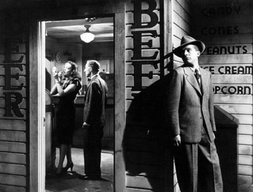
Then, as Europe descended into the long darkness of the Second World War and ominous clouds gathered on the American horizon, a completely new style of filmmaking began to appear. Its subjects were grim, its settings gritty, and its dialogue cynical. Its practitioners began to exploit the natural advantages of black-and-white film to highlight the contrast between light and shadow and drew on the foundations of German expressionism to create a somber, unsettling mood using striking camera angles and carefully-framed shots. The characters that emerged to populate these films were of a new and different breed, as well. While the bad still ended unhappily, the good (if any of these flawed, ambiguous characters could be called “good”) only rarely managed anything better than to end slightly less unhappily.

filmnoir2The term which was eventually coined to describe these dystopian visions of humanity’s depraved underbelly is “film noir,” or black film. The “classic” period of film noir-generally said to have begun in the early 1940s and lasted until the late 1950s-includes some of the greatest films ever made, with the involvement of some of the best artists and storytellers of the twentieth century. Since the end of that classic period, film noir has continued to evolve and to produce films hailed as classics.

However, one of the defining features of film noirs continues to be their unflinching willingness to stare directly into the face of human wickedness, evil, and sin. In this exploration of six films from the classic noir period plus the acclaimed neo-noir Chinatown, I will examine cinematic portraits of evil across three decades of film production and discover what we can learn about evil from the diverse group of talented writers and directors who brought them to the screen.

Continue reading ‘When the Wicked Prosper: Unmasking Cinematic Evil from The Maltese Falcon to Chinatown