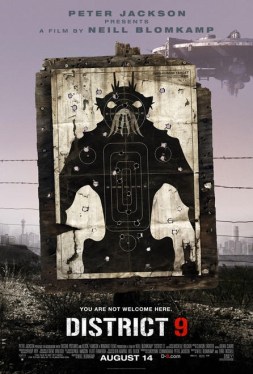
starring Sharto Copley
written by Neill Blomkamp and Terri Tatchell & directed by Neill Blomkamp
Rated R for bloody violence and pervasive language.
94%
20 years ago, an enormous alien ship arrived and parked itself directly over Johannesburg, South Africa. Instead of first contact with highly-advanced beings, humanity finds the ship full of filthy, malnourished alien refugees. With international pressure mounting, the government relocates the “prawn” to a temporary camp, which soon becomes a permanent slum: District 9. Now, with human/alien relations strained to the breaking point, a chance encounter between Wikus Van De Merwe (Copley), a well-meaning but incompetent bureaucrat, and a prawn named Christopher Johnson will have volatile and unexpected consequences for everyone.
District 9 immediately drops the viewer into a fully-developed world that is at once exotic and familiar, fleshed-out with an intense attention to detail. The film begins as a documentary, using news reports and interviews to handle the details of exposition. The beauty of the technique is that it allows the setting to be developed to a point where explanations aren’t clumsy or forced, and unanswered questions don’t feel like plot holes. As the movie progresses, the film’s mode of narration gradually and gracefully slips into cinematic omniscience. Almost imperceptibly, the camera becomes a fly on the wall rather than part of the action, and the viewer is drawn completely into the story.
The illusion is maintained in part thanks to a cast of complete unknowns, most notable Copley as Wikus, the movie’s “everyman” hero. Actually, calling him an everyman might even be an overstatement. I’m not sure I’ve ever seen a less-likely action hero. Wikus begins the film as a sort of South African Michael Scott (the clueless manager of TV’s “The Office”), and wanders dangerously close to self-parody during the opening scenes. Ultimately, though, he becomes a believable character precisely because he is so flawed, and so conflicted between his desire to do the right thing on the one hand, and his constant self-interest on the other. He becomes the film’s moral center, but not until he has also displayed the darker side of humanity.
Even viewers unfamiliar with the recent history of South Africa will immediately recognize the subtext here, as the prawn are abused and exploited in every way imaginable. Terms like “dehumanizing” and “human rights” don’t even seem to occur to anyone. After all, these aren’t humans. Only Wikus eventually comes to realize how wrong they have been, and how wrong he, personally, has been; an inner transformation that mirrors the external one, Wikus’ identification with “the Other” is made possible by his transformation into the Other. Wikus is not maliciously evil, as some of the other characters are. He is exemplary of a more ordinary, complacent, and banal evil. Unwilling to rock the boat, he pretends everything is fine and pursues success within a system he knows is unjust. When he finally admits as much to Christopher Johnson late in the film, we sense that it may be the most dramatic change he has experienced.
While it may not be immediately obvious, District 9 is an action movie at heart. Without Wikus’s growth as a character, and as a person, it might be easy for all of its big ideas to get lost in the sturm and drang of the climax. The final half-hour or so is fantastically entertaining, even if it does seem to shift the focus away from the film’s disturbing message about humanity. By then the point has been made, and rather than browbeat the audience with it further, Blomkamp allows room for some straightforward, adrenaline-charged fun. It helps that, unlike much of this summer’s blockbuster fare, the extended, explosion-laced firefight has been earned by the depth of the plot.
Incidentally, I should probably mention that this is not a film for the faint of heart or (more importantly) the weak of stomach. And alongside that warning, I will also add the minor complaint that the movie tries to fake its audience out a few too many times with slow motion and mournful music; a small but grating misstep in a film that otherwise manages to avoid cinematic formulas and tropes to a refreshing degree. And speaking of “refreshing,” the story of District 9‘s production is a model of what I wish we’d see more of from Hollywood. Director Neill Blomkamp was set to direct a movie based on the Halo video game franchise for producer Peter Jackson, but when funding fell through, they put this together instead on a shoestring budget (the lack of financing doesn’t show). “What’s that,” you say, “a completely original science fiction story produced in place of yet another tired video game adaptation?” Yes, indeed. More, please!
A mere 9 months after I posted the first image of Johnny Depp as the Mad Hatter, and 8 months before the scheduled release, some actual footage emerges from Tim Burton’s take on Alice in Wonderland. Behold:
If I had seen this before Burton and Depp did Charlie and the Chocolate Factory, I would be very excited right now. As it is, I’ll stick to a vaguely cautious optimism. It looks fantastic (visually), and it still has an amazing cast going for it. Now, let the waiting continue.
starring Daniel Radcliffe, Michael Gambon, and Jim Broadbent
written by Steve Kloves & directed by David Yates
Rated PG for scary images, some violence, language and mild sensuality.
81%
Harry Potter returns for his 6th year at Hogwarts, where a new professor, Horace Slughorn (Broadbent), has taken a position as the Potions master, allowing Professor Snape to take on the ill-fated job of teaching Defense Against the Dark Arts. Harry finds unexpected academic success in Slughorn’s class thanks to a mysterious textbook that once belonged to someone called “the half-blood prince.” Meanwhile, Dumbledore reluctantly enlists Harry’s help in his quest to uncover the secrets of Voldemort’s past in the hope of discovering some weakness that could lead to the Dark Lord’s defeat.
After six films, I believe that Harry Potter is the longest-running franchise of directly-adapted literary material (although perhaps James Bond holds that honor). In any case, by now everyone knows exactly what they are getting when a new Harry Potter film comes out. Fans of the books and movies will be compelled to see it, people who haven’t kept up probably won’t bother. There’s really no point in reviewing the movie at all, at least for the purposes of offering guidance to a potential audience. However, there are some things about Harry Potter 6 that need to be said, and questions that need to be asked.
The most pressing question is of direct concern to what this franchise has become: Who is this movie for, exactly? That is the one thing I cannot figure out. Certainly it cannot be for fans of the books, as this latest outing leaves out so much of its source (as usual) that at times it can only be said to vaguely resemble it. The funeral of a major character which took up the entire last chapter of the book is here reduced to a terse, shocked memorial around his lifeless body. The constant attacks on good witches and wizards referred to in newspaper reports throughout the book (creating a palpable feeling of dread and of omnipresent evil) are reduced to a tepid on-screen assault on the main characters which claims no casualties. Condensation is of paramount importance to any adaptation, but coherence and meaning should never be sacrificed so cavalierly and consistently in favor of computer-generated pyrotechnics (a hallmark of the last few films).
Then again, Half-Blood Prince cannot be for anyone who has not read the books, as (here more than in any previous episode) the filmmakers have given up on any pretense of catering to an audience that has not memorized the original story. The film begins abruptly, in medias res, with no explanation or introduction (I struggled, disoriented, for some minutes to recall to mind where the end of the last book/film had left our heroes). Characters fly through scenes with bewildering rapidity and no introduction (Remus Lupin and Nymphadora Tonks, for instance, appear in a single scene and their names are not mentioned). Sirius Black, Harry’s godfather, whose death at the end of the last film devastated Harry, is never referred to directly. Bellatrix Lestrange, the witch who killed him (as you may remember, or not), does seem to be taunting Harry about it at one point (we can only assume, as the dialog doesn’t say).
So, if this film does not function as a reasonable adaptation of its source, and cannot function as a coherent, independent cinematic experience, what is its function? With all that I have said about it thus far, I ought now to be able to dismiss it as an inferior and unpleasant venture, but that would be dishonest. I did have a very good time visiting Hogwarts on the big screen once more, and for all that it got wrong, the movie did get a few very important things right. For starters, Broadbent steals every scene that he appears in. He delivers such a delightfully-broad comic rendition of the pompous, dithering British academic that one almost cannot help but revel in it with him. And, of course, the rest of the supporting cast continues to be brilliant. I would watch a far worse film than this for the pleasure of seeing Alan Rickman’s Snape in action once again.
Harry Potter movies are all about atmosphere, and Yates continues to lay it on thick. Rowling’s wizarding world is just a fun place to visit, even if nothing that’s going on in it makes a lot of sense. And, as the stakes in these films continue to rise, the battles grow more intense, and the special effects seem to have no trouble keeping up. Perhaps when all seven (no, eight . . . but that’s a different rant) films are finally released to DVD, I’ll go back and watch them all to see how they hold up, both on their own and over the life of the series. I rather doubt that the added perspective will do Harry Potter and the Half-Blood Prince any favors, but in the meantime, I’ll take the Potter-fix that I can get and go home happy.
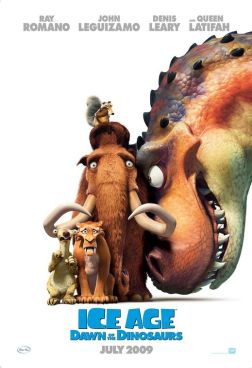
starring Ray Romano, John Leguizamo, Queen Latifah, and Simon Pegg
written by Peter Ackerman and Michael Berg & directed by Carlos Saldanha and Mike Thurmeier
Rated PG for some mild rude humor and peril.
77%
Feeling a bit left out because mammoths Manny (Romano) and Ellie (Latifah) are having a baby, Sid the Sloth (Leguizamo) inadvisably adopts three abandoned eggs which hatch into baby dinosaurs. Soon, an angry mother dinosaur appears to reclaim her offspring, and departs with babies and Sid in tow. Determined to rescue their friend, Manny, Ellie, and the rest follow the trail into a lush underground jungle full of dangerous dinosaurs and a deranged but bush-savvy weasel named Buck (Pegg).
Something must be said and gotten out of the way up-front: There was nothing special or well-done enough about the original Ice Age movie to even remotely justify one, and now two, sequels. There never was and still is not any really worthwhile story to be told involving these characters in this setting. Taking that as a given, it can be said that Dawn of the Dinosaurs is not significantly better or worse than its predecessors. Fans of the series will be happy. The mediocre standard of entertainment continues.
Each of the three main characters (Manny, Diego, and Sid) has a sort of subplot/character arc, but they are fairly weak. Manny, who talks more and more like Romano’s character from “Everybody Loves Raymond,” is adjusting to the thought of becoming a father. Diego feels that he is losing his edge. Sid struggles with motherhood. Oh, and then there’s Scrat (you know, the odd little squirrel who is eternally chasing that surprisingly elusive acorn). He has a new love interest/rival in Scratte, a female who has apparently evolved the ability to glide.
It’s rather dull, forgettable stuff for the first third or so, and then a bright spot arrives in the form of Buck the weasel. His presence in the movie might be a sign of desperation from writers who have run out of ideas for the main characters (and they have), but he injects just enough zany randomness into the film to make it all sort of work, or at least keep you laughing enough that you don’t notice it doesn’t work.
I will say this for it: unlike some of the films that have been released in 3D since the new craze began, the extra dimension is put to good use here. In fact, reflecting back on the previous installments it occurred to me that this is a franchise that ought to have been in 3D all along. Much of the films’ action revolves around set pieces where the characters are falling, flying or sliding through things. In this case there is a particularly nice sequence involving a rescue aboard a pterodactyl.
The chief fault, aside from a general sense of the unremarkable, is the fact that the movie doesn’t even pretend to resolve with any sort of finality. It is trapped in the doleful certainty that more sequels will follow (rumors of a fourth Ice Age movie in production are already circulating). The presumption of a sequel ruins the best gag in the film: a hilarious sequence that seems to perfectly wrap up the epic, three-movie story of Scrat and his acorn. But the filmmakers can’t just leave it at that because Scrat’s interludes are a central component of the franchise. I guess that’s sort of the central problem with the entire concept from the outset. It wants to be marketable more than it wants to be good.
I just finally watched the first Transformers on Monday, and it should be no surprise to anyone who knows me that it wasn’t really my cup of tea. I thought that it had its moments, but overall it was far too long, built almost entirely out of the most tired and shopworn cliches, and its attempts at humor were almost universally groan-worthy. Frankly, I was a bit bored by the whole thing, and I wasn’t terribly impressed by the final battle (during which I often had a difficult time telling the various giant robots apart as they threw each other into the scenery).
I initially watched the movie in case I should happen to want to go see the recently-released sequel to write a review. However, given my feelings about it, I have not yet decided when or if I will see it. Having experienced some difficulty sitting through Transformers on DVD in the comfort of my own home, where I could pause it anytime that I liked, I can’t really imagine braving the theater alone to be held hostage for another two-and-a-half hours of more of the same. And, really, who needs it when you have the far more entertaining spectacle of dozens of hilarious critical reviews of Michael Bay’s latest masterpiece? Jim Emerson, who rather amusingly refers to Revenge of the Fallen by the well-known internet acronym “ROTFL,” has noticed the reaction as well.
For my own part, I was so entertained that I thought it would be worthwhile to share a few of my favorites from the blurbs on Rotten Tomatoes, that you might perhaps understand how I might not be overeager to hit up the local cineplex this week. I have to wonder, when there is such a void of creativity as there seems to have been in this movie, do critics feel some kind of deep-seated need to fill it? Like some sort of simple defense mechanism designed to somehow redeem the experience? I don’t know, but that’s one possible explanation for what I’m seeing here.
First, a few eye-catching entries from several dozen negative reviews:
“It’s like being hit over the head repeatedly with a very expensive, very loud train set. After two and a half hours in this bludgeoning company, you’re begging Bay to put away the boys’ toys and make a rom-com.”
(Ed Potton, Times UK)
“The only part of Fallen more boring than when things are exploding is when things aren’t exploding.”
(Josh Bell, Las Vegas Weekly)
“If you ever wondered what a movie would look like geared toward the underdeveloped brain of a gestating zygote…then Transformers: Revenge of the Fallen is the insipid illustration you’ve been waiting for.”
(Bill Gibron, PopMatters)
“[L]ike the most totally awesome artifact ever of the end of the American empire… loud, obnoxious, sexist, racist, juvenile, unthinking, visceral, and violent… and in love with ourselves for it.”
(MaryAnn Johanson, Flick Filosopher)
Oddly, though, it was the positive reviews that caught my eye even more; not because they were so few, but because I couldn’t manage to wrap my brain around how someone could say any of these things about a movie and still recommend it to someone else:
“Good when it is good, but extremely, shockingly, horrifyingly bad when it is bad.”
(Willie Waffle, WaffleMovies.com)
“This is cinematic poetry for pinheads. It’s less of a film than a reason for a noise ordinance.”
(Kevin Williamson, Jam! Movies)
“While it would be hard to make a case for ‘Revenge of the Fallen’ as ‘good’ in any normal sense of the word, it possesses such brute force that the viewer is left with two options: surrender, or suffer in silence.”
(Tom Huddlestone, Time Out)
“It’s like watching a blender for two hours while someone shouts at you. And then the last half an hour is the same, except it’s more like having your head strapped to a washing machine while you watch a blender and someone shouts at you.”
(FHM, UK)
Seriously, what in the world? Ah, well. I’ll leave you with this lovely gem, which is the first paragraph of Ebert’s magnificent evisceration, and the recommendation that you go read the rest of it:
“Transformers: Revenge of the Fallen” is a horrible experience of unbearable length, briefly punctuated by three or four amusing moments. One of these involves a dog-like robot humping the leg of the heroine. Such are the meager joys. If you want to save yourself the ticket price, go into the kitchen, cue up a male choir singing the music of hell, and get a kid to start banging pots and pans together. Then close your eyes and use your imagination.
The Academy has rewound the clock in what may be the most significant Oscar rule change in recent memory. Ever since the 1945 ceremony, five nominees have been chosen each year as candidates for the top award. Beginning with the next ceremony, the Academy will be returning to the early years by selecting 10 nominees for the Best Picture category. This is pretty huge, actually, and it almost seems like an act of desperation as television audiences have continued to drop for the show’s annual broadcast. The change will almost guarantee that more popular films like The Dark Knight, or even WALL-E would have a strong shot at the nomination.
Overall, this seems like an overwhelmingly positive change to me, for a number of reasons. At worst, it isn’t likely to decrease the quality of the films chosen by the institution that awarded its highest honor to [insert favorite Oscar gaffe here]. It opens up the field to allow all sorts of films to be considered, even if they aren’t obvious Oscar-bait. That can only mean good things, both for the average, “populist” moviegoer and for the more picky folks (like me). Just imagine what the ballot might have looked like, even during the past 2 or 3 years, if the field had been opened up before.
I’m also interested to see what effect this will have on the sorts of films that actually get the award (although that may take several years to judge). Perhaps even more interesting will be the effect it will have on how and when awards-season films are marketed and released, and on the massive annual prediction game that consumes the weeks leading up to the nomination announcements and the ceremony itself. I have no speculations about this at all, and it’s really far too early to be talking about the Oscars. This news was just too massive to pass up.
It all started with a 1963 French novel by Pierre Boulle, author of The Bridge over the River Kwai. Unsurprisingly, the book and film versions of Planet of the Apes had very little in common by the time the story had been translated from page to screen five years later. The film script went through a few drafts, including a treatment by Rod Serling of “The Twilight Zone” fame, before gaining approval for production. The green light came thanks in part to a successful screen test of the ape make-up process and in part to the attachment of star Charlton Heston as American astronaut George Taylor. (For more information, see the fascinating 1998 documentary Behind the Planet of the Apes.)
After a centuries-long voyage traveling near the speed of light, Taylor and his crew crash land on a mysterious planet ruled by a race of sentient apes who capture and experiment on the wild, speechless humans that wander and feed nearby. Temporarily deprived of his voice by an unfortunate gunshot wound, Taylor adjusts to life in a cage and struggles to communicate his intelligence to Dr. Zira (Kim Hunter) and her fiance Dr. Cornelius (Roddy McDowall), a pair of scientists whose work threatens the status quo established by ape law and religion.
Despite being over four decades old, Planet of the Apes works beautifully as a piece of engaging science fiction because of two things. First, it doesn’t settle for visual effects that are merely “acceptable” for its time, resulting in a look and feel that still holds up well even by modern standards. Scenes like the crash landing, for instance, are exciting, convincing and artful thanks to some creative camerawork. More importantly, though, for the movie to function it is imperative that the ape characters should be more believable than humorous, and the look that was created succeeds dramatically.
In fact, while this seems like it ought to be mere B-movie camp, it exceeds expectations on every level. There is a great score by Jerry Goldsmith which fits every moment perfectly, from the haunting opening credits onward. The cast has a number of top-notch actors, including multiple Oscar-winners. The cinematography is several cuts above what anyone might expect from this sort of thing, real eye-catching stuff. It establishes the mood and the tone every bit as effectively as the score. (Planet of the Apes was nominated for its costumes and its score, and received an honorary award for the amazing ape makeup.)
Second, the movie tells a good science fiction story in the classic sense of using the genre to prompt a conversation about where we are headed and where we have been as a species. To the totally uninitiated viewer (which I was when I first saw this), the plot is full of surprising new developments as the situation shifts and changes. However, the impact is not lessened at all by having seen it before or knowing what it’s all about, and the startling final image still lands like a punch to the gut (more on that in a moment). The fictional universe created here is seamless and absorbing, and the characters are memorable.
The movie establishes its trajectory immediately. In the opening scene, Taylor is sending out one last broadcast to earth before entering the long sleep with the others. We learn that, although they have only been gone from earth for a few months in relative ship time thanks to their extreme speed, centuries have already passed back home. By the time they arrive at their destination, a few thousand years will have gone by. Already we know that this is basically a one-way trip. As Taylor wraps up his monologue, he begins to wax philosophical and we get a better picture of the sort of person he is: “Does man, that marvel of the universe, that glorious paradox who sent me to the stars, still make war against his brother?”
Taylor’s companions are Dodge and Landon. The former is an explorer at heart, consumed with curiosity and willing to go anywhere and do anything if it means having questions answered. Landon is a bit more complicated. Not entirely happy to be there, his ambition and his pride wouldn’t let him turn down the offer of the mission when his name came up.
Taylor is quite different from the other two, as we soon learn after the crew crashes in the middle of a lake and ejects into the life raft. Dodge and Landon watch forlornly as the ship sinks beneath the surface, but Taylor keeps paddling, his gaze fixed straight ahead to the shore: “Okay, we’re here to stay.”
Taylor, too, has his own reasons for joining the mission. He explains, “I’m a seeker too. But my dreams aren’t like yours. I can’t help thinking that somewhere in the universe there has to be something better than man. Has to be.” He is a cynic, but only because he is also an idealist. Recognizing the corruption of his own world, Taylor has gone looking for a better one. By the time Taylor has become a prisoner of the apes, it is clear that he hasn’t found a better world.
Or is it? This is one of the fascinating ambiguities of the film. Certainly there is much that is wrong with the ape civilization from Taylor’s perspective. After all, humans are treated like animals. Of course, the role reversal is one of the film’s chief conceits. Humans in this world are viewed in much the same light as apes are where Taylor comes from. Once Taylor finally manages to connect with Zira, however, we get a much different picture of ape society.
There are three species of apes: orangutans, gorillas, and chimpanzees. Orangutans are the elite, political and religious leaders. Gorillas form the military and police force. Chimpanzees are scientists and engineers. It becomes clear very quickly that Zira and Cornelius are severely limited in their scientific pursuits by the apes’ religious doctrine. Zira believes humans are intelligent enough to be domesticated, which most apes find laughable and some consider borderline heretical. Cornelius has formulated a primitive theory of evolution based on some archaeological finds which suggest that apes evolved from humans, a theory which is contradicted by ape scripture.
It is fairly obvious what is going on here: a commentary on the modern tension between science and religion with the assumption that religious dogma holds scientific progress in check. When he’s not hatching escape plans and running around Ape City implementing them, Taylor spends most of his time arguing with Dr. Zaius, the minister of science. Zaius, however, answers Taylor’s seemingly irrefutable arguments with scripture passages and silence. Taylor accuses him of willful ignorance motivated by cowardice, but the truth is a bit more interesting.
Zaius, thanks to his privileged position in ape society, knows much more about man than he is letting on. He and Taylor share a mutual disdain for humankind based on their knowledge, but during his time among the apes, Taylor has somehow reconnected with his own humanity. As the only human with a voice, he is practically forced to step into the role of lone defender of his species.
Taylor, Zira, and Cornelius manage to force Zaius’s hand when he pursues them into the Forbidden Zone (where Taylor’s ship initially crashed) and catches them at Cornelius’s abandoned archaeological dig, only to have Taylor take him hostage and force his gorilla troops to withdraw. There, in a climactic denouement, Cornelius reveals his discovery of a human society which predates the apes. Despite Zaius’s protests that “There is no contradiction between faith and science, true science!” Taylor definitively verifies Cornelius’s theory.
This triumph proves to be a Pyrrhic victory, however, when Zaius regains the upper-hand and orders the gorillas to dynamite the site. Zira and Cornelius are horrified, but Zaius seems neither particularly troubled nor very happy with the situation. He doesn’t like it, but he is genuinely certain that his actions are necessary for “simian survival.”
As the film draws to a close, Taylor manages to secure freedom, transportation, and supplies for himself and the human girl he has taken a liking to and affectionately nicknamed “Nova.” Zaius is, truth be told, only too happy to be rid of him. The two humans ride off up the beach together as a new Adam and Eve, and Taylor seems to have found his purpose at last: to rebuild the race from scratch.
Then, in the devastating final moments, Taylor rounds a bend and comes face to face with the ruins of the Statue of Liberty. Suddenly, what should have been clear long before (after all, the apes do speak American English) becomes horribly apparent. Taylor has been home all the time, on a future earth laid waste by nuclear warfare.
It is never surprising (although this is one of the most shocking twist endings in movie history) to run up against references to a nuclear apocalypse in a film made during the Cold War. At a time when it actually seemed probable that most of humanity would be killed by nuclear warfare, the threat could never have been far from the popular imagination. What is most interesting about this particular case is the light that it casts on the themes expounded in the rest of the film.
Suddenly, Zaius becomes a much wiser and more sympathetic character, and his religious dogma becomes the lesser of two evils. The greater evil by far is scientific progress, one of several lessons Zaius and the apes have learned via human example. By comparison, ape society begins to look positively idyllic. Taken at face value, Planet of the Apes appears to be a parable about a clash between faith and science, using ape society as a thinly-disguised proxy to debate the question innocuously. However, the final scene rewrites everything that has come before, not only turning Taylor’s world upside-down (quite literally), but subverting the film’s consistent privileging of science over religion.
In focusing on a few of the fascinating thematic elements in play in this film, I have probably short-changed its entertainment value. Planet of the Apes is full of action, comedy, drama . . . in short, all of the ingredients necessary to please the average moviegoer. It was conceived as a stand-alone film, and although its success prompted several sequels, two televisions series, and a remake, it remains by far the best of the movies and the only genuine classic of the franchise. In other words, if you just see one Planet of the Apes movie, make it this one.
Young, charismatic English professor John Keating (Robin Williams) challenges his students through poetry to live life to the fullest and resist conformity with the standards of the strait-laced, wealthy Welton Academy for boys they attend. Along the way, he inspires them to “seize the day” by standing up to authority and taking control of their own destinies, as well as resurrect the “Dead Poets Society” (a midnight gathering of poetry lovers) Keating founded when he was a student at Welton.
There’s not a lot of middle ground with this movie: it will evoke either raptures of inspiration or an intense desire to vomit. I rather tend towards the latter reaction. For a story that’s all about bucking convention, Dead Poets Society relies far too much on shallow platitudes and tired cliches. I’m not even that taken with the 19th-century Romantics, but fans of their work and ideology ought to be outraged by the use it is put to here. Lest I be accused of overstating my case, though, I will admit that Williams is enjoyable to watch in the role of Keating, and there are other good, well-acted characters and some fun little scenes. It’s the overall effect, and the risk that someone might take this outrageous pablum seriously, that I object to.
X-Men: The Last Stand – 64%
The crisis within the mutant community that has been growing throughout the previous two X-Men installments comes to a head when the American government finds a “cure” that can erase mutant powers. The two mutant camps, led by Professor X (Patrick Stewart) and Magneto (Ian McKellen), respectively, draw closer to all-out warfare over their radically different philosophies. Matters are complicated further by the unexpected resurrection of Jean Grey (Famke Janssen) as the powerful and dangerous “Phoenix.”
This third cinematic outing of the X-Men is a textbook example of how to kill a franchise based on a beloved non-movie source: Change directors, ignore the original material and the previous films, and wreak unrepairable havoc on the fictional universe by offing major characters and bludgeoning ongoing story arcs to death. I guess that’s what should be expected when you bring in the man behind the Rush Hour trilogy. The movie brings back the formidable cast it has recruited from the previous movies, and adds some excellent new faces (most notably Kelsey Grammer as “Beast”), but it’s hard to fully enjoy this level of narrative carnage, even if it is accompanied by some neat ideas and a few flashy special effects.
Coneheads – 72%
Beldar and Prymatt Conehead (Dan Aykroyd and Jane Curtin, respectively) are an alien couple stranded on earth while on a scouting mission. After several years of this life, the new surroundings have begun to feel like home, especially for their teenage daughter. Unfortunately, the government is beginning to suspect that there is something not quite right about the Conehead family. This movie’s amusing conceit is that the Coneheads can move unnoticed through human society, despite their enormous, bizarrely-shaped craniums. With that and Aykroyd going for it, Coneheads fares about as well as any movie I’ve seen based on a skit from “Saturday Night Live.”
28 Days Later – 94%
Jim (Cillian Murphy) wakes up in a London hospital 28 days after a group of animal rights activists release monkeys infected with the virulent “rage” virus, sweeping England with a pandemic that turns everyone who comes in contact with it into a ravening, flesh-hungry ghoul. Narrowly escaping his first encounter with the infected, Jim falls in with a few survivors and struggles to find a sanctuary that will allow them enough time to formulate a plan of action.
Danny Boyle’s intense, adrenaline-fueled take on the zombie genre is both smart and thrilling, never staying still long enough to get monotonous. The cast is small, but perfectly chosen, including Naomi Harris, Brendan Gleeson, and Christopher Eccleston. It is great material, and Boyle gets everything right and makes it look easy. As the overwhelming majority of the zombie genre will attest, it decidedly is not.
Blood Diamond – 89%
Kidnapped by rebels from his home in Sierra Leone and forced to work in the diamond mines, Solomon Vandy (Djimon Hounsou) has very little to hope for until the day when he unearths and manages to conceal an enormous, priceless diamond. Imprisoned shortly afterwards by the government army, Vandy is contacted by Danny Archer (Leonardo DiCaprio), a cynical smuggler who will use his connection with idealistic American journalist Maddy Bowen (Jennifer Connelly) to find Vandy’s family if Vandy will lead him to the diamond. Vandy agrees, but it may already be too late for his son, who has been pressed into the service of the rebel army.
This is a powerful, absorbing story built around the current situation in Sierra Leone, where the insatiable international demand for precious stones has been harnessed to fund a bloody civil war. It is a situation that deserves attention, although this particular film walks a fine line between informing and preaching, and it postures a bit shamelessly in parts, which further obscures the story it is telling. Some viewers may find DiCaprio’s accent distracting (though this is by no means a bad performance). It’s far from perfect, but still worth a look.
The 58th Annual Academy Awards were hosted by Robin Williams. Out of Africa was nominated for 11 Oscars: Best Picture, Best Director, Best Editing, Best Adapted Screenplay, Best Cinematography, Best Actress (Meryl Streep), Best Supporting Actor (Klaus Maria Brandauer, Best Art Direction, Best Original Score, Best Costumes, and Best Sound. The other nominees included The Color Purple (11 nominations, no wins), Witness (8 nominations, 2 wins), Kiss of the Spider Woman (4 nominations, 1 win), Prizzi’s Honor (8 nominations, 1 win), Akira Kurosawa’s Ran (4 nominations, 1 win), and Back to the Future (4 nominations, 1 win).
Ultimately, Best Actress went to Geraldine Page for The Trip to Bountiful (Streep had already been nominated 5 times, with 2 wins, by this point). Don Ameche won Best Supporting Actor for Cocoon. Witness got Best Editing and Best Costumes was awarded to Ran. Out of Africa won its remaining nominations, for a total of 7 Oscars. Meanwhile, The Color Purple astoundingly went home empty-handed.
In hindsight, Out of Africa appears to be a perfect storm of Oscar-bait elements and seems to have been almost guaranteed a sweep. This was not how it seemed at the time, but consider: The film has an epic scope (and length), it is set in an exotic historical locale, it is a biopic, it is centered around a romance. All of these are things which are said to appeal to Oscar voters, and a cynical modern viewer might perhaps question whether the film was intentionally constructed specifically for the awards ceremony. It’s not a very profitable bit of speculation, but I’m getting ahead of myself.
The movie is about the life and experiences of Karen Blixen (Streep), a wealthy Danish woman who moves to Kenya in the early 1900s. Karen initially goes to join her husband (Brandauer) and run a ranch. However, she arrives to find that he has unilaterally decided (using her money) that they will grow coffee instead, despite the unsuitable location. As she struggles to make the venture work, foster good relations with the local natives, and generally flout colonial conventions, her husband proves (in several ways) to be unworthy of her. Eventually, she begins a passionate relationship with adventurer Denys Finch Hatton (Redford), and grows to love her life in Africa, leaving her own distinct mark on everyone who meets her. The film is based on Blixen’s memoirs, published under the pen-name Isak Denisen.
There is a lot to like about Out of Africa; perhaps too much. The production is full of memorable scenes thanks largely to the glorious African landscapes captured on film and bolstered by the lovely, sweeping score. Streep is very good in the lead, disappearing into character as she always does so brilliantly. Blixen’s story is almost too good to be true, but the film remains reasonably faithful to its source and she lived, it seems, a very cinematic life. The story of how the film was made is an interesting one in itself, and the more I hear about what went into the making of it behind-the-scenes, the more I admire it for what it is.
What it is not, however, is the sort of movie I could watch over and over again. Despite covering a large amount of material, the movie feels overlong. While full of memorable movie moments, the overarching movement of the whole sometimes feels too disconnected and directionless. This assessment is extraordinarily personal, however. Another viewer might be totally enthralled by the beauty of the images and the interactions of the characters where I was not quite drawn in. A second viewing might make it easier for me to avoid holding the film at arm’s length and appreciate it more fully.
One enormously distracting element was the extremely poor integration of on-location footage with actors working in studios. A great deal of filming was done in Africa, but many shots were accomplished simply by filming the actors in front of screens, as with all close-ups of Streep and Redford during the otherwise magnificent flight over Africa scene. Amidst the gorgeous, soaring shots of the tiny plane gliding above the amazing scenery below, there are jarringly awful shots of the two actors on-board the plane which are obviously fabricated. It’s the sort of thing that is quite common in older movies (look at any scene filmed in a car until just a few decades ago, for example), and it normally doesn’t bother me. In this case, however, it was totally at odds with the aesthetics of the movie, and it would have been worthwhile to either devise an alternate method or leave the close-ups out entirely.
starring Will Ferrell, Anna Friel, and Danny McBride
written by Chris Henchy and Dennis McNicholas & directed by Brad Silberling
Rated PG-13 for crude and sexual content, and for language including a drug reference.
34%
Eccentric scientist Dr. Rick Marshall (Ferrell) has been laughed out of academia because of his radical theories about space, time, and parallel universes. Undaunted, he embarks on a voyage of discovery with beautiful British research assistant Holly Cantrell (Friel) and indomitable redneck Will Stanton (McBride) and winds up in a dimensional dumping ground populated by all sorts of strange and dangerous creatures. Soon it becomes clear that Marshall has stumbled on a secret that may leave the fate of the entire multiverse dangling in the balance.
It’s not at all difficult to see that this adaptation of a cheesy 1970s television show is a disastrous misfire almost from beginning to end. A far more interesting question to consider is why exactly it fails so miserably. The problem is not really that the story and characters make no sense, or that the production values are poor, or even that the humor is too whimsical and self-aware. All of these things are true, but none of them really sums up the reason that Land of the Lost is such a painful viewing experience. So where does the blame lie?
Despite reasonable suspicions to the contrary, Will Ferrell and his co-stars are not entirely to blame here. Although he is often notably excellent in supporting roles, movies in which Ferrell plays the central character are rarely received so favorably. His brand of comedy is generally loud and crude, revolving around a series of extreme situations which repeatedly deflate his brashly (or naively) overconfident persona through a combination of physical pain and gross-out humiliation. In this movie, Ferrell falls off of things and things fall on him. He deliberately douses himself in urine, downing a few swigs for good measure. He is excreted by a dinosaur (mercifully off-screen).
Ferrell is actually a funny guy, and Friel and McBride both endearing and entertaining. Many of the gags are not fundamentally and inherently unfunny. Unfortunately, in Land of the Lost the humor has a lot to accomplish and very few resources to work with. There is no context for any of these jokes, and they do not flow naturally out of or into anything. It is not entirely important that there be a coherent plot to make this idea work, but events must be connected by something more than simply the sequence they are shown in. Most of the scenes in this movie could have been scrambled into a completely random order with no loss of meaning. Perhaps they were.
Worse yet, the humor is not allowed to succeed or fail on its own merits. Instead, each joke must be hammered mercilessly into oblivion until the audience can no longer remember why they might have chuckled initially. It is not enough for Rick to be swallowed by a dinosaur and then reappear after having obviously emerged from the other end. Will must pretend to be unbelievably thick and question him for some minutes about how he escaped until Rick is forced to spell everything out. I shudder to calculate how much of the movie’s run-time consists of having its jokes meticulously explained until they have no hope of being funny (if they ever did).
The fault clearly rests with the lazy, shoddy writing. With a concept like this, the possibilities are literally almost infinite. Why then should the writers have needed to fall back on an endless string of poop jokes? It’s sad to see the opportunity wasted, because there are so many hints at what might have been. Among the movie’s producers were Sid and Marty Krofft, the creators of the original television series (which was aimed primarily at children). Throughout Land of the Lost we see people in rubber suits so cheap one can almost spot the zipper and poor computer-generated effects that the actors barely pretend to be interacting with.
There is a sustained camp aesthetic at work which seems to indicate an awareness that it is possible to tell a fun, engaging story without state-of-the-art digital effects and zillion-dollar pyrotechnics. I’m not always sure whether anyone making summer blockbusters knows that anymore. Unfortunately, a fun and engaging story never shows up, and the reliance on scatological humor signals an abandonment of the younger audience of the show and of good taste in general. Not even a late-night screening and the desire to be amused could force any genuine laughter out of me, and I was left wishing I’d stayed home and gone to bed instead.
Understand that all original content in Moviegoings is my property under copyright.
"Everyone has the right to the protection of the moral and material interests resulting from any scientific, literary or artistic production of which he is the author." -- Univ. Decl. of Human Rights
Unless otherwise noted, all original content in Moviegoings is licensed under a Creative Commons License.
Comment Policy
Commenting here is a privilege that may be revoked. Visitors to Moviegoings are allowed to post comments only for noncommercial purposes. Unsolicited advertising ("spam") may be altered or deleted at any time. Violation may result in appropriate countermeasures, including but not limited to IP banning, IP publishing, notification of ISPs, and civil and criminal legal action.

 starring Sharto Copley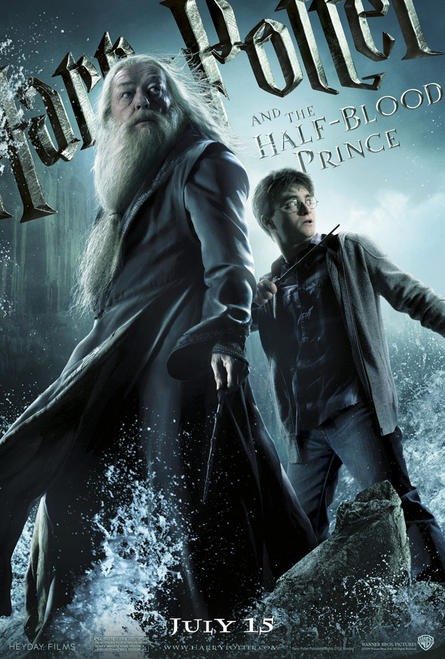
 starring Ray Romano, John Leguizamo, Queen Latifah, and Simon Pegg
 It all started with a 1963 French novel by Pierre Boulle, author of The Bridge over the River Kwai. Unsurprisingly, the book and film versions of Planet of the Apes had very little in common by the time the story had been translated from page to screen five years later. The film script went through a few drafts, including a treatment by Rod Serling of “The Twilight Zone” fame, before gaining approval for production. The green light came thanks in part to a successful screen test of the ape make-up process and in part to the attachment of star Charlton Heston as American astronaut George Taylor. (For more information, see the fascinating 1998 documentary Behind the Planet of the Apes.)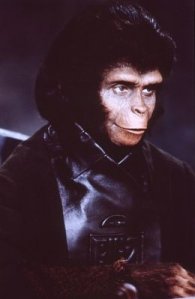
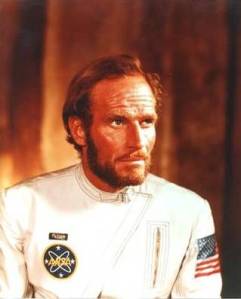 Taylor’s companions are Dodge and Landon. The former is an explorer at heart, consumed with curiosity and willing to go anywhere and do anything if it means having questions answered. Landon is a bit more complicated. Not entirely happy to be there, his ambition and his pride wouldn’t let him turn down the offer of the mission when his name came up.
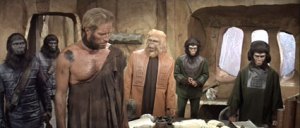 There are three species of apes: orangutans, gorillas, and chimpanzees. Orangutans are the elite, political and religious leaders. Gorillas form the military and police force. Chimpanzees are scientists and engineers. It becomes clear very quickly that Zira and Cornelius are severely limited in their scientific pursuits by the apes’ religious doctrine. Zira believes humans are intelligent enough to be domesticated, which most apes find laughable and some consider borderline heretical. Cornelius has formulated a primitive theory of evolution based on some archaeological finds which suggest that apes evolved from humans, a theory which is contradicted by ape scripture.
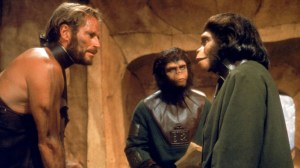 Zaius, thanks to his privileged position in ape society, knows much more about man than he is letting on. He and Taylor share a mutual disdain for humankind based on their knowledge, but during his time among the apes, Taylor has somehow reconnected with his own humanity. As the only human with a voice, he is practically forced to step into the role of lone defender of his species.
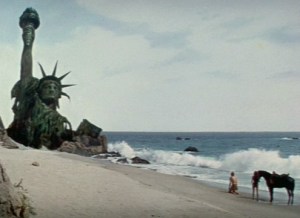 Then, in the devastating final moments, Taylor rounds a bend and comes face to face with the ruins of the Statue of Liberty. Suddenly, what should have been clear long before (after all, the apes do speak American English) becomes horribly apparent. Taylor has been home all the time, on a future earth laid waste by nuclear warfare.
 The 58th Annual Academy Awards were hosted by Robin Williams. Out of Africa was nominated for 11 Oscars: Best Picture, Best Director, Best Editing, Best Adapted Screenplay, Best Cinematography, Best Actress (Meryl Streep), Best Supporting Actor (Klaus Maria Brandauer, Best Art Direction, Best Original Score, Best Costumes, and Best Sound. The other nominees included The Color Purple (11 nominations, no wins), Witness (8 nominations, 2 wins), Kiss of the Spider Woman (4 nominations, 1 win), Prizzi’s Honor (8 nominations, 1 win), Akira Kurosawa’s Ran (4 nominations, 1 win), and Back to the Future (4 nominations, 1 win).
 starring Will Ferrell, Anna Friel, and Danny McBride


 Moviegoings