A Man for All Seasons: Best Picture, 1966

•October 6, 2009 • 2 Comments

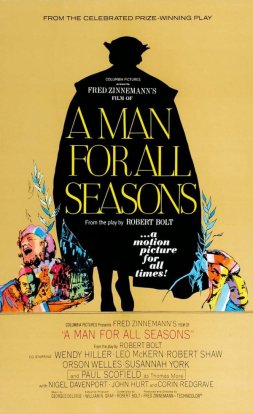
amanforallseasonsposterThe 39th Annual Academy Awards were hosted by Bob Hope. A Man for All Seasons was nominated for 8 Oscars: Best Picture, Best Director, Best Actor (Paul Scofield), Best Adapted Screenplay, Best Cinematography, Best Supporting Actor (Robert Shaw), Best Supporting Actress (Wendy Hiller), and Best Costume Design. It was not a very notable year in English-language cinema (although it saw the release of foreign masterpieces like The Battle of Algiers and Au hasard Balthazar). Quite the opposite, in some ways, as Cary Grant appeared in his final film, the amusing but trite Walk, Don’t Run.

The situation at the Oscars was an unusual one. Three of the Best Picture nominees (The Sand Pebbles, 8 nominations, Alfie, 5 nominations, The Russians Are Coming, the Russians Are Coming, 4 nominations) walked away empty-handed. There were only ever two front-runners, both adaptations of stage plays: A Man for All Seasons and the explosive Who’s Afraid of Virginia Woolf? (13 nominations, 5 wins). Of the awards they were competing for, Who’s Afraid of Virginia Woolf? got Best Supporting Actress and lost the rest. Best Supporting Actor went to Walter Matthau for The Fortune Cookie (4 nominations, 1 win), leaving A Man for All Seasons with 6.

The film, based on a Tony-award winning play by Robert Bolt (previously nominated for an Oscar for Lawrence of Arabia), follows the political fortunes of Thomas More from King Henry VIII’s initial bid to divorce Catherine of Aragon in about 1525 to his beheading in 1537. More, widely regarded as a man of incorruptible integrity by the entire country, is initially named as chancellor by the king in the hopes that More’s wisdom and reputation will be of use in procuring a divorce. However, it soon becomes clear that More has no intention of compromising his convictions or his loyalty to the Catholic church, and the king’s favor turns to annoyance and then to enmity.

In cinematic terms, A Man for All Seasons is a bit of a relic. It never really escapes the stagy feel of an adapted play, or transcends the generic look of period piece of the time (aside from a few noteworthy elements like the on-location bits at Hampton Court). It would simply lie there, quite forgettable, were it not based on such excellent material. While remaining accurate enough to keep grumbling historians quiet, Bolt transforms the story of More’s life into a sort of fable for the 20th-century humanist (and never-mind that More is the only character we are meant to care about).

At its heart, this is a story about a crisis of conscience. Specifically, the main character has one, and no one else does. Thomas More is a marvelous character study because he knows the demands of his conscience with such incredible precision, while at the same time possessing such a prudent and thorough knowledge of law that he can keep himself out of trouble (at least for a time). The audience (whether or not they completely agree with More’s principled stand) can remain sympathetic because More does not simply throw his life away in a defiant fit of pique. He clings to life almost as desperately as he clings to his beliefs, which makes his sacrifice all the more heroic.

There are two chief ways in which the filmmakers establish More’s exceptional moral character: by example and by contrast with other characters. There is a noteworthy scene early on where More accidentally accepts a bribe (a rich silver cup) from a woman whose case is awaiting his judgment. He has been up half the night, called to visit the current chancellor (Cardinal Wolsey) down the river at Hampton Court, and he is obviously not thinking clearly when she shoves the cup into his hands with a vague utterance and disappears into the crowd clamoring for his attention. Immediately after this, he refuses a basket of baked apples from an old couple, telling them that their daughter will receive “the same judgment I would give my own: a fair one, quickly.”

On the way back down the river, he finds an inscription on the bottom of the cup and throws it overboard in disgust. The shocked boatman is quick to rescue it, reminding him “That’s worth money, sir!” More settles the cup back into his lap, but when he finds Rich (a young man hoping for a position at court through More’s influence) waiting for him on the dock, he gives the cup to him as an object lesson in temptation and corruption and encourages him to take a position as a schoolteacher. “If I was [a great teacher], who would know it?” Rich wants to know. “You,” More replies, “your pupils, your friends. God. Not a bad public, that.”

Rich, however, is determined to sell his soul for a position of power, which leads him to conspire with Thomas Cromwell in order to bring about More’s downfall. Their plots begin with an attempt to use the silver cup to show that More accepted bribes and end with Rich bearing false witness in front of Parliament, a lie which prompts More to say, “In good faith, Rich, I am sorrier for your perjury than my peril.”

Meanwhile, lest we miss the significance of More’s prudence, the film puts him in conversation with his daughter Margaret’s principled but hot-headed suitor (and later husband), William Roper. Roper appears early on as an unwelcome visitor when More returns home from his all-night visit to Wolsey to find him wooing Margaret. More does not approve of Roper because his sharp criticism of the Church has led him to become a Lutheran. Roper repeatedly makes it clear that, given the chance, he would actively create trouble for himself.

Unlike More, Roper remains clueless about the appropriate time, place, and manner in which to dissent from authority or go about fighting evil. At one point, he passionately proclaims his willingness to (as More puts it) “cut a great road through the law to get after the Devil.” But he is left speechless when More explains that even the Devil must be granted benefit of law, if only so it may remain intact to protect the righteous.

And so it goes, with More standing as a continual contrast to the example of everyone else. In fact, More is lionized to such a degree (even forgiving his executioner on the chopping block) that I have always regarded the film as something of a hagiography, which is appropriate since More was officially canonized by Pope Pius XI in 1935. He has all of the most quotable lines, and while this portrait of Thomas More, the saint, may not be the most well-rounded perspective on Thomas More, the man, what we see on the screen is inspiring.

However, his story has more value than simply to model how a courageous man of conscience handles himself. What keeps this story surprisingly relevant is its examination of the relationship between private faith and public morality, and of the responsibilities of a statesman who also happens to be a churchman.

The English Reformation is a rich setting for this sort of inquiry, representing as it does one of the many historical points of crisis during which the Christian church became a tool to serve the interests of the state. Cardinal Wolsey (played with relish by Orson Welles) is introduced immediately as a man of the church whose interests, ambitions, and sensibilities are tied completely to terrestrial politics.

Ultimately, disgraced and stripped of his title, he seems to realize his mistake: “If I had served God half so well as I have served my king, God would not have left me here to die in this place.” More, as he also dies, disgraced and stripped of his title, is secure in his knowledge that God “will not refuse one who is so blithe to go to him.”

The inescapable truth about both of their lives is that they, like everyone, end in death. The difference between them lies in how they have allowed their personal faith to inform their political actions. The example speaks to anyone involved (as either observer or participant) in the political process. Whether they have convictions, as More does, merely claim to have them, like his predecessor, Wolsey, or make no pretense of having them, as with his successor, Cromwell, A Man for All Seasons has a message for them.

Continue reading ‘A Man for All Seasons: Best Picture, 1966′

Theological Moviegoings: Pan’s Labyrinth

•September 29, 2009 • Leave a Comment

PansLabyrinth

Pan’s Labyrinth, Guillermo del Toro’s dark “fairy tale for grown-ups,” might best be described as non-escapist fantasy. The description holds up regardless of whether one sees the collision between the film’s real world and its fairy world as imagined or actual. In the former case, this is a story about a girl so miserable and alone in the real world that she manufactures an imaginary one to replace it, only to find that she cannot completely banish the harsh brutality which surrounds her. In the latter case, the film becomes the story of a girl who discovers that the world everyone else perceives exists alongside another, invisible world that remains somehow strangely familiar.

However, before any viewer begins to genuinely engage the rich network of themes and symbols that are in play throughout this movie, they will have confronted three strong elements that drive the film on a surface level; three being a number which, by strange coincidence (or is it?), plays a central role in the symbolic framework of Pan’s Labyrinth.

First, the movie tells two compelling stories that operate in parallel with one another to create a plot greater than the sum of its parts. Ofelia, the young heroine of the fairy world story, is unhappily accompanying her pregnant mother to a rural outpost in 1944 Spain where they will join her stepfather, a sadistic army captain working to stamp out a small guerilla force hiding out in the nearby mountains.

Mercedes, the adult heroine of the real world story, is the captain’s housekeeper, secretly in league with the guerillas led by her brother and playing a dangerous game of espionage. Both women struggle to do the right thing amidst dangerous and murky circumstances where the best choice is not always clear, and we watch in suspense as their fates hang in the balance.

Second, the movie is visually stunning. No one inspires character design like del Toro (as he has since proved again in Hellboy II). The titular Faun and the terrifying “Pale Man” are marvelous creations that stand out amidst a wealth of exciting and imaginative work. Despite the fantastical elements involved in the film, Pan’s Labyrinth never feels as though it has left concrete reality behind through the use of computer-generated effects or overly-fanciful aesthetics. Instead, the look and feel of the faun’s world complements the gritty reality of the captain’s world to the enrichment of both.

Finally, the movie refuses to pull its punches, raising the stakes through graphic depictions of horrific violence. In an early scene, Captain Vidal brutally destroys a man’s face with a flashlight, beating him again and again as the camera barely flinches and the soundtrack picks up the sickening crunch of breaking bones. Meanwhile, the fairy world can be just as terrible, such as when the Pale Man devours two of Ofelia’s companions after she has disobeyed the Faun’s instructions.

All of these things, the suspense and fascination of a well-told story, the gorgeous, eye-catching world of the film, and the grotesque violence that come with it, can be distracting to an audience not necessarily looking for subtext or a hidden meaning. Nevertheless, repeated viewings reveal a depth that is difficult to ignore. Not strictly allegorical, Pan’s Labyrinth is nevertheless a morality play with a suggestive layer of spiritual significance amidst the references to mythology and 20th-century Spanish history.

Ofelia feels instinctively that she somehow does not belong in the world that she inhabits. This is confirmed when she meets the Faun and learns that she is, in fact, the lost fairy princess described in the opening voice-over. This world is not her home, but before she can return to her true father, she must complete three tasks demonstrating courage, obedience, and sacrificial love.

Throughout her quest, we are led to suspect that the Faun is perhaps not as good as Ofelia believes him to be. He certainly is not safe. So it is natural to be suspicious when, after Ofelia has fouled up the second task by failing to follow instructions, the Faun returns to give her one more chance on the condition that she do exactly as he orders without question or pause. We have already been primed to mistrust this sort of demand by an earlier exchange between the doctor and Captain Vidal. (“To obey – just like that – for the sake of obeying, without questioning,” the doctor explains, “that’s something only people like you can do, Captain.”)

Ofelia does not witness this conversation, but she doesn’t have to. When the Faun, brandishing a ceremonial dagger, demands that she hand over her infant brother so that they may complete the final task, she refuses, even though he promises to only take a drop of blood. Ofelia shares the doctor’s strength of moral character, which is (of course) precisely what proves that she is the true princess after all.

Meanwhile, Mercedes has demonstrated the same qualities, though the world she must navigate is not nearly as black-and-white as Ofelia’s. At her lowest point, she is wracked by guilt and self-doubt because her position inside the Captain’s household, of such crucial importance to the resistance, has forced her to work alongside a man she knows is a monster. We know, however, that she is literally the key to the rebel’s continued survival and ultimate victory.

The end of Pan’s Labyrinth is left deliberately ambiguous by showing Ofelia die as she enters (or hallucinates) the fairy kingdom where her mother and father are waiting with the Faun. I would argue that, at least in terms of what this film has to say to an audience, resolution is irrelevant (although I suspect that the director leans towards the happier of the two possible endings). Whether or not the fairy world genuinely exists and is waiting beyond the grave to welcome Ofelia home again, Pan’s Labyrinth has answered all of the questions that it raises about obedience, choice, and moral character.

Theological Moviegoings: Children of Men

•September 22, 2009 • 2 Comments

childrenofmen

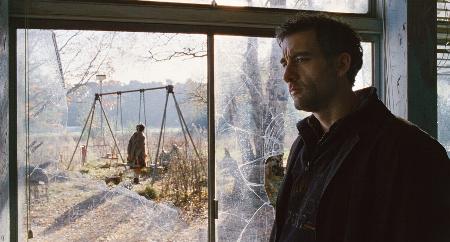
Director Alfonso Cuarón claims to have deliberately avoided reading Children of Men by P.D. James before he made this adaptation of her novel, although his co-writer did. Cuarón reportedly wanted to avoid being “sidetracked” from his own vision, which was to use the premise of global infertility erasing humanity’s hope for the future to explore contemporary social and political attitudes. The novel, while in some ways just as political, is more contemplative than this chase film (as it might be generically described), and a good deal more spiritual. Or is it?

The plots of both novel and film are driven by a miraculous pregnancy, which an anti-government organization calling themselves “Fishes” hopes will give them political leverage. However, the novel is full of meaningful religious referents, from its title to the names of characters and of the “Fishes” themselves. Many of these labels remain intact in the film, but they don’t seem to point anywhere. In semiotic terms, Children of Men seems to be full of signifiers without a corresponding signified. Still, even half a sign can hint at deeper things.

Even on its surface, this is a story of a spiritually-dead man who is reawakened to hope and new life by the birth of a child. Theo is a stoic unbeliever surrounded by fervent true believers: his ex-wife Julian, fiery terrorist leader Luke, aging flower child Jasper, and earnestly-simple Miriam. All of these people (in some sense) lay down their lives for Kee and her fetus, finally leaving only Theo to witness the single most important event in the history of this fictional world: the baby’s arrival into the world. Eventually he will lay down his life as well, and his journey from self-serving to self-sacrificing is paralleled by his change in footwear. Partway through the film he loses his shoes and is forced to replace them with a pair of flip-flops (sandals).

Although there are several action set pieces in the film, visually Children of Men doesn’t operate like a contemporary action film with frenetic editing and jump cuts. Instead, most scenes are constructed out of very few shots, as though the camera is spontaneously capturing events as they happen. The setting of the story, England in 2027, unfolds in the same gradual, natural way. The film opens as Theo hears a news report in a coffee shop that the youngest person in the world has been killed. Moments after he exits with his coffee, a bomb goes off inside. As chaos erupts, the screen cuts to black, revealing the film’s title over a high-pitched whine that evokes the ringing in Theo’s ears caused by the explosion.

The stark dystopia created for the movie is subtly undercut by its soundtrack, which consistently communicates feelings of quasi-religious reverence. There is very little music in the actual world of the film, with the exception of that supplied by Jasper’s character (who seems to have a soundtrack for his own life). He plays grating, atonal tribal music twice, first as a joke to lighten Theo’s mood, and later as part of the alarm system when the perimeter of his property is breached. However, he also plays a beautiful, haunting cover of “Ruby Tuesday” as he administers the suicide drug “Quietus” to his wife before the Fishes arrive.

The odd thing is that the former type of music would seem more in keeping with the film’s aesthetic, but it is the latter type which underscores the real thematic unity. The music is most noticeable in the scenes involving Kee and her baby. There is a sort of high-church, almost heavenly choir supported by quiet strings indicating that (despite the surroundings) this is not the ordinary birth of an ordinary child.

Meanwhile, although a great deal of exposition and setting is established through studiously-incidental dialogue and hints dropped in the margins, this is a film that makes its most important points visually. At one point, Theo, Miriam, and Kee stop off in the ruined shell of an elementary school, and while Miriam describes her experiences as a midwife when the infertility pandemic first began, the impact of the account is overshadowed by the even more potent images of the abandoned school. Later, Miriam is hauled off of a prison bus on the way into a refugee community, pushed to her knees, and “bagged” at the end of a line of prisoners with similar black hoods (a deliberate reference to Abu Ghraib).

The latter example is the sort of politically-charged image that the message of the film is constructed around. However, there are also a number of explicitly Christian references. Theo discovers that Kee is pregnant as she stands in a stable (barn) surrounded by livestock. The sight of her swollen belly provokes a shocked “Jesus Christ” from him. This is later echoed by another character who discovers the baby after it is born. The sight of the baby also brings a full-scale urban battle to a complete halt, at least for a few moments, late in the film as soldiers fall to their knees and cross themselves. I would argue that the movie’s theological imagery, and the underlying story it represents, ultimately overwhelms the film’s political message.

Theo’s purpose in all of this is to bring the child to a rendezvous point with the so-called “Human Project,” which he isn’t even sure exists. His leap of faith is rewarded in the final seconds of the film, but he doesn’t live to see it (or, presumably, need to). By contrast, Luke has a very different purpose in mind. There is a moment in the midst of the previously-mentioned battle when Theo has arrived to rescue Kee and her baby from the Fishes and he is confronted by Luke, who tells him: “Julian was wrong. They thought it could be peaceful. But how can it be peaceful when they try to take away your dignity?”

Unlike Julian, Luke thinks violence is the means to his political end, and he hopes that the miracle child will be the conquering Messiah his cause needs. What he fails to understand is that, like Jesus, this child represents a hope for humanity’s future that has nothing to do with temporal political agendas. Similarly, as time passes the more topical, political fragments of Children of Men continue to lose force, but its spiritual elements only grow more and more pronounced.

Theological Moviegoings: The Last Temptation of Christ

•September 15, 2009 • 4 Comments

lasttemptationofchrist
The Last Temptation of Christ is probably the most potent and challenging film depiction of Jesus that I have ever seen. Having said that, I won’t be disingenuous or feign ignorance. This was an extremely controversial film when it was first released in 1988, and it remains a highly-charged viewing experience today. There are plenty of good reasons for this, particularly if you’re a fundamentalist who doesn’t take the time to watch and think about what you’re condemning, but even the less dogmatic might see good reason to approach this material with caution.

Honestly, if that weren’t the case, I rather doubt the result would be as powerful as it is. The film begins with a disclaimer of sorts, noting that it is based on the novel by Nikos Kazantzakis, not on the biblical Gospels. Poppycock. I can understand the importance of establishing upfront that there is a literary source other than the Bible in play here, but what was Kazantzakis’ novel if not a re-imagining of that very source? Furthermore, I would argue that The Last Temptation of Christ makes very little sense without some knowledge of the original Gospels, and in fact, that its message is far more meaningful to a (receptive) Christian audience than a secular one.

The Last Temptation of Christ is a very dense 164 minutes, and there would be a lot to unpack in a full, detailed treatment of the material. In general terms, though, I regard the film as being divided into three distinct sections (the first and third almost entirely extra-biblical, framing a middle portion drawn largely from the Gospels). Each of these sections corresponds primarily to one of the three strong religious criticisms of the film identified and addressed by William Telford (in his essay from Explorations in Theology and Film). A brief response to these objections as they arise in the film will illuminate what I believe is being accomplished theologically through the narrative.

The first objection is that this Jesus believes himself to be flawed, at least in some sense, and expresses feelings of guilt for some unspecified sins, referring to himself as a liar and a coward. Telford’s response to this objection is not very compelling. He simply notes that Jesus’ sinlessness does not seem to have been a significant theological concern of the early church. More to the point, this objection fails to take into account the very nature of this film’s inquiry into its central character.

Jesus is introduced as the only Jewish carpenter willing to build crosses for the Romans, and Judas soon arrives to berate him. Jesus explains his bizarre actions as a way of resisting his purpose, of running away from God. This is, in fact, precisely what he does a few scenes later, after a visit to Mary Magdalene’s house of ill-repute. However, he finds that he cannot escape his calling, and when Judas arrives (on orders from the Zealots) to kill Jesus, he finds that a startling transformation has taken place.

No longer the tormented, half-crazed man he was a few days before, this Jesus is on a mission. Judas finds himself reluctantly following, although at first merely to observe and complete his own assassination mission if necessary. Eventually he will become the wisest and most loyal of Jesus’ disciples. He has witnessed the beginning of what one might clumsily call the “character arc” that maps Jesus’ growth from, not a bad man, but certainly not an admirable one, into the Savior of the world. Portraying a Jesus who struggles can be a tricky thing, but too often in film we get a Jesus who is not relatable because everything comes so easily to him.

This raises a second objection: That this Jesus is frequently doubtful, confused, and uncertain regarding his identity and purpose. He realizes only gradually that he is the Messiah, and explains to Judas that his message seems inconsistent because God’s revelation of the plan is somewhat fuzzy and limited. Telford approaches this charge with a double fistful of Bible verses which portray a Jesus who is ambiguous, a bit contradictory, and above all, human. What makes him the Christ in this film, however, (and perhaps in the Gospels as well) is his heroic victory over his own humanity, “of spirit over flesh.”

Part of what drives the narrative (as it unfolds in this film) is that Jesus doesn’t always know what will happen next, even when we do. Strangely, if anything, this only adds to the power of the scenes drawn explicitly from the Gospels, particularly Jesus’ temptation in the desert (which does depart considerably from Scripture in its specifics) and his resurrection of Lazarus (which is the most dramatic rendition I have witnessed).

Jesus begins his ministry by ad-libbing the Sermon on the Mount to the group that was just about to stone Mary Magdalene, but eventually comes to realize that events are leading, as they must, to his death. The longer he follows God, the more in-tune he becomes to what he is supposed to do. Ultimately, this leads him to convince a reluctant Judas that his greatest act of love and loyalty will be one of betrayal.

This leads to the titular last temptation experienced by Jesus as he hangs on the cross, surrounded by the groans of the two criminals on either side and the mocking shouts of the crowd. He is approached by a young girl who claims to be his guardian angel, and she helps him down from the cross (no one notices that he has disappeared) and explains that, just as Isaac was saved from the sacrificial blade at the last moment, so God is sparing his life. To his immense and visible relief, she reveals that he is not the Messiah after all, just an ordinary man caught up in extraordinary events.

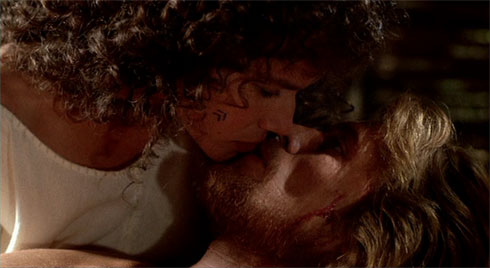
This guardian angel leads him to a peaceful cottage where Mary Magdalene is waiting to marry him and tend to his wounds. This brings us to the third (and, no doubt, most emotionally-charged objection) that the Jesus of the film is “sexualized.” That is, he is physically attracted to women, chiefly Mary Magdalene, whom he actually impregnates during this extended dream/vision sequence in the final act. However, Telford points out that this takes place within the context of marriage and for the specific purpose of procreation, and it is clear that Jesus is tempted, not by a sexual fantasy, but by a domestic one. As a man (and a young man at that), he feels a desire to live a full life complete with a wife, children, and a home. Sex is incidental.

Jesus experiences a lifetime during these moments on the cross, living to an old age surrounded by loving women and by his many children. But, as he lays on his deathbed, chaos erupts outside and a few of his disciples, by now quite old as well, arrive to see him one last time. Peter is deferential as always, but Judas is furious with Jesus for abandoning his mission at the critical moment, and thus cheapening Judas’s own sacrifice in agreeing to betray him. He reveals that the guardian angel, who has stayed by Jesus’ side throughout the long years, is Satan, who has snatched victory from the jaws of defeat by tempting Jesus from his post.

In response, Jesus struggles off of the bed and pulls himself across the floor and outside, where he begs God for another chance to finish what he started. As he cries out amidst the screaming and fire all around him, he “wakes up” and finds himself still on the cross. Presumably only a few moments have passed. Filled with a new resolve, Jesus draws himself up enough to finally proclaim “It is accomplished.”

The sense of genuine accomplishment that flows from the screen during this final moment of the film is indescribable. What remains for anyone familiar with the New Testament is a stunning portrait of a Savior who, being fully man even as he was fully God, fought heroically and overcame the temptations that all of us struggle with in order to complete his divine task. Given its length and depth, there are many other aspects of the film, both technical and theological, that are worthy of attention and discussion, but the film’s central purpose and most significant accomplishment is in showing that Jesus’ death on the cross was itself a significant accomplishment.

9

•September 11, 2009 • Leave a Comment

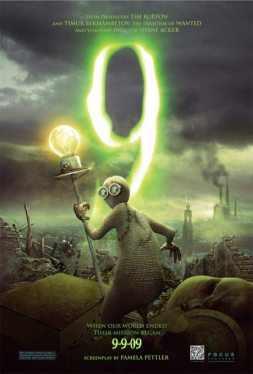
9posterstarring Elijah Wood, John C. Reilly, and Jennifer Connelly
written by Pamela Pettler and Shane Acker & directed by Shane Acker
Rated PG-13 for violence and scary images.
77%

Director Acker expands his 2005 Oscar-nominated short into an feature-length animated film. 9 (Wood), a living rag doll created by a now-dead scientist, wakes up for the first time to a post-apocalyptic wasteland in which humanity has died in a mysterious war. The only remaining inhabitants of this world are 9, the previous 8 rag dolls the scientist made, and a monstrous mechanical creature known only as “The Beast.” As 9 struggles to survive in this hostile environment, he begins to realize that he and his companions were created for a purpose, and that he holds the key to their collective destiny.

9 is a confusing little film that never quite seems to get across any big ideas or go anywhere terribly significant, despite hints at a much larger story left untold. However, the world that Acker has created is so absorbing and creatively-visualized that it will likely be some time before viewers notice the narrative shortcomings. 9 has a genuinely unique and inventive aesthetic that is totally absorbing from the very beginning. I never tired (during the film’s admittedly brief runtime) of the strange-but-familiar images that appeared on the screen as events unfolded.

The framework upon which this brilliantly-conceived tapestry is hung, however, is so flat and generic that it never seems more than woefully underdeveloped. It doesn’t help that nothing is given a name, leaving the movie’s backstory to sound like the bare-bones summary given at an early pitch meeting. “The Scientist” builds “The Machine” in service of “The State,” but the evil “Chancellor” allows its potential to be abused and it creates a swarm of mechanical nightmares that wipe out everyone and everything. No doubt this was done to make the story seem timeless and archetypal, but instead it comes across as lazy and bland.

No doubt one major cause of these shortcomings is the film’s transformation from a 10-minute short with no dialogue into an 80-minute film with an all-star cast of voice actors. In its original form, the story needed no explanation or context. It had its small but resourceful protagonist and an antagonist who pursued him across a dystopian landscape. Given the opportunity to flesh-out his highly-original world with an equally-original origin story, Acker has turned to some combination of Nazi Germany and the Terminator franchise, with some bizarre silliness about the transference of souls (reminiscent of 2001’s ill-fated Final Fantasy) thrown in without any sort of guiding mechanic to ensure that it makes sense.

The changes are not all bad, however. There was something endearing about the silent expressiveness of 9 and his companions when they couldn’t speak, but giving them voices and distinct personalities turns out to be one of this movie’s strengths. The greatest pleasure of the opening act is being introduced to the other characters, one by one, and then watching them develop and interact as individuals. The A-list talent providing the dialogue doesn’t hurt, either. They include Christopher Plummer as crotchety leader 1, Martin Landau as the more adventurous 2, John C. Reilly as the kind, nervous 5, and Jennifer Connelly as the bold, competent 7. Still, I have to admit that my favorite characters were the silent twins, 3 and 4.

Throughout 9 I couldn’t shake the feeling that this would have made a better video game than a movie. It had all of the elements of an excellent puzzle or adventure game, and the plot had all of the structural components of that medium. Certainly if I had been required to play my way through the discoveries and revelations of the movie, they wouldn’t have seemed as obvious, or as perfunctory, as they do.

I find Acker’s work here very promising for a first-time director. He has a flair for the visual and an excellent sense of the essentials of character. Because of that, I kept wanting to like 9 more than I did. Anyone who enjoys the original short (which can still be found on YouTube) will likely have a good time, as I did. Ultimately, though, I was left unsatisfied, and a bit underwhelmed. There is a lot to like, but audiences will be left scratching their heads and wondering what went wrong.

Theological Moviegoings: Jesus of Montreal

•September 8, 2009 • Leave a Comment

jesusofmontreal

Jesus of Montreal begins with a suicide, or so it appears. The act is actually staged as the dramatic finale of a stage play, but we only realize this as the man appears to dangle from the end of the rope and the audience (previously unseen and unheard) erupts into applause. It is a humorous and disorienting moment for the film audience, and it immediately prepares them to look deeper as they continue watching; not everything may be what it seems at first.

It’s an apt place to begin a contemporary retelling of the story of Jesus, particularly one in which conventional, orthodox notions of who he was are occasionally challenged. In the film, a Catholic priest hires a celebrated local actor, Daniel Coulombe, to update and stage the Passion play his church has put on every summer for the past 40 years. The priest, Father Leclerc, expects Daniel to make the play more relevant to modern audiences, and perhaps draw in people who might not otherwise attend. Both men achieve what they set out for, but (of course) the results surprise them both.

Before production can seriously begin, Daniel has to assemble a troupe of “disciples” who are compatible with his vision for the play. However, the actors are recruited from unexpected places. For instance, one is busy dubbing a porn film when Daniel approaches him, though he heeds the (casting) call and leaves to follow Daniel in the middle of the recording session.

The most-developed of these followers is a beautiful young actress named Mireille, who Daniel finds filming an ad for an expensive perfume. She agrees to take on the role of Mary, despite the cruel insistence of her boyfriend that her acting talent is solely a factor of her sex appeal. She enjoys the change in self-perception that comes from stepping into a role that isn’t designed to display her like a piece of meat, and when trouble arises later she is the most insistent that the group forge ahead. She has begun to see herself in a way that she never has, and she can’t bear to think of returning to the way things were before.

Of course, the most dramatic events revolve around Daniel’s experiences. There is an early scene where Daniel is researching his character in the library. A stranger, a woman, approaches him and says, “You are looking for Jesus? He will find you.” As Daniel puts the play together, and then takes on the central role night after night, he begins to “live into his role.” What began as a job “becomes a vocation” (as Robert Johnston explains in Reel Spirituality).

He finds himself in trouble with authorities after his outrage over the demeaning treatment of Mireille at an audition for a beer commercial leads him to destroy thousands of dollars worth of equipment and chase the offending parties out of the auditorium. Meanwhile, the unexpected success of his passion play prompts a local advertising mogul to offer him the opportunity to “sell out” and have the entire city in the palm of his hand. Daniel himself seems a bit surprised by his response to these situations.

All of these extreme, life-changing events which the characters experience successfully mirror the lives of people in the Gospels. Again and again, contact with Christ not only proves to be life-changing, but is transformative in such a way that the person cannot imagine returning to the life they lived before. In Jesus of Montreal, the story of Jesus is invested with that power to change lives in startling and unlikely ways.

At the same time, just as Daniel’s Passion play reaches new audiences in new ways, the film audience’s experience of watching him take on the role of Christ in his own life can challenge perceptions and shed new light on the story as well. A traditional retelling of the biblical account of Jesus’s life can seem drab and familiar, even when rendered dramatically on film, but by changing the details, the filmmakers can bring the heart of the story into the spotlight once more.

Then, too, at such a temporal and cultural distance, it is easy to lose sight of just how revolutionary and counterintuitive Jesus and his message were to the people in and near 1st-century Jerusalem. When Daniel breaks up the beer commercial audition, for example, we are reminded of the divide between what is culturally acceptable and what is morally acceptable, and of how shocking it must have been when Jesus drove the merchants from the temple.

Incidentally, Jesus of Montreal, like the Jesus of the Gospels, has some things to say about organized religion (in this case the Catholic rather than the Jewish faith, naturally). In this case, the presence of the church is actually more of an absence. In the few scenes which show the interior of the sanctuary it is always empty. Despite the ornate beauty of the architecture and decorations, this church is spiritually dead. The revival is going on outside its walls.

This brings us to Father Leclerc, the most church’s most visible representative. He is furious with Daniel after he sees the play for the first time, but his reasons are somewhat surprising. He is not upset with Daniel’s modifications to the official Jesus narrative because he believes it is blasphemous or heretical, but because he knows his superiors will. Leclerc has long-since ceased to be a believer, but he continues to go through the motions as the head of his church because he is afraid of losing his job and having nothing left to fall back on. The actors encourage him to join them, promising to accept him and do what they can for him, but he is too afraid.

The conflict between Daniel and Leclerc reaches its peak when Leclerc orders the other actors to return to performing his original script and they refuse. Furious, he storms inside the church and Daniel follows him to have it out. The two argue about the play, and Leclerc accuses Daniel of interfering with his ministry to the congregation. He claims to offer a sanctuary and a listening ear to people who cannot afford to visit a psychiatrist. However, it is clear that the comfort he offers is as empty as his faith, and as the church itself.

The actors, after sharing a “last supper” of pizza, decide to put on one last performance for the public. In the midst of the crucifixion scene, an altercation between a group of guards and some members of the audience leads to an accident which fatally injures Daniel. However, he lives on in two important ways. First, his friends donate his organs to the hospital, and they are transplanted into several waiting patients (restoring sight for one woman, extending the life of a man in need of a new heart, etc.). Second, an organization is set up in his name, with the actors who worked with him agreeing to take charge of it and ensure that it adheres to his principles.

This is the weakest portion of the movie, as the circumstances surrounding Daniel’s death and legacy seem a bit forced for the sake of their Gospel parallels, and hence a bit unbelievable. However, the film as a whole sheds some powerful light on the question of what Jesus’ approach to society and culture might look like now, perhaps opening the viewer’s eyes to see the world a bit differently and understand some of the importance and uniqueness of Christ’s message in a new and relevant way.

Amadeus: Best Picture, 1984

•September 1, 2009 • Leave a Comment

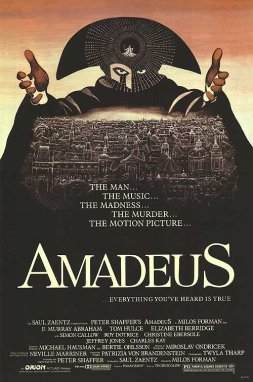
AmadeusposterThe 57th Annual Academy Awards were hosted by Jack Lemmon. Amadeus was nominated for 11 Oscars: Best Picture, Best Director, Best Actor (F. Murray Abraham), Best Actor (Tom Hulce), Best Editing, Best Adapted Screenplay, Best Cinematography, Best Art Direction, Best Costume Design, Best Makeup, and Best Sound. Major contenders that year included A Passage to India (11 nominations, 2 wins), Places in the Heart (7 nominations, 2 wins), and The Killing Fields (7 nominations, 3 wins). F. Murray Abraham’s Salieri beat out Tom Hulce’s Mozart to take the award, and The Killing Fields won both Best Cinematography and Best Editing, leaving Amadeus with a total of 8 Oscars.

The film, based on a Tony-winning play by Peter Shaffer (who also won the screenplay award), follows a very one-sided rivalry between Antonio Salieri, court composer to Austrian Emperor Joseph II, and musical prodigy Wolfgang Amadeus Mozart. As a boy, Salieri makes a vow to honor God with his music, if God will reward him with the necessary talent. He feels that God has accepted this bargain, until Mozart arrives on the scene. Salieri immediately recognizes a talent that dwarfs his own, but is appalled to discover that the young Mozart is a vulgar, lascivious man. Unable to understand why God would choose to mock him by rewarding someone like Mozart with superior musical ability, Salieri pits himself against the Almighty in an effort to thwart and frustrate Mozart at every turn.

Amadeus begins, many years after the death of the title character, with Salieri’s attempted suicide and relocation to a primitive mental ward (an interesting setting considering director Milos Forman’s previous multiple Oscar-winner, One Flew Over the Cuckoo’s Nest). He is visited there by a very young priest, and there is considerable irony in hearing Salieri addressed as “my son.” Salieri immediately makes it clear that he does not wish to confess, but he cannot resist the opportunity to tell his story. His account is a sort of “apology” in the sense of explaining and defending his beliefs and actions. From this point events unfold as an extended flashback which begins with Salieri’s childhood desire to be a musician.

As we get an idea of Salieri’s life and character, it becomes clear that there is a disconnect between his actions and his perception of himself. He recounts how, as a boy, he prayed “the proudest prayer a boy could pray” asking God to grant him talent. In return, he promises his chastity, industry, and humility. There is no apparent recognition of the contradiction between promising humility in a prideful prayer. He regards his father’s sudden death as a divine miracle in answer to his prayer (for which he feels no remorse). Indeed, Salieri gleefully regards any unexpected occurrence that works in his favor as a miracle. However, anything that frustrates him is also a result of divine intervention in his life.

On the one hand, Salieri believes that God is in control and actively at work in the world. On the other hand, he also seems convinced that the world revolves around him (or at least should). Meanwhile, although he doesn’t seem aware of it, Salieri is in continual violation of the spirit of his vow, if not the letter. He is not chaste in anything but the strictest sense of the word; for instance, he admits to the priest that he was “in lust” with his pupil, the beautiful opera singer Katerina Cavalieri. Also, while we don’t see him gorging himself, several scenes quietly emphasize his taste for fine food. Abraham plays these parts brilliantly, conveying the quasi-sexual and self-indulgent nature of Salieri’s love of sweets.

Perhaps the most significant contradiction of all, however, is Salieri’s philosophy of art. His primary aesthetic is essentially a theological one. Unlike most of the other characters in the film, Salieri believes that art (particularly in musical form, in this case) offers a connection with the divine. He frequently recognizes salvific themes in Mozart’s music, and even expresses the belief that Mozart’s music speaks with “the voice of God.” Strangely, though, Salieri is outraged. While he apparently recognizes that God can speak through anyone, he doesn’t believe that God should. He feels cheated of a gift that he is certain he deserves more than Mozart. As far as Salieri can see, not only do the wicked prosper, they do so with God’s full support and blessing.

Mozart, however,  does suffer for his own shortcomings. Less reflective than Salieri, he indulges in an unhealthy lifestyle that revolves around the constant consumption of alcohol and attending wild parties late into the night. His extravagance is a source of contention in his marriage and keeps him constantly on the verge of financial ruin. Mozart truly is just an overgrown child, and the film hints at his father’s failure to raise him well, but Salieri hears only the mocking laughter of God in Mozart’s juvenile cackle.

In the midst of his rage and envy, Salieri fails to recognize the significance of being able to experience God through Mozart’s music in a way that no one else in the film can, including Mozart himself. This is perhaps one of the most significant ideas in the film: Not only can God speak through “secular” art, but the ability to recognize and appreciate the Creator in art is itself a gift. And it is a gift which Salieri clearly possesses, as he shows again and again through his eye-opening voice-over commentary on Mozart’s music (which is the film’s third important character).

There is also a striking recurring shot which communicates the idea of art as an act of creation mimicking the Act of Creation: The conductor (either Mozart or Salieri) directs the orchestra in the royal opera house. The shot is framed with the conductor at the center, shot from below, with the richly-decorated beauty of the full auditorium as a backdrop. The musician as creator fills this enclosed “universe” with the sounds of music, maintaining total control over both the performers who follow his lead and play his music, and the enraptured audience.

The conflict gradually escalates until it leads Salieri to a breaking point, a sort of crisis of faith. He takes down the crucifix we have often seen him appeal to, leaving behind a stark outline on the wall where it once hung, and casts it into the fire. As the symbol of his devotion burns, he makes a new vow to God: “From now on we are enemies, You and I. Because You choose for Your instrument a boastful, lustful, smutty, infantile boy and give me for reward only the ability to recognize the incarnation. Because You are unjust, unfair, unkind, I will block You, I swear it. I will hinder and harm Your creature on earth as far as I am able.”

It is clearly a point of no return for Salieri, and as he sets himself up here as an antagonist to God he becomes a semi-diabolical figure. This connection is emphasized visually when Salieri repeatedly dons the costume worn by Mozart’s father before his death. The ghastly black robe and hat with its different masks for the front and back of the head signals Salieri’s assumption of his new role as a deceiver.

As I mentioned above, Mozart’s music plays a role so significant that it could be considered the film’s third major character. Its presence is palpable from the opening moments of Amadeus, still haunting Salieri long after the death of its composer. He feels that he has been kept alive so that God can torture him with the knowledge that Mozart has achieved musical immortality, while his own work fades into obscurity within his lifetime. Still, there is no denying that he remains powerfully affected by the art of the man he hates; so much so that he opens up the audience to the power of the music as he describes his experiences with it.

Ultimately, his plan to kill Mozart and win out over God revolves around turning the composer’s own music against him. Knowing of both the incredible potency of Mozart’s ability and his guilt over the death of his father, Salieri commissions a requiem mass. For a composer who speaks with the voice of God and can summon up the ghost of his own father or fill a theater with “the music of forgiveness,” being tasked with the music of death could prove quite dangerous (as it in fact does). As the work grows towards completion, Mozart draws himself closer and closer to death until he is too weak to even finish the work and Salieri must step in to help.

Their collaboration on Mozart’s deathbed is an amazing scene because it brings to a thematic head everything that the film has been about, particularly the conflict between Mozart’s effortless talent and Salieri’s reluctant admiration and the power of artistic creation. The music floods the soundtrack as Mozart dictates the notes onto the page, and there is a palpable feeling that he is summoning spiritual forces into the material world.

Amadeus is a magnificent, lavishly-produced film that speaks directly to the nature of the relationship between art and theology. It demonstrates the blindness of those who cannot recognize that such a relationship exists, but also something else: The destruction of a man who is consumed by his outraged inability to reconcile the majesty and purity of divine revelation with the flawed human instrument that expresses it.


Continue reading ‘Amadeus: Best Picture, 1984′

Scripture/Film Pairings

•August 27, 2009 • Leave a Comment

Borrowed from a friend on Facebook:

Here’s a challenge for you. For each of the Scripture divisions listed below, identify an appropriate film to watch.

You may take a lot of approaches to this task. For example, you may name a movie that would set the right mood for someone reading through that part of the Bible. Or a movie with a plot that runs parallel to a key story. Or a movie that provides a contrast to the Bible — maybe one that serves as a warning. And of course, you can try to find movies that translate key biblical themes artistically. Be as creative and unusual as you like. The goal is to help us think about the Bible (and these movies) in a new light.

Post this challenge and your answers in a note of your own, tagging me and a few other people so we can compare answers. There is just one rule for the movie choices: Do not include any evangelistic or Bible-story films. That would be too obvious.

The categories:

1) Origins
2) Law
3) OT History
4) Poetry
5) Wisdom
6) Prophecy
7) Apocrypha
8) NT History
9) Epistles
10) Revelation

My answers are below.

————————-

1) Origins: Unbreakable
2) Law: Atonement
3) OT History: Eternal Sunshine of the Spotless Mind
4) Poetry: Amadeus
5) Wisdom: The Virgin Spring
6) Prophecy: Dogville
7) Apocrypha: Pulp Fiction
8) Gospel: Perfume: The Story of a Murderer
9) Epistles: Shane
10) Revelation: In Bruges

What would you pick?

The Good Old Summertime

•August 25, 2009 • Leave a Comment

I had a great summer this year, ranging from an excellent class (that I didn’t think I would enjoy) to an excellent weekend at the Texas Shakespeare Festival (which I was pretty sure I would enjoy). And, as always, in the midst of traveling the country to visit friends and family and taking care of business here at home, I had some amazing movie-watching experiences. Unfortunately, summer being what it is, there was a bit of a frustrating slow-down on Moviegoings activity. This is particularly annoying because I ought to have more time to post during the summer, not less (and, in fact, I do . . . but nevermind). In any case, I had an extraordinarily difficult time narrowing my viewing experiences of the last few months down to a top ten . . . but here they are, in no particular order:

Wise Blood

The Battle of Algiers

The Conversation

Kicking and Screaming

Marjoe

Bonnie and Clyde

Boogie Nights

The Hurt Locker

The Virgin Spring

Waltz with Bashir

I’ve wanted to see John Huston’s adaptation of Flannery O’Connor’s Wise Blood ever since I first heard that it existed some years ago, so as soon as I learned that it was getting the Criterion treatment, I was ready. The movie did not disappoint: A rich adaptation that brings the source to life in a unique way that I’m sure I will revisit again and again. And this wasn’t the only spiritually-challenging film I encountered. I was floored by the 1972 documentary Marjoe, in which a fraudulent evangelist invited a film crew to follow him around the country for one last tour to expose the shallow trickery employed by him and others like him. It was an eye-opening experience, even for someone (like me) who has always been a bit suspicious of such methods. I was also deeply moved by Ingmar Bergman’s The Virgin Spring, a raw, shocking examination of human responses to evil and suffering.

I also experienced three amazing war films. There was the startlingly relevant 1966 French film The Battle of Algiers, detailing that conflict with an astounding attention to both detail and the bigger picture. In 2003, the Pentagon organised screenings of the film subtitled “How to win the battle against terrorism and lose the war of ideas.” It is an apt description that doesn’t seem to have been taken to heart. Speaking of the War in Iraq (and political commentary thereon), I was totally blown away by The Hurt Locker, the best American movie of the year so far. The film tells the story of a few months in the lives of an elite American bomb squad in Iraq, and is probably the first genuinely successful movie about the conflict precisely because it avoids heavy-handed political undertones and simply tells an amazing story. Finally, I at last had the chance to experience Waltz with Bashir, an animated movie which is unlike any film I have ever seen (animated or otherwise). The movie really brings home both the short-term and long-lasting horrors of war, evoking timeless anti-war classics like All Quiet on the Western Front (novel and film).

The somber mood continued with The Conversation, in which the best surveillance expert in the business experiences a crisis of conscience over one of the jobs he has taken on. This Coppola-directed Best-Picture nominee has been overshadowed by his masterful Godfather, Part II, but it deserves to be seen and discussed. Also nominated for Best Picture, but still deserving attention, is 1967 classic Bonnie and Clyde. This film definitely lives up to its reputation as a seminal American film, and it’s a lot of fun as well.

Finally, although nothing I chose for the top ten could be called genuinely light-hearted, both Boogie Nights and Kicking and Screaming walked a fine line between comedy and tragedy. The former is Paul Thomas Anderson’s towering epic (and it really does belong in that genre) about the adult film industry during the 1970s and ’80s. The latter is an ennui-filled movie about a group of brilliant-but-directionless recent college graduates who can’t seem to escape the orbit of their alma mater. It might have struck a bit close to home. Maybe.

Honorable Mentions:

Up

Pixar strikes again with a funny and moving story about dreams deferred.

The Nightmare Before Christmas

Hard to believe I had never seen this before, but I loved it. Great music, great concept, great production values. I could go on and on . . .

Dear Zachary: A Letter to a Son About His Father

Documentary filmmaker Kurt Kuenne sets out to make a movie about his best friend Andrew after he is murdered by his girlfriend (who also happens to be pregnant with their child). The result is an incredible story that needs to be seen and heard.

District 9

The surprise blockbuster of the summer is undoubtedly this action-packed sci-fi allegory about apartheid in South Africa. It blew away all of the pricey, shiny American contenders.

Shadows and Fog

In this hilarious Woody Allen film, his character is pulled out of bed by the neighbors to wander the streets in search of a serial strangler who may or may not be out there. Mob insanity and existential musings ensue.

One, Two, Three

Dr. Strangelove remains the definitive Cold War comedy about nuclear war, but One, Two, Three starring James Cagney has the market cornered when it comes to Iron Curtain farce. Cagney plays a fast-talking executive of the Coca-Cola company branch in Berlin, assigned to chaperone his American boss’s daughter (and frustrate her determined attempts to marry a dashing young Communist).

Moon

This small sci-fi drama was another pleasant summer-release surprise. Sam Bell is nearing the end of a 3-year solo shift mining precious resources on the moon. He can hardly wait to get home to his wife and daughter, but an unfortunate accident and a startling discovery threaten his mental stability and his chances of returning home.

The Verdict

Paul Newman is a broken-down old lawyer who sold his soul a very long time ago . . . but he finds an unexpected chance for personal redemption when a fat medical malpractice suit falls in his lap.

Ponyo

Hayao Miyazaki’s latest animated masterpiece has arrived in America, and does not disappoint. The story is slight and definitely aimed at a much younger audience than some of his previous works, but viewers will still be amazed by the artistry of his visuals.

Knowing

This apocalyptic Nicolas Cage thriller is much better than it looks. At least, I thought so. The concept is intriguing, though outrageously far-fetched. However, anyone willing to simply “go with it” will likely be entertained.

Fall Movielogue, 2009

•August 24, 2009 • Leave a Comment

August 24 – January 10

# Title (Production Year) Rating% Date Watched — Review links, if any (*Title* denotes top ten movie of period)

1303 Solaris (1972) 99% 8/24/2009
1304 The Great Buck Howard (2008) 89% 8/25/2009
1305 Trouble the Water (2008) 69% 8/27/2009
1306 We Are Wizards (2008) 35% 8/28/2009
1307 Guru (2007) 80% 8/31/2009
1308 Killer’s Kiss (1955) 45% 9/1/2009
1309 Osmosis Jones (2001) 71% 9/3/2009
1310 Spartacus (1960) 96% 9/4/2009
1311 Blazing Saddles (1974) 52% 9/5/2009
1312 Jesus of Montreal (1989) 85% 9/6/2009 — Post
1313 Tobacco Road (1941) 44% 9/8/2009
1314 Beavis and Butt-head Do America (1996) 53% 9/9/2009
1315 The Earrings of Madame de… (1953) 97% 9/9/2009
1316 9 (2009) 77% 9/11/2009 — Post
1317 Key Largo (1948) 95% 9/12/2009
1318 *The Last Temptation of Christ* (1988) 95% 9/13/2009 — Post
1319 Resident Evil: Apocalypse (2004) 54% 9/13/2009
1320 The Adventures of Baron Munchausen (1988) 94% 9/15/2009
1321 Cloudy with a Chance of Meatballs (2009) 89% 9/22/2009
1322 Young Mr. Lincoln (1939) 81% 9/23/2009
1323 The Informant! (2009) 91% 9/24/2009
1324 Mimic (1997) 59% 9/25/2009
1325 Au hasard Balthazar (1966) 91% 9/30/2009
1326 Zombieland (2009) 87% 10/2/2009
1327 Elmer Gantry (1960) 94% 10/4/2009
1328 A Man for All Seasons (1966) 91% 10/7/2009 — Post
1329 Last Year at Marienbad (1961) 87% 10/8/2009
1330 Dante’s Inferno (2007) 66% 10/9/2009
1331 Toy Story (1995) 96% 10/9/2009
1332 *Toy Story 2* (1999) 97% 10/9/2009
1333 To Be or Not To Be (1942) 76% 10/11/2009
1334 Silent Light (2007) 67% 10/11/2009
1335 Bedtime Stories (2008) 44% 10/11/2009
1336 Inside Deep Throat (2005) 83% 10/11/2009
1337 MirrorMask (2005) 89% 10/13/2009
1338 The Firemen’s Ball (1967) 95% 10/13/2009
1339 Horsemen (2009) 21% 10/15/2009
1340 Flatliners (1990) 84% 10/16/2009
1341 The Red Balloon (1956) 96% 10/17/2009
1342 Who’s Afraid of Virginia Woolf? (1966) 87% 10/18/2009
1343 Random Harvest (1942) 67% 10/20/2009
1344 Where the Wild Things Are (2009) 82% 10/20/2009
1345 *The Browning Version* (1951) 100% 10/22/2009
1346 *A Serious Man* (2009) 100% 10/23/2009
1347 Future War (1997) 0% 10/24/2009
1348 Zombiemania (2008) 66% 10/25/2009
1349 Christmas in July (1940) 91% 10/26/2009
1350 Great Expectations (1946) 95% 10/27/2009
1351 Daisy Miller (1974) 77% 10/28/2009
1352 Zombie Nightmare (1986) 0% 10/31/2009
1353 The Mummy (1932) 70% 10/31/2009
1354 Abbott and Costello Meet the Mummy (1955) 61% 10/31/2009
1355 Carrie (1976) 83% 10/31/2009
1356 Matilda (1996) 76% 11/1/2009
1357 Cape Fear (1991) 96% 11/2/2009
1358 Eve’s Bayou (1997) 96% 11/4/2009
1359 The Men Who Stare at Goats (2009) 51% 11/7/2009
1360 Hannah and Her Sisters (1986) 83% 11/8/2009
1361 The Adventures of Milo and Otis (1986) 40% 11/10/2009
1362 Follow That Bird (1985) 83% 11/10/2009
1363 The Heart Is a Lonely Hunter (1968) 90% 11/13/2009
1364 The Ballad of the Sad Cafe (1991) 78% 11/13/2009
1365 Hangover Square (1945) 33% 11/13/2009
1366 First Spaceship on Venus (1960) 0% 11/13/2009
1367 *Inglorious Basterds* (2009) 97% 11/14/2009
1368 *Spirited Away* (2001) 98% 11/17/2009
1369 Vernon, Florida (1981) 86% 11/20/2009
1370 Drag Me to Hell (2009) 82% 11/24/2009
1371 An Education (2009) 93% 11/25/2009
1372 The Messenger (2009) 77% 11/29/2009
1373 The Road (2009) 95% 11/29/2009
1374 *Fantastic Mr. Fox* (2009) 96% 12/7/2009
1375 The Princess and the Frog (2009) 74% 12/11/2009
1376 Enemy at the Gates (2001) 90% 12/13/2009
1377 The Box (2009) 83% 12/16/2009
1378 Avatar (2009) 94% 12/18/2009 — Post
1379 Kill Bill: Vol. 1 (2003) 93% 12/19/2009
1380 *Kill Bill: Vol. 2* (2004) 97% 12/20/2009
1381 Sherlock Holmes (2009) 84% 12/26/2009
1382 *The Fog of War* (2003) 96% 12/28/2009
1383 *Almost Famous* (2000) 97% 12/30/2009
1384 Eyes Wide Shut (1999) 93% 12/31/2009
1385 Charley’s Aunt (1941) 60% 1/6/2010
1386 Up in the Air (2009) 96% 1/7/2010