2011: An Oscar Commentary

•February 27, 2011 • 2 Comments

I don’t have much to say about this year’s show, which is one of the compliments that I would give it. It didn’t draw attention to itself, one way or another. It felt streamlined rather than bloated. It really felt like it was all about celebrating movies, and that’s all to the good.

As for the hosts: James Franco, I have to say, was kind of lacking in the charisma department. He walked out at the beginning and seemed like he was about to run screaming from the room from sheer nerves. When he came out again, he just stood there, stony-faced for the remainder of the show. Did he take something? Fortunately, Anne Hathaway kept plugging gamely along, carrying Franco as far as she could on bubbly charm (which she has in spades). Some of her jokes landed flat, but she didn’t linger. I give her top marks as an Oscar host.

As for the spread of awards, they were dis-satisfyingly thin this year. So much so that one would struggle to come up with a clear Big Winner. The King’s Speech, Best Picture, took only 4 awards, but so did Inception, while the night’s other favorite, The Social Network, received only 3. This ties The King’s Speech with (most recently) Best Picture winners No Country for Old Men (2007) and Million Dollar Baby (2004). What sets this apart, though, are the stunning 12 nominations that The King’s Speech had going in (compared to 8 and 7, respectively, for the other two). In fact, I think this might be the biggest nomination-to-award discrepancy every for a Best Picture winner. Clearly the Academy liked The King’s Speech . . . Just not that much.

As for the other categories, we’ve got 2 wins apiece for Toy Story 3, The Fighter, and Alice in Wonderland (a travesty), plus a single win for Black Swan to round things out. The other 4 Best Picture nominees (The Kids Are All Right, True Grit, Winter’s Bone, and 127 Hours) faced a complete shut-out in multiple categories (4, 10, 4, and 6, respectively). Of those, True Grit had the most devastating night of all, with the most losses. Very sad. At least they can have the satisfaction of having made a terrific film. I can’t wait to see what the Coens have for us next year!

Now to take a quick look at my predictions. I didn’t make public predictions this year, but I did continue my usual practice of joining the contest at “Beat the Crowd.” This year, unlike last year, I did not beat the crowd, and I actually logged my lowest score in years with only 13 correct predictions. Last year I had 15. That’s just how it goes sometimes. See you next year . . .

Full commentary continues below the fold.

Continue reading ‘2011: An Oscar Commentary’

Enjoying the Scenery: The Henley Sequence (The Social Network)

•February 13, 2011 • 2 Comments

David Fincher’s The Social Network is a film that has captured the cultural zeitgeist to a rare and almost frightening degree. It is a story of our time, chronicling the birth of Facebook as an event surrounded by personal conflicts that grew into legal battles over Mark Zuckerberg’s creation of a multi-billion dollar social networking empire. The movie’s tagline sums it all up perfectly: “You don’t get to 500 million friends without making a few enemies.” Indeed.

Two of those enemies are Cameron and Tyler Winklevoss (both played by Armie Hammer in the film). The Winklevoss twins are a privileged pair, both physically and financially. They are tall and athletic, with smooth features and sandy blond hair. They are “Harvard gentlemen,” members of the rowing team, upstanding, idealistic, and courteous to a fault. They remind me of the Hardy Boys: clean-cut, all-American guys who always land on their feet. Until they meet Mark Zuckerberg, that is.

A few months after the Winklevosses and their partner Divya Narendra hire Zuckerberg to finish writing the code for their social networking site, he launches “Thefacebook” and severs his ties with them. They are outraged and bewildered. They have been too trusting. Tyler and Divya want to take legal action immediately, but Cameron is certain there must be some mistake. He believes that they must handle the situation like the gentlemen they are, but their frustration builds as Zuckerberg stonewalls them and the university refuses to take action. With each passing day, Zuckerberg’s lead grows as his site improves and expands to include other schools.

Into the midst of this little drama comes the rowing race at the Henley Royal Regatta. Most of the scenes in the film to this point, aside from a few “coding” montages,  have been about conversations, developing characters, exploring relationships. They have transpired in confined spaces: dorm rooms, conference rooms, classrooms. Even the outdoor scenes have a confined feeling in the midst of the majestic buildings on the Harvard campus. This is something different. It stands out immediately.

The scene fades in on an aerial shot of the River Thames, filmed with a tilt-shift lens. The unique effect makes everything look tiny and artificial, like miniatures or toys. The scene cuts between a few more images shot with the same or similar effect. The focus is blurred around the edges of the shot. People move in slow-motion. Several visual clues give away the British setting. The music is muted, and plays with a slight synthetic buzz, almost as though it, too, is out of focus. There is no other sound on the audio track.

Suddenly, the music shifts into sharper focus with a stronger, faster beat as the camera drops down from the sky onto a long shot of the race. The rowers are pulling directly towards the camera from several hundred yards away. The melody is obvious now: It is a “cover” of Grieg’s “In the Hall of the Mountain King.” The music and the sequence build slowly together for over half a minute, constructed from shots of about 4 to 6 seconds in length. We see the boats from multiple angles and distances, and the rhythm of the scene feels in tune with the rhythm of the rowers and their oars. There are repeated close-ups of various rowers as they pull back out of focus, straining against the oar, and then lean forward into focus again.

Now the music shifts again, taking on an urgent, frenetic tone. The rowers grit their teeth and puff out their cheeks as they exhale. The shot length drops to about 1 to 2 seconds as the pace builds. One long shot of the race features a spectator wearing a straw hat in the foreground, prominent but out of focus. He points to the boats, claps his hands, and mouths, “Come on!” The finish line is nearing, but the Harvard team seems frozen 2/3 of a boat-length behind “Hollandia Roeiclub.” They row gamely, but remain stationary relative to the other boat.

Less than half a minute has gone by, and now the shot length is shorter still, with multiple cuts every second. The intensity has reached a fever pitch. Two quick cuts show the numbered prow of each boat knifing through the water. The coxswains pound the sides of their boats and bark commands. A Winklevoss darts a glance at the other boat, judging the state of the race. And then, just like that, it is over. The Dutch team’s victory is shot from the side, revealing the flash of the camera recording the finish as they cross the line just ahead of the “Harvard Crimson.”

The winners, as exhausted as the losers, raise their arms in victory, and then there are three quick close-ups before the camera pans back up to the sky to end the scene. The first is of Divya Narendra, who turns away from the loss with a disappointed frown. Then we see one Winklevoss collapse backwards, while the other leans forward with his head between his knees, chest heaving. They have given the race their all, but have still come up short.

The entire sequence lasts less than two minutes. In the very next scene, the boys learn that Zuckerberg has extended his site’s reach “across the pond,” an almost intolerable revelation in the wake of their crushing defeat, and Cameron finally concedes that it is time to bring in the lawyers. The race scene simultaneously signals a major turning point for the Winklevoss twins, and serves as a perfect cinematic expression of who they are.

This is their world. Like the race they are competing in, it is as well-mannered as it is elite, governed by a rigid code of honor and sportsmanship, and reinforced by long tradition. But this is a false reality, as indicated by the tilt-shift that lends everything an air of constructed artificiality, and it is crumbling around them.

Everything that once came to them so effortlessly is now out of their control. The increasingly-frantic music and ever-shorter shot lengths match the grimaces and tightened muscles that mark their futile struggle to hold their position. Zuckerberg isn’t always as insightful as he thinks, but perhaps he is onto something when he observes later in the film that, “The ‘Winklevii’ aren’t suing me for intellectual property theft. They’re suing me because for the first time in their lives, things didn’t go exactly the way they were supposed to for them.”

Cameron and Tyler don’t really need the money. This defeat will not ruin their lives. Their futures are as assured as they always were, but their privileged background makes this a difficult pill to swallow. As they continue to row steadily, going through the only motions they know, Zuckerberg is pulling further and further ahead. Fair or not, he launched first, and in life, as in rowing, first is all that matters. They have lost the race. Deep down, they know it, and now the audience does, too.

Ranking the Disney Canon

•February 4, 2011 • 5 Comments

A few years ago, Rachel and I watched the whole Disney canon (that is, full-length Disney animated films that received a theatrical release) as it existed at the time. I believe there were 46 or 47 movies at that point. In the years since then, we have always gone to see each new release as it joined an animation tradition that stretches back almost 75 years. A lot of these films, of course, I grew up watching (some dozens and dozens of times). Others I had never seen at all. It was a fun and very interesting experience to observe the evolution of Disney animation across decades of development, and then discuss between ourselves which ones were the true classics, and which were the stinkers.

That being the case, as soon as I saw the ranked list of Disney’s 50 animated features on “Rotten Tomatoes,” I knew I would have to make my own. My longtime readers know how much of a sucker I am for lists. I love reading through collections of films (and other things) that have been brought together within some category (whether it be genre, year of release, director, quality, etc.), and then ordered by personal preference. The best film lists are always put together by an individual or group with a real passion for films in general, and a genuine excitement about their selections.

So, while “Rotten Tomatoes” occasionally puts out some interesting lists, the way they go about it (via broad-based critical “consensus” and using an elaborate formula) is rarely satisfying. This list is no exception. After all, what living, breathing human being would rank a rollicking fun-fest like Robin Hood so near the bottom of the list, beneath even the truly dismal Home on the Range? And who would stick the deeply mediocre Bolt just shy of the top ten, even above The Little Mermaid, the film that kicked off the Disney animation renaissance?

Ranking the films myself wasn’t quite as easy as I expected, and what I came up with probably isn’t that far off of the RT list, but the differences are significant to me. And the list is mine. Here it is:

Continue reading ‘Ranking the Disney Canon’

Lost at Sea: Walden Media and Narnia-Adaptation-as-Shipwreck

•December 15, 2010 • 4 Comments

To understand how Michael Apted’s Voyage of the Dawn Treader strays so badly off-course it is necessary to understand what makes C. S. Lewis’s book a consistent favorite for many Narnia fans. The Pevensies initially discover Narnia, of course, in The Lion, the Witch, and the Wardrobe, and their entry into that world is full of the tentative thrill of new discoveries tempered by the immediate and ongoing threat posed by the White Witch and her eternal winter.

A year later, the same four children went back in Prince Caspian (subtitled The Return to Narnia) and find a world so completely altered that it takes them some time to recognize it. Everything beloved and familiar about Narnia seems to be gone, at least at first, and their task for much of the book is to set about helping restore it.

The Voyage of the Dawn Treader is quite different in this respect. Peter and Susan are gone, too old to return to Narnia, and Eustace has come along against his will, adding a whole new dynamic. This remains the only book in the series in which none of the characters visit the Narnian mainland: a true voyage of discovery for both characters and readers.

Caspian hopes to find out what happened to the seven lost lords (and he does), but nothing significant hinges upon his success. There is no immediate threat or danger, merely the promise of new and surprising adventures, of wind and waves and a journey eastward towards the rising sun (a direction the ship in the film never seems to travel at all). Caspian’s intention is to sail for a year and a day, and see what he finds. Reepicheep believes that they may reach Aslan’s country, and it is this promise that drives the story ever forward.

In the film this impetus is entirely supplanted by the introduction of quest-driven plot that appears, literally, out of nowhere. Readers of the book will be as surprised as the rest of the audience when Edmund and Caspian, taken by slavers on the first island they visit, watch a group of captives in a small rowboat suddenly devoured by a cloud of green mist that materializes and then disappears just as quickly.

Those who are not sold as slaves, they are told, are “sacrificed” to the mist, though no one knows its source. Cue the episode with the Magician and the Dufflepuds so that the former can provide some much-needed exposition: The mist is pure evil, and it is spreading. The heroes must defeat it by reuniting the seven swords given by Aslan to the Telmarines, and placing them on Aslan’s Table on Ramandu’s island, or else the world will be covered in darkness.

The gaping problem with this is that we know (even from the last film) that the Telmarines did not believe in Aslan or talking animals or any of Narnia’s “special” qualities, thus making it difficult to understand how or why Aslan would have given them magical swords. Beyond that, though, the entire focus of the journey suddenly becomes tinged with an urgency that wasn’t there before.

Even as they encounter new surprises around every corner, the characters have no time to stop and wonder at them; they must press on to the final battle. The driving question of the book that kept me hooked as a kid (Can one sail to the end of the world, and what might one find there?), is all but ignored. The entire (brief) build-up and arrival at the end of the world feels rushed, anti-climactic, and drained of significance (which, I suppose, should not surprise anyone who recalls the end of the last film).

Thematically, of course, the film is just as hit-or-miss. One major focus is on faith. “We have nothing if not belief,” Reepicheep declares at one point, though whether your belief is grounded in anything genuine seems to matter very little. There is a conversation between Lucy and a stowaway girl (daughter of one of the sacrifices to the green mist) late in the film, in which Lucy tries to communicate the importance of simply having faith that Aslan will work things out.

Lucy provides no reasons for having this faith (although she, of anyone, ought to have plenty of them), but the little girl raises an interesting question. She points out that Aslan did not stop her mother from being taken, raising the possibility of a foray into theodicy and the problem of evil that is simply left hanging. Lucy has no answer to the girl’s challenge, and neither, it seems, do the screenwriters.

There is also a great deal of emphasis on the idea of overcoming temptation from evil. For Lucy, this plays out through her lack of self-esteem and jealousy of Susan’s good looks, a minor element of the book that becomes the major arc for the character here as Aslan teaches Lucy to love herself as she is (an interesting and not unwelcome addition, overall). For Edmund, this predictably means another power struggle with the current king of Narnia, and more appearances by the White Witch (ho-hum).

Eustace, of course, spends much of the film as a dragon because of his greed and bad temper. However, the film seems a bit confused about whether the transformation reflects something good about Eustace, or something bad. “Extraordinary things,” Reepicheep tells him, “only happen to extraordinary people.” Oops.

Eustace’s restoration, an event of major significance in the novel (if not the whole series), becomes a rushed plot device in the midst of the final battle. As dragon Eustace and the others on the ship fight off an imaginary sea serpent, the unhinged Lord Roop embeds the last magical sword in Eustace’s hide, driving him away.

Once clear of the darkness, he lands on a convenient strip of sand, where Aslan quickly slashes away his dragon skin and teleports him directly back to the table so he can wave the sword at the mist a bit and then place it on the table, saving the day. Aslan then teleports Eustace back into the water next to the Dawn Treader (he couldn’t at least drop him in the boat?).

The entire climax begs the question of why, if he could simply collect all of his magical swords by magic and magically place them where they needed to be anyway, Aslan insisted they do everything the hard way up to that point. This sort of obvious cheating drains the climax of tension and the victory of any real sense of accomplishment. I cannot stress enough the complete and utter arbitrariness of this quest, lacking even internal logic or expositional support.

Consider the quest to destroy the One Ring in Tolkien, a task driven by the villain’s evil and his growing power, the successful completion of which would lead to victory for the heroes for clearly explained reasons. Consider even Aslan’s sacrifice in the first book/film, necessitated by the clearly-explained Deep Magic and made successful by the clearly-explained Deeper Magic. Obviously, in the latter example, as in all of the Chronicles, such events are invested with a great deal of symbolic meaning. What, then, is the symbolic significance of collecting seven magic swords and laying them on a table in order to defeat evil water vapor?

Furthermore, what previously-explained portion of the rules that govern this made-up world make sense of a scenario in which Aslan plans for the eventuality of an evil green mist by giving out seven magical weapons to seven random men who do not believe in him with the idea that they sail them (without being prompted) across the world and place them in a completely random location? Even when this is explained, it isn’t discussed as a prophecy or as information from Aslan himself or really much of anything. The magician Coriakin simply explains that this is what they must do, and they proceed without question.

The filmmakers’ tin ear for logic and internal consistency (what do they teach them at these film schools?) is evident in small details as well as large. In what was no doubt intended as a sly nod to fans at the end of the film, Eustace’s mother calls up to her newly-returned (and totally transformed son) that Jill Pole has dropped by for a visit. What on earth for? As we can surmise from earlier in the book/film, and from the beginning of The Silver Chair, Eustace is as obnoxious at school as at home, and Jill would have no reason to want to visit him unless she either somehow intuited his transformation, or she is as obnoxious as he is.

Finally, Aslan’s underwhelming screen presence in the films seems to have infected even the characters, who (like us) grow steadily less impressed at each of his appearances. As Reepicheep, Edmund, Lucy, Eustace and Caspian walk along the final beach towards the large wave separating them from Aslan’s Country, the lion himself appears behind them. Eustace notices him first, and says something, whereupon they all turn and cock their heads to the side as though expressing mild interest.

Even Lucy can’t muster up enough enthusiasm to wave to him, let alone run up and give him the hug that no physical force would have been able to prevent the book character from delivering. The haphazard intrusions by Aslan in this film are lackluster enough, but the utterly lifeless reaction his physical presence inspires renders it impossible to care about him at all.

There may be very little really wrong with this film that total ignorance of its source wouldn’t fix, and for some people, that makes it a success. However, one need only consider the oft-repeated goal of the filmmakers to understand how dismally it falls short of their intentions. It would be one thing if they were forthcoming about their intention to go their own way with the material, but the dreary insistence, in interview after interview, that, really, they are staying faithful to Lewis’s books as much as they reasonably can is downright iniquitous.

I’m sure a great deal of the problem has to do with the fact that they simply do not understand the stories that they are translating, but that is supposed to be Douglas Gresham’s role as executive producer and literary executor; both jobs at which he appears to be failing. Whether he is deluding himself, or allowing himself to be deceived by a smokescreen that insists that the Chronicles of Narnia would not play well on-screen as they were written matters very little at this point. If these films are still to be considered the progeny of C. S. Lewis, they can only be illegitimate at best. The time has come to stop hoping that anyone with any level of control over these films is going to get a clue.

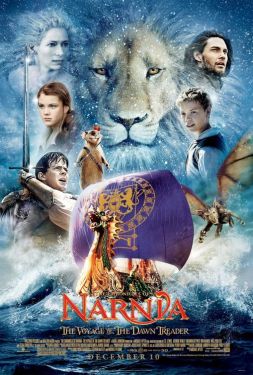
The Chronicles of Narnia: The Voyage of the Dawn Treader

•December 12, 2010 • 1 Comment

starring Georgie Henley, Skandar Keynes, Ben Barnes, and Will Poulter
written by Christopher Markus, Stephen McFeely, and Michael Petroni & directed by Michael Apted
Rated PG for some frightening images and sequences of fantasy action.
79%

Edmund (Keynes) and Lucy (Henley) are miserably sitting out World War II with their obnoxious cousin, Eustace Scrubb (Poulter), when all three of them are unexpectedly dragged to Narnia through a painting of a ship sailing the open sea. Plucked from the ocean, they are brought aboard the Dawn Treader and meet their old friend King Caspian (Barnes) on an expedition to locate the seven lost lords who were forced to flee Narnia for remaining loyal to Caspian’s father many years before. But larger trouble is brewing, and they soon discover that they must also recover the seven swords that belong to the lords in order to stop a mysterious green mist that threatens to cloud the world with evil.

With this third entry into the Narnia franchise, the series may finally be earning some distance from the label “Lord of the Rings lite,” but continues to distance itself still further from C. S. Lewis’s beloved book series. The degree to which the filmmakers’ tone-deaf approach to adaptation proceeds from a conscious attempt to improve on a story that has already withstood the test of time or from an inability to comprehend how these stories function remains unclear. I suspect some combination of both may be to blame. There seems to be little rhyme or reason governing the plot that has replaced the story of the book, while many of those semi-familiar elements that remain are jarringly devoid of context.

The episodic nature of The Voyage of the Dawn Treader seems to have given the writers the impression that they could disassemble it and then piece it haphazardly back together without anyone noticing much difference. The question was not “how we can translate what is on the page to the screen,” but “how can we rewrite the story in a way that strings all of the most exciting bits together?” The result falls apart as an adaptation and as a chapter in the larger story, but it works so hard to maintain even a tenuous connection to its source that it cannot function well as a film, either. The challenge is to explain why without simply producing a list of complaints (which I could certainly do).

However, to do this properly would take up entirely too much space here, and would be largely irrelevant to a review of the film. Any fans of the original book will have spotted the problem from the plot summary, and everyone else will remain unswayed by an attempt at fidelity criticism. Suffice to say that the plot feels like exactly what it is: an attempt to impose a rather silly impetus into a story that was already eventful enough to fill a 2-hour film. There is no longer much time left to stop and smell the roses (or, rather, the sea air); or, for that matter, to flesh out the characters, mature their relationships with one another, develop the themes, or much of anything else that gives a film depth and dimension and makes it worth revisiting. What we have is diverting, certainly, but utterly forgettable.

It is that much sadder to see that this needn’t have been the case, thanks to the involvement of so many talented people with the film. Will Poulter, whose magnificent performance in Son of Rambow left me with no doubt about his abilities, hits Eustace’s marks right on the nose. The chemistry between Eustace and Reepicheep (now voiced by Simon Pegg, replacing Eddie Izzard; a marked improvement) is incredibly fun to watch as their relationship develops. My only complaint is that Eustace spends so much of the film as a dragon that a great deal of the process transpires in CGI, without Poulter’s involvement.

However, this trip to Narnia really soars in the visual department. I don’t think I saw anything that I didn’t like. The disastrous, shallow storytelling will quickly fade from memory, but I won’t soon forget the Magician’s garden and mansion, the frightful sea serpent, or the look of the Dawn Treader itself. On the level of design, Voyage of the Dawn Treader is practically flawless. Everything looks exactly as it ought to, and is beautifully conceived and rendered. If only its literary and spiritual vision were as clear as its actual vision.

The upshot of it all is, if you like fantasy adventures and you can forget that you’ve ever read a book called The Voyage of the Dawn Treader by C. S. Lewis, then this movie is a fine way to pass the time while you wait to see David Yates finally wrap up the ever-declining, seemingly interminable Harry Potter film franchise. If, on the other hand, you see no reason why you should have to watch yet another favorite book series mauled beyond recognition on the big screen, by all means, stay far, far away. Douglas Gresham and the suits at Walden Media are unlikely to get the message at this point, but you’ll feel a lot better about yourself. You can’t stop them, but happily there’s no law that says you have to watch.

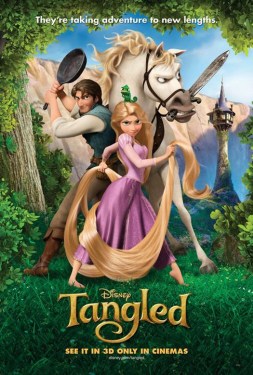
Tangled

•November 26, 2010 • Leave a Comment

starring Mandy Moore, Zachary Levi, and Donna Murphy
written by Dan Fogelman & directed by Nathan Greno and Byron Howard
Rated PG for brief mild violence.
91%

When evil Mother Gothel’s (Murphy) rejuvenating flower is taken to heal the pregnant queen, the newborn princess, Rapunzel (Moore), absorbs the flower’s magical properties into her incredible golden hair. Realizing that she cannot keep the hair without the baby, Mother Gothel steals Rapunzel and raises her as her own daughter, safely hidden from the world in a remote tower, until the day Flynn Rider (Levi), a thief on the run, accidentally stumbles upon the lost princess.

It has been nearly two decades since I saw this kind of Disney magic unleashed on a fairy tale. Frankly, I wasn’t sure anyone could successfully play a fairy tale this straight in our hyper-ironic, post-Shrek world, but Tangled, Disney’s 50th animated feature, may have finally broken the spell cast by Shrek’s popular fracturing of fairy tales back in 2001. This is not to say that Tangled is devoid of laughs (far from it), but it has an emotional, dramatic center that makes it more than just a comedy.

Despite scattered flaws, it represents a welcome rebirth of the classic Disney tradition that has had such an enormous influence on animated storytelling for over seven decades, and that has been woefully absent for the last ten years. And it appears in a computer-generated cartoon, no less, succeeding where the traditionally-animated Princess and the Frog failed last year. Despite the fears of Disney purists, the only thing audiences are likely to notice about the visuals of this movie is how incredibly gorgeous they are. There is a scene involving thousands of lit paper lanterns rising into the sky that may well make your eyeballs swoon with its spectacular luminosity.

Everything else we want out of a traditional Disney cartoon is here, as well. There are some memorable, show-stopping tunes, and an excellent score, by Alan Menken (whose past work for Disney has earned him 7 Oscar nominations and 4 wins), though there are also some less-than-stellar-ditties. Personally, I found the plot developments that accompanied the rather irritating “I’ve Got a Dream” to be a bit too silly, but this is the exception rather than the rule. Thinking back, I can’t recall whether the visuals and the story were what made the songs work so well, or if it was the other way around, but it is clear that there is a well-balanced relationship between the two, and the whole is greater than the sum of its parts.

The characters are also great. Mother Gothel is quite a bit sneakier and less overtly wicked than the usual cartoon villain, and the appropriately named Stabbington Brothers add a fun dimension to the movie’s rogue gallery. The most roguish character, of course, is Flynn Rider, whose egotistical bravado is a bit annoying until it becomes clear that it is meant to be regarded as a character flaw to be overcome rather than an endearing quality. There are also a couple of supporting animal characters, of course: Pascal, Rapunzel’s pet chameleon (and confidante) and Maximus, the white stallion of the palace guard and the biggest scene-stealer in the movie. Most important is Rapunzel herself, whose infectious exuberance, adventurous spirit, and ability to handle herself make her perhaps the most compulsively likable Disney princess ever.

Screenwriter Dan Fogelman has really done an excellent job re-imagining the original “Rapunzel” story into something completely new that, at the same time, still feels very much like a traditional fairy tale. However, while he that keeps us guessing during the first half, things start to feel a bit formulaic during the second. Longtime Disney fans will probably revel in all of the familiar elements that pop up, but sometimes it feels as though the movie is trying a little too hard to hit every well-worn trope it can reach, and that leads to some unnecessary predictability. More of a minor distraction than a major complaint, the length of Rapunzel’s hair is also wildly inconsistent throughout the story. Sometimes it is too long to make logistical sense for plot purposes (how can she keep it from getting, well, tangled in everything she goes anywhere near?), but when necessary it seems to shrink to more manageable lengths so as not to impede the action sequences.

Although it’s not perfect, Tangled is a whole lot of fun, and a step in the right direction for a studio that has been without clear direction for far too long. My only remaining complaint is with the title: Tangled doesn’t seem to describe anything that happens in this movie. I assume it is somehow a reference to Rapunzel’s propensity for getting everyone she meets tangled up in her life via her hair, but this is not a thematic thread that receives any overt emphasis. Meanwhile, Rapunzel herself is such a bright, glowing presence throughout that I suspect most people will, like me, find themselves thinking of this movie as Rapunzel; a much more appropriate title for a film in the tradition of Snow White, Cinderella, Sleeping Beauty, and Beauty and the Beast. Disney fans and animation fans alike have good reason to rejoice in this sparkling entry to the Disney canon, and anyone looking for rousing, light-hearted entertainment will have no trouble finding it at theaters this weekend.

Hiatus

•November 24, 2010 • 2 Comments

I believe it is customary to announce a hiatus before it happens rather than after the fact, but the truth is, I don’t ever plan to go on a hiatus from blogging. It just happens when life gets overwhelming. My last post here on Moviegoings went up around the time when I completed and defended my master’s thesis (1 or 2 portions of which have appeared here while it was in process). Having generated 60 or 70 pages of intense academic writing during the previous month, I didn’t really feel like sitting down to write anything for quite some time after that.

Furthermore, the day that I defended my thesis, I also attended the first meeting of my final graduate class, and about a month later, before I had even walked across the stage to receive my degree, I had begun my new job as a school librarian and social studies and English teacher. As librarian, I am also in charge of textbook distribution, and the first month of school I was in the building for most of every single day, easily surpassing 60 hours each week as I organized textbooks, reorganized the library, planned lessons, graded papers, and . . . Well, too many other things to list. It has been intense and challenging, but also highly satisfying and meaningful to work so closely with children from kindergarten through high school.

In the meantime, I have felt like I’m doing well to watch any movies at all, let alone generate any meaningful thoughts about them. And that is a state of affairs that I am simply not satisfied with. What I do here at Moviegoings is important to me, and I have no plans to abandon it, or even to lay it aside. However, with the start of my new career and other big changes on the way at home, it was clear that my return would require effort and intentionality. As the weeks went by, my thoughts turned with increasing frequency to how I could return to some kind of semi-regular posting schedule without neglecting my personal and professional obligations.

Basically, it comes down to something very simple that can still be very difficult to accomplish: a return to the basic discipline of writing every single day, no matter what, even if only for a few minutes. And that is what I propose to do, starting with this post. So, if any of you are still out there, expect to see some activity at Moviegoings once again! And if no one is still out there, I hope you come back and join the conversation I am beginning once again. I blog for myself (the only way to really sustain this form), but I prefer dialogue to monologue when I can get it.

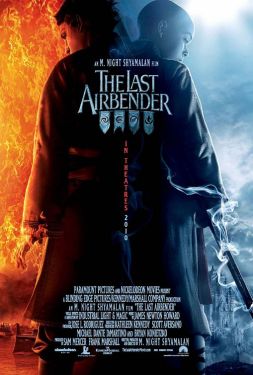
The Last Airbender

•July 3, 2010 • 2 Comments

starring Noah Ringer, Dev Patel, Nicola Peltz, and Jackson Rathbone
written & directed by M. Night Shyamalan
Rated PG for fantasy action violence.
24%

“Water.  Earth.  Fire.  Air.  Long ago, the four nations lived together in harmony.  Then, everything changed when the Fire Nation attacked.  Only the Avatar, master of all four elements, could stop them.  But when the world needed him most, he vanished.  A hundred years passed and my brother and I discovered the new Avatar, an airbender named Aang.  And although his airbending skills are great, he has a lot to learn before he’s ready to save anyone.  But I believe Aang can save the world.”

This monologue, delivered by Katara of the Southern Water Tribe, begins every episode of the hit animated series, Avatar: The Last Airbender. In 61 half-hour episodes across three incredible seasons, Michael Dante DiMartino and Bryan Konietzko built up an amazing alternate world and a rich mythology, populated with well-developed, lovable characters. It only took M. Night Shyamalan 103 minutes to drive it all completely into the ground. Of course, no adaptation, no matter how bad, can ever do anything to ruin the original. But that may be hard to remember amidst the unbelievable awfulness of Shyamalan’s The Last Airbender.

It can’t be a coincidence that this film thinks the title character’s name rhymes with “wrong;” it’s just too appropriate. I can’t imagine why Shyamalan couldn’t even be bothered to make sure his actors knew how to pronounce things correctly (for instance, “Sew-ka”), but it’s endemic of his utter lack of respect for the material and inattention to detail. There has to be an element of carelessness behind the fact that a few of the characters pronounce the word “avatar” correctly, but most of them repeatedly say “aw-vatar.” But disrespect is the only way to explain the absence of Momo, Aang’s pet winged lemur. I say absence because, although a creature resembling Momo appears in one or two shots in the film, none of the non-CG characters seems to notice that he’s there, and he certainly doesn’t have a name.

Then again, the characters who are on-screen don’t fare much better. The short-tempered firebender Prince Zuko (Patel) is supposed to be scowling all of the time, but it’s not nearly as noticeable when no one else so much as cracks a smile through the entire movie. So much of the show’s charm is predicated on its humor and sense of fun, but the kids in The Last Airbender have no sense of humor and no charisma. Aang (Ringer), defined in the show by his child-like mischievousness and perpetual grin, is unremittingly grim here (when he isn’t just confused). Sokka (Rathbone) spends most of the film looking as though his eyes are about to pop out of his head from the strain of holding any and all displays of emotion in check. And Katara (Peltz), the emotional center of the series, just looks like she’s always on the point of crying.

In fact, none of them delivers a single line that doesn’t sound like it’s being read. Somehow, though, I can’t believe that all of these kids are talentless actors. The fault has to lie with the writing and the direction; there doesn’t seem to have been any. Dialogue can’t be made to sound like anything other than reading when 90% of it is incredibly clumsy exposition. And yet, even though this is one of the most overexplained movies you’ll ever see, nothing in it makes any sense. People who remember the series well will probably be able to piece together what’s going on and why, but no one else stands a chance. And then, it just ends.

Still, even if the acting is terrible, the story nonexistent, and fidelity to the source a distant memory, at least there’s bound to be some decent action, right? Wrong. In perhaps its most impressive feat, this movie manages to make elemental bending look really, really stupid. Leaving aside the clunky, poorly-rendered computer effects, the choreography involved looks terrible; probably because it looks more like choreography than martial arts. It still remains unclear to me why, if a bender has to render a complicated series of balletic and seemingly arbitrary dance moves in order to conjure, say, a blast of air or a water whip, someone with a sword can’t charge in and lop off their arm. In any case, be aware: You will laugh at how dumb these people look waving their arms around to throw fake-looking globules of computer-generated water, fire, earth, and air at each other.

Somehow, all indications to the contrary, I didn’t quite believe that a show as well-made and well-written as Avatar: The Last Airbender could be transformed into a Level-5 disaster. Honestly, I’m still not sure how it was done, and trying to think about it is just depressing. I may have to go out and purchase the television series just to off-set the sin of having given money to the people who made this awful, awful film. This movie is a crime against good storytelling, a vicious act of vandalism, and an all-around abomination. Please, do not go see it.

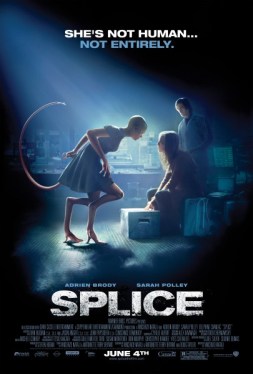
Splice

•June 4, 2010 • Leave a Comment

starring Adrien Brody, Sarah Polley, and Delphine Chanéac
written by Vincenzo Natali, Antoinette Terry Bryant, and Doug Taylor & directed by Vincenzo Natali
Rated R for disturbing elements including strong sexuality, nudity, sci-fi violence and language.
84%

Clive (Brody) and Elsa (Polley) are a pair of brilliant biochemists with complete autonomy to develop new products for a large pharmaceutical corporation. Their latest project is splicing together multiple types of animal DNA to develop valuable new proteins. However, what has them most excited is the idea of adding human DNA, a move their bosses forbid. Deciding to go ahead anyway, they create and bond with an incredible new life form named Dren (Chanéac), but terrifying developments make it clear that they have made a mistake.

Splice puts a rather interesting spin on the old Frankenstein story of mad scientists who have gone too far by genre-splicing a family drama allegory into its horror-style storytelling. The story’s central conceit is the way in which Dren becomes a surrogate child to Clive and Elsa, playing out a compressed arc from infancy to troubled adolescence as her “parents” are forced to deal with their own baggage. The result, much like the multi-species splicing performed by the film’s characters, is erratic, a bit unpredictable, and increasingly unstable, but certainly never boring.

Dren seems somewhat unique among movie monsters in that she is unsettling but not repulsive. She is not a sympathetic character at almost any point in the movie, but killing her never seems like the right thing to do. The right thing to do would have been never to bring her into being in the first place. Once that deed is done, the moral dilemma of her continued existence is an extraordinarily sticky one. However, her creators do not recognize for a very long time that what they have wrought is in fact a monster, and despite the fascinating design and development of Dren, they get most of our attention as events unfold.

Brody is an interesting performer to watch, but he takes a backseat to Polley in every way here. She proved herself in horror (having nothing to prove as an actress) in the surprisingly good Dawn of the Dead remake a few years ago, and she really sells an extremely intelligent character who makes a long string of poor choices. Her passionate enthusiasm and scientific curiosity sweep both her and her partner beyond the point of no return almost effortlessly. The poorest choice of the film, though, is made by Brody, who ultimately takes the movie in a deeply unsettling new direction with a completely outrageous decision that is not convincing for a single moment.

This serves as the catalyst for everything going to pieces in the final act, but it’s hard to hold that against the film too much. Across the horror genre as a whole, the two most common weaknesses are an escalating need to shock a jaded audience, and drawing to a conclusion without going over the top and betraying everything that has come before. The more interesting the premise, and the more portentous the build-up of it, the more difficult the movie’s task in finding a satisfying resolution, and Splice sets a high standard early on. In my view, it ultimately fails at both escalation and conclusion, but not catastrophically.

The movie’s most endearing flaw, though, is in trying to do so much. We’ve seen science go too far and create a monster many times before. However, the standard cautionary fable quickly splices in gender, body, and family motifs, and juggles them effortlessly. There are enough themes here for a dozen horror movies, and the ubiquitous reproduction and parenting metaphors are elaborate and multi-layered. I realize that not everyone goes to see horror movies looking for thematic depth and rich intertextuality, but when they’re present, everyone benefits. My point is that this is smart, thought-provoking stuff, much like the director’s previous Cube, and definitely a cut above the normal genre fare.

Marma-puke?

•June 3, 2010 • 1 Comment

My apologies if you actually watched that trailer. It jumped me in a darkened theater. I literally cannot fathom watching 85 more minutes like those 2. No, that is the privileged role of the professional movie critic. I wonder if movies like this make them question why they ever started down their present career path in the first place.

One thing’s for sure: These movies certainly make them cranky. I love it when critics get cranky. And who can blame them? This movie features a character named “Chupadogra.” The only question is how Marmaduke has managed to score as high as an 8% on Rotten Tomatoes.

Here are a few of the choicest comments:

“There is a special place in hell for filmmakers who deliberately force audiences to endure a worse dog movie than both “Marley & Me” and “The Shaggy Dog” remake put together.”
(Edward Douglas, ComingSoon.net)
Rankings like this are why I don’t watch dog movies. Ever.

“As talking-dog movies go, Marmaduke makes Beverly Hills Chihuahua look like Up.”
(Carrie Rickey, Philadelphia Inquirer)
Having barely survived Beverly Hills Chihuahua myself, I hope for the sake of the species that this remark is uncalled for.

“The flea-bitten screenplay seems to have been plucked from the wastebasket of recycled ideas and rewritten by someone whose third language was English — after Danish and Dog.”
(Joe Williams, St. Louis Post-Dispatch)
Dude, what have the Danes ever done to– Ohhhh . . .

Marmaduke was designed to be as nondescript as possible in its mediocrity. I have seen the enemy and I have already forgotten what it looks like.”
(Simon Abrams, Slant) An excellent, literate review.

“Based on the comic strip about a big Great Dane who does things a dog does while its human owners say exactly what he’s doing, Marmaduke tells the story of a big Great Dane who does things a dog does while he says exactly what he’s doing. […] The movie’s verbal jokes are comprised of cultural references and puns. Although, does replacing certain syllables of words with “bark” actually constitute a pun? Whatever it is, it’s used whenever possible.”
(Mark Dujsik, Mark Reviews Movies)

“Really the only people who ought to see Marmaduke are very young children and very chemically altered adults, and since neither of those groups are all that capable of buying movie tickets, any amount of money this movie makes will be too much.”
(Katey Rich, Cinema Blend)

“When one of the last sounds you hear in a work of family entertainment is a Great Dane passing gas, there’s only one conclusion to be drawn. The movie hates your family.”
(Wesley Morris, The Boston Globe)

“No animals were used, and no humans were entertained in the making of this movie.”
(Matt Pais, Metromix.com)

“This tale of a philosophical Great Dane who speaks with Owen Wilson’s voice is not entirely without merit. Well, actually, it is, but never mind.”
(Liz Braun, Jam! Movies)

Well, you get the idea. Still, given the complaints about uninspired, dog-related puns . . . there are a surprising number of them crammed into all of these reviews. Anyway, I’ll wrap this up with a word from Roger Ebert. He always puts things into perspective:

“And then … but enough. Why am I writing, and why are you reading, a review of a talking animal movie?”