
Chronicle

•February 5, 2012 • 1 Comment

starring Dane DeHaan, Alex Russell, and Michael B. Jordan
written by Max Landis & Josh Trank and directed by Josh Trank
Rated PG-13 for intense action and violence, thematic material, some language, sexual content and teen drinking.
85%

Three high school seniors, Andrew (DeHaan), a withdrawn outcast with a dark family life, Matt (Russell), his light-hearted, philosopher-quoting cousin, and Steve (Jordan) a popular, outgoing candidate for student body president, all gain telekinetic powers when they stumble upon a mysterious, pulsating object. As their powers grow, tensions and complications arise, all documented by Andrew’s video camera and other bits of found footage.

Orson Welles was only 26 when he made Citizen Kane, so it’s not hugely surprising that 26-year old writer/director Josh Trank has produced such a solid film (though certainly no Citizen Kane) with his feature debut. It would be more surprising to learn that this movie had come from someone older. From beginning to end, this feels like a story that emerged directly from fresh, raw experiences in an American public school during the last decade, mixed with the basic, premise-level conceits of comic books that have been around for far longer.

It would, however, be a mistake to call this a “superhero” movie when it’s really more of a “superpower” movie. Perhaps that seems like too fine of a distinction. A few days before I graduated from high school, I sat in a darkened theater with many of my friends and watched Spider-Man (2002) for the first time. Like Chronicle, Spider-Man is about a high school student who acquires superpowers and must then work out how to handle the enormous responsibility that accompanies them. But, because Spider-Man is a superhero movie, it explores this theme by having Peter Parker don a colorful costume and do battle with an equally-colorful supervillain, who (conveniently) comes into some superpowers of his own at around this same time. Chronicle, on the other hand, ventures to ask what a few real high schoolers attending a real high school (a justification for the well-worn “found footage” device) would actually do if they suddenly had such powers; a question that is simultaneously so compelling and so obvious one wonders immediately why no one has thought to ask it in a film before.

First, there’s basic juvenile mischief: they bean each other in the head with baseballs, use a leaf-blower to lift a girl’s skirt, prank various people in a store. But as they continue to experiment, they realize they’re getting stronger, and for at least one of them, a victim of bullying and insults everywhere he goes, that means a chance to go about righting all of the many things that are wrong with his life. Beyond the novelty of the superpower device, this journey opens up a sad window into the lives of contemporary teenagers, with all of its casual cruelty and pressures to indulge in the pleasure of the moment. Of course, there’s nothing here that we don’t already know, but there is a visceral immediacy that comes from the strong performances of the largely-unknown cast; most of all from Dane DeHaan’s ability to walk a thin line between sweet-but-misunderstood loner and twisted, bitter sociopath.

The use of “found footage,” which is as near as a film can come to the “first-person narration” approach to fiction, has by now been used so frequently that it may have begun to tax the patience of fans and detractors alike. The novelty of the form (which some would cite as its primary appeal) is long gone, and any use of it in a film now had better be well-justified by some necessity of the story being told, as it can no longer hope to captivate simply by being different. Although there is arguably some attempt to justify that choice here, the way the film is edited makes it seem that Trank wanted to have his cake and eat it, too.

Throughout Chronicle, the camera-wielding main characters come into contact with other cameras (we are, as a society, now constantly in danger of appearing on film at a moment’s notice no matter where we are), and those cameras are used to provide additional angles and perspectives on events. For example, there is a girl named Casey, who (like the boys) wields her camera everywhere she goes, ostensibly filming “for her blog,” although there seems to be no real rhyme or reason behind what she is recording. Her presence in any given scene allows the director to cut back and forth during conversations. Late in the film, during a major action sequence, Andrew telekinetically swipes an armload of iPhones and digital cameras and arranges them around himself, allowing Trank 360 degrees of possible angles to play with. And, even though there is a security camera in one unconscious character’s hospital room, the police set up a second camera at the foot of the bed which must be kept recording at all times even though no one is present, allowing for still more angles.

Thus, throughout the movie, it is difficult not to question why any given character would be compelled to film what is going on, particularly when what is being filmed is either highly incriminating or extremely inconvenient. Why (and how) would one of the teens expend the mental energy to levitate a camera around and film himself assaulting a gang of neighborhood thugs, for example? There is also a constant question of who assembled all of this footage, and how. Andrew’s original camera is lost some 15 minutes into the movie, buried deep underground, but we are able to watch everything that he filmed on it. Who went around and collected the dozen or so personal video recorders that Andrew films himself on during the climax? And how did they survive being dropped so many stories when he was done with them?

Questions like this are a constant distraction from the substance of the story itself, which must surely be a sign that the found footage device may not have been the best choice in this case. Still, this apparent attempt at “artiness” or “trendiness” aside, it’s hard to complain too loudly when there is bright, young talent (director, writer, and actors) collaborating on something that, in every other way, feels so fresh and original. Chronicle is a welcome break from the same-old superhero thing, if not from the same-old found footage thing, and I hope the filmmakers behind it have many more stories left to tell, and many more chances to tell them.

2012: An Oscar Primer

•January 31, 2012 • Leave a Comment

I didn’t even prime the primer last year, because the demands of my job make it difficult to watch the announcement of the nominees and respond immediately, but I wanted to go ahead anyway this year. I’ve still been trying (with mixed success) to keep up with the race, but I find myself having to go farther and farther out of my way to see even the films with the biggest buzz surrounding them.
Nearly half of the Best Picture nominees, including the two that are considered this year’s front-runners, have not yet been released in my city. Now, I may not live in the cultural capital of the nation, but there is still a large audience for all things cultural in my city. We, and other large swathes of the population of this country, are consistently excluded from this conversation and fed a steady diet of inane mediocrity and worse. Alvin and the Chipmunks 3 is still taking up multiple screens here (really? over a month and you think everyone who wants to see that still hasn’t made it in? just release it to Redbox already), and I have small hope that many more of the films I most want to see will arrive before Oscar night.

There is a lot of talk about the problems of Oscar ratings and drawing in viewers, and I’ve heard it said that people don’t watch the Oscars because the Academy passes over the films they like in favor of the films they’ve never heard of. The Academy has attempted to fix this in recent years by dramatically increasing the pool of Best Picture nominees, but the real problem is something else entirely. People have never heard of the films that are being nominated because the studios behind them don’t bother to market those films to a wide audience, let alone make them accessible to that audience. I feel kind of lucky that I only have to drive 100 miles to see limited releases, though even that has become largely impossible with full-time work, a baby, and a limited budget.

Anyway, we have nominees to discuss. The Academy has introduced yet another wrinkle into its nomination process, and the number of Best Picture nominees will now vary each year between 5 and 10 depending on how many films meet a minimum “first-place votes” requirement. Basically, it’s complicated, but don’t worry about it because I’m kind of expecting this rule to change next year. In any case, that means 9 nominees for Best Picture this year:

War Horse – Some people might call this conventional, cliche, and sentimental. I’d call it old-fashioned, a throwback to classic films and filmmakers and to a time when sentimentality wasn’t so deliberately cloying. I loved it. And, particularly after the massive disappointment of Spielberg’s Tintin, it was a welcome relief to go to War Horse and get lost for hours in the simple pleasure of being at the movies. It has 6 nominations: Best Cinematography, Best Art Direction, Best Music, Best Sound Editing, and Best Sound Mixing. These categories speak to the rich auditory and visual experience of watching this film, and I think I agree completely with the nominations it got and did not get.

The Artist – By now it’s no surprise to anyone who is paying attention to see this title on the list. But if you had told me last year that a foreign silent film would score 10 nominations and be considered the front-runner of this year’s race, I would have laughed and reminded you that it has been 83 years since a silent film was nominated for Best Picture, and that foreign language nominations (does this count?) are rare and never win. And I think Schindler’s List, nearly 20 years ago, was the first black-and-white film to win in decades. If I had somehow believed this could happen, I would then have lamented that there was no chance of the film coming to a theater near me, but I guess I’ll stop whining about that. Since I haven’t seen it, I don’t have much to say about it, except that I really hope I get to see it before Oscar night (it looks like it will be coming to town in early February). The other nominations are: Best Director, Best Original Screenplay, Best Actor, Best Supporting Actress, Best Cinematography, Best Art Direction, Best Costumes, Best Editing, and Best Music.

Moneyball – I am really not into sports films, but Moneyball offered me a glimpse of why people care so much about sports and think they matter. That’s an accomplishment that has to count for something. It’s a highly-enjoyable and well-made film, based on actual events, with some great performances, and a strong screenplay. Very solid pick for this category, and a movie I wouldn’t mind seeing again. And now we’ll start seeing trailers that mention “Academy Award Nominee Jonah Hill,” so that will be weird. The film has 6 nominations: Best Adapted Screenplay, Best Actor, Best Supporting Actor, Best Editing, and Best Sound Mixing.

The Descendants – This film has some major acclaim behind it, and is surrounded by rave reviews, which was confusing to me until I saw it. Well, it’s still a little confusing. There is something unique about the delicate, graceful way that it navigates a string of painful and emotional situations, transitioning seamlessly between laughter and tears. The writing is strong, and the performances are strong. It’s a good movie. But a great movie? I don’t know. I don’t think so. It’s still the best Hawaii movie since Lilo and Stitch, though. The Descendants has 5 nominations: Best Director, Best Adapted Screenplay, Best Actor, and Best Editing.

The Tree of Life – I think it’s fair to say that this is the movie that inspired the most conversations, and the most passionate conversations, this year. Although he is showing signs of becoming more prolific, a new film by Terrence Malick is rare enough to be considered An Event. This is his most ambitious project yet, a semi-autobiographical meditation on birth, childhood, death, creation, evolution, life, the universe, and everything. I was fortunate to have a chance to see it in the theater, and I found it challenging and thought-provoking, but also dense and murky at times. It is certainly not a film with an obvious point to make, or one that reveals all of its quirks and mysteries on a first viewing. That can make for either a rewarding or an irritating experience, depending on the spirit you approach it with, but the most serious criticism that one could charge it with, in my opinion, is that it swings for the stars and only hits the moon. It only has 3 nominations: Best Director and Best Cinematography.

Midnight in Paris – Everyone says this is Woody Allen’s best film in years, and they’re right. When Allen is on, he is on fire. This is only his second screenwriting nomination in a decade (his 15th nomination), his first directing nomination in nearly 2 decades (his 7th nomination), and his first film to be nominated for Best Picture in a quarter of a century (his 3rd nomination). All are well-deserved in this case. This is one of those Woody Allen movies that leaves me wanting more, and sends me looking for more of his films that I haven’t seen. It has 4 nominations, with the last being Best Art Direction.

The Help – I passed on several chances to go see this film because I wasn’t sure that I really wanted to. It is clearly a popular favorite, and the way it was being praised and reviled reminded me very much of the reception for The Blind Side a few years ago. And I hated that movie something fierce. In any case, I caught it on DVD over Christmas, and found the comparison to be somewhat apt. Both films pander to mainstream white audiences’ smug complacency about race and racism, are loaded with cliches and feel-good chuckles, and feature a stand-out performance by an actress that even detractors of the film are willing to praise. I liked The Help better than The Blind Side, but I also had a serious academic interest in it, as I wrote my thesis on adaptations of Southern novels into films. The movie has four nominations: Best Actress, and two for Best Supporting Actress.

Hugo – I can say with no reservations that this is my stand-out favorite film of the year. Martin Scorsese’s first children’s movie is also a passionate plea for film preservation, and it turned out to be a strong justification for the existence of film critics, as well. The advertising for the movie was so spectacularly inept that I probably wouldn’t have gone to see it if it had not been championed by so many. It is a lush and glorious cinematic experience that reminds us all why the world first fell in love with the movies and their wondrous magic over a century ago. It leads the field this year with 11 nominations: Best Director, Best Adapted Screenplay, Best Editing, Best Cinematography, Best Art Direction, Best Costumes, Best Music, Best Visual Effects, Best Sound Editing, and Best Sound Mixing.

Extremely Loud & Incredibly Close – This is the one film on the list about which I am genuinely baffled. I had not seen anyone predict its inclusion since it was released to decidedly poor reviews some weeks ago. And I’m not really happy that I’ll now feel obligated to see it. I guess the Academy just can’t resist Stephen Daldry. This is his 4th film, and he received a Best Director nomination for the previous 3, along with Best Picture nominations twice. The movie has a very weak 2 nominations, with the other being Best Supporting Actor. Seriously, what is this movie doing here?

And now for a brief look at the other nominees, beginning with those which I have already seen:

Continue reading ‘2012: An Oscar Primer’

Enjoying the Scenery: Waiting for the Train (Once Upon a Time in the West)

•November 11, 2011 • Leave a Comment

The year is 1967, and three Italian film aficionados, Dario Argento, Bernardo Bertolucci, and Sergio Leone, having spent several months watching and discussing Westerns, are collaborating on a story. Argento will one day be famous for his influence on the Italian giallo genre of slasher films, but his directing career has not yet begun. Bertolucci will go on to achieve enormous critical success, sweeping the Oscars with his 1987 film The Last Emperor, but he has yet to make his mark. Leone has recently released The Good, the Bad and the Ugly, the third of the Italian-style horse operas in his “Dollars Trilogy,” already widely known to American audiences and critics as “spaghetti Westerns,” and the story the men are working on is for him.

This story, too, will look to the most quintessentially American film genre for inspiration. Pooling their vastly different creative sensibilities, their shared passion for the art of cinema, and their encyclopedic knowledge of classic Western films, the Italians complete a story treatment. And, in due course, this story will become Leone’s masterpiece: C’era una vota il West (1968), or Once Upon a Time in the West, as it is known in America.

In fact, a more slavishly literal translation of the Italian title would be “There Was Once the West.” Of course, that lacks the idiomatic flair of the American title, but it indicates the film’s depiction of a closing frontier, bustling with the activity of new settlement, encroaching civilization, and the construction of the transcontinental railroad. Very little time remains for the wandering, just-but-lawless mythic hero to roam this land. The film is a fairy-tale clash of primal good and evil archetypes, as “Once Upon a Time” suggests, but it is also about the end of “The West” as the physical location embodying An Idea about American exceptionalism and rugged individualism; An Idea that will be endlessly discussed, depicted, and reinvested with new meanings by artists and historians alike. “There Was Once the West,” but not anymore.

By the end of the first scene, a great deal about the story and the characters remains obscure, but all of this thematic and genre baggage is in play. Although it does eventually introduce the protagonist, this scene is really more of a prologue than a proper beginning to the story. It is a spectacular exercise in sustained tone, quietly and gradually immersing us in the world of the film for ten hypnotic minutes during which three men wait for a train to arrive. Real life is like this, sitting and waiting for something to happen, but those in-between times are easily forgotten or overlooked when we watch movies where every scene begins as something is happening and ends after that something has happened so that we can move on to the next scene and the next event. The idea that normal life stuff is happening whenever the characters are not on the screen is one of the great illusions of the cinema.

Continue reading ‘Enjoying the Scenery: Waiting for the Train (Once Upon a Time in the West)’

Franchise Files: Beneath the Planet of the Apes (1970)

•August 4, 2011 • Leave a Comment

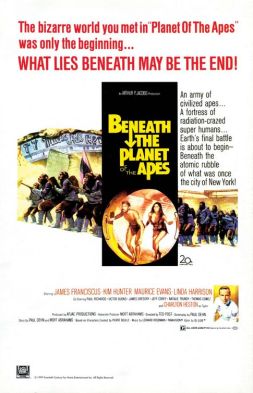
The original1968 Planet of the Apes doesn’t seem like an obvious candidate for a sequel, at least until you learn that it actually made quite a bit of money. Certainly, sequels have been brought to the screen with far less to go on, but the screenwriters faced a challenging task. Although the story does end on something of a cliff-hanger, it is not immediately clear where another outing with these characters in this world could logically go. Watching Beneath the Planet of the Apes, released two years later, it becomes clear that logic didn’t really enter into the equation at all. Even by comparison with the three Apes movies that followed, one each year, this is thin stuff, and easily the weakest entry in the franchise.
Beneath went into production with a critical handicap: Charlton Heston was unwilling to play a major role in the film. As Taylor was the only sentient human character left alive at the end of the first movie, Heston’s decision left any potential sequel without a protagonist mainstream audiences could relate to. Of course, this needn’t have been a handicap at all. Any number of interesting ways to approach such a problem and take the story in a bold new direction consistent with the edgy, ambiguous ending of the original immediately suggest themselves. Unfortunately, the filmmakers decided to go completely the other way instead.

The new protagonist is Brent, played by James Franciscus, yet another astronaut from Earth’s past, the sole survivor of yet another crashed spaceship, this one sent in search of Taylor and his crew. Brent immediately encounters Taylor’s mute girlfriend Nova, still carrying his dog-tags, then stumbles his way through an onerous retread of Taylor’s experiences from the previous movie that occupies roughly half of the runtime of this one. We learn via flashback that Taylor and Nova, after riding off together into the Forbidden Zone, encountered a series of strange phenomena (walls of fire, lightning without clouds, earthquakes), and then came upon a large cliff-face where nothing had been before. Taylor, apparently acting on impulse, dives right through the seemingly solid rock wall and vanishes until the end of the movie.

Meanwhile, Brent observes the gorilla army preparing to invade the Forbidden Zone (to confront the someone or something that apparently inhabits the region) before he and Nova escape from Ape City using the long-abandoned tunnels of the New York Subway, learning for the first time that he has arrived on a future Earth rather than another planet. Traveling deeper into the huge system of tunnels, Brent finally stumbles upon an underground society of mutant humans with powers of telepathy and a religion based on the worship of a nuclear “doomsday” bomb occupying the altar amidst the ruins of St. Patrick’s Cathedral.
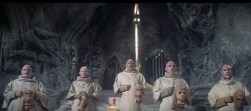
Here Brent is finally reunited with Taylor, who has been taken prisoner by the mutants. The mutants then nearly succeed in forcing them to murder each other using their telepathic powers, but the pair manage to escape. The gorilla invasion is successful thanks to the leadership of the orangutan Dr. Zaius, who sees through the mutants’ telepathic illusions. As the gorillas charge in and lay waste to the mutant society, Brent and Taylor attempt to prevent the mutants from purposely detonating the nuke, and the gorillas from accidentally setting it off. Their efforts backfire horribly when Taylor is riddled with bullets and falls on the activation switch. In the film’s final seconds, the screen goes completely white and a solemn voice intones, “In one of the countless billions of galaxies in the universe, lies a medium-sized star, and one of its satellites, a green and insignificant planet, is now dead.”

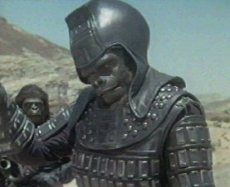
Apart from being a total downer, the film’s destruction-of-the-planet ending is rendered absurd in retrospect. What looked like a definitive end to the series was actually only the second of five films. Beneath the Planet of the Apes also tries very hard to be more action- and effects-driven than its predecessor, which just ends up making it far less thoughtful. There are, however, a few glancing attempts at social commentary. Most notable is a scene where a small chimpanzee peace protest is forcibly removed from the road to allow the gorilla army to pass. The soldiers grappling with the protesters is shot up-close with what seems like a shaky, hand-held camera, presumably meant to evoke news footage of Vietnam War protesters. The army then proceeds, trampling the peace banners under their horses’ hooves.

The heavy-handed evocation of Vietnam is nothing, though, compared to how this movie tramples on the first film’s rich thematic discussion of the tension between science and religion. Someone seems to have realized that the apocalyptic ending of the first film rendered its defense of science over religion fascinatingly ambiguous: Sure, religious dogma in ape society deliberately holds back scientific progress, even to the point of repression, but if the alternative is the complete destruction of civilization itself, which is really the lesser of the two evils? Beneath the Planet of the Apes works overtime to redeem science from the onus of nuclear devastation established in Planet of the Apes and shift the ultimate blame squarely onto religious fanaticism.
In mutant society, religion is depicted at its most absurd extreme in the mindless adulation of an inanimate object. That these bomb-worshiping nitwits also happen to be a race of hyper-intelligent beings with the power to control minds and the intellectual sophistication to turn the apes’ own religious superstition (the gorillas’ one significant handicap) against them doesn’t seem to have struck anyone behind the making of this film as a significant contradiction. Ultimately it is the wild-eyed nihilism of the faithful that dooms the world to nuclear destruction, rather than the cold, emotionless logic of the scientists who created the doomsday weapon that does the job.

For all that it gets wrong, though, Beneath the Planet of the Apes somehow manages to be memorable in a so-bad-that-it’s-good sort of way. Sure, it’s not particularly coherent, but it does bring a number of indelible images to the screen, mostly having to do with the telepathic mutants, the hideous visages they hide under their normal-looking human masks, the shining, phallic bomb they worship, and the wild illusions they produce to confound their enemies. The scale is also somewhat grander in this film, with the impressive gorilla army seen training for battle, traveling in formation, and marshaling for the final attack. Their leader, the charismatic, war-mongering General Ursus (who loudly declaims, “The only good human is a dead human!”) is an interesting new addition to the cast of ape characters.

It’s hard to deny that the film is a failure by any real standard of movie quality, and this remains the easiest of the series to skip without missing any essential details of the overarching plot (which the filmmakers were just making up as they went along anyway). Nevertheless, there is actually plenty of good, campy fun to be had in the watching of it, and any true Apes fan won’t want to miss out. And you’ve got to hand it to that ending: For all their threats to humanity, how many movies actually follow through with the total destruction of Earth and all human life?

American Movie: The Avenging Conscience (1914)

•July 20, 2011 • 1 Comment

Throughout the first decade of the 20th century, American film production continued to grow, from dozens of short films released each year, to hundreds. By the ‘teens, annual releases numbered in the thousands, and films were also growing in length, from a mere reel or two, to half a dozen or more. The motion picture as novelty and fad had given way to a full-blown film industry, and business was booming. But with greater success came increased audience expectations.

Films had to be about something, and with audiences standing by to consume the latest movies as fast as the studios could crank them out, there was no time for a lot of originality.  Filmmakers turned to two established sources, drawn by the warm glow of familiarity, for inspiration: adaptation and genre. Film as a growing art form was quick to capitalize on the successes of the other narrative arts (literature and drama), and to revisit, over and over again, the kinds of stories audiences responded to, like romantic melodramas, slapstick comedies, westerns, and even the odd flirtation with horror.

However, as Carlos Clarens observes in his seminal Illustrated History of Horror and Science-Fiction Films, “unlike the Western and slapstick comedy, horror movies were not indigenous to the American screen. Horror is nourished by myth, tradition, and legend—all of which require centuries of rich elaboration.” Still over a decade away from its sesquicentennial, the United States seemingly lacked the ingredients for horror that its European counterparts enjoyed, but for a canny director with a vision, there has always been plenty of material to work with.

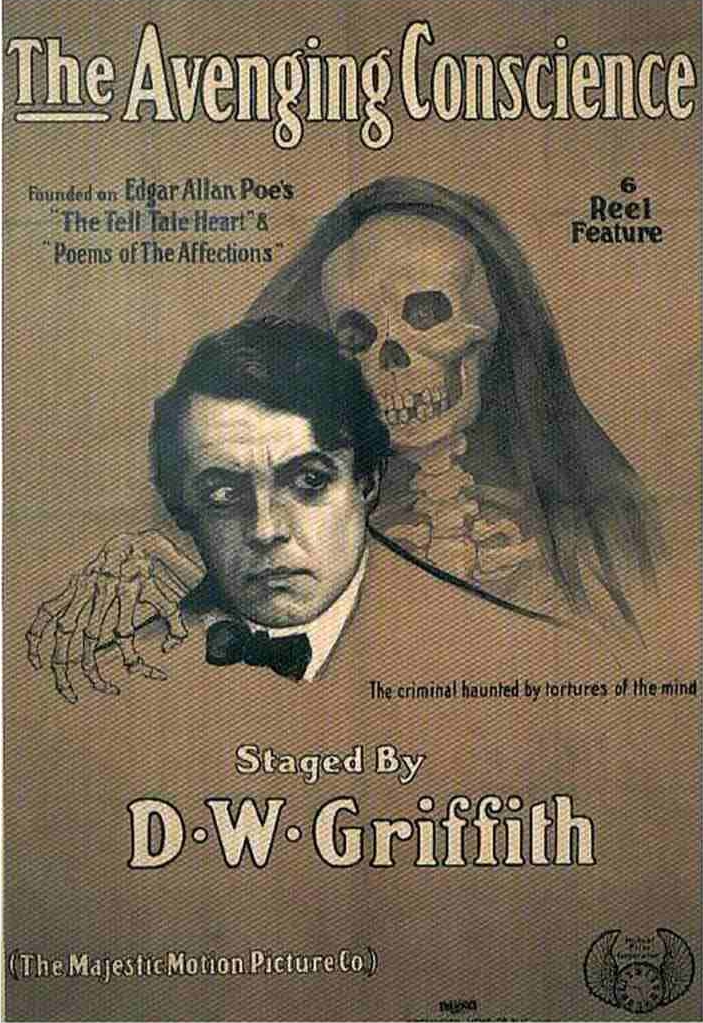
In 1914, that director was none other than D. W. Griffith, in the midst of a highly successful transitional period in his career. The previous year, as an employee of Biograph, he had secretly made his first feature-length film, Judith of Bethulia. Biograph, peeved at Griffith’s defiance and convinced that audiences would not sit still for the full hour, refused to release it. In response, Griffith took his entire crew and defected to the Mutual Film Corporation, where he was given autonomy to produce his own films as joint head of the new Reliance-Majestic Studios. The Avenging Conscience (subtitled “Thou Shalt Not Kill”) was the last of four feature films that Griffith produced that year before beginning work on The Birth of a Nation. It is America’s first feature-length horror film.

For inspiration, Griffith turned to the man whose name is synonymous with the American tradition of Gothic terror and suspense, Edgar Allan Poe, freely adapting elements from several of Poe’s best-known stories and poems into an unmistakably Griffith-ian tale of morality and melodrama. Griffith had used Poe as a cinematic subject at least once before, in a brief biographical short made five years earlier to coincide with the hundredth anniversary of the author’s birth. (How strange to realize that this film is further removed from us than that event was from Griffith.)

The plot of The Avenging Conscience draws most heavily on “The Tell-Tale Heart,” depicting the travails of a young man (played by none other than Henry B. Walthall, the star of Birth of a Nation) whose uncle (and guardian) forbids him to marry his true love, a girl whose appearances are accompanied by quotations from Poe’s “Annabel Lee” (Blanche Sweet, whose credits include the title role in Judith of Bethulia). Thwarted and despairing, the young man observes a spider killing a fly that has been caught in its web, and then watches a swarm of ants kill a spider. In his troubled state of mind, he concludes that nature is “one long system of murder,” and hatches a plot to kill his uncle (whose eye-patch suggests the single, dead “vulture eye” of Poe’s story) and conceal the body behind the brick facade of the fireplace. Unfortunately, there is a witness to his crime, and he is blackmailed for a portion of his inheritance.

To make matters worse, his new independence is tainted by the intrusion of his uncle’s accusing spirit, and he is plagued with remorseful visions of a melancholy Christ and of Moses angrily wielding the 6th Commandment. Suffering a nervous breakdown, he has himself committed to a sanitarium, which both fails to cure him and arouses the suspicions of an investigating detective. The young man’s fragile psyche quickly disintegrates in the face of intense interrogation, and he confesses to his crime before fleeing. A brief manhunt ends with the young man hanging himself and his sweetheart throwing herself off of a cliff. However, in a surprise twist, the young man awakes to find that it has all been a dream and his uncle is still alive and has reconsidered the situation, and everyone ends happily and at peace.

All of Griffith’s talent as a cutting-edge filmmaker and shortcomings as a hopelessly old-fashioned storyteller are on full display here. The cast includes several Griffith regulars like Spottiswoode Aitken, George Siegmann, and Mae Marsh (all of whom would go straight on to major roles in Birth of a Nation), but Marsh’s character is a particular oddity here. She plays a lovestruck maid opposite Robert Harron’s oblivious grocery boy in a comic subplot that feels jarringly out-of-place, and then vanishes 20 minutes in.

The whole first act, which ought to move swiftly into darker territory once the characters have been established, lags on and on as though Griffith is reluctant to reach his destination. The final scene in the movie is reminiscent of the grand conclusions of Birth of a Nation and Intolerance, depicting the two lovers enjoying a natural scene overlaid by a beatific vision of Pan charming forest animals and children in cheap costumes, but the slight subject matter renders the device even sillier here.

Still, despite obvious flaws, The Avenging Conscience excels throughout what is presumably the “dream sequence” portion of the film. Griffith’s seamless editing in the scene where the young man observes the brutality of nature serves as an apt and visually-arresting device for introducing the idea of murder. Griffith then ratchets up the tension as the young man works himself up to the deed. Having him forgo the relatively clean kill with his revolver to physically strangle the old man is a particularly visceral touch, and the audience is immediately implicated in the terror of the young man’s guilt through the suspense of whether he will be caught. Trick camera effects are also well-employed at several points to summon the ghostly uncle.

The film’s greatest success, though, is the confession scene. Lacking both sound and descriptive text to suggest the beating of the victim’s “hideous heart” that drives the protagonist of Poe’s story over the edge, Griffith relies on a tour-de-force of impressionistic editing to evoke a rhythmic tapping that is almost audible.  Cutting rapidly between the ticking clock, the detective’s foot tapping the floor, his pencil tapping the table, and the nephew’s darting eyes, Griffith works both protagonist and audience into a near-frenzy until the nephew rushes to the door, half-mad. Throwing it open, he witnesses a ghoulish procession of images suggesting hell, death, and encroaching doom. The combination of anxiety and the grotesque make this scene the horrific climax of a film that offers little in the way of true horror.

The many elements of romantic melodrama in the movie, coupled with the overtly didactic tone indicated by the subtitle “Thou Shalt Not Kill,” and the general lack of legitimate scariness (particularly to a modern audience) may render this film’s horror pedigree somewhat questionable. Nevertheless, it does fit Robin Wood’s definitive description of the genre in “The American Nightmare”:

the true subject of the horror genre is the struggle for recognition of all that our civilization represses or oppresses, its reemergence dramatized, as in our nightmares, as an object of horror, a matter for terror, and the happy ending […] signifying the restoration of repression.

In early cinema, in fantasy films as well as horror and other genres, the involvement of the supernatural was almost universally revealed at the end to have been “only a dream” (a device that remained common after the advent of sound films, as evident in such famous examples as 1939’s The Wizard of Oz). As Wood explains, “the conditions under which a dream becomes a nightmare are that the repressed wish is, from the point of view of consciousness, so terrible that it must be repudiated as loathsome, and that it is so strong and powerful as to constitute a serious threat.” The overuse of this device in early films may well indicate the heightened repression of a pre-Jazz Age audience and their need for reassurance before exiting the “dream world” of the movie theater.

In this case, the emergence of the repressed occurs within a literal nightmare, which (by Wood’s definition) is somewhat redundant. Still, there is an element of catharsis when the young nephew of The Avenging Conscience awakes from his dream and is relieved to discover that he has not committed a murder. He proceeds to reveal the dream to his uncle, and the two share a hearty laugh about it. It does not seem to occur to either of them that the dream has revealed the nephew’s true (though repressed) desire to enact his uncle’s death. The audience, as well, is comforted to learn that young people in love are not capable of patricide, after all, even if they are frustrated with the restrictions placed on them by their elders.

The film’s central conflict also fits Wood’s description of the basic formula of horror: “normality is threatened by the Monster,” and either is or is not defeated. Here, as in many of Poe’s presciently pre-Freudian tales of psychological terror, “normality and the Monster are two aspects of the same person.” The young man is a dutiful nephew and devoted lover, but also a coldly-calculating killer. That this murderous monster exists “only” in a Poe-fueled dream should hardly be comforting to anyone who recognizes the truth it reveals: that everyone has a dark side waiting to be unleashed. But for movie-going audiences in 1914, such truths were best confined to a dream within a dream, as only the feverish nightmare of a character inhabiting the collective reverie of the motion picture screen.

Harry Potter and the Deathly Hallows: Part 2

•July 15, 2011 • 1 Comment

starring Daniel Radcliffe, Rupert Grint, Emma Watson and Ralph Fiennes
written by Steve Kloves and directed by David Yates
Rated PG-13 for some sequences of intense action violence and frightening images.
91%

Picking up immediately where the first part left off, as the evil Lord Voldemort (Fiennes) takes possession of the powerful Elder Wand and launches an all-out attack on Hogwarts, Harry Potter (Radcliffe) and his friends must move swiftly to recover and destroy the remaining Horcruxes that make Voldemort immortal and invulnerable before the forces of darkness overrun everything they hold dear.

Hard to believe now that, 15 years ago, Harry Potter existed only in the imagination of author J. K. Rowling. Strange to realize that the current generation of kids and teenagers don’t remember a world without Harry Potter and the cultural juggernaut that he became. And yet, all things must eventually come to an end, even the longest-running, most financially-successful continuous film franchise in history.* Given that status, Deathly Hallows: Part 2 has a great deal of expectation to live up to, though my own hopes for this series have remained low since every film after the third sacrificed character development and the richness of the wizarding world to focus on the action set-pieces.

I have made no secret of my annoyance with the mediocrity of the second half of the Harry Potter film series, which I would classify as barely coherent “good parts” versions of the books on which they are based. Even the more exhaustive approach of the first half of Deathly Hallows felt like too little, too late, and only underscored the woeful inadequacies of the previous films.

Happily, none of that baggage really seemed to matter amidst the sweeping grandeur of the final film of what suddenly feels like a far more epic saga. Trying to imagine Deathly Hallows crammed into a single film is impossible (almost as impossible as imagining the same treatment for Goblet of Fire, Order of the Phoenix, or Half-Blood Prince, but okay, I’ll let it go). The final battle is both huge and deeply personal, as familiar faces flash past, locked in mortal combat. The level of death and destruction is frightening, driving the threat palpably home, and the effects are dazzling, probably the best the series has ever offered. Best of all, the supporting characters, brought to life by perhaps the most star-studded cast of all time, finally have a chance to shine one more time before the end.

In addition, splitting the story in half has allowed time for emotional revelations and plenty of significant, lingering glances (although perhaps a few too many of the latter). Here is a film that never lets us forget its portentousness. Some moments are so weighted down with the gravity of their own significance that they bring the film to a grinding halt, too, but perhaps this is an indulgence that can scarcely be avoided in the grand finale of an 8-film story arc that has been a decade in the making. Another difficulty for a film that is all climax is the anti-climactic feeling of let-down at the end. This is not so easy to dismiss. The movie builds and builds and builds to an unbearable pitch, and then drops the audience into the end credits almost entirely sans catharsis.

To explain why that is, it is necessary to take a moment to discuss the film as adaptation, and to reveal some details in this paragraph and the next that could be considered spoilers, particularly to anyone who hasn’t read the book. In Rowling’s version, when Harry has his final showdown with Voldemort, they are surrounded by all of the other characters, and Harry’s victory is accompanied by a jubilant outburst that explodes off the page as everyone celebrates the end of the long months of worry, sadness, oppression, and death. In the film, there are no witnesses to the final battle between Harry and Voldemort, nor is there any indication that anyone else even knows the Dark Lord is dead when Harry re-enters the school and finds everyone calmly eating breakfast. There is an enormous sense of relief, but no feeling of joy. The film draws to a close in a mood of quiet, contemplative exhaustion, but without any of the elation that we would expect.

This is a Big Deal, and I think it brings the franchise limping into port when it should have entered triumphantly under full sail, but large ships are unwieldy (almost as unwieldy as this analogy is becoming), and the filmmakers are to be commended for at least bringing this one in more or less intact. Meanwhile, I had two more quibbles with the adaptation, both of which relate to the religious undertones of the book, which I might as well air here. The first is that Harry does not extend a chance for redemption to Voldemort, as they do not really converse during their final duel. (Much of that dialogue is compacted and transferred to a later scene.) The second is, as near as I can tell, a new line of dialogue where Dumbledore stops and amends one of the greatest and most significant phrases in the series “Help will always be given at Hogwarts to those who ask for it” to “Help will always be given at Hogwarts to those who deserve it.” I don’t want to take up too much space here going into why I have such a problem with this change, but more importantly, I can think of no reason that explains why it was done or what it is meant to signify.

These are relatively small matters. There is no doubt that this the greatest Potter film since Prisoner of Azkaban. I look forward to the chance to watch both parts of Deathly Hallows back-to-back, and I might even be convinced to rewatch the entire series in light of its successful conclusion, though I have seen the last four only once apiece and not felt the lack. Neither of the final films seems to have been meant to stand alone, and, if they can’t quite hold a candle to the pleasures of reading the series they are based on, they at least live up to the cinematic promise that such a massive undertaking has led us to expect. As adaptations of beloved stories go, it would be greedy to ask for anything more than that.

*A handful of other franchises have run longer than 8 films (most notably the Bond films, with 23), but none without regularly cycling through major characters or the actors who play them.

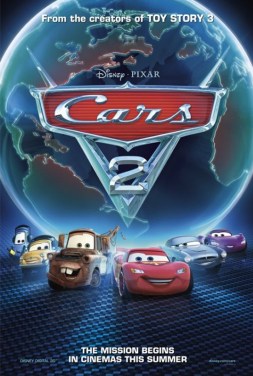
Cars 2

•June 28, 2011 • Leave a Comment

starring Larry the Cable Guy, Owen Wilson, Michael Caine, and Emily Mortimer

written by Ben Queen & directed by John Lasseter and Brad Lewis
Rated G.
62%

When billionaire oil tycoon Sir Miles Axlerod (Eddie Izzard) stages the first-ever World Grand Prix to showcase his new alternative fuel, Lightning McQueen (Wilson) agrees to compete, bringing best friend Tow Mater (Larry) along for the globetrotting ride. Soon, the bumbling Mater is working with British spies Finn McMissile (Caine) and Holley Shiftwell (Mortimer) to foil a sinister plot involving Big Oil and a confederation of maligned and bitter “lemons.”

What a terrible novelty Cars 2 is: A bad film by a studio that has been reliably cranking out masterpieces for a decade and a half. It’s almost the reverse of last year’s How to Train Your Dragon from DreamWorks, which was a masterpiece from a studio that has reliably delivered mediocre films. Cars 2 is not the first Pixar film to be less than perfect; A Bug’s Life will probably never be considered a “classic,” and the first Cars was none too compelling. But while fans might argue themselves hoarse deciding which is the greatest of the many magical stories Pixar has brought to life, there isn’t any room left for disagreement about which is their worst.

Is this a bad film, though, or merely bad by comparison? Am I just holding Pixar’s movies to an impossible standard (albeit a standard they have set), thus ruining what would otherwise have been a more enjoyable experience? Perhaps, but I don’t believe so. I know what I like, and I disliked this movie after going in with low to moderate expectations. In fact, if it weren’t a Pixar production, I wouldn’t have gone at all. Maybe this movie was simply not for me, though. I am not a fan of NASCAR, or car racing in general, and I know very little about cars beyond how to drive and maintain them. There were definitely jokes and references in Cars 2 that went over my head, but again, I don’t think that’s the whole story.

Any movie that genuinely rates a sequel introduces us to a group of memorable characters who inhabit their own unique world. Whatever else we might say about Cars, it did do that much. A good sequel, then, will find new ways for those characters to grow and change, introduce new and interesting characters, and give us a chance to see more of the world they inhabit. The trouble is that Cars 2 only manages the second of those things, and only partially succeeds at that.

The most obvious problem is the world of Cars. It’s stupid. It doesn’t make any sense. We didn’t really see enough of it in the original for this to pose a significant problem, but in the jet-setting sequel, it’s impossible to get away from the issue. In Pixar’s other films, their characters inhabit the same world humans do, and much of the imaginative charm of these stories is the way they depict the secret lives of toys, bugs, monsters, fish, rats and what have you as they go about their business undetected. There are no humans in Cars. There are only, well . . . cars. This raised some strange questions. In Cars 2, those questions grow so large that they totally overwhelm the story.

Leave aside for a moment the quandaries of a world in which cars presumably manufacture themselves and exist as a sentient life-form that is an end in itself rather than as a mere means of transportation. In Cars 2, the characters journey all over the globe, and we are constantly slapped in the face with the fact that this isn’t just some alternate world inhabited by cars instead of people; it is our world and we have been mysteriously replaced by our vehicles with everything else left untouched.

Everywhere the cars travel they are surrounded by recognizable landmarks of our cultures and societies: Notre Dame and the Eiffel Tower in Paris, a rustic Old World village in Italy, Buckingham Palace and the Big Ben in London, etc. So many of these man-made (car-made?) landmarks that the film visits are in cities that have existed for hundreds or thousands of years, but the oldest automobile is, what, 150 years old? Where did all of this stuff come from? Did the cars’ ancestors build it all? Were they wagons? Chariots? Carriages? But the horseless kind, right? Because there aren’t any animals in this world. In one scene, a flock of tiny airplanes flutter away from a fountain, but that’s about it.

As these questions started to accumulate, I found it more and more difficult to make sense of anything, and my suspension of disbelief started to implode. There is a throwaway joke at one point, a cheap laugh, where Mater asks, “Is the Popemobile Catholic?” Then, a few scenes later, we see the Popemobile attending the race in Italy, riding in what is presumably the Popemobilemobile. Wait, what? I had idly wondered a few scenes before why cars would have churches: To worship and observe the sacarments, of course. Was the Jesusmobile wrecked for the sins of all vehicles? Do they gather for the Eucarist and sip motor oil and nibble hubcap wafers? The world of Cars is built on a whimsical but shallow conceit that it cannot sustain in any sort of coherent fashion.

I am over-thinking this to an absurd degree. The point is: Whatever was going on in Cars 2 was not interesting enough to keep these sorts of things from distracting me. Maybe I am an anomaly in this respect. Maybe these things won’t bother anyone else. The world of the movie, for all its absurdity, is still gorgeous to behold. Pixar hasn’t slouched in the visual department. So let’s lay that aside and consider the real reason this movie exists: Every year since 2006, Cars has been a multi-billion dollar merchandising bonanza. Cars 2 stands to boost those profits to a degree that exceeds my imagination by exponentially increasing the number of things that can be turned into cool toys, and deploying them in what amounts to a feature-length commercial.

Certainly the new major characters are a lot of fun, particularly Michael Caine’s way-cool, gadget-laden spy car and John Turturro’s charmingly arrogant Formula 1 Italian, Francesco Bernoulli. I would totally play with a toy based on Jason Isaacs’ Siddeley the spy plane, or the mad genius Professor Z. There are also some fantastic cameos, like Bruce Campbell’s brief appearance as an American spy car. But so much of the expanded population we see in the movie seems based on paper-thin stereotypes. There are some great laughs in the Cars 2 versions of Japan, France, Italy, and England, but I couldn’t shake the uncomfortable feeling that some of these cultures were being reduced to their broadest caricatures (okay, I’ll stop).

That uncomfortable feeling was only heightened by Mater’s character arc. Most of the original characters, though present, are lost in the crowd this time around, but Mater has moved to the fore as a celebration of loud-mouthed American ignorance abroad. As the automotive avatar of redneck culture, it is only natural that Mater’s fish-out-of-water experiences outside of his beloved Radiator Springs would form the comedic center of the movie, but by making him the main character, his abrasive buffoonery becomes the problematic target of that all-too-cliche kid movie moral: Be true to who you are.

Early in the movie, Mater’s oblivious and often rude antics are a source of constant embarrassment for Lightning McQueen, and even cause the loss of a race at one point, creating a rift between the two friends. Later on, Mater finally realizes that everyone sees him as an idiot, and painfully recalls his outrageous behavior, prompting him to seek reconciliation. But not so fast, because it is McQueen who comes crawling back first to tell Mater that he doesn’t have to care about what other people think, a view which is further confirmed by the supporting characters.

Thus, Mater’s intolerable boorishness and bad manners are affirmed, and even lionized, as an admirable quality. Presumably a character learning that you don’t have to sacrifice your identity to be polite and that it isn’t arrogant or elitist to acquire a little cultural sensitivity is just too nuanced, even for a movie filled with international intrigue in a battle between fossil fuels and alternative energy.

I get it. I really do. Cars 2 is a feature-length version of the sequences at the beginning of the first and third Toy Story films, where Andy stages imaginative and outlandish adventures in his bedroom. This is John Lasseter, playing in his bedroom with his toy cars for 2 hours. But there’s a reason the hilarious train robbery scene that kicks off Toy Story 3 didn’t continue into the rest of the movie: It would have amounted to empty, if sporadically entertaining, spectacle from storytellers who have consistently prompted us to develop an appetite for something more, and then delivered that something more. Cars 2 was not an unbearable experience, but I went home hungry.

Super 8

•June 10, 2011 • Leave a Comment

starring Joel Courtney, Riley Griffiths, Elle Fanning, and Kyle Chandler
written & directed by J. J. Abrams
Rated PG-13 for intense sequences of sci-fi action and violence, language and some drug use.
94%

It is the summer of 1979, and Joe Lamb (Courtney), son of a small-town deputy (Chandler), is adjusting to the loss of his mother and helping his buddy Charles Kaznyk (Griffiths) film a zombie movie. In the midst of capturing a crucial scene late one night, Joe, Charles, their friends, and Alice Dainard (Fanning), witness a catastrophic train accident. The next day, the Air Force is in town, all sorts of strange things are happening, and the kids’ “super 8” camera may have captured some footage that the government doesn’t want anyone to see.

J. J. Abrams is so confoundedly tight-lipped about his film projects that it is difficult to know what manner of revelations about this film would constitute “spoilers.” That makes the reviewing process difficult and unwieldy, but there is nothing complicated or awkward about the simple, undeniable pleasure of watching this movie. With this throwback to the sorts of films Steven Spielberg was making three decades ago, Abrams milks the nostalgia factor just enough to evoke fond memories without losing his storytelling edge.

It would have been so easy for this film to be E.T. meets Cloverfield that it feels almost defiant in turning out to be something else entirely. Every summer we all seem to briefly forget that there can be blockbusters that are about something more than their own special effects, and it’s always a good summer when a movie like Super 8 shows up to remind us. Unlike, say, Pirates 4, this is not a movie about bewildered humans wandering aimlessly through a plotless wasteland of digital creatures and stuff blowing up. It is a movie about grief and forgiveness and friendship and wildly-improbable summer adventures in which things also happen to blow up rather spectacularly from time to time.

In fact, the primacy of story is, if not a major theme of Super 8, at least present as a nod to the audience and a word of advice to other filmmakers. In a scene which crosses the line into meta-commentary on the film itself, Charles explains to Joe that their movie is going to need more than just “good zombie deaths” to compete in the film festival. It needs a story with characters that the audience will care about, or else it will be nothing at all. Although Abrams may have tipped his hand too far with this bit of dialogue, the point is well taken, and even though Abrams has revealed exactly what he’s up to, we find ourselves caught up in the fates of his characters anyway.

It doesn’t hurt that he has assembled a brilliant ensemble of child actors, most of them complete unknowns (with the obvious, but welcome, exception of Elle Fanning). In fact, Super 8 marks the film debuts of both Courtney and Griffiths, the two leads. You’d never know it; they both do a phenomenal job in addition to the novelty of bringing fresh faces to the film. Seriously, where did they find these kids, and how did they get so lucky? But, to see where Abrams is getting his cues, go back to a movie like The Goonies (1985) in which familiar names like Sean Astin and Josh Brolin got their start as unknown child actors headlining a major feature film produced by Spielberg.

Oddly, the mysterious force at the center of the effects-driven mayhem in Super 8 is so totally upstaged by the kids and their story that its presence in the film is almost superfluous. And, although I will play the game and avoid discussing it further out of respect for anyone who has not yet seen the movie, the level of secrecy, in the advertising and in the movie itself, is absurd. There is nothing particularly original or surprising about the major plot revelations that take place late in the film, and the mystery surrounding the whole business just feels self-indulgent. Abrams should give his film-literate audience a bit more credit. Although, perhaps he simply meant this movie for a generation that hasn’t grown up on a steady summer diet of Spielberg. Either way, that complaint rather pales in the light of a chance to enjoy this welcome dose of fun and meaningful blockbuster fare.

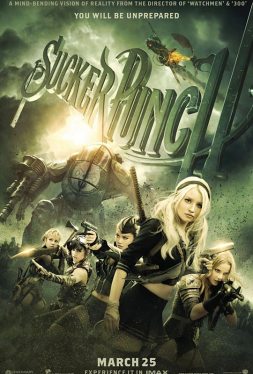
Sucker Punch

•March 27, 2011 • 4 Comments

starring Emily Browning, Abbie Cornish, Jena Malone, and Carla Gugino
written by Zack Snyder and Steve Shibuya & directed by Zack Snyder
Rated PG-13 for thematic material involving sexuality, violence and combat sequences, and for language.
45%

After Baby Doll (Browning) is committed to an insane asylum by her evil stepfather, she retreats into an adrenaline-fueled fantasy world with fellow inmates Sweet Pea (Cornish), Rocket (Malone), Blondie (Vanessa Hudgens), and Amber (Jamie Chung). The five must work together to retrieve the five items that they will need to stage an escape before Baby is lobotomized in five days time.

Interestingly enough, this is Zack Snyder’s first screenwriting credit since he co-wrote 300. It can be no coincidence, then, that I haven’t seen a movie as repulsively exploitative, self-defeating, and relentlessly misogynistic as Sucker Punch since I squirmed my way through 300 five years ago. Despite the fact that Snyder spends nearly two hours literally nuking the screen with the most ridiculously cool things he can think of, his overt hatred of women taints every frame with a nauseous aftertaste.

There can be no denying Snyder’s immense talent as a filmmaker, so I won’t even try to pretend he isn’t good at his job. This is a man with an incredibly fine level of artistic control. He has a superb grasp of the elements of cinema at his disposal, and a visual aesthetic that is as magnificent as it is distinctly his own. But that is no excuse for the outrages that are on display here from the very first minute of the movie. Sucker Punch is what happens when a talented director has an eye for beauty and an ugly imagination. The only real question is how, despite his skill, Snyder got so many talented actresses to play out his warped fantasies for the camera.

The bulk of this film revolves around stylized depictions of sexual violence perpetrated against helpless women by grotesque lechers, and sexualized violence perpetrated by women doing battle in skimpy fetish costumes. The degree to which the camera lingers lovingly on both is downright disturbing for anyone who happens to be paying attention. It’s all undeniably gorgeous to look at, but what is it that we’re looking at, exactly? The audience is cordially invited to gorge themselves on a lush visual feast of repugnant sleaze that, most outrageously of all, somehow milked a mere PG-13 rating out of the obviously broken MPAA.

Meanwhile, the storytelling is about as brain-dead as anything I’ve seen. While, again, every action set-piece is absurdly awesome in a video game/music video sort of way, nothing of substance strings them all together and they lack both weight and internal consistency. Snyder is obviously hoping that we won’t notice how stupid it all is amidst the fireworks of his masturbatory orgasm of cinematic self-indulgence. So pervasive is this phenomenon that it is impossible to even single out a particular sequence for ridicule. Consider, though, the manner in which Snyder clumsily strings his ideas together to maximize the combination of exploitation and titillation:

Ostensibly the story is about Baby Doll escaping from the insane asylum. Only it isn’t interesting enough (or sexy enough) to just have her be in an asylum, so almost immediately her imagination transports her to some sort of underground club where she and the other inmates are sexual slaves, forced to perform for wealthy and powerful clients in outfits that are much more pleasing to the male gaze than asylum-wear. Except, even that isn’t interesting enough, so Baby Doll immediately discovers that she has the ability to hypnotically seduce anyone who watches her dance as she fades into a trance in which she does battle as a sexy schoolgirl against orcs, dragons, steam-powered Nazi zombies, giant robot samurai, and so on ad nauseum. That’s just a taste, though. It’s really far more incoherent than I am capable of expressing.

Probably the worst thing about Sucker Punch is not that it exists, but that so many people aren’t going to recognize what it truly is. They’ll confuse the scenes of infantilized, fetishized young women wielding guns and swords as symbolic of female empowerment, mistake the muddled confusion between reality and fantasy for some kind of profound statement about psychological coping mechanisms, and completely miss the significance of the film’s thin pretense that it abhors violence against women while it continually wallows in it. Zack Snyder should be ashamed, but I’ve just seen a pretty strong body of evidence that he hasn’t got any shame, and I expect he’ll be laughing all the way to the bank.

The Oscar Snub

•March 2, 2011 • Leave a Comment

It is a tradition almost as old and rich as the Oscars themselves: The sneaking suspicion, year after year, that maybe, just maybe, the Academy hasn’t chosen the most excellent possible piece of cinema as their Best Picture. Some even go so far as to suggest that Oscar has never actually gotten it right. While I would say this is an exaggeration, it’s only natural that, as time passes and opinions rise and fall, some years should stick out as particularly egregious examples of Oscar getting it dead wrong. Even then, while everyone agrees that the wrong movie won the ultimate prize, there may not be a clear consensus about who the most worthy winner actually was.

In the spirit of this time-honored tradition of second-guessing the biggest film awards show of the year, have a look at this short “Time” piece highlighting what they consider to have been the 10 most significant Best Picture snubs of all-time. And, in honor of the equally prevalent tradition of second-guessing the second-guessers, I present my thoughts on their thoughts. This list is in major need of discussion. After all, they’ve completely missed the three biggest snubs of them all . . .

There’s one very important thing that needs to be said about the Oscars, and awards shows in general, before one begins such a discussion. The entire concept of awards shows and what they are supposed to be about is wrong. Human nature seems to demand a clear winner, but it’s much better to appreciate awards shows as a celebration of excellence that includes not only a winner, but a pool of nominees from which the winner is chosen. Picking the winner is a formality (and if no winner was chosen, what would we argue about?), but the point is, most years, no one movie is the best of the year.

Sometimes, it’s like picking the best slice of a chocolate cake; all of these great films together represent the best the year had to offer, and all of them should be appreciated and enjoyed by as wide an audience as possible. At their best, awards shows and the whole awards process connect audiences with great art that they might not have been aware of otherwise, and get us all talking about them and their relative merits. It’s a magnificent conversation that I always revel in.

With that in mind, I’ve taken a look at each year covered in the “Time” list and pulled out a small selection of films they haven’t mentioned, rather than just one, and added a little commentary on the subject of “relative merits” . . . Enjoy, and feel free to toss in your own thoughts below.

1997 – They say . . .

L.A. Confidential should never have lost to Titanic. I agree, but 1997 was a surprisingly good year for films, both noticed and overlooked. Here are four films I’d submit for the Best Picture ballot alongside L.A. Confidential, any one of which could have easily replaced Titanic, and most of which I would pick over L.A. Confidential (which I quite like):

Gattaca – A brilliant, noir-ish twist on the gene-bending future of Brave New World
The Sweet Hereafter
– Atom Egoyan’s achingly lyrical examination of people confronted with unimaginable tragedy
Jackie Brown
– Quentin Tarantino’s whip-smart homage (okay, one of his homages) to the blaxploitation films of the ’70s
Boogie Nights
– Paul Thomas Anderson delivers a towering epic about one star’s rise and fall in the porn industry during the late ’70s and early ’80s

1989 – They say . . .

Born on the Fourth of July should have beaten Driving Miss Daisy. They may have a point, but by 1989, the Vietnam War film had run its course as sure-fire Oscar bait. Here are four more-deserving candidates:

Crimes and Misdemeanors – Woody Allen’s greatest dramatic achievement; a thought-provoking rumination on the themes raised by Dostoevsky’s Crime and Punishment
Henry V
– Perhaps the best of Kenneth Branagh’s adaptations of Shakespeare
Jesus of Montreal – A fascinating examination of the mutually-transformative power of art and the gospel, each on the other
Indiana Jones and the Last Crusade – A glorious capstone on what many feel ought to have been only a trilogy of films, and the best cinematic Grail Quest of them all

1990 – They say . . .

Goodfellas ought to have crushed Dances With Wolves. No doubt. But what about . . .

Rosencrantz and Guildenstern Are Dead – A brainy adaptation of an equally brainy play that throws Shakespeare’s Hamlet onto its head by rewriting it through the eyes of a pair of minor characters
Jacob’s Ladder – A mind-bending pseudo-spiritual pseudo-horror film that will bury itself deep into your psyche, and then stay there
Edward Scissorhands – Tim Burton’s masterful suburban fairytale, and the first of many collaborations between Burton and Johnny Depp
Miller’s Crossing – Magnificent early Coen Brothers, and a top-notch gangster flick to boot

1980 They say . . .

That Raging Bull should never have lost to Ordinary People. I mostly agree. I prefer Ordinary People, but Raging Bull is clearly the superior film on pretty much every level. Still, there are some other possibilities:

Airplane! – An iconic disaster spoof that never stops being funny
The Shining – Stanley Kubrick’s disturbingly memorable foray into horror, based on the Stephen King novel
The Elephant Man – David Lynch’s most accessible film, and the direct inspiration for the Best Makeup Oscar
The Empire Strikes Back – The best of the Star Wars films, and an awesome and entertaining movie in its own right

1964 They say . . .

Dr. Strangelove should have gotten the award over My Fair Lady. They are dead on. Dr. Strangelove was the greatest movie of 1964, one of the greatest movies of the 1960s, and perhaps the best comedy of all time. Here are some more ’64 classics:

Mary Poppins – Disney’s greatest live-action success, and a musical with twice the charm of My Fair Lady
Becket
– Based on the play, features Peter O’Toole as Henry II, who finds himself butting heads with his best friend Thomas Becket (Richard Burton) after making him Archbishop of Canterbury
Marnie – Lesser Hitchcock is still better than the best of most of the rest, and that remains true of this rather Freudian tale of frigidity, sexual repression, and kleptomania
The Train – A spectacular slow-burn action-thriller in which the French Resistance must delay a Nazi train that is trying to get a huge shipment of stolen art out of Paris ahead of the advancing Allies

1998 – They say . . .

That Shakespeare in Love shouldn’t have beaten Saving Private Ryan. I say I didn’t know anyone was still lauding that propagandist bit of Greatest Generation fetishism. I actually prefer Shakespeare in Love, despite its flaws. Not that Spielberg made a bad movie, it’s just not the best. It’s not even the best WWII movie to come out that year. In fact, a boatload of amazing films come to mind when I think of 1998, and I probably wouldn’t even put Saving Private Ryan on my top 10 above movies like Rushmore, Pleasantville, or The Red Violin . . . To say nothing of the five I would have chosen to fill the nominee slots:

The Truman Show – Jim Carrey does great dramatic work in a fable about the ultimate reality TV show that has only gotten more relevant with the passage of time
American History X – A hard-hitting examination of racism in America which, though limited in scope and a bit facile in resolution, remains incredibly powerful
The Big Lebowski – The best and most philosophical of the Coen Brothers’ comedies, and probably their most quotable film to date
Run Lola Run – A non-stop, hyper-kinetic adrenaline shot that never gets old, even after several repeated viewings
The Thin Red Line – Recently a tagline for Inglourious Basterds informed us that we had “never seen war” until we’d seen it through the eyes of Quentin Tarantino . . . this movie shows that that claim is actually true of Terrence Malick

1944 – They say . . .

Double Indemnity shouldn’t have lost, and especially not to Going My Way. Hear, hear. Despite what I said above, I probably would put this one in the top 3 worst upsets in Oscar history. Double Indemnity was the best movie of the year, and maybe even the best film noir of them all. 1944 also brought us:

Laura – Another lovely little noir classic with some startling twists throughout
Lifeboat – Hitchcock’s love of technical challenges is on full display in this film set entirely inside of a small boat adrift on the open sea
Meet Me in St. Louis – Vincent Minelli’s spectacular Judy Garland musical is raucous turn-of-the-century fun
Gaslight – a spectacular psychological thriller that features an incredible cast and a spooky Victorian setting

1941 – They say . . .

How Green Was My Valley shouldn’t have beaten Citizen Kane. That’s almost too obvious to even say. Everyone knows that, even if they’ve never seen Citizen Kane (but how many today have seen How Green Was My Valley?). I wouldn’t dare to question the conventional wisdom about Kane, but 1941 was a pretty good year for other reasons as well:

Sullivan’s Travels – A classic social dramedy that manages to be both a great examination of Depression-era America, and a philosophical statement about the purpose of the film industry
The Maltese Falcon – The first really great film noir, and an archetype of the genre, featuring iconic roles for Humphrey Bogart, Peter Lorre, and Sydney Greenstreet
Dumbo – A short but sweet Disney animation classic, featuring a winsome protagonist who doesn’t have a single line of spoken dialogue
The Lady Eve – Preston Sturges produced not one, but two amazing films in 1941: Sullivan’s Travels and this, a hilarious screwball comedy with Henry Fonda and Barabara Stanwyck

1981 – They say . . .

Chariots of Fire should have lost to Reds. I’m not so sure that’s true, and at the very least, they’re doing Chariots a gross injustice. Plus, they’re overlooking another pair of worthy contenders (okay, yes, I couldn’t find a lot going in ’81):

Das Boot – The ultimate submarine movie, and Wolfgang Petersen’s masterpiece
Raiders of the Lost Ark – The one movie of 1981 that everyone has seen and loved should have taken the prize

1976 – They say . . .

Rocky should have lost to Taxi Driver, Network, All the President’s Men, or Bound for Glory. I’ve only seen the first three of those, but I’d definitely agree with any of them. Of course, the trouble is, they’ve picked too many candidates on this one, and I couldn’t nose up anymore worthy contenders. Of those choices, I’d have gone with Taxi Driver.

So that’s “Time” and their top ten Oscar snubs . . . Here are the three that they forgot. How could they?

1956The Searchers loses to Around the World in Eighty Days. The latter had length, budget, and a boatload of celebrities going for it, but the former is the greatest Western ever made, and the movie John Ford and John Wayne should have won their Oscars for.

1958Vertigo loses to Gigi. Alfred Hitchcock’s greatest thriller not only went unnominated for Best Picture, it lost one of its only two nominations to the shallow, utterly insipid and lackluster Gigi, which won an outrageous nine awards. The Academy will never live that one down.

1994Forrest Gump wins over Ed Wood, Quiz Show, The Shawshank Redemption, and Pulp Fiction. I mean, sure, Forrest Gump is cute and all, but come on. Maybe the voters just freaked out because they were drowning in too much quality cinema to make any kind of reasonable decision. I don’t know what happened. I just know it was wrong.