
Movie Screen, Time Machine: The 1920s

•September 15, 2012 • 1 Comment

A few weeks ago, I said the 1910s contained the most significant leap forward of any decade in movie history, but it’s worth noting that the most visible change occurred during the 1920s . . . well, actually, the most audible. As Donald Crafton says in The Talkies:

Silent and Sound cinema. Few demarcations are so sharply drawn, so elegantly opposed, so pristinely binary. In the movies, sound is either off or on. Everyday conversation, reference books, shelving in video stores, college film courses and their textbooks, film rental catalogs, and festivals are organized around this fundamental rift in the history of the medium. […] Sound divides the movies with the assuredness of biblical duality.

So, that obviously happened, and although Crafton goes on to question those assumptions, there’s no denying that the shift is a dramatic one for the casual viewer. But that’s late in the decade . . . The 1920s were essentially a silent decade, though not like the 1910s. The films of the 1920s have a fully-developed cinematic language. They are complex and sophisticated compared to the films of the previous decade, and even (in some cases) several later decades. The cinema of the ’20s is a full-fledged art form, not a developing one.

Now, while I could get away with discussing a mere 10 films as though they were an adequate cross-section of the 1910s, I can’t pretend that’s the case in the 1920s. What I observed in the films that I watched was a particular flair for the exotic and a penchant for spectacle. I saw fantastical flights of imagination and a fascination with foreign lands and cultures. I saw productions that required significant resources, with enormous sets, elaborate costumes, large casts, and intricate set-pieces. I saw surprisingly elegant camera work of a sort that all but disappeared for some time after the talkies arrived and temporarily confined the camera inside a stationary sound-proof box.

In short, it pained me to realize how unfamiliar I am with what is clearly one of the most dynamic decades in film history, and I will certainly be looking to remedy that situation as soon as my journey to the present is complete. Meanwhile, here are some more specific details about the films that I watched:

The Golem (1920)

This is a slice of ( early German horror, and no one did it better than they during this period. But the eeriest thing about watching this film today is that it is a Weimar retelling of the centuries-old legend of the Golem of Prague, a monstrous creature brought to life by a Rabbi to save the Jews from persecution. Paul Wegener wrote, directed, and played the title character. Wegener was not Jewish, and during the Nazi regime he appeared in propaganda films as an actor of the state, but secretly he worked against them. Considering his fascination with the golem (this was his third golem film), you’d think the Nazis could have seen that coming. Anyway, off-topic. The point is, it’s hard to watch a German film from 1920 that begins with someone seeing “grave danger to the Jewish people” written in the stars and not think ahead.

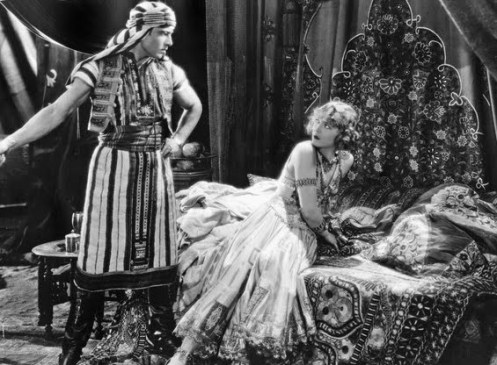
The Sheik (1921)

Cleverly labeled “The Shriek” by a snarky critic, this film launched Rudolph Valentino, the French-Italian “Latin Lover,” into the stratosphere of stardom, provoking a fanaticism in men and women that roughly parallels the contemporary response to the Twilight novels and movies. And, like TwilightThe Sheik is about an incredibly creepy “romantic” relationship. In this case, the titular desert chieftain, Ahmed, falls for a plucky Englishwoman, Diana, and kidnaps her when she has the audacity to set out across the desert without a European male to escort her. The remainder of the film consists of Ahmed systematically breaking Diana’s unladylike independent spirit until she realizes that she’s actually in love with him. But (unlike in the original novel, penned by a woman) at least he doesn’t rape her.

Nanook of the North (1922)

Regarded as the first feature-length documentary, this comes from a time when that designation meant something else. Sort of. We tend to regard non-fiction films as depictions of actual events and realities, even though we know that they are edited and manufactured in a way that imposes the filmmaker’s narrative upon us. Robert J. Flaherty felt that reality needed a bit more help. He wanted to capture traditional Eskimo family life, and he did, with riveting accuracy. Except that he staged all of it, assembling the “family” himself and getting his main character to forego the firearms he hunted with for the spear his ancestors used. Still, staged or not, you watch real Eskimos building a real igloo and tell me you’re not watching reality.

Our Hospitality (1923)

Buster Keaton is the master of full-on, belly-laugh-inspiring hilarity. His brand of comedy is visceral and intensely physical, and this comedy of antebellum life and Southern manners is one of his best films. This is one of those movies where, rather than pick a favorite part, one might be more inspired to make a top ten list of the funniest scenes, and then still feel like too many great moments were left out. To see Buster Keaton in action is to wonder what real point there might be to adding sound to the movies.

The Thief of Bagdad (1924)

Douglas Fairbanks was the first great swashbuckling action star, and this is surely one of the greatest adventure films of all time, tailor-made for his robust athleticism and sense of whimsy and fun. The scale of the thing beggars the imagination, and I know of no clearer example that demonstrates how film had matured from the previous decade. The giant, opulent sets dwarf the actors, and Fairbanks seems to have refused to allow anything to limit his vision, no matter how fantastical. The result is two and a half hours positively packed with battles, acrobatics, monsters, and magic.

The Phantom of the Opera (1925)

I think it seems a bit odd to a post-Andrew Lloyd Webber generation to imagine a silent film version of this story. But the story, of course, comes from a novel, which is equally devoid of the “sound of music” (as it were). The 1925 version, strikingly faithful to the original, brings the story brilliantly to life thanks to smart use of atmospheric locations, an excellent score (including some well-timed opera singing), and especially Lon Chaney’s incredible, iconic make-up. The real stand-out scene (among many memorable moments) is the masquerade, filmed in color, with the opera ghost’s eye-popping costume. Wow.

The Black Pirate (1926)

Speaking of early technicolor, I really have a strong association in my mind between silent film and black-and-white, as I think most people do. So it’s decidedly weird to watch a silent color film. This one is another Douglas Fairbanks swashbuckler, in which he plays the victim of pirates who swears revenge and accomplishes it by becoming a pirate himself. It’s high adventure on the high seas, and all that, and I can only imagine that the novelty of it played quite well, but I can’t say I found it terribly engaging otherwise.

The Jazz Singer (1927)

It’s hard to describe the experience of hearing Al Jolson speak the first words in a major feature film after having watched over a dozen silent films in a row. Certainly it can’t begin to match what it must have been like in 1927 to hear speech suddenly burst forth from the mouth of a moving picture, but it does give an inkling of how heart-stopping the effect must have been for audiences at the time. The story is maudlin, but it plays, and I love that it is a silent film except for when Jolson’s character sings, as though he is only really able to express and make himself heard through music.

The Crowd (1928)

Of course, sound didn’t just sweep through American cinema overnight, and my 1928 film is another silent classic. When asked decades later why there were not more movies about ordinary people, Jean Luc Godard replied, “Why remake The Crowd?” It’s not hard to see how this could be regarded as the definitive film about ordinary, anonymous existence amid the faceless masses of modern metropolitan life. I watched this film sandwiched between two fairly melodramatic musicals which, for all their use of sound, can’t touch the basic humanity of this story. And it was hard not to notice the extreme mobility of Vidor’s camera in contrast to the point-and-shoot of the early talkies.

The Broadway Melody (1929)

I wrote more extensively about this film here. Suffice to say that it was interesting as the first film of its kind, as a curious choice for Best Picture at the Academy Awards, and in short, as a cultural artifact, with all of the dusty entombment that label implies. There’s just not a lot here for contemporary audiences to enjoy, but it’s clear why it was successful in its day. This is a great jumping-off point for a train of thought about what makes a classic endure, and what sorts of popular films are destined to be just a flash in the pan.

Time to hit the Threadbare Thirties!
The Broadway Melody: Best Picture, 1929

•September 9, 2012 • 1 Comment

The Host: The 2nd Annual Academy Awards were hosted by William C. deMille, elder brother of (you guessed it) Cecil B.
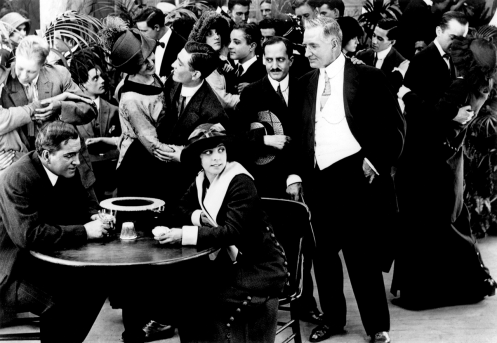
The Nominations: The Broadway Melody was nominated for 3 awards: Best Picture, Best Director, and Best Actress.

The Competition: Practically everything about this year’s ceremony is weird, beginning with the nominees. The heaviest competition this year was from The Patriot (a biopic, and the last silent film to be nominated for Best Picture until 2011) and In Old Arizona (a western featuring, of all things, the Cisco Kid), each with 5 nominations. Also in the running were Alibi (a crime drama) and The Divine Lady (a historical romance), with 3 nominations apiece, and Hollywood Revue, with a single nomination (for Best Picture).

This last is a particularly curious one. Like Broadway Melody, it was a musical released by MGM, but unlike the other film, Hollywood Revue is merely a plotless “talent show” featuring the MGM star roster (as the title suggests). As such, I can’t understand what it was doing on the list at all.

The Results: The oddities of the year continue with the outcome of the ceremony. Of the mere 7 awards that were given out for this year, each went to a different film, an anomaly that has never been duplicated. Thus, Broadway Melody is one of the three movies to win Best Picture and nothing else, while the other two awards it was nominated for went to Mary Pickford for her performance in Coquette (the silent legend’s first talkie) and Frank Lloyd for his direction of The Divine Lady.

The Film: Eddie Kearns, a moderately successful singer/songwriter on Broadway, is sure his new “Broadway Melody” will be a smash-hit, and he knows just who to perform it with. His fiancee, Hank Mahoney, and her sister, Queenie, have a traveling vaudeville act, newly arrived in New York City, and they’re hoping Eddie can provide their big break. As they struggle to convince producer Francis Zanfield to hire them, then to rehearse, Eddie falls for Queenie, who reciprocates. Unwilling to hurt her sister by stealing her fiance, Queenie entertains the attentions of notorious playboy Jock Warriner. Drama ensues, between songs, and love triumphs in the end. Sort of.

The Experience: The Broadway Melody isn’t devoid of interest for the modern viewer, but that interest is entirely in its status as a cultural artifact. As a movie, there’s basically nothing of any note going on. The songs are bland (even the title number is smarmy and pandering), the choreography is pedestrian, and the story is all but nonexistent. Anita Page (Queenie) and Bessie Love (Hank) do give solid performances, and their characters stand out as interesting to watch and worth caring about, but given the ending, that almost makes it worse.

See, Eddie, though engaged to Hank, apparently hasn’t seen Queenie in a number of years, during which time she has grown quite lovely indeed. On the strength of that alone, his affections immediately shift, and poor Queenie is also left to navigate further attention and advances from all directions. Every male character in the film is a swine, with the exception of the girls’ Uncle Jed, a character with a comical stutter like Porky Pig that gets old fast. Hank and Queenie, happily, do not succumb to catty bickering. They quarrel, certainly, but only as a result of each of them looking out for the other.

Anyway, eventually Hank realizes that Queenie is only entertaining Jock in an attempt to ignore Eddie, and she goads Eddie into going after her sister by pretending she never loved him. Eddie and Queenie marry, and Hank heads unhappily back to the sticks with a new dance partner she can’t stand. But, hey . . . That’s show business? I guess? Whatever. You can only get so far just criticizing the past from a position of present-day superiority. There are other things about this movie that are far more interesting.

Let’s talk about the shallow playboy, “Jock Warriner,” for example. The pronunciation of the name is so specific, I only knew his name wasn’t “Jack Warner” because the spelling is shown on a business card. Jack Warner, of course, was the youngest of the four Warner Brothers (yes, those Warner brothers), heads of one of MGM’s rival studios. I don’t know whether the gross caricature in this film has any basis in his actual reputation, or if it was just a straight hatchet job. I do know that in 1929, Jack Warner was still married to his first wife. Either way, the really interesting thing is the blatant openness of the insult, with barely even a perfunctory attempt at plausible deniability.

Perhaps it’s just genial inter-studio ribbing, but that’s not what it feels like. Here’s what I think: In the mid-1920s, various companies were competing to achieve a synchronized-sound process, but the major studios were in no hurry to see the transition happen. They all agreed together to wait. The second-tier Warner Bros., however, was willing to gamble on the new technology, and they jumped into the game with a process that used bulky recorded discs played in synchronization with the film. The Jazz Singer, of course, was their famous and well-received attempt to insert sound into a feature film, and its success and the success of WB’s subsequent talkies helped drive the change.

But the change didn’t happen over night. Even after deciding that the sound film’s time had come, the major studios came together again and agreed that they would put off the transition for another year while they investigated which synchronized-sound system they would all adopt together. Warner, naturally, milked this head-start for all it was worth. When the majors finally chose their system, they went with an arguably inferior but vastly more convenient sound-on-film process. Warner swore to stick with discs, but eventually caved.

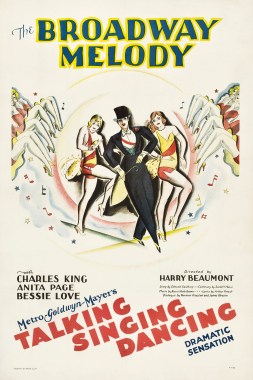
Meanwhile, the big studios finally entered the sound game in early 1929, and Broadway Melody was one of the first major forays by MGM. Note the prominence of the words “TALKING SINGING DANCING” in the advertising above. The movie was (sort of) MGM’s much-delayed answer to Warner and its sound films, and perhaps the apparent animosity reflected in the “Jock Warriner” character is part of that.

All that pettiness aside, it’s hard to deny The Broadway Melody‘s significance as the first true Hollywood musical, appearing basically fully-formed as a genre in 1929. Not that “movie musicals” hadn’t basically been done before. The Jazz Singer is technically a musical, but only the songs are heard. And, of course, the “musical” obviously wasn’t a new idea. So, it’s hard to forgive this film it’s cliche-ridden triteness, and I’d love to know more about the traditions that it drew from. Looking over my comments thus far, though, it should be quite telling that the context is more interesting than the film.

The Verdict: I don’t believe I’ve seen a single film from 1929 other than this one, but I can’t imagine that there weren’t better films. I’d certainly like to see Pickford’s first talkie (though it was poorly received at the time), and many of the other nominees sound interesting. This was certainly a year of significant change in the industry, and it’s not terribly strange to find that upheaval inversely reflected in the middlebrow safeness of the films being produced.

Movie Screen, Time Machine: The 1910s

•September 3, 2012 • 1 Comment

I’ll probably say something like this more than once as we go along, but basically the most significant leap forward in movie history happened during the 1910s. It’s not quite as flashy or obvious as the transition to sound, color, wide screens, gimmicks like 3D, etc., but it’s hard to understate the change from 1910 to 1919.

In 1910, movies were short, less than 15 minutes. 1% of the films that year could be considered “features.” Consequently, stories were basic, simple, even simplistic. The people who made movies and appeared in them were anonymous. A variety of national cinemas were flourishing all over the world, but European cinema dominated. Thomas Edison and his Motion Picture Patents Company had a monopoly on most legitimate film production, distribution, and exhibition in the United States, though the industrious and inventive independents were still doing their own thing. The camera filmed scenes like a stage play, no moving and no zooming. Acting was exaggerated and histrionic.

By 1919, feature-length films had become the new norm, accounting for 50% of the releases that year, though most of them were still under an hour in length. Stories, and ways of telling them cinematically, had increased immeasurably in sophistication. The Movie Star had popped into existence, and names like Mary Pickford, Douglas Fairbanks, and Charlie Chaplin brought audiences into theaters in droves. Other people had their names in the credits as well, like directors D.W. Griffith and Thomas H. Ince. The Great War had handicapped European filmmaking severely, and American cinema had filled the vacuum. Edison’s monopoly had been legally and financially defeated, and the innovators ruled the field. Filmmakers had learned how to edit, and discovered the value of the close-up. Acting was more subtle, more natural.

So, what kinds of movies did they make in the 1910s? Well, basically I watched three different kinds of movies: serious adaptations, comedies of modern life, and tragedies of modern life. The first category is all about prestige: the Bible, Dante, Shakespeare. These are movies that say, “You can take us seriously as art because we were written by . . .” and although we still have those movies now, this was a decade when movies still needed that kind of leg-up with the culture (or, at least, with the cultured). As you also might expect, these films have, on the whole, very little life in them. Adaptation has come quite a long way since then, but in the days before sound, literary adaptation usually meant a piece of great art entombed in fragments in a piece of mediocre entertainment.

All of the life, naturally, exists in the films about modern life, whether comic or tragic. The cinema of the 1910s appears very socially conscious to my eyes now, probably because the social issues of the day stand out so sharply to me today. In particular, there is a significant concern with the gap between rich and poor, and especially with the plight of the underprivileged: immigrants, orphans, immigrant orphans. And there’s World War I, of course . . . well, “The Great War,” rather. That came up a bit, as well. Not a good time to be a German in America. Or anyone foreign, or especially ethnic, for that matter. There are issues that are part of the social consciousness, and then there are the issues of which society is completely unconscious.

Those are just a few of my impressions. I can’t boil a whole decade down to a few words based on a few movies, of course, but it was fascinating peek inside the times. This time travel thing is working out just the way I hoped. Here are some specifics about the movies that I watched:

L’Inferno (1911)

A lavish Italian adaptation of the great literary work by Dante Alighieri, this was the oldest feature film I could find. The use of special effects and sheer imagination provides a significant wow factor. Static shots and a lack of close-ups make things a bit dull at times, but are typical of the period. The recent DVD release features a score by Tangerine Dream, complete with choir singing Dante’s original text (translated) at key points, which is a nice touch for modern audiences.

From the Manger to the Cross (1912)

This is a straitlaced retelling of the life of Jesus Christ. It’s chief claim to fame, aside from extreme age, is its use of authentic locations in the Middle East, a major innovation at the time. You can read a lot more about it here, but the upshot of it is, unless you have a personal interest in film history or Bible films, don’t bother. There is very little here that is of any interest to the casual viewer.

Traffic in Souls (1913)

A rather scary “social-awareness” film about the existence of white slavery (i.e. sex-trafficking), with the emphasis firmly on the “white” in terms of actual public interest. The surprisingly cynical plot posits a flawlessly-organized conspiracy that exists at every level of society. There is also excellent use of cross-cutting that generates significant suspense, and the combination of cutting-edge technique and commentary on contemporary life and culture make it easily one of the most significant films of its time.

The Squaw Man (1914)

Cecil B. DeMille’s first film, this is perhaps better known as the first feature film to be made in Hollywood. DeMille went on to successfully remake this movie two more times, a unique accomplishment in film history, but for the life of me, I can’t see what about the story appealed to him so much. A wrongfully-accused Englishman absconds to the American West in disgrace, has Western-ish adventures, becomes a semi-successful rancher, marries an Indian woman, and has a son. His foolish values bring tragedy on his self-sacrificing wife, but everything works out pretty well for him in the end, and its unclear which end we’re supposed to care about more.

The Italian (1915)

A vivacious Italian comes to America to make his fortune so he can marry the girl of his dreams. His shoe-shining brings enough money to send for her, and the two are married happily, but immigrant life is tough, and tragedy strikes. The Italian, once full of the joy of life, finds his spirit completely broken by the hardships and injustices of life in America. This is a hard-hitting, emotional look at the immigrant experience, heightened by the temporal closeness to its subject. This isn’t just historical commentary on an abstract past, its social commentary on a literal present.

King Lear (1916)

I began this film wondering what a silent filmmaker could have hoped to communicate of the magnificence of Shakespeare’s mastery of the English language, and I finished it wondering basically the same thing. The performances, featuring seasoned Shakespearean players, are about as good as they can be, which, without any dialogue, is really not that good. Still, a lack of monologues does condense things a good bit, and Lear’s story is easily told in its entirety in about an hour. So, even if it isn’t very good, it’s also not very long.

Rebecca of Sunnybrook Farm (1917)

Child-like Mary Pickford is a poor girl from a large family sent to live with her grouchy aunts. Her mischievous but cheerful ways transform their lives and the lives of the town in the usual fashion for stories of this nature. There is some good fun here, mostly thanks to Pickford’s boundless charm and energy, despite a story that, even in 1917, was utterly cliche. Pickford made a career out of playing this role over and over again, but watching her play it, you can see how achieved such popularity.

Shoulder Arms (1918)

Charlie Chaplin tramp-walks his way through the trenches of the Great War, to the amusement of all. Accidentally volunteering for an assignment behind enemy lines, he saves a captured comrade (twice), romances a French girl, and captures The Kaiser himself! Too bad it all turns out to be a dream he’s having in his cot back at boot camp. This film, a fascinating look at WWI while it was still ongoing, studiously avoids showing combat, and walks a thin line between comedy and pathos in depicting the misery of trench-warfare. Interesting stuff, and also a lot of fun. You can always count on Chaplin for some big laughs.

Daddy-Long-Legs (1919)

Mary Pickford is at it again, this time as a young orphan living a hard-knock life before her innate beauty and cleverness win her a wealthy patron and a college education. There’s a thick undercurrent of social commentary throughout the first half of this movie, but it is eventually set aside in favor of romantic melodrama. One might even say that a serious consideration of class difference takes a backseat to the American myth of success through talent and hard-work. But then, one might be looking a bit too deeply into shallow waters.

I’m off to the Roaring Twenties!

American Movie: From the Manger to the Cross (1912)

•August 28, 2012 • 2 Comments

Exactly what role Bible-based Christian faith played in the founding and formation of the United States is a point of contention in certain circles. However, as far as I know, no one argues that the Bible and Christianity have ever been less than a major presence in American culture. It is no surprise, then, to discover a film about the life of Jesus Christ among the oldest surviving American features*. So old, in fact, that it dates from a few years before multi-reel films were the norm, and thus (to some extent) serves as part of the transition that brought about that most-significant development.
Of course, various factors prompted the complete transition from the 10-minute (or shorter) scenarios favored by the conservative business side of the fledgling movie industry to 1- and 2-hour narrative movies, but I like to think that the decisive factor was pure artistic innovation bursting the suffocating boundaries of the single-reel format. To be sure, great paintings exist on small canvases, but it would be a sad, Sistine Chapel-less world if all painters were restricted by size. Similarly, many short stories are recognized masterpieces, but what would literature be without the novel? Whatever else contributed to the evolution of narrative films beyond the constraints of extreme brevity, surely filmmakers were always destined to use the art of cinema to tell longer stories.

Although Australia was responsible for the first feature-length film in 1906, it was the Italians who succeeded in genuinely captivating American audiences with longer films. One film in particular, Dante’s Inferno (possibly Italy’s first feature, 1911), was enormously profitable in the United States thanks to its impressive scope, large cast, extremely sophisticated effects, and the unassailable respectability of its literary source. It is an early example of consummate form and craftsmanship, full of emotion and spectacle and edge-of-your-seat terror, and must have ignited jealousy, ambition, and imagination in any serious filmmaker who saw it. And, yes, its financial success didn’t hurt at all.

In 1912, the business side of the American film industry was embroiled in a full-scale war between Thomas Edison’s iron-fisted Motion Picture Patents Company (MCCP, or simply “The Trust”) and dozens of tiny independents trying to carve out their own share of the pie. The Trust was formed years earlier thanks to nearly a decade of abuse of the American legal system by Edison and his bottomless pockets. In short, Edison leveraged his patents into a string of endless lawsuits which, even when he lost (which he frequently did), threatened his competitors with bankruptcy.

In 1908, all of the major players were ready to capitulate, and the result was the MCCP: an alliance of 9 production companies in control of all the key patents for both making and exhibiting films. They limited sales of all American raw film stock to licensed producers only, and those producers’ films could only be handled by licensed distributors, and shown only by licensed exhibitors, who were permitted to show only licensed films. It was a good old-fashioned monopoly from top to bottom. Fortunately for the future of movies, Edison’s vision for the industry ultimately set the stage for his own demise.

The Trust sought to reshape film culture (and increase profits) by appealing to a better class of audience. On the distribution and exhibition side, this meant throwing their considerable weight, and best-quality prints, behind nicer theaters in upscale neighborhoods. On the production side, it meant attracting the desired audience with more sophisticated, respectable films. Longer films could even go on tour to appear in nicer venues and command higher ticket prices.

This strategy led them to simply ignore thousands of cheap, independent operations in smaller towns and poorer neighborhoods, expecting them to fold without the supply of fresh, new films that the MCCP now controlled almost entirely. These early nickelodeons made their money through sheer volume of patrons, which required a program of short films that changed on a daily basis. Their demands were therefore as enormous as their audiences’ appetites, and Edison hoped to starve them of their product.

However, far from killing off independent film production, this environment actually sparked greater ingenuity and innovation. For any filmmakers who could find a way around Edison’s “blockade” (as Robert Sklar so aptly terms it), these theaters represented an irresistibly lucrative market. Edison had effectively challenged all comers to outwit him or face extinction, and opportunistic entrepreneurs came swarming forth to face him, often by surreptitiously using Edison’s own patented technology. When Edison showed that he was not above responding with gangs of thugs, the independents simply traveled beyond his reach to out-of-the-way places that no one had ever heard of, like Hollywood, California.

Continue reading ‘American Movie: From the Manger to the Cross (1912)’

Regarding Time Travel

•August 20, 2012 • 1 Comment

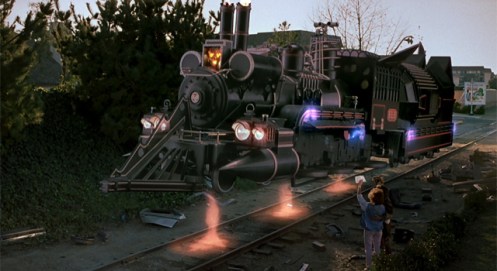
Don’t let that picture of Doc Brown’s absurdly awesome flying locomotive time machine from Back to the Future Part III fool you. As much as I love a good time-travel movie, this isn’t a post about that. It’s a post about how I’m going to travel through time. I’ll get to that shortly . . . Well, actually, not so shortly. If you want to skip all my ruminating and time-travel to the key point, just jump down a little over halfway. I’ve highlighted the relevant paragraph.

Anyway . . . It’s odd, though, isn’t it? In fiction, time travel almost universally turns out to be a Very Bad Idea, but we keep on telling stories where people do it. Why is that, do you suppose? To make some kind of point about messing with history? That hardly seems necessary, right?

“Remember, it may seem like a good idea to go back and kill Hitler/save JFK/screw up your parents’ first meeting, but you’re only inviting greater trouble. Seriously, that last one should be especially obvious. Come on, now.” Maybe it’s a weak, subconscious attempt to convince ourselves that we really wouldn’t want to time travel, even if we could.

Fascinating hypothetical questions and generic thrills aside, part of the appeal has got to be the allure of firsthand experience. For the true enthusiast, no amount of reading can really compare to being there, and the past is the one thing (other than the edge of the universe) that just keeps getting further and further away.

Nothing is going to change that, at least in my lifetime. I know this for a fact, because I haven’t visited myself yet, which obviously I would. Even Stephen Hawking had a similar idea, and carried it out in delightfully geeky fashion:

But that doesn’t get rid of the desire to experience life in the past. Things were so different back then, whenever back then may have been, but what was it really like? A disappointingly small number of time travel movies and shows have had any interest in this question, even though it is obviously the primary source of interest in time travel. What scholar in any of a thousand different fields wouldn’t kill for the chance to choose even one specific point in history to visit?

2003’s Timeline, based on the 1999 Michael Crichton novel, is generally reviled, but I rather liked it, and one of my favorite things is the kid-on-Christmas-morning glee of Gerard Butler’s character, medieval historian and enthusiast Andre Marek. It is disgracefully rare for anyone who really appreciates what is going on to be afforded the privilege of time travel. Even Doc Brown misses out on the maiden voyage of his own time machine.

Continue reading ‘Regarding Time Travel’

Annie Hall: Best Picture, 1977

•August 11, 2012 • Leave a Comment

The Host: The 50th Annual Academy Awards were hosted, for the 18th and last time, by Bob Hope.
The Nominations: Annie Hall was nominated for an exceptionally-low but exceptionally-prestigious 5 awards: Best Picture, Best Director, Best Original Screenplay, Best Actor, Best Actress.

The Competition: Other nominees included The Goodbye Girl (5 nominations, mostly overlapped with Annie Hall, 1 win), Julia (11 nominations, 3 wins), The Turning Point (11 nominations, no wins, an astounding and unprecedented shut-out), and, of course, Star Wars (10 nominations, 6 wins, all in technical categories). For what it’s worth, how many of those movies have you heard of? How many have you seen? If you’re the average American moviegoer, the answer is “1.”

The Results: Had Annie Hall swept all 5 awards, it would be 1 of 4 motion pictures to score a grand slam. However, Woody Allen’s acting nomination (certainly the weakest link of Allen’s writer-director-star credits) went to Richard Dreyfuss for The Goodbye Girl instead.

The Film: Allen explores the turbulence of relationships through the romance between his standard comedic persona, here named Alvy Singer, a neurotic stand-up comedian whose self-awareness and propensity for addressing the audience makes the film feel autobiographical, and Annie Hall (Keaton), a lively, eccentric, insecure woman he meets through mutual friends. The movie meanders non-linearly through Alvy’s life and relationships, often with heretofore uncharacteristic seriousness for an Allen film, unearthing both wisdom and humor in its examination of Alvy’s and Annie’s often tempestuous life together.

The Experience: I have to admit up-front that I walked into this movie with a lot of baggage. Like so many people, I have been an avid fan of Star Wars since I was a kid. Whenever it was that I first heard that Star Wars lost recognition as the absolute best film of 1977 to some movie called Annie Hall that I and my peers had never even heard of, I didn’t even need to hear any more to know right away that a dreadful mistake had been made. This was, of course, before I had ever seen any Woody Allen films, with the exception of 1998’s Antz, if that counts . . . no, no it doesn’t.

I’m fairly certain that the first Allen film that I actually saw (and saw in theaters) was Scoop (2006), so hardly an auspicious beginning, but as a dedicated student of film, I sought out more. Allen, the most prolific American director working today, has directed over 40 films in his career, and I have seen over half of them, but I have been halfway avoiding Annie Hall all this time because I was afraid that I would hate it, and then I’d just be another disgruntled Star Wars fan.

Because I do like Allen’s films, on the whole. I’ve seen some really lousy ones, and some that hardly seemed worth the trouble of committing to film, but when Allen gets everything right, as he does every several years or so, there’s almost nothing more enjoyable than just basking in the glow of it. So after I recently re-watched Star Wars for the first time in several years, I realized that the time had come.

And now the dreadful irony: I waited too long. Perhaps I should have tried to watch Allen’s films in the order that he released them, rather than jumping around so haphazardly. This was his first attempt to mix drama with his particular brand of silliness. It was a major departure for him, in a bold new artistic direction. But watching Annie Hall after seeing much of Allen’s later work robbed it of that freshness, and of any sort of subtlety. Alvy spends most of the movie explaining what’s happening in the movie, and for all his annoyance with the windbags around him, he’s almost insufferably pedantic.

I could not wipe my mind clean and see this movie in a vacuum. So many of Allen’s admittedly inventive devices (the use of animation, the hilarious scene in the movie line, the split-screen therapy session, the conversations between Alvy and people he is remembering) feel ostentatiously self-indulgent. The movie grinds to a dead halt around them in order to draw attention to Allen’s cleverness. While it is something of a flaw and a draw that Allen always allows his own character at least a few painfully-stagy one-liners, here his asides practically overwhelm everything else in a way that they do not in my favorite Allen films.

But at the same time, I get it. This is all part of the point. Alvy is Allen, and he is an emasculated character who feels very conflicted about his life, especially his love life, and he compensates by exercising the writer’s prerogative to wrest control of the narrative and appeal directly to the audience for support and understanding. It works, sporadically, but it bothers me. It feels clumsier than Allen’s later attempts to address these same themes, which I suppose is how it should be for an artist with such a lengthy career.

The saving grace of the whole film is Diane Keaton’s performance as Annie. She breathes such incredible life into a character that Allen has also brilliantly written as a whole, complete, independent person. I began the film expecting to see a 1970s analogue of the recent “manic pixie dream girl” trope, but Annie is not just some mildly-quirky muse who helps the male lead to grow. She isn’t a strong, take-charge feminist, or a mousy sidekick, or any of a thousand other stereotypes and cliches. She is just herself, and it is her character that really grows during the film, partially because of Alvy and partially despite him. Meanwhile, he is left wondering what happened to this woman he thought himself totally superior to, pulling strings that are now connected to a figment of his own imagination. She has moved on to a more fulfilling future, leaving him to replay the trajectory of their relationship in his own favor through his writing, the one thing he can really control.

During its best and most insightful moments, Annie Hall reminded me of two other films: When Harry Met Sally (1989) and Eternal Sunshine of the Spotless Mind (2004). Both forego a traditional narrative structure to peel apart the complex layers of serious adult relationships, with varying degrees of profundity. Annie Hall plays like an uncomfortable marriage between When Harry Met Sally‘s comic cutesiness and Eternal Sunshine‘s grim pessimism towards those who do not learn from history. Given a choice, I’d watch either of those films, or Allen’s masterful Crimes and Misdemeanors (1989) over a repeat viewing of Annie Hall.

The Verdict: I’ve seen a handful of films from 1977, but I’m missing most of the major awards contenders. There are a few that missed out on most of the attention at the time, like Dario Argento’s fascinating-but-flawed thriller Suspiria, Spielberg’s Close Encounters of the Third Kind, which isn’t among my favorites, and Disney’s The Rescuers. There are also several films, like Equus and The Duellists, Killer of Sheep, and Scorsese’s New York, New York, that I remain anxious to see. However, I find myself arriving at what now feels like the inevitable conclusion. Star Wars should have been recognized as the Best Picture of 1977. And, if history is any judge, it has been.

Movie Habit

•June 14, 2012 • Leave a Comment

Comedian Mark Malkoff, mildly famous for a series of bizarre and thoroughly entertaining stunts (many of which are on his YouTube channel), has done it again. His latest wild accomplishment is The Netflix Challenge. An answer to the question: What is the best value an individual can get for the $7.99 a month it costs to get unlimited streaming on Netflix? That answer, apparently, is 252 films (404.25 hours) at 3.2 cents a film. I’ll let you watch the above video if you want any additional details.

I love that idea, and I’m mildly jealous at the number he was able to hit, averaging over 8 films per day (as grueling as that must have been). I’m pretty sure I’ve never gone higher than 6, and the most films I ever watched in a month was 46, and that was several years ago. I don’t always manage to see 252 films in a year, let alone in a single month. Of course, that’s true of almost everyone, but I’m not like almost everyone. I have a bit of a movie habit.

I think I heard somewhere once that it was once possible to have seen every single movie ever made, but sometime in the 1960s the rate of new films being produced combined with the backlog of old films began to vastly outdistance the human lifespan. Half a century on from that, I’m not even sure it’s possible to see every worthwhile film ever made, but I quietly hope that it is, even though I continue to waste time on far too many inferior movies (sometimes more than once!), to say nothing of the great films that I watch over and over again.

Eight years ago, I began keeping a log of the unique movies I was watching (no repeats), and since then, I’ve tried to make a point of seeing at least one movie a day that isn’t yet on the list, as nearly as possible. Eight years ago, I was in college, and even though I realized I had a lot of free time on my hands, I really had no idea how much I had. As time has passed and I’ve gotten married, gotten a job, earned a Master’s degree, and had a child, I’ve often gone several days without seeing anything new, but the thought of that next movie is rarely far from my mind.

As I look back at my record, which is nearing 1850 films, I see that my monthly average during the last eight years is nearly 19 films. That’s one every day and a half or so. And that’s feature-length films, not counting TV shows, or any films seen more than once. Not bad, all things considered. This wouldn’t have been remotely possible without Netflix, which I’ve subscribed to since February of 2004, and particularly without instant streaming through the Roku box that I’ve had connected to my TV for the past few years. It’s a great time to be a film buff.

I have two Netflix queues: one for DVDs and one for instant watching. I don’t know how many people are aware of this, but there is a maximum length for Netflix queues. Netflix won’t let you add more than 500 films to your queue, and both of mine have been maxed out for years (with maybe 100 films-worth of overlap as movies come and go from “Watch Instantly”). I literally can’t watch movies fast enough to keep my queue unclogged. Really the only reason I’m ever able to add new things to my instant-watch queue is that a bunch of movies expire off of it before a batch of new ones become available.

In other words, I could match Malkoff’s ridiculous rate for a month and still have nearly 3/4 of my Netflix list left to watch. To really clear it out, I’d need to keep up that pace from now until October. Ouch. Of course, a fair portion of my instant queue is made up of TV shows, some of which have literally hundreds of episodes, so it would actually take longer, but never mind. The point is, I’m not going to run out of things to watch . . . ever.

As it happens, though, even before I saw the Netflix Challenge, I was already casually shooting for a personal best this month. It’s been a few years since I managed to average a film a day for a full month, and I wanted to try for that number and see how far I could exceed it. And that’s why, even though I watched Errol Morris’s The Thin Blue Line earlier today, and I’ve just finished The Tailor of Panama, and my daughter will probably be awake in 7 hours (if I’m lucky and she sleeps in a bit), I’m still going to watch Dirty Harry before I go to bed. That’ll make 21 films so far this month, not counting the 3 repeats I watched, and the hours of TV shows (which is my wife’s Netflix viewing preference . . . she likes her entertainment in smaller chunks).

I don’t think I’d care to try to break Malkoff’s new Netflix record, though it would be physically possible. 3 movies in a day is kind of fun; 9 films a day would be exhausting. More importantly, they’d all blur together into a kind of weird fever-dream, and I wouldn’t really be experiencing them. I track my numbers rigorously because I’m obsessive about lists and records, and I like big numbers, but it isn’t about sheer quantity. It’s about enjoying and engaging with cinematic stories from a wide variety of traditions, cultures, eras, and genres. I’d like to write about more of the things I watch and engage them even further, but when life is busy and I have to choose between watching movies and writing about them, I just watch.

The Cabin in the Woods

•April 14, 2012 • Leave a Comment

starring Kristen Connolly, Chris Hemsworth, and Fran Kranz
written by Joss Whedon & Drew Goddard and directed by Drew Goddard
Rated R for strong bloody horror violence and gore, language, drug use and some sexuality/nudity.
94%

Curt’s (Hemsworth) cousin just bought a cabin out in the woods, and now Curt and four of his college friends (Connolly, Kranz, etc.) are loading up the camper for a weekend of rustic debauchery. The trip begins promisingly, but quickly turns sour as night falls and the friends are systematically hunted and picked off one by one. Horror ensues.

The Cabin in the Woods left me simultaneously wanting to talk and talk and talk someone’s ear off about it, but not wanting to ruin someone else’s pleasure of discovering its many surprises for themselves. So, in consideration of the latter impulse, I could just stop here after noting that, although the film’s hook gives off every appearance of being a slavishly by-the-numbers slasher movie, any horror fan would be doing themselves a grave disservice if they missed seeing it. If you think you might want to see it, and you’re very spoiler-conscious, this would be a good time to stop reading (though, in that case, you should have stayed off the internet entirely). I intend to continue in general terms only, but if you care, don’t take the risk.

During the first 15 minutes or so of the movie, I was beginning to think it would make an excellent double feature with Tucker and Dale vs. Evil, last year’s hysterically clever inversion of the “hillbilly horror” formula. Maybe 30 minutes after that, I began to suspect that it would be a better match with Scream, Wes Craven’s genre-savvy meta-commentary on slasher movies, which went on to spawn its own horror franchise before spiraling into extreme self-parody. Eventually, I realized that The Cabin in the Woods, though it might be at home alongside many classic horror films, is really in a class all by itself.

Film scholars and enthusiasts frequently write essays, articles, and even entire books discussing and dissecting the horror genre and what makes it tick. What is “horror”? Why does it exist? Why do people enjoy horror movies? A lot of what they have to say is insightful and thought-provoking, but the broad appeal of reading an academic treatise is always somewhat limited. Whedon and Goddard have, instead, addressed these questions in highly-entertaining movie form. Their movie simultaneously critiques and revels in the excesses of the genre, and ends up rather cheekily suggesting that horror can save the world, even though (or, perhaps, because) its roots are in a place of primitive darkness and evil from humanity’s shared past.

However, as I said, the interest in hearing all of this spelled out, while fascinating to me, is limited. In The Cabin in the Woods, it is largely subtext, and even when the movie is essentially spelling out genre archetypes and their functions, it doesn’t lose sight of the all-important goal of giving the audience a good time with unexpected humor and storytelling that is full of surprises. It’s also, as near as I could tell, full of holes from the ground up, but getting hung up on that rather misses the point.

It’s great to see Whedon veterans like Amy Acker and Fran Kranz in familiar roles. Even better, though, are Richard Jenkins and Bradley Whitford as Sitterson and Hadley, thinly-veiled author surrogates, sardonically exchanging wry, self-aware banter as events unfold. They’re like Statler and Waldorf, the Muppet critics: technically part of the movie, but one-step removed, and always ready with an irreverent comment.

Now, given that I have used the word “horror” 10 (now 11) times, I’ve probably given a pretty strong impression that this is a horror movie. That’s not strictly true. There are a few jump moments, some disturbing images, some conventionally scary situations, and a definite penchant for blood and gore. That said, I laughed far more than I cringed. The Cabin in the Woods is a horror movie the way Shaun of the Dead, Zombieland, and Army of Darkness are horror . . . by default. This is an exceptionally sharp comedy, packed to the rafters with allusions and inside jokes, from a writer who is known for playfully blurring the lines between genres, and it’s hard to have this much fun and not think happy thoughts about Whedon’s forthcoming The Avengers.

2012: An Oscar Commentary

•February 26, 2012 • Leave a Comment

Another year, another Oscar commentary. This may well have been the emptiest experience I’ve had watching the Oscars to-date. The effort was there, the entertainment, the experience . . . but there was so little life among the contenders. The edgy films, the revolutionary films, the exciting films . . . Those were all shut out in the nomination stage. Now here we are with an Oscar night that lies there, comatose, as they hand the Oscars out, for the most part, exactly where everyone expected them to go. It almost defeats the purpose of keeping it a secret, as it’s hard to imagine less suspense either way.

Billy Crystal was clearly a strong choice for hosting duties. He kept things moving, wasn’t obtrusive, entertained the audience, and got in some good jabs without being overtly mean . . . A solid performance from an old pro at this game. I basically approve. There were some genuinely awesome acts, as well, particularly the hilarious “focus group” sketch and the spectacular Cirque du Soleil performance. If there had been a bit more of this, and a bit fewer confusing montages, lukewarm wins, and commercial breaks, tonight would have really sung, but it can’t be said that there weren’t people giving 100% on this one.

The Artist, as best picture winner, finished the night tied with Hugo for most wins at 5 awards apiece (out of 10 and 11 nominations, respectively). That keeps it well out of sweep territory, and just above years when the awards have been even more evenly split (The King’s SpeechNo Country for Old Men, and The Departed all won 4). Of the remaining nominees, only The Iron Lady, with 2 wins, won more than a single award. And is anyone really happy about that?

Of the other Best Picture nominees, only The DescendantsThe Help, and Midnight in Paris won anything at all. 4 Best Picture nominees went home completely empty-handed, and three of them were films I really liked. It may be a long time before the Academy lives down shutting out The Tree of Life and Moneyball, in particular. Then again, the biggest fans of those films already know better than to take the Academy seriously. Spielberg will be back again soon, I’m sure. His star-studded Lincoln is due out in December.

Looking back at my initial predictions, it looks like I had 8 right, but increased that to 13 when I tweaked my predictions before the ceremony began. That’s a tie with last year, but my record is not improving. Maybe that has something to do with so few of the awards going the way I most wanted them to. Here’s hoping for something better, all the way around, next year!

Full commentary continues below the fold.

Continue reading ‘2012: An Oscar Commentary’

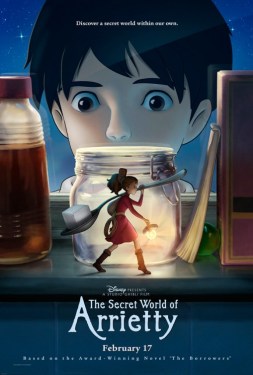
The Secret World of Arrietty

•February 20, 2012 • Leave a Comment

starring Bridgit Mendler, Will Arnett, and Amy Poehler
written by Hayao Miyazaki & Keiko Niwa and directed by Hiromasa Yonebayashi
Rated G.
96%

14-year old Arrietty (Mendler) is a smart, adventurous girl who stands just 4 inches tall and lives under the floorboards of a large country house with her equally diminutive parents, Pod (Arnett) and Homily (Poehler). These “Borrowers,” as they call themselves, subsist from items that will not be missed by the humans, and they may be the last of their kind. This concern couldn’t be further from Arrietty’s mind on the exciting occasion of her first borrowing expedition, but everything changes when she is seen by a young boy who has just moved into the house.

I spent almost all of Arrietty‘s 94 minutes with a smile on my face. I don’t absolutely love every Studio Ghibli film, but when they hit the mark, there truly is no more enjoyable visit to the theater (or, more often, 3 or 4 visits). The movie rolls past in waves of cathartic wonder and lush visuals and delightful music. This may be Ghibli’s best film since Spirited Away in 2001. The story may feel slight, particularly by comparison with their more epic fantasy outings in the uneven Tales from Earthsea (2006) and the brilliant Howl’s Moving Castle (2004). Still, the plot recognizably follows the major arc of Mary Norton’s 1952 novel The Borrowers on which it is based, and not all stories shake the world.

The best thing about the film is its extremely likable title character, whose energetic curiosity drives events forward, but also provides opportunities to slow down and take in the richly-imagined surroundings. Arrietty is compassionate, ingenious, empathetic, spirited, and a lot of other complimentary adjectives that make her an ideal companion for adventure and exploration. It is obvious from the moment she is introduced, laughing good-humoredly over a narrow escape from the cat, that this is a character we will enjoy spending the rest of the movie with. Her cheerful liveliness and her natural awe in the presence of the mundane accouterments of our everyday lives makes her the perfect audience surrogate, reinvesting our surroundings with the novelty of seeing them as if for the first time.

It helps that everything in this movie looks gorgeous. One of the studio’s greatest animation strengths is in its bright, color-filled rendering of the natural world, whether it be a flower-filled meadow, an overgrown backyard, or an ivy-covered wall. Arrietty’s size gives us plenty of chances to get up-close and personal with the flowers, grass, and leaves that the film reproduces so beautifully. Even better, though, are the startling landscapes indoors; the vast reaches of a cavernous kitchen, the intricacies of an especially ornate dollhouse, and the labyrinthine twists and turns between the walls and under the floors. There is literally something new and exciting to see around every corner.

The music for the film was done by French singer Cécile Corbel, who joined the project after she sent a fan letter to Studio Ghibli along with one of her albums. There is a distinctly Celtic flavor to her music, heavy on the harp (Corbel’s instrument), that coincides spectacularly with the rural greenery and rustic flavor of the movie. The music, which frequently has lyrics (Corbel performed the main song for the film herself in Japanese, English, French, German, and Italian), might seem intrusive at times, but it generally reinforces rather than overwhelms. If the animation were not so good, it might be tempting to close your eyes and simply listen.

The greatest challenge in telling this story, I imagine, would be keeping The Secret World of Arrietty grounded in some kind of emotional reality, and not allowing it to float the audience airily away to a fairy world of near-paradisal perfection. As in many of his other films, Miyazaki deftly weights the happy innocence of childhood with the sadness of mortality and bittersweet joys and sorrows of new friendships that are over all too briefly. This tempers the film’s lightness and brings meaning to the characters’ journey. Arrietty’s story continues, without dialogue, into the credits, inviting the audience to sit quietly and reflect on the film (at least until a Disney pop song, unique to the American release, cuts in). Almost the entire theater stayed through the credits at the weekend showing I attended, which is virtually unprecedented in my experience.

It’s a shame that so few American films feature great female characters like this, or use the freedom of animation to do something more than make cartoon animals reference pop culture and crack wise. It’s an even greater shame that so few of the films the rest of the world is making find their way into a wide theatrical release here, and that it takes so long for those that do to arrive (Arrietty was released in Japan over 18 months ago). That only makes this movie all the more a rare treat. Go see The Secret World of Arrietty while it’s in theaters; first, because it’s important that we support movies like this when we can. But even more significantly, if you don’t go, you’ll be missing out.