Filmed from a nearby building, street and foot traffic are seen coming and going across the Leeds Bridge. Several coaches and wagons pass each other on the road. A man crosses over in front of a heavily-laden cart and behind a smaller carriage. A number of people move along the sidewalks to either side of the roadway.
Essentials:
Aside from the Roundhay Garden Scene, almost no other films taken by Louis Le Prince on his single-lens camera survive (if there were any more to begin with, which is unknown). But this one is pretty special. As far as I know, this is the earliest moving image that captures an unstaged look at people just living their lives out in the world. Candid filming of people in the street would become quite commonplace as cinema continued to develop, but this is the oldest glimpse we have of a street scene . . . And it’s not New York, or Paris, or even London, as one might expect. It’s in Leeds, because that’s just where Le Prince, a Frenchman who later took dual French and American citizenship, happened to be living and working at the time.
The significance of this is, at least, not lost on Leeds. Le Prince is commemorated in several ways around the city, including with a small blue plaque on the Leeds Bridge (pictured at right), in honor of this film. It’s inaccurate to say that he was in any way influential on the developing art or technologies of cinema . . . only that he should have been. His inventions and his films were developed completely out of the public eye, and would have been lost to history entirely if not for the later efforts of his family to see him recognized for his achievements. In addition to these few scraps of film, some of his cameras survived. It is believed that he had developed and tested a projector, but he never patented it, and only some drawings of possible designs remain. Really, it’s incredible that we have any of his work at all.
Screening:
For as much as it captures within the frame, Traffic Crossing Leeds Bridge is tantalizingly brief and full of details that are difficult to make out. If you want to get a good look, you’ll need to pause it or play it on a loop. Even then, we can only tell so much. My eye is particularly drawn to the man and child (father and son?) walking together in the closest corner of the frame. Does it seem that the man is hurrying the child along just a bit? I think his left arm might be around the child’s shoulder or at least behind his back. The man turns and his right arm comes up as the clip ends. Is he tipping his hat to someone, or scolding the child? I could spend hours squinting at the margins of the frame and wondering.
Just like the blurred shadows we can just make out as people in Daguerre’s 1838 photograph, the people on this street likely lived and died never knowing that, whatever brought them to this precise point on the Leeds Bridge at just this moment in late October of 1888, their presence there was forever frozen in time.
Four people move about a garden (yard) in Roundhay, Leeds. The nearby house occupies the left side of the frame. The young man, beginning by the house steps and facing the camera, purposefully marches in a wide semi-circle that takes him to the opposite side of the frame, facing away from the camera. The young woman, just to his right, turns slowly and begins to step away from the camera. The older woman, standing a bit further back, begins an exaggerated march in place, almost as though she is miming walking. The older man, behind the older woman and facing away from her and the camera, strides a few steps forward, then turns (still striding) and begins to walk back towards the group.
Essentials:
This is it! The birth of cinema!
Well, no, not really. That has already happened, but also it won’t happen for several more years. As I’ve said, I can’t tell you precisely where cinema begins. But this is the most important landmark yet. Louis Le Prince’s Roundhay Garden Scene, shot at his father-in-law’s house on October 14, 1888, is the oldest surviving piece of film (that we know of currently). Everything that we’ve seen before this was a series of individual drawings or photographs that (depending on the work) may or may not have originally been intended to be viewed or projected in motion. This was recorded on an actual strip of film using a single-lens camera that represented a significant step forward from Le Prince’s earlier 16-lens design.
Louis Daguerre had taken the first photographic image of a person in 1838. Now, 50 years later, his son’s friend, a boy who grew up visiting his studio, had captured the first filmed moving picture of a person. It’s almost too poetic. To watch this is to witness the work of a man who is on the precipice of revolutionizing everything, and doing it years before the big names credited with the invention of cinema. Instead, Le Prince is largely forgotten where others became household names instead, as the result of a mystery that remains unsolved to this day.
Le Prince spent the next few years working on a method to successfully project his films for an audience, and in 1890 he planned to travel to New York in order to premier his work before the public for the first time. He was about to make history. Before leaving for the United States, he returned to France to visit his brother, then boarded a train to Paris on September 16. He was never seen again, disappearing without a trace. No sign of what had happened to him was ever found, and he was declared dead 7 years later. His achievements, many of which were never seen outside of his immediate circle of friends and family, remained largely unknown for decades. It’s a startlingly abrupt and unsatisfying ending to a story that was clearly far from over.
Screening:
Le Prince’s story is haunting, but what’s most fascinating about the Roundhay Garden Scene is that it isn’t just the first movie (y’know, sort of), it’s the first home movie. The subjects are Le Prince’s son, his mother-in-law (who died 10 days after this was filmed), his father-in-law, and a friend of the family. It feels spontaneous in a way that we haven’t seen before now, but also extremely self-conscious in a way that we won’t see for some time yet.
These people are absolutely performing, but in a way that suggests that Le Prince said, “Okay, just do something! Move around! Whatever!” and started filming. Each person has a totally different reaction to that prompt. The result is momentous for reasons that have nothing to do with the people being filmed or what they’re doing. But it’s a 135-year old record of family and friends spending time together, and perhaps also being good sports in humoring Le Prince’s experiment, and that’s kind of beautiful in itself, isn’t it?
(English: Horse and Rider Jumping Over an Obstacle)
Summary:
A Prussian military officer, holding the reins only in his left hand and leaning back in the saddle, rides his horse towards an obstacle and vaults it. Then, a different rider, holding the reins in both hands and sitting upright, guides his horse in leaping both a ditch and a taller obstacle that are adjacent to each other.
Essentials:
Germany had its own answer to Muybridge and Marey in the 1880s: Ottomar Anschütz. He shared much in common with the other two men. Like Muybridge, Anschütz used a battery of multiple cameras to photograph horses in motion, and like Marey, he was acclaimed for his images of birds in flight. However, Anschütz was quite formidable as both a photographer and an inventor, and the images he produced were of a notably high quality for his time, even as he constantly made improvements to his equipment.
The photographs of horses jumping over obstacles were taken as part of a scientific study on behalf of the Prussian War Ministry, in order to help improve their riders’ technique. Around the same time, he made his own version of the zoetrope, which he called a “wundertrommel” (or “wonder drum”). Where Muybridge’s priorities were artistic and in some senses educational, and Marey’s were very strictly scientific, Anschütz had an interest in entertainment. Chronophotography could be useful (and he put it to useful purposes), but he also saw that it was something people would be interested in simply seeing for its own sake.
In 1887, he completed his “schnellseher” (“quick viewer”), which was called the “electrotachyscope” by the English-speaking world. This device created the illusion of moving images through the use of a large spinning disc, and could be watched by several people at a time, though the animations it produced all probably lasted less than 3 seconds before looping. Anschütz’s device used an intermittent light source to create its illusion of movement, which allowed him to use photographs at a time when Muybridge was constrained to using drawn silhouettes of his photographs when giving lectures. This may have eventually inspired Thomas Edison’s use of the same technique for his kinetoscope. Edison probably saw the electrotachyscope in action when he visited the 1889 Exposition Universelle in Paris, though he may have seen it even earlier, as it was demonstrated in New York some time before.
By early 1890, Anschütz had designed a coin-operated version of his device that could be viewed through a peephole. Several dozen were soon installed around the world, making it a possible source of inspiration for Edison’s use of the peephole format for film exhibition a few years later. There was an “electrotachyscope automat” in New York over two years before the first kinetoscope parlor opened. Furthermore, film historian Deac Rossell has claimed that several of the early kinetoscope films were essentially remakes of Anschütz’s work, including both The Barbershop and Record of a Sneeze, and that he may have also inspired films by the likes of the Lumière Brothers and Georges Méliès.
In 1894, Anschütz developed and patented a projecting electrotachyscope, and on November 25, in Berlin, he showed the first-ever projection of a motion picture in the world. Beginning the following February, he began a regular program of the first commercial screenings of motion pictures. Within less than a decade, Anschütz had created the first device that could exhibit motion pictures, then modified it to create the first commercial device for motion picture viewing, and then modified it again to display the first projected motion pictures for an audience.
However, all of these devices used photographs on spinning discs, not on strips of film. This is likely why he is so little-known today; not only because his spinning discs were a technological dead-end, but because he apparently refused to work with celluloid film. In March 1895, the first Edison kinetoscope parlor opened in Berlin, and at the end of that month, Anschütz’s projecting electrotachyscope show closed, never to re-open. He abruptly abandoned the field of motion pictures, turning instead to continuing his innovations in regular photography.
Was it a coincidence that Anschütz chose this moment to simply end several years of increasingly impressive technological advances that had seemed to leave the adherents of celluloid trailing in his wake? Perhaps, but as both an inventor and an entertainer, he must have seen that film offered possibilities that he couldn’t hope to match with spinning discs of photographic plates. Rossell states that he was “constitutionally unable” to work with film at a time when the images it produced were so inferior to his own. His refusal to compromise on quality seems to have led him to gracefully bow out of the future of motion pictures. Truthfully, his is a much happier ending than those experienced by many who either continued to try and fail to adapt their suddenly obsolete motion picture entertainments to the changing times, or who never stopped chasing the faded glories of early successes that were all too brief.
Screening:
The version below also includes three additional motion pictures by Anschütz in addition to the two of horses leaping obstacles. All three are of men performing some kind of athletic action. The first two may be the same man, and are particularly reminiscent of Muybridge’s work. I think all five of these examples of Anschütz’s work bear out the claim that he was producing higher quality pictures than anyone else in the mid- to late-1880s. There is both a smoothness to the motion and a level of detail that is unmatched by anything else I’ve seen. Notice the way you can see the second horse kicking up fountains of dirt as it leaps. I love that. And the way the clip goes from full speed to slow-motion really shows off the beauty that Anschütz captured. It’s truly magnificent.
This is not the first human to appear in a work we’ve discussed, but he’s the first to appear “out in the world” rather than in the highly-controlled surroundings where Muybridge worked. Beyond that, there isn’t much that I can say definitively about this scene. The man doesn’t even walk around the corner, really. He has already rounded it (if only just) in the first image. I think we can say that he has a beard and a dark head of hair, though he may also be wearing a hat. He’s dressed in a knee-length smock that’s likely occupational. According to information about a possibly related set of photographs, it seems that he may be a mechanic (that would explain the object that seems to be a wheel just at the left edge of the frame). We can get a vague sense of the kinds of buildings we can see, but I can’t tell you anything about what they are, though the main building could plausibly be a garage. This was taken in Paris, and even the exact corner has been identified, but it looks very different after 135 years.
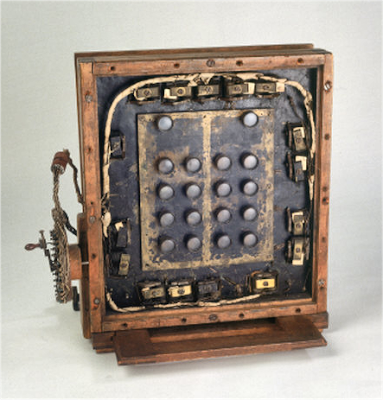
Man Walking Around a Corner was photographed by Louis Le Prince, using a 16-lens camera of his own design (pictured to the right). About 4 of the 16 photographs were not exposed correctly, which accounts for the gaps that appear when they are run in sequence. This, in turn, helps mask what would otherwise be more evident: Since each lens is located in a different position on the camera, this causes each frame to “jump” slightly in comparison to the previous image. This is most noticeable if you slow the video posted below down to 1/4 speed and watch the wall of the building to the far right, behind the main building in the foreground. Notice how it seems to shift, even though the camera remains stationary.
Le Prince was an artist and inventor whose interest in photography began at a very young age, when he spent time in the studio of his father’s friend, Louis Daguerre. That’s “Daguerre” as in “daguerreotype,” the first publicly-available photographic process. Daguerre first developed his process in the 1830s, and the government of France bought it from him in exchange for a lifelong pension for him and the son of his deceased partner. The French government then proceeded to widely publicize the process for free, as their country’s gift to the world, and photography soon went mainstream. To the left you’ll see the earliest known photograph of a person, taken by Daguerre in 1838. There are at least 2, and possibly as many as 4, people appearing in this picture. The long exposure time necessary for this image meant that most of the passing traffic didn’t appear, but a few bystanders were stationary enough to do so. The most obvious is the man in the lower-right corner, whose decision to pause and have his boots polished on the corner that morning immortalized him in a way that he likely never learned about.
Meanwhile, Man Walking Around a Corner is more important for what it isn’t than for what it is: It isn’t a filmed moving image. Like much of what we’ve discussed before, it’s yet another sequence of photographs that can be used to simulate a moving image. But for Le Prince, although it failed to entirely produce the desired effect, it represented a successful step closer to his goal of producing a genuine moving image . . . a goal that was about to be realized.
Screening:
By itself, this brief work (so brief, in fact, that you’d miss it entirely with a slow blink), may not seem terribly interesting. It does raise interesting questions in my mind, about the man who was in it and what he knew or did not know about the images being taken. Did Le Prince direct him, or were these images taken unannounced? The subject seems to be looking directly at the camera, and continues looking at it as he walks across the frame. What did he know about this strange device that Le Prince was aiming at him and its capabilities? Speculation aside, though, Man Walking Around a Corner is really most interesting as part of Le Prince’s larger story, which (as we will soon see) is both momentous and mysterious.
A series of figures comprised of dots and lines, vaguely resembling a stick-figure representation of a person, appear one-by-one across the screen, filling the frame from right to left. Each is configured slightly differently from the one before it as the stick figure “walks” by swinging its “arm” and raising and lowering its “leg.”
Essentials:
I have chosen to translate the title as you see above based on the unconfirmed assumption that its creator, Étienne-Jules Marey, intentionally named it after La Mettrie’s seminal 1747 work of materialist philosophy. It’s certainly appropriate, given this image of a human figure represented by the fewest possible number of lines in order to demonstrate the purely mechanical aspects of the body in motion. Marey’s work should be reminiscent of (but is also clearly distinct from) the motion photography of Eadweard Muybridge.
The two were not only contemporaries, but communicated with each other, and even met in 1881 to discuss their work and methods. Actually, the connection between them runs even deeper than that. It was Marey’s drawings of horses in motion that first inspired Leland Stanford to attempt to depict the same process through photography. And, in turn, Muybridge’s photographs for Stanford ignited Marey’s pursuit of photography.
But although Muybridge’s efforts to capture bodies in motion began as an experiment to test a specific hypothesis, his most famous later work wasn’t notable for its scientific rigor so much as for its relationship with art and artists. This is where Muybridge’s and Marey’s work clearly diverges. Muybridge entered the field of motion photography after several years of already working as a photographer, and those were the main sensibilities he retained. Marey entered it as a scientist driven by the questions of an entire field of study.
Probably the most obvious difference lies in what they each produced. We’ve already seen several examples of Muybridge’s sequences of photographs shot by a series of a few dozen cameras triggered one after the other. Marey designed a single apparatus that could take several images in a sequence and record them all on the same plate. He called this device the “chronophotographic gun.” Marey’s invention was inspired by the much larger “Janssen revolver” that Janssen used to capture the transit of Venus across the sun in 1874, and Janssen’s design was, in turn, inspired by (and named after) the Colt revolver. So the “gun” label was entirely appropriate. Plus . . . Well, just look at it:
Where the Janssen revolver was enormous, larger even than a cannon, Marey’s chronophotographic gun was easily portable and usable by a single operator. In fact, he used it extensively to photograph birds during excursions to Naples, where the oddity of a man who seemed to be hunting birds but never fired at them earned him a nickname among the locals: “the idiot of Posillipo” (after the neighborhood he frequented).
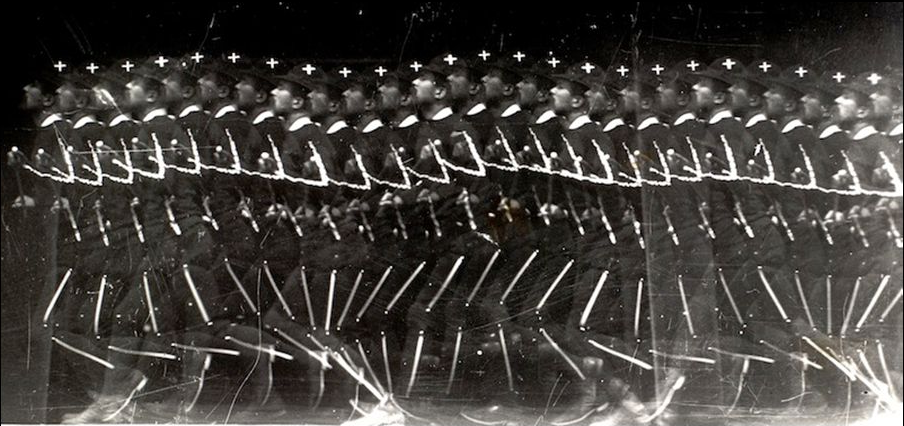
Now, with as much of an innovator as Marey was, my jaw still dropped when (after having watched the animation several times) I first saw how L’Homme Machine was made. Like Sallie Gardner at a Gallop, it was produced from a series of reference images. Take a look at this example of the type of image used:
Primitive though it may be, this is likely the earliest attempt at motion capture animation, pre-dating the patenting of the processes that would later become commonplace, and their introduction to movie audiences, by decades. I’m kind of in awe of it.
Screening:
Although produced for science, not for art, L’Homme Machine anticipates the work of many well-known avant-garde artists to come. It’s genuinely amazing the way he has reduced his figure to the bare essentials while still managing to convey exactly what it is at a glance. A collection of 2 dots and 5 lines advances across the screen, and the brain immediately says, “Ah, of course, a person walking.”
Two nude women step toward each other, right arms outstretched as though for a handshake. They clasp hands and draw each other in, leaning forward to kiss as the woman on the right reaches out with her left hand to clasp the other woman’s arm. The scene is shot from 3 angles: from the side and then separately from behind each woman, all at such a distance as to precisely contain their full bodies in the frame.
Essentials:
This sequence is listed on the most authoritative movie databases with a date of 1882. I don’t know how that came about, but I’m fairly certain that, as with the last film, that date can’t possibly be correct. In 1882, Eadweard Muybridge was embroiled in his lawsuit against Leland Stanford over credit for his photographs of Stanford’s horses. This suit was not simply a point of pride for Muybridge. In the wake of Stanford’s failure to credit him, London’s Royal Society of Arts, believing Muybridge had plagiarized, rescinded an offer of funding for his photographic studies, entirely upending his plans.
However, in 1883 he got an offer from the University of Pennsylvania and they set him up in a studio in Philadelphia, where he took tens of thousands of images over the following years. These appear to have been taken in that studio. I’ve put the year as 1884, not as definitive, but as a guess at the earliest date these could likely have been taken . . . Though in fact they are copyrighted 1887, as are the thousands of other photographs published by Muybridge that year in his monumental collection Animal Locomotion: An Electro-photographic Investigation of Consecutive Phases of Animal Movements. I’m not entirely sure where or when this title The Kiss originates, either, though that, too, is its standard film database listing. In Animal Locomotion, the page reads only “Plate 444,” and it seems to be cataloged elsewhere under the more descriptive title “Two women kissing.”
Regardless of what it’s called or when, precisely, it was taken, we have returned to a discussion of Muybridge’s work one final time because Plate 444 has a significance that went unrecognized until relatively recently: It represents the first-ever moving image of a kiss, predating the previous “first” by about a decade. And, at the height of the Victorian Era, it just happens to be a kiss between two women. And they both happen to be nude. The nudity, at least, doesn’t seem terribly significant. Certainly, a great many of Muybridge’s subjects appear in the nude, whether men, women, or children, and this seems entirely in keeping with what we’d expect from photographic studies of the motion of the human body that went on to become a major point of reference for artists. Their purpose was not to titillate.
Of even greater interest to modern audiences is the fact that this was a same-sex kiss. Does that make it an early victory for representation? Perhaps. I’m not here to burst anyone’s bubble on that front. I will say that I’ve also seen it suggested in a few places that photographing a nude man and a nude woman inhabiting the same physical space would have been considered pornographic, and that strikes me as a plausible consideration. But these two narratives are not mutually exclusive, either. Who these women were, and what, if anything, they were to each other is lost to history, and Muybridge’s intentions remain equally opaque. All we have are the images themselves.
Screening:
As described at the beginning of the video below, I’ve embedded a version with a few different interpretations of this sequence of photographs. It sets them in motion at a few different speeds, and also includes a 2012 “remix” of sorts that incorporates music and some creative editing by a UK-based artist. I’m not sure that it really adds anything to the experience, but at less than a minute you can afford to form your own opinion. Here also is a link to a high-quality image of the original page containing all 24 photographs. Regardless of what version you prefer to experience, I hope you’ll agree that there’s something beautiful about witnessing such a simple, physical display of human connection and affection across all these years.
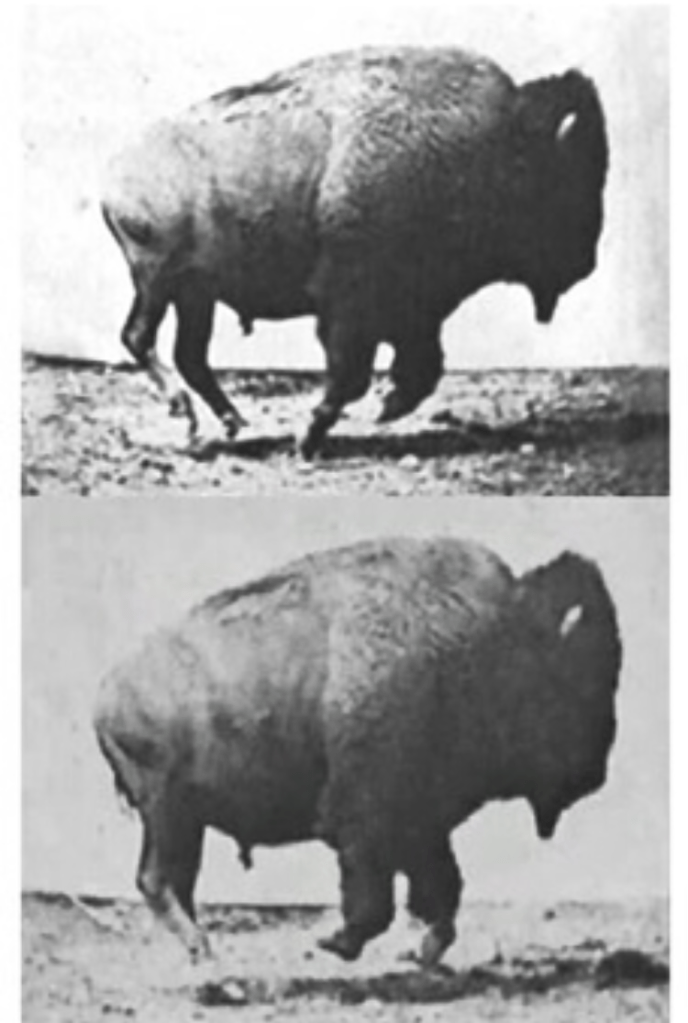
A buffalo, shot in profile against a light backdrop through 16 consecutive images, gallops heavily across a patch of bare ground.
Essentials:
Eadweard Muybridge produced a truly staggering number of photographic motion study sequences during the 20-year period that began with his partnership with Leland Stanford. A great many of them are quite striking and could certainly be discussed as significant in some way, but they do tend to fall into fairly broad categories. Any series that began examining each one individually would inevitably grow repetitive almost immediately, at least if it were produced by someone who knows as little about the art and science of photography as I do. But, as we move sequentially through significant moments in film history, I do think it’s worth pausing once again to elaborate further on this work chosen as representative of many (rather than as the most important singled-out of all).
You will find this extremely short sequence listed in various film databases as Buffalo Running with a date of 1883. However, it is known that this series was one of several taken at the Philadelphia Zoo, and we also know from contemporary newspaper accounts that Muybridge conducted his photographic sessions there late during the summers of 1884 and 1885, so I’ve chosen to substitute a date from that timeframe here. Furthermore, although it is generally titled “Buffalo Running” as seen above, Muybridge published it in his Animal Locomotion collection with only the words “Plate 700” and a copyright date of 1887 (the year of the collection’s publication). Interestingly, like the series preceding it (Plate 699), this is cataloged as “A buffalo walking,” though that seems erroneous, as well. (Incidentally, if you look closely at the linked image, you can plainly see the edge of the screen erected behind the buffalo, stretched tight and held aloft by a simple frame of some kind.)
In any case, this brief clip makes clear (all the more if you set it to run on a loop) both the advances Muybridge had made to his methods and equipment in the several years since he photographed Sallie Gardner, and a hint of how he had begun to branch out in his choice of subjects. In addition to large, galloping quadrupeds, Muybridge photographed kicking mules, strolling capybaras, trotting ostriches, flying cockatoos, and on and on and on. And those were just the animals. He began photographing humans in motion just as extensively during this time as well, with just as diverse a range of motions. Clearly this was no longer just a casual experiment undertaken between long expeditions around the world. The unexpected success of his experimental photography prompted him to change the entire course of his career, which in turn changed (even in some ways set) the course of film history.
By 1893, Muybridge’s fame and influence was such that a Zoopraxographical Hall was specially built for the World’s Columbian Exposition in Chicago, where he gave a series of lectures accompanied by projected motion pictures using his invention for which the building was named. With audiences of paying customers in attendance, it has been called the first commercial movie theater.
Screening:
Muybridge took these photographs at a time when the buffalo had been hunted nearly to extinction, and this was one of only a few hundred left alive. As fortunate as we are to have these surviving images, we are even more fortunate that they are not of a now-extinct species of animal. For that reason alone, I recommend you enjoy watching this majestic creature loping gamely into our present-day world alongside the many descendants of his species.
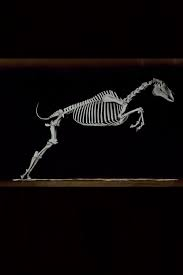
The full skeleton of a horse appears against a dark backdrop. It moves forward at a gallop, passing through a sequence of poses that will be familiar to anyone who has seen Muybridge’s earlier photographs of the horse Sallie Gardner. Suddenly, the skeleton appears to leap over a white post that abruptly appears in the frame and comes to a landing on the other side.
Essentials:
I have not been able to find a lot of well-sourced information about either the circumstances or the purpose of this piece of photographic wizardry. According to the Library of Congress, we know that Muybridge took these in California in 1878-79 (though he didn’t copyright them until 1881), so he was presumably still working with Leland Stanford. Their relationship broke down a few years later, after Stanford commissioned a book based on Muybridge’s photographs without giving him sufficient credit.
It seems likely that these photographs were taken to more clearly show the motion of the horse’s movements as Muybridge’s studies continued. And, of course, these are actual photographs. Although Muybridge did publicly show his photographs of Sallie Gardner in motion, the simulated motion of Sallie Gardner at a Gallop that he exhibited did not use the photographs themselves, but rather silhouettes of his images reproduced by hand, presumably so that it would be easier either to discern or to focus on the important details of the motion while watching the display (and possibly so it would be easier to produce further copies for display). Skeleton of Horse was a step forward, not only because it gave a detailed look at the skeleton as it passed through the ranges of motion, but because that motion is being simulated by the photographs themselves! This was possible at such a high level of quality because the skeleton could be posed, and so the more-developed processes of photography requiring longer capture times could be used.
You also might see the result referred to as the earliest known example of stop-motion animation. Certainly it seems like a breakthrough, whether Muybridge deserves the credit or not, to make the leap from simulating motion with a sequence of animated drawings, to capturing motion through a sequence of photographs of actual motion, to conceiving of creating the illusion of motion through a series of photographs of an otherwise inanimate object being manipulated by the photographer.
Screening:
There’s no denying that Skeleton of Horse lacks the breathtaking sense of actual speed that we get from Sallie Gardner at a Gallop, but there’s still something quite fascinating about seeing those same movements reproduced using the skeleton. Watch closely for the slight variations from one image to the next that are such a defining characteristic of this technique, particularly the movements of the bones in the tail and slight opening and closing of the jaw. And, of course, the jump is a totally new element. I like that they only bothered to insert the obstacle at the precise moment that the skeleton is above it, but not before or after. It almost feels like an afterthought: “Oh, I guess we’ll have it jumping over something, sure.”
The dark silhouette of a horse and its rider appear against a light background passing in front of a sequence of numbered markers. The jockey stands in the saddle, never quite coming to a sitting position as the horse moves at a gallop (in this case at around 36 mph), its mane and tail streaming back as the rushing wind flies past. Played at a variety of speeds, the brief snippet offers either a vivid depiction of equine speed, or a previously unavailable dissection of precisely how a horse’s body moves at the height of a full gallop. And the latter, it turns out, was the whole point.
Essentials:
Eadweard Muybridge was a somewhat eccentric English photographer, a pioneer in the field and a globetrotter. Leland Stanford, who had built a fortune in the California Gold Rush, was a former governor of the state, and, as a founder and the first president of the rail company that completed the western half of the first transcontinental railroad, he drove the ceremonial “golden spike” that signified the route’s completion in 1869. Stanford was also an enthusiastic trainer of racehorses. He had a belief that the long-standing theory of how horses moved at speed, which had guided artistic depictions of galloping horses for centuries, was incorrect, and that the infant science of photography could prove it. So, he recruited Muybridge and financed several attempts to capture images of a horse in motion.
Muybridge initially believed that Stanford’s objective couldn’t be accomplished with existing technology. Instantaneous photography was just too primitive, and shutter speeds were too slow to capture images at the necessary durations. Nevertheless, he set to work beginning in 1873. Over the next few years (with a few interruptions, including several months during which he was arrested and tried for murdering his wife’s lover), Muybridge slowly perfected the devices and process that could produce satisfactory results. In June of 1878, he took a series of photographs of the horse Sallie Gardner in motion using a battery of 24 cameras. The results clearly showed exactly what Stanford had suspected. The prevailing theory was wrong. The horse’s hooves did indeed all leave the ground simultaneously, and they did so while curled up under the horse’s body (the opposite of what many painting depicted), as it galloped around the track.
Muybridge began giving lectures using his images the following month, combining a phenakistiscope (an early device for simulating motion from a series of images) with a projector to demonstrate his findings for audiences, making Sallie Gardner and her rider the first stars of a movie. (Muybridge would soon develop his own invention, the zoopraxiscope, to better project his motion pictures, which in turn directly influenced the development of the first movie projectors, including Thomas Edison’s.) Muybridge’s use of these images was significant in 2 ways: It was the first time we know of that motion pictures were exhibited for an audience using images taken of real-life motion, and, as news spread of what Muybridge had done, people around the world were inspired by the possibilities and applications of motion picture photography and exhibition in a way that they hadn’t been before.
Screening:
There’s just something deeply thrilling about witnessing a moving image of an event that took place almost 145 years ago. What I particularly like about the version I’ve embedded below is that it begins by showing a few repetitions of the sequence of photographs, including the image of the horse standing still. It then transitions to a loop of the horse moving in extreme slow motion to that you can take in every detail of the movement that people were discovering for the very first time thanks to Muybridge’s photographs. Finally, the loop gradually speeds up until it is running at full speed, clearly showing how impossible it is to discern the same information simply by observing with the naked eye, and allowing us to appreciate this brief glimpse of a galloping horse at its natural speed. These different presentations of the same images gives us a sense of the different ways audiences might have experienced them, depending on what the exhibitor intended to demonstrate at that moment. And, as I say, it’s simply a pleasure to watch.
A monkey perches atop a music stand holding either a human-sized violin or a monkey-sized cello. It wears a brightly-colored outfit and a jaunty cap with an enormous plume. As it plays the instrument, its head sways smoothly back in forth, perhaps in time to the music. Its right hand draws the bow back and forth across the strings as its left hand dances on the neck until you can almost hear the tune it plays.
Essentials:
This is one of several surviving proto-animations from Reynaud’s praxinoscope, but in contrast to his very abstract Rosace Magique, Le Singe Musicien features a recognizable image. We might even call this one of the first animated cartoon characters. (You see me hedging my bets there, even in 1878. I said cinematic “firsts” are notoriously hard to pin down.) And for an animated loop that lasts approximately 2 seconds, it’s such a dynamic character! The whole body is in motion, foot tapping, feather bobbing . . . even the eyes blink. Thoroughly charming.
Screening:
Try this: Put the animation on a loop (it might help to watch it in GIF form, from somewhere like here), and then play some violin music behind it . . . Maybe a favorite classical piece, or something like this street violin cover of “Dance Monkey.” The beauty of it is, almost anything energetic or upbeat will work. Perhaps that’s partly why this still exists. As the music plays, let the image fill your screen and just . . . watch, and you tell me why Le Singe Musicien is still around.
Understand that all original content in Moviegoings is my property under copyright.
"Everyone has the right to the protection of the moral and material interests resulting from any scientific, literary or artistic production of which he is the author." -- Univ. Decl. of Human Rights
Unless otherwise noted, all original content in Moviegoings is licensed under a Creative Commons License.
Comment Policy
Commenting here is a privilege that may be revoked. Visitors to Moviegoings are allowed to post comments only for noncommercial purposes. Unsolicited advertising ("spam") may be altered or deleted at any time. Violation may result in appropriate countermeasures, including but not limited to IP banning, IP publishing, notification of ISPs, and civil and criminal legal action.








 Moviegoings