
Film History Essentials: Irish Mail – L.& N.W. Railway – Taking up Water at Full Speed (1898)

In 1800, the Acts of Union created the United Kingdom of Great Britain and Ireland, forming a merged parliament that would legislate for the entirety of England, Ireland, Scotland, and Wales. This formation of a shared government intensified the need for improved lines of communication between Dublin and London. Passage by stagecoach from the Welsh town of Holyhead (the nearest port to Dublin across the Irish Sea) to London could take up to two days. Improvements to the roads and harbors cut this time significantly, but it would still take over a day for mail to pass between the two cities.
The situation was transformed by the arrival of steam locomotive transportation and public railways in the 1830s. A connection from London to Liverpool was completed in 1838, and most of the mail began to pass through there. However, Liverpool was over twice as far as Holyhead from Dublin by sea, without being a great deal closer to London by land.
In 1850, the appropriately-named Chester & Holyhead Railway Company completed a rail line between those two points. At Chester, the train could connect with the main rail lines down to London, cutting transit time to under 12 hours. The C&HR was absorbed several years later by the London & North Western Railway, which now took charge of the all-important (and lucrative) Irish Mail service.
L&NWR almost immediately began considering ways that they could cut the delivery time even further. The most significant delay was in the trains’ need to stop to refill their water tanks. Steam-powered locomotion obviously requires a great deal of water. Locomotives at the time could hold, at most, about 2000 gallons of water, but the 85-mile journey between Holyhead and Chester alone could require as much as 2400 gallons.
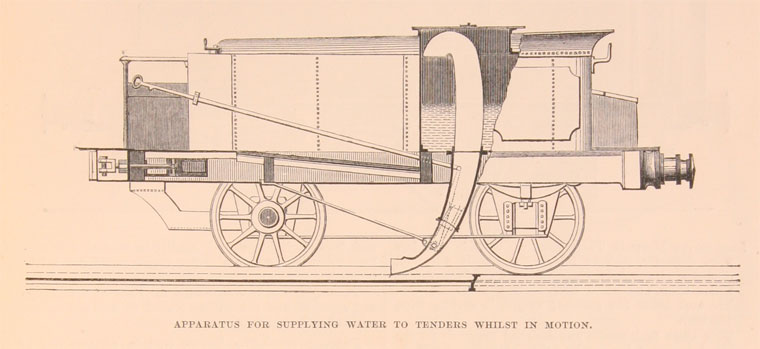
To tackle this problem, the company turned to their chief engineer, John Ramsbottom. Ramsbottom’s solution was to set up water troughs about a quarter of a mile long (though some were as long as 0.4 miles), and narrow and shallow enough to lie between the rails so the train could pass over the top of them. While traveling at speed, the train’s fireman would lower a “scoop,” and the forward momentum could force 1000+ gallons up a chute and into the water tanks (see right).
Rather than require the scoop to be dropped with precision just as the train reached the trough, it was designed to sit a bit too high when lowered. Then, the rails on either side of the trough were lowered slightly so that the whole train would drop enough to dip the scoop into the water, then raised up again on the other side. The scoop was also made so that, if it were to catch on anything, it would tear away easily and cleanly without damaging the rest of the train.
A whole network of these troughs was eventually put into operation, although designing and maintaining them involved some interesting challenges. They could only be placed on long stretches of relatively straight and level track. The water in them had to be replenished after each use, which took some time. And the troughs would freeze over in the winter, requiring them to be heated by steam pipes at regular intervals.
The ultimate payoff, though, was that by the 1880s, the complete run from London to Holyhead, over 260 miles, could be completed in 5-6 hours. In favorable weather, the crossing by steamer to Dublin could be done in another 3-4 hours. With these systems in place, mail could be sent from London to Dublin in the morning, and have a reply in return by the following morning. It was quite a change from the round-trip of several days just a few generations earlier.
Screening:

John Ramsbottom retired from L&NWR in 1871. His successor was Francis Webb, who designed all of the company’s locomotives from then until 1903. Based on the details and number visible in this film, the locomotive seen here appears to be the Jeanie Deans, the fourth of Webb’s “Teutonic class” design, built in 1890 and scrapped in 1906. (It’s just possible to make out part of the name as the train passes by the camera about a minute in.)
Jeanie Deans was the only locomotive of the ten Teutonics not to be named for a ship from the White Star Line (eventual operators of the RMS Titanic). It was named, instead, for the protagonist of the Walter Scott novel The Heart of Midlothian, a hugely-popular character. Representing 19th-century ideals of dedication and integrity, Jeanie Deans served as a namesake for everything from pubs to paddle steamers to hospital units to an Australian potato.
The film begins as the train passes through a station, and there is a wealth of signage and detail visible. Signposts to either side of the main station building reveal this to be Bushey, a small town just to the northwest of London. The train is presumably outward bound from London, and is filling its water tank in preparation for the next leg of the journey. The next water trough would have been at Wolverton, nearly 40 miles further on. Moments after leaving Bushey behind, the mail train passes a freight train coming from the opposite direction.
After the other train has gone by, it’s possible to see the water trough that’s located on the track it just vacated. Seconds later, the mail train reaches the water trough it will use to refill. Several workmen (a few of whom may have been specifically tasked with monitoring and maintaining the troughs) stand alongside the tracks observing as the train takes up water. It’s possible to tell exactly when the scoop meets the water, as a great deal comes spraying out the side at ground-level, followed shortly by a cascade gushing out over the top and sides just in front of the first train car.
According to records, the Bushey water troughs were 505 yards long. Based on the approximate length of time it takes the train to pass the trough, it is traveling at around 50 miles per hour (likely not its “full speed,” despite what the title says). As it completes the operation, the train carrying the camera slows and allows it to pass, revealing that the mail train is pulling six cars behind it. Some of these were likely carrying passengers, who could take advantage of this express train in order to expedite their travel to Ireland or various destinations in Scotland and the north of England.
There’s something genuinely thrilling about this unique tracking shot of a 19th-century train in action, showcasing the culmination of several decades of engineering ingenuity in speed and efficiency. The torrents of water spewing out make for a truly spectacular sight, perfectly framed by the expert camerawork of (who else) William Dickson. Though, of course, whoever is operating the train that he is riding on certainly deserves a great deal of credit for their skill as they match the speed of the mail train and then gradually slow down at just the right moment to let it go by.


 Moviegoings